Image of the Day… Satellite Picture of Snow Covered U.S. ….

Satellite Picture Shows Snow-covered U.S. Deep Freeze

NOAA’s GOES-East satellite provided a look at the frigid eastern two-thirds of the U.S. on Jan. 7, 2015, that shows a blanket of northern snow, lake-effect snow from the Great Lakes and clouds behind the Arctic cold front.

A visible picture captured at 11 a.m. EST showed the effects of the latest Arctic outbreak. The cold front that brought the Arctic air moved as far south as Florida, and stretched back over the Gulf of Mexico and just west of Texas. The image shows clouds behind the frontal boundary stretching from the Carolinas west over the Heartland. Farther north, a wide band of fallen snow covers the ground from New England west to Montana, with rivers appearing like veins. The GOES-East satellite image also shows wind-whipped lake-effect snows off the Great Lakes, blowing to the southeast. Meanwhile, Florida, the nation’s warm spot appeared almost cloud-free.

Image Credit: NASA/NOAA GOES Project  

SOURCE:::: http://www.nasa.gov

Natarajan

Jan 10 2015

World”s Safest Airline ….

QANTAS has been named the world’s safest airline, after a year when fatal air accidents soared above the 10-year average.

In a report published by AirlineRatings.com last night, Qantas was lauded for amassing “an extraordinary record of firsts” in safety and operations over its 94-year history. It also has a fatality free record in the jet era.

The company’s rating system, which is endorsed by the International Civil Aviation Organization, a United Nations agency, takes into account a variety of factors related to audits from aviation’s governing bodies and lead associations as well as government audits and the airlines’ fatality records.

Operational histories and incident records were also analysed.

Qantas was named the leader in terms of real-time monitoring of its engines across its fleet using satellite communications.

“Doing so allows the airline to detect problems before they become a major safety issue,” the report says.

The airline was also described as a leader in the development of an avionics system that provides a direct data link communication between the pilot and the air traffic controller, as well as the development of flight data recorders to monitor plane and crew performance.

The flying kangaroo wins for its safety and operations.

The flying kangaroo wins for its safety and operations. Source: Getty Images

The report comes after what was “in no doubt” a bad year for airline safety, AirlineRatings.com said, adding 2014 included some of the industry’s most tragic and bizarre incidents.

“Certainly, 21 fatal accidents with 986 fatalities — higher than the 10-year average — is sickening. However, the world’s airlines carried a record 3.3 billion passengers on 27 million flights,” the report says.

AirlineRatings.com said the high number of deaths came despite the number of accidents for 2014 being at a record low 21 — one for every 1.3 million flights.

“Two of the crashes last year — MH370 and MH17 — were unprecedented in modern times and claimed 537 lives,” the report says.

“Flashback 50 years and there were a staggering 87 crashes killing 1,597 when airlines carried only 141 million passengers — five per cent of today’s number.”

Air New Zealand made the top 10 of the world’s safest airlines.

Air New Zealand made the top 10 of the world’s safest airlines. Source: Supplied

The report rates 449 airlines. Making up the remainder of the top 10 in alphabetical order were Air New Zealand, Cathay Pacific, British Airways, Emirates, Etihad Airways, EVA Air, Finnair, Lufthansa and Singapore Airlines.

Low-cost carriers were also included in a separate list, with Jetstar making the top 10 along with Aer Lingus, Alaska Airlines, Icelandair, Jetblue, Kulula.com, Monarch Airlines, Thomas Cook, TUI Fly and Westjet.

AirlineRatings has been used by millions of passengers from 232 countries and its safety rating.

SOURCE:::: http://www.news.com.au

Natarajan

Jan 7 2015

Miracle Girl Survivor Reports Plane Crash….

Map

A disoriented seven-year-old US girl has walked to a home in the US state of Kentucky to report that her plane had crashed, police say.

The plane was later found with four bodies inside in Lyon County, about 30 miles (50km) east of Paducah city.

US TV news network NBC said the girl told the man who answered the door to her that her parents died in the crash.

The identity of the girl has not been released and police have not commented on her relationship with the victims.

The Federal Aviation Administration said air traffic controllers lost contact with the Piper PA-34 aircraft after the pilot reported engine problems.

About 30 minutes after the plane lost contact, a resident of Lyon County called police to say the girl had walked to his home to report the crash.

‘Brave little girl’

Larry Wilkins, 71, told NBC when he answered his door on Friday night there was a “little girl” standing there barefooted who was “bleeding pretty badly”.

“She told me that her mom and her dad were dead, and she was in a plane crash, and the plane was upside down,” he said.

“She asked if she could stay here. I got a wash cloth and cleaned her up. And of course called 911,” he added. “I felt so sorry for her, tears come to my eyes. Brave little girl.”

Kentucky State Police said those killed in the crash were Marty Gutzler, 49, and Kimberly Gutzler, 45, their 9-year-old daughter, Piper Gutzler, and Piper’s 14-year-old cousin, Sierra Walder.

“This girl came out of the wreckage herself and found the closest residence and reported the plane crash,” Kentucky police Sgt Dean Patterson told reporters.

“It’s a miracle in a sense that she survived it, but it’s tragic that four others didn’t,” he added.

He said the plane had been heading for Illinois from Florida and had crashed in a wooded area near a lake.

The girl is reported to be in hospital receiving treatment for non-life-threatening injuries.

This Date In Science….Luna 1 Spacecraft Headed towards Moon… !!!

This date in science: Luna 1 spacecraft heads toward moon

Luna 1 was a milestone for exploration of the solar system, but American historians suspect the spacecraft failed one major objective: to hit the moon. Image credit: NASA
Some historians believe Luna 1 – a Soviet spacecraft – was supposed to hit the moon. It would have been a large coup for the Soviets in the early days of the Space Race.

January 2, 1959. Trailing orange sodium gas, the Luna 1 spacecraft broke free of Earth’s gravity on this date, to head towards the moon.

However, the spacecraft did fly successfully past Earth’s neighbor on January 4, 1959.
Luna 1 was a milestone for exploration of the solar system, but American historians suspect the spacecraft failed one major objective: to hit the moon.
And the orange gas? It was supposed to help scientists track the spacecraft and to test the behaviours of gas in space. The 795-pound spacecraft also picked up new data on the Earth’s radiation belt.

Bottom line: On January 2, 1959, the Luna 1 spacecraft broke free of Earth’s gravity on this date, heading towards the moon.

SOURCE:::: http://www.earthsky.org

Natarajan

Image of the Day… New Year’s Comet Love Joy !!!

New Year’s Comet Lovejoy

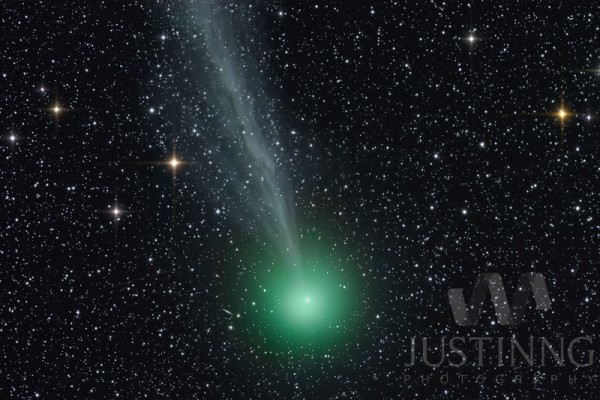
Wow! Comet Lovejoy is really living up to its name! A wonderful December 29 photo from Justin Ng of Singapore and a link below to how you can see the comet.

Comet Lovejoy on December 29, 2014 by Justin Ng from Singapore.   Visit Justin Ng's website.

Have you seen Comet Lovejoy yet? Although telescopes and binoculars are still the best way to find and view the comet, it’s now barely within the limit for visibility with the unaided eye under exceptional viewing conditions. Justin Ng of Singapore took this fine photo. He wrote:

I would like to suggest an image of Comet Lovejoy that I’ve just taken on 29 December 2014 at around 12.30 AM SGT. This is a LRGB image with a total exposure time of 12 minutes. A spiral galaxy, NGC1886, is also visible in the image, located on the left of the comet’s coma.

SOURCE::: http://www.earthsky.org

Natarajan

AirAsia Crash: Flying Into a Thunderstorm is the Biggest ” No No” in Commercial Aviation …

First thing’s first, we need to trundle out the boring but critical post-crash disclaimer: It is a bad idea to speculate too broadly on the how-and-why so soon after an air disaster.

AirAsia Clouds

Almost always the initial hunches and theories end up totally off-base or at best incomplete. We live in an age when people want and expect instant answers, but that just isn’t possible with plane crashes.

It often takes months or even years before a cause is nailed down. In some cases we never learn for sure what happened.

That said, a seeming red flag in Sunday’s AirAsia disappearance is the weather. Could the Airbus A320, flying from the busy Indonesian city of Surabaya to Singapore, have wandered inadvertently into a violent thunderstorm and suffered some kind of catastrophic malfunction or structural failure? It’s possible.

I’ll point out that flying into thunderstorms is about the biggest no-no in all of commercial aviation. The crew had asked for a weather-related altitude change shortly before the disappearance, a request that was denied by air traffic control — presumably because of traffic constraints. This isn’t terribly unusual; pilots ask for altitude changes and route deviations all the time, and not always are they granted. However, that does not mean the AirAsia crew had no choice but to plow headlong into a storm. Worst-case, the crew always reserves the right to do what it needs to do, with or without permission. I cannot imagine the pilots willingly flew into what, on the radar screen, would have been a bright red splotch of potentially dangerous airspace. Perhaps a patch of weather that the pilots presumed would be manageable turned out to be otherwise? We don’t know.

Some are drawing comparisons between this incident and the 2009 Air France tragedy. They occurred under somewhat similar circumstances, and the media is eager to link these recent incidents together and wring some scary significance out of them. Some commentators have noted, for instance, that both planes were built by Airbus. I understand the temptation here, but this is extremely premature, and it’s unlikely that the aircraft model played a significant role. Remember that basically half of all the commercial jetliners in the sky are Airbus models.

An even bigger red herring is the fact that the pilots made no distress call. Several news outlets have brought this up. Effectively it means nothing. Communicating with air traffic control is pretty far down the task hierarchy when dealing with an emergency. The pilots’ priority is to control the airplane and deal with whatever malfunction or urgency is at hand. Talking to ATC comes later, if it’s practical.

So, the year appears to be closing on a tragic note. That’s a shame, seeing that 2013 was the safest year in the history of modern commercial aviation. Not to sound flip, but we can’t expect every year to be the safest, and it’s important to look at the broader context. This year will be something of a correction, but over the past ten or fifteen years the rate of fatal accidents, per miles flown, has been steadily falling. The International Civil Aviation Organization (ICAO) reports that for every million flights, the chance of a crash is one-sixth what it was in 1980, even with more than double the number of planes in the air.

Whenever people bring up the less-than-stellar accident record for 2014, I remind them of how bad things used to be. In 1985, 27 — twenty seven! — serious aviation accidents killed almost 2,500 people. That included the JAL crash outside Tokyo with 520 fatalities; the Arrow Air disaster in Newfoundland that killed 240 American servicemen, and the Air-India bombing over the North Atlantic with 329 dead. Two of history’s ten worst disasters happened within two months of each other! That’s a bad year.

Headquartered in Kuala-Lumpur, Malaysia, AirAsia is the largest low-fares airline in Asia, and one of the biggest in the world. It operates about 70 aircraft, all of them A320s, on routes around Indonesia, Thailand, Malaysia and beyond. (AirAsia X is the airline’s long-haul affiliate, and operates the larger A330.) I flew AirAsia between Bangkok and Phuket a few years ago. For what it’s worth, except for a delay on the outbound leg, its operation struck me as no more or less professional than that of any other major airline.

Asia, by the way, is now the world’s biggest and busiest air travel market, having surpassed both North America and Europe.

This article originally appeared at AskThePilot.com.

SOURCE::::

http://www.businessinsider .com

Natarajan
Read more: http://www.askthepilot.com/airasia-flight-missing/#ixzz3NQpTxsKx

Image of the Day…. View of Alps from Space …

View of the Alps From Space

Expedition 42 Flight Engineer Samantha Cristoforetti of the European Space Agency (ESA) took this photograph of the Alps from the International Space Station, andposted it to social media on Tuesday, Dec. 23, 2014. She wrote, “I’m biased, but aren’t the Alps from space spectacular? What a foggy day on the Po plane, though! #Italy”

Image Credit: NASA/ESA/Samantha Cristoforetti 

SOURCE:::: http://www.nasa.gov

Natarajan

What Happened to Air Asia Flight QZ 8501 ?

The first aircraft to land at the newly-launched Low Cost Carrier Terminal-KLIA (LCCT-KLIA) sits on the tarmac in Sepang outside Kuala Lumpur March 23, 2006. 
AirAsia plane

An AirAsia plane went missing during a flight to Singapore shortly after asking to deviate from its planned flight path because of bad weather.

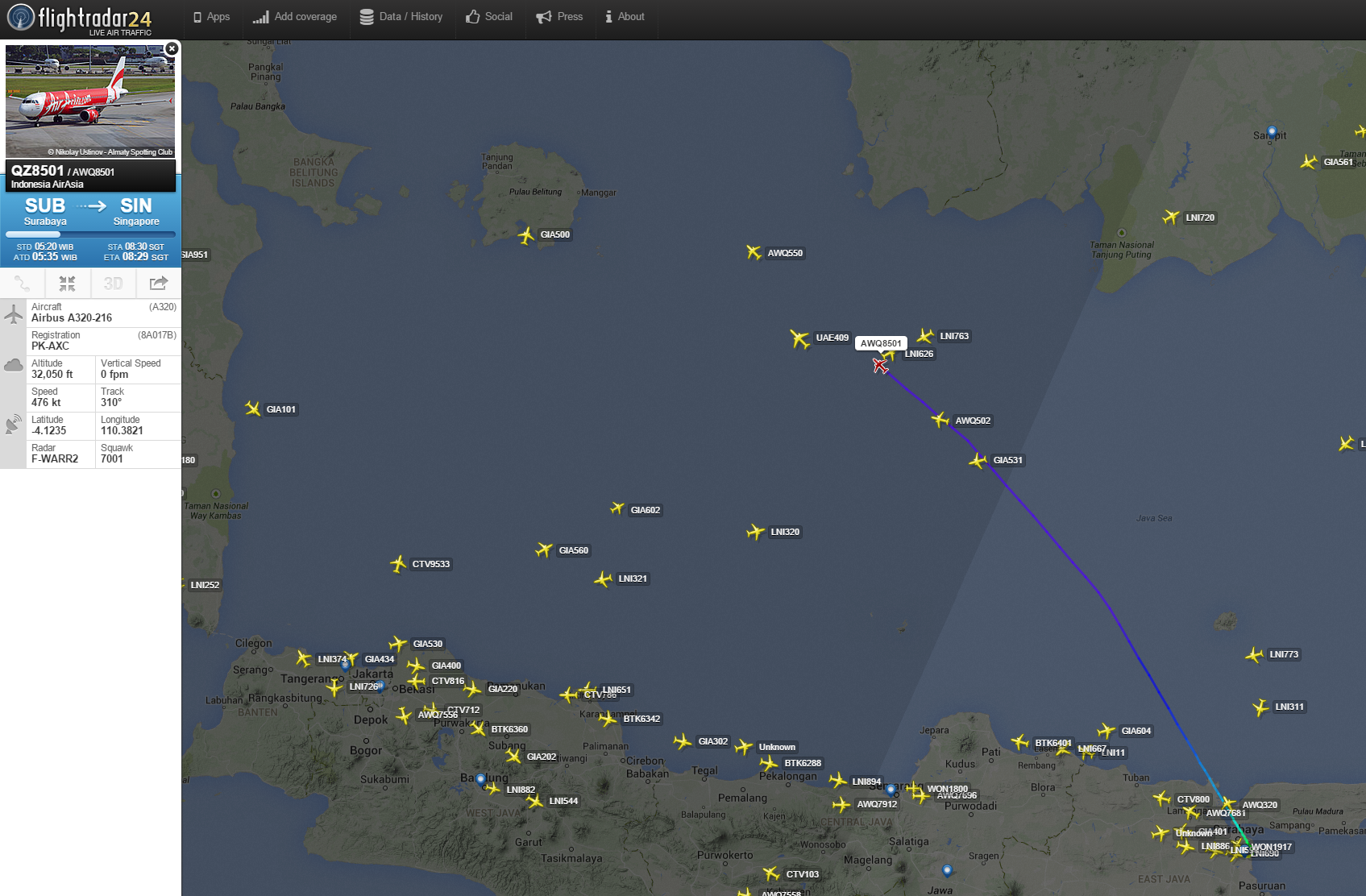
AirAsia flight QZ 8501 lost contact with air traffic control at about 6:17 a.m. on Sunday, about halfway through the flight from Surabaya, Indonesia to Singapore. The plane is thought to have crashed near the Indonesian island of Belitung, but search and rescue teams have yet to find any wreckage.

Satellite imagery from the area where the plane went missing showed severe thunderstorms around the time it disappeared:

View image on Twitter


CNN meteorologist Derek Van Dam said “lines of very heavy thunderstorms” were present when the plane was in the air, but also pointed out that “turbulence doesn’t necessarily bring down aeroplanes.”

The search and rescue operation has been suspended overnight. Singapore’s air force and navy is helping with the operation to locate the plane.

Here’s where it lost contact with air traffic control:

AirAsia plane map

155 Indonesians are on board the plane, along with three people from South Korea, and one from Singapare, Britain, Malaysia, and France. Of those passengers, 16 are children and one is an infant.

The missing plane is an Airbus A320-200, a popular and generally reliable model. The plane is about six years old and is operated by AirAsia’s Indonesian affiliate, which the Malaysia-based company holds a 48.9% stake in, CNN reports


SOURCE::: PAMELA ENGEL in http://www.busionessinsider.com.au

Natarajan

International Space Station Astronaut Wakes up to an Incredible Sight from Space …

View image on Twitter

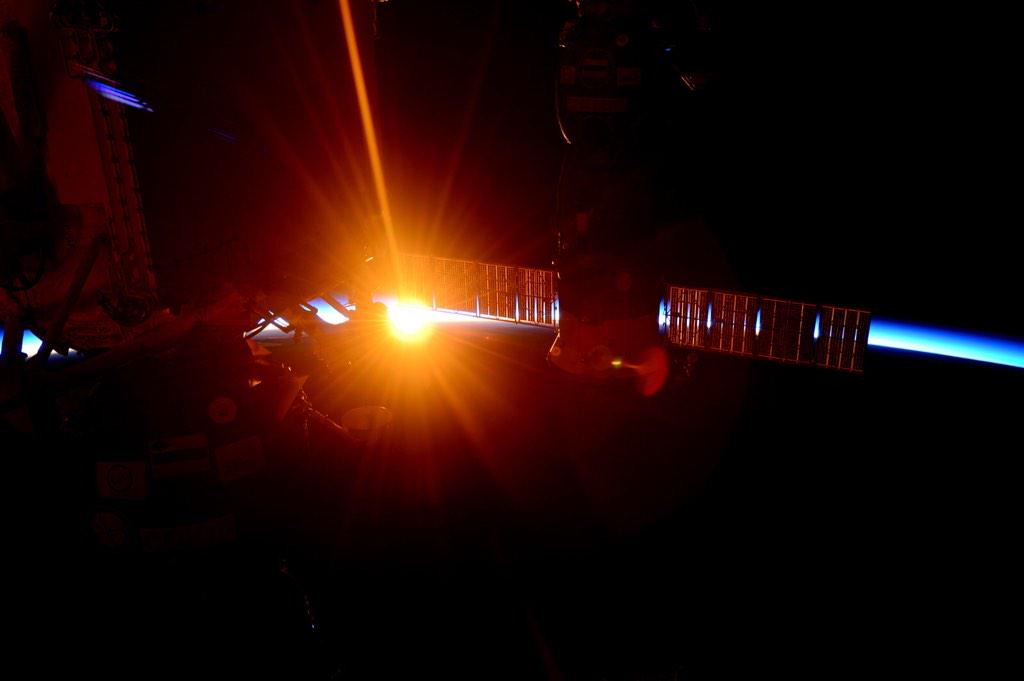
NASA astronaut Terry W. Virts woke up to an incredible sight from space Thursday morning — one he said was “better than any present” he could ask for.

“Sunrise on Christmas morning- better than any present I could ask for!!!!” tweeted Virts, who is currently aboard the International Space Station.


The image was widely circulated on the social media platform, amassing nearly 3,000 retweets and more than 4,200 favorites.

“So awesome,” one person tweeted back at him.

“Astonishing,” echoed another.

“What a view,’ wrote one more.

SOURCE:::  IN  www.theblaze.com

Natarajan