Christmas Greeting Message From International Space Station Astronauts …

Expedition 42 Commander Barry Wilmore and Flight Engineer Terry Virts send greetings and talk a little about their own Christmas Day in space.

Aboard the International Space Station, Expedition 42 Commander Barry Wilmore and Flight Engineer Terry Virts of NASA offered their thoughts and best wishes to the world for the Christmas holiday during downlink messages from the orbital complex on December 17. Wilmore has been aboard the research lab since late September and will remain in orbit until mid-March 2015. Virts arrived at the station in late November and will stay until mid-May 2015.

SOURCE:::: http://www.earthsky.org

Natarajan

Image of the Day… Colorful Christmas Island …

When Aqua flew over Christmas Island on Nov. 11, 2014, the MODIS instrument aboard took a visible picture of Christmas Island.
Image Credit: NASA Goddard MODIS Rapid Response

When Aqua flew over Christmas Island on Nov. 11, 2014, the MODIS instrument aboard took a visible picture of Christmas Island. Image Credit: NASA Goddard MODIS Rapid Response

A NASA satellite has captured a colourful photo of Christmas Island in the Southern Indian Ocean from space.

Christmas Island, an Australian Territory, is a coral atoll (a ring-shaped reef, island, or chain of islands made up of coral) in the northern Line Islands.

When NASA’s Aqua satellite flew over Christmas Island on November 11, 2014, the Moderate Resolution Imaging Spectroradiometer took a visible picture of the small atoll.

The island is only 135 square kilometres in area and has a tropical equatorial climate with a wet season that runs from December to April.

Although an Australian Territory, Christmas Island is located 2,600 km north-west of Perth, Western Australia.

The island is famous for land dwelling red crab which scramble to the sea each November to release eggs.

(This article was published on December 24, 2014)
SOURCE::::www.thehindubusinessline.com
Natarajan


America to Australia in 6 Hours !!!


From America to Australia in Under 6 Hours

Just 100 years ago, getting from America to Europe was a voyage that took several days by ocean liners. With the invention of airplanes, that travel time was significantly shortened to under 24 hours. At the apex of the era of transatlantic flight, the Concorde was able to fly 100 passengers at mach 2.0 speeds from New York to London in just over 3.5 hours.

Now, the European Space Agency (ESA) just greenlighted the next stage of modern transportation – the hypersonic flight. The ESA has approved a new round of funding to project LAPCAT (Long-Term Advanced Propulsion Concepts and Technologies).
Hypersonic Plane

Ignoring its funny name, the new plane will fly at mach 5.0 speeds (that’s five times the speed of sound!), using liquid hydrogen engines. The planes will be able to travel from England to Australia in four hours, carry 300 passengers and even fly to space in just 15 minutes.

The new kind of engine is being developed by the British company Reaction Engines, who is said to invest over 60 million GBP in the development, and are going to start builing a full-scale prototype engine.

Hypersonic Plane

Current jet engines require that airplanes carry liquid oxygen as a coolant because in speeds beyond mach 3.0 the engines cannot use external oxygen for cooling. The new type of engine can use external oxygen freely, allowing it to cool down its engines from over 1,000°c (1,832°f) to -150°c (-328°f) in a fraction of a second.
Hypersonic Plane

Experts are hailing this development as the biggest advancement in aviation since the invention of the jet engine. The cost of a single plane is estimated to be a whopping $1.1 Billion and will have no windows.


Hypersonic passenger plane LAPCAT A2 explainer


The Long-term Advanced Propulsion Concept and Technologies (LAPCAT) was developed by British company Reaction Engines Limited (REL) and funded by the European Space Agency (ESA). The 139-meter long hypersonic plane has four liquid hydrogen-powered Synergistic Air-Breathing Rocket Engine (SABRE) engines and can carry up to 300 passengers.
It can travel up to 6,100 kilometer per hour – five times faster than the Airbus A380. By using liquid hydrogen as fuel instead of fossil fuel it is also greener and would only produce water vapor and nitrous oxide instead of carbon emissions. SOURCE: Research and Technology Agency, Reaction Engines Limited (REL), Transport Research & Innovation Portal


SOURCE:::: http://www.ba-bamail.com and YOU TUBE

Natarajan

Astronaut’s-Eye View of NASA’s Orion Spacecraft Re-entry…

New video recorded during NASA’s Orion return through Earth’s atmosphere provides viewers a taste of what the vehicle endured as it returned through Earth’s atmosphere during its Dec. 5 flight test.
Image Credit:
NASA

New video recorded during the return of NASA’s Orion through Earth’s atmosphere this month provides a taste of the intense conditions the spacecraft and the astronauts it carries will endure when they return from deep space destinations on the journey to Mars.

Among the first data to be removed from Orion following its uncrewed Dec. 5 flight test was video recorded through windows in Orion’s crew module. Although much of the video was transmitted down to Earth and shown in real time on NASA Television, it was not available in its entirety. Also, the blackout caused by the superheated plasma surrounding the vehicle as it endured the peak temperatures of its descent prevented downlink of any information at that key point. However, the cameras were able to record the view and now the public can have an up-close look at the extreme environment a spacecraft experiences as it travels back through Earth’s environment from beyond low-Earth orbit.

The video begins 10 minutes before Orion’s 11:29 a.m. EST splashdown in the Pacific Ocean, just as the spacecraft was beginning to experience Earth’s atmosphere. Peak heating from the friction caused by the atmosphere rubbing against Orion’s heat shield comes less than two minutes later, and the footage shows the plasma created by the interaction change from white to yellow to lavender to magenta as the temperature increases.

As Orion emerges safely on the other side of its trial by fire, the camera continues to record the deployment of the series of parachutes that slowed it to a safe 20 mph for landing and the final splash as Orion touched down on Earth.

NASA's Orion spacecraft is viewed by media at NASA's Kennedy Space Center, Fla. on Dec. 19, 2014.
NASA’s Orion spacecraft is viewed by members of the media at the Launch Abort System Facility at NASA’s Kennedy Space Center in Florida. Orion made the 8-day, 2,700 mile overland trip back to Kennedy from Naval Base San Diego in California. Analysis of date obtained during its two-orbit, four-and-a-half hour mission Dec. 5 will provide engineers detailed information on how the spacecraft fared. The Ground Systems Development and Operations Program led the recovery, offload and transportation efforts.
Image Credit:
NASA/Dimitri Gerondidakis

Orion was then retrieved by a combined NASA, U.S. Navy and Lockheed Martin team and carried back to shore aboard the Navy’s USS Anchorage. After returning to shore, it was loaded on to a truck and driven back to NASA’s Kennedy Space Center in Florida, where it arrived on Thursday.

Orion traveled 3,600 miles above Earth on its 4.5-hour flight test – farther than any spacecraft built for humans has been in more than 40 years. In coming back from that distance, it also traveled faster and experienced hotter temperatures – 20,000 mph and near 4,000 degrees Fahrenheit, to be exact. Orion will travel faster and experience even higher temperatures on future missions, when it returns from greater distances, but this altitude allowed engineers to perform a good checkout of Orion’s critical systems – in particular its heat shield.

Orion’s flight test was a critical step on NASA’s journey to Mars. Work already has begun on the next Orion capsule, which will launch for the first time on top of NASA’s new Space Launch System rocket and travel to a distant retrograde orbit around the moon.

To view the video of Orion’s re-entry, visit:

https://www.youtube.com/watch?v=MtWzuZ6WZ8E 

SOURCE::::www.nasa.gov

Natarajan

This Day In Space Science… Establishment of NASA Ames on 20 Dec 1939…

75th Anniversary of NASA Ames

December 20, 2014 marks NASA Ames Research Center’s 75th Anniversary. The center was established in 1939 as the second laboratory of the National Advisory Committee for Aeronautics, and was named for the chair of the NACA, Joseph S. Ames. It was located at Moffett Field in Sunnyvale, California, now at the heart of Silicon Valley. The Laboratory was renamed the NASA Ames Research Center with the formation of NASA in 1958.

This June 2, 1943 photograph shows the construction of the Ames full-scale 40- by 80-foot wind tunnel, with a side view of the entrance cone and a blimp in the background.

Image Credit: NASA 

SOURCE::::www.nasa.gov

Natarajan

Interesting Facts about ISRO’s Largest Rocket…GSLV Mark III…!!!

Image: GSLV Mark III on the night ahead of its launch at Sriharikota, near Chennai. Photograph: ISRO/Twitter

The successful launch of GSLV Mark III makes ISRO self reliant in launching heavier communication satellites

The Indian Space Research Organisation on Thursday launched its first experimental suborbital flight.

This was the test launch for ISRO heaviest and upgraded rocket, the GSLV Mark III, which is carrying the Crew Module Atmospheric Re-entry Experiment (CARE).

The flight took off from ISRO’s space station Sriharikota, near Chennai. Here are five things you need to know about the GSLV Mark III mission.

1) After its successful Mars mission, this is ISRO’s next step to put a man in space.

2) The Rs 155 crore mission has twin purposes — the main purpose is to test the rocket’s atmospheric flight stability with around 4-tonne luggage. The second is to study the re-entry characteristics of the crew module called Crew Module Atmospheric Re-entry Experiment.

3) Other critical technologies are also to be developed for ISRO’s manned mission. These are being developed parallelly at other centres. But recovery of the capsule from out of atmosphere will be the first to be tested.

4) GSLV Mark III is the heaviest next generation rocket, conceived and designed to make ISRO self reliant in launching heavier communication satellites of INSAT-4 class, which weigh 4,500 to 5,000 kg. Once operational, this rocket will have the capability to ferry four-tonne class of Insat series of communication satellites, which are currently being launched through Arianespace.

5) This is the second mission of the GSLV rocket during the last four years after two such launches failed in 2010.

SOURCE::::www.rediff.com

Natarajan

Is There Life on Mars ?… Question Remains….

Questions of life on Mars revive with methane spike

Curiosity rover has now measured a dramatic spike in methane, an organic chemical, in the Martian air, plus other organic molecules in a Martian rock.

The first definitive detection of Martian organic chemicals in material on the surface of Mars came from analysis by NASA's Curiosity Mars rover of sample powder from this mudstone target,

The mystery of whether Mars has or ever had life got a boost today (December 16, 2014) when NASA announced that its Curiosity rover – which landed on Mars in August, 2012 – has measured a tenfold spike in methane in the atmosphere around the rover. NASA scientists made the announcement at the annual meeting of the American Geophysical Union in San Francisco. The journal Science also published these results today.

Methane is an organic chemical, and it’s conceivable, although far from certain, methane-belching microbes on Mars might be responsible for the spike.

Overall, researchers said, methane levels recorded by Curiosity’s onboard Sample Analysis at Mars (SAM) are lower than expected.

However, for about a two-month period in late 2013 and early 2014, researchers did observe a temporary and dramatic increase in methane in the Martian air around the rover.

NASA scientists are quick to point out that the source of the methane on Mars could be either biological or non-biological. For example, a non-biological source of the methane might be an interaction between water and rock.

At the same time, for the first time ever, the rover has detected other organic molecules in a rock-powder sample collected by drilling into a rock on Mars, which scientists have dubbed Cumberland. Organic molecules, which contain carbon and usually hydrogen, are chemical building blocks of life (although they can exist without the presence of life). NASA says it’s the first definitive detection of organics in surface materials of Mars. These Martian organics could either have formed on Mars or been delivered to Mars by meteorites, scientists say.

Is there life on Mars today, or was there ever life on Mars? These results don’t prove either speculation. However, said John Grotzinger, Curiosity project scientist of the California Institute of Technology in Pasadena:

We will keep working on the puzzles these findings present. Can we learn more about the active chemistry causing such fluctuations in the amount of methane in the atmosphere? Can we choose rock targets where identifiable organics have been preserved?

NASA says that Curiosity is:

… one element of NASA’s ongoing Mars research and preparation for a human mission to Mars in the 2030s.

Read more about Curiosity’s measurement of a methane spike on Mars.

Bottom line: Mars Curiosity rover measures a dramatic spike in methane and detects other organic molecules in a rock-powder sample collected by the robotic laboratory’s drill.

SOURCE:::: http://www.earthsky.org

Natarajan

This Day in Science… Wright Brothers’ First Flight !!!

December 17, 1903. On this date, two Ohio brothers – Wilbur and Orville Wright – made the first bonafide, manned, controlled, heavier-than-air flight. It was the first airplane, and it took off at 10:35 a.m. with Orville Wright on board as pilot. He flew their vehicle, called theFlyer, for 12 seconds over 120 feet (about 37 meters) of sandy ground just outside Kitty Hawk, North Carolina.

One of the world’s most famous early photographs serves to commemorate the flight.

The Wright brothers' airplane on its first powered flight on December 17, 1903.  Via Library of Congress.

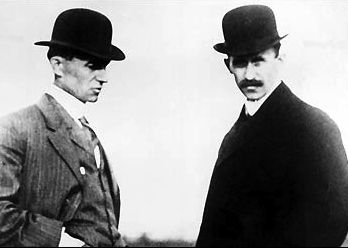
Wilbur and Orville Wright.

Two years later, the Wrights wrote in a patent application that their airplane design:

… provide[s] means for guiding the machine both vertically and horizontally … combining lightness, strength, convenience of construction, and certain other advantages.

Were the Wright brothers always destined for the skies? It’s known that their father gave them a rubber-band-powered flying toy when they were still children. The toy was made of cork and bamboo, with a paper body.

By 1899 – when Wilbur was 33 years old and Orville was 28 – the brothers were already learning everything they could about the science of aeronautics and the history of attempted human flight. Their first airplane were gliders, which they tested on the long, isolated beaches of Kitty Hawk. By 1902, they had built a glider that could be manned and controlled by a human pilot. It held a world record for gliding over 600 feet (nearly 200 meters).

Their first powered aircraft had a 40-foot (12-meter) wingspan, weighed 750 lbs, and had a 12-horsepower engine.

That first flight in December 1903 marked the beginning of a new era of global travel and relatedness.

By the way, at the time they received their patent for their airplane in 1906, several other aviators of the day claimed to have been the first to use the Wrights’ method of turning the airplane by warping or twisting the wings. But this part of the design, too, was included in the Wrights’ patent. In 2013, a story came to light about another would-be aviator, Gustave Whitehead, whose first flight supposedly beat the Wright brothers by two years. Thus far, that story has not been supported and is not accepted by aviation scholars.

Bottom line: The first airplane soared for 12 seconds over 120 feet (about 37 meters) of sandy ground just outside Kitty Hawk, North Carolina on December 17, 1903.

SOURCE:::: http://www.earthsky.org

Natarajan

Image of the Day…Sunset Over the Gulf of Mexico…

Sunset Over the Gulf of Mexico

From the International Space Station, Expedition 42 Flight Engineer Terry W. Virts took this photograph of the Gulf of Mexico and U.S. Gulf Coast at sunset and posted it to social media on Dec. 14, 2014.

The space station and its crew orbit Earth from an altitude of 220 miles, traveling at a speed of approximately 17,500 miles per hour. Because the station completes each trip around the globe in about 92 minutes, the crew experiences 16 sunrises and sunsets each day.

Image Credit: NASA/Terry Virts 

SOURCE::::www.nasa.gov

Natarajan

Image of the Day…Mars Exploration Rover opportunity …

 Opportunity Pausing at a Bright Outcrop on Endeavour Rim, Sol 3854

NASA’s Mars Exploration Rover Opportunity is continuing its traverse southward on the western rim of Endeavour Crater during the fall of 2014, stopping to investigate targets of scientific interest along way.  This view is from Opportunity’s front hazard avoidance camera on Nov. 26, 2014, during the 3,854th Martian day, or sol, of the rover’s work on Mars. This camera is mounted low on the rover and has a wide-angle lens.

The scene includes Opportunity’s robotic arm, called the “instrument deployment device,” at upper left. Portions of the pale bedrock exposed on the ground in front of the rover are within the arm’s reach. Researchers used instruments on the arm to examine a target called “Calera” on this patch of bedrock.  The wheel tracks in the scene are from the drive — in reverse — to this location, a drive of 32.5 feet (9.9 meters) on Sol 3846 (Nov. 18, 2014).

Image Credit: NASA/JPL-Caltech  

SOURCE:::: http://www.nasa.gov

Natarajan