Meet The Man Who Posted Himself From London to Perth in a Wooden Box…!!!

When Australian Reg Spiers found himself penniless in London without enough money for a plane ticket home to Adelaide, he decided to post himself back in a wooden box.

Spiers, now 73, lives in Adelaide with his new partner and he remains close friends with the McSorley family

Spiers, now 73, lives in Adelaide with his new partner and two dogs and he remains close friends with the McSorley family.

It was 1964, and the 22-year-old champion javelin thrower was in Britain, desperate to get back to Australia for his daughter’s birthday and to see his wife.

He showed up out of the blue at the East London flat of his close friend – English javelin thrower John McSorley – and presented him with his problem.

Too impatient to work and save up the money for a plane ticket, together Spiers and McSorley hatched a harebrained scheme to build a timber box and send Spiers back to his home country via air freight.


Reg Spiers (left, in the 1960s) posted himself from London to Perth in a wooden box (replica pictured right)

Miraculously he survived the 63-hour journey across three continents inside the 1.52m by 91cm by 76 cm box

Miraculously he survived the 63-hour journey across three continents inside the 1.52m by 91cm by 76 cm box

What followed was a nightmarish 63-hour journey across three continents in which he was delayed in fog for 24 hours, dropped from a forklift and almost suffered dehydration after being left on a scorching tarmac in Bombay, India.

But Spiers survived, and went on to live an extraordinary life in which he travelled the world with his lover, assumed false identities and smuggled narcotics for international drug syndicates.

His sensational life has been documented in a book by McSorley’s wife and son, Julie and Marcus McSorley, titled Out Of The Box: The Highs And Lows Of A Champion Smuggler.

The specifics of Spiers’ crazy plan to post himself from London to Perth were decided over drinks at Twickenham’s Crown pub in October 1964.

The largest box they were allowed to send measured five feet by three feet by two feet six inches (1.52m by 91cm by 76 cm).

They decided they would label the box ‘plastic emulsion’, to be sent from a fake British chemical company to a fake shoe company in Perth.

A ‘Mr Graham’ was listed as the cash-on-delivery recipient – but because no one would ever collect it the money would never be paid and Spiers’ trip would be free.

McSorley built the box inside his flat over a series of late nights, with a number of specifications including side straps and a belt to hold Spiers in place when the box was loaded onto aircraft.

The timber box also opened at both ends, so Spiers could get out and walk around the cargo once the plane was in the air.

Spiers had worked in a cargo shipping section of an airport, so had some inside knowledge about what could be shipped without drawing undue notice from customs and other officials.

He was also incredibly lucky. By the 1960s, the cargo holds of many commercial airliners were pressurised and heated, to protect goods being shipped. This meant Spiers was able to breathe inside the plane while the air outside became too thin as the plane gained altitude, and he did not freeze to death.

Spiers didn’t eat for a week in preparation for his journey, in order to slow his bodily functions down.

He packed a small bag with essential belongings such as his passport, and food and drink including a bottle of fruit juice, two tins of spaghetti, a packet of biscuits, a bar of chocolate and a tube of fruit gums.

On Saturday October 17 1964, McSorley and two friends loaded the box containing Spiers onto a van and drove it to the terminal at Heathrow Airport.

A clerk weighed the box and McSorley handed him his freight forms, before giving the box a quick pat and disappearing into the airport crowd hoping for the best.

Unfortunately for Spiers the journey did not begin well. A thick fog descended on the airport delaying all flights for more than 24 hours.

According to the watch he kept with him it was more than 28 hours before his box was transported to an airplane for the first leg of the trip – a short flight to Paris.

The timber box also opened at both ends, so Spiers could get out and walk around the cargo once the plane was in the air

The timber box also opened at both ends, so Spiers could get out and walk around the cargo once the plane was in the air

Spiers survived the first part of his journey relatively easily – he managed to eat some food and relieve himself in a spare plastic bottle he had brought with him.

The second leg of the journey was from Paris to Bombay.

He was able to get out of the box and move around, but sleeping inside the crate was problematic.

Spiers could only stretch his legs if he was sitting up straight, and could only lie down if his legs were bent.

About 37 hours since he was first dropped off at Heathrow, the plane made its descent into Bombay.

The Indian airport staff that unloaded the aircraft upended his crate as they placed it on the tarmac leaving him dangling upside down from the box’s straps.

He was also precariously balancing a spaghetti can filled with urine, which he had been forced to use after filling the only plastic bottle he packed.

Spiers was left on the scorching tarmac for hours while the Indian ground staff ate their lunch and did other jobs.

He was able to unhook himself from his straps and sit upright in the box, but sunlight streaming through cracks in the wood turned the box into a sauna, and before long he was forced to strip off all his sweat-drenched clothes.

The story was the subject of a media circus after Spiers forgot to contact his friend McSorley back in London to let him know he arrived in Australia safely. Pictured is a cameraman with the box Spiers travelled in


Nearing dehydration, Spiers contemplated turning himself in, wary that the press would ‘have a field day’ if a mysterious naked man emerged from a wooden box on the tarmac in Bombay.

But after a number of hours relief came for Spiers when a vehicle arrived to move his box, driving him out of direct sunlight and onto the aircraft that would take him on the final leg of his journey.

The flight was supposed to travel directly from Bombay to Perth but made a fuel stop in Singapore

It continued on its journey and after 63 hours and almost 21,000 km Spiers arrived exhausted – but miraculously alive – at Perth Airport.

His box was offloaded into a freight shed and he managed to escape when airport workers left to take a smoke break.

He sneaked along a series of warehouses towards the airport terminal, before blending in with a group of passengers disembarking an Ansett plane that had just touched down.

Spiers used his passport to clear immigration and walk out of the airport like a regular traveller.

From Perth he hitchhiked his way across the Nullarbor before meeting a priest who shouted him a train trip to Adelaide.

The story was the subject of a media circus after Spiers forgot to contact his friend McSorley back in London to let him know he arrived in Australia safely.

Panicked, McSorley called a journalist he knew at a British newspaper asking for help to track him down.

The journalist called a correspondent based in Adelaide, and from there the story was picked up by media all over the world – so much so that the airline Spiers had sneaked onto was pressured into allowing Spiers to fly for free.

McSorley’s son Marcus McSorley – who co-wrote the book detailing his extraordinary feat – said the journey was ‘just the beginning’ of Spiers’ sensational life.

‘After the box incident Reg went on to smuggle a different kind of substance,’ Mr McSorley told Daily Mail Australia.

‘He went onto assume three different identities, was wanted in three different continents, he went on the run with his lover and was sentenced to death in Sri Lanka as a Frenchman.

‘The guy’s lived quite a life.’

In 1981 Spiers and his lover – known under the pseudonym ‘Annie’ in the book – were among a syndicate to be arrested and charged in Australia over a plot to smuggle $1.2 million worth of hashish into the country from India.

But while out on bail the couple fled to India.

They lived very much a Bonnie and Clyde lifestyle,’ Mr McSorley said.

‘On the run there they had to make money somehow and Reg was caught again in Bombay in 1983.’

Police in India alleged he and Annie tried to smuggle hashish back to Australia by attaching it to the bottom of a boat.

The couple spent time in separate Bombay prisons, but when they were out on bail they fled the country.

Spiers was arrested for drug smuggling a third time in Sri Lanka in 1984, over a plot to smuggle heroin to Amsterdam. At the time he was travelling using a French passport.

He was sentenced to death, but had his conviction overturned.

In 1987 he was transported back to Adelaide by Australian authorities where he served more than three years in Yatala, Mobilong, and Cadell prisons for the offences he was charged with back in 1981.

In 1994, Annie turned herself into an Australian embassy in Germany and was extradited home.

She was sentenced to six months in jail after a judge found that she committed her crimes due to ‘an infatuation, bordering on obsession,’ for Spiers.

Annie visited him in Adelaide after she was released, but after almost nine years apart the pair did not rekindle their romance.

Spiers and his first wife stayed married for several years after he risked his life to get back to her in the air freight box in 1964, but they separated after having a second daughter.

In 2012, Spiers appeared in court charged with cultivating and trafficking a commercial quantity of cannabis and illegal possession of a revolver.

In 2013, all charges against him were dropped in the Port Adelaide Magistrates Court after prosecutors tendered no evidence.

‘Reg has such charisma and an aura about him whereby he can make anything happen,’ Mr McSorley said.

‘He makes you feel totally alive when you’re around him.

‘Given all he’s done he’s got a lot of great attributes.’

For more details on Spiers’ extraordinary life, read Out Of The Box: The Highs And Lows Of A Champion Smuggler.

Spiers, now 73, lives in Adelaide with his new partner and he remains close friends with the McSorley family

TIMELINE OF REG SPIERS’ EXTRAORDINARY  LIFE

1964: Spiers travels from London to Perth in a wooden air freight box via Paris, Bombay and Singapore.

1981: Spiers is arrested in Australia over a plot to smuggle $1.2 million worth of hashish into the country from India.

He and his ‘lover’ Annie flee the country to India while out on bail.

1983: Spiers is arrested in Bombay and accused of trying to smuggle hashish back to Australia by attaching it to the bottom of a boat.

The couple flee the country again while out on bail.

1984: Spiers is arrested for drug smuggling in Sri Lanka, over a plot to smuggle heroin to Amsterdam. At the time he was travelling using a French passport.

He was sentenced to death, but had his conviction overturned.

1987: Spiers is transported back to Adelaide by Australian authorities. He serves more than three years in Yatala, Mobilong, and Cadell prisons for the offences he was charged with back in 1981.

1994: Annie turns herself into an Australian embassy in Germany and is extradited home.

She serves a six-month prison sentence.

2012: Spiers appears in an Adelaide court charged with cultivating and trafficking a commercial quantity of cannabis and illegal possession of a revolver.

2013: All charges against Spiers are dropped in the Port Adelaide Magistrates Court after prosecutors tender no evidence.

Read more: http://www.dailymail.co.uk/news/article-2987568/The-man-posted-London-Perth-wooden-BOX-went-escape-death-sentence-Sri-Lanka-smuggling-heroin-lives-quiet-life-Adelaide-two-dogs.html#ixzz3TyvBN6tt

SOURCE:::: SARAH MICHAEL in www. dailymail.co.uk

Natarajan

Image For The Day…. Dwarf Planet Ceres as Seen From Dawn Spacecraft Of NASA…

NASA’s Dawn spacecraft has become the first mission to achieve orbit around a dwarf planet. The spacecraft was approximately 38,000 miles (61,000) kilometers from Ceres when it was captured by the dwarf planet’s gravity at about 4:39 a.m. PST (7:39 a.m. EST) Friday, March 6.

This image of Ceres was taken by the Dawn spacecraft on March 1, just a few days before the mission achieved orbit around the previously unexplored world. The image shows Ceres as a crescent, mostly in shadow because the spacecraft’s trajectory put it on a side of Ceres that faces away from the sun until mid-April. When Dawn emerges from Ceres’ dark side, it will deliver ever-sharper images as it spirals to lower orbits around the planet.

The image was obtained at a distance of about 30,000 miles (about 48,000 kilometers) at a sun-Ceres-spacecraft angle, or phase angle, of 123 degrees. Image scale on Ceres is 1.9 miles (2.9 kilometers) per pixel. Ceres has an average diameter of about 590 miles (950 kilometers).

Dawn’s mission is managed by NASA’s Jet Propulsion Laboratory, Pasadena, California, for NASA’s Science Mission Directorate in Washington. Dawn is a project of the directorate’s Discovery Program, managed by NASA’s Marshall Space Flight Center in Huntsville, Alabama. The University of California, Los Angeles, is responsible for overall Dawn mission science. Orbital ATK Inc., in Dulles, Virginia, designed and built the spacecraft. The German Aerospace Center, the Max Planck Institute for Solar System Research, the Italian Space Agency and the Italian National Astrophysical Institute are international partners on the mission team. For a complete list of acknowledgments, http://dawn.jpl.nasa.gov/mission.

Image Credit: NASA/JPL-Caltech/UCLA/MPS/DLR/IDA 

SOURCE:::: http://www.nasa.gov

Natarajan

Himalayas From 20000 Feet ….A Video Clip …


The Himalayas From 20,000 Feet

It isn’t easy to film at 20,000 feet, but the aerial cinema experts at Teton Gravity Research have outdone themselves in this video of the world’s highest mountains.

This first ultra HD footage of the Himalayas is shot from above 20,000 ft. with the GSS C520 system, the most advanced gyro-stabilized camera system in the world.

It was shot from a helicopter with a crew flying from Kathmandu at 4,600 ft. up to 24,000 ft. on supplemental oxygen. The images of Mt. Everest, Ama Dablam, and Lhotse are so clear and sharp it’s like nothing we’ve ever seen.

SOURCE:::: http://www.you tube .com and http://www.yougottobekidding.wordpress.com

Natarajan


“Harrison Ford is Not Only a Reel Hero… But A Real Hero …” !!!

Harrison Ford showed he takes flying as seriously as acting when he crashed

Officials examine Harrison Ford's vintage airplane on the Penmar Golf Course in Los Angeles, where he crash-landed it on Thursday.

DAMIAN DOVARGANES / THE ASSOCIATED PRESS

Officials examine Harrison Ford’s vintage airplane on the Penmar Golf Course in Los Angeles, where he crash-landed it on Thursday.

Harrison Ford is a hero.

Harrison Fords Jules Verne Award (cropped).JPG

If you said this to his face, of course, he’d scowl. He’d tap his Breitling Aerospace watch and give you 30 seconds to explain. Then you’d back up two steps and nervously recallhis brush with death on Thursday.

“Well, Mr. Ford, when the engine in your Ryan Aeronautical ST3KR conked out after takeoff from Santa Monica Airport, you made an emergency landing on a golf course. You steered away from houses and roadways. You were as cool as Han Solo, as focused as Indiana Jones. Strapped inside that vintage two-seater, you glided to safety without killing yourself or anyone on the ground. Just imagine if . . . ”

“. . . What’s your point?” Ford would cut you off, sounding a bit like his villainous character Dr. Norman Spencer in What Lies Beneath. “I’m no hero. I just take flying very seriously.”

The post-shock reaction to the crash, in which Ford was injured but is expected to fully recover, was predictable. There were stories suggesting the 72-year-old is a real lifedaredevil. There were headlines that wondered if the actor had “the experience to pilot the vintage WWII plane that crashed.”

This is what we do when a celebrity crashes. We theorize, speculate, inculpate, deconstruct and ask pointed questions. The exercise gets foggy and more feverish when those accidents are fatal. In 1997, John Denver was killed after crashing his experimental Rutan Long-EZ plane in Monterey Bay. Two years later, John F. Kennedy Jr., his wife Carolyn Bessette and her sister Lauren died when the Piper Saratoga he was piloting went down in the Atlantic.

We know travelling on a commercial airliner is now safer than at any time since the dawn of powered flight. An MIT study in 2013 concluded a person could fly every day for 123,000 years before getting into a fatal crash. But fear is not rational. And statistics are of cold comfort when we see footage of mishaps, as on Thursday morning when Delta Flight 1086 skidded off an icy runway at LaGuardia Airport.

Meanwhile, Sunday marks a grim anniversary: it has been one year since Malaysia Airlines Flight 370 vanished without a trace.

Accidents happen. Conditions in the sky and on the ground can be unpredictable. Pilots are not immune to error. There can be deadly mechanical failures, especially in aircraft not equipped with the automated systems and safety redundancies and sophisticated navigation computers found in commercial fleets.

Five years ago, a pilot died after his Cessna crashed eerily close to where Ford touched down near the eighth hole at Penmar Golf Course. Santa Monica Airport, where celebrities such as Tom Cruise and Arnold Schwarzenegger keep their planes, has been the point of departure or arrival for at least a dozen crashes since 1989.

So why is Ford a hero? Because during a terrifying few seconds, when everything could have gone terribly wrong, he calmly did everything right. He was flying a plane that was built in the same year he was born.

But as it turns out, Ford is a great pilot for the same reason he’s a great actor: he takes it seriously.

He immerses himself in the process. He masters the small details. He is respectful of the machines he controls and the physical laws he cannot. As he observed in a non-daredevil way in 1998: “Flying attracted me as a chance to develop a skill, build a body of knowledge, not as a way to seek danger. I try to observe a distinction between exciting and scary.”

That distinction has revealed itself in previous close calls.

In 1999, a number of experts were stunned when Ford walked away unscathed after crash-landing his helicopter during a training exercise in California. The next year, he made an emergency landing at Lincoln Municipal Airport in Nebraska due to wind shear. One official who witnessed Ford’s deft handling of the twin-engine Beechcraft Bonanza said: “He’s either very experienced or darn lucky.”

But this isn’t a binary equation. Ford is now both. And that he’s used his love of flying to help others — including rescuing a hiker in Idaho in 2000 and, the following year,finding a missing a Boy Scout in Yellowstone National Park — is proof Hollywood is not just a toxic sinkhole of ego and greed and narcissism.

Hidden behind the fame, lurking behind some of the most memorable characters of our time, stand real heroes.

vmenon@thestar.ca 

SOURCE::::: vinay menon , columnist in http://www.the star.com and http://www.you tube.com

Natarajan

” MARS once had More Water Than Earth”s Arctic Ocean….”

NASA Research Suggests Mars Once Had More Water than Earth’s Arctic Ocean

Mars once held more water than Earth's Arctic Ocean

NASA scientists have determined that a primitive ocean on Mars held more water than Earth’s Arctic Ocean and that the Red Planet has lost 87 percent of that water to space.
Image Credit:
NASA/GSFC

A primitive ocean on Mars held more water than Earth’s Arctic Ocean, according to NASA scientists who, using ground-based observatories, measured water signatures in the Red Planet’s atmosphere.

Scientists have been searching for answers to why this vast water supply left the surface. Details of the observations and computations appear in Thursday’s edition of Science magazine.

“Our study provides a solid estimate of how much water Mars once had, by determining how much water was lost to space,” said Geronimo Villanueva, a scientist at NASA’s Goddard Space Flight Center in Greenbelt, Maryland, and lead author of the new paper. “With this work, we can better understand the history of water on Mars.”

Perhaps about 4.3 billion years ago, Mars would have had enough water to cover its entire surface in a liquid layer about 450 feet (137 meters) deep. More likely, the water would have formed an ocean occupying almost half of Mars’ northern hemisphere, in some regions reaching depths greater than a mile (1.6 kilometers).

The new estimate is based on detailed observations made at the European Southern Observatory’s Very Large Telescope in Chile, and the W.M. Keck Observatory and NASA Infrared Telescope Facility in Hawaii. With these powerful instruments, the researchers distinguished the chemical signatures of two slightly different forms of water in Mars’ atmosphere. One is the familiar H2O. The other is HDO, a naturally occurring variation in which one hydrogen is replaced by a heavier form, called deuterium.

By comparing the ratio of HDO to H2O in water on Mars today and comparing it with the ratio in water trapped in a Mars meteorite dating from about 4.5 billion years ago, scientists can measure the subsequent atmospheric changes and determine how much water has escaped into space.

The team mapped H2O and HDO levels several times over nearly six years, which is equal to approximately three Martian years. The resulting data produced global snapshots of each compound, as well as their ratio. These first-of-their-kind maps reveal regional variations called microclimates and seasonal changes, even though modern Mars is essentially a desert.

The research team was especially interested in regions near Mars’ north and south poles, because the polar ice caps hold the planet’s largest known water reservoir. The water stored there is thought to capture the evolution of Mars’ water during the wet Noachian period, which ended about 3.7 billion years ago, to the present.

From the measurements of atmospheric water in the near-polar region, the researchers determined the enrichment, or relative amounts of the two types of water, in the planet’s permanent ice caps. The enrichment of the ice caps told them how much water Mars must have lost – a volume 6.5 times larger than the volume in the polar caps now. That means the volume of Mars’ early ocean must have been at least 20 million cubic kilometers (5 million cubic miles).

Based on the surface of Mars today, a likely location for this water would be in the Northern Plains, considered a good candidate because of the low-lying ground. An ancient ocean there would have covered 19 percent of the planet’s surface. By comparison, the Atlantic Ocean occupies 17 percent of Earth’s surface.

“With Mars losing that much water, the planet was very likely wet for a longer period of time than was previously thought, suggesting it might have been habitable for longer,” said Michael Mumma, a senior scientist at Goddard and the second author on the paper.

NASA is studying Mars with a host of spacecraft and rovers under the agency’s Mars Exploration Program, including the Opportunity and Curiosity rovers, Odyssey and Mars Reconnaissance Orbiter spacecraft, and the MAVEN orbiter, which arrived at the Red Planet in September 2014 to study the planet’s upper atmosphere.

In 2016, a Mars lander mission called InSight will launch to take a first look into the deep interior of Mars. The agency also is participating in ESA’s (European Space Agency) 2016 and 2018 ExoMars missions, including providing telecommunication radios to ESA’s 2016 orbiter and a critical element of the astrobiology instrument on the 2018 ExoMars rover. NASA’s next rover, heading to Mars in 2020, will carry instruments to conduct unprecedented science and exploration technology investigations on the Red Planet.

NASA’s Mars Exploration Program seeks to characterize and understand Mars as a dynamic system, including its present and past environment, climate cycles, geology and biological potential. In parallel, NASA is developing the human spaceflight capabilities needed for future round-trip missions to Mars in the 2030s.

To view a video of this finding, visit:

http://youtu.be/WH8kHncLZwM 

SOURCE:::::;www.nasa.gov

Natarajan

Look Where This Aircraft Stopped … !!!

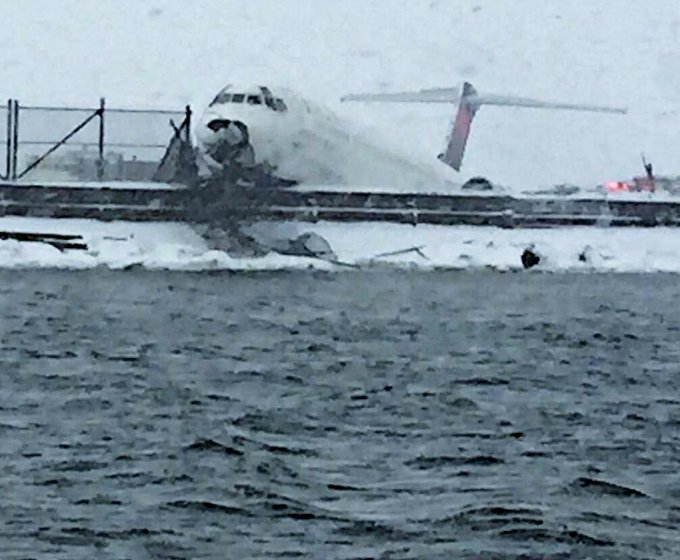
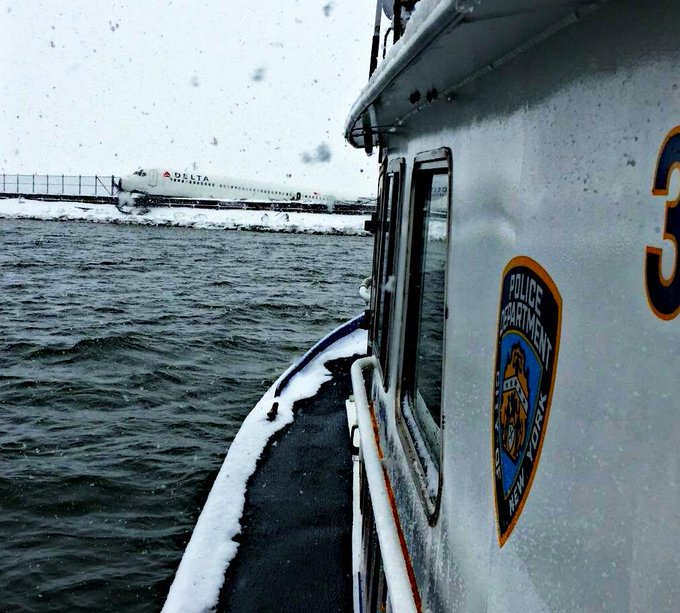
A PLANE has skidded off a snowy runway at New York’s LaGuardia Airport​, crashing through a seawall fence​ before stopping just metres from the water’s edge.

None of the 125 passengers and five crew members on board was seriously hurt, but six people suffered minor injuries, sources told The New York Post.

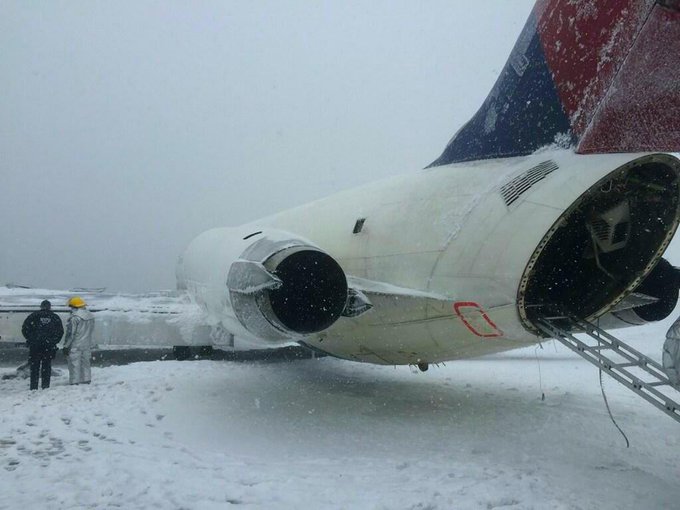
Fuel was leaking from the MD-88 jet and emergency responders were spraying foam to prevent a potential fire after the wing was shorn off.

Sources said Delta Flight 1086 from Atlanta was landing during a snowstorm when it slid off the side of Runway 13 and crashed into a Flushing Bay seawall around 11am Thursday (3am Friday AEDT.

Supplied Editorial DELTA SKID LGA

View image on Twitter

Frightening … a Delta passenger plane has skidded on the runway at LaGuardia Airport. Picture: Instagram/veeestchicSource: Supplied 

Delta Airlines said in a statement: “Customers deplaned via aircraft slides and have moved to the terminal on buses. Our priority is ensuring our customers and crew members are safe.

“Delta will work with all authorities and stakeholders to look into what happened in this incident.”

Passenger Sam Stern, 64, of Sarasota, Florida, was seated with his wife in an emergency-exit row and had to yank out the window so everyone could escape.

“We came in for landing, the plane hit the ground. As it started to apply the brakes, it started skidding. It didn’t spin around or anything,” he said. “It ended up hitting the embankment. The wing broke off.”

“I’m fine, I hurt my back. Everybody was shaken up, but everyone remained calm and was very caring about everybody else,” he added.

View image on Twitter View image on Twitter

A first responder on the ground was also heard asking if the controller was in touch with the Flight 1086 pilot.

“I’m calling up … no response,” the controller said.

“OK, sir, he is leaking fuel on the left side of his aircraft … heavily. His wing is ruptured,” the responder said.

The incident marked Delta’s first mishap since December 5, 2013, when a 767 returned to land at Madrid-Barajas Airport in Spain after a tire failure at takeoff, according to the Aviation Safety Network.

This story originally appeared in The New York Post.

SOURCE:::: http://www.news.com.au

Natarajan

Image of the Day…. Smallest Full Moon On March 5 2015…

Curtis Beaird in south Georgia captured this shot.

EarthSky Facebook friend Curtis Beaird in south Georgia captured the shot above.

Tonight’s full moon is the smallest full moon of the year. We’ve heard it called the micro-moon or mini-moon. This March 5, 2015 full moon lies about 50,000 kilometers (30,000 miles) farther away from Earth than will the year’s closest full moon – the full supermoon and Northern Hemisphere’s Harvest Moon – on September 28. The March 5 moon is the year’s farthest full moon because full moon and lunar apogee – the moon’s farthest point in its monthly orbit – both fall on the same date.

Every year has a closest full moon, of course. The mini-moon returns about one month and 18 days later with each passing year, meaning that, in 2016, the year’s smallest full moon will come on April 22. In 2017, it’ll come June 9. In 2018, the year’s smallest full moon will come on July 27. And so on, no doubt until our earthly calendars are long forgotten.

By the way, as an aside, mark your calendar for that September 28, 2015 full moon – the Harvest moon – and closest full moon of this year. It’ll also stage a total eclipse of the moon, which some will call a Blood Moon eclipse. It concludes a series of four straight total lunar eclipses that started on April 15, 2014.

The crest of the moon’s full phase comes on March 5, 2015 at precisely 18:05 Universal Time.

Although the full moon occurs at the same instant all around the world, our clocks read differently in different time zones. In the United States, the moon turns exactly full onThursday, March 5, at 1:05 p.m. EST, 12:05 p.m. CST, 11:05 a.m. MST or 10:05 a.m. PST. So the Americas won’t see the moon at the instant it turns full because it happens during the daytime hours, when the moon is below the horizon and under our feet.

The moon looks full for several days around full moon.  William Vann caught this rising almost-full moon on March 4, 2015.

The moon looks full for several days around full moon. William Vann submitted this shot. It’s the rising almost-full moon on March 4, 2015.

No matter where you live worldwide, look for the full moon tonight, lighting up the nighttime from Thursday nightfall until dawn Friday. As with any moon at the vicinity of full moon, tonight’s moon rises in the east at early evening, climbs highest in the sky around midnight and sets in the west in the vicinity of sunrise.

In North America, we often call the March full moon by the names of Sap Moon, Crow Moon, Worm Moon or Lenten Moon. But in recent years, we’ve also heard the term mini-moon to describe the year’s smallest full moon. It’s not a name (like Sap Moon). It’s not bound to a particular month or season. It’s just a term to describe the year’s smallest moon.

What is a mini-moon or micro-moon? Like most astronomers, we at EarthSky have always referred to the year’s smallest full moon as an apogee full moon. The terms mini-moon andmicro-moon stem from popular culture. They roll off the tongue more easily than apogee full moon. As some indication of the appellation’s growing popularity, we’ve found that theNASA Astronomy Photo of the Day and timeanddate.org sites both like to call the smallest full moon a micro-moon.

Billie C. Barb caught this shot of the rising moon on March 4, 2015 from the state of Washington, saying it was

Billie C. Barb submitted this photo of the rising moon on March 4, 2015 from the state of Washington, saying it was “. . . a love affair between the moon and the evergreens.”

Bottom line: The micro-moon or mini-moon – smallest full moon of 2015 – comes on March 5, 2015 It lies about 50,000 kilometers (30,000 miles) farther away from Earth than will the full moon supermoon of September 28, 2015.

SOURCE:::: http://www.earhskynews.org

Natarajan

Image of the Day…. ” Astronaut Salutes Leonard Nimoy From Orbit…”

International Space Station astronaut Terry Virts (@AstroTerry) tweeted this image of a Vulcan hand salute from orbit as a tribute to actor Leonard Nimoy, who died on Friday, Feb. 27, 2015. Nimoy played science officer Mr. Spock in the Star Trek series that served as an inspiration to generations of scientists, engineers and sci-fi fans around the world.

Cape Cod and Boston, Massachusetts, Nimoy’s home town, are visible through the station window.

SOURCE:::::: http://www.nasa.gov

Natarajan

Picture of the Day… Half Moon !!!


Photograph of Half Moon  as appeared on the clear blue  sky of Brisbane  on 25 th Feb Evening.

This Picture was Taken by my son Senthil Natarajan  right from the front lawns of his Home at  Brisbane , Australia .

He is not a Professional Photographer , but has got a keen interest in photography and enjoys  his moments with his camera.

I admire his skill and this Picture in particular … Looks like a PICTURE  captured by the crew of International Space Station  from Spaceship !!!

He has posted this picture  in his FB Column … Having appreciated my son for this photograph , i thought that i should share this  picture with my friends and followers of my site thro this Post

Image Credit….Senthil Natarajan

Natarajan


Watch Sunday Spacewalk on March 1…

NASA astronaut Terry, Virts Flight Engineer of Expedition 42 is seen working to complete a cable routing task while near the forward facing port of the Harmony module on the International Space Station. February 21, 2015. Image credit: NASA

NASA astronaut Terry, Virts Flight Engineer of Expedition 42 is seen working to complete a cable routing task while near the forward facing port of the Harmony module on the International Space Station. February 21, 2015. Image credit: NASA

On Sunday (March 1, 2015) two NASA astronauts aboard the International Space Station (ISS) will perform the last of Expedition 42’s scheduled spacewalks. The spacewalk will begin around 6:10 a.m. Central Time and is expected to last about 6 hours, 45 minutes. NASA Television coverage on Sunday will begin at 5 a.m. Central time. Watch here

NASA astronauts Barry Wilmore and Terry Virts completed the first spacewalk on February 21 and the second on Wednesday (February 25.)

The spacewalks are designed to prepare the orbiting laboratory for future arrivals by U.S. commercial crew spacecraft. The astronauts are laying cables along the forward end of the U.S. segment to bring power and communication to two International Docking Adapters slated to arrive later this year. The new docking ports will welcome U.S. commercial spacecraft launching from Florida beginning in 2017, permitting the standard station crew size to grow from six to seven and potentially double the amount of crew time devoted to research.

When astronaut Terry Virts returned the airlock after Wednesday’s spacewalk, he reported a minor seepage of water in his helmet. The Mission Management Team reviewed the status of spacewalk preparations as well as an analysis of the minor seepage of water and on Friday morning, the team expressed a high degree of confidence was that the suit’s systems are all in good shape and gave approval to proceed with Sunday’s spacewalk as planned.

Spacewalk specialists reported that Virts’ suit — serial number 3005 — has a history of what is called “sublimator water carryover”, a small amount of residual water in the sublimator cooling component that can condense once the environment around the suit is re-pressurized following its exposure to vacuum during a spacewalk, resulting in a tiny amount of water pushing into the helmet.

Spacewalkers Terry Virts and Barry Wilmore work outside Pressurized Mating Adapter-2. Image credit: NASA TV

Spacewalkers Terry Virts and Barry Wilmore work outside Pressurized Mating Adapter-2. Image credit: NASA TV

NASA astronaut Barry Wilmore works outside the International Space Station on the first of three spacewalks preparing the station for future arrivals by U.S. commercial crew spacecraft, Saturday, February 21, 2015. Fellow spacewalker Terry Virts, seen reflected in the visor, shared this photograph on social media.  View larger. \  Image credit; NASA

NASA astronaut Barry Wilmore works outside the International Space Station on the first of three spacewalks preparing the station for future arrivals by U.S. commercial crew spacecraft, Saturday, February 21, 2015. Fellow spacewalker Terry Virts, seen reflected in the visor, shared this photograph on social media.
View larger. | Image credit: NASA

During Sunday’s spacewalk, Virts and Expedition 42 Commander Barry Wilmore will deploy 400 feet of cable along the truss of the station and install antennas as part of the new Common Communications for Visiting Vehicles (C2V2) system that will provide rendezvous and navigational data to visiting vehicles approaching the station, including the new U.S. commercial crew vehicles

NASA astronaut Terry Virts Flight Engineer of Expedition 42 on the International Space Station is seen working to complete a cable routing task while the sun begins to peak over the Earth’s horizon on February 21 2015. Image credit: NASA

NASA astronaut Terry Virts Flight Engineer of Expedition 42 on the International Space Station is seen working to complete a cable routing task while the sun begins to peak over the Earth’s horizon on February 21 2015. Image credit: NASA

All three spacewalks are in support of the long-planned ISS reconfiguration from its current configuration, which was designed to support visiting Space Shuttles, to its new configuration optimived for future visiting commercial crew and cargo vehicles.

While cargo vehicles attach to the ISS using the process of berthing, whereby they are captured with the station’s robotic arm and positioned below a berthing port prior to being bolted into place, commercial crew vehicles will not use this method.

This is because the process of un-berthing takes a long time to complete, since cables and ducting between the visiting spacecraft and the ISS must first be manually disconnected, control boxes installed, hatches closed, and then the visiting spacecraft must be maneuvered away from the station with the robotic arm.

This means that berthing ports cannot support a rapid evacuation of crew from the ISS should it ever be necessary, which will be one of the primary roles of the commercial crew vehicles as they serve as “lifeboats” during their crew’s stay at the ISS.

Instead, crewed vehicles will attach to the ISS via a process of docking, whereby the visiting spacecraft flies itself all the way into its docking port and attaches via a capture ring striking a corresponding attachment mechanism..

The leading end effector of the Canadarm2 (bottom foreground) will be lubricated Wednesday when astronauts Barry Wilmore conduct their second spacewalk.  Imge credit: NASA TV

The leading end effector of the Canadarm2 (bottom foreground) will be lubricated Wednesday when astronauts Barry Wilmore conduct their second spacewalk. Image credit: NASA TV

Bottom line: NASA astronauts Barry Wilmore and Terry Virts aboard the International Space Station (ISS) completed the first of three spacewalk on February 21, 2105 and the second on February. On Sunday (March 1, 2015) they will perform the last of Expedition 42’s scheduled spacewalks. The astronauts are securing cables to prepare the orbiting laboratory for future arrivals by U.S. commercial crew.

SOURCE::::www.earthsky.org

Natarajan