This date in science: Yuri Gagarin’s birthday….9th March

He was a Russian Soviet pilot and the first human to travel to space, in 1961. Later, he became one of the world’s true heroes …


“Let’s go! (Poyekhali!)” Image via ESA.

March 9, 2016. Yuri Alekseyevitch Gagarin (1934 – 1968) would have been 82 today. He became the first human ever to travel into space on April 12, 1961, flying into orbit around Earth for 89.1 minutes in Russia’s Vostok 1 spacecraft. He circled the Earth once and flew as high as 200 miles (327 km). The entire mission, from launching to landing lasted 108 minutes.

Yuri was born on a small farm west of Moscow. His father was a bricklayer, a carpenter, and a farmer. His mother was a milkmaid. He was the third in a family of four children.

During the Second World War, the Gagarin family was broken apart as two of Yuri’s older sisters were taken into labor camps by the Nazis. The Gagarins were forced out of their house, and dug a hideout in the ground, where they stayed until the end of the war. After the war, the family moved to Gziatsk.

Gagarin was inspired to become a pilot while still a teenager. When a Russian Yak fighter plane was forced to land in a field near his home, the praise those pilots received left a mark on the young Gagarin. He wanted to be like them.

He studied to become a foundryman (a foundry is a factory that melts metals in special furnaces and pours the molten metal into molds for making products). He was singled out for his skillfulness to further his studies in the Saratov Technical School.

Vostok 1 via Wikimedia Commons.

Vostok 1 via Wikimedia Commons.

There, his dream to become a pilot took root, as during his 4th and last year at Saratov, he had the chance to join a local flying club. He learned to operate a plane, and flew by himself for the first time in 1955.

That same year, he also graduated from school, and was recruited by the Soviet Army.

At the advice of his flying mentor, he joined the Soviet Air Force, and went on studying at the Orenburg School of Aviation. There, he was taught to fly MIGs.

During his studies at Orenburg, he also met his future wife, Valentina Ivanova Goryacheva, who was a nursing student at the time.

In November, 1957, when Gagarin was 23, he graduated from Orenburg with honors and married Valentina. Later, the couple had two girls, Yelena, and Galina.

In 1959, after the Russians succeeded at photographing the far side of the moon for the first time with Luna 3, many – including Yuri – felt it was about time for the first man to be sent to space. He and a few other men were accepted for cosmonaut training in 1960 after a lot of selection.

The selected candidates underwent not only physical training, but also mental and psychological training.

Gagarin was known for his good humour, perseverance, and calm.

On April 12, 1961, the Russians amazed the world by launching Vostok 3KA-3 (Vostok 1) from the Baikonur Cosmodrome with Yuri Gagarin aboard. Vostok means East in Russian.

East for sunrise, and for the rise of the Space Age.

Hear a recording of Yuri Gagarin saying “poyekhali” (“let’s go”) before the launch.

Yuri  Gagarin in Warsaw in 1961.  Image via Wikimedia Commons.

Yuri Gagarin in Warsaw in 1961. Image via Wikimedia Commons.

Gagarin on a visit to Sweden, 1964.  Image via Wikimedia Commons.

Gagarin in Sweden in 1964. Image via Wikimedia Commons.

After coming back from space, Gagarin became an international celebrity. Khrushchev awarded him with the title of Hero of the Soviet Union.

His dream had come true.

Gagarin and his wife began touring the world, where Yuri was decorated for his legendary accomplishment. It’s rumored that Gagarin didn’t handle his fame very well, however.

In 1962, he was appointed as a deputy of the Soviet Union, and he was elected to the Central Committee of the Young Communist League. But Gagarin was not entirely happy. He felt he didn’t train to fly only once. He wanted to fly more, but – according to the stories about him – those around him tried to stop him for fear of losing the great Soviet hero.

In 1963, Gagarin later became deputy training director of the Cosmonaut Training Center outside Moscow. Later, the training center was named for him.

The following year he started extensive training to become a fighter pilot. He died on March 27, 1968, at the age of 34 due to the crash of a MiG – 15UTI that he and colleague Vladimir Seryogin were flying from the Chkalovski Air Base.

Their bodies were collected near the small town of Khirzach, and were cremated. Their ashes are a part of the Kremlin Building in the Red Square, in Moscow.

Yuri's plaque at the Kremlin in Moscow, via Wikimedia Commons.

Yuri’s plaque at the Kremlin in Moscow, via Wikimedia Commons.

Bottom line: Born on March 9, 1934, Yuri Alekseyevitch Gagarin (1934 – 1968) was the first human being ever to travel into space. His historic flight took place on on April 12, 1961, when he orbited Earth for 89.1 minutes in Russia’s Vostok 1 spacecraft.

Source……www.earthsky.org

Natarajan

Celebrating International Women’s Day….

NASA astronauts and JAXA astronaut at work inside International Space Station's Robotics Workstation

In this April 8, 2010 photograph, STS-131 mission specialists Stephanie Wilson of NASA, Naoko Yamazaki of the Japanese Aerospace Exploration Agency (JAXA), Dorothy Metcalf-Lindenburger of NASA, and Expedition 23 flight engineer Tracy Caldwell Dyson (top left) work at the robotics workstation on the International Space Station, in support of transfer operations using the station’s Canadarm2 robotic arm to move cargo from the Multi-Purpose Logistics Module.

The STS-131 mission’s seven-member crew launched aboard space shuttle Discovery on April 5 from NASA’s Kennedy Space Center, joining the six residents of the space station when the shuttle docked on April 7. The merging of the two crews marked the first time four women were in space at the same time.

Image Credit: NASA

Source….www.nasa .gov

Natarajan

Photos of today’s Solar Eclipse….

View larger. | March 9, 2016 total eclipse of the sun by Justin Ng of Singapore.

Justin Ng at Amazing City Beach Resort in Palu, Indonesia captured this photo of the March 9, 2016 total eclipse of the sun. He captured what is one of the most famous of all eclipse phenomena: the legendary diamond ring effect. It happens twice in a total eclipse … in the final moments before totality, and just as totality ends. You can also see a flare from the sun, on its lefthand limb.

A Kannan in Singapore caught the partial phases, too.  He wrote:

A Kannan in Singapore caught the partial phases, too. He wrote: “The partial solar eclipse was observed in Singapore skies this morning covering about 85% of the sun from Earth.”

Source…..www.earthsky.org

Natarajan

” One-Year Crew Returns to Earth…”

Soyuz capsule with parachute deployed descends through clouds on the way to landing

The Soyuz TMA-18M spacecraft is seen as it lands with Expedition 46 Commander Scott Kelly of NASA and Russian cosmonauts Mikhail Kornienko and Sergey Volkov of Roscosmos near the town of Zhezkazgan, Kazakhstan on Wednesday, March 2, 2016 (Kazakh time). Kelly and Kornienko completed an International Space Station record year-long mission to collect valuable data on the effect of long duration weightlessness on the human body that will be used to formulate a human mission to Mars. Volkov returned after spending six months on the station.

Photo Credit: (NASA/Bill Ingalls)

Source….www.nasa.gov

natarajan

The Stunning Beauty of Braided Rivers….!!!

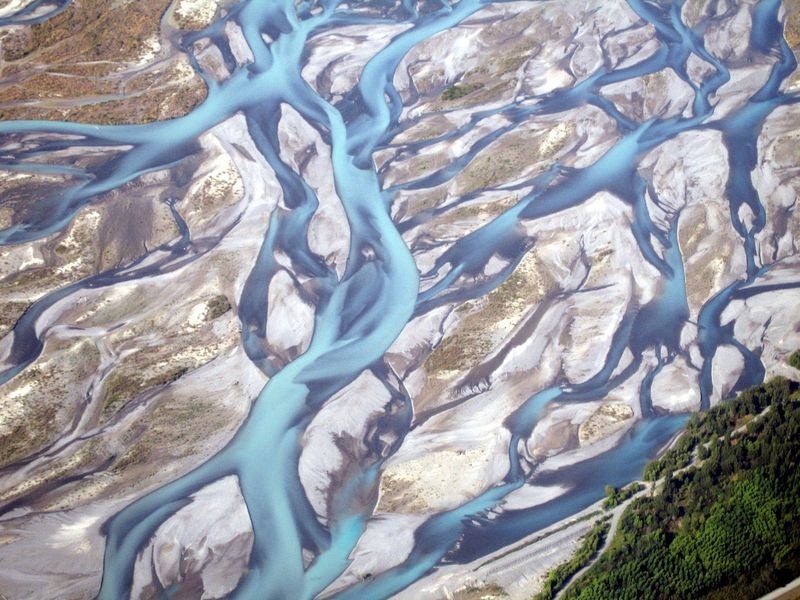
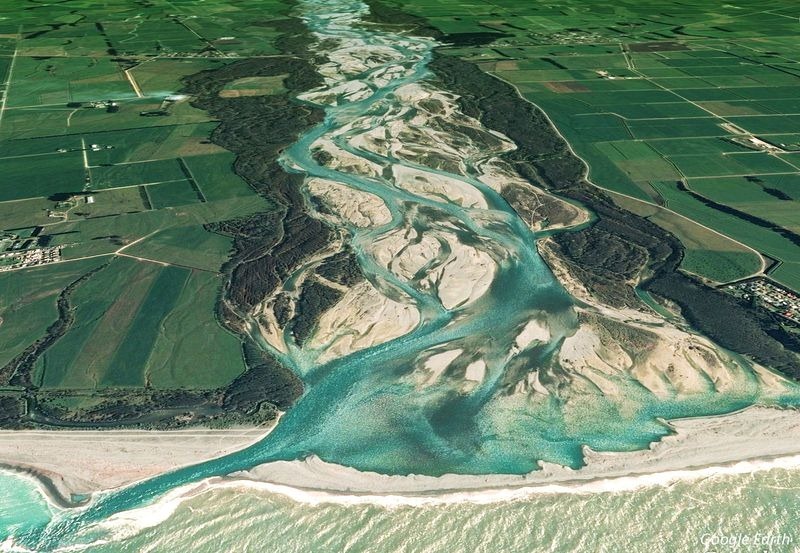
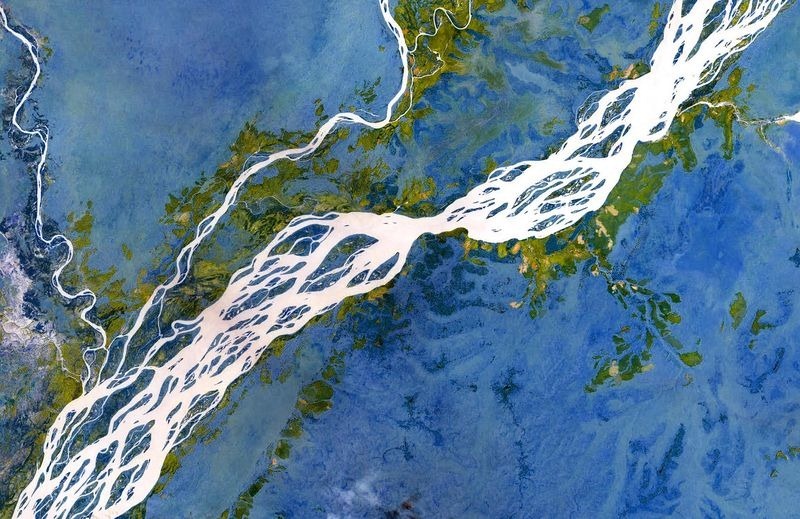
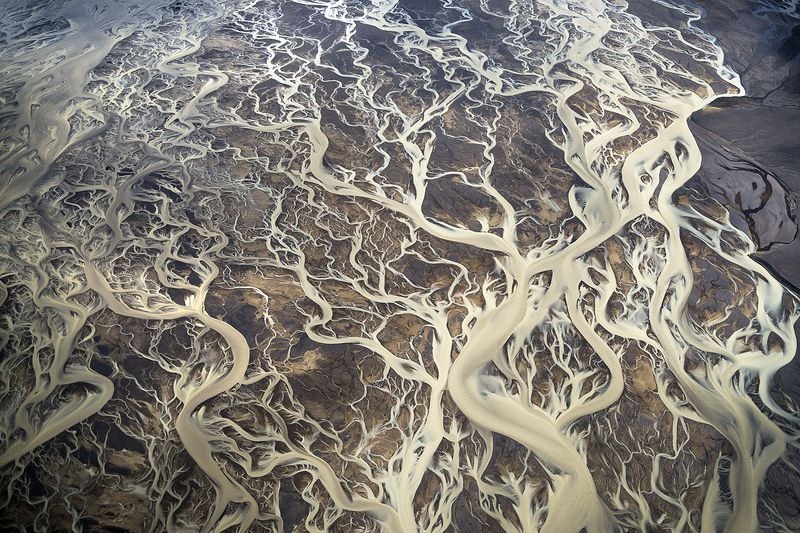
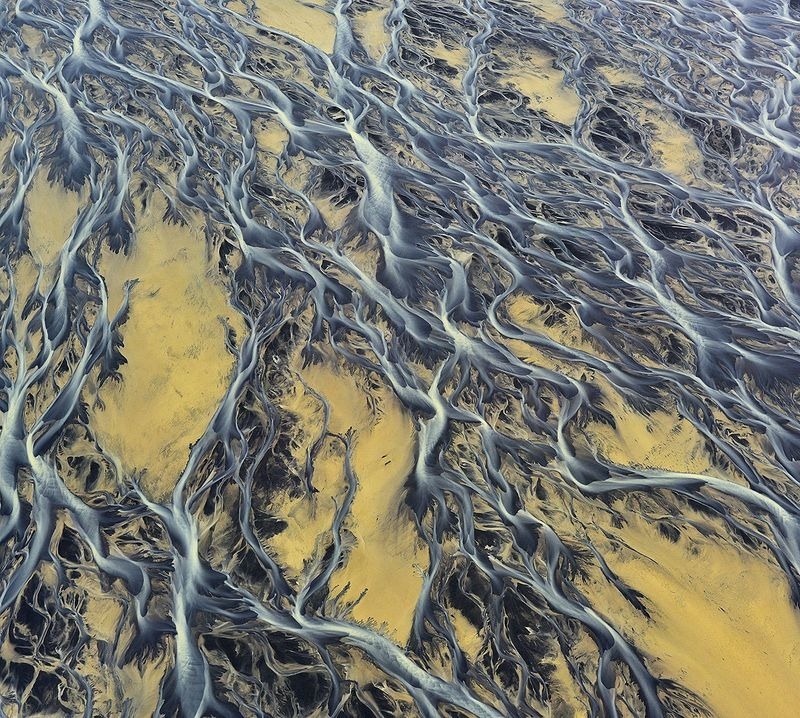
Most rivers flow in one broad channel of water, but some rivers split into lots of small channels that continually split and join each other to give a braided appearance. These are called braided rivers.

Braided rivers are usually wide but shallow. They typically form on fairly steep slopes and carry large amount of coarse-grained sediments. When the river’s flow decreases, these sediments get deposited on the river bed leaving behind small temporary islands of sands that cause the river’s channel to split. Aside from a steep gradient and abundance of sediments, a variable water discharge rate is essential to their formation. Consequently, braided rivers exist near mountainous regions, especially those with glaciers. Braided channels are also found in environments that dramatically decrease channel depth, and hence channel velocity, such as river deltas, alluvial fans and peneplains.

iceland-braided-river-3

A braided river in Iceland. Photo credit: Andre Ermolaev/500px

The pattern of the braided channels will change over time as the sediment islands get eroded away and deposited in new islands as the speed and amount of water in the river changes.

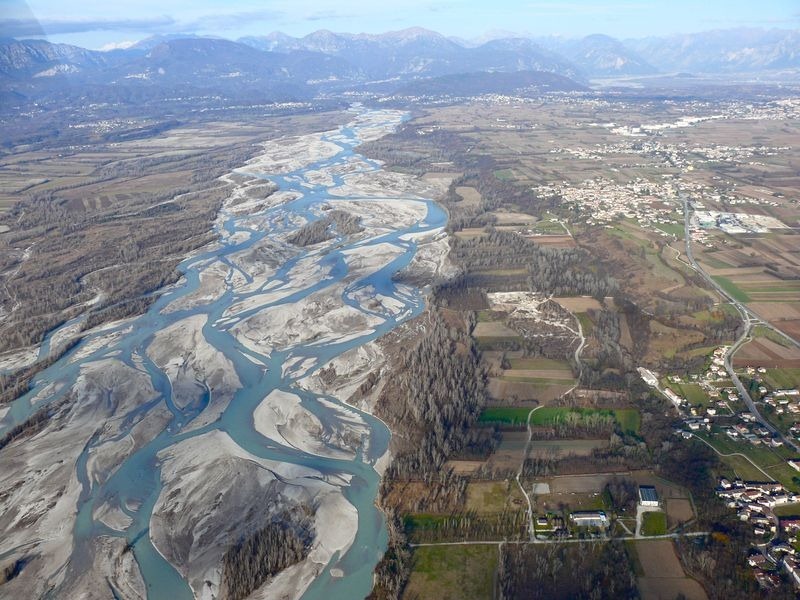
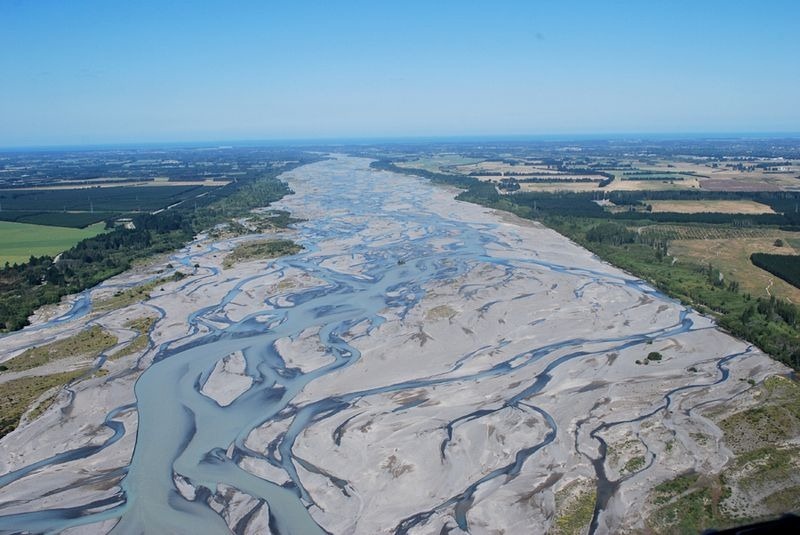
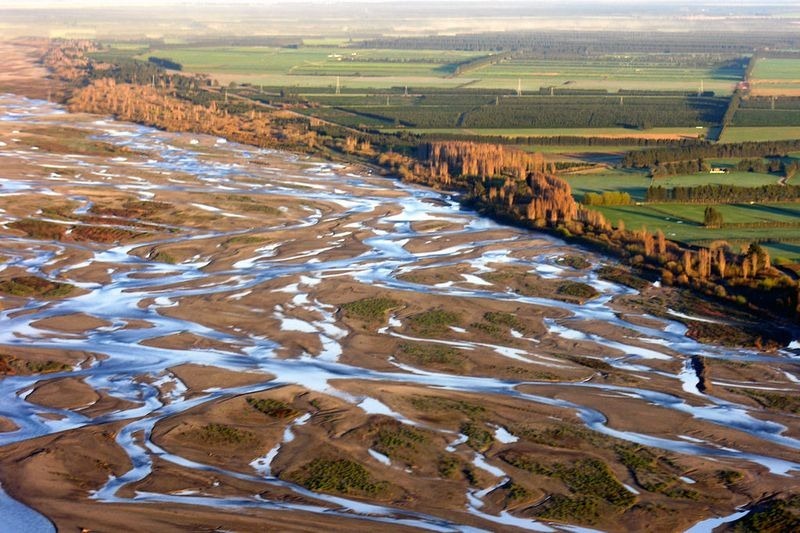
Rivers with braided channels look stunningly beautiful in satellite images or from airplanes. Here are some of the most beautiful examples of braided rivers.

rakaia-River

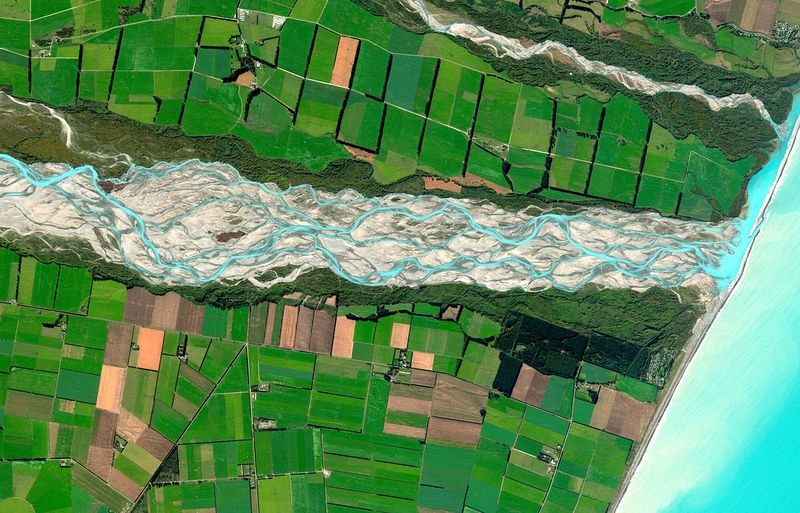
The Rakaia River in the Canterbury Plains in New Zealand’s South Island is a beautiful example of a braided river. It is one of the largest braided rivers in New Zealand. Photo credit: Andrew Cooper/Wikimedia

rakaia-river-braided-2

Rakaia River. Photo credit: www.digitalglobeblog.com

rakaia-river-braided-1

Rakaia River. Photo credit: Geoff Leeming/Flickr

brahmaputra-braided-river-1

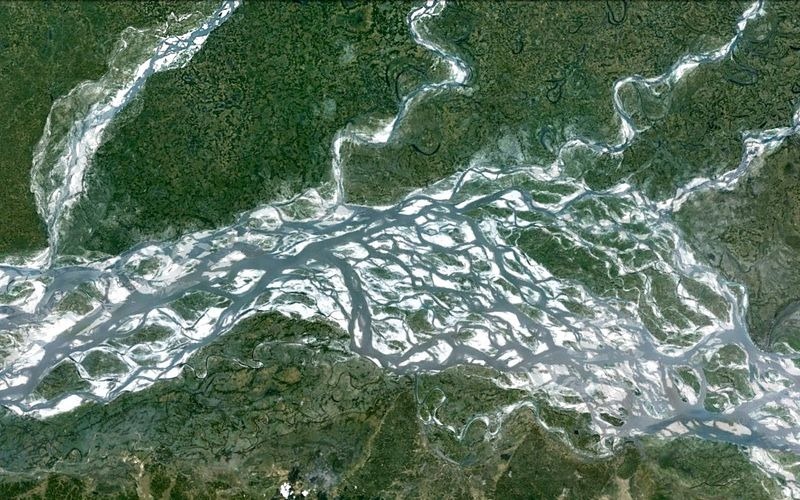
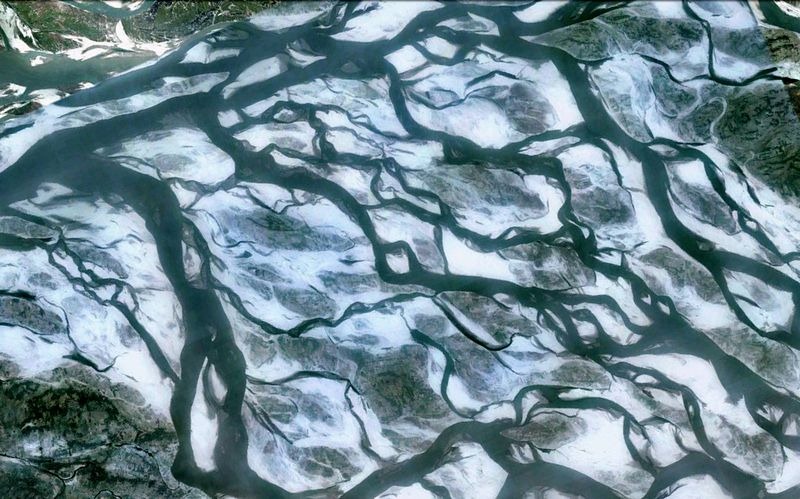
The Brahmaputra River in Tibet, India and Bangladesh is another classic example. The river originates in Tibet and enters India through the state of Arunachal Pradesh. The river gets intricately braided once it enters the state of Assam where it acquires its common name Brahmaputra. For the next 700 km of its braided course through the valley, it gets mighty big even in the dry season. During rains, its banks are more than 8 km apart. Photo credit:Google Earth/patternsofnatureblog.com

brahmaputra-braided-river-2

Brahmaputra River. Photo credit: Google Earth/patternsofnatureblog.com

waitaki-braided-river-1

The Waitaki River is another large braided river in the South Island of New Zealand. It drains the Mackenzie Basin and runs some 110 kilometers south-east to enter the Pacific Ocean between Timaru and Oamaru. Photo credit: Google Earth

tagliamento

The Tagliamento River in north-east Italy is braided as it flows from the Alps to the Adriatic Sea. Photo credit:www.udine20.it

waimakariri-braided

The Waimakariri River in the South Island of New Zealand, is a braided river, about a kilometer wide with many changing channels cutting through the shingle. Photo credit: unknown/spacebattles.com

waimakariri-river-braided-1

The Waimakariri River. Photo credit: Philip Capper/Flickr

congo-braided-river-1

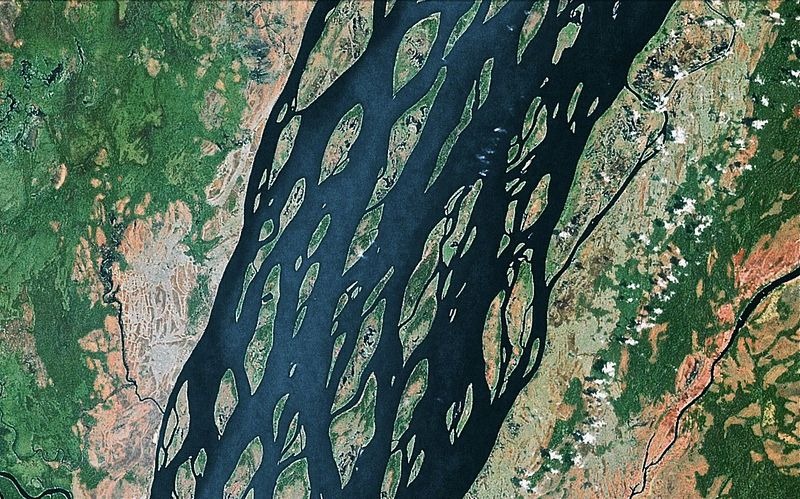
A Landsat image of a braided section of the Congo River. Photo credit: Wired

congo-braided-river-2

The Congo River. Photo credit: Google Earth/patternsofnatureblog.com

ob-river-braided-1

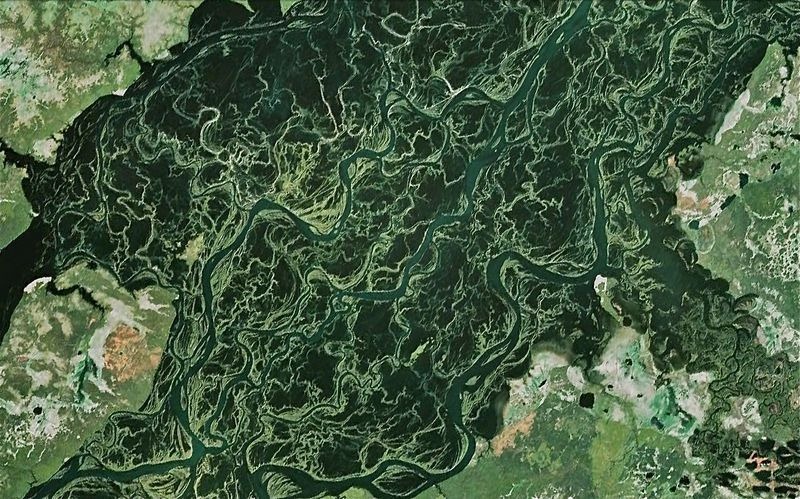
The Ob River in western Siberia, Russia, is the world’s seventh longest river. Photo credit: Google Earth/patternsofnatureblog.com

parana-river-braided-1

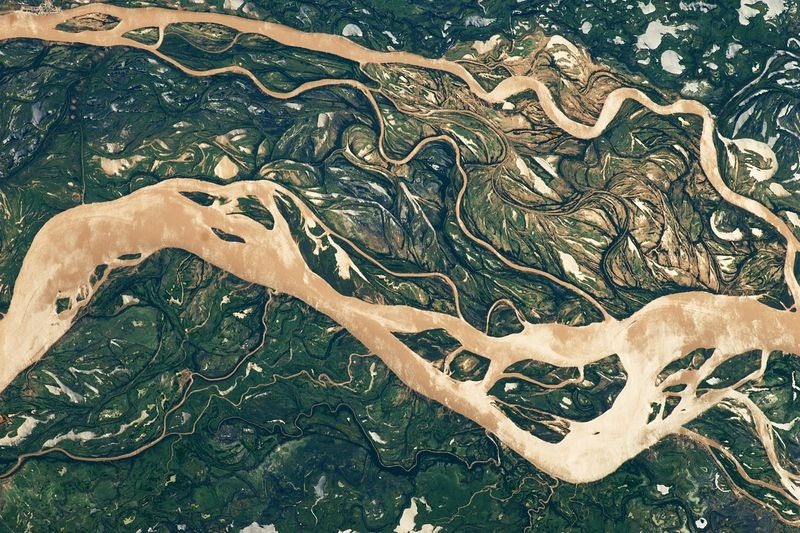
The Paraná River in South America. This photograph shows a 29-kilometer stretch of the Paraná, downstream of the small city of Goya, Argentina. Photo credit: NASA

iceland-braided-river-1

A braided river in Iceland. Photo credit: Andre Ermolaev/500px

iceland-braided-river-2

A braided river in Iceland. Photo credit: Andre Ermolaev/500px

Source….www.amusingplanet.com

Natarajan

Image of the Day…. Robin in the backdrop of Moon !!!

First robin of the year

On Saturday, our friend Suzanne Murphy got her first robin sighting of the year yesterday in southern Wisconsin. Spring is coming!

Photo credit: Suzanne Murphy

Photo credit: Suzanne Murphy

Suzanne Murphy got a sign of spring on Saturday (February 20, 2016). She reported:

I was shooting a photo of the moon above this tree and a robin flew into my photo! This is my first Robin sighting of the year here in southern Wisconsin.

Photo credit: Suzanne Murphy

Photo credit: Suzanne Murphy

Source….www.earthsky.org

Natarajan

This date in science: John Glenn first American to orbit Earth….

On February 20, 1962, John Glenn became the first American to orbit the Earth. He made three turns around the planet before returning safely.

John Glenn and Friendship 7

February 20, 1962. John Glenn became the first American to orbit the Earth on this date. He made three turns around the planet before returning safely in his space capsule, which was called Friendship 7. He followed two Russian cosmonauts in making this early orbit of our planet: Yuri Gagarin ( April 1961) and Gherman Titov (August 1961).

While Glenn was in orbit, NASA controllers received an indication that the heat shield on his craft had come loose. They instructed Glenn not to jettison the rockets underneath the heat shield during re-entry, because the rockets might be able to hold the shield in place. Fortunately, the indication turned out to be a false alarm.

Glenn returned to space at age 77 aboard the space shuttle Discovery in 1995, making him the oldest person to fly in space. His mission’s primary scientific aim at that time was to study the effects of spaceflight on seniors.

John Glenn climbs into the Friendship 7 spacecraft just before making his first trip into space on February 20, 1962. Photo via NASA

John Glenn and Friendship 7

John Glenn and Friendship 7

Here's What John Glenn saw on February 20, 1962.  Just 5 minutes and 44 seconds after launch, Glenn offered his first words about the view from his porthole: “This is Friendship 7. Can see clear back; a big cloud pattern way back across towards the Cape. Beautiful sight.” Three hours later, at the beginning of his third orbit, Glenn photographed this panoramic view of Florida from the Georgia border (right, under clouds) to just north of Cape Canaveral. His American homeland was 162 miles (260 kilometers) below. “I have the Cape in sight down there,” he noted to mission controllers. “It looks real fine from up here. I can see the whole state of Florida just laid out like on a map. Beautiful.”  Image via NASA

Here’s what John Glenn saw on February 20, 1962. Just 5 minutes and 44 seconds after launch, Glenn offered his first words about the view from his porthole: “This is Friendship 7. Can see clear back; a big cloud pattern way back across towards the Cape. Beautiful sight.” Three hours later, at the beginning of his third orbit, Glenn photographed this panoramic view of Florida from the Georgia border (right, under clouds) to just north of Cape Canaveral. His American homeland was 162 miles (260 kilometers) below. “I have the Cape in sight down there,” he noted to mission controllers. “It looks real fine from up here. I can see the whole state of Florida just laid out like on a map. Beautiful.” Image via NASA

Bottom line: John Glenn became the first American to orbit Earth on February 20, 1962. His space capsule was called Friendship 7.

Source……www.earthsky.org

Natarajan

Earth in True Perspective….

Everything is relative. You don’t need to be Einstein to understand that. A human is as big to an ant, as a building may be to a human. The world is vast and large – it’s size is dominated by massive oceans and continents.

But ever since we’ve developed the ability to look beyond our atmosphere, it became more and more apparent that the earth is in fact small. Too tiny to even comprehend, when compared to other planets, stars, galaxies and the universe itself. So just to give you an idea of how tiny we really are, here are some visual aids.

size of earth

size of earth

size of earth

size of earth

size of earth

size of earth

size of earth

size of earth

size of earth

size of earth

size of earth

size of earth

size of earth

size of earth

size of earth

size of earth

size of earth

size of earth

size of earth

size of earth

size of earth

size of earth

size of earth

size of earth

size of earth

size of earth

size of earth

Source…..www.ba-bamail.com

Natarajan

Image of the Day….” Three Stars of Orion …”

Orion and the Chinese New Year

“When the three stars of Orion shine highly at the southern sky after sunset, that means it’s time for the spring festival.”

The three Belt stars of Orion on February 7, 2016 via Jeff Dai and Jingyi Zhang.  Visit Jeff Dai on Facebook.

The three Belt stars of Orion on February 7, 2016 captured by Jeff Dai. Visit Jeff Dai on Facebook.

Jeff Dai and Jingyi Zhang in Chongqing, China submitted this photo and drawing to EarthSky on February 7, 2016, the first day of the Chinese New Year celebration, which is going on this week across Asia. They focused on the three Belt stars in the constellation Orion. They are three medium-bright stars in a short, straight row at the mid-section of the Hunter. Jeff and Jingyi wrote:

As you know, the three lined-up prominent stars of Orion are easily recognized.

The Chinese regarded them as the three gods of fortune, prosperity and longevity. When the three stars shine highly at the southern sky after sunset, that means it’s time for the spring festival.

Here is the view tonight, Happy Chinese New Year!

In Chinese tradition, the 3 belt stars of Orion represent 3 gods.

In Chinese tradition, the 3 belt stars of Orion represent 3 gods. Drawing by Jingyi Zhang.

Bottom line: A photo from China of the three Belt stars of Orion the Hunter and a short discussion of these stars in Chinese tradition … just in time for the Chinese New Year celebration going on this week across Asia.

Source……www.earthsky.org

Natarajan
Image of the Day…Space Station Flyover of the Mediterranean…

Nighttime photograph from low Earth orbit of Mediterranean showing clouds and city lights

Expedition 46 flight engineer Tim Peake of the European Space Agency (ESA) shared this stunning nighttime photograph with his social media followers on Jan. 25, 2016, writing, “Beautiful night pass over Italy, Alps and Mediterranean.”

Image Credit: ESA/NASA

Source…….www.nasa.gov

Natarajan