Clingstone: The House on The Rock…!!!

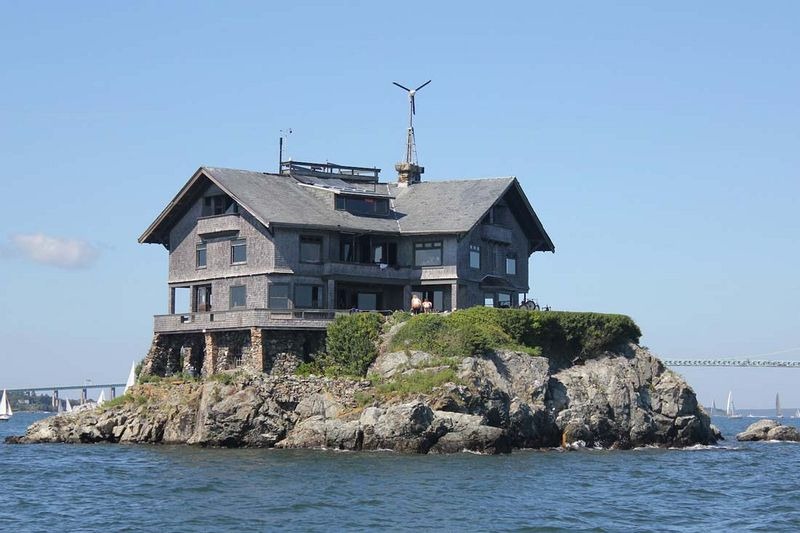
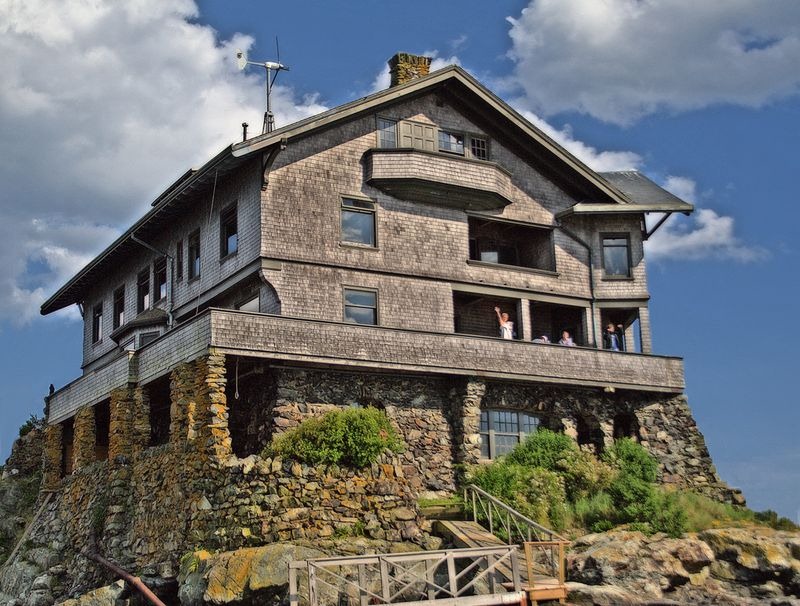
Perched on top of a small, rocky island in Narragansett Bay, near Jamestown, Rhode Island, the United States, is a three-story, cedar shingle mansion built by Philadelphia socialite Joseph Lovering Wharton in 1905. Wharton had built the house as an act of defiance after the government seized his land and summer home that he had in the Fort Wetherill area in south Jamestown, to enlarge the fort at the end of the 1800s. Angered at being ousted from his property, Wharton decided to build a house where no one could bother him, and Clingstone happened. One source claims that the name “Clingstone” was suggested when someone remarked that it was “a peach of a house”. Clingstone is a botanical term for fruits that has a hard stone-like seed inside. Or perhaps, the name is a reference to the way the house clings to the rock.

clingstone-house-6

Photo credit: mansion-homes.com

In spite of its perilious location in the sea, the Clingstone has managed to survive more than a hundred years, weathering countless storms and hurricanes. Originally there was a long stone jetty with gymnasts’ rings and bars, but it was blown away by the Great Hurricane of 1938. The house itself, which sits only 20 feet above sea level, survived with minimal damage. Now Clingstone’s current owner, Henry Wood, a distant cousin of Wharton, regularly goes out to Clingstone with his three grown sons to watch the yearly hurricanes in action.

Henry Wood, who is a Boston-based architect, had bought the house in 1961. It had been lying vacant for two decades after the death of Wharton’s widow in 1941. When Wood acquired it, the house was in a shabby condition with all its windows smashed, the floors rotten and covered with pigeon droppings, and the roof mostly gone.

Wood and his sons take pride in their environment-friendly renovations of the house. The house is totally off the power grid. A windmill on the roof provides electricity, while photovoltaic cells charge a bank of batteries in the basement for additional power. Rainwater collected from the roof into a 3,000-gallon cistern provide water for washing and cleaning. Drinking water comes from a sea-water filtration system. Water is heated by solar panels. The house even has a composting toilet. The compost is then used to fertilize the garden.

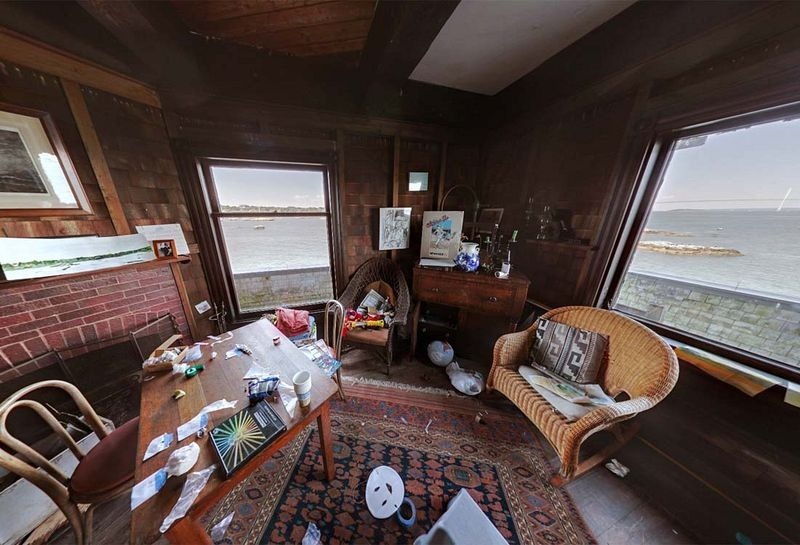
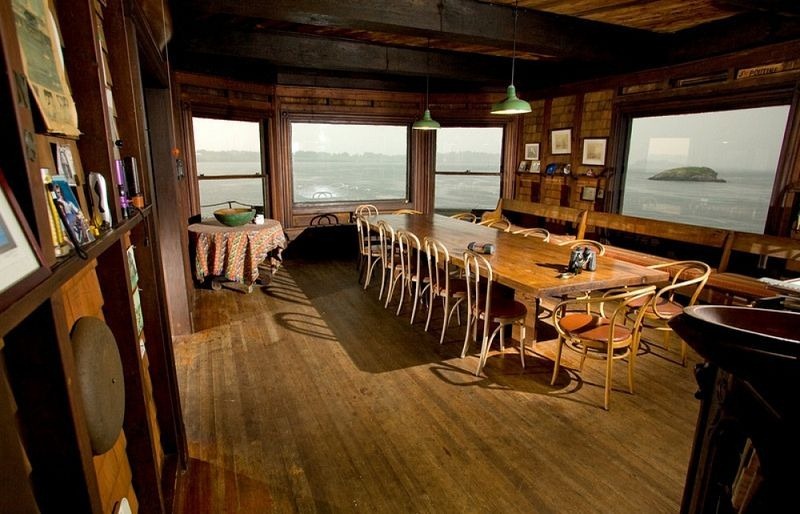
Although refitting the house with green technology has certainly been expensive, Wood has managed to cut corners by acquiring furnishings from thrift shops or yard sales. Windows, light fixtures and doorknobs were scavenged from old buildings that were torn down. The long cypress dining room table was retrieved from the bottom of a cistern.

Today, the house has 23 rooms, including 10 bedrooms and five bathrooms. Visible from the shores, the house is known by locals as “The House on a Rock”.

clingstone-house-5


Photo credit: mansion-homes.com

clingstone-house-22

Photo credit: G.E.Long/Flickr

clingstone-house-10

Photo credit: mansion-homes.com

clingstone-house-21

Photo credit: Eric Jacobs

clingstone-house-1

Photo credit: mansion-homes.com

Source…..www.amusingplanet.com

Natarajan


Cabin Pressure and Oxygen Supply Aboard Commercial Aircraft….

How Cabin Pressure and Oxygen Supplies are Maintained Aboard Commercial Aircraft

Because the economics of having large oxygen tanks aboard airliners simply doesn’t work out (not to mention that the air quality inside the plane would rapidly become unpleasant if fresh air wasn’t constantly supplied, regardless of the oxygen levels), commercial airplanes have a very clever system installed to solve the problem of ultra-low pressure atmosphere at cruising altitudes.

In most modern airliners (the Boeing 787 Dreamliner not withstanding), outside air is “bled off” from the compressor stage of the turbine engines and eventually piped into the passenger areas. However, a bit of processing is needed first as the compressed air is extremely hot (on the order of nearly 400 degrees Fahrenheit

or 200 degrees Celsius) at this stage. Thus, before it enters the passenger compartment, it is first allowed to expand and is run through a heat exchanger and air cycle system to cool it off sufficiently. This system also can work as a heater, with some of the hot air mixed in with the cooled air to regulate cabin temperature.

1280px-Turbofan_operation.svgOnce cooled and filtered, the pressurized air, which now has sufficient oxygen density to keep people happily conscious, is piped into the cabin area, usually at levels around 12 psi (about equivalent to atmospheric pressure at 7,000 feet).  Why 12 psi instead of something like sea-level pressures of about 14.7 psi? 12 psi is sufficient for the majority of passengers while simultaneously reducing the structural strain on the aircraft itself over something like sea level atmospheric pressures.

As for the air already in the cabin, this is vented out through an outflow valve (or multiple valves in larger aircraft), usually located near the rear of the plane. (FunNote: Before smoking was banned on commercial aircraft, the area around this outflow valve was generally stained dark brown from tobacco smoke.)

This outflow valve opens and closes automatically to maintain a steady pressure inside the cabin, while the entire system is ensuring that fresh air is continually being piped into and eventually blown out of the aircraft. In fact, while many complain of airplanes seeming “stuffy,” this system ensures that all the air in the aircraft is being completely replaced on average every 2-3 minutes. Yes, that means that your car, house or office is likely significantly more “stuffy” than a commercial airplane flying at 35,000 feet.

(Note: the Boeing 787 Dreamliner handles cabin pressurization a little differently, using a modernized version of the old, somewhat inefficient, electric compressor system seen on many older aircraft.)

Unfortunately, sometimes planes lose cabin pressure. Whatever the cause, the loss of pressure (usually set at atmospheric pressures past 14,000 ft) will result in oxygen masks deploying. From here, useful consciousness may only last as little as 5-15 seconds, depending on remaining cabin pressure, which is why it’s critical to immediately put your mask on, rather than helping someone else first. You can help them much better when you’re not unconscious or dead.

So how do these airline oxygen masks actually work? It turns out, the economics of having a centralized oxygen tank to provide even emergency oxygen for passengers likewise simply doesn’t add up. Similarly, having tiny individual pressurized oxygen tanks also isn’t feasible. In fact, these masks aren’t hooked up to any tank or air line at all. So how are you able to breathe oxygen through them?
Science.

While designs can vary slightly, in general, when you pull on the device to place it over your face, the tug on the mask’s lanyard releases a spring-loaded mechanism that sets off a small explosive charge. (Yep.) The resulting spark triggers a mixture of lead styphnate and tetracene to generate heat, which will eventually cause a chemical reaction that produces oxygen for your mask. (This is why they tell you to tug on the mask to get the oxygen flowing- you’ve got to set off the explosive charge to get the whole thing going.)

That’s right. What you breathe through the mask didn’t begin as pure oxygen. Rather, the plane is equipped with numerous small chemical oxygen generators (also known as “oxygen candles,” about the size of a small package of tennis balls) which contain a mixture of mostly sodium chlorate (NaClO3), less than 5% barium peroxide (BaO2) and less than 1% potassium perchlorate (KClO4). When these chemicals are heated by the lead styphnate and tetracene, each undergoes a reaction that ultimately results in a fair bit of filtered, life sustaining oxygen running through the tube to you.
Of course, you might also smell a faint burning odor, but this is nothing to be alarmed about; it just assures you that the system is working. In fact, if the plane is actually on fire, the masks usually won’t deploy, so as not to make the fire worse with the extra oxygen.

This brings us to the question of why the plastic bag on the breathing apparatus won’t necessarily inflate as you’re using the device. More than just cosmetic, the bags serve as something of a reservoir for oxygen. If you aren’t taking a breath at all (and have a good seal with the mask tight against your face) the bag keeps the precious, continuously flowing oxygen from escaping into the thin air around you, enabling more of the collected oxygen to be taken in when you do take a breath.  When this is happening, or you are breathing out with the valves on the mask releasing much of the used air, the bag may begin to inflate as oxygen collects. When you breathe in, it will deflate.

So why won’t it always inflate at least a little to show its working? To begin with, you may not have a great seal with the mask on your face, particularly if you have facial hair.  This will allow any produced oxygen (and air you exhale) to more readily escape. (As long as the mask is reasonably secure on your face,

this should still provide you with sufficient oxygen to get by on as long as the plane isn’t flying above 40,000 feet and the pilot does his or her job and gets the plane down below 10,000 feet as rapidly as safely possible.)

Even if you have a good seal, however, the rate at which the oxygen is generated is often not enough to fully inflate the masks’ bag before you take deep, potentially panicky breaths, deflating it. This is simply because the oxygen generation isn’t on-demand (for the passengers anyway), but simply a continuous-flow production of oxygen.

Despite the potentially slow production, the chemical oxygen generators do provide oxygen at a sufficient rate to sustain passengers, generally designed such that peak oxygen production occurs right away (when the plane may be at very high altitude) with the oxygen production rates tailing off over the course of approximately 12-20 minutes before the system burns itself out.

This should be long enough for the pilots to get the plane low enough so that the air pressure is high enough for (relatively) normal atmospheric breathing. And if you’ve ever been lucky enough to be in this sort of situation, you know that those pilots can get the plane from altitudes like 35,000+ feet to safer atmospheric levels alarmingly quickly in an emergency; while it may not be literally true, it at least can seem like roller coasters have nothing on them, which is a good thing in this case.

Source….www.today i foundout.com

natarajan

 

Image of the Day…”Moonset Viewed From the International Space Station”

Earth's moon photographed from low Earth Orbit with blue at bottom of frame

Expedition 47 Flight Engineer Tim Peake of the European Space Agency took this striking photograph of the moon from his vantage point aboard the International Space Station on March 28, 2016.  Peake (@astro_timpeake) shared the image on March 30 and wrote to his social media followers, “I was looking for #Antarctica – hard to spot from our orbit. Settled for a moonset instead.”

Image Credit: ESA/NASA

Source….www.nasa.gov

Natarajan

Image of the Day…” 40000 feet over Greenland ” !!!

A clear day over one of the world’s two great ice sheets.

View larger. | The Oceans Melting Greenland (OMG) field campaign team is flying NASA’s G-III aircraft at about 40,000 feet. On a clear day, this altitude also provides a stunning perspective of one of the world’s two great ice sheets (the other is Antarctica). The flight Saturday, March 26, over the northeast coastline was one of those clear days. Read more about this image.

A science mission called the Oceans Melting Greenland field campaign is flying NASA’s G-III aircraft at about 40,000 feet over Greenland. On a clear day, this altitude also provides a stunning perspective of one of the world’s two great ice sheets (the other is Antarctica). The flight Saturday, March 26, 2016, over the northeast coastline was one of those clear days. Read more about this image. Image via NASA.

Source…..www.earthsky.org

Natarajan

Image of the Day…” An Iconic Building view with the Moon behind it….”

Moon and Empire State Building

A distant view of an iconic building, with the moon behind it.

Photo taken March 23, 2016 by Jennifer Khordi.

Photo taken March 23, 2016 by Jennifer Khordi.

Jennifer Khordi posted this photo at EarthSky Facebook this week. It’s the full moon, seen behind the Empire State Building in New York City. Jennifer caught a telephoto view of this building and moon, from New Jersey. She wrote on March 23, 2016:

The full Worm Moon as it passed behind the Empire State Building tonight, from New Jersey, at 560mm.

Source…..www.earthsky.org

Natarajan

Mangalore Boy Uses Kites to Harness Wind Power & Generate Electricity…!!!

A young boy in Mangalore bagged the Gandhian Young Technological Innovation Award for his innovative project that harnessed the power of wind, through kites.

22-year-old Royston Vijay Castellino, who studied at the Srinivas Institute of Technology, Mangalore, looked into the impact of wind power systems, and concluded that they have limitations to produce electricity. However, his innovative model, which uses a kite to harness wind from high altitudes, wipes out those inefficiencies.

Calling it the “Winds of Change”, he has also applied for a patent.

kites

Representational image

Source: Wikimedia Commons

In 2015, he had completed a project on this as part of his BE electronics and electrical engineering course in his final year. The aim of his project, according to Castellino, was to make wind power generation low cost, increase efficiency, and make it useful in generating electricity in rural areas.

When he experimented on kites, he discovered that the power is at its peak from a kite when it is rotated to make an infinity symbol in the sky. “I also observed that a four-line kite gives more power than a dual-line kite. So, I started to build a strong base with a four-line kite control system,” he said.

To work on the model, he said that he first ordered a four-line power kite from China. Then, he found bicycle parts, crank wheels and sprockets to use as materials. He modified a ceiling fan with permanent magnets, and then wound the rims of the bicycle wheel with threads. He used a wireless transmitter and receiver circuit to control the kite through a motor, and a chain drive to increase the speed. “The output can be improved by increasing the area of the kite,” he explained, “And the project can be made fully automatic by installing sensors on the kite which determine the position of the kite and send data to the base station.”

Since wind energy can be intermittent, he said that two similar kites can produce continuous power. “By installing two kites, energy can be transferred to the utility grid directly. This project can be made highly portable by using a vehicle as a base station which consists of a generator and control system.”

Last year, he was awarded the Project of the Year Award by Karnataka State Council for Science and Technology, at a competition organised by Indian Institute of Science in Bengaluru.

Source……Neeti Vijaykumar in http://www.the betterindia.com

Natarajan

Images of the Day…Monday Night Moon and Jupiter…….

EarthSky friends capture the night sky’s 2 brightest objects, the moon and Jupiter, on Monday night, March 21.

Moon and Jupiter - March 21 2016 - photographed in Tucson, Arizona by Eliot Herman.


Moon and Jupiter – March 21 2016 – photographed in Tucson, Arizona by Eliot Herman.

Jupiter and moon on March 21, 2016 from Jacob Zimmer in Louisville, Kentucky.

Jupiter and moon on March 21, 2016 from Jacob Zimmer in Louisville, Kentucky.

Moon and Jupiter on March 21, 2016 from Karl Diefenderfer in Pennsylvania.

Moon and Jupiter on March 21, 2016 from Karl Diefenderfer in Pennsylvania.

Source…….www.earthsky.org

Natarajan

Image of the Day… Total solar eclipse of March 9 2016 …

View larger. | March 9, 2016, total solar eclipse from Palu, Indonesia.  Photo by Justin Ng of Singapore.

View larger. | March 9, 2016, total solar eclipse from Palu, Indonesia. Photo by Justin Ng of Singapore, who wrote: “Sun’s corona extends millions of kilometers into space and it is visible to the unaided eye during a total solar eclipse. During totality, temperature at my location dropped by 10 to 15 degrees Celsius and I was able to see planet Venus and Mercury when the area became dark. I took 12 different exposures during totality to cover as much dynamic range as possible and stacked them in Photoshop to produce this image.”

Source…..www.earthsky.org

Natarajan

Image of the Day… Lunar shadow across Earth..

Lunar shadow moves across Earth

This is way cool. Watch the moon’s shadow move across Earth during the March 9 total solar eclipse. A first ever animation from deep space.

March 9, 2016. Image credit: NASA

A camera aboard the DSCOVR satellite captured a unique view of this week’s solar eclipse. On March 9, 2016, residents of the Western Pacific looked up in the early morning hours to observe the only total solar eclipse of 2016, while DSCOVR looked down from a million miles away and captured the shadow of the moon crossing the planet.

In the animation above, the shadow of the new moon starts crossing the Indian Ocean and marches past Indonesia and Australia into the open waters and islands of Oceania (Melanesia, Micronesia, and Polynesia) and the Pacific Ocean. Note how the shadow moves in the same direction as Earth rotates. The bright spot in the center of each disk is sunglint — the reflection of sunlight directly back at the satellite’s camera.

NOAA’s DSCOVR satellite is the Nation’s first operational satellite in deep space. DSCOVR hovers between the sun and Earth at all times, maintaining a constant view of the sun and sun-lit side of Earth.

Adam Szabo is NASA’s project scientist for DSCOVR. He said:

What is unique for us is that being near the sun-Earth line, we follow the complete passage of the lunar shadow from one edge of the Earth to the other. A geosynchronous satellite would have to be lucky to have the middle of an eclipse at noon local time for it. I am not aware of anybody ever capturing the full eclipse in one set of images or video.

The animation above was assembled from 13 images acquired on March 9, 2016, by NASA’s Earth Polychromatic Imaging Camera (EPIC), a four-megapixel charge-coupled device (CCD) and Cassegrain telescope on the DSCOVR satellite.

Japan’s Himawari-8 satellite also captured a series of images showing the procession of the shadow during this eclipse, which you can view here.

Bottom line: On March 9, 2016, a camera aboard the DSCOVR satellite captured the shadow of the moon crossing Earth from a million miles away during the only total solar eclipse of 2016.

Source…..www.earthsky.org

Natarajan

How to see a solar eclipse at 35,000 ft in the air?…. Here’s the answer!

It’s very rare that a company fulfill its customer’s wish. And that too at about 35,000 feet in the air.

But Alaska Airlines has done that by changing its flight path on Tuesday, so that passengers could enjoy the view of solar eclipse.

IMAGE: Treat your eyes with this breathtaking view. Solar eclipse from Alaska Airlines flight. Photograph: Alaska Airlines/Twitter 

The airliner made this plan a year ago when one of the passengers, Joseph Rao, who is the associate astronomer at the American Museum of Natural History’s Hayden Planetarium, informed it that Alaska Airlines flight 870 from Anchorage to Honolulu would intersect the eclipse’s path.

But there was a catch. The flight’s scheduled departure time was 25 minutes too early to see the eclipse.

After several deliberations the airline decided to adjust the timing to give passengers a chance to witness the grand spectacle.

HERE (external link) is the full video.

IMAGE: Solar eclipse from Alaska Airlines flight. Photograph: Alaska Airlines/Twitter

Source…..www.rediff.com

Natarajan