” Jaw-dropping images of Earth from space in 2015″

Astronauts on board the International Space Station beamed back some spectacular views of Earth this year.

The Earth Observations team at NASA’s Johnson Space Center selected the 15 best photographs, which we’ve republished here.

Astronauts aboard the International Space Station took this image of Adele Island, off Australia’s north coast, on June 11, 2015. The tiny island is only 2.9 kilometres (2 miles) long.

Astronauts aboard the International Space Station took this image of Adele Island, off Australia’s north coast, on June 11, 2015. The tiny island is only 2.9 kilometres (2 miles) long.

This image shows landscapes of the arid Sahara and the dark green marshes of Lake Chad, which stand out in the foreground.

This image shows landscapes of the arid Sahara and the dark green marshes of Lake Chad, which stand out in the foreground.

Hawaii’s Kilauea volcano is seen on the left in a photo taken in February.

Hawaii’s Kilauea volcano is seen on the left in a photo taken in February.

The peaks of Colombia’s Santa Marta are so high that trees cannot grow. The highest peak has a permanent snow cap and is the only place where snow can be seen from the tropical beaches of the Caribbean coast.

The peaks of Colombia’s Santa Marta are so high that trees cannot grow. The highest peak has a permanent snow cap and is the only place where snow can be seen from the tropical beaches of the Caribbean coast.

Southern Scandinavia is illuminated under a full moon in this image, which also features a green aurora to the north and the Baltic Sea, seen as a black patch in the lower right of the photo.

Southern Scandinavia is illuminated under a full moon in this image, which also features a green aurora to the north and the Baltic Sea, seen as a black patch in the lower right of the photo.

The Paraná River, South America’s second-largest, pours brown muddy water into a wide estuary known as the River Plate.

The Paraná River, South America’s second-largest, pours brown muddy water into a wide estuary known as the River Plate.

The snow-covered Himalaya range is seen near the China–India border.

The snow-covered Himalaya range is seen near the China–India border.

Laguna Colorada, a lake in the Bolivian Andes Mountains, lies at 4,300 metres (14,100 feet) above sea level. Algae in the water is responsible for the lake’s deep red-brown color.

Laguna Colorada, a lake in the Bolivian Andes Mountains, lies at 4,300 metres (14,100 feet) above sea level. Algae in the water is responsible for the lake's deep red-brown color.

Fish farms are seen on the coast of China’s northeast province of Liaoning.

Fish farms are seen on the coast of China’s northeast province of Liaoning.

This September image shows the winding border between Pakistan and India, one of the few places on Earth where an international boundary can be seen at night.

This September image shows the winding border between Pakistan and India, one of the few places on Earth where an international boundary can be seen at night.

Brightly-coloured salt ponds are seen on the coast of Tunisia’s port city, Sfax.

Brightly-coloured salt ponds are seen on the coast of Tunisia's port city, Sfax.

Red-brown coastal lagoons are seen on this stretch of Western Australia’s coastline, in a photo taken on June 11.

Red-brown coastal lagoons are seen on this stretch of Western Australia's coastline, in a photo taken on June 11.

This photo, taken on June 15, shows the northern tip of Massachusetts’ Cape Cod.

This photo, taken on June 15, shows the northern tip of Massachusetts' Cape Cod.

The Mekong River, Southeast Asia’s largest river, flows on the border between Thailand and Laos. Heavy monsoon rainfall at the end of July created a red-brown channel of floodwater.

The Mekong River, Southeast Asia’s largest river, flows on the border between Thailand and Laos. Heavy monsoon rainfall at the end of July created a red-brown channel of floodwater.

A red sprite — a major electrical discharge thought to occur during large thunderstorms — is captured above the white light of an active thunderstorm high over Missouri or Illinois.

A red sprite — a major electrical discharge thought to occur during large thunderstorms — is captured above the white light of an active thunderstorm high over Missouri or Illinois.

Source……..

Unusual Airport Runways Around the World….!!!

1. Gisborne
Airport, New Zealand

This North Island airport is one of the few in the
World that has a railway line running through its runway. Both the railway
And the airport are active, so let’s hope they are precise about their
Scheduling.

2. Juancho E. Yrausquin Airport, Saba Island

Blink and you might miss it. With only 400m in length, this Caribbean island has the shortest commercial

air strip on the planet. Obviously, this tiny runway is only suitable for small aircraft.

3. Courchevel Altiport, France

This airfield high in the French Alps is a convenient yet treacherous drop-off point for wealthy skiers

at the chi-chi Courchevel slopes. In fact, there are ski runs no far from the 1,762 ft (537 m) mountaintop

runway. Frequent fog, snow, ice and low clouds make it even more extreme. You’ll want to make sure your

small plane or helicopter pilot is well trained.

4. Don Mueang Airport, Thailand

There aren’t many airports in the world that have an 18 hole golf course right amongst the runways. Fore!

5. Tenzing-Hillary Airport, Nepal

If you’re planning on trekking to Mount Everest, chances are you’ll arrive via this small Nepalese airport

in Lukla. It has a short runway with a 9,334 feet (2900 meter) drop off the edge. Not for the faint of heart.

6. Agatti Aerodrome, Lakshadweep, India

This 4000 feet long island runway doesn’t leave much margin for error. A few more inches, and passengers

are going to be swimming sooner than they bargained for.

7. Barra International Airport, Scotland

Barra International Airport, on a remote northern island in Scotland, has the only beach runway for scheduled

flights in the world. At high tide, some of the runways are underwater..

8. Gibraltar International Airport

These are red lights you don’t want to run..

9. Gustaf III Airport, Saint-Barthélemy

This runway is so tiny, only planes with a maximum of 20 people can land here. That helps keep St. Barts

an exclusive upscale Caribbean haven for the rich and famous.

10. Kansai International Airport, Japan

With land at a premium in Japan, they decided to build this major airport on an artificial island offshore in

Osaka Bay. If its ocean setting doesn’t give you chills, its also regularly subjected to earthquakes, typhoons

and storm surges. Oh, and the island is also sinking. This airport’s construction and constant reinforcement

makes it the most expensive civil works project in modern history.

11. Madeira Airport, Portugal

The previous airport on this Portuguese archipelago was notoriously challenging due to its short runway

surrounded by high mountains and the ocean. So, they extended it with an impressive – yet frightening –

platform supported by 180 columns off the edge of the land.

12. Narsarsuaq Airport, Greenland

This runway is short and sweet whether you’re coming or going. It is considered one of the world’s most

challenging approaches.. Pilots have to fly up a fjord known for its turbulence and wind gusts.

13. Savannah-Hilton Head International Airport

A pair of grave makers are embedded into Runway 10 at this airport, in remembrance to the Dotson Family who

used to own the land. One of the graves dates back to 1857. The law states that next of kin need to authorize

the moving of family graves, and when they couldn’t be located, the airport engineers let them be.

14. Wellington Airport, New Zealand

This airport in New Zealand’s capital city has a short runway, so only smaller aircraft can land there.

It’s known for turbulent landings due to the channeling effect of the Cook Strait creating gusty winds.

15. Princess Juliana International Airport, Sint Maarten

This beachside airport on the Dutch side of Saint Martin is right across the street from Maho Beach. It is

known for its extremely low-altitude flyover landing approach, and tourists flock here to experience the rush

of the planes overhead. Definitely one of the craziest airport runways you got to see to believe.

16. Ice Camp Barneo, North Pole

This snowy strip not far from the North Pole is open for just 4 weeks per year. Built on a drifting ice

base, it’s a fully functional runway suitable for cargo planes like the Antonov AN-74. Perhaps Santa

Claus uses it too.


Curiosity’s 10 best images of Mars in 2015….

As of December, 2015, Curiosity has acquired over 292,000 images from Mars’ surface. Here are our picks for the top 10 images by the rover in 2015.

Strata rocks and dark sand in an area that has been named

Strata rocks and dark sand in an area that has been named ‘Kimberley.’ The strata in the foreground dip towards the base of Mount Sharp, indicating flow of water toward a basin that existed before the larger bulk of the mountain formed. The images obtained by NASA’s Curiosity rover in October, 2015, led scientists conclude there were ancient lakes on this area. Credits: NASA/JPL-Caltech/MSSS

Since its August 5-6, 2012 landing on Mars – an event known to space scientists as seven minutes of terror – NASA’s Curiosity rover has been studying the surface of Mars. Its job now is to determine whether the Gale Crater area, the area in which it landed, ever had the right conditions to support microbial life. As of December, 2015 – using its 17 cameras – Curiosity has acquired over 292,000 images from the surface of Mars. The images on this page are our picks of some of the best images captured by the rover in 2015.

Curiosity has seen a lot of layered rocks on the surface of Mars, like these amazing rocks captured on July, 2015. Credits: NASA/JPL-Caltech/MSSS

Curiosity has seen a lot of layered rocks on the surface of Mars, like these amazing rocks captured in July, 2015.Read more about this image. Credits: NASA/JPL-Caltech/MSSS

The rover mission’s official name is the Mars Science Laboratory. The rover itself is 9 feet (about 3 meters) long and 7 feet (about 2.7 meters) wide, and weighs about 2,000 pounds (900 kg).

 It is not Arizona or Utah...this is planet Mars as seen by Curiosity on September, 2015.  This image shows regions that include a long ridge teeming with hematite, an iron oxide. Just beyond is an undulating plain rich in clay minerals. And just beyond that are a multitude of rounded buttes, all high in sulfate minerals. The changing mineralogy in these layers of Mount Sharp suggests a changing environment in early Mars, though all involve exposure to water billions of years ago. Image via NASA/JPL-Caltech/MSSS

It’s not Arizona or Utah … this is planet Mars as seen by Curiosity on September, 2015. This image shows regions that include a long ridge teeming with hematite, an iron oxide. Just beyond is an undulating plain rich in clay minerals. And just beyond that are a multitude of rounded buttes, all high in sulfate minerals. The changing mineralogy in these layers of Mount Sharp suggests a changing environment in early Mars, though all involve exposure to water billions of years ago. Image via NASA/JPL-Caltech/MSSS

Sunset in Mars' Gale Crater. NASA's Curiosity Mars rover captured the sun setting on April 15, 2015 from the rover's location in Gale Crater. The color has been calibrated and white-balanced to remove camera artifacts. Mastcam sees color very similarly to what human eyes see, although it is actually a little less sensitive to blue than people are. Dust in the Martian atmosphere has fine particles that permit blue light to penetrate the atmosphere more efficiently than longer-wavelength colors. That causes the blue colors in the mixed light coming from the sun to stay closer to sun's part of the sky, compared to the wider scattering of yellow and red colors. Image via NASA/JPL-Caltech/MSSS

Sunset on Mars. The Curiosity rover captured the sun setting on April 15, 2015 from the Gale Crater. The color has been calibrated and white-balanced to remove camera artifacts. The rover’s ‘Mastcam’ sees color very similarly to what human eyes see, although it is actually a little less sensitive to blue than people are. Dust in the Martian atmosphere has fine particles that permit blue light to penetrate the atmosphere more efficiently than longer-wavelength colors. That causes the blue colors in the mixed light coming from the sun to stay closer to sun’s part of the sky, compared to the wider scattering of yellow and red colors. Image via NASA/JPL-Caltech/MSSS

Two orbiters that were already studying Mars when Curiosity arrived. They are the Mars Reconnaissance Orbiter, and Mars Odyssey. These two act as satellites, relaying pictures and data from the rover back to Earth.]

Diverse composition of mineral veins at the

Diverse composition of mineral veins at the ‘Garden City’ site investigated by Curiosity suggests multiple episodes of groundwater activity. The prominent mineral veins vary in thickness and brightness, and include: 1) thin, dark-toned fracture filling material; 2) thick, dark-toned vein material in large fractures; 3) light-toned vein material, which was deposited last. Researchers used the Mastcam and other instruments on Curiosity in March and April 2015 to study the structure and composition of mineral veins at Garden City, for information about fluids that deposited minerals in fractured rock there. Image via NASA/JPL-Caltech/MSSS

Because color images use much more data or bandwidth to be transmitted to our planet, a lot of black and white images are sent to the orbiting spacecraft that occasionally passes over t

he rover’s location for a short time. However, some color images are eventually sent.

This is an area lining the northwestern edge of Mount Sharp. The scene combines multiple images taken with the Mast Camera on NASA’s Curiosity Mars rover on Sept. 25, 2015. Dunes are larger than wind-blown ripples of sand or dust that Curiosity and other rovers have visited previously. You can see the dark dunes by clicking again after opening this panorama. Image via NASA/JPL-Caltech/MSSS

Giant antennas at California (USA), Australia and Spain compose the Deep Space Network that receives pictures and data from the Mars spacecraft as well as from other interplanetary spacecraft.

A Selfie on Mars. Curiosity extended its robotic arm and used the camera on the arm's end to capture this self portrait on October 6,2015. The image was taken at the

A selfie on Mars. Curiosity extended its robotic arm and used the camera on the arm’s end to capture this self portrait on October 6, 2015. The image was taken at the ‘Big Sky’ site, where its drill collected the mission’s fifth taste of Mount Sharp. Image via NASA/JPL-Caltech/MSSS

Dark rocks on route to Mountains. Diverse terrain is visible on this image taken on Mount Sharp on April 10, 2015. The color has been approximately white-balanced to resemble how the scene would appear under daytime lighting conditions on Earth. Image via NASA/JPL-Caltech/MSSS]

Dark rocks on route to mountains. Diverse terrain is visible on this image taken on Mount Sharp on April 10, 2015. The color has been approximately white-balanced to resemble how the scene would appear under daytime lighting conditions on Earth. Image via NASA/JPL-Caltech/MSSS

Damage on the aluminum wheels is evident after 7 miles (11.3 km) on the odometer of the Curiosity rover. Mars' terrain and diverse rocks led to more wheel damage than was expected. However scientists think the 20 inches (51 cm) wheels may permit the rover to continue its mission. Image via NASA/JPL-Caltech/MSSS

Damage on the aluminum wheels is evident after 7 miles (11.3 km) on the odometer of the Curiosity rover. Mars’ terrain and diverse rocks led to more wheel damage than was expected. However scientists think the 20 inches (51 cm) wheels may permit the rover to continue its mission. Image via NASA/JPL-Caltech/MSSS

A Solar Eclipse from Mars. Curiosity captured Phobos, one of the two small martian moons passing in front of the Sun in July, 2015. Although Phobos is only about 14 miles (22.5 km) in diameter, it orbits Mars at just 6,000 km ( 3,728 miles) which is relatively close. Image via NASA/JPL-Caltech/MSSS

A Solar Eclipse from Mars. Curiosity captured Phobos, one of the two small martian moons passing in front of the Sun in July, 2015. Although Phobos is only about 14 miles (22.5 km) in diameter, it orbits Mars at just 6,000 km ( 3,728 miles) which is relatively close. Image via NASA/JPL-Caltech/MSSS

Where is Curiosity right now? The rover is located in an area of Mount Sharp that has been named Namib dune. The rover is analyzing the composition and grain size of a ripple.

Source….www.earthsky.org

Natarajan

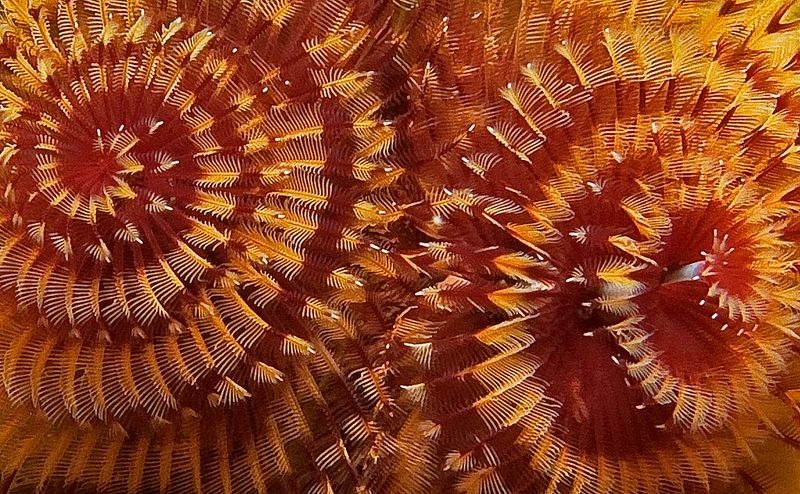
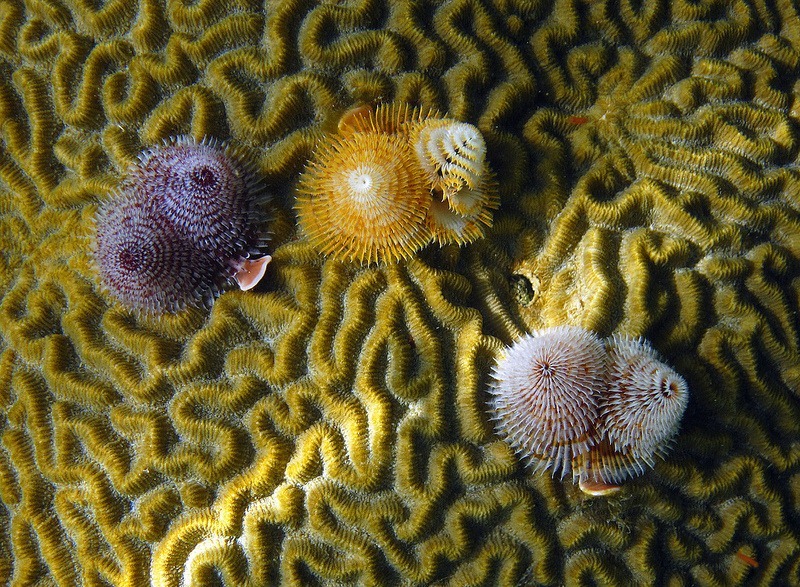
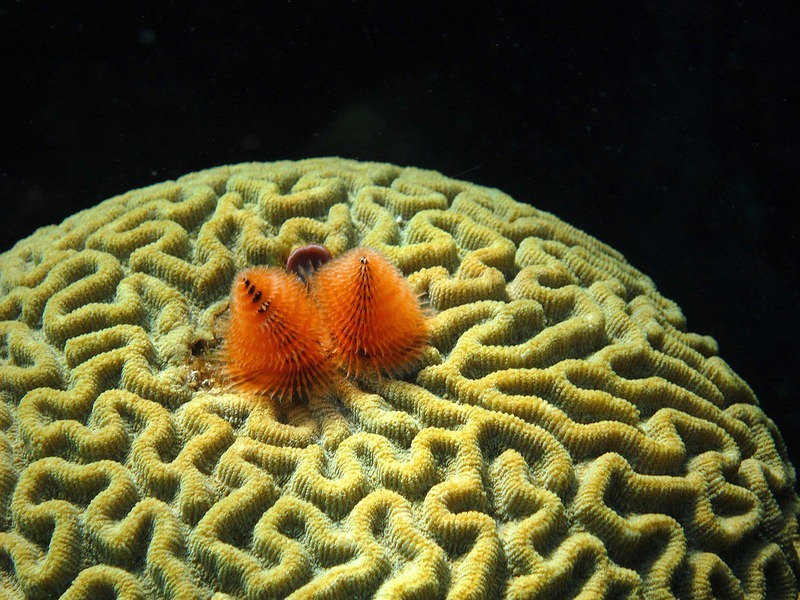
The Christmas Tree Worm ….!!!

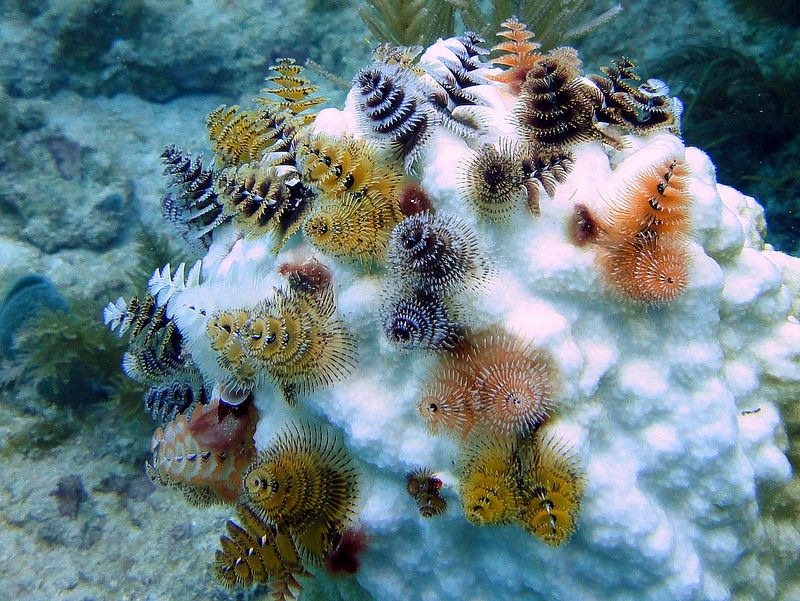
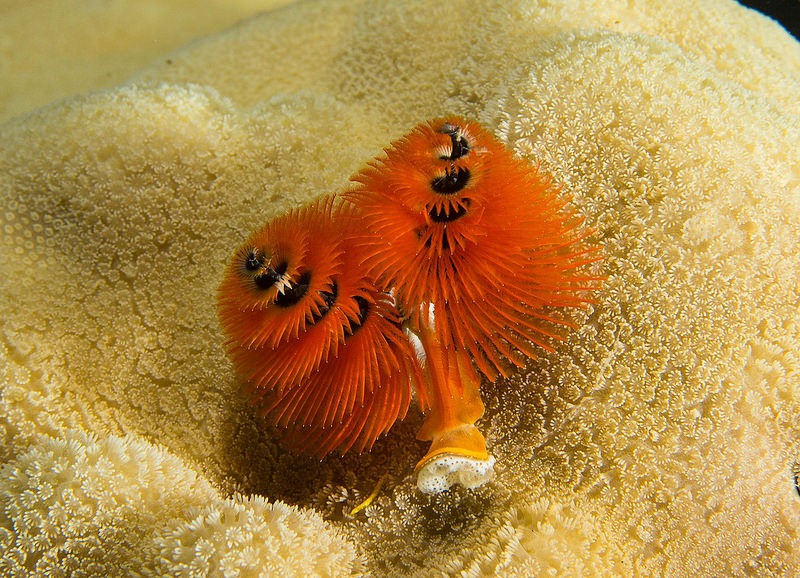
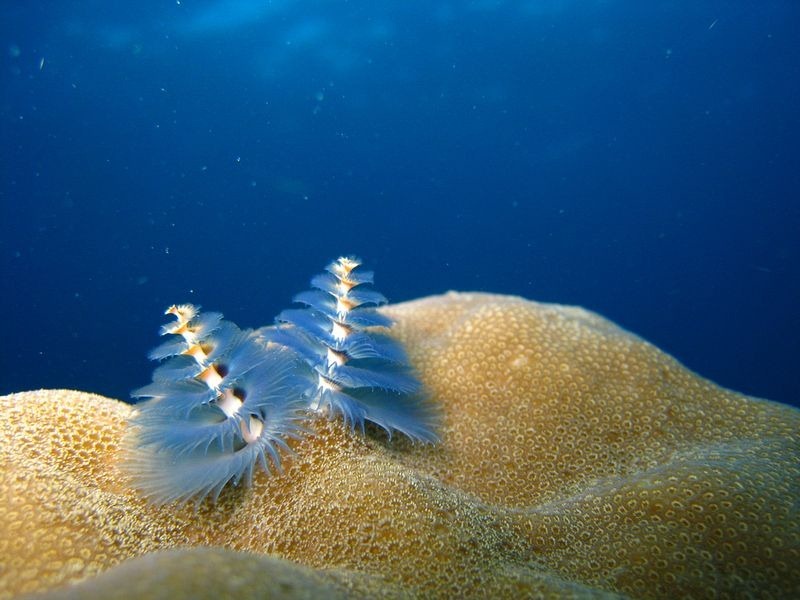
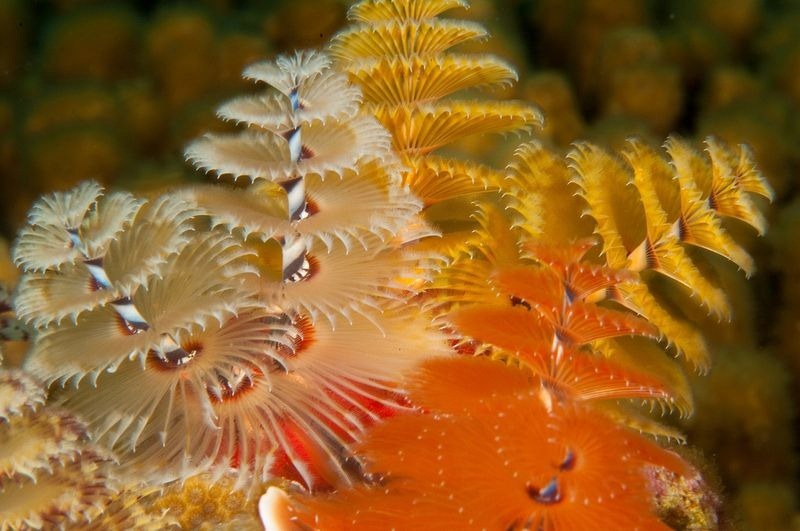
Scientifically that are called spirobranchus giganteus, but they are better known by their colloquial name — Christmas tree worm. The worm is so called not because they feed on fig trees but because they look like them.

The spirobranchus giganteus live in the ocean and sports two magnificent spirals of plumes that protrude from its tube-like body and which look like tiny Christmas trees. These plumes are composed of hair-like appendages called radioles that radiate from the worm’s central spine, and help the animal to grab food, which typically consists of microscopic plants, or phytoplankton, floating in the water. The plumes are also used for respiration. Measuring less than 4 cm in height, they come in many colors including orange, yellow, blue, and white and, are easily spotted due to their shape, beauty, and color.

christmas-tree-worm-9

Photo credit: Matt Kieffer/Flickr


The Christmas tree worm doesn’t like to move about much. Once they find a good place on a live calcareous coral, they burrow a hole and live their for the rest of their lives, occasionally emerging from their home to catch passing plankton with their fully extended plumes. They are very sensitive to disturbances and will rapidly retract into their burrows at the slightest touch or passing shadow.

christmas-tree-worm-10

christmas-tree-worm-1

christmas-tree-worm-3

christmas-tree-worm-6

christmas-tree-worm-7

christmas-tree-worm-8

Photo credit: Doug Finney/Flickr

Sources: NOAA / Marine Bio via My Modern Met

Source….www.amusingplanet.com

Natarajan


Image of the Day…”Zinnia Flowers @ International Space Station…”

Zinnia Flowers Starting to Grow on the International Space Station

Zinnia flowers are starting to grow in the International Space Station's Veggie facility

Zinnia flowers are starting to grow in the International Space Station’s Veggie facility as part of the VEG-01 investigation. Veggie provides lighting and nutrient supply for plants in the form of a low-cost growth chamber and planting “pillows” to provide nutrients for the root system. These plants appear larger than their ground-based counterparts and scientists expect buds to form on the larger plants soon.

The Veggie facility supports a variety of plant species that can be cultivated for educational outreach, fresh food and even recreation for crew members on long-duration missions. Previously, the facility has grown lettuce — which was consumed by the crew earlier this year — and now investigators are attempting to grow Zinnia flowers. Understanding how flowering plants grow in microgravity can be applied to growing other edible flowering plants, such as tomatoes.

Image Credit: NASA

” If the world looks at me and says, you can do nothing,’ I look back at the world and say ‘I can do anything’.”

Srikanth Bolla (pictured below) is standing tall living by his conviction that if the “world looks at me and says, ‘Srikanth, you can do nothing,’ I look back at the world and say ‘I can do anything’.”


Srikanth Bolla

When he was born, neighbours in the village suggested that his parents smother him.

It was better than the pain they would have to go through their lifetime, some said.

He is a “useless” baby without eyes… being born blind is a sin, others added.

Twenty-three years later, Srikanth Bolla is standing tall living by his conviction that if the “world looks at me and says, ‘Srikanth, you can do nothing,’ I look back at the world and say ‘I can do anything’.”

Srikanth is the CEO of Hyderabad-based Bollant Industries, an organisation that employs uneducated disabled employees to manufacture eco-friendly, disposable consumer packaging solutions, which is worth Rs 50 crores.

He considers himself the luckiest man alive, not because he is now a millionaire, but because his uneducated parents, who earned Rs 20,000 a year, did not heed any of the ‘advice’ they received and raised him with love and affection.

“They are the richest people I know,” says Srikanth.

Underdog success story

What is it about stories like Srikanth’s that so inspire and fill one with hope?

Could it be the multiple zeroes after a dollar sign or the belief that you and I can achieve similar success if we set our minds and hearts to it?

Underdog success stories touch a raw nerve. After all, everyone faces adversity, they dream, and they work hard.

It is another matter that only a few cross the threshold of limits set by society.

In Srikanth’s case, it is his sheer tenacity that shines through the dark clouds of his misfortune.

Being born blind was just one part of the story. He was also born poor. And you know what that means in a society like ours.

In school, he was pushed to the back bench and not allowed to play.

The little village school had no way of knowing what inclusion meant.

When he wanted to take up science after his class X, he was denied the option because of his disability.

All of 18, Srikanth not only fought the system but went on to become the first international blind student to be admitted to the prestigious Massachusetts Institute of Technology (MIT) in the US.

As author Paulo Coelho says, “We warriors of light must be prepared to have patience in difficult times and to know the Universe is conspiring in our favour, even though we may not understand how.”

Today, Srikanth has four production plants, one each in Hubli (Karnataka) and Nizamabad (Telangana), and two in Hyderabad (Telangana). Another plant, which will be one hundred percent solar

operated, is coming up in Sri City, an integrated business city in Andhra Pradesh, 55 kms from Chennai.

Angel investor Ravi Mantha, who met Srikanth about two years ago, was so impressed with his business acumen and vision for his company that he not only decided to mentor him but also invested in Srikanth’s company.

It was a small, tin-roof shack in an industrial area near Hyderabad. There were eight employees and three machines under the shed. I expected him to talk about how he wanted to make a social impact, but was surprised by the business clarity and technical knowhow in someone so young,” Ravi says.

They are raising $2-million (around Rs 13 crores) in funding and have already raised Rs 9 crores.

According to Ravi, his personal goal is to “take the company to IPO.”

A vision to build a sustainable company with a workforce comprising 70 percent people with disability is no mean task.

“Srikanth’s vision is inbuilt in the company. It is not just a lip service to CSR,” adds Ravi.

Isolation a big curse

“The isolation of differently-abled people starts at birth,” Srikanth said in his first public speech on the INKTalks stage in Mumbai last month. According to him, “Compassion is a way of showing someone to live; to give someone an opportunity to thrive and make them rich. Richness does not come from money, it comes from happiness.”

When Srikanth was growing up, his father, a farmer, would take him to the fields but the little boy couldn’t be of any help.

His father then decided that he might as well study.

“In my parent’s entrepreneurship model, I was a failure. In entrepreneurship, we have a lean business model where we evaluate an enterprise and say how quickly it fails.”

Since the nearest school in his village was five kilometres away, he had to make his way there mostly on foot. He did this for two years.

“No one acknowledged my presence. I was put in the last bench. I could not participate in the PT class.

That was the time in my life I thought I was the poorest child in the world. It was not because of lack of money but because of loneliness.”

When his father realised that the child was not learning anything, he admitted Srikanth to a special needs school in Hyderabad.

The boy thrived in the compassion he was shown there. He not only learnt to play chess and cricket but excelled in them. He topped his class, even embracing an opportunity to work with late President Dr APJ Abdul Kalam in the Lead India project.

But none of this mattered much because Srikanth was denied admission to the science stream in class XI.

He cleared the Andhra Pradesh class X state board exams with over 90 percent marks, but the board said he could only take Arts subjects after that.

“Was it because I was born blind? No. I was made blind by the perceptions of the people.”

Having been denied the opportunity, Srikanth decided to fight for it.

“I sued the government and fought for six months. In the end, I got a government order that said I could take the science subjects but at my ‘own risk’. ”

Thus not ‘risking’ anything to chance, Srikanth did whatever he could to prove them wrong.

He got all the textbooks converted to audio books, worked day and night to complete the course and managed to secure 98 percent in the XII board exams.

Fortune favours the brave

Sometimes, life mimics a steeplechase. Especially when it comes to those it has big plans for.

It did not give Srikanth enough time to bask in his victory when it threw another spanner in the works. He applied for IIT, BITSPilani, and other top engineering colleges, but did not get a hall ticket.

Instead, “I got a letter saying ‘you are blind, hence you are not allowed to apply for competitive exams.’ If IIT did not want me, I did not want IIT either. How long can you fight?”

He chose his battles carefully and did his homework searching the Internet to find the best engineering programme for someone like himself. He applied to schools in the US and got into the top four — MIT, Stanford, Berkeley, and Carnegie Mellon.

He went to MIT (with a scholarship) as the first international blind student in the school’s history.

It wasn’t easy adjusting to life there, but by and by he started to do well.

Towards the end of his bachelor’s course when the ‘what next’ question came up, it brought him back to where he had started.

“Many questions bothered me. Why should a disabled child be pushed to the back row in the class? Why should the 10 percent of the disabled population of India be left out of the Indian economy?

Why can’t they make a living like everyone else with dignity?”

He decided to give up the ‘golden’ opportunity in corporate America and came back to India in search of answers to his questions. He set up a support service platform to rehabilitate, nurture and integrate differently-abled people in society.

“We helped about 3000 students in acquiring an education and vocational rehabilitation. But then I thought what about their employment? So I built this company and now employ 150 differently-abled people.”

Good always rebounds

Entrepreneur bravehearts like the warriors of Paulo Coelho always find one unflinching support, an anchor to keep them afloat. In Srikanth’s case, it is his co-founder Swarnalatha.

“She was his special needs teacher in school. She has been his mentor and guide through all these years. She trains all the employees with disabilities at Bollant thereby creating a strong community where they feel valued,” says Ravi, adding, “Srikanth is a true source of my inspiration. He is not only my young friend and protégé but is also my mentor who teaches me daily that anything is possible if you set your mind to it.”

The boy who was born blind is today showing many the path to real happiness.

He says his three most important life lessons are: “Show compassion and make people rich. Include people in your life and remove loneliness, and lastly, do something good; it will come back to you.”

Lead image: Kind courtesy INKTalks

source….Dipti Nair in http://www.rediff.com

Natarajan”

” Pouring Hot Tea At -40C Near The Arctic Circle During Sunset…” !!!

Science tells us that hot water turns into a cloud of ice crystals when tossed at subzero temperatures, but Ontario based photographer Michael Davies managed capture this phenomenon on camera. This past Sunday, just 20km south of the Arctic Circle, Davies took these incredible photos of his friend Markus hurling hot tea in -40°C weather.

“Prepared with multiple thermoses filled with tea, we began tossing the water and shooting,” Davies told Huff Post. “Nothing of this shot was to chance, I followed the temperature, watched for calm wind, and planned the shot and set it up. Even the sun in the middle of the spray was something I was hoping for, even though it’s impossible to control.”

More info: michaelhdavies.com | Flickr (h/t: huffpost, colossal)

“Prepared with multiple thermoses filled with tea, we began tossing the water and shooting”

tossed-tea-arctic-photo-michael-davies-2

“Nothing of this shot was to chance, I followed the temperature, watched for calm wind, and planned the shot and set it up.”

tossed-tea-arctic-photo-michael-davies-9

“Even the sun in the middle of the spray was something I was hoping for, even though it’s impossible to control”

tossed-tea-arctic-photo-michael-davies-1

Source….www.boredpanda.com

Natarajan

Message for the Day…” Learn to live in love and harmony with all the members of your society. “

Sathya Sai Baba

Embodiments of Divine Love! Wherever you may be, never give room for any differences. Everyone must get rid of all selfishness, self-interest and self-centeredness. Mutual regard (Mamatha), equipoise (Samatha) and forbearance (kshamatha) are basic qualities necessary for every human being. Hence develop love, forbearance and compassion. Realise that love is present in everyone. Get rid of all differences and adhere to your faith and traditions. Learn to live in love and harmony with all the members of your society. When differences of all kinds are given up, love will grow in you and you can have a direct vision of God. Without love, verbal prayers are of no avail. Divine love is the only unifier, motivator and harbinger of joy to everyone. God is love and God can be realised only through love. All saints and religions have emphasized the greatness of love, truth, sacrifice and unity. Therefore cultivate love.


They Say the Blind Should Not Lead the Blind. She Proves Them Wrong…..

She could not walk alone herself once. She now helps others walk. Meet Tiffany, the woman with visual disability who has a vision beyond the ordinary.

“What does it mean when people say I cannot walk by myself, I cannot travel by myself? I have a mouth to talk, I have a brain to think, I can walk, and I have a cane to find my way around. Then why can I not travel by myself? I was like a bird in a cage, not allowed to come out without an escort. But now my life has been transformed,” these words and thoughts just tumble out of an excited Tiffany Brar.

The “whys” and “why nots” that once plagued her are now helping her change the lives of other blind people. She is on a journey from complete dependency and is well on the road of independence.

Tiffany is a 26-year-old teacher, entrepreneur, motivational speaker, and she is blind. Being blind is the last piece of information you need about her because she has created many more powerful identities for herself.

Tiffany created these identities by transgressing the conventions of how the life of a blind girl should be.

Blind people walking

Earlier, she was not trusted with the ability to take care of herself and her personal needs. She never travelled by herself. She did not even know that the ‘white cane’ existed. Tiffany’s life, until she was 18, was like that of a typical, totally dependent blind person in India. But it had to change.

As far back as Tiffany can remember, she has been blind. Born into an army family, Tiffany was schooled across India — Darjeeling, Delhi, Thiruvananthapuram, and Wellington — accommodating her father’s postings. While her father, General Brar, was busy at his demanding job, it was her mother, Leslie, who was Tiffany’s backbone. She was a gentle, caring woman who strongly influenced the little girl’s early life. Leslie always felt for the poor and went out of her way to help the needy. And this gentleness is what she left with Tiffany before succumbing to a fatal illness.

Tiffany was all of 12 years when her mother passed away. Those were tough times and Tiffany had to gather her courage and learn to live life by herself. Her father was posted in Delhi but Tiffany found herself completely out of place in the big city. She loved a simple life and the high society buzz in Delhi did not settle well with her. Tiffany went back to Thiruvananthapuram, a place very close to her heart and where she lives today, to continue her schooling until 11th standard. The final year of her schooling was in Wellington, a place that gave her the strongest support in her life, Vinita Akka.

Vinita Akka was the domestic help at Tiffany’s hostel. Vinita Akka affectionately took care of Tiffany, taught her how to dress up, fold clothes, make her bed, and do all those seemingly ordinary things that we do in our daily lives.

Blind people walking

Neither the regular schools, nor the blind schools that Tiffany went to, had bothered to teach her how to handle these basic needs. She recalls that sometimes she and other blind children even wore their clothes inside out. They cared little about their physical appearance. When Vinita Akka began to take an interest in Tiffany, the seeds for change were sown. Tiffany started dressing well and began to learn to manage her day-to-day activities on her own. She persistently trained herself to change her mannerisms as well. Yet, there were many more miles to cross on the road to independence.

Tiffany could not go anywhere alone. She was always escorted by someone. The words “impossible” and “you can’t do it” continually echoed from the people around her. But Tiffany was determined that this would not continue. By the time she got a chance to break free and discover herself, she had spent 18 years of her life like this.

After completing her schooling at Wellington, Tiffany moved to Thiruvananthapuram to pursue her Bachelors in English, along with Vinita Akka who was by now like a mother to her. It was here that her life changed. Her father once took her to the Kanthari Center in Thiruvananthapuram, an organization that provides leadership training for individuals who are inclined to bring about social change. Tiffany held her father’s hand and started walking towards the Kanthari office that was under construction. That’s when Sabriye Tenberken, the co-founder of Kanthari, handed a white cane to Tiffany and urged her to walk on her own.

Her father immediately shouted, “No, you cannot walk alone here. There’s rubble and debris all around. You will fall.”

Something inside Tiffany made her push aside her father’s hand, raise her own hands and grab the white cane, unheeding of the anxious voice of her father.

She started tapping her way to the office. These taps of the white cane became the most liberating experience for Tiffany — she now knew she wanted to walk free.

Blind people walking

Picture for representation only. Source: Wikimedia

Tiffany joined Kanthari as a receptionist and went on to do an entrepreneurship course at the organization. By now she was travelling all by herself. She found her way on the public roads and transport, which she otherwise wouldn’t ever have traversed without constant help. She took buses to go around the city and uninhibitedly asked people for help to cross the roads. By now, she had many friends who she would meet on her daily commute, who looked up to her with pride.

Once Tiffany felt that she was living like any other person, she wanted many like her to experience this joy. She found the inspiration to serve in Sabriye Tenberken and her husband Paul Kronenberg, the co-founders of Kanthari. Sabriye was herself blind but had made an extraordinary effort to come out of her own limitations to help other blind people.

Sabriye and her husband founded the first blind school in Tibet and also founded Braille without Borders, an organization that helps the blind to take charge of their own lives.

Blind people walking

Braille without Borders

Source: Facebook

Tiffany recognized that, like them, she too could bring about a change in the lives of the blind.

To equip herself better, she decided to pursue a B.Ed. in Special Education from Sri Ramakrishna Mission Vidyalaya in Coimbatore. Given her own experience, she knew how other blind people were afraid to come out of their protected zones. They lacked mobility, confidence and the necessary life skills to accomplish this on their own. According to the 2001 census survey, there were 400,000 blind people in the state of Kerala.

“Where were all these blind people? Why didn’t we see them walking on our roads? I decided I must be the one to make a difference,” says Tiffany, who was, in 2012, well equipped with her education to start her project ‘Jyothirgamaya.’

Jyothirgamaya, which means ‘from darkness to light,’ is a mobile blind school that is based on the idea that if blind people cannot go to school, let the school go to the blind.

VI

Picture for representation only. Source: J P Davidson/Flickr

The idea was the brainchild of N. Krishnaswamy, a retired police officer from Tamil Nadu, and the first of its kind in the state of Kerala.

Through Jyothirgamaya, Tiffany and her team visit the homes of many blind people in Thiruvananthapuram. They teach them Braille, computers, personal grooming, and other life skills. They are taught to use the white cane and become mobile. Jyothirgamaya organizes camps across Kerala to mobilize the blind. It also organises outdoor activities, city tours and introduces new and unfamiliar activities.

Tiffany is just 26 and has a lifetime of service ahead that she’s prepared for.

“I envision a society without any physical or psychological barriers towards the blind – a barrier free environment where the blind can walk freely, can travel, can work, think for themselves, and live proud and dignified lives like other citizens. Society thinks that we can only sing sweet songs, only become teachers and telephone operators in the bank. But we can do more. We can dance, we can fire juggle, we can do martial arts, we can become managers and directors of companies. But society is constantly interpreting what we can do and what we can’t. This has to change very soon,” says a spirited Tiffany.

She is a woman with a vision beyond the ordinary.

About the author: Ranjini Sivaswamy is a freelance writer and one of the first team members of The Better India. She comes from a mass communication background and is currently a consultant with IIM Bangalore.

Source…..Ranjini Sivaswany in http://www.the betterindia.com

Natarajan

” The son of a coolie who became a doctor and delivers girl children free of cost…

Dr Ganesh Rakh has delivered 436 baby girls free of charge. The son of a coolie and housemaid, he wanted to be a wrestler as a child, but his mother encouraged him to study hard and get a proper job.

The doctor wants to change the mindset of a ‘boy-obsessed’ society. A Ganesh Nadar/Rediff.com spoke to the doctor with a heart.

When I was a child I wanted to become a wrestler. My father was a coolie and my mother used to work as a housemaid washing people’s vessels in their home.

My mother said that if I became a wrestler I would eat up all the food in the house and there would be no food left for others. She also said that I would end up as a coolie like my father. Instead I should study and get a proper job.

I studied and became a doctor.

I have been a doctor for the past 15 years. In the early days I used to treat patients in their homes in the day and work in a private hospital in the night. Even when I was in college, I used to work the night shift in hospitals.

In 2007, I started the Medicare hospital. For the last four years we have not charged a fee when a girl child is born in this hospital. We have delivered 436 girl children through this scheme.

Dr Ganesh Rakh with a new-born baby girl

When a new-born girl child needs intensive care, we provide that too without charge.

Parents are obsessed with boys. They come to me and say they want a boy. I tell them ‘God decides.’ They don’t realise that doctors cannot do anything about the sex of the baby. They go to babas (godmen).

Pregnant mothers are so tense because relatives say give us a baby boy. In the delivery room if it is a boy they forget all the pain. If it’s a girl they start crying about the pain. Relatives celebrate when it is a boy; they ignore the mother if it is a girl.

When its time to pay the hospital bill, they will happily pay if it is a boy but grumble if it’s a girl. So I decided to celebrate the girl child and not charge for the delivery.

When a girl child is born we distribute cakes and sweets to all the patients in the hospital.

Celebrating with mothers who have delivered baby girls

IMAGE: Mothers cut a cake to celebrate the birth of their daughters at Dr Rakh’s hospital. This is a ritual each time a girl child is born. Photographs: Kind courtesy Dr Ganesh Rakh

What is surprising is even when it is the first child, they want a boy. Even literate and rich people want a boy first. They feel that if they have a boy first they don’t have to worry about later children.

A few patients who deliver girls insist on paying. We tell them to give that money to other girl children born in our hospital who need the money.

A few twins have been born in our hospital. When both are girls we don’t charge anything. If one baby is a boy, we charge 50%.

We charges are Rs 10,000 for a normal delivery and Rs 25,000 for a Caesarean section.

When a girl child is born, we make the mother cut a cake. We distribute the cake and sweets to all the patients and relatives in the hospital. We also give bouquets to the mother and close relatives. We spend about Rs 2,000 per child on this.

This is a 50 bed hospital. There are 35 people working here, which includes doctors and support staff. I personally work very hard. We don’t have too much money to pay the extra staff. For the last six months, I have been doing night duty here.

I don’t know whether it is because of the free for girl child scheme or otherwise, but lots of deliveries are happening in our hospital. Sometimes 5 children are born here in one day.

When a patient asks us what baby she will deliver, we always say it will be a girl.

Save the Girl campaign

Volunteers at a campaign to save the girl child. Dr Rakh says every doctor should deliver one girl free of charge at least once a month.

I know the national sex ratio is 914 females to 1,000 males. Only if everyone starts working like me can we make a difference to this. I cannot alone make a difference.

Everyone should celebrate a girl child. Celebrate your own girl child and automatically you will respect all girls. Crime against girls will decline. Crime starts in the mind.

Several panchayat leaders call me to speak in their villages. I go there as part of our campaign to ‘Save the girl child.’

I have met many doctors and told them not to charge for the delivery of a girl child, at least one a month. I encourage them and so far 6,000 doctors have supported me.

If every doctor in the country delivers one girl child free, lakhs of baby girls will be benefited.

A UN report in 2012 says that a girl child up to 5 years is 75% more likely to die than a boy in India. I have experienced this first hand. We have a neo-natal intensive care unit for babies.

For boys the parents will tell us to save the child till the last minute. When it is a girl they prefer to take the child home after sometime. They don’t try their best.

I have never contacted the government, any institution or individual for donations. For government funds you have to prepare lots of documents, so I have never applied.

I am not an accountant, I am a doctor. I am not an expert in collecting funds. If it comes good, if not we will continue with the work we are doing now. We will be able to do more work if funds come, if not we will do what we are doing now.

I work for almost 17 hours a day. I see 50 to 100 patients in the out patients department every day. I have to earn enough to support my girl child campaign. All my staff work very hard. I also work the night shift so that I don’t have to pay another doctor salary.

I live with my parents, my two brothers and their wives. I have a nine year old girl.

When I want to relax I play with my daughter. I teach her wrestling too. Spending time with my family is the only way I like to relax. I take my family with me when I go out for the ‘Save the girl child’ campaign.

I don’t take a weekly holiday. The last time I took a vacation was four years ago. I went to Kerala for a week with my family.

I have seen that educated people are the same when it comes to wanting a male child. Literacy makes no difference. I have observed that in tribal areas the sex ratio is better. The mindset has to change.

Celebrating the girl child

Bouquets and sweets are distributed when a girl is born at the hospital each time. Dr Rakh wants other doctors to do the same.

For things to change, society must learn to celebrate the girl child. They must realise that a girl child is as good as a boy child. They must not differentiate.

The government is running many campaigns to save the girl child, but its focus is on government hospitals. Female foeticide happens in private hospitals. Private hospitals must be encouraged to join the save the girl child campaign.

Only 5% pregnant mothers go to government hospitals. 95% go to private hospitals. The focus should be on private hospitals and private doctors.

6,000 doctors have promised me that they will deliver one baby girl free. Some have promised to deliver 5 baby girls free. Whether they are going to do it once a month or once a year, I don’t know. But every little bit helps. What is important is that these doctors will never support female foeticide.

A Ganesh Nadar / Rediff.com

Source……www.rediff.com

Natarajan