IT hub wakes up to traffic, pollution woes…..

10,000 vehicles off the roads; 2 lakh man hours and 1 lakh litres of fuel saved

he IT industry is known for its innovative, time saving, efficient solutions for a wide variety of challenges.

Now it appears that the sector has woken up to another challenge – traffic and environmental pollution that diminishes the quality of life of its employees.

The industry in Hyderabad employs 3.5 lakh and the city is among the top-5 in the country that accounts for $100 billion worth of IT exports.

But it has just realised the pressure it’s exerting on the city traffic and the impact of the additional carbon emissions to the environment.

A survey found that about one lakh man hours are being wasted each day with employees struggling to get to the offices, negotiating tough traffic.

So, as a start, about 11,000 IT employees are now taking public buses on Thursday to get to their offices in the Hi-Tec City-Gachibowli IT Hub of Hyderabad. Thousands of others car-pool, walk or cycle to their offices as part of an initiative by HYSEA, which represents firms that export IT services worth $10 billion.

“About 40,000 litres of fuel is being wasted each day, resulting in 96 tonnes of additional emissions of carbon dioxide. The numbers are staggering considering the small area,” Ramesh Loganathan, President of HYSEA (Hyderabad Software Exporters’ Association), told BusinessLine. And what it achieved over the month is encouraging.

Benefits aplenty

Most companies in the IT corridor reported reduction of up to 20 per cent of cars. Over 10,000 motor vehicles are off the roads each Thursday. The city is free of about 273 tonnes of greenhouse gas emissions.

Enthused by the response to the Car-Free-Thursday initiative, the association is now planning to expand the scope.

It is going to ask companies to discourage staff coming in cars on Thursdays. It wants them to introduce parking fee and introduce a system of allowing cars with even or odd numbers.

The association has decided to lend its voice to the World Car Free Day that is slated to happen on September 22.

Hyderabad is among the 1,000 cities across the world that consented to join the movement.

In association with the Cyberabad police, Road Transport Corporation and other stakeholders, the HYSEA has come out with a vision document ‘Re-imagining Transport in Our Cities’.

“The idea is to promote sustainable transport and make Hyderabad a congestion-free and pollution-free smart city,” the document said.

The industry, with the help of the IT department of Telangana, is planning to develop necessary infrastructure to encourage the staff to use cycles.

“To begin with, we are asking hundreds of Car-Free-Thursday initiative volunteers to use cycle at least for a day or two to get to their offices,” Loganathan said.

Source…K.V.Kurmanath …www.thehindubusinessline.com

Natarajan

Raspberry Pi Kits for School Children in Kerala…..

Children in Kerala will enjoy high quality computer science education as the state government has taken a very useful step to ensure that both government as well as aided schools are able to provide better computer science education to the students. This, they are doing with the help of advanced technology like the Raspberry Pi kits for children. Here’s more.

The Kerala government has launched two school-projects with the aim of teaching basic computer science to students in a better manner.

These are the ‘Learn to Code’ project, which is in the second phase of execution, and the ‘Electronics@School’ project which was launched this Saturday.

Photo Credit: Esme Vos/Flickr

The ‘Learn to Code‘ project was launched in February by the Chief Minister Oommen Chandy. In the pilot phase of the project, 2,500 selected students of class eight were given Raspberry Pi kits and were trained in programming by IT experts.

The Raspberry Pi is a computer developed by an UK-based firm to help in the teaching basic computer science at schools.

It is a low cost, credit card sized computer, which gets plugged into a display unit (like a monitor or TV), and uses a simple keyboard and mouse for operation.

raspi

Photo Credit: Clive Darra/Flickr

It performs the basic functions of a desktop and can be used for things like word processing, playing games and watching videos. It can also be used for internet surfing besides helping children learn programming in languages like Scratch and Python. Each kit costs Rs. 4,324 and includes a Raspberry Pi B+ board, enclosure, 8GB SD card, HDMI cable, HDMI-to-VGA cable, USB keyboard and USB mouse.

The project is being implemented by the Technopark Technology Business Incubator (TTBI) in association with Kerala’s IT@School project, and Kochi-based mobile internet technology incubator Startup Village. The complete project aims to distribute 10,000 kits to selected students annually, and that will be followed by training and mentorship sessions.

“We require skilled employees for India to become a manufacturing powerhouse, who can build products for industries such as electronics and ICT. To build these products, we need excellent coders and they are the key to building startups which will turn into billion dollar companies,” IT Principal Secretary P.H. Kurian said.

During the inauguration of the ‘Electronics@School’ project, the Chief Minister said that 10,000 students will be selected on the basis of merit and they will get the Raspberry Pi kits. Other than that, the government will take steps to provide these kits to every government and aided school to help in common coding practice. The second phase of the project was flagged off with the distribution of these kits to 7,500 schoolchildren.

Under Electronics@School project, kits for hands-on training in basic electronics will be provided to selected children. The kit is based on the simple concept of puzzle solving that helps students understand electronics through a trial and error method. Thus, children can make simple electronic items.

“This year government will distribute 6,000 Electronics kit to various Schools across the State. The Electronics Kit is aligned with the Physics curriculum of classes 9 and 10”, said state Minister for IT and Industries P K Kunhalikkutty.

A coding competition was also conducted in the first stage of the ‘Learn to Code’ project; the awards for which was given during the inauguration. The Education Minister PK Abdu Rabb also said that both the ‘Learn to Code’ and ‘Electronics@School’ projects would be made part of the curriculum.

The Raspberry Pi kit distribution is the first such project in India and currently the only state-sponsored programme of its kind in the world.

Source…..Tanaya Singh…..www.the betterindia.com

Natarajan

100 Families in This Village Bring in Just One Ganpati Idol for Celebrations Since 55 Years…

In these days of increasing water pollution due to the large number of Ganpati idols used during Ganesh Chaturthi celebrations every year, there is one village that is setting a brilliant example of how the festival can be celebrated the eco-friendly way.

The residents of Agroli village in Navi Mumbai have been practicing a very unique tradition since the past 55 years.

Ganesh Chaturthi celebrations in this village are marked by an extraordinary rule that every family abides by, and is happy to follow. They celebrate the festival with the concept of ‘One village, one Ganpati’.

Thus, in a village of about a hundred families, only one common Ganpati idol is brought in, and the festival is celebrated by one and all.

agroli

Picture for representation only. Credit: Manil Gupta/Flickr

The villagers hence contribute to the betterment of the environment in their own way as they reduce the number of idols used during the festival from 100 to just one. The ‘One village, one Ganpati‘ concept was initiated in 1961 by a villager named Bhau Sakharam Patil. Since then, this custom is being followed under the leadership of Agroli Sarvajanik Ganeshotsav Mandal formed by the villagers.

Prior to this idea, every house in the village used to bring in an idol of their own. To fulfil the religious practices, some families even had to take large loans from landlords living in the nearby villages. Most of them were unable to repay the loan, or had to undergo several difficulties to pay it back. Thus, Bhau Sakharam Patil, the leader of salt workers in the villages, decided to start community celebrations to cut the unnecessary expenditure during the festive season.

What started with the simple mission of saving money, has now turned into a major eco-friendly initiative, and is successfully propagating the Swachh Bharat mission.

“Imbibing Lokmanya Tilak’s teachings of social get-togethers, we have continued the practice in the true Indian spirit,” said Datta Kambotkar, a member of the mandal, to the Times of India.

Thus, every family chips in with a sum of Rs. 500-700 and they participate in the prayers together. The celebrations include five days of cultural events in which local kids get a chance to showcase their talent. This is followed by devotional programs till the tenth day of the festival, and villagers of different caste and creed also join in.

 Source….Tanaya Singh …www.the better india.com

Natarajan

How 32 Youth Groups Are Fighting Hunger in Rural West Bengal …….

Youngsters in 32 villages of Ghoshergram and Jhunjkagram panchayats in Bankura district of West Bengal have formed groups that spread awareness on issues related to health, education and development in amazing ways.

Kshama Mondal, 19, of Housibad village, which falls under Jhunjka gram panchayat in Chhatna block of Bankura district, West Bengal, enjoys learning new facts related to the food and nutritional needs of her people and then putting this important information to practice. From being an active participant in the nutrition camps that are organised regularly in her village, Kshama has moved on to encouraging others. As a member of the Hosibad Naba Tarun Taruni Dal, a youth group in her village, she is involved in creating awareness on nutrition, health, education and development. Encouraging this process are the activists of the Kolkata-based non-government organisation, Development Research Communication and Services Centre (DRCSC).

Currently, 32 youth groups, comprising 10-15 members, have been set up in Ghosher and Jhunjka gram panchayats, covering 32 villages of Chhatna block. Over 50 per cent of the members are girls like Kshama. –

Youngsters in 32 villages of Ghoshergram and Jhunjkagram panchayats in Bankura district of West Bengal have formed groups that spread awareness on issues related to health, education and development. (Credit: DRCSC\WFS)

Youngsters in 32 villages of Ghoshergram and Jhunjkagram panchayats in Bankura district of West Bengal have formed groups that spread awareness on issues related to health, education and development. (Credit: DRCSC\WFS) Anirban Banerjee of DRCSC, shares, “We partnered with Welthungerhilfe of Germany to implement the Fight Hunger First Initiative (FHFI) in the rural areas of West Bengal. Food security, income security and education security form the focus of this programme. We realized that to ensure sustainable progress in all three areas, it was imperative to involve the youth, which is why we are reaching out to youngsters between 12 and 22 years.”

He believes that not only will young people be able to mobilise and motivate their family and friends but eventually, as adults, they will also be in a position to sustain the movement to ensure a far reaching impact.

One group has been constituted in each village and they have been trained to function independently.

Suryakanta Das of DRCSC’s Education Team, elaborates, “The groups are involved in creating awareness and monitoring Integrated Child Development Service (ICDS) and mid-day meals. Besides this, they conduct workshops and discussions on nutrition, check on the implementation of the Mahatma Gandhi National Rural Employment Guarantee Act (MGNREGA) and even keep an eye on the workings of the school management committee or the village education committee for the proper implementation of the Right to Education Act.”

Kshama looks forward to being with her group as their joint activities help them form a bond with the community.

Girl youth club members explain the Infant Young and Child Feeding (IYCF) cards to the pregnant women and lactating mothers in their villages. (Credit: DRCSC\WFS)

“I like explaining the Infant Young and Child Feeding (IYCF) cards to the pregnant women and lactating mothers. It feels nice to be in a position to help and guide them towards better health,” says the teenager.

Her group even conducts workshops where the nutritional value of different leaves, fruits, grains that are available in the area is explained and the local women taught to cook nutritious meals. “For us young girls these are important learnings for life,” she smiles.

Another way in which the youth groups put forth their messages is through street plays.

“We write and stage the street plays on themes like basic hygiene, hand-washing, healthy diet and good food habits. We also emphasise the importance of taking children for timely check-ups to the primary health centre,” elaborates Amita Roy, 15, of the Bortor Ashar Alo group from Bortor village under Ghosher gram panchayat.

Commemorative occasions like World Water Day, World Climate Day, World Health Day, Global Family Day, Earth Day, and so on, are observed in Bortor village with rallies and plays. The youngsters now even act as the bridge between the school and the community, calling for meetings between parents and the school management or village education committees so that the local community’s Right to Education is realised.

However, it is their green fingers that are truly inspiring. Ten groups have created gardens on the premises of 11 primary schools as well as two ICDS centres, all of them managed and maintained by the enthusiastic members themselves.

To get to know the local topography better, the groups draw up a village profile map, clearly demarcating the agricultural land, fallow land, ponds, rivers, forest, and so on.

Ten youth clubs in the region have created gardens on the premises of 11 primary schools as well as two ICDS centres, all of them managed by the young members. (Credit: DRCSC\WFS)

“While its mostly the boys who participate in this activity, there are some girls too who take part, especially those interested in mapping, topography, resource management,” remarks Sarla Tudu, 16, of Dharam Mandoya group from the tribal village of Kendua under Jhunjka gram panchayat.

At the Siuli Pahari Primary school, a wonderful green patch is being cared for by the Siuli Pahari Nabajiban Dal.

Kakoli Mal, 13, a group member and a secondary school student, elaborates, “We have pitched in to create this school garden, utilising whatever area was available for the purpose. The students help us out by watering the plants or doing the weeding, but the hard work of planting and manuring is done by us. We have planted a variety of vegetables, tubers, leafy vegetables and this produce is used to prepare healthier mid-day meals.”

Those involved in managing the school gardens hold weekly classes on natural resource management and talk to students about their local environment and the ecology as well. The merit of using organic fertilisers, such as vermi-compost or compost and liquid manure, is widely known these days.

“For the youth, participating in such group initiatives has many advantages. It provides practical learnings related to environmental education, which is a part of their syllabus in school. Apart from this it prepares the ground for them to become eligible for the work-for-pay schemes of the panchayat, like doing surveys, once they turn 18. Many of the youth in the 18-22 age group, who are part of the initiative, have become vocal participants in the gram sabha meetings and have the potential to be community leaders. They have realised that knowledge is power,” observes Das.

One successful youth leader who has emerged through this intervention is Laltu Gorai, 21, who has been elected the Upa-Panchayat Pradhan of Benagoria village that falls under the Ghosher gram panchayat. Laltu has been able to better facilitate the implementation of schemes like the MGNREGA because of his broader awareness and community experience thanks to the experience he gained during his work for the local youth group.

There have been numerous multiplier effects of this intervention. Currently, youngsters from within the community are motivated to come forward and work together to bring about positive changes in their lives – be it related to their health, education or employment. The trust factor is high and the bonding strong, which only brightens the chances of this transformation being sustained in the coming years, too.

Written by Ajitha Menon for Women’s Feature Service (WFS) and republished here in arrangement with WFS. –   in http://www.thebetterindia.com

Natarajan

At the Age 64 , She adopted her First Orphan…

Thousands of orphaned children in India never find loving homes because the authorities take too long to declare them ‘free for adoption.’ Prabhavati Muthal, 79 years old and mother of two adopted orphans herself, has been fighting to get justice for these children all her life. We appeal to all our readers to support her by signing her petition.

“We are guilty of many errors and many faults, but our worst crime is abandoning the children, neglecting the fountain of life. Many of the things we need can wait. The child cannot. Right now is the time his bones are being formed, his blood is being made, and his senses are being developed. To him we cannot answer ‘tomorrow,’ his name is ‘today’.”

― Gabriela Mistral

“Aai tu Aai saarkhi nahi disat, Aaji sarkhi diste. Mala ‘Mummy Papa’ hawa aahe” 

(Mom you don’t look like a mom, you look like a grandma. I want my Mummy Papa!)

Mohini often used to say this to Prof. Prabhavati Muthal. Mohini was 5-years-old now and she had heard from her schoolmates that she had not come out of her mother’s womb but from a dirty sack, and because of that, her right arm was paralyzed.

kilbil2

Photo Credit: Tawheed Manzoor/Flickr

On November 30, 1996, Prof. Prabhavati Muthal had retired and was all set to relax for the rest of her life in Chandrapur, Maharashtra, after working for 35 years as a history professor. Her son was a well-known paediatrician at the local government hospital.

There was no orphanage in the town. Thus, unwanted and orphan (mostly newborn) babies landed in Dr. Muthal’s ward. Like all government hospital wards, this too was crowded. The nursing staff were always overloaded.

On March 30, 1997, a lady sarpanch from a nearby village brought a brutally battered newborn girl to Dr. Muthal. The baby was just 3 days old. She had been tied in a gunny bag and thrown in the garbage to die. Someone had found her and informed the sarpanch.

The girl was visibly injured. Her skull was fractured. Yet, for three days, the lady sarpanch had not provided her with any treatment nor had she informed the police. Consequently, the child became critically sick, developed a high fever and started convulsing.

Even then, the lady was reluctant to let the hospital keep the child and treat her. Dr. Muthal had to threaten her and force her to admit the child to the government hospital. On seeing how serious the child’s condition was, the lady sarpanch disappeared from the scene.

For weeks, the child hovered between life and death. One usually associates government staff with impersonal and callous behaviour, but the nurses at this government hospital rallied together to save the child. One of the sisters told Dr. Muthal: “God will not forgive us if we cannot save this child.”

Due to their untiring efforts, the child survived. But the prolonged battle for life had taken its toll. She was badly emaciated and cranky due to constant pain. She had major neurologic deficit, which left her right side paralysed. Feeding and cleaning her was an ordeal.

Prof. Prabhavati Muthal willingly took over this daunting task. With her selfless love and care, the child gradually improved. As she grew healthier, a beautiful face emerged. She looked so attractive that she was called ‘Mohini.’

kilbil1

Little abandoned but inncocent infants giggling at Kilbil, not knowing their fate

Her story attracted a journalist’s attention and she became well known. Many people, including a doctor, came forward to adopt her. Suddenly, the lady sarpanch re-entered the scene and demanded custody of the child.

The custody of orphan children is decided by the JWB or Juvenile Welfare Board (the name for the Child Welfare Committee before the year 2000). To everybody’s surprise, the local JWB gave Mohini’s custody to the same sarpanch, ignoring better claimants and the lady’s past suspicious behaviour.

Alarmed, Prabhavati approached the Sessions Court. After a prolonged struggle lasting over 2 years, the Sessions Court finally overturned the JWB’s order.

Prabhavati then decided to establish an orphanage so that Mohini had a place to stay. The orphanage, called Kilbil (chirping of birds), is now 16 years old.

Prabhavati Muthal with a 1.5-year-old child who is waiting to be made free for adoption by CWC

Prabhavati Muthal with a 1.5-year-old child who is waiting to be made ‘free for adoption’ by CWC –

However, Mohini’s agony did not end here. The infuriated JWB avenged the situation by blocking her transfer to the orphanage for a year. Finally, her case was cleared by special order of the state government. The JWB continued to obstruct her rehabilitation. She was finally declared ‘free for adoption’ by the Session Court under section 7.3 of the Juvenile Justice Act after one more year.

Free For Adoption’ means that a child’s parents or guardians have relinquished their parental rights or have had them terminated in a court of law. Once this has occurred, a child is then ‘legally free’ to be adopted by another person or family member. Any orphan or abandoned or surrendered child, declared legally free for adoption by the Child Welfare Committee (CWC), is eligible for adoption.

“Most of the couples prefer small babies so that they can enjoy each milestone of the baby while growing up. If a child is not made ‘free for adoption’ soon, then mostly they don’t get adopted and lead an affectionless life,” says Prabhavati Muthal.

Unfortunately, in Mohini’s case too, all the prospective adoptive parents had given up by the time she became ‘free for adoption.’ No one was willing to wait for years and fight court battles just to adopt a physically impaired child.

When nobody came forward to adopt her for more than a year, Prabhavati decided to adopt Mohini herself and become a mother to a 4-year-old child at the age of 64. –

kilbil4

Kilbil had now become the home of many abandoned children. Vasundhara (Vasu) was one of them. Just a few days old, Vasundhara was found in one of the movie theatres of Chandrapur. She did not have one ear. Every adoptive couple wanted a beautiful and flawless child and so did not adopt Vasu. It was Vasu’s 11th year in Kilbil. She was supposed to go to a remand house for juveniles once she became 12. Prabhavati couldn’t let this child go and so, once again, she took the legal guardianship of Vasundhara.

Vasu and Mohini are sisters with the same mother now!

At the time that Prabhavati was looking to adopt Mohini, the law required that to contest a case, you must be the ‘aggrieved party.’ This means you should be affected somehow by the case — it is only then that you have the ‘locus standi,’ that is, eligibility to participate in the judicial dispute.

Prabhavati had none, but she could participate in the dispute because lawmakers then (1986 version of the Juvenile Justice Act) had wisely put in Sec 7.3, which said:

“The powers conferred on the board or juvenile court by or under this act may also be exercised by the high court and the court of session, when the proceeding comes before them in appeal, revision or otherwise.” – Juvenile Justice Act 1986. Sec. 7.3 Chapter II

The word ‘otherwise’ opened the window for any conscientious citizen to seek redress from the Sessions Court purely on merit of the case, bypassing technicalities like ‘locus standi.’ The same clause also allowed the Sessions Court to declare Mohini ‘free for adoption.’

It is vital to keep this window open for the orphans, because they have no one to look after them. The orphanages that keep the children and the parents who adopt the children are really ‘beneficiaries’ and not truly ‘aggrieved.’ They have no real stake in any individual child.

The only victim of a wrong decision (or lack of decision) is the orphan child. The child is therefore, the only truly ‘aggrieved. –

Unfortunately, this Section was deleted only for orphan babies in the newer editions of the Act. The implications are tremendous for the orphan children, because now the CWC has absolute power over orphan children. There is no effective, accessible mechanism to correct its mistakes, misdeeds and inaction. –

Please help Prabhavati make a representation to the government authorities to suitably amend the Juvenile Justice Act and include a clause like Sec. 7.3 of 1986 Juvenile Justice Act in the present Bill for orphan children by signing this petition

. Prabhavati has also penned the story of her struggle in a book titled Adhantari. This book has bagged an award from the Maharashtra government. –

kilil5

If you wish to help Prabhavati in her struggle for justice for these kids, or wish to donate for Kilbil, or want to adopt a child, please email at kilbil.mvm@gmail.com. You can buy Adhantari (the book is in Marathi) by writing to the same email address. Prof. Muthal is also looking for writers who can translate the book into English.

About the author: A mechanical engineer, Manabi Katoch has been brought up listening to Tagore’s poems and stories, so she is kind of an emotional person within. She loves writing poems and stories on social and political issues. Few of her poems can be viewed on www.poemocean.com and satires on www.mindthenews.com. She has worked with Wipro, Frankfinn and Educomp in the past.
Source………Manabi Katoch….www.the betterindia.com
Natarajan


Meet the Only Indian Woman to Participate in ‘The Most Dangerous Race in the World…..

Who wants to ride through 17 cities, over 3000 kms, in 2 weeks over bumpy roads in a flimsy vehicle? Only crazy extreme-adventure-sport-loving foreigners, right? Wrong! There’s one daring 29-year-old from Mumbai who also decided to take on the challenge. Meet Rutavi Mehta, just back from her maiden auto rickshaw race, which she finished in only 12 days.

In April, 2015, about 250 people from over 50 countries came down to India to be part of a very unique adventure sport – an auto rickshaw run. The challenge was to drive an auto rickshaw for about 3,000 kms, from Jaisalmer in Rajasthan to Shillong in Meghalaya, covering the breadth of the country in just two weeks — that’s six states and 17 cities. This feat, considered one of the most dangerous adventure sports in the world, had to be accomplished without any backup teams of mechanics, no guidance in terms of directions or any other help, in barely roadworthy vehicles that are certainly not meant to be driven long distance.

Among these 250 people, there was just one Indian participant – Rutavi Mehta.

Rutavi and her team at the finish line

Rutavi and her team at the finish line

“I had known about this adventure sport since a long time,” says Rutavi, a travel consultant by profession. “It was in 2007, when a couple of rickshaws had come down to the hotel where I was working as a marketing head earlier…that’s when I came to know about the run.”

At that time though, she hadn’t even dreamt that she would herself participate in the run one day.

Rutavi is from the hospitality industry and has backpacked through Europe in the past. As a travel consultant today, she runs her own company called Photokatha – a place where various travelers from across the country share their travel experiences. She also runs various campaigns with tourism boards of different states as a consultant. Recently, she got a chance to design and head a Kerala Blog Express campaign where 27 international bloggers traveled in different parts of Kerala to experience the culture of the state.

The Rickshaw Run is organized by a UK-based group known as ‘The Adventurists.’ The first run took place in 2006, when the contestants covered the route from Kochi in Kerala to Darjeeling in West Bengal. Since then, the sport is organized with a different route in India every six months, and there has never been a single run in which all the participants have reached the finish line.

There is no prize for winning this difficult race, which is more about giving than getting. –

The participants

The only necessary requirement for competing is that every team (usually 3 people) should raise a minimum amount of £1000 (USD 1550) for organizations that are working towards the protection of the environment. The two organizations they donated to were Cool Earth and Planeterra. Cool Earth is an environmental charity group working for the protection of rainforests and the local communities living in those areas. Planeterra is also a non-profit organization that helps empower local people to develop their communities and conserve their environment.

Rutavi was very unsure about participating in the race at first.

“A couple of my friends from the travel blogger industry were coming to India and they wanted to be a part of the run. They had already registered for it, but I was not sure,” she remembers.

Being a woman and travelling pan-India was a scary thought to begin with. Moreover, she did not know how to drive a rickshaw. But the sense of adventure, the spirit of charity, and the motivation of friends added up and she got herself registered. “I went out, borrowed a rickshaw and learned how to ride it in a few days.”

Every team in the run has a maximum of three members. Rutavi participated with her friends Derek Freal and Ryan Brown who are travel bloggers from USA — they called themselves Teen Romanchaak Yaar (three adventurous friends). The teams are required to cover a distance of 300 km each day, with one person driving for 100 km at a stretch. –

rutavi3

“In a rickshaw, 300 km is like 600 km by car, since the maximum speed is only 55 km/hr, and you don’t have any cushions to support you during the bumpy ride,” says Rutavi.

The race is an expensive one, says Rutavi. The registration fee itself is £2500, a part of which goes directly for charity. In return for the registration amount, they only get the rickshaw. Her team decided to crowd fund this fee, and with the help of friends, family, some corporate organizations and the travelling network created by all three of them, they raised enough for registration as well as for the cause even before the race had started. As for their accommodation, they partnered with different organizations and individuals.

“Since we are travel bloggers, many companies supported us. Zostel (a chain of backpackers’ hostels) came on board as the hospitality partner. In most of the cities we stayed in Zostel and we partnered with similar organizations for our stay and food in other parts,” says Rutavi.

Mountainous terrain, broken roads, unknown paths, and rivers to cross – Rutavi saw it all during the journey.

rutavi2

“I met people from so many countries and got a chance to learn about their cultures. People from Norway, Canada, some countries that I had never even heard about – I learnt how they live, about their culture, food, music, and so much more. There was also a lot of creativity going on around us. Rickshaws were decorated in many unique and brilliant ways,” she says.

But there were some very difficult spots as well. The rickshaw run is considered to be one of the most dangerous adventurous sports by many.

Rickshaw Run – Old-school Adventure Across India

Watch this video clip ….

This is because the difficult roads have to be covered on a three wheeler seven horsepower rickshaw, without any support or knowledge about the way, without any back-up or a set route. Rutavi’s team survived two accidents also. One was in Allahabad and the other one in Guwahati, just 150 km before the final destination. But she did not give up and made it to the finish line in spite of some bad injuries.

The one thing that she realised with this journey is that no matter which part of India you are in, people are very helpful. She was amazed to see how the local people turned up to help every time they needed something. If the rickshaw broke down, mechanics would help them without taking any money in return, and people would also offer food at many places. All because they were happy to see a very simple vehicle being used for a charitable cause!

Rutavi says she has travelled to 1500 destinations around the world so far. This enthusiastic wayfarer has spent months exploring Lakshadweep all on her own. She also goes to Ladakh for two months every year where she teaches kids.

rutavi4

Rutavi says that besides getting the thrill of adventure from her rickshaw run, she had one more motive for doing it:

“To empower Indian women with a ‘women can do, and will do’ attitude. People keep saying India is not safe. The aim was to show that women can travel fearlessly in India. It all starts with the realization that they can overcome any fear,” she says.

“My attitude towards rickshaw rides has also changed. Whenever I travel by rickshaws now, I talk to the drivers and tell them about my experience. Many of them can’t believe that I rode a rickshaw for such a long time,” she concludes laughing.

You can contact Rutavi at rutavi@photokatha.in

Source…..Tanaya Singh ,…..www.the betterindia .com

Natarajan


Hats off to this Lady …A Mumbai Baker Made A 35 Kg Ganesha Idol From Pure Chocolate To Feed Underprivileged Kids….

Festivals indeed occupy an important place in our lives and they bring our family and friends together. But aren’t we supposed to spread happiness and share our joy with the world too?

This year, from Spiderman to Bahubali, we stumbled upon some of the most innovative designs of Ganesha idols.

But, this wonder woman, Rintu Kalyani Rathod, chose to celebrate Ganesh Chaturthi in a totally different way.

12039352_701034069997652_2507224158049280558_n

She has her own bakery, ‘Rini Bakes – Bake my Dreams’ in Mumbai. Apparently, this wonder woman made a 38 inches tall chocolate Ganesha with 35 kg of chocolate in 50 hours.

12042774_898470626873412_116968633211130024_n

After 5 days, she has planned to immerse Ganesha in milk, feed the chocolate Ganesha to hundreds of underprivileged kids and spread happiness in the lives of those kids.

This is what this amazing lady said on her Facebook post:

“It pains me tremendously to see the way our environment is exploited in the name of devotion. I just couldn’t bare the sight on the beach after the visarjan. Drunk people dancing on the streets on vulgar film songs blaring from loud speakers is not devotion.

I am a commercial designer turned designer baker. I decided to make my idol from chocolate last year. We immersed the idol in milk and distributed the chocolate milk among the underprivileged kids prasad. 1100 people took the prasad last year. It was a 28 kg, 32 inches tall idol. Real visarjan is done by bringing smiles on the faces of little kids not by polluting our waters.

This year my idol is 35 kg and 38 inches tall. It took me 50 hours to make it. Hope to distribute prasad to many more people this time, so bappa can stay in them forever. After all, bappa’s favourite place to reside is inside us, nowhere else.”


12004699_701011136666612_118751374215903213_n

Isn’t this the perfect way to celebrate Ganesh Chaturthi? After all, happiness doesn’t result from what we get, but from what we give.

If you really believe in God, then do your bit. Be a better person and celebrate the spirit of mankind.

News Source: Facebook andShuvro Ghoshal in  www.storypick.com

Natarajan

How a farm labourer became a CEO of a Company …. An Inspiring Story…

From earning Rs 5 a day as a farm labourer to starting an IT services company that is worth Rs 1.5 crore (Rs 15 million), Jyoti Reddy’s story of success is nothing short of an inspiring movie plot.

That night she decided to break the rules.

With a few friends, whom she referred as akka, she did not return to the orphanage till way past midnight.

It was Sivaratri, the great night of Shiva, when the planets are potently aligned to embrace his cosmic dance.

After visiting the Shiva temple in their village, they decided to do something really daring — go for a movie, a blockbuster love story.

She laughs, a deep throaty laugh, which betrays a teenager’s giggles at the memory of forbidden pleasure.

Anila Jyothi Reddy has travelled very far from that night and her obscure village in Warangal in Telangana.

Her memories though are as fresh as it were yesterday.

“When we returned late in the night, we got a good thrashing from the warden. But I was so enamoured by the movie that I did not much care for the repercussion. I thought I should also marry for love,” she tells me.

Jyoti Reddy

Not all dreams come true

But fate — the eternal party spoiler — intervened.

Jyothi was married off exactly a year later at the age of 16 to a man 10 years her senior.

Love did not figure in the arrangement that her parents made for her future.

All her hopes of a better life seemed to recede like the bullock cart in the rear view mirror of a speeding highway truck.

He was a farmer who had not even passed the intermediate.

She was thus doomed to a fate of a daily farm labourer slogging the whole day in the paddy field under the blazing hot Telangana sun.

For all her efforts, Jyothi earned a meagre Rs 5 a day. She did this for five years from 1985 to 1990.

“I became a mother at 17. I had to do all the household chores and then head straight to the fields.

“I would return home at dusk and get down to making dinner.

“We did not have any stove, so I had to cook on a wood fire chulha,” she tells me over the phone from Hyderabad, where she visits at this time of the year from her home in the US.

Today, Jyothi is the CEO of a $15 million IT company, Key Software Solutions, based in Phoenix, Arizona, US.

Her incredible story seems to be the stuff of fiction conjured up by a shrewd novelist inflicting numerous sufferings on his protagonist to eventually make her a winner.

Except here, Jyothi herself altered her destiny.

Unwilling to live a life that was preordained for her, she beat all odds to emerge a winner.

A forced orphan

Jyothi’s aspirations were slowly growing wings.

“I could not stand being poor. I was born poor and was wed into another poor family,” she says.

Those days her dream was to have four plastic boxes full of daal (lentils) and rice.

“I would dream of having more than enough food to feed my children. I did not want to give them the life I was leading.”

Having been married off at the age of 16, Jyothi became a mother at 17 with her first daughter, followed by another girl a year later.

“At 18, I was a mother to two girls. There was never enough money for either medicine or to buy them toys.”

When the time came to admit them in school, she opted for Telugu medium because the fees was Rs 25 a month, while for an English medium school it was Rs 50 per month.

I could educate both my girls at Rs 50 hence I chose to send them to a Telugu medium school.”

Jyothi is the second among her four siblings.

Because of abject poverty at home, her father admitted his two daughters into an orphanage saying that they were motherless.

“I lived in an orphanage for five years from class five to class 10. Life there was tougher. My sister could not manage and would cry the whole time. My father had to take her back home.”

But Jyothi stuck on.

Even though she missed her mother and needed her the most, she finally adjusted to remaining in the orphanage.

“I remember a wealthy man would visit the orphanage every year to distribute sweets and blankets.

“I was a very sickly child then, and I would imagine myself being rich one day and carry a suitcase with 10 new saris in it,” she laughs re-imagining her dreams those days, which she was afraid to share with her hostel mates lest they made fun of her.

Nobody’s children

Jyothi makes it a point to come to India every year on August 29.

It is her birthday and she celebrates it with children in different orphanages in Warangal.

She also sponsors a mentally challenged kids’ home where there are 220 children.

She says passionately, “Two percent of India’s population comprises orphans. They do not have any identification. They are uncared for and unwanted. The people who work in orphanages only work there for the money, and not to give care and love to the orphans.”

She has been pursuing the cause of orphan children for many years now and has met ministers in power to bring the plight of these children to their notice.

She is concerned that though the state government has released data for orphan boys till class 10 who are in child remand homes, there is no data for girl orphans.

Where are the girls? Why are they missing?” she asks and replies to her own question.

“Because they are trafficked; they are forced into prostitution. I visited one home in Hyderabad where six girls in their 10th class had given birth. In the same home, these mother orphans were living with their orphan children.”

Being in a position of power today, Jyothi is voicing her concerns at every forum and making sure that the plight of the orphans does not go unheard.

But there was a time when she had to be a mute spectator to the injustices meted out to her by her own husband and in-laws.

With many mouths to feed and little or no income, life was hard.

“My concern was my children. I had a lot of restrictions. I could not talk to any other men, could not go out besides going to work in the fields.”

But as they say where there’s a will, there’s a way.

Jyothi heard an opportunity knock on her door when she started teaching the other farm hands at a night school.

From a labourer, she became a government teacher.

“I would motivate them to learn the basics. That was my job. I soon got a promotion, and would visit every village in Warangal to train women and youth to learn to stitch clothes.”

She was now earning Rs 120 a month.

“It was as if I had got one lakh rupees. I could now spend on my children’s medicine. It was a lot of money for me.”

The American dream

She completed a vocational course from Ambedkar Open University and wanted to enroll for MA in English at Kakatiya University in Warangal.

“I had often dreamt of having a name plate outside my house with the words ‘Dr Anila Jyothi Reddy.'”

However, she could not pass her course and all her dreams of doing a PhD in English came to an end.

But a chance meeting with a cousin from the US fired her imagination and she knew it in her heart that if she had to escape this vortex of poverty she had to go to the US.

“This is too much, right? This is crazy,” she laughs again with joy in reply to my question on how she managed to go to the US.

Talking about her NRI cousin who inspired her, she says, “She had style. It was so different from my ‘teacher look’. I did not leave my hair loose, I did not wear goggles or drive a car. I asked her can I come to America.”

Her cousin told her, “An aggressive woman like you can easily manage in America.”

Jyothi did not waste any time and enrolled for computer software classes.

She would commute to Hyderabad daily because her husband did not like the idea of her living away from home.

She was determined to go to the US. But it was hard to convince her husband.

“I was really greedy to go to the US. That was the only way I thought I could give my children a good life.”

She took the help of relatives and friends to apply for a US visa.

“I make use of every resource and time that I can manage. I never wasted time even while teaching.

“I used to run a chit fund for the other teachers. My salary in 1994-95 was Rs 5,000, I used to earn Rs 25,000 from the chit fund — all this when I was only 23-24 years old.

“I tried to save as much as I could so that I could go to the US.”

Jyothi’s biggest desire was to drive a car, and she knew only if she went to the US, she could drive one.

“There were too many restrictions at home. But one good thing my husband has done is given me two children to fight my life,” she says with a chuckle.

“My girls are like me. They are hard workers and do not waste time.”

Her daughters are software engineers. They are both married now and live in the US.

From poverty to abundance

The American dream is not an easy one.

Though Jyothi fought her fate and reached the land of opportunities, it was a rough ride.

“There was no support for me there. I did not know English very well, and it was a struggle each day.”

She found a PG accommodation with a Gujarati family in New Jersey at $350 per month.

“I did not have a cell phone. I used to walk three miles daily to work.”

She worked as a sales girl, then as a room service person in a motel in South Carolina, as a baby sitter in Phoenix, Arizona, as a gas station attendant, and software recruiter in Virginia.

Finally, she started her own business.

“When I returned to my village after two years, I went to the village temple for Shiv puja and the priest told me, ‘You will not get a job in the US, but if you do business you will become a millionaire.’

She took the help of relatives and friends to apply for a US visa.

“I make use of every resource and time that I can manage. I never wasted time even while teaching.

“I used to run a chit fund for the other teachers. My salary in 1994-95 was Rs 5,000, I used to earn Rs 25,000 from the chit fund — all this when I was only 23-24 years old.

“I tried to save as much as I could so that I could go to the US.”

Jyothi’s biggest desire was to drive a car, and she knew only if she went to the US, she could drive one.

“There were too many restrictions at home. But one good thing my husband has done is given me two children to fight my life,” she says with a chuckle.

“My girls are like me. They are hard workers and do not waste time.”

Her daughters are software engineers. They are both married now and live in the US.

From poverty to abundance

The American dream is not an easy one.

Though Jyothi fought her fate and reached the land of opportunities, it was a rough ride.

“There was no support for me there. I did not know English very well, and it was a struggle each day.”

She found a PG accommodation with a Gujarati family in New Jersey at $350 per month.

“I did not have a cell phone. I used to walk three miles daily to work.”

She worked as a sales girl, then as a room service person in a motel in South Carolina, as a baby sitter in Phoenix, Arizona, as a gas station attendant, and software recruiter in Virginia.

Finally, she started her own business.

“When I returned to my village after two years, I went to the village temple for Shiv puja and the priest told me, ‘You will not get a job in the US, but if you do business you will become a millionaire.’

Jyoti Reddy with young kids

yothi recalls how she would walk bare feet even during the harsh summer months.

Curious, I ask her how many shoes she owns today?

“I now have 200 pairs. It takes me 10 to 15 minutes to find a matching pair with my clothes.”

And why shouldn’t she indulge.

The first time she bought herself anything was when she was working as a teacher.

“I had only two saris. I badly needed a third one. I bought a sari for myself for Rs 135 and believe it or not, I still have that sari.”

I had to ask her which is the most expensive sari in her wardrobe.

“I spent Rs 1 lakh, 60,000 on a blue and silver sari for my younger daughter’s wedding,” she tells me with a nervous laugh.

She owns six houses in the US and two in India. And yes, she finally made her dream of driving a car come true.

She drives a Mercedes-Benz, sports dark glasses and keeps her hair loose.

Drive to succeed

Such has been her journey that Kakatiya University’s second degree English lesson has a chapter on her.

“Believe me, once I had begged the same university to give me a job and they had refused. Today, a lot of village children read about me and want to know who this living person is.”

She has been speaking to me for more than an hour while she is on her way to a meeting in Hyderabad.

She is going to Delhi the next day to take her case about missing orphan girls to the ruling party.

Life for her is no longer looking into the rear view mirror and following rules made by other people. She is stepping up the accelerator at full speed ahead.

All photographs: Kind courtesy   jyothireddy.com

Source…Dipti Nair…www.rediff.com

Natarajan

” Fixing Taps to Save Water In India”…

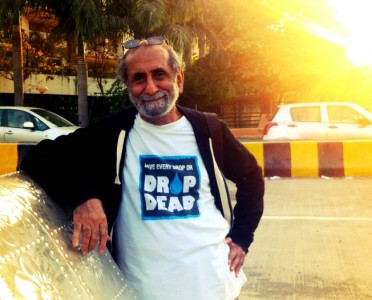
Author and painter Aabid Surti may have won awards for his writing and art, but he has also made a mark in another field: water conservation. For the last seven years, the 77-year-old has spent his Sundays going to apartments in Mumbai, and volunteering to fix leaking taps.

The Alternative, a Bangalore-based website seeking to chronicle and support social development in India, is currently running a campaign on sustainable water conservation called Catch Every Drop (#catcheverydrop). At The Alternative, Kirti introduces us to Aabid Surti’s work:

The 77-year-old celebrates Sunday like none else, picking a building in Mumbai’s far-flung suburb Mira Road and, with his plumber and a volunteer in tow, searching it for leaking taps to plug. Free of charge. His reward? “A lot of water saved. And sometimes, an offer for lunch,” he says simply. Surti’s non-governmental organisation, Drop Dead, has just one employee – him.

Aabid Surti, by Aalif Surti (CC BY-NC 3.0).

Aabid Surti, from Aalif Surti’s blog (CC BY-NC 3.0).

Aabid Surti’s son Aalif Surti (@SuperAalif) has told the story of how it all began:

“I read an interview of the former UN chief Boutros Boutros Ghali,” Aabid recalls, “who said that by 2025 more than 40 countries are expected to experience water crisis. I remembered my childhood in a ghetto fighting for each bucket of water. I knew that shortage of water is the end of civilized life.” Around the same time, in 2007, he was sitting in a friend’s house and noticed a leaky tap. It bothered him. When he pointed it out, his friend, like others, dismissed it casually: it was too expensive and inconvenient to call a plumber for such a minor job – even plumbers resisted coming to only replace old gaskets. A few days later, he came across a statistic in the newspaper: a tap that drips once every second wastes a thousand litres of water in a month. That triggered an idea. He would take a plumber from door to door and fix taps for free – one apartment complex every weekend.

Of course there was the issue of covering costs:

As a creative artist, he had earned more goodwill than money and the first challenge was funding. “But,” he says, “if you have a noble thought, nature takes care of it.” Within a few days, he got a message that he was unexpectedly being awarded Rs.1,00,000 ($2,000) by the Hindi Sahitya Sansthan for his contribution to Hindi literature [an award from the government of Uttar Pradesh]. And one Sunday morning in 2007, the International Year of Water, he set out with a plumber to fix the problem for his neighbors. He began by simply replacing old O-ring rubber gaskets with new ones, buying new fixtures from the wholesale market. He named his one-man NGO ‘Drop Dead’ and created a tagline: save every drop… or drop dead. Every Sunday, the Drop Dead team – which consisted of Aabid himself, Riyaaz the plumber and a female volunteer Tejal – picked the apartment blocks, got permission from the housing societies, and got to work. A day before, Tejal would hand out pamphlets explaining their mission and paste posters in elevators and apartment lobbies spreading awareness on the looming water crisis. And by Sunday afternoon, they would ensure the buildings were drip-dry. By the end of the first year, they had visited 1533 homes and fixed around 400 taps. Slowly, the news began to spread.

Not only does the project help save water, it empowers the community:

As Aabid rings another door-bell on yet another Sunday in Mira Road, seven years into his one-man mission, he says: “Anyone can launch a water conservation project in his or her area. That’s the beauty of this concept. It doesn’t require much funding or even an office. And most importantly, it puts the power back in our own hands.”

Now Aabid Surti would like similar initiatives to be started in others parts of India, so that as much water as possible is saved.

These Rickshawallahs Know More About Birds Than You Do. For Sure.

There are some 100 odd men plying these quaint three wheeler cycles in Bharatpur. From identifying the near extinct Siberian cranes, to guiding photographers to the best spots within the sanctuary, to speaking at length about the breeding habits of painted storks, these rickshawallahs will amaze you with their stupendous knowledge.

The Keoladeo Ghana National Park, formerly known as the Bharatpur Bird Sanctuary, in Bharatpur, Rajasthan, is a famous avifauna sanctuary that plays host to thousands of birds, especially during the winter season. Over 230 species of birds are known to have made this national park their home. It is also a major tourist centre with scores of ornithologists arriving here in the hibernation season. It was declared a protected sanctuary in 1971. It is also a declared World Heritage Site.

8

What is impressive about this sanctuary is the way it is managed. There are many people – foreign tourists, nature lovers, bird watchers, and weekend travellers who visit often as Bharatpur is not very far from Delhi and Jaipur. The place is off-limits for vehicular traffic unlike many other zoo-parks where you can buy a ticket and take the vehicle inside. However, you don’t need to walk long distances to get around in Bharatpur. There are cycles on hire and guides with rickshaws, who charge a very reasonable sum of Rs.100 per hour.

6

These rickshaw guides have acquired their knowledge of the birds over many years. But it isn’t just experience that makes them such amazing ‘ornithologists.’ Most of them have attended a three-month rigorous course conducted by the forest department of the park and are authorised to be guides.

5

Amarchand is one such rickshaw guide. He can identify 230 species of birds and he gives a running commentary of the surroundings to his passengers as he ferries them around.

3

The park management has also arranged for professional binoculars, guide books and more, that are a must to fully understand, watch and enjoy Amarchand’s commentary. –

2

The rickshaw guide idea is a novel one and definitely needs to be replicated in other sanctuaries too. However, there is a downside to it. There is hardly any work for the rickshawallahs in the summer months. They have to then ply their rickshaws in town or look for alternative employment. –

7

They would like to become permanent employees of the park. As it is, they say, they pick up trash left by the visitors and help keep the place clean. These rickshawallahs are not just guides, they also help preserve the environment in the parks. –

Nevertheless, whether the park gives them employment or not, these enterprising rickshawallahs have carved a niche for themselves. Besides improving their English speaking skills, they have even learnt some broken French and German to converse with the tourists who come here. These guides may not have been given the status they deserve by the Rajasthan tourism department but those who regularly visit the park have complete faith in their knowledge and even ask for their assistance when making documentaries or researching and writing about migratory birds.

4

There are very few places like this sanctuary and its unique rickshawallah guides – not just in India but in the world. So the next time you are anywhere near Delhi or Jaipur, please visit this place while it still stands and plays home to several rare migratory birds. Taj Mahal can wait, but beautiful birds cannot! –

About the author: Tejaswi Bhagavatula is a Hyderabad-based writer, poet, painter, biker, photographer, corporate profile-writer, on-the-way-CA, part-time tax consultant – all to fund his passion for travelling! He wishes to work for change through bringing out stories and his dream is to ride to Ladakh on his dear old Bullet, while learning and writing about people he meets all along the way and someday, maybe make it a storybook. Inputs by: Nishi Malhotra –

Source….www.thebetterindia.com

Natarajan