Image of the Day…Bar-Headed Geese in India…!!!

Bar-headed geese in India

A beautiful shot of bar-headed geese – one of the world’s highest flying birds – over a wetlands in India in November 2014. Photo by Abhinav Singhai.

Photo Credit: Abhinav Singhai.  Visit Abhinav Singhai's Flickr page

EarthSky Facebook friend Abhinav Singhai in India captured this evocative shot of bar-headed geese over Basai Wetlands, a well-known destination for birders near Delhi, India. He said there were hundreds of geese over the wetlands that day.

Thank you, Abhihav!

The bar-headed goose is a fascinating bird, by the way, and one of the world’s highest-flying birds. It’s been heard flying across Mount Makalu – the fifth highest mountain on Earth at 8,481 meters (27,825 ft). The British explorer George Lowe is said to have reported seeing bar-headed geese flying over Mount Everest – 8,848 meters (29,029 ft)! You’ll find mention of Lowe’s tale about the geese here.

According to Wikipedia, the bar-headed goose is:

… a goose that breeds in Central Asia in colonies of thousands near mountain lakes and winters in South Asia, as far south as peninsular India …

The bird is pale grey and is easily distinguished from any of the other grey geese of the genus Anser by the black bars on its head.

A Bar-headed Goose in St James's Park, London, England.  Photo by DAVID ILIFF. License: CC-BY-SA 3.0 via Wikipedia.

Bottom line: A beautiful shot of bar-headed geese flying over a wetlands in India in November 2014. Photo by Abhinav Singhai.

SOURCE::::www.earthsky.org

Natarajan

Things We all Did as Indian Kids …!!!

Read on to know what we all did as Indian kids.

1. Rolled on the playground, got dirty in the mud

1st-Get-dirty-in-mud

Cuz mitti mein nai khela toh kya khela.


2. Played hopscotch, chupa chupi

2nd-play-hopscotch


3. We had no prom nights but we had some awesome times dancing in sarvajanik Ganpati and Durga pooja utsav

3rd-sarvajanik-dance


4. Played galli cricket

4th-galli-cricket

Cuz galli was our cricket stadium


5. Watched Shaktiman with all the neighborhood kids on Sundays

5th-Shaktiman

and hoped to become Shaktiman as a grown up or meet him some day.


6. Saw Aahat and almost peed in our pants, but saw it anyway

6th-Aahat


7. Made paper balls and played cricket during recess hours in school

7th-paper-balls


8. Ate baraf ka gola on the last day of the school to welcome summer holidays

8th-baraf-ka-gola


9. Played popular pop songs like Made in India and Dooba Dooba rehta hoon loudly

9th-Pop-songs


10. Fixed our chappal by tucking in the strap with the help of a twig; every time we played outdoor games

10th-chappal


11. Saw “Jalebbiiii” ad and instantly demanded for hot and delicious jalebi

11th-jalebi-add

Image source


12. Katti toh katti barah baje batti tu kha matti mein khau ice cream

12th-katti

Say this as soon as you’re angry or annoyed with your friend. And no there was nothing like pinky promise, the above sign meant katti.


13. Rasna rozana utsav was your favorite ad and drink, especially during summer vacation

13th-rasna-rozana-utsav


14. Got excited when the door bell rang so you could open the door like Sweety from Hum Paanch

14th-Hum-Paanch


15. Put those brown covers just a day before the first day of school

15th-brown-cover

To let the feeling sink in. Yes school is starting tomorrow.


16. When electricity went off after sunset, gather around with friends and enjoy the dark time with ghost stories or chupa chupi

16th-playing-in-the-dark

These are the things we all did as Indian kids and man how we loved every single minute of it.
Cheers to those times :)

SOURCE:::: http://www.storypick.com

Natarajan

” Silence is the Thing, amid the Din…”

The noise and confusion that reigns in the world around us.

A French black-and-white silent movie, The Artist, won top honours at the Academy Awards in 2012. It had to happen. There is so much eloquence in silence. Remember the Charlie Chaplin genre of films? Are they coming back? I am no movie buff. But violence and noise are things humankind should shun. And silence being golden is a good break, and we are in dire need of it. The cacophony all around is killing.

We watch on television the noise and confusion that reigns in the world around us. Everybody has something to say but nobody wants to listen. There is zero tolerance.

We watch programmes on TV where the anchor and a panel of experts discuss and analyse issues. They begin nicely enough, but when the debate gets heated, sparks fly and everyone begins to talk simultaneously. Even the anchor has a problem controlling them. The one with most lung power out-speaks others. We are left numb.

Thank god we have the option of switching off the TV to get instant relief. Today’s music is also all noise. Where are the lyrics and the soft and soothing voices? Thank god for classical music — we still can listen to them and derive soul satisfaction.

I admire the silence of the West. Their neighbourhoods are so quiet. One can drink deep of such silence, especially when one is on a walk absorbing a lot of things. I love my India alright, but our strong point is not silence. We may well be one of the noisiest countries on the planet. In the bus, or in queues, in movies theatres, restaurants or even when they go for walks, people talk so loudly that they will wake up entire neighbourhoods — especially early in the morning. Now with dogs abounding on every street, if one dog starts barking, others follow it up with a chorus.

Even children don’t lag behind. I remember watching kids at play in a neighbourhood, abroad. There, like the adults the kids hardly ever scream or shout. Only Indian children scream their throats out.

This happened when I was once holidaying in the U.S. in Silicon Valley. A Japanese lady complained to the office of an apartment complex about an Indian family. The parents were off to work, and the grandparents had come for a holiday and they were teaching the kids slokas. Everytime the kids recited back what had been taught, the grandparents and the kids clapped with all their might, creating a ruckus.

The Japanese lady said: “That is the time my baby is fast asleep and my neighbours are yelling their heads off. The baby is startled into waking up and I am unable to finish my house work.” Being in the adjoining building, I too had heard the kids reciting the slokas and thought it to be laudable. The grandparents, I thought, were spending quality time with them, but they could have kept the decibel level low.

Once upon a time fire-crackers were lighted only during Deepavali. Now they are set off on birthdays, weddings, elections and what have you. Accompanying them on such occasions is loud film music. The world, as Wordsworth wrote, ‘is too much with us’. We are drowning in a welter of noise and other negative factors like road rage, violence, fisticuffs and streetfights. We see so much pent-up anger in people on a number of issues waiting to explode. The word ‘kolaveri’ said it all.

Remember the ‘Tower of Babel’ where people were shouting themselves hoarse in a diversity of tongues and nobody wanted to hear the other? We thought it was mythical, but no, it was real enough. All the chaos is back, it seems. As they say there is nothing new under the sun and history has a way of repeating itself. Things have to come full circle.

Keywords: Silencenoise pollutionnoise tolerance

SOURCE::::: Prema Ramakrishnan in http://www.thehindu.com

Natarajan

Dialysis @ Rs 100…? ….He Made it Happen !!!

Indian American Harvard Medical School student Sachin Jain looks beyond boundaries of direct service.

Sachin Jain comes from a family of philanthropists.

His India-born father, Subhash, and others funded Jain’s paternal aunt Shanti, who had committed her life to rural health care in Phalodi, Rajasthan.

The family runs the HBS Trust, which, among other things, runs a non-profit hospital (Kalapurnam General Hospital) and a school (Bal Academy).

He watched as his father and brother, Roopam, worked their own magic, once sending to India supplies from a hospital in Kansas that went bankrupt.

Sachin had done his share in organising things for his parents in the United States.

He spent some time at the hospital, even living there awhile.

But if he was to help, he saw that he could not make the same kind of headway his father perhaps did.

He realised there were cultural nuances to India, one that essentially made for a foreign context for him, he says:

“As someone who grew up in America, I don’t have that. People there know to get things done… There’s a different work culture in India.”

Sachin, who went to Harvard Medical School, taking a break to do his MBA first, and then to work awhile in the Obama administration, says, “As I got older, (I saw) the special sweet spot I could be at (would be one where I could) build partnerships that create novel programmes.”

He spoke to Kent Theiry, chief executive officer, Davita, the largest dialysis material supplier in the US, and worked out a deal to do collaborative work on dialysis services in India.

Thanks to Davita and other sources of funding, the HBS Trust has two dialysis centres — in Jodhpur and Phalodi.

Already 17,000 patients have used the facilities in Jodhpur, 3500 in Phalodi.

The charges are on the ability to pay, amounting to about Rs 100 ($1.63) and Rs 200 ($3.27) per session.

That well-nurtured partnership has been on for almost six years.

Sachin also worked out a deal with the Medical Mission for Children (Boston), which worked on cleft lips and palates.

“They were interested in going to India,” Jain says, adding that he “didn’t think there was need for this.”

But a few advertisements in the local papers there unleashed an overwhelming response.

He now realises how important the seven-year partnership has been in helping people living with that social stigma get jobs or even get married.

Sachin goes there every year, to meet family and see how the hospitals are doing.

In the US, he practices at the Boston Veterans Hospital, is editor-in-chief of Healthcare, an academic publication, and the chief innovation officer at Merck.

On the side he organises trips for doctors to India.

The role of Indian Americans has been to go back and give frontline service, he says, adding, “My job is understanding what is going there.”

He says he spends a lot of time maintaining relationships, failing to fix a deal 80 percent of the time.

He speaks of another dialysis company he has been wooing, which has coyly refused to play nice yet.

Something might happen next month or next fall. The important thing is not to get discouraged, Jain says.

He adds that right now people think of doing direct service. But, just as he did, there is also the option for young people to learn to use the options they have here.

SOURCE::::: P.Rajendran in http://www.rediff.com

Natarajan

Gujarat International Finance Tec -City…GIFT…India”s First Smart City !!!

India’s first smart city takes shape

KIRAN SHARMA, Nikkei staff writer

Artist rendering of Gujarat International Finance Tec-City

Gujarat, one of India’s largest manufacturing hubs and Prime Minister Narendra Modi’s home state, is the site of the country’s first smart city built from scratch.

Launched in 2007, Gujarat International Finance Tec-City (GIFT) is Modi’s dream project and a joint venture between the Gujarat state government and Infrastructure Leasing & Financial Services.

The $12 billion smart city, located 12km from Ahmedabad international airport and 8km from the state capital, Gandhinagar, aims to become a global financial hub, offering international companies world-class infrastructure.

“The project is attracting a number of companies. The Bombay Stock Exchange (BSE) Brokers’ Forum has been allotted 300,000 sq. feet (27,870 sq. meters) in GIFT city for development of a commercial tower,” Gujarat Finance Minister Saurabhbhai Patel told the Nikkei Asian Review.

The BSE Brokers’ Forum is shifting its back office operations to a $20 million tower in GIFT city from Mumbai to cut costs. “With Gujarat being a low-cost center, naturally the cost there is lower than Bombay,” said Alok Churiwala, vice chairman of BSE Brokers’ Forum, which has stake of about 40% in the BSE.

The BSE is the world’s largest stock exchange in terms of listed companies with more than 5,000. More stock exchanges from around the world are expected to set up operations in GIFT city in the coming years. GIFT plans to attract 6-8% of India’s financial services to the new smart city.

The 358 hectare smart city is still being built, however developers are trying to speed up construction.

Gujarat, which had strong growth during Modi’s tenure as its chief minister, accounts for 16% of manufacturing in India and 25% of the country’s exports. “Gujarat ports also handle 33% of India’s cargo,” Patel said.

The idea for GIFT city came about after Modi visited Hong Kong’s International Finance Center. A report by McKinsey & Co. found that financial services in India were contributing 5% to the country’s gross domestic product and that the figure is expected to rise to 15-20% by 2020.

“Gujarat has been doing well in manufacturing and trading, and needed to do something in the services sector so that there’s a balance in the economy,” Dipesh Shah, GIFT city’s vice president, told the Nikkei Asian Review.

“GIFT city’s development will happen in three four-year phases, starting in 2012, 2016 and 2020,” Shah said. GIFT city’s tallest building, the Diamond Tower, will be 410 meters high and built in the last phase of development, Shah said.

Twelve million out of the 13 million sq feet (1.2 million square meters) earmarked for development in the first phase has been filled. “Banks like HDFC, Bank of India and Bank of Baroda have already taken space in the first of the two towers built,” Shah said. Other organizations like Tata Communications, World Trade Center and State Bank of India are building their own offices.

Most of GIFT city, 67%, has been zoned for commercial development, 22% for residential development and 11% is for social facilities. A school, hospital, club, five-star hotel and a university are also planned.

“The International Finance Services Center (IFSC) at GIFT city is the only place in India where you can do offshore banking, offshore insurance and offshore asset management. Its operating guidelines are due in about four to six months, following which the city will become functional,” Shah said. He also said things are moving at a much faster pace since Modi became prime minister in May.

“If India does not develop an IFSC, then every year from 2015 we will start losing $50 billion to places like London, Singapore and Dubai, which have financial service centers,” said Shah.

According to Shah, GIFT city will create 1 million new jobs: 500,000 in capital-market trading and core financial services, and 500,000 support staff jobs.

He said the focus now is on developing infrastructure. “Most of GIFT city’s infrastructure is a first for India. A district cooling system will be operational by December, following which we will not require individual air conditioning. We are also working on an automated waste management system and a utility tunnel. We have connected all utilities to a common command and operation center.”

Shah said Japanese companies have also shown interest in GIFT city. “Jetro (The Japan External Trade Organization) and some other Japanese organizations are planning to visit the site. Japanese companies are strong in infrastructure development and smart technology, and GIFT provides both. This is the first smart city to go operational in India,” he said.

The Modi government wants to build 100 smart cities in India. During Modi’s recent visit to Japan he briefed Prime Minister Shinzo Abe on his smart cities project and his plan to renew heritage cities, such as Varanasi. Abe expressed support for his plans.

The U.S government also welcomed India’s offer for American companies to be the lead partner in developing smart cities in Ajmer, Vishakhapatnam and Allahabad.

And the Canadian government also said it is keen to partner with India to build smart cities, pointing out Toronto, Vancouver and Calgary are among world’s top 10 smart cities.

SOURCE:::: http://asia.nikkei.com/

Natarajan

” Satellite Image of India During Diwali” …Real and Fake !!!

The Hindu festival of Diwali celebrates the victory of Good over the Evil and Light over Darkness. It also marks the beginning of the Hindu New Year. This year, Diwali falls on October 23. Lighting lamps, candles, and fireworks are a big part of Diwali. It’s a celebration of light! But can you see those celebratory lights from space? The answer is no. NASA saysthe extra light produced during Diwali is so subtle that space images don’t show it. This post is about a real satellite image of India during Diwali, versus a false one that’s been circulating on the Internet for a few years, especially around the time of the Diwali festival.

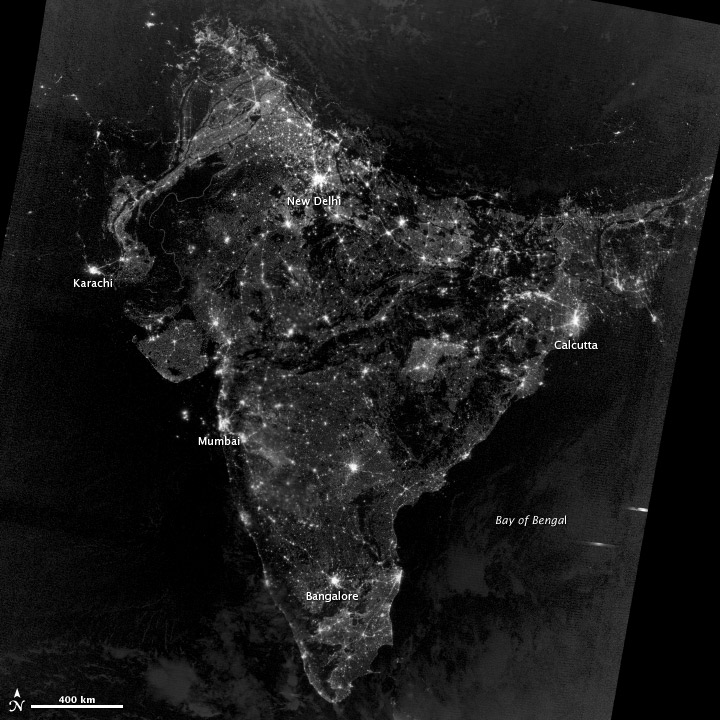
First, a real image:

The image above – which has been artificially brightened – shows what India looked like from space on the night during Diwali in November, 2012. It’s what India looks like from space onany night, according to NASA.

This image is from a NASA satellite known as Suomi NPP, for National Polar-orbiting Partnership. An instrument carried on this satellite – which detects light in a range of wavelengths from green to near-infrared – acquired this image in a single night. The image has been brightened to make the city lights easier to distinguish.

Most of the bright areas are cities and towns in India, which is home to more than 1.2 billion people and has at least 30 cities with populations over 1 million. Cities in Bangladesh, Nepal, and Pakistan are also visible near the edges of the image.

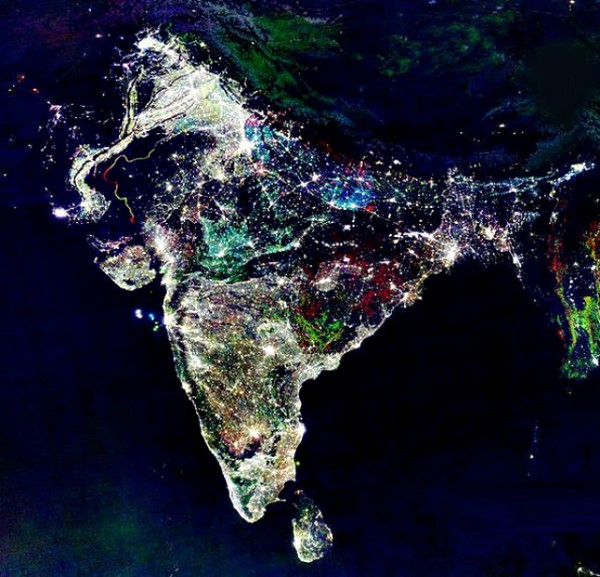
Now, the fake one:

In contrast, here is the false Diwali image, which has been circulating via the Internet for some years. It doesn’t show what it claims to show; that is, it doesn’t show India on a single night during the Diwali festival.

This image comes from satellite data, too, but not a single satellite on a single night. It’s based on data from U.S. Defense Meteorological Satellite Program (DMSP) satellites, and it’s a color-composite created in 2003 by NOAA scientist Chris Elvidge to highlight population growth over time. In this image, white areas show city lights that were visible prior to 1992, while blue, green, and red shades indicate city lights that became visible in 1992, 1998, and 2003 respectively.

Bottom line: This post contains a real space image of India, taken during the 2012 Diwali festival. The image is shown in contrast to another space image – a composite, put together with data taken over many years – which has circulated in recent years. The composite image does not show India during Diwali. NASA says the extra light so many enjoy during Diwali would not be visible from space.

SOURCE::::earthskynews

Natarajan

” For Many Years , It Upset Me That I was a Businessman…” Says Dilip Kapur

I wondered what mistakes I made in my life to be a businessman. Deep down, I still have doubts about it.’

Shobha Warrier meets the amazing Dilip Kapur who built a Rs 160 crore business with just Rs 25,000.

Image: Dilip Kapur whose Hidesign has grown from its artisan roots to an international brand. Photograph: Sreeram Selvaraj

Business was not Dilip Kapur’s first love. He actually wanted to “change the world.” But as fate would have it, what started as a hobby, is today a business worth over Rs 160 crore (Rs 1.6 billion) with 76 exclusive showrooms and a distribution network in 23 countries.

Founded in 1978 as a two man workshop, Dilip Kapur’s Hidesign has grown into a global brand recognised for quality, ecological values and personalised service.

“For many years, it upset me that I was a businessman. I wondered what mistakes I made in my life to be one. Deep down, I still have doubts about it. Business is not something I wanted to do,” says Kapur, the founder-president of Hidesign, the leather goods manufacturer based in Pondicherry/Puducherry, adding that even today he has many questions about doing business.

Kapur’s father, a rich businessman in Delhi, relinquished all his wealth and moved to Pondicherry in 1954 when Kapur was just five, and joined the Aurobindo Ashram.

After studying in the Ashram school as a free spirited boy, Kapoor studied at the Phillips Academy, Andover, Massachusetts, and later at Princeton University, graduating in liberal arts. He did his PhD in international affairs at Princeton.

When he was at university, the Vietnam War broke and along with that, the hippie and ant-Vietnam movements. “I was a hippie with long hair!’ he remembers. “We all thought we would be able to change the world.”

Image: Hidesign’s leather collection includes handbags, clutches, briefcases, laptop cases, wallets, belts and garments. Photograph: Sreeram Selvaraj

As the war ended, he got a job and that was the first time he was introduced to leather. “I loved the look of it. Unlike cloth, it was very tactile; you can touch it and feel it. There is a three dimension feel to leather; you can see through leather. It is more living unlike cloth.”

As part of his training, he made bills once a week and that was when he noticed that all the rare leather imported from England was called E I Leather. He found out that E I Leather, described as the finest vegetable tanned leather in the world, actually stood for East India Leather.

Considered to be the best for hand colouring, highly expensive shoes and bags in Italy, and the UK were made from this brand of leather. A huge surprise awaited him when he was told that E I Leather was imported from Madras (now Chennai)!

“They were importing from my homeland and I didn’t know. It was one of our heritages which we have lost. India used to be a big centre for vegetable tanned leather, the other two were Italy and Brazil. But when chemical tanning came to India, vegetable tanning slowly vanished.”

With every passing day Kapur realised he disliked the US more. “I really believed Vietnam was American imperialism. Maybe because I was an Indian, I felt connected to Vietnam. The arrogance of America upset me a lot; they thought they could do anything to any country. I admired Vietnam for the way they fought America. The Vietnam War was only one of the reasons why I decided to come back; I always knew one day I was going to come back,” he says.

“I had this pride that I was an Indian and wanted to live in India. No Indian who went to America at that time came back.”

Image: Hidesign has three design teams based in Milan, London and Pondicherry. Photograph: Sreeram Selvaraj

Back in Pondicherry in 1978, there was nothing much for him to do except plant trees and plan the affairs of Auroville. As he helped build Auroville, he indulged in his hobby of designing leather bags, and went searching for the source of E I Leather.

To his disappointment, tanner after tanner that he visited told him that they had stopped using the E I process and shifted to the more modern chrome tanning process.

“The disastrous results were apparent all around the tanneries. Where tannery waste water had once nurtured surrounding fields, now these areas were poisoned deserts with high incidence of cancer and skin diseases. Farmers, tanners, tanneries and environment, once bound together in a symbiotic and mutually beneficial relationship, were now enemies.”

Thus began his search to find the last remaining skilled tanners of E I Leather to dedicate himself “to research more innovative methods of tanning, based firmly on a heritage that had once created the greatest leather in the world!”

What he did next was visit the cobbler’s colony looking for the best cobbler there. All fingers pointed towards Murugan, a cobbler who could make his own patterns.

Murugan became Kapur’s first employee and continues to be part of Hidesign’s 35-year long journey.

Image: Hidesign sees great value in natural beauty. Photograph: Sreeram Selvaraj

Kapur was pleasantly surprised when a friend of his bought the very first handmade bag he designed for Rs 300.

“I just couldn’t believe that somebody would actually buy a bag I made. This friend knew I was making a bag and when I finished it, she found it so beautiful that she bought it. It was very unexpected.”

Kapur was now making one bag a day and gifting them to family members. It caught the attention of a German friend in Auroville. He modelled with the bags for the catalogue of the World Hunger Organisation and placed an order for 1,400 bags.

“Imagine, I had just started my business and had only one cobbler working for me. The realisation that people would place an order for what you did as a hobby, was amazing. After six months, I supplied 200 bags to him. That was all I could make.”

When such a big order landed his way, Kapur knew it was time to expand. With Rs 25,000 as capital, he expanded his hobby into a business. Most of the money was spent on buying leather, other accessories and a sewing machine.

“If I knew it would grow into a business, I would have closed it down at that time itself. I am not a Socialist or a Communist. I am not even a capitalist; I am a liberalist!” exclaims Kapur.

Image: Hidesign’s leathers are full grain and have not been corrected with paint and pigment to hide natural defects. Photograph: Sreeram Selvaraj

The bags were packed off with the name Hide (leather) and Design with ‘de’ in shadows, but a London company made it one word, Hidesign saying two ‘de’s would not read good. That was how Hidesign was born.

Soon, another order was placed by a friend who used to stay in Auroville but had gone back to Australia.

The next big step in Kapur’s journey was the British store chain John Lewis stocked Hidesign bags.

“We only had rebels as our customers in the first few years. It took us ten years to conquer the mainstream market. By then, the whole culture of the world had changed and people became less conservative and more casual. The biggest break was John Lewis buying our products.”

Image: Hidesign’s products are individually handcrafted using the finest leather. Photograph: Sreeram Selvaraj

Having left India at the age of 15, Kapur felt like a foreigner having no knowledge of the country. So, when he started designing bags, he was doing that for himself and people like him who liked anything that looked natural and rustic. He felt awkward when they moved from the ‘rebel camp’ to the ‘mainstream camp.’

“It was like a progression even though they (John Lewis) forced us to go mainstream. Our leather used to be handmade, but they wanted us to make it a little more even. Till then, we were catering only to the ‘alternate culture’. At John Lewis, our customers were the normal Europeans who were till then buying Italian bags. Yes, it was exciting to replace high-end Italian bags.”

Kapur felt this was the “end of innocence.”

In 1992 Hidesign’s Boxy Bag won the Accessory of the Year award from Accessory Magazine. Kapur had designed a little suitcase like a box with a long strap. The distributor collected the award from Princess Diana. She gave the award and took the bag home.

Stephen Spielberg picked a Hidesign bag and used it in a movie. Bob Hawke, Australia’s former prime minister, carried a Hidesign bag all the time.

The biggest surprise for Kapur was when India became a big market. By now, the number of people working for him had increased and the small unit became a big factory. Today, 3,000 people work for Hidesign, which has 2,000 stores.

“When we started selling in India in 2000, we sold only 6 per cent of our products here. We couldn’t even find a distributor in India who understood our products. So we opened our own stores, first in Delhi and then in Bangalore. Now, India is our biggest market, 65 per cent of our sales are in India. Our customers are from the 25 to 35 age group.”

“After liberalisation the world came to India and Indians went to the world. Suddenly you see many Indians having the same lifestyle as a person in San Fransisco and London.”

Image: The natural and ecological tanning process enhances the intrinsic characteristics and individuality of Hidesign’s leather. Photograph: Sreeram Selvaraj

Until 2005, most of Hidesign’s Indian customers were men, but post-2005, women became big fans of Hidesign. Internationally, 70 per cent of its customers are still men.

A businessman who was never ambitious, Kapur now wants Hidesign to grow and become a leader in India.

“I want to see it as an important brand internationally, but I don’t think in terms of numbers and rupees. We want to stay natural and ecological. That is very important to us. Hidesign is part of a movement that makes people conscious of the environment and never exploit any human being. We should have a reason to be there and a story to tell.”

Shobha Warrier/Rediff.com in Pondicherry

SOURCE:::::Rediff.com
Natarajan

India”s NIRBHAY Subsonic Cruise Missile… Few Facts on its Launch …

Nirbhay, India’s first home-grown subsonic cruise missile, was on Friday successfully test-launched from the Interim Test Range in Chandipur, near Balasore in Orissa.

This is Nirbhay’s second launch, the first being terminated mid-way on 12 March 2013 owing to a technical snag. Nirbhay, with an expected strike range of 800-1000 km, is the first missile being made completely in Bangalore.

Here are some facts of the missile:

1) Nirbhay is a subsonic cruise missile – it starts off as a rocket and then turns into an aircraft.

2) Nirbhay is expected to have an expected strike range of 800-1000 km.

3) The missile was nurtured at the Defence Research and Development Organisation’s premier laboratory Aeronautical Development Establishment in Bangalore’s C V Raman Nagar.

4) The cost of one missile is Rs 10 crore.

5) It has good loitering capability, good control and guidance, high degree of accuracy in terms of impact and very good stealth features.

6) The Nirbhay missile is similar to the US Tomahawks, which can fly like an aircraft and capable of travelling up to 1,000 km.

7) It can fly at tree-top level making it difficult to detect on radar and as it approaches the target, the missile can determine the point of impact while hovering over the target.

8) It gives India the capacity to launch different kinds of payloads at different ranges from various platforms at a very low cost. It can be launched from a mobile launcher.

SOURCE::: REDIFF.COM  
Natarajan

Meet Mr. Arvind Subramanian … Chief Economic Adviser to Govt. Of India…

After his candidacy first emerged in August, US based economist Arvind Subramanian has finally been selected as chief economic adviser by the Indian government.


This announcement came at a newsconference in New Delhi where Subramanian was present. He is a development economist who worked closely with Reserve Bank of India (RBI) Governor Raghuram Rajan when both were at the International Monetary Fund (IMF).

According to analysts, one of the prime factors that tipped scales in favour of Arvind Subramanian was his proximity to RBI governor Raghuram Rajan. Narendra Modi personally handpicked Arvind to be his chief economic adviser.

Confirming his appointment in an impromptu news conference outside the Finance Ministry, Mr Subramanian said: “It is a great honour… to serve in a government that has a mandate for reform and change.” He said macro-economic stability and creating favourable conditions for investment will be priorities.

Traditionally, the chief economic adviser is responsible for producing the annual Economic Survey – a document on the state of economy that underpins the drafting of the Budget – and a mid-year economic update that is presented to Parliament.

Recently, Mr Subramanian criticised the Indian government’s decision to derail a WTO deal struck last year to streamline trade procedures by tying it to a separate controversy over food subsidies.

He also criticised Mr Jaitley’s maiden budget in July for being too optimistic in its revenue forecasts.

Mr Subramanian was educated in India and Britain and went on to serve at the IMF and at the forerunner to the World Trade Organization, before taking senior academic posts at Harvard and Johns Hopkins universities in the United States.

In 2011, Foreign Policy magazine has named him as one of the world’s top 100 global thinkers. He obtained his undergraduate degree from St. Stephens College, Delhi; his MBA from the Indian Institute of Management at Ahmedabad, India; and his M.Phil and D.Phil from the University of Oxford, UK.

Below is a small bio of Arvind Subramanian (Courtesy- Peterson Institute of International economics) 

Arvind Subramanian is the Dennis Weatherstone Senior Fellow at the Peterson Institute for International Economics and senior fellow at the Center for Global Development. His book Eclipse: Living in the Shadow of China’s Economic Dominance was published in September 2011, and he is coauthor of Who Needs to Open the Capital Account? (2012). Foreign Policy magazine has named him as one of the world’s top 100 global thinkers in 2011.

He was assistant director in the Research Department of the International Monetary Fund. He served at the GATT (1988–92) during the Uruguay Round of trade negotiations and taught at Harvard University’s Kennedy School of Government (1999–2000) and at Johns Hopkins’ School for Advanced International Studies (2008–10).

He has written on growth, trade, development, institutions, aid, oil, India, Africa, and the World Trade Organization. He has published widely in academic and other journals, including the American Economic Review (Papers and Proceedings), Review of Economics and Statistics, Journal of International Economics, Journal of Monetary Economics, Journal of Public Economics, Journal of Economic Growth, Journal of Development Economics, Brookings Papers on Economic Activity, Oxford Review of Economic Policy, International Monetary Fund Staff Papers, Foreign Affairs, World Economy, and Economic and Political Weekly.

He has also published or been cited in leading magazines and newspapers, including the Economist, Financial Times, Washington Post, New York Times, Wall Street Journal, Newsweek, and New York Review of Books. He contributes frequently to the Financial Times and is a columnist in India’s leading financial daily, Business Standard.

He advises the Indian government in different capacities, including as a member of the Finance Minister’s Expert Group on the G-20. His book India’s Turn: Understanding the Economic Transformation was published in 2008 by Oxford University Press.

With agency inputs  

Source::::www.dnaindia.com

Natarajan


Happy Birthday ‘ People’s President ‘… DR. Abdul Kalam Turns 83 Today !!!

APJ Abdul Kalam turns 82 today

Indians, let’s wish ‘happy birthday’ to one of the most popular Rashtrapati the country every had – Dr APJ Abdul Kalam ! Kalam, also known as ‘missile man of India’, is celebrating his 83rd birthday today. He assumed the office as India’s 11th president in 2002. During his tenure, he made the highest office in India accessible to the common man in the country and was affectionately called ‘people’s president’. Kalam was a gentle, amiable, approachable president, known for his simplicity. Before his term as the country’s Rashtapati, Kalam worked as an aerospace engineer with Defence Research and Development Organisation (DRDO) and Indian Space Research Organisation (ISRO). Kalam was born into a family of Tamil Muslims in Rameswaram, a small temple town located in the southern most edge of India in 1931. A brilliant student, Kalam graduated from Madras Institute of Technology and joined DRDO and later, ISRO. “After observing my teacher teaching me how birds fly…I aimed something to fly…Then I pursued my studies in Physics and aerospace,” he said recently at an event attended by students. There are many missions to the credit of this ‘missile man’. Kalam is well-known for his work on the development of ballistic missile and launch vehicle technology and he played a pivotal role in India’s Pokhran-II nuclear tests in 1998, the first since the original nuclear test by India in 1974. Kalam was the project director of India’s first indigenous Satellite Launch Vehicle (SLV-III) which successfully deployed the Rohini satellite in earth’s orbit in July 1980. In a poll conducted by news channel CNN-IBN, he was selected as India’s Best President. The country has conferred on him the prestigious Bharat Ratna, Padma Vibhushan and Padma Bhushan. During his term as Rashtrapati, Kalam visited universities and schools across the country, interacted with children. No wonder, his 79th birthday was recognised as World Student’s Day by United Nations. Kalam has also received honorary doctoral degrees from 36 unversities and institutions worldwide. Kalam has penned a number of books including ‘The Wings of Fire’, his autobiography, which has been translated and published in 13 languages so far. His books are largely popular among the student community in the country. “For the last one decade when I became President and after it, I had one dream and that was when can I in my lifetime see smile on a billion faces,” he recently told a boy who asked him what kept him motivated all the time. More power to this great visionary !

SOURCE::::news.oneindia.in

Natarajan

Read more at: http://news.oneindia.in/india/happy-birthday-people-s-president-apj-abdul-kalam-tur-1540924.html