Image of the Day…Full Moon Rising over Lotus Temple in NewDelhi …


Full moon rising over Lotus Temple in Delhi, India

We saw many photos of the October 8 moon during the total lunar eclipse. Here’s one from India, where the eclipse was less easily visible.

Photo by Abhinav Singhai.  Visit him on Flickr.

Our friend Abhinav Singhai captured this moonrise (Hunters Moon) time lapse over the Lotus Temple in Delhi, India. It was October 8, 2014, the night of the total lunar eclipse. Abhinav wrote:

Penumbral lunar eclipse was visible from Delhi at the time of moonrise, and visible in the first picture as well (slight shadow).

SOURCE:::: EARTHSKYNEWS

Natarajan

10 Clean Cities That Make India Proud !!!

Chandigarh has emerged as the cleanest city in India as per a study conducted by the ministry of urban development.


Dancers perform during the Republic Day celebrations in the northern Indian city of Chandigarh January 26, 2011. India celebrated its 62nd Republic Day on Wednesday.Ajay Verma/Reuters

Prime Minister Narendra Modi’s nationwide ‘Clean India campaign’ or Swachh Bharat Abhiyan is very well received by the masses and celebrities alike.

Be it celebrities like actor Aamir Khan, BSF Jawans or the aam junta – most have joined hands to make this mission a success by 2019. However, according to data available with the Ministry of Urban Development, there are ten cities which are very clean and these are:

Chandigarh

State: Chandigarh

The city has emerged as the cleanest city in India as per a study conducted by the ministry of urban development.

In order to keep its ranking and reputation as the greenest and cleanest city in India, the administration of Chandigarh along with The Energy and Resources Institute to working towards environment-friendly including use of natural construction material and lower energy consumption.

Chandigarh is also on the way to become the country’s first solar city by 2016.


Image: Temple tank in Shravanabelagola. Photograph: Courtesy, Dinesh Kannambadi/Wikimedia Commons

Mysore

State:Karnataka

In 2008, a citizen group in Mysore started a movement called Let’s do it! campaign to clean up not only the city but the entire country.

The response to this campaign has been huge. The youth in the city are spreading awareness on what each one of them can do individually and collectively to keep Mysore clean.


Image: Vehicles move over a bridge built over the river Tapi at Surat, in Gujarat. Photographs: Amit Dave/Reuters

Surat

State: Gujarat

The diamond city of Gujarat follows high standard of cleanliness at public places. The civic authority in the city is very strict about cleanliness on roads and public places.


Image: Prime Minister Narendra Modi launching the cleanliness drive for Swacch Bharat Mission from Valmiki Basti, in New Delhi. Photograph: PIB photos

New Delhi Municipal Council (NDMC)

State: Delhi

NDMC has intensified its cleaning operations after the launch of Swach Bharat campaign. Volunteers have even identified highly populated belts where they can spread their cleanliness drive.

NMDC is also keen to clean the backlanes of crowded colonies.


Image: Sports enthusiasts exercising on a clean road in New Delhi. Photograph: Reuters

Delhi Cantt

State: Delhi

Delhi is also considered a clean city due to the presence of various citizen forums that are actively involved in various cleanliness drives across the city.


Image: Mukkombu, a famous tourist spot in Tiruchirappalli. Photograph: Courtesy, Tiruchirappalli Tourism

Tiruchirappalli

State: Tamil Nadu

Tiruchirappalli is a city with amazing tourist spots. The citizens surely know how to keep their city clean. Tourists who have visited the city will tell you about clean habits that each one in the city follows.


Image:XLRI, Jamshedpur. Photograph: Rediff archives

Jamshedpur

State: Jharkhand

Jamshedpur adheres to a high standard on sanitation and cleanliness.

The steel city is totally sanitised and citizens here believe that healthy living is utmost important and for this purpose they must adapt to cleaner habits.


Image: Mangalore Town Hall. Photograph: Courtesy, Premkudva/Wikimedia Commons

Mangalore

State: Karnataka

In Mangalore, the popular Nirmala Nagara Yojana is a very effective scheme to implement cleanliness in the city.

Volunteers of this scheme arranges for collection of garbage in a segregated manner from every household, the garbage so collected is later classified into different categories which can be used as a landfill material or used for making compost.


Image: Bandstand, Rajkot. Photograph: Courtesy, Jadia Gaurand/Wikimedia Commons.

Rajkot

State: Gujarat

Rajkot is the fastest growing city in the country. The city’s civic body, resident forums are actively involved in keeping the city clean.


Kanpur

State: Uttar Pradesh

Kanpur is the biggest city in Uttar Pradesh with high industrial growth rate.

The city was not so clean few year ago, but currently, the city had made it to the list of clean cities in the country.

The credit for maintaining cleanliness goes to the local authorities and citizens who follow strict civic rules.

SOURCE:::: Rediff.com

Natarajan

Image of the day…. Image sent by MANGALYAAN on 7 Oct 2014 !!!

India’s maiden spacecraft to Mars—Mangalyaan—has send another image of the Red Planet, captured by the camera on board.

“Another full disc image of Mars, taken by the Mars Color Camera, from an altitude of 66,543 km. Dark region towards south of the cloud formation is Elysium – the second largest volcanic province on Mars,” the facebook page of Isro Mars Orbiter said on Tuesday.

The spacecraft had beamed its first photos of Mars’ crater-marked surface a day after India successfully put the probe into the red planet’s orbit.

Just after that Isro had uploaded the regional dust storm activities over northern hemisphere of Mars – captured by Mars Color Camera.The image was taken from an altitude of 74500 km from the surface of Mars.

India joined an exclusive global club of deep space explorers on September 24 when the indigenously-made spacecraft successfully slipped into the orbit around Mars after a 10-month journey on a relatively shoe-string budget.

Source:::: http://www.hindustantimes.com

Natarajan

Eid In India …. Few Pictures reflecting the Festive and Religious Moments …

Children celebrating Eid-al-Azha at the historic Jama Masjid in New Delhi. Photo: Sandeep Saxena


Children exchange greetings at Idgah Masjid on the occasion of Eid-al-Azha in Nalgonda on Monday. Photo:Singam Venkataramana


People greet each other at Jama Masjid on the occasion of Eid al-Azha in New Delhi on Monday. Photo: Sandeep Saxena


People offer prayers at Jama Masjid on the occasion of Eid al-Azha in New Delhi on Monday. Photo: Sandeep Saxena


Devotees gathered at the Ferozshah Kotla in Delhi to offer Eid prayers

SOURCE:::: The Hindu.com

Natarajan

This 24 years old is Empowering Rural Bihar …. How ?

An internship experience in West Champaran inspired University  Of Pennsylvania graduate   Zubin Sharma to take up the cause of educating the less privileged. 


He realised that the kids in India’s villages have the potential to change the world. 

In the last four years, Sharma’s team of volunteers and teachers have impacted thousands of lives and changed their futures. Find out how!

The future of India lies in its villages.”

This famous quote by Mahatma Gandhi is being threatened today with India looking towards a shining future in its cities and skyscrapers.

However Zubin Sharma , a 24 year-old graduate of University of Pennsylvania, took Gandhi’s words to heart.

Zubin Sharma '09

After starting an organisation called SEEKHO India in 2013 to introduce a culture of education in Bihar, Zubin realised that bringing together the existing strengths of a community could help increase its collective well-being.

That’s how Project Potential was born, with a vision to help people and communities everywhere reach their potential.

Here, Zubin talks about his inspiration behind the initiative and how it is changing and empowering the lives of people in rural India.

From U Penn. to Bihar, how and when did the idea of empowering Indian villages begin?

I landed in rural Kishanganj District in Bihar during a gap semester from U Penn that I took to test a hypothesis I had – that people everywhere have potential and that this potential can be used to create change.

I was working with an NGO there, and while the NGO was doing a good job, they weren’t able to reach a lot of small hamlets, so I wanted to see what else could be done.

SEEKHO was formed out of a village meeting in one of these small hamlets, in which the community was asked, “What are our shared goals for the future?”

Everyone said, ‘education,’ so we worked to provide education.

We’ve provided education to over 4,000 people since February 2013 through local people, who we trained as teachers.

What was your most surprising observation when you first came to Bihar?

The first time I came to Bihar was in 2010 on an internship with Husk Power Systems in West Champaran.

What surprised me was how much potential I saw; all anyone would ever say about Bihar was how backward it was, which made no sense to me, since I saw a lot of innovation and movement happening.

Correct me if I’m wrong, but you can’t be backward if you’re moving forward!

The second important point is how adaptable human beings are to their material environment.

With Husk Power Systems, I lived in a one room mud hut during my internship, and adjusted to the living conditions within 24 hours.

In Kishanganj, I had it a little better, sleeping on the floor with a building, so that was even easier.

Many people say, ‘OMG, I could never do that,’ to which I say, ‘yes you can! Just give it a try!’

Zubin with Project Potential volunteers Project Potential focusses on the existing resources and strengths of a community. Tell us more about how that notion evolved.

While we have accomplished a lot in the past few years with SEEKHO, we saw that a lot of other systemic challenges, like poverty, health, and communal strife often hold children back from getting educated.

Many of our local teachers were picking up on this fact and actually started providing services in other areas, like Ganesh, who trained the community in sanitation practices.

Seeing this, we felt like our teachers could do much more than just teach — they could change the underlying systemic issues that were blocking students from learning.

So we did a three-month pilot and saw amazing results — two villages getting electrified, a pre-school getting built, new associations built, new learning centres opened, etc, all using locally available individual, community, or institutional resources.

Most importantly, we saw the community coming together in a way that it hadn’t before.

These findings led me to found Project Potential.

A poster for empowerment of girl child released by Project PotentialHow does Project Potential work?

Take 19 year-old Razia for example, who is what we call a Village Visionary.

She mobilised women in the community to build an association.

The association then set their goals:

• Learn basic literacy

• Get their kids educated

For basic literacy, she trained A LOCAL GIRL to teach the women.

The main obstacle to get kids educated was flooding in the rainy season.

So she organized A MEETING with the block educational officer, who then set up a bridge school for them to get educated.

Finally, FOR EARNING MONEY she worked with local businessmen to get them jobs and then also helped them get job cards. So this is the kind of work we do.

As you can see, it’s all about using local, available resources to help the community achieve their self-defined goals.

We discuss it in three steps:

1. Building an army of Village Visionaries

2. Connecting the dots

3. Getting stuff done

We have six Village Visionaries in the field right now, and will have 24 more beginning in January.

The Project Potential ‘family’ have people from various backgrounds, countries and most certainly different strengths. Was it difficult finding people who would readily leave what they were doing to come and work in Bihar?

Project Potential is an international family of people, who are connected by a belief in the potential of people, a commitment to action, and an understanding that our RELATIONSHIPS matter over all else.

Take Jason House, for example, an ACQUAINTANCE from college and a Wharton graduate.

He read an article I wrote on some mindfulness work we had done in Nepal, and then told me he wanted to quit his job and work with us in India.

Now he’s adopted an Indian name — Sanjay bhai — and wears a gamsha and a lungi.

He fits in so well, and wherever we work, everyone in the community knows and loves him.

So, in short, it’s not tough — there are lots of people for whom Project Potential was their calling and exactly what they were looking for — a community and family built on super strong values and 110 per cent committed to its people.

Is there any parting message you’d like to give our readers?

Gandhi only had 24 hours a day. Same goes for you. No excuses. Start making moves!

Photos Courtesy: Seekho India and Project Potential’s Facebook Pages


SOURCE::::rediff.com

Natarajan

” No Need for India to Knock at the Doors of Elite Space Club …” !!!

The ‘New York Times’ Publishes Racist Comic About India’s Space

Mission

Last week, India became the first Asian nation to reach Mars, and the first in the world to do so on its first attempt.

The spacecraft called Mars Orbiter Mission (MOM) in English and “Mangalyaan” or “mars craft” in Hindi was launched in November and reached the orbit on Wednesday, to much jubilation from the public.

India’s first interplanetary mission is all the more creditable because, at $72 million, Mangalyaan cost just a fraction of NASA’s $670 million Maven, and $2 billion Curiosity Rover. It also cost less than to produce the film Gravity, and at Rs.7 or 11 cents, per kilometer, cost less than the per-kilometer cost of commuting by autorickshaw in most Indian cities.

So yesterday’s New York Times’ comic by Heng, titled “India’s budget mission to Mars” seems in poor taste.

2014-09-29-racistcomic.jpg

The comic depicts a poor Indian farmer in traditional garb, accompanied by a bored-looking cow, eagerly knocking on the door of “Elite Space Club”. The two people in the elite space club drinking wine and reading about India’s mission in the papers look perturbed and hesitant to open the door. It is also worth noting that the members of the elite space club are male, white, elderly and look wealthy. Whether meant to be funny or ironic, the racial, national and classist stereotyping is apparent.

In reaching Mars, the Indian Space Research Organization (ISRO) joins the ranks of Soviet space program, NASA and European Space Agency. It not only did so on a budget, but also battling “brain drain“. It’s a commonly lamented problem that many of the country’s brightest scientists and engineers end up working internationally, and tend to shy away from research in India, especially an area like space research, because it’s not as lucrative.

The comic strip comes at the time of Indian Prime Minister, Narendra Modi’s maiden visit to the United States. Addressing a 20,000 strong crowd at Manhattan’s iconic Madison Square Garden yesterday, he emphasized India’s new role on the world stage and its growing economic clout. “When people ask if we still play with snakes in our country, I tell them that now we play with the mouse,” Mr Modi said, drawing attention to the changing stereotype of India from a nation of snake charmers to one of technical prowess.

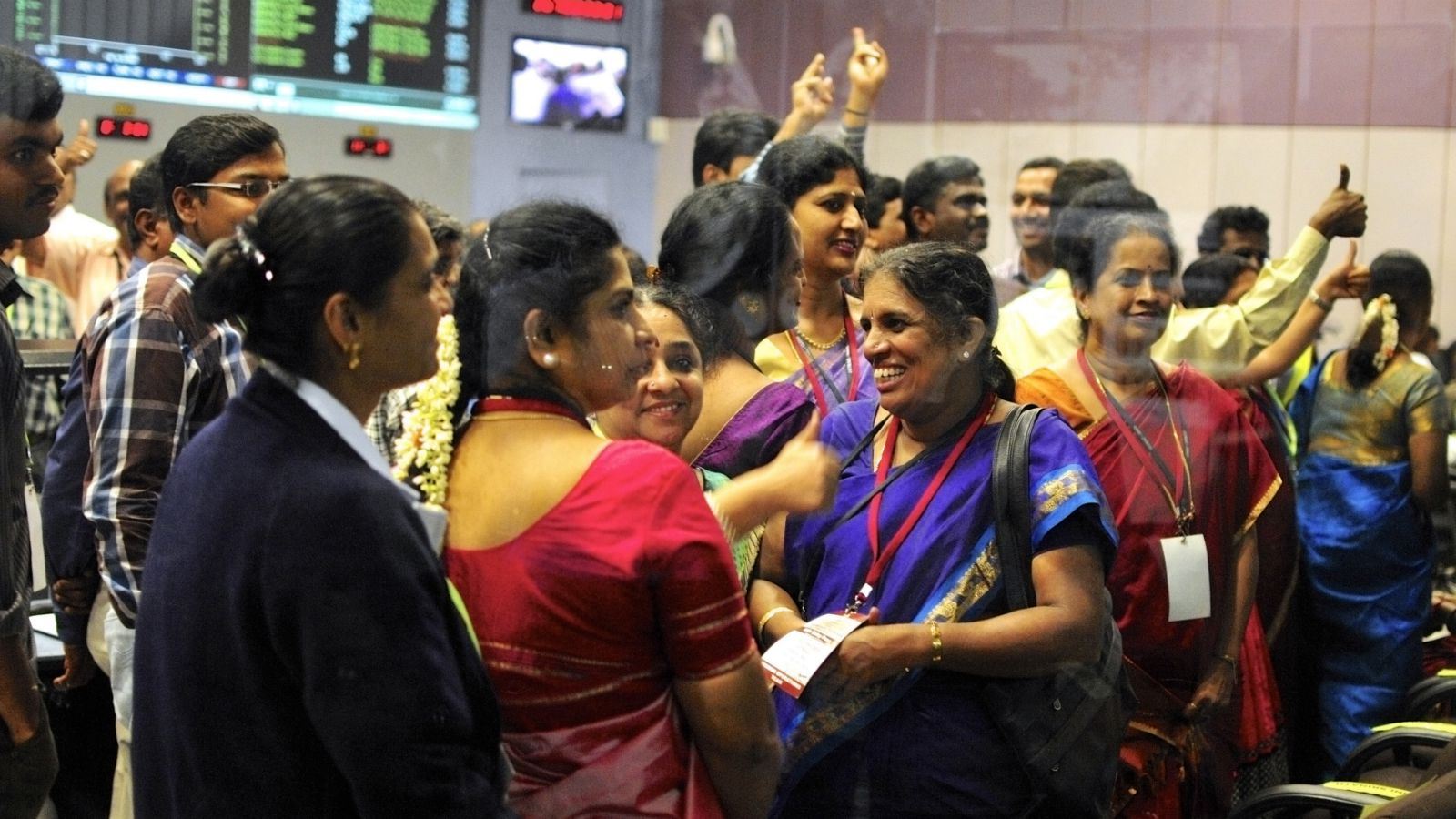
In case the Times is wondering what interplanetary-mission-heading Indian scientists look like then here you go, this is what they look like:

2014-09-29-isroscientists.jpg

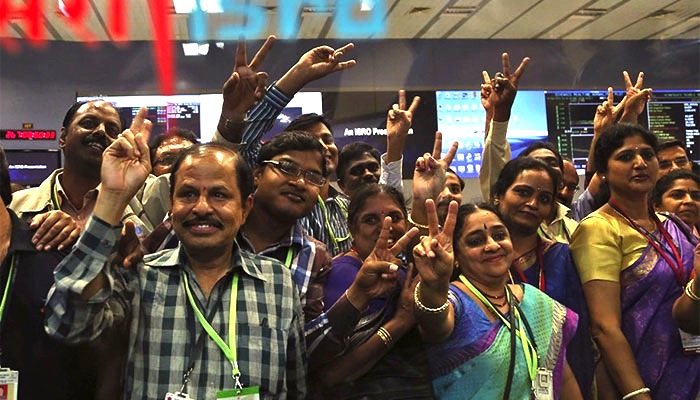
And this:

2014-09-29-isro2.jpg

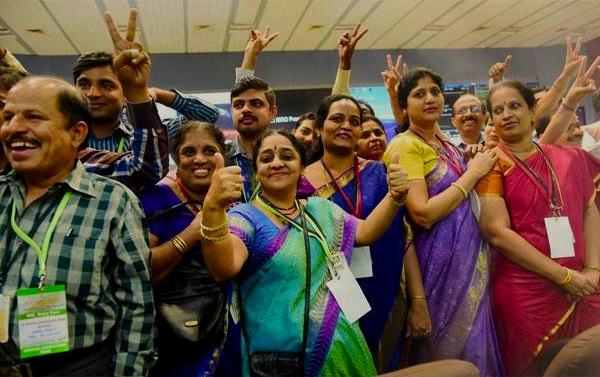
And this:

2014-09-29-isro3.jpg

The male engineers are wearing Western gear, while some of the female engineers are rocking traditional silk saris, the kind usually worn on special occasions, and jasmine flowers in their hair. On regular days, they work in full suits. There are no farm animals in sight at the ISRO office. And they certainly don’t look desperate for membership into some secret elite club. In fact, their jubilance says it all.

See, there are lots of socially and economically elite people in the world — being elite is like winning the lottery. But only a handful of human beings in history can claim to have sent a spaceship to another planet. That is brilliance and merit. That is actualizing human potential and literally moving humanity forward — like inventing the wheel, or, you know, sending a spaceship to Mars. One doesn’t have to be a rocket scientist to understand that.

SOURCE::::   IN  http://www.huffingtonpost.com/  

NATARAJAN

Image of the Day…. Images of MARS sent by India”s MOM …

Mars and its atmosphere, seen by MOM spacecraft

Two early images from India’s MOM spacecraft. One shows an edge of Mars, with the planet’s tenuous atmosphere above. The other shows the whole planet. Beautiful!

India's Mars Orbiter Mission (MOM) captured this image of the

The world applauded India last week as its maiden interplanetary spacecraft – the Mars Orbiter Mission, or MOM – achieved orbit around the Red Planet. Here are some of the first images transmitted from MOM. At top, a gorgeous shot of the limb, or edge, of Mars with the tenuous Martian atmosphere silhouetted against the blackness of space. The Indian Space Research Organization (ISRO), India’s space agency, released this image on September 25, 2014, about a day after MOM arrived.

ISRO announced that MOM successfully entered into an orbit around planet Mars on September 24, 2014 at 7:30 a.m. India Standard Time (02:00 UTC; 20:00 EDT in the U.S. on September 23). MOM carries five instrument suite whose mission is to study the surface and atmosphere of Mars with a particular emphasis on measuring the methane in the Martian atmosphere: a key indicator of microbial life.

Image via Mars Orbiter Mission

Above is another beauty from MOM, acquired on September 28, 2014.

The Schiaparelli Basin (460 kilometers / 286 miles wide) is visible just below right, of dead center. To the left is the Meridiani Terra with Meridiani Planum where NASA’s Opportunity rover is still operating almost flawlessly after 10 years on Mars.

Oxia Palus is clearly visible as is Chryse Planitia where the Viking 1 lander touched down in July 1976 and also the Ares Vallis, where the Mars Pathfinder successfully landed in July 1997.

Syrtis Major is visible towards the right limb.

Bottom line: Here are some early images from India’s MOM spacecraft. One shows the limb of Mars, with its tenuous atmosphere above. The other shows the whole planet, with a dust storm visible in the planet’s northern hemisphere. Beautiful!

SOURCE:::: earth sky news

Natarajan

World Heart Day…29 Sep …Tune into the First-Ever Heart Song !!!

World Heart Day is celebrated across the globe to create awareness on heartdiseases.

In today’s age, heart ailments have become common among Indians too. In 2010, heart disease was cited as the no. 1 killer in rural and urban India. Studies have also pointed out that 3 out of every 5 woman in India develop the risk of heart disease.

In this scenario, dna has put forth an initiative to create a song that will help promote healthy heart in the country with the great support from its readers. Bollywood actor Ranveer Singh too showed he had a giving heart.


Source::::: Apoorva Rao  in http://www.dnaindia.com/  and you tube

Natarajan


Image of the Day…Pic. That Spoke 1000 Words !!!

India’s Mars mission: Picture that spoke 1,000 words

Indian staff from the Indian Space Research Organisation (ISRO) celebrate after the Mars Orbiter Spacecraft (MoM) successfully entered the Mars orbit

Related Stories

When the crowded command control room of India’s Mars mission exploded into applause after it successfully put a satellite into orbit around the Red Planet, photographer Manjunath Kiran of the AFP news agency clicked this remarkable image of scientists congratulating each other.

Wednesday’s picture arrived with a rather anodyne caption saying “staff from the Indian Space Research Organisation (Isro) celebrate after the Mars Orbiter Spacecraft (Mom) successfully entered the Mars orbit”.

But in reality, the picture was about much more than that – a bunch of smiling Indian women resplendent in gorgeous saris greeting each other as their male colleagues look on admiringly at mission control in Bangalore.

“The women were leading the applause when the good news arrived. They were celebrating more than men. Who said men are from Mars and women are from Venus?” says senior science journalist Pallava Bagla, who was present in the control room.

The picture – which brightened up my manic morning writing up the Mars mission story – went viral and became the event’s image of the day.

People in their thousands tweeted that they loved it. One said “when was the last time you saw women scientists celebrate a space mission?”; another that the women showed “we don’t need to wear labcoats”. Others said the scientists in saris had “redefined mission control” and called them “true role models”.

The chatter even veered into the contentious Indian debate about tradition and modernity.

Look at our rocket scientists, said one tweet, when women working in call centres think that wearing jeans “makes them modern and scientific”. Somebody wondered why “no matter how much women succeed/achieve, the focus ultimately is on what they are wearing?” That, another respondent tweeted, is “because we have newspapers telling us that smart career women don’t wear saris only western business suits!”.

Although we do not know for sure whether all the women in this picture are engineers or scientists, they all probably work with India’s space agency. Some 20% of Isro’s 14,246 employees are women and their numbers are growing.

Nandini Harinath, 44, a physicist and a mother of two, was the deputy operations director of the Mars mission – in other words, she was the person “operating” the spacecraft between Earth and Mars. “It’s easier to bring up children than to control the Mars orbiter,” she told the NDTV news channel. Minal Sampath and her team built three instruments for the spacecraft and she wants to become “the first woman director of a space centre”.

A woman leads one of the agency’s main strategic programmes. Another female engineer was in charge of wheeling out the 15-storey-high 320,000kg (320 tonne) Satellite Launch Vehicle (SLV) from the vehicle assembly building to the launch pad. Tessy Thomas, a scientist from India’s Defence Research and Development Organisation (DRDO), is thought to be one of the very few women working on strategic nuclear ballistic missiles in the world. Three women led a team which launched a communication satellite three years ago.

What next? Will a woman head India’s space agency one day? (All seven chairmen of Isro so far have been men.) And, as Pallava Bagla writes, Isro reckons that the first astronaut from India “could well be a woman”. When that happens, Indian women will be over the moon.

SOURCE:::: Soutik BiswasDelhi correspondent IN BBC.COM

Natarajan

India Makes History…”MANGALYAAN” enters Mars Orbit !!!

India makes history, Mars orbiter enters red planet’s orbit


India has triumphed in its first interplanetary attempt by successfully putting a satellite into orbit around Mars.

India’s ambitious Mars Orbiter Mission (MOM) entered a crucial phase Wednesday with the country’s space scientists steering the spacecraft to the red planet’s orbit.

After rotating the Orbiter towards Mars, the main engine was fired 24 minutes from Mars to enter the Martian orbit, which will be about 500 km from its surface and 215 million km away from the Earth in radio distance.

The spacecraft will consume about 250 kg of liquid fuel with oxidiser.

India has triumphed in its first interplanetary attempt by successfully putting a satellite into orbit around Mars.

Scientists broke into wild cheers Wednesday morning as the orbiter’s engines completed 24 minutes of burn time and maneuvered into its designated place around the red planet.

The success of India’s Mars Orbiter Mission, affectionately nicknamed MOM, brings India into an elite club of Martian explorers that includes United States, the European Space Agency and the former Soviet Union.

The Indian Space and Research Organisation described the mission as flawless.

SOURCE:::::YAHOO India.com

Natarajan