” My Name Is Prof. Sandeep Desai…Pl join me In my Mission …”

Why this Professor begs on Mumbai trains

MUMBAI 52-year-old Professor Sandeep Desai is a familiar face on Mumbai’s local trains. He goes around begging on the crowded local trains to raise funds for running English medium schools for underprivileged children in rural Maharashtra and Rajasthan. Desai has been doing this for more than two years and has raised more than 50 lakh rupees that is used to run four schools. And the fifth school in Ratnagiri district of Maharashtra is set to open next month. All this has been done because of the commuters who donate generously every time Professor Desai boards their compartment.

Raunak Mehta, a commuter on the Western Railway tells NDTV: “He has several news paper cut-outs about himself which he carries around with him. I have been travelling in this train for two years now and I see him every day, if he wasn’t genuine he wouldn’t come here every day. There are a lot of young children in India who are unable to receive education. Iif these children are getting support and are being educated because we made a small donation, then we are very grateful.”

Professor Desai says, “We are not organised as of now, but soon we will have the right people because people are now themselves taking interest in what we want to do in the future and volunteering to come up. We are not only going to have volunteers, we are also going to have some employees who will be demarcated for certain responsibilities and every year we plan to start one more school.”

Meanwhile, for the five hundred students who benefit from Professor Desai’s endeavour, it is a life changing opportunity. In Umarkhed taluka of the far-flung Yavatmal district of Maharashtra, which is in the Vidarbha region known for farmers’ suicides children spend four hours in school everyday learning, free of cost. Dhiraj Dongare, an Auto-Driver, who makes around Rs. 100 a day, says “I used to save money every day to ensure my kids get education. I never imagined I would be able to send them to an English medium school.  Professor Desai has made it possible for us to send our kids to an English medium school. He is like a god for us.”

Professor Desai however continues with his mission ever evening cajoling commuters with his talks on the trains. He says his job has just begun and there is a long road ahead. He begins his talk with these lines: “Good Afternoon to everybody, “Donating for education is the ultimate form of charity”. My name is professor Sandeep Desai, I am the founder trustee of Shlok Public Trust, in rural areas we operate English medium schools. I invite all of you’ll to join my mission.”

Professor Desai adds that he has been able to do this not only because of the generosity of commuters, but also the support from railway staff. As we reach our destination and board the train we hear him share yet another message with his fellow commuters, “If you give a man food, you only feed him for a day. If you give him education, you feed him for a lifetime.”

And as his box starts filling up with donation, Professor Desai smiles at us and says, “What is amazing is the number of people who want to do something but don’t know how to do it. And many of them are here on these local trains. I am hoping all of them will join me.”

Source::::ndtv.com

Natarajan

Emami….Amazing Success Story….From Rs 20k to Rs 8000 Crores !!!

With the acquisition of Himani, Emami entered the mainstream personal care category in the late seventies, notes RS Agarwal.

The late 1960s were not the best of times to kick off one’s own business venture. Certainly not for two young boys, who did not hail from a business family and who were already engaged in cushy jobs in a large and respectable corporate group (Birla Group).

But then, if you love being the boss rather than being bossed around, if you have a desire to be in control, things will always be different.

And that’s exactly what happened with me and my childhood BEST FRIEND Radheshyam Goenka. So it was by choice that we left our jobs and stepped into business.

The entrepreneurial journey has never been smooth and certainly not in the initial days. We had the toughest ride in the initial years.

The greatest challenge was to get the right product line and control our losses. In 1974, we finally set up Kemco Chemicals, an ayurvedic medicine and cosmetics manufacturing unit with an initial capital of Rs 20,000.

Well, that was the beginning. The mid-70s were marked by the story of ‘the great Indian middle class’ with its growing propensity to consume and increasing purchasing power.

That was the time we rolled out Emami vanishing cream and Emami talcum powder.

We did not taste success initially.

But our failures gave us the most vital insight – if you are to capture the consumer’s mind space, there is no alternative but to stand out in the MARKET

And mind you, this particular MARKET was dominated by multinationals with deep pockets. I must also add here that the idea of standing out in the MARKET is easier said than done.

The task was even tougher because we were constrained by limited resources, a truly lean workforce.

We had to put on several hats simultaneously – strategists,MARKETERS door-to-door salesmen, payment collectors and what not. We realised (and rightly so) that the only way to survive and grow would be through innovation and introduction of new products.

For the first time in the history of Indian FMCG industry, we introduced products with imported French perfume and innovative packaging in plastic containers with imported Japanese labels that had golden motifs and printing. The strategy paid off and shortly both the products became immensely popular and by 1978, Emami vanishing cream became the market leader with 22 per cent market share and Emami talcum powder became the No.2 brand in its category in India.

We realised we were on the right track. People say the art of entrepreneurship lies in the capability of finding opportunities that others would not find, finding solutions that others can’t create and finding a silver lining and making some good out of chaos. And the same year (in 1978), we sensed a great opportunity in the century old, ailing Himani Ltd.

Himani, which had a strong brand equity in eastern India and a well laid out factory in Kolkata, was up for sale and we took a somewhat revolutionary step by acquiring that company, notwithstanding the fact that inorganic growth was not the order of the day for FMCG companies in those days.  The FINANCIAL risk was also significant.


But eventually the move proved to be a turning point for us. Subsequent to our acquisition of Himani, we saw enormous potential in the antiseptic cream MARKET, which was then monopolised by Boroline.

We were aggressive and came up with our first flagship brand Boroplus antiseptic cream from the stable of Himani in 1984.

Three years down the road, BoroPlus, the only antiseptic cream with ayurvedic ingredients, became the MARKET leader. The next decade (the 90s) was extremely eventful for Emami and we started off with the launch of our next flagship brand, another innovative product Navratna cool oil, again from the Himani stable.

It was also an industry first. The MARKET dominated by traditional hair oils, actually had a latent demand for a therapeutic oil that could also act as stress buster.

We came up with a second plant at Pondicherry to ramp up capacity. Navratna, the Rs 500 crore-plus brand today, is the MARKET leader in cool oil category in the country.

We were on a roll and in 1995, Kemco Chemicals, our first partnership firm was converted into a public limited company as Emami Ltd. In 1998, Emami Ltd was merged with Himani Ltd and its name was changed to Emami Ltd as per fresh certificate of incorporation dated September 1, 1998.

Our business strategy, over the years, has thrived on continuous ideation, innovation, spotting of the right opportunity and on-time execution.

When fairness creams were meant for women only and our peers and others never thought that men might also desire to look ‘fair’, we realised that a whopping 30 per cent of female fairness cream users were in fact men who were actually closet users.

Call it a MARKETING history or something else, in 2005, we launched Fair and Handsome, the first fairness cream for men.

Then came the acquisition of another century-old ayurvedic major, Zandu Pharmaceuticals, which has been yet another landmark and turning point in Emami’s history.

Before we finally bought over a controlling stake of 68.9 per cent in Zandu for Rs 713 crore in 2008, almost all key players in the Indian FMCG business had tried their luck and failed.

The Zandu takeover brought to our fold some of the popular and prominent brands like Zandu Balm, Zandu Chyawanprash, Zandu Kesri Jeevan, Zandu Pancharishta, Sudarshan and Nityam Churna.

The Zandu business grew rapidly, and we became debt-free within two years of the deal.

We also pioneered the concept of celebrity brand endorsement and in-film advertising to create a noise and make our products known in the market. MARKETING gurus will always recall matinee idol of yesteryears – Rajesh Khanna’s reel role as the managing director of Emami in the 1983 film Agar Tum Na Hote.

Over the years, our products have been endorsed by celebrated and acclaimed entertainment and sports personalities like Madhuri Dixit, Sri Devi, Sonakshi Sinha, Kareena Kapoor, Sachin Tendulkar, Sourav Ganguly, Mary Kom and so on. We are possibly the only brand in the country to have both Amitabh Bachchan and Shah Rukh Khan as endorsers for the same brand, Navratna.

Today, we are a homegrown multi-national with presence in 63 countries. With a group turnover of Rs 8,000 crore (Rs 80 billion) and a MARKET cap of Rs 18,000 crore (Rs 180 billion) and supported by a strong workforce of 20,000, we now stand tall, not only among Indian business conglomerates, but both Radheshyam Goenka and myself feature amongst the top Forbes 50 billionaires of India.

But what is more satisfying, as the second generation promoter directors from our two families gear up to take this Group to the next level, is the fact over the last 40 years we did not have A SINGLE  day of labour unrest.

The show, or shall I say, the battle to excel goes on.

(RS Agarwal co-founder & Joint chairman, Emami Group)

RS Agarwal

Source:   AND  Rediff.com
Natarajan

Money Lessons We Learn From ” Dussehra” !!!

Dussehra is a festival that marks the defeat of the evil king Ravana by Lord Rama who stands as a symbol of all that is good in humanity according to mythology. In some parts of India it is also celebrated as Vijayadashami or the day when the Goddess Durga defeated the demon king Mahisasura.

In Hindu tradition, Dussehra calls for big celebrations and is regarded to be a time to take a fresh perspective of life and marks the beginning of new things.

As you spruce up for Dussehra puja this year, we have a suggestion for you! How about looking at your finances in a whole new way?

In fact Dussehra has some precious financial lessons that you can implement.

Cast away your bad debt

Hindu men prepare to burn an effigy of 10-headed demon king Ravana during Dussehra festival celebrations in the western Indian city of Ahmedabad October 13, 2013. Effigies of the 10-headed Demon King Ravana are burnt on Dussehra, the Hindu festival that commemorates the triumph of Lord Rama over Ravana, marking the victory of good over evil.

Photograph: Amit Dave/Reuters

Dussehra, as we mentioned earlier, is the time when good conquers evil, so if you have too much of credit card debt and are perilously close to reaching your credit limit, focus all your energies towards the repayment of this kind of debt.

This is a debt of the worst sort and can be the real enemy of your financial plan.

Not only is it a high cost debt, as you pay a steep rate of interest on it, it will also impact your credit score negatively over the longer term.

Lead a life of financial self discipline

Lord Rama advocated a life of ‘Dharma’ meaning one has to be upright and responsible in life. The same principles should be made applicable to your finances as well.

If you are an important earning member of your family, you must apply financial discipline in a manner that you take care of your family’s needs not just at present but provide for the future as well.

This means you need to save wisely.

Just like Lord Rama, did not deter in living a life of frugality when it was required of him, you too must learn to live on less than you earn so that you save enough for future needs, like education of your children, health and other emergencies and most importantly have a comfortable and stress free retirement yourself.

Protect your finances

Dussehra is a time when the Hindu faith is renewed in the divine promise, that whenever there is evil prevailing on Earth, a saviour will be born to protect humanity. You too should take a cue from this message and learn to protect your finances.

By protection, we mean, you should have enough life, health and asset insurance.

Mostly, people get so caught up with growing their portfolio that they keep insurance at a minimum. On the contrary, it should be the other way around.

You should first assess the insurance needs of your family and then invest the surplus in other instruments to maximise your gains.

It’s a time for new beginnings

Dussehra also signifies doing away with the old and getting a new lease of life. Apply this principle to your finances as well.

If you do not have a proper financial plan chalked out according to the short term and long term financial goals you have in life, there isn’t a better time to begin!

Dussehra is a time of joy and hope, so make this Dussehra an occasion of immense joy as you vow to approach your finances from a new and fresh perspective.

The author is a credit expert with 10 years of experience in personal finance and consumer banking industry and another 7 years in credit bureau sector. Rajiv was instrumental in setting up India’s first credit bureau, Credit Information Bureau (India) Limited (CIBIL). He has also worked with Citibank, Canara Bank, HDFC Bank, IDBI Bank and Experian in various capacities.

The author is Director & Co-founder, Creditvidya.com  

SOURCE:::: Rediff.com

Natarajan

Thanks to Elizabeth Holmes…Blood Tests in Future Would be Totally Different !!!

The next time you get a blood test, you might not have to go to the doctor and watch vials of blood fill up as the precious fluid is drawn from your arm.

No more wondering to yourself – “ah, how much more can they take before I pass out?”

Instead you might be able to walk into a Walgreens pharmacy for a reportedly painless fingerprick that will draw just a tiny drop of blood, thanks to Elizabeth Holmes, 30, the youngest woman and third-youngest billionaire on Forbes’s newly-released annual ranking of the 400 richest Americans.

Theranos Chairman, CEO and Founder Elizabeth Holmes

Revolutionizing the blood test is a golden idea.

Because of new testing methods developed by Holmes’s startupTheranos, that LONE drop can now yield a ton of information.

The company can run hundreds of tests on a drop of blood far more quickly than could be done with whole vials in the past – and it costs a lot less.

A Billion Dollar Idea

Holmes dropped out of Stanford at 19 to found what would become Theranos after deciding that her tuition MONEY could be better put to use by transforming healthcare.

Traditional blood testing is shockingly difficult and expensive for a tool that’s used so frequently. It also hasn’t changed since the 1960s.

It’s done in hospitals and doctor’s offices. Vials of blood have to be sent out and tested, which can take weeks using traditional methods, and is prone to human error. And of course, sticking a needle in someone’s arm scares some people enough that they avoid getting blood drawn, even when it could reveal life saving information.

Holmes recognized that process was ripe for disruption.

It took a decade for her idea to be ready for primetime, but now it seems that her decision to drop out was undoubtedly a good call. Last year, Walgreens announced that it will be installing Theranos Wellness Centers in pharmacies across the country, with locations already up and running in Phoenix and Palo Alto. And Holmes has raised $400 million in venture capital for Theranos, which is now valued at $9 billion (Holmes owns 50%).

The other two 30-year-olds that are just a little bit younger on Forbes’s List, Facebook founder Mark Zuckerberg and his former roommate, Facebook CEO Dustin Moskovitz, also have access to a wealth of information about people – but their data is less likely to save a life.

elizabeth holmes theranos

Courtesy Theranos

How It Works

One closely-guarded secret is what MedCityNews calls “the most interesting part of [the Theranos] story”: how exactly the technology behind its blood test works. The company’s methods are protected by more than a dozen patentsfiled as far back as 2004 and as recently as last week.

In an interview with Wired, Holmes hinted at some of the key ideas behind Theranos.

“We had to develop… methodologies that would make it possible to accelerate results,” she explained. “In the case of a virus or bacteria, traditionally tested using a culture, we measure the DNA of the pathogen instead so we can report results much faster.”

While we can’t yet assess independently how well that method works when compared to traditional blood tests, it already seems to be upending the old way of doing things.

Why Blood Tests?

Holmes told Medscape that she targeted lab medicine because it drives about 80% of clinical decisions made by doctors.

By zeroing in on the inefficiencies of that system, the Theranos approach completely revolutionizes it.

The new tests can be done without going to the doctor, which saves both MONEY and time. Most results are available in about four hours, which means that you could swing by a pharmacy and have a test done the day before a doctor’s visit, and then the results would be available for the physician.

Quick tests that can be done at any time are already a total change, but the amount of data the company can get from a single drop of blood is amazing.

Blood samples have traditionally been used for one test, but if a follow up was needed, another sample had to be drawn and sent out – making it less likely that someone would get care. The Theranos approach means the same drop can be used for dozens of different tests.

It’s cheap too. One common criticism of the healthcare system is that the pricing structure is a confusing disaster of a labyrinth that makes it impossible to know how much anything costs. Theranos lists its prices online, and they’re impressive.

Each test costs less than 50% of standard Medicare and Medicaid reimbursement rates. If those two programs were to perform all tests at those prices, they’d save $202 billion over the next decade, according to an interview with Holmes on Wired.

Plus, people get access to their own results.

source::::: KEVIN LORIA  in  http://www.businessinsider.in/

Natarajan

As an example of how helpful that can be, Holmes told Wired that Theranos charges $35 for a fertility test, which is usually paid for out-of-pocket and costs up to $2,000.

But she also explained that this data could be useful for anyone looking to gain a better understanding of their health.

“By testing, you can start to understand your body, understand yourself, change your diet, change your lifestyle, and begin to change your life,” she said.

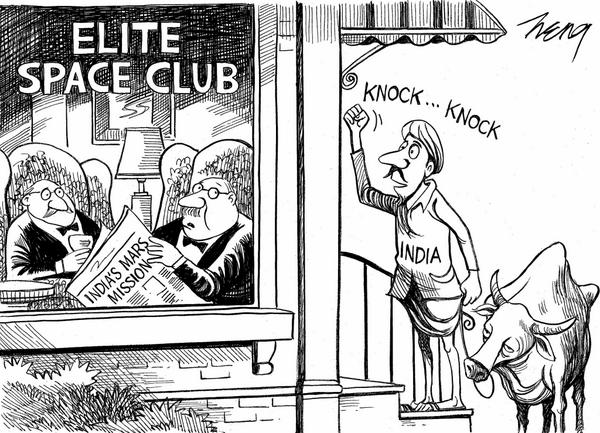
” No Need for India to Knock at the Doors of Elite Space Club …” !!!

The ‘New York Times’ Publishes Racist Comic About India’s Space

Mission

Last week, India became the first Asian nation to reach Mars, and the first in the world to do so on its first attempt.

The spacecraft called Mars Orbiter Mission (MOM) in English and “Mangalyaan” or “mars craft” in Hindi was launched in November and reached the orbit on Wednesday, to much jubilation from the public.

India’s first interplanetary mission is all the more creditable because, at $72 million, Mangalyaan cost just a fraction of NASA’s $670 million Maven, and $2 billion Curiosity Rover. It also cost less than to produce the film Gravity, and at Rs.7 or 11 cents, per kilometer, cost less than the per-kilometer cost of commuting by autorickshaw in most Indian cities.

So yesterday’s New York Times’ comic by Heng, titled “India’s budget mission to Mars” seems in poor taste.

2014-09-29-racistcomic.jpg

The comic depicts a poor Indian farmer in traditional garb, accompanied by a bored-looking cow, eagerly knocking on the door of “Elite Space Club”. The two people in the elite space club drinking wine and reading about India’s mission in the papers look perturbed and hesitant to open the door. It is also worth noting that the members of the elite space club are male, white, elderly and look wealthy. Whether meant to be funny or ironic, the racial, national and classist stereotyping is apparent.

In reaching Mars, the Indian Space Research Organization (ISRO) joins the ranks of Soviet space program, NASA and European Space Agency. It not only did so on a budget, but also battling “brain drain“. It’s a commonly lamented problem that many of the country’s brightest scientists and engineers end up working internationally, and tend to shy away from research in India, especially an area like space research, because it’s not as lucrative.

The comic strip comes at the time of Indian Prime Minister, Narendra Modi’s maiden visit to the United States. Addressing a 20,000 strong crowd at Manhattan’s iconic Madison Square Garden yesterday, he emphasized India’s new role on the world stage and its growing economic clout. “When people ask if we still play with snakes in our country, I tell them that now we play with the mouse,” Mr Modi said, drawing attention to the changing stereotype of India from a nation of snake charmers to one of technical prowess.

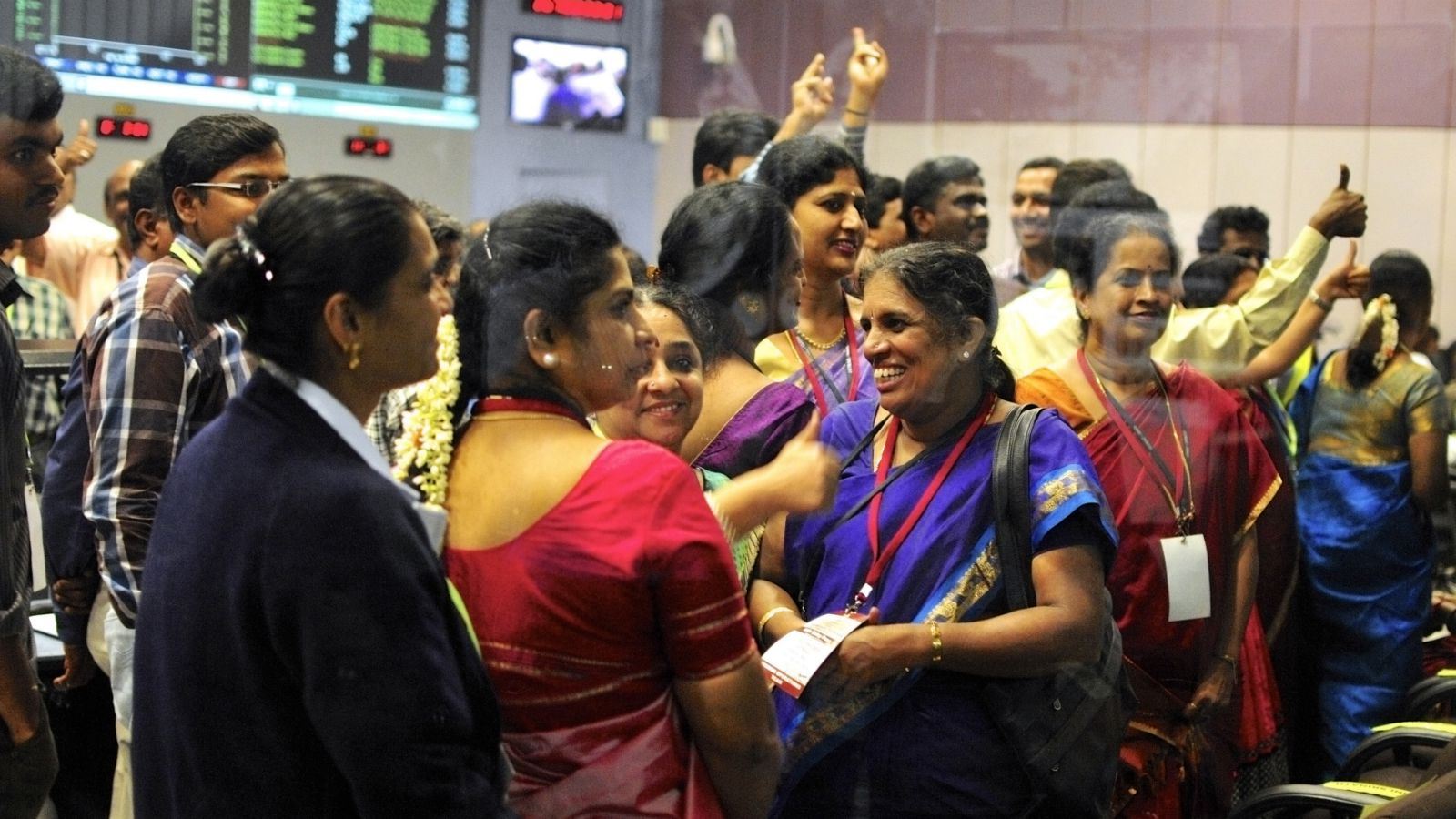
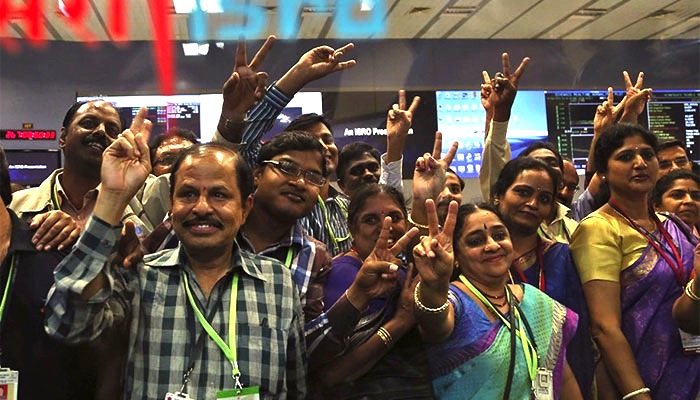
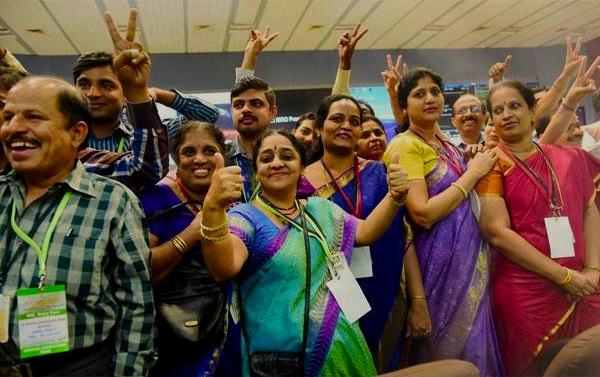
In case the Times is wondering what interplanetary-mission-heading Indian scientists look like then here you go, this is what they look like:

2014-09-29-isroscientists.jpg

And this:

2014-09-29-isro2.jpg

And this:

2014-09-29-isro3.jpg

The male engineers are wearing Western gear, while some of the female engineers are rocking traditional silk saris, the kind usually worn on special occasions, and jasmine flowers in their hair. On regular days, they work in full suits. There are no farm animals in sight at the ISRO office. And they certainly don’t look desperate for membership into some secret elite club. In fact, their jubilance says it all.

See, there are lots of socially and economically elite people in the world — being elite is like winning the lottery. But only a handful of human beings in history can claim to have sent a spaceship to another planet. That is brilliance and merit. That is actualizing human potential and literally moving humanity forward — like inventing the wheel, or, you know, sending a spaceship to Mars. One doesn’t have to be a rocket scientist to understand that.

SOURCE::::   IN  http://www.huffingtonpost.com/  

NATARAJAN

Nauru”s Downfall From Rich Nation to Sick Economy ….

The island of Nauru. Picture: Bradley Hunter

The island of Nauru. Picture: Bradley Hunter Source: News Limited

IT’S a deeply troubled nation that has been plunged into a nightmare scenario, struggling with a failed economy, health crisis and the destruction of its natural beauty. But life wasn’t always like this in Nauru.

At just 21 square kilometres, it’s the smallest island nation in the world and has a population of just over 10,000. Yet this former British colony, which lies approximately 4000km from Sydney in the Pacific Ocean, was once so prosperous that it was the envy of the entire world.

And it was all thanks to bird poo.

We’re not kidding. The discovery of huge deposits of fossilised bird poo that had accumulated for over 1000 years changed this nation forever. It made for an excellent fertiliser and sparked a huge mining effort, first by foreign companies, then by the islanders themselves in 1968 when they achieved independence from Britain.

By 1980 Nauru had become the wealthiest nation on the planet, per capita. A monumental achievement for such a tiny, remote island.

Secondary mining of phosphate in Nauru, 2007. Picture: Lorrie Graham

Secondary mining of phosphate in Nauru, 2007. Picture: Lorrie Graham Source: Flickr

Rolling in riches, the locals abandoned their traditional lifestyles and turned to unhealthy food, alcohol and cigarettes.

It wasn’t long before a health crisis hit, and hard.

Life expectancy plunged to just 50, while rates of diabetes, heart disease and other chronic illnesses skyrocketed along with their waistlines. In 2007, 94.5 per cent of its residents were identified by the World Health Organisation as overweight, and 71.7 per cent obese — the highest rate in the world. It was overtaken in the obesity stakes by Mexico in 2013.

These days, Nauru has the highest prevalence of type-two diabetes in the world, affecting 31 per cent of adults.

The downfall of the world’s richest country

Locals walk to fight obesity. Picture: DFAT Source: Flickr

That was just the start of their problems. The phosphates ran out in the early 1980s, along with the nation’s primary income source.

With so much of the island mined, all that was left was an environmental wasteland riddled with decay. The damage is so severe that 75 per cent of the country is uninhabitable.

While Nauru was formerly known as “Pleasant Island” due to its lavish tropical vegetation, it’s a harsh reality that it no longer lives up to this name.

A message in Nauru. Picture: Lorrie Graham

A message in Nauru. Picture: Lorrie Graham Source: Flickr

‘The effects of mining are very distinctive, because the phosphate develops within coral pinnacles, so you have to scoop the phosphate out from within the pinnacles themselves,” Professor John Connell, head of the School of Geosciences at the University of Sydney told the ABC. “So those scooped areas descend about three metres … So it produces an extraordinary landscape which is visually quite dramatic and is totally useless for anything else.”

The coral pinnacles of Nauru. Picture: Bradley Hunter

The coral pinnacles of Nauru. Picture: Bradley Hunter Source: News Limited

Locals were devastated at the loss of their once-stunning scenery.

“I wish we’d never discovered that phosphate,” Rev. James Aingimea, 84, the minister of the Nauru Congregational Church told the New York Times at the time. “I wish Nauru could be like it was before. When I was a boy, it was so beautiful. There were trees. It was green everywhere, and we could eat the fresh coconuts and breadfruit. Now I see what has happened here, and I want to cry.”

Health warnings in Nauru. Picture: DFAT

Health warnings in Nauru. Picture: DFAT Source: Flickr

Many residents had quit their jobs and went on huge spending sprees including expensive holiday and shopping trips, and importing sports cars – even a Lamborghini. So there was little cash left.

“Hardly anyone thought of investing the money. Dollar notes were even used as toilet paper,” a local told the BBC. “It was like every day was party day.”

In the years that followed, the island went virtually bankrupt. The government, who had made a series of bad investment choices, froze wages and started borrowing heavily from trusts.

The island. Picture: ARM, Wikipedia

The island. Picture: ARM, Wikipedia Source: Supplied

“A lot of money was invested in things which never actually turned out to work,” Professor John Connell, head of the School of Geosciences at the University of Sydney told the ABC. ‘For example, buildings in overseas countries, like Nauru House in Melbourne, hotels in some countries, phosphate factories, curiously, in countries like India and the Philippines, most of which never really survived.”

Now, many homes are run down, and those sports cars are rusted wrecks.

Locals enjoy a game of volleyball. Picture: DFAT

Locals enjoy a game of volleyball. Picture: DFAT Source: Flickr

With little financial options, in 2001 Nauru entered into an agreement with Australia to house a detention centre in return for foreign aid, of which they became reliant. As of this year, that amount Australia provides is $27.1 million.

Detention centre being constructed. Picture: Deidenang Clint

Detention centre being constructed. Picture: Deidenang Clint Source: Supplied

These days, for many Australians, the first thing we think of when Nauru is mentioned is the plight of asylum seekers there. But all that could soon change; the more than 1000 asylum seekers in Nauru could soon be moved to Cambodia under a new deal.

Source::::KATE SCHNEIDER, Travel Editor in news.com.au

Natarajan

World”s Longest Flight On Biggest Plane ….

A380 pushing the limits

QANTAS is making aviation history today as the world’s largest passenger aircraft, the superjumbo A380, starts flying the world’s longest route — a non-stop trip lasting nearly 16 hours.

Well, it’s 14 hours 50 minutes to get from Sydney to Dallas/Fort Worth, but a longer 15 hours 30 minutes to return.

Passengers travelling on the route are now privy to the glam and size of the increasingly popular A380 with Qantas operating six direct return services per week.

Qantas Group CEO Alan Joyce says the move reflect the airline’s history of endurance, setting records and connecting Australians to the world.

“Today, Qantas is leading the way again with the introduction of the world’s largest passenger aircraft on the world’s longest route, Sydney to Dallas/Fort Worth, with a flying time of almost 16 hours,” Mr Joyce said this morning at a media conference at Sydney Airport.

So what’s the attraction of arriving in the boot/scooting cowboy-laden city?

“Since starting on the route in 2011 the feedback from our corporate customers, especially those in the resources, technology and agricultural sectors, tells us they like flying into the Dallas hub because it gets them closer to their final destination in the US and offers great onward connections.

“The Dallas/Fort Worth service offers direct access right into the heart of the US with over 50 connections to all US major cities all within four hours, including Orlando, Boston and Houston.”

Qantas recently announced increased services to the US, and will now offer 41 services per week to North America. About half of these services are operated by A380 aircraft and the other half by B747s with A380-style interiors.

Alan Joyce at the meeting event today.

Alan Joyce at the meeting event today. Source: NewsComAu

Mr Joyce said introducing A380 services between Sydney and Dallas/Fort Worth, which is the only direct flight from Australia to inland United States, would provide enhance the customer experience and boost capacity.

“We know our customers will value the comfort of the A380 on this route,” he said. “It’s also a vote of confidence in Qantas’s business going forward.

“Not only will the A380 increase seats on the route by more than 10 per cent each week, it will also provide us with greater fuel efficiency and the range to operate the return service direct back to Sydney.

Dallas, here we come.

Dallas, here we come. Source: News Limited

“Our customers also now have the choice of four cabins to both Los Angeles and Dallas/Fort Worth as we introduce our Marc Newson designed First Class Suites on the Dallas/Fort Worth route for the first time.”

The new A380 service will also create further opportunities for both tourism and TRADE between Australia and the US.

“Dallas/Fort Worth is home to our partner American Airlines, and it’s the perfect hub for both business and leisure travellers heading in either direction across the Pacific.”

Mr Joyce said the fall in the Australian dollar actually has a positive impact on its international business.

“Sure there is always an impact in fuel prices but luckily we have seen a decrease in fuel prices of late regardless.”


The world’s longest flights in distance include The Sydney — Dallas/Fort Worth leg at 13,804km followed by Delta’s Johannesburg to Atlanta at 13,582km and Emirates Dubai — Los Angeles at 13,420km.

In 1989, Qantas operated the world’s longest non-stop delivery flight, when it flew a Boeing B747-400 from London to Sydney in 21 hours. Meanwhile Qantas holds the record for the longest regular commercial flight time-wise, set in 1944 from Perth to Sri Lanka.

The new flight replaces the current Boeing 747-400ER aircraft used on the route. The A380 will step up to a daily service over the 2014-2015 summer holiday season, from December 9 2014 to January 20 2015.

DFW airport is upgrading one terminal with three extra aerobridges to load passengers on the double-decker jet, while Qantas’ partner Emirates is set to begin A380 flights between DFW and Dubai from October 1.

Qantas’ existing flights between Melbourne, Dubai and London will be retimed to make room for these extra A380 services.

“This schedule change unlocks more A380 flying time that we can use on the Dallas route, and now offers four times the number of onward connections to Europe because of the new arrival time of the Melbourne flight into Dubai,” adds Qantas CEO Alan Joyce.

Qantas says the current mix of Boeing 747 and Airbus A380 flights from Sydney to Hong Kong will also face “adjustments”, although the airline hasn’t yet revealed whether the A380 will disappear from Asia entirely.

Fun flying facts:

• The Qantas A380 carries 323,000 litres of fuel, equivalent to eight backyard swimming pools.

• The Qantas A380 is fitted with a First, Business, Premium Economy and Economy cabin offering 484 seats, (14 First, 64 Business, 35 Premium Economy and 371 Economy).

• Qantas is the larger purchaser of Australian wines.

• The A380 delivers up to 10 per cent improvement in fuel efficiency and carbon emissions per revenue tonne kilometre, than most of today’s largest passenger jets.

• Qantas began flying to Dallas Fort Worth in May 2011 and is the only carrier to operate direct services from Australia to Dallas/Fort Worth.

The writer is flying as a guest of Qantas.Follow Melissa’s (mis)adventures to Texas on Instagram and Twitter @melissahoyer.   

Source:::: MELISSA HOYER  in news.com.au

Natarajan

The Most Entertaining Airports In The World …

Here are seven international airports that go beyond free Wi-Fi and luggage carts to offer truly entertaining amenities.

Amsterdam Airport Schiphol, Haarlemmermeer, Netherlands

Amsterdam Airport SchipholFlickr/ajay_suresh

Amsterdam Schiphol Airport highlights: “Holland Boulevard,” a library, Dutch Kitchen restaurant, a museum, and Holland CASINO.

Changi International Airport, Changi, Singapore

changi slideFlickr/wongjunhao

Changi International Airport highlights: Nature trails, gardens, a four-story slide, a rooftop pool, and a movie theater (free admission).

Munich Airport, Munich, Germany

Munich AirportMunich Airport

Munich Airport highlights: Airbrau brewery and restaurant, free surfing lessons in the outdoor wave pool (summer only), volleyball tournaments, and a Christmas MARKET.

Incheon International Airport, Incheon, South Korea

incheon airportFlickr/zionorbi

Incheon International Airport highlights: “Spa on Air” sauna, Thai massage, the Ice Forest skating rink, a movie theater, gardens, and traditional musical performances.

Hong Kong International Airport, Chek Lap Kok, Hong Kong

Hong Kong International AirportHong Kong International Airport

Hong Kong International Airport highlights: A nine-hole golf course, the Aviation Discovery Center, the Dream Come True Education Park, and an IMAX theater.

Vancouver International Airport, Richmond, British Columbia

vancouver airportFlickr/alanchan

Vancouver International Airport highlights: A 114,000-liter aquarium and a jellyfish exhibit.

Zurich Airport, Zurich, Switzerland

zurich airportFlickr/patrick_nouhailler

Zurich Airport highlights: Observation decks and a miniature airport for children.

This article originally appeared at SmarterTravel.

SOURCE::: Business insider.com

Natarajan

Read more: http://www.smartertravel.com/photo-galleries/editorial/the-worlds-seven-most-entertaining-airports.html#ixzz3ENucJlFf

5 Surprising Things That Cost More Than India’s Historic Mission To Mars !!!

India just became Asia’s first interplanetary power. The country’s Mangalyaan satellite successfully made it into orbit around Mars on Wednesday after a roughly 10-month journey. The mission comes at an astonishingly low cost of $74 million, or nearly one-tenth of the price of NASA’s MAVEN spacecraft that entered the red planet’s orbit Sunday night.

Indian Space Research Organization chief K. Radhakrishnan even called the Mars Orbiter Mission “the cheapest interplanetary mission ever to be undertaken by the world.”

Just how cheap? This graph shows a handful of surprising things that cost more than India’s Mars mission.

India Mars

Business Insider

  • The most expensive apartment ever sold in London had a price tag of $237 million. You could get three of India’s satellites for that cost, and with a better view.
  • The new F-35 fighter jet costs a jaw-dropping $160 million a pop.
  • “Gravity” starring George Clooney and Sandra Bullock cost about $100 million. That’s about one-third more than the cost of the successful Mars mission.
  • The Airbus A380 would set you back more than $400 million. You could get more than five Mangalyaan satellites for that price.


SOURCE:::: Mike Bird  in Business Insider India.com

NATARAJAN

Mangalyaan Reaches MARS On FIRST Attempt…


India put a satellite into Mars orbit early Wednesday, the only nation to have done so on a maiden voyage and the first in Asia to reach the red planet.

As the country’s Prime Minister Narendra Modi looked on, space scientists at mission control in Bangalore, India’s tech capital, announced that the Mangalyaan orbiter had entered Mars orbit after a 10-month voyage from Earth.

Mangalyaan, Hindi for Mars craft, cost $74 million to send into space, making it by far the cheapest of recent missions to Mars. The U.S. spent $671 million getting its Maven satellite to Mars orbit, where it arrived late Sunday.

Mr. Modi boasted in June that India had spent less than Hollywood had on producing the film “Gravity” to reach the red planet. On Wednesday, Mr. Modi, wearing a bright red jacket, hugged  Koppillil Radhakrishnan chairman of the Indian Space Research Organisation, before addressing ISRO scientists in Hindi and English. “History has been created today, we have dared to reach out into the unknown and have achieved the near impossible,” Mr. Modi said.  ”I congratulate all ISRO scientists as well as all my fellow Indians on this historic occasion.”

“We have gone beyond the boundaries of human enterprise and imagination. We have navigated our spacecraft through a route known to very few,” the prime minister added.

A father and son looked at a scale model of India’s Mars Orbiter spacecraft at the Nehru Planetarium as a special preview on the Mars Orbiter Mission, in Bangalore on Sept. 23, 2014.
Manjunath Kiran/Agence France-Presse/Getty Images

India now joins a small club of nations — the U.S., Russia and those in the European Space Agency – to have mastered interplanetary travel, giving it bragging rights over Asian rivals China and Japan whose attempts to get to Mars failed.

“Domestically this will boost the morale of the people that India has gained tremendous economic and technical development and is on the way pretty fast to becoming a developed country,” said Ram Jakhu, a professor at the Institute of Air and Space Law at McGill University in Canada. “Externally, India will have its head held high to say that it is capable of such a complex task.”

The mission, which took just four years from feasibility study to arrival at Mars orbit, will now study the surface of the planet to establish the presence of methane, among other tasks using the five instruments in its 15-kilogram payload.

The primary aim of the mission was to see if India had the technological capability to get to Mars. Now that it’s done so, the next step will be to complete a moon landing before possibly attempting manned missions, Mr. Radhakrishnan of ISRO told India’s NDTV on Tuesday.

Critics of the mission have questioned whether India, where 40% of children are malnourished, should have a space program at all. But advocates argue that development in space in turn drives innovation on Earth.

“India’s space program has a socio-economic basis for purposes like remote sensing and medical advancement. From that perspective, none of the money has gone in an extravagant way where it isn’t used for the benefit of the common man,” said Ajey Lele, author of “Mission Mars: India’s Quest for the Red Planet.”

To hold costs down, India relied on technologies it has used before and saved on fuel by using a smaller rocket to put its spacecraft into Earth orbit first to gain enough momentum to slingshot it toward Mars. India spends $1.2 billion a year on its space program: a dollar for every member of its population. On Wednesday, for many Indians cheering their country’s achievement, that looked like a bargain.

SOURCE:::: http://blogs.wsj.com/indiarealtime/2014/09/24/indias-mangalyaan-enters-mars-orbit/

Natarajanb