11 Common Beliefs About Food That Are Actually Not True….

Let’s face it – we are all foodies. Some of you are complete gluttons, like me, and some might keep what they eat in check, but we all love to eat. Then again, none of us like any added problems like, obesity or cholesterol that come with eating (overeating, in my case), right!

That is the reason why we often vow to eat healthy, and try to follow certain diets that celebrities apparently follow, to get in shape. What we fail to realize is that more often than not, we end up believing in myths circulated by companies trying to sell stuff or know-it-all self-claimed diet experts. Take these 11 myths about food for example, that I used to think were true, until now.

1. Artificial sweeteners are better than sugar

Image source

Not really. Though using artificial sweetener can decrease the calorie intake and help with your weight control, on the other hand, it might contribute to diabetes and other health troubles!

Source


2. You need to eat meat to get enough protein

Image source

Nature is rich in nutrients, luckily, and you can very well get your required amount of protein without having to eat meat. Quinoa, avocado, peas etc are also quite rich in proteins.

Source

3. Fats are bad for you

Actually, some fats are essential for health, like monounsaturated and polyunsaturated fats, along with omega-3 fatty acids; these are normally found in nuts, seeds, olive oil, etc. They protect us from heart diseases and cancer.

Image source


Source


4. Fresh vegetables are more nutritious than frozen ones

Image source

Rather than ‘fresh’ vegetable kept for long, frozen vegetables are generally frozen when they are their most fresh, with most of the nutrition value remaining intact!

Source


5. Fried food is always too fatty

Image source

Though fried food is always considered one of the biggest culprits creating heart troubles and such, they are kind of wrongly accused. The health risk often depends on the kind of oil used, and how fried the stuff is, along with what stuff is being fried; just because it’s fried, doesn’t mean it’s bad.

Source


6. All saturated fats increase cholesterol


Image source

Nope. In fact, polyunsaturated fats, generally found in corn oil or sunflower oil, help to reduce harmful LDL cholesterol, and improve the cholesterol profile of our body.

Source


7. Eating eggs is not exactly excellent for your health

Image source

On the contrary, eggs are rich in several nutrients like betaine and choline that contribute towards keeping your heart healthy. Eggs are also a great source of healthy proteins.

Source


8. Added sugar is always bad for health

Image source

No way. We need sugar to function properly, as it supplies ready energy to fuel our muscles, and also helps to keep our brains active. Though I wouldn’t suggest you to binge on sugar, a little bit of it won’t hurt, really.

Source

9. Organic food has better nutrition value


Image source

There is not much extra health benefit of organic food over conventional food, a team of Stanford scientists have found after an extensive study.

Source

10. Carbohydrates are fattening

Image source

Carbs are not always your worst nightmare, despite all the diets asking you to cut it down. Rather, cutting carbs down can affect your metabolism, increase stress hormones, and decrease thyroid function.

Source


11. Calories we eat at night stick to our body more than when taken during the day

Image source

Your weight gain depends on the amount of calorie you are taking in, not on when you are taking it in.

Source

Folks, don’t just give in to excessive advertisements or slimming diets claiming to thin you down in a few days. Eat well, live well.

Source….   Anwesha Maiti…www.storypick.com

natarajan

Image of the day….

Morning Aurora From the Space Station

Aurora in early morning on Earth's horizon with city lights below and space station solar arrays above

NASA astronaut Scott Kelly (@StationCDRKelly) captured this photograph of the green lights of the aurora from the International Space Station on Oct. 7, 2015. Sharing with his social media followers, Kelly wrote, “The daily morning dose of #aurora to help wake you up. #GoodMorning from @Space_Station! #YearInSpace”

Image Credit: NASA

Source….www.nasa.gov

natarajan

Why Do we Touch the Feet of Our Elders….?

1. Why do we touch the feet of our elders?

Why do we touch the feet of our elders?

Touching the feet of elders as a mark of respect is an age old practice in Indian tradition. Often this practice is looked upon with derision by some people as feet are generally considered unclean and such people argue that there could be other better ways of conveying the respect. However, there are a number of reasons behind the practice of touching the elders’ feet that indicate how wonderfully beneficial and meaningful this practice is.

2. Foundations for Buildings

Foundations for Buildings

Feet are for the body as the foundations are for buildings. The entire weight of a person is borne by the feet when he stands and moves about. Except birds and some rare cases of mammals, humans are endowed with the gift of being able to walk erect in two feet. When we bend down and touch the feet of our elders, our ego is also automatically subdued and we indicate that we respect their age, wisdom, achievements and experience. Being pleased of our humility, they in turn bless us.

3. Padasparshan

Padasparshan

Usually, those that command padasparshan (touching the feet) include spiritual masters, teachers, grand parents, parents, elder brothers and senior citizens. Usually, these people have accumulated a lot of virtues, knowledge and experience. Their maturity shall have enabled them with a good insight into the truths and realities of life. The thoughts, vibrations and the words emanating from them shall be so powerful in immensely benefiting those who seek their blessings.

4. Way of Touching the feet of Elders


There is a particular way of touching the feet of elders. The person touching their feet must bend down in front of them with the back hunched and hands stretching forward. Usually, when the hands are stretched to touch their feet, it is advised that the hands are crossed in a way the right hand touches their right foot and the left hand touches their left foot. Yet another prescription states that the left hand should touch their right foot and the right hand should touch their left foot.

5. Positive Energy

Positive Energy

In either case, when the hands touch the feet, there is a closed circuit establish between those seeking the blessings and those blessing them. The result is a highly positive energy flowing from their feet to the other person transferring a lot of good will and healing energy. Also, the person whose feet are touched usually stretches his or her hands to touch the upper head of the person with a gesture of blessing. This connection forms yet another circuit again transferring energy and blessings.

6. Benefits

It is matter of fact that only elders who seek your well being and those who are noble in their attitude and conduct are to be touched thus. Generally one’s grand parents, teachers, parents, elder brothers and noble people would naturally bless from their heart genuinely seeking the welfare of those who touch their feet. Therefore, this act shall confer incomparable benefits. Psychologically this act confers humility and cultivates a sense of respect enjoining people in the right path.

7. Hindu Tradition

Hindu Tradition

The Hindu tradition states that by touching the feet of elders, people are blessed with strength, intellect, Knowledge and fame. The underlying symbolism of this act is that the elders have walked on this earth longer than you and have accumulated a great amount of wisdom. You can in fact immensely benefit even from the dust that their feet have gathered all along the way.

Source….www.speakingtree.in

Natarajan

Pictures of the Day…

Bill Clinton Young Kennedy

Bill Clinton (left) shakes hands with President John F. Kennedy at the White House in 1963. Image Source: www.vintag.es

Camel Yawn Pyramids Egypt

A camel yawns near the Great Pyramids of Giza, Egypt. Photo by Claire Thomas. Image Source: National Geographic

Colorado River Delta Aerial

The Colorado River delta in Mexico as viewed from above. Photo by Edward Burtynsky. Image Source: National Geographic

The Haunting Chinese Village Reclaimed By Nature

Houses Covered In Growth

Image Source: All That Is Interesting

Of the 400 islands that make up the Shengsi archipelago in the mouth of China’s Yangtze River, only 18 are inhabitable. And of those 18, one has recently slipped back into the control of Mother Nature in the most hauntingly beautiful way you could imagine. The houses that dot the hillsides of Goqui Island, once home to fishermen and their families, are now covered in lush, green growth that is truly stunning. See the houses become one with the hills in this photo set.

Goqui China Reclaimed By Nature

Image Source: All That Is Interesting

China House Reclaimed By Nature

Image Source: All That Is Interesting

By on October 2, 2015 in

John Kuroski

In addition to serving as the Assistant Editor of All That Is Interesting, John Kuroski is the Managing Editor of Elmore Magazine, a New York-based music publication.
Source….www.all-that-is-interesting.com
Natarajan

In Nepal, Every Dog Has Its “Day”. Literally……!!!

Dog Festival Nepal Sprinkled

Most dog owners would do just about anything for their canine companions. In Nepal, Hindu populations take that affection to another level.

Coinciding with the traditional Hindu festival of Diwali, the people of Nepal reserve the second day of the annual five-day Tihar Festival to honor man’s best friend. On this day — called Kukur Tihar, or “worship of the dogs” — participants pay tribute to the divine attachment between humans and their faithful, four-legged companions.

Dogs play a significant role in Hindu mythology. Sarama — the mother of dogs — assists the ruler of Heaven, with dogs guarding the gates to the afterlife. Thus during the festival, all dogs – even strays – enjoy special treats, are decorated with malla (garlands of marigold), and colorful head markings to denote their sacredness. The markings, called tika, also serve to bless all who encounter the dog.

Dogs aren’t the only animals honored during the festival, though. Worshipers also pay tribute to cows (which signify wealth and prosperity) and crows, to which people make food offerings in order to deter sadness, grief and to banish death from their homes.

The festivals of Tihar are meant to commemorate not just the sacred bond humans hold with their creator, but also the divine in our relationships with living beings on Earth — something of which we should all take note from time to time.

This year, the Tihar Festival begins on November 9th. In the meantime, enjoy these photos of Kukur Tihars past:

Dog Festival Nepal Garland On

A patient pup receives a garland of bright orange marigolds. Source: Connect Citizen


Dog Festival Nepal Sitting Up

This jaunty little guy joins the police dogs in putting on a show. Source: Imgur

Dog Festival Nepal Paint

The vermilion-colored dye nearly covers almost the whole face of this adored dog. Source: Imgur

Dog Festival Nepal Tongue

Perhaps this sweet guy’s mouth is watering at the anticipation of his treats. Source: Reuters

Dog Festival Nepal Kid

It must be uplifting to see so many appreciated dogs around the city; both strays and those with homes. Source:ofenmacher

Dog festival Nepal welcome

Man’s best friend deserves all the love and respect in the world, every day. Source: AP Photo/Binod Joshi

By By on October 5, 2015 in

Source….www.all-that-is-interesting.com

Natarajan

Daddy’s Little Girl Interrupts Military Ceremony to Welcome Him Home…..

Daddy's Little Girl Interrupts Military Ceremony to Welcome Him Home


Screengrab taken from video posted on Facebook by KKTV 11 News

Military protocol be damned, this two-year-old hasn’t seen her daddy in a long time and isn’t going to wait a second longer to give him a proper welcome.

In a video that’s now touching a million hearts, little Karis Oglesby, dressed in an ensemble inspired by the US flag with sparkling gold boots to match, can be seen darting towards her dad Lt Daniel Ogelsby at the formal homecoming ceremony in Fort Carson, Colorado. With outstretched arms (and not a care in the world), she rushes to daddy to give him a warm hug. Cue in the aaawwws now…

Lt Ogelsby was among 300 Fort Carson soldiers who were welcomed back home after a nine-month deployment in the Middle East, according to The Gazette. US military protocol dictates that homecoming soldiers have to be given a formal welcome by their commander. After that they are allowed to meet their families.

“She was excited. She spotted me from a couple rows back and she couldn’t contain herself. I wasn’t gonna tell her no,” the happy father told KKTV 11 News.

Luckily for us, the adorable moment was captured on camera for posterity.

Source….www.ndtv.com
Natarajan

Have you ever seen a Goddess Durga idol this tall?…..

This Durga Puja, the world’s largest Durga idol will be installed at the Deshapriya Park in south Kolkata.

Reportage: Indrani Roy/Rediff.com. Photographs: Abhiroop Dey Sarkar

Tallest Durga idol

Artisan Mintu Pal is working round the clock at the Deshapriya Park Puja Committee workshop in Kolkata.


Eto Boro? Shotti! (This tall? Really?)

A teaser advertisement like this was doing the rounds of Kolkata since August.

While some thought it to be a telecom company advertisement, others felt it was about the tallest residential building that is about to come up in Kolkata soon.

Durga idol

Artisans give shape to Goddess Durga’s bahana — the lion — at the Deshapriya Park Puja Committee workshop in Kolkata.


Star Cement revealed recently that the teaser was its campaign for the world’s largest Durga idol to be installed at Deshapriya Park in south Kolkata.

“This year, Kolkata will see an idol of Goddess Durga that will touch the sky. Star Cement and the Deshapriya Park Puja Committee are the joint organisers of this event,” said Sanjay Kumar Gupta, CEO, Star Cement.

Durga

Artisan Mintu Pal stands next to the idol of Mahishasura at the Deshapriya Park Puja Committee workshop in Kolkata.

“This is an exciting challenge for me,” he told Rediff.com

Idol

About 40 artisans were at work at the Deshapriya Park Puja Committee workshop in Kolkata.


The fibreglass idol will be transferred to a huge platform at the centre of the park.

Durga idol

An assistant rubs clay on the fibre-glass hand of the idol.


Pal earlier created a 62-foot idol at the Salt Lake FD Block Durga Puja in 2011.

This year, Pal is all set to break his own record. This idol will be close to 100 foot, the artisan said.

He was in China recently to witness the making of the tallest Buddha statue (250 feet).

The pandal under construction

Artisans give final touches to the pandal at the Deshapriya Park in Kolkata.


Though the organisers are not giving away details of the budget, Star Cement is said to have already spent Rs 2.5 crore (Rs 25 million) for the teaser ads.

“The idol alone would cost Rs 50 lakh (Rs 5 million),” a source told Rediff.com

Durga idol being chiselled

An artisan adds finishing touches to the idol.


The Puja committee is taking precautions for crowd management and security during the four days of the festival, starting October 19.

The Puja organisers have also applied for a certificate to the Guinness Book of World Records and eagerly await ratification.

Indrani Roy / Rediff.com in Kolkata

Source…..www.rediff.com

Natarajan

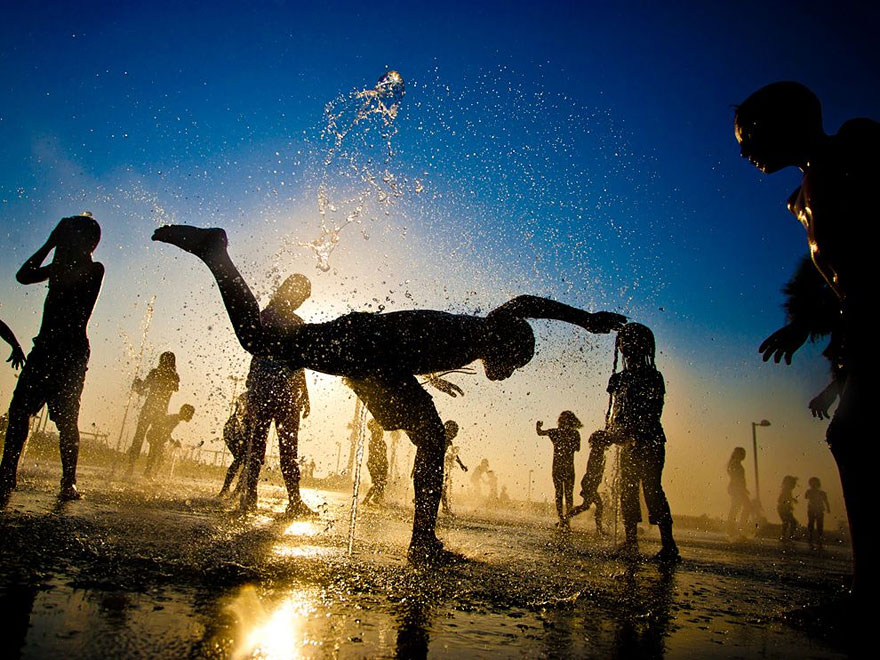
” Childhood is Wonderful …No Matter Wherever You Go …” !!!

No matter their cultural background, no matter their economic situation, kids will always find imaginative ways to have fun. Their wild imaginations and magical childhood moments, when captured on camera by talented photographers, can make for truly wonderful photos. These 33 images we collected will prove that childhood can be wonderful no matter where you go.

Many in the Western world fear that technology is making today’s children lose touch with nature and with their own creativity, and while there are arguments to be made for the intellectual stimulation that apps and programs for children can bring, there’s also something to be said for simply playing with a stick in the mud or chasing dandelion seeds though an open meadow.

For better or worse, the children in these photos seem entirely content making their own fun. For us adults, it’s important not to let our world-weary and jaded experience stifle our childish hopefulness and imagination!

Indonesia

Image credits: Ipoenk Graphic

children-around-the-world-70

Image credits: Agoes Antara

Image credits: I Gede Lila Kantiana

Image credits: Gede Lila Kantiana

Russia

Image credits: Светлана Квашинa

Image credits: Elena Shumilova

Burkina Faso

Image credits: Òscar Tardío

Myanmar

children-around-the-world-65

Image credits: Chan Kwok Hung

Tajikistan

Image credits: Damon Lynch

India

children-around-the-world-60

Image credits: Sandee Pachetan

chidren-playing-around-the-world-55

Image Credits: Sudharsan Ravikumar

Image credits: Mukund Images

Vietnam

chidren-playing-around-the-world-51

Image Credits: HT KëñShi

Ghana

children-around-the-world-61

Image credits: Terry White

Estonia

children-around-the-world-54

mage credits: Elika Hunt

Thailand

Image credits: Sarawut Intarob

Image credits: Sarawut Intarob

Image credits: Sarawut Intarob

South Africa

children-around-the-world-55

Image credits: Muhammed Muheisen

children-around-the-world-60

Source: tinosoriano.com

Peru

children-around-the-world-52

Image credits: Enrique Castro-Mendivil

Ethiopia

children-around-the-world-50

Image credits: Csilla Zelko

Italy

children-around-the-world-61

Image credits: Michael Potyomin

Israel

children-around-the-world-64

Image credits: Dima Vazinovich

USA

Image credits: Jake Olson

Indonesia #2

Image credits: Rio Rinaldi Rachmatullah

Image credits: James Khoo

children-around-the-world-53

Image credits: Hendrik Priyanto

chidren-playing-around-the-world-50

Image Credits: Mio Cade

Uganda

Image credits: John Van Den Hende

Romania

Image credits: Elena Simona Craciun

Russia

Image credits: Elena Shumilova

Source…..www.boredpanda.com

natarajan


How a Mobile App Is Bringing Better Maternal Health Care to Rural Karnataka in India….

An Auxiliary Nurse Midwife (ANM) is often the first point of contact between a health centre and a mother or expectant mother in India. She takes care of activities as basic as registration of pregnant women to more advanced interventions like routine immunization, identifying medical complications and providing referrals. An ANM has a lot of responsibilities and this simple, mobile-based intervention, Suyojana, enables her to effectively carry out her duties.

Rohini, from Chamrajnagar, Karnataka, is an Auxiliary Nurse Midwife (ANM), working in rural areas of the state. Despite the fact that she is proactive and interested in her work, Rohini often finds herself struggling to remain on top of all the information required to serve her patients effectively. From tracking crucial health parameters to scheduling important visits for critical cases, Rohini finds herself swamped with details that she is unable to handle in an organized manner.

Recently, however, Rohini began using Suyojana, a mobile-based application that improves the decision-making processes in maternal and child care activities undertaken by ANMs.

“The Suyojana application guides me from one step to another, within examinations and investigations, and does not let me skip a single step. This has made my work way more organized and systematic. The application has also made it very easy to identify high-risk cases and refer the patients on time to better facilities. The tool helps me take the right decisions at the right time,” says Rohini.

ANMs can keep track of their patients in a better way and also take necessary actions on time.


ANMs can keep track of their patients in a better way and also take necessary actions on time. –

Rohini is just one among several ANMs who have benefitted from the simple technology, Suyojana, launched by Swasti, a health resource centre established to provide health services to socially backward communities, in collaboration with D-Tree International and Karuna Trust.

“Swasti has been working in this field for 11 years now and work on improving different aspects of public health. Since ANMs do such important work at the grassroots level, we thought it was necessary to make decision-making easier for them through this mobile intervention,” says Shama Karkal, Director, Swasti.

The issue

The app does not let an ANM update her patients' profile until all the fields in the app are filled.

The app does not let an ANM update her patients’ profile until all the fields in the app are filled. –

As par-medical professionals who are closest to the rural communities, ANMs play a crucial role. They are required to use their knowledge in order to take requisite actions on time.

Though ANMs undergo training, many times they are unaware of the basic practices they should follow. Shama recalls that ANMs met during the pilot did not carry blood pressure or weighing machines during home visits. “Everyone assumes that they know what they are doing. Even ANMs are not aware of what they could do better and there is no system to monitor the quality of the care they provide.

Without the application, ANMs can skip many of the examinations and other critical components of an ante-natal or post-natal visit.

This results in incomplete and in-accurate health monitoring of pregnant women and children.

The solution 

This is where Suyojana plays a crucial role. This mobile-based clinical-decision support system (DSS) provides ANMs with consistent guidance with antenatal care (ANC), postnatal care (PNC), and neonatal care.

The mobile app takes ANMs through all the procedures and guidelines to identify the person’s conditions and provides options for decision making. The app uses the national guidelines maternal and neonatal care to guide the ANM. The app also allowsANMs to track patients they have visited, their expected clinic visit dates, their medication, etc. This also helps ANMs to identify those women who are due for their next appointment, both in-clinic visits and home visits.

“The app has various forms which ANMs complete during different visits. The forms in the application include registration, antenatal history (for ANC clients), pregnancy outcome (for PNC clients), danger signs, physical examination, investigation tests, intervention, and counselling. Basic care and monitoring of the child is also included — from foetal heart rate to neonatal danger signs, pre-referral treatments and home-based new-born care counselling. Required fields in the app must be completed in order to complete the visit and record it. This way, every aspect of the care provided is tracked,” says Shama.

With the app the ANMs do not need to maintain multiple registers. The app generates the standard reports which can be further customized.

Another interesting aspect of the app is that it also runs offline and synchronizes with the server using general packet radio service (GPRS) for back up, reporting and analysis.

The impact

With the app the ANMs do not need to maintain multiple registers.

With the app the ANMs do not need to maintain multiple registers.

Thanks to the easily available data, a supervisor can track the details from the server and can identify maternal health trends in a particular area. This way ANMs can also take expert advice from remote locations and can decide the next step they need to take on time.

“This application will help us in quickly referring a complicated case to higher public health facilities and will replace the cumbersome procedure of checking registers and day books. All we would be required to do is click on the app to get all the details. This would be a great relief for us and reduce our workload,” says Saraswathi, yet another ANM from Karnataka.

The interesting initiative, which was launched as a pilot project in March 2014 in Chamarajanagar district, involved 31 ANMs in four districts of Karnataka, including Chamarajanagar, Ramanagara, Bijapur, and Chikkaballapur.

To make the app more user-friendly, all the information is available in Kannada. The ANMs are first given formal training before they actually start using this app. Once the training is complete, ANMs using this app and sync the data collected by them on a regular basis. There is also a full-time supervisor who assists the ANMs in case of difficulties.

“We launched it on mobile phones since they are easier to use and are more handy. Currently, we install the app on the mobile phones of ANMs and it is not available for the general public to use,” says Shama.

Though the simple mobile app looks like a feasible solution to address difficulties of ANMs and the quality of care provided by them, the team is still struggling to have it accepted with the government.

The pilot was funded by D-Tree International, has a small team of four members, who are looking forward to expanding the initiative to cover many more districts and ANMs.

To know more about the initiative, contact Angela at – angela@swasti.org or check out their website.

Source…..Shreya Pareek….www.the betterindia.com

Natarajan

Here’s How You Can Access Online Courses of 7 IITs. For Free….

The National Programme for Technology Enhanced Learning (NPTEL), an e-learning platform, is revolutionising the concept of internet based higher education in India.

Developed on the lines of the Open Courseware by Massachusetts Institute of Technology, to some extent, the National Programme for Technology Enhanced Learning (NPTEL) is bringing some of the best teachers of the country together, enabling students to access courses on engineering, sciences, technology, management, humanities and more, free of cost, all across the globe.

Content on the platform is being used by many educational institutions. Faculty members are using it as part of their lesson plan to teach university curriculum, and students are using it to prepare for jobs and competitive exams.

NPTEL

Picture for representation only. Photo Credit: Flickr

NPTEL is a joint venture of seven IITs (Indian Institute of Technology) and Indian Institute of Science (IISc), funded by the Ministry of Human Resource Development, Government of India. The seven IITs include IIT Bombay, Delhi, Guwahati, Kanpur, Kharagpur, Madras and Roorkee. It was developed with the aim of providing e-learning through course content in the form of web based supplements and video courses.

Up till Aug 2015, NPTEL had 420 web courses and 509 video courses, which can be accessed freely through the website nptel.ac.in. These include approximately 921 courses, and each course has about 40 video lectures, which are one hour long. There are online discussion forums as well where students can post and review questions. Courses are also accompanied by assignments, handouts, self-evaluations tasks, etc. Some of the disciplines include Aerospace Engineering, Biotechnology, Atmospheric Science, Chemical Engineering, Management, Humanities and Social Sciences, etc. There is no specific eligibility for the courses. The faculty member of a course may recommend some basic knowledge required for certain topics.

The video content is accessible free of cost. These videos can be downloaded through the official NPTEL website, in MP4, FLV and 3gp formats. They can also be streamed through the YouTube channel here. Students can obtain the video courses on hard disks as well, at the NPTEL office in IIT Madras.

The focus areas of the NPTEL project is to provide higher education, professional education, distance education and a continuous open learning atmosphere. It is a curriculum building exercise and the NPTEL content adheres to the syllabi of All India Council for Technical Education and the slightly modified curricula of major affiliating universities.

The courses are well structured and elaborate. Institutions are encouraged to build their own versions of NPTEL courses based on their curriculum using the NPTEL material available online. Thus the project is also meant to fill the gap between the current expertise level of faculty in institutions like  IITs and IISc, and those in other engineering colleges across India.

Certification courses are also offered in association with industry partners like Aricent, NASSCOM and Google. These courses are offered 2 or 3 times every year. Students need to give an exam by paying a nominal fee, and after completion of the course, they get a certificate. Till August 2015, 7,267 students had received such certificates.

To know more about NPTEL, visit here. 

Source….Tanaya Singh….www.thebetterindia.com

Natarajan