This Day In Space Science… Establishment of NASA Ames on 20 Dec 1939…

75th Anniversary of NASA Ames

December 20, 2014 marks NASA Ames Research Center’s 75th Anniversary. The center was established in 1939 as the second laboratory of the National Advisory Committee for Aeronautics, and was named for the chair of the NACA, Joseph S. Ames. It was located at Moffett Field in Sunnyvale, California, now at the heart of Silicon Valley. The Laboratory was renamed the NASA Ames Research Center with the formation of NASA in 1958.

This June 2, 1943 photograph shows the construction of the Ames full-scale 40- by 80-foot wind tunnel, with a side view of the entrance cone and a blimp in the background.

Image Credit: NASA 

SOURCE::::www.nasa.gov

Natarajan

Image of the Day…Ice Berg in South Atlantic !!!

Big iceberg in South Atlantic

Satellites have detected an iceberg adrift in the South Atlantic Ocean. It’s big … but doesn’t meet the criteria for tracking or naming.

The Aqua satellite caught this image of the unnamed iceberg on December 3, 2014.  Image via NASA Earth Observatory.

On December 3, 2014, satellite images revealed a large iceberg – measuring about 165 square kilometers (64 square miles) – east of the southern tip of South America in the South Atlantic Ocean. This iceberg doesn’t meet the criteria for tracking or naming. NASA Earth Observatory said:

Only icebergs that have a side measuring at least 19 kilometers (12 miles) long are named and tracked by the U.S. National Ice Center. That means nearly round or square icebergs—like the one pictured above—can be quite large and still not meet the criteria for naming and tracking.

But it’s still a big iceberg and so interesting. Icebergs such as this one break off from Antarctica, but scientists aren’t sure exactly where on the continent this one broke away.

In that way, it’s different from iceberg B31, a much bigger iceberg, which broke away from Antarctica’s Pine Island Glacier in late 2013 and has been hugging the Antarctic continent since then. B31 is a whopping 240 square miles (over 600 square kilometers). NASA recentlyre-acquired it via satellite, and, although B31 does meet the criteria for tracking and naming, for now it remains in the Amundsen Sea near Antarctica, although free now of surrounding debris and sea ice.

Large icebergs like these pose a danger to ships. For example, in 2007, the MS Explorer, a small Canadian cruise ship, sank after striking an iceberg near the South Shetland Islands.

Read more about the unnamed iceberg from NASA’s Earth Observatory.

Read more about the even bigger iceberg B31.

NASA's Aqua satellite captured this image of a large, unnamed iceberg moving in the South Atlantic on December 5, 2014.  Image via NASA Earth Observatory.

Bottom line: Early December 2014 images of the large, nearly circular iceberg adrift in the South Atlantic Ocean. It’s big – 165 square kilometers (64 square miles) – but doesn’t meet the criteria for tracking or naming.

SOURCE:::: http://www.earthsky.org

Natarajan

Is There Life on Mars ?… Question Remains….

Questions of life on Mars revive with methane spike

Curiosity rover has now measured a dramatic spike in methane, an organic chemical, in the Martian air, plus other organic molecules in a Martian rock.

The first definitive detection of Martian organic chemicals in material on the surface of Mars came from analysis by NASA's Curiosity Mars rover of sample powder from this mudstone target,

The mystery of whether Mars has or ever had life got a boost today (December 16, 2014) when NASA announced that its Curiosity rover – which landed on Mars in August, 2012 – has measured a tenfold spike in methane in the atmosphere around the rover. NASA scientists made the announcement at the annual meeting of the American Geophysical Union in San Francisco. The journal Science also published these results today.

Methane is an organic chemical, and it’s conceivable, although far from certain, methane-belching microbes on Mars might be responsible for the spike.

Overall, researchers said, methane levels recorded by Curiosity’s onboard Sample Analysis at Mars (SAM) are lower than expected.

However, for about a two-month period in late 2013 and early 2014, researchers did observe a temporary and dramatic increase in methane in the Martian air around the rover.

NASA scientists are quick to point out that the source of the methane on Mars could be either biological or non-biological. For example, a non-biological source of the methane might be an interaction between water and rock.

At the same time, for the first time ever, the rover has detected other organic molecules in a rock-powder sample collected by drilling into a rock on Mars, which scientists have dubbed Cumberland. Organic molecules, which contain carbon and usually hydrogen, are chemical building blocks of life (although they can exist without the presence of life). NASA says it’s the first definitive detection of organics in surface materials of Mars. These Martian organics could either have formed on Mars or been delivered to Mars by meteorites, scientists say.

Is there life on Mars today, or was there ever life on Mars? These results don’t prove either speculation. However, said John Grotzinger, Curiosity project scientist of the California Institute of Technology in Pasadena:

We will keep working on the puzzles these findings present. Can we learn more about the active chemistry causing such fluctuations in the amount of methane in the atmosphere? Can we choose rock targets where identifiable organics have been preserved?

NASA says that Curiosity is:

… one element of NASA’s ongoing Mars research and preparation for a human mission to Mars in the 2030s.

Read more about Curiosity’s measurement of a methane spike on Mars.

Bottom line: Mars Curiosity rover measures a dramatic spike in methane and detects other organic molecules in a rock-powder sample collected by the robotic laboratory’s drill.

SOURCE:::: http://www.earthsky.org

Natarajan

This Day in Science… Wright Brothers’ First Flight !!!

December 17, 1903. On this date, two Ohio brothers – Wilbur and Orville Wright – made the first bonafide, manned, controlled, heavier-than-air flight. It was the first airplane, and it took off at 10:35 a.m. with Orville Wright on board as pilot. He flew their vehicle, called theFlyer, for 12 seconds over 120 feet (about 37 meters) of sandy ground just outside Kitty Hawk, North Carolina.

One of the world’s most famous early photographs serves to commemorate the flight.

The Wright brothers' airplane on its first powered flight on December 17, 1903.  Via Library of Congress.

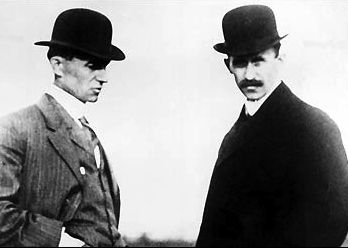
Wilbur and Orville Wright.

Two years later, the Wrights wrote in a patent application that their airplane design:

… provide[s] means for guiding the machine both vertically and horizontally … combining lightness, strength, convenience of construction, and certain other advantages.

Were the Wright brothers always destined for the skies? It’s known that their father gave them a rubber-band-powered flying toy when they were still children. The toy was made of cork and bamboo, with a paper body.

By 1899 – when Wilbur was 33 years old and Orville was 28 – the brothers were already learning everything they could about the science of aeronautics and the history of attempted human flight. Their first airplane were gliders, which they tested on the long, isolated beaches of Kitty Hawk. By 1902, they had built a glider that could be manned and controlled by a human pilot. It held a world record for gliding over 600 feet (nearly 200 meters).

Their first powered aircraft had a 40-foot (12-meter) wingspan, weighed 750 lbs, and had a 12-horsepower engine.

That first flight in December 1903 marked the beginning of a new era of global travel and relatedness.

By the way, at the time they received their patent for their airplane in 1906, several other aviators of the day claimed to have been the first to use the Wrights’ method of turning the airplane by warping or twisting the wings. But this part of the design, too, was included in the Wrights’ patent. In 2013, a story came to light about another would-be aviator, Gustave Whitehead, whose first flight supposedly beat the Wright brothers by two years. Thus far, that story has not been supported and is not accepted by aviation scholars.

Bottom line: The first airplane soared for 12 seconds over 120 feet (about 37 meters) of sandy ground just outside Kitty Hawk, North Carolina on December 17, 1903.

SOURCE:::: http://www.earthsky.org

Natarajan

Image of the Day…Sunset Over the Gulf of Mexico…

Sunset Over the Gulf of Mexico

From the International Space Station, Expedition 42 Flight Engineer Terry W. Virts took this photograph of the Gulf of Mexico and U.S. Gulf Coast at sunset and posted it to social media on Dec. 14, 2014.

The space station and its crew orbit Earth from an altitude of 220 miles, traveling at a speed of approximately 17,500 miles per hour. Because the station completes each trip around the globe in about 92 minutes, the crew experiences 16 sunrises and sunsets each day.

Image Credit: NASA/Terry Virts 

SOURCE::::www.nasa.gov

Natarajan

Image of the Day…Mars Exploration Rover opportunity …

 Opportunity Pausing at a Bright Outcrop on Endeavour Rim, Sol 3854

NASA’s Mars Exploration Rover Opportunity is continuing its traverse southward on the western rim of Endeavour Crater during the fall of 2014, stopping to investigate targets of scientific interest along way.  This view is from Opportunity’s front hazard avoidance camera on Nov. 26, 2014, during the 3,854th Martian day, or sol, of the rover’s work on Mars. This camera is mounted low on the rover and has a wide-angle lens.

The scene includes Opportunity’s robotic arm, called the “instrument deployment device,” at upper left. Portions of the pale bedrock exposed on the ground in front of the rover are within the arm’s reach. Researchers used instruments on the arm to examine a target called “Calera” on this patch of bedrock.  The wheel tracks in the scene are from the drive — in reverse — to this location, a drive of 32.5 feet (9.9 meters) on Sol 3846 (Nov. 18, 2014).

Image Credit: NASA/JPL-Caltech  

SOURCE:::: http://www.nasa.gov

Natarajan

Indian American Vivek Murthy is Now ‘America’s Doctor’ !!! …First Indian to Hold this Post …

US senate voted to confirm Vivek Murthy as the next surgeon general, a position often called America’s Doctor. He is the first Indian American to hold and the position, and the youngest.


The US senate voted to confirm Dr. Vivek Hallegere Murthy as the next surgeon general, a position often called America’s Doctor. (AP File Photo)

His confirmation also marked a major defeat for the powerful gun lobby spearheaded by the National Rifles Association, which had lobbied hard with senators to block a vote.

And nearly succeeded, delaying a vote for 10 months.

Democrats pushed the nomination through in the dying days of their leadership of the upper chamber, which passes into Republican hand next month following recent polls.

Murthy was confirmed by a 51-43 vote.

Welcoming Murthy’s confirmation as “America’s Doctor”, President Barack Obama said he will “hit the ground running” and “build on the progress we’ve made combating Ebola”.

Indian Americans, who were following the confirmation process closely, were ecstatic. Ami Bera, Indian American congressman, called the confirmation “historic” for the community.

At 37, Murthy, who was born into a family from Karnataka, becomes the youngest surgeon general in US history, something that made some senators publicly wonder if he was too young.

Considered whip smart – studied biochemical sciences from Harvard and then a combined medicine and business degree from Yale – Murthy has been working at Harvard’s Brigham and Women’s Hospital as a physician.

But it were his political work and comments about gun control that got him into trouble with Republicans, many of whom vowed to not let his nomination go through.

Specially this tweet from him in October, 2012: “Tired of politicians playing politics w/ guns, putting lives at risk b/c they’re scared of NRA. Guns are a health care issue.”

NRA wrote to all senators urging them to block his nomination saying his confirmation would be “prescription for disaster for America’s gun owners”. Many senators agreed.

One Republican senator pointedly asked Murthy his confirmation hearing in February if he will use the office of surgeon general to push his personal views on gun control.

Murthy responded in the negative, saying he will be focussing on obesity prevention. But his critics were not convinced. They had one other issue with him.

He was an outspoken supporter of Obama’s healthcare reforms.
Some other Indian Americans nominated to high offices by Obama

Sri Srinivasan: Judge at DC circuit court of appeals (roughly a high court), which puts him in line for a Supreme Court judgeship

Nisha Biswal: First Indian American to hold the powerful position of assistant secretary of state heading South and Central Asia

Rich Verma: As the first Indian American named US ambassador to a major country – India. He was confirmed by the senate last week. Verma earlier held the position of assistant secretary of state for legislative affairs

Aneesh Chopra: First Chief Technology Officer of the United States, who has since moved on, running unsuccessfully for the Democratic ticket for Virginia governorship

Preet Bharara: Who as US attorney for the Southern District of New York has successfully prosecuted many for insider trading, including Rajat Gupta. His prosecution of diplomat Devyani Khobragade, however, did go down well with Indians

Rajiv Shah: As USAID administrator, Shah is possibly the senior most Indian American in Obama’s administration now

Puneet Talwar: Assistant secretary of state for bureau of political-military affairs. He is reported to have played a significant role in the recent thaw in US-Iran ties

Vivek Kundra: First Chief Information Officer of the US, who has since moved on

– SOURCE::::www.hindustantimes.com

Natarajan

” SRI CHAKRAM ” Formation on Desert Sand ? …

ஶ்ரீ சக்ரம் (சுயம்பு )

Published on Dec 1, 2014

அமெரிக்காவின் ஒரெகன் மாநிலத்தின் ஸ்டீன்ஸ் மலைகளின் தென்கிழக்குல் உள்ள இடம்தான் மிக்கி பேசின் சூரியனின் வெப்பத்தில் மணல் கொப்பளிக்கும் அளவுக்கு பாலைவன தேசம்.பில் மில்லர் என்கிற ராணுவ அதிகாரி இந்த இடத்தை குட்டி விமானம் மூலம் கடந்து செல்கையில் 13.3 mile சதுர அளவுக்கு வரி வரியாக வரைபடம் போன்ற ஒன்றை கண்டார் ஏதோ நாட்டின் வரை படம் என்று நினைத்து அதை பற்றி ஆராய்ந்தவருக்கு பயங்கர அதிர்ச்சி காரணம் அது நம் இந்து மதத்தில் காலம் காலமாக வழிபடும் சிவ விஷ்ணு பராசக்தியை குறிக்கும் ஶ்ரீசக்கரம் தான் அவர் பார்த்தது தொடர்ந்து 30 நிமிடங்கள் வட்டமிட்ட பின்னே தான் அவரால் முழு சக்கரத்தையும் 1 தடவை சுற்ற முடிந்தது. இதை ப் போலவே வரைய அவர்களால் எவ்வளவு முயன்றும் (1990 to 2014) இன்று வரை முடியவில்லை காரணம் நாலாயிரம் அடி மேலே பறந்து பார்த்தால் தான் ஶ்ரீசக்கரம் என்றே தெரியும். UFO ஆராய்ச்சியாளர்கள் டான் நியுமேன்,ஆலன் டெக்ளர் இருவரும் இந்த இடத்தை செப் 15 ல் ஆய்வு செய்தனர் அந்த ஆய்வில் இந்த இடத்தை சுற்றியுள்ள எந்த பகுதியிலும் மனித கால் தடமோ வாகன வந்து சென்ற தடமோ இல்லை என்றும் மனிதனால் இது சாத்தியமே இல்லை என்றும் கருத்து தெரிவித்துள்ளனர்

SOURCE::: http://www.youtube.com

Natarajan

Image of the Day…”Colorful and Plankton-full Patagonian Waters” !!!

Late spring and summer weather brings blooms of color to the Atlantic Ocean off of South America, at least from a satellite view. The Patagonian Shelf Break is a biologically rich patch of ocean where airborne dust from the land, iron-rich currents from the south, and upwelling currents from the depths provide a bounty of nutrients for the grass of the sea—phytoplankton. In turn, those floating sunlight harvesters become food for some of the richest fisheries in the world.

The Visible Infrared Imaging Radiometer Suite (VIIRS) on Suomi NPP captured this view of phytoplankton-rich waters off of Argentina on Dec. 2, 2014. Scientists in NASA’s Ocean Color Group used three wavelengths (671, 551, and 443 nanometers) of visible and near-infrared light to highlight different plankton communities in the water. Bands of color not only reveal the location of plankton, but also the dynamic eddies and currents that carry them.

> More Information

Image Credit: Norman Kuring, NASA’s Ocean Color Group, using VIIRS data from the Suomi National Polar-orbiting Partnership

SOURCE:::www.nasa.gov

Natarajan 

” Why a $ is called a Buck …” !!!

Why a Dollar is Also Called a “Buck”!!!

As with many etymologies, the exact root of this word is difficult to say with one hundred percent certainty. However, the leading theory is extremely plausible and backed up by a fair bit of documented evidence. Specifically, it is thought that a dollar is called a “buck” thanks to deer.

One of the earliest references of this was in 1748, about 44 years before the first U.S. dollar was minted, where there is a reference to the exchange rate for a cask of whiskey traded to Native Americans being “5 bucks”, referring to deerskins. In yet another documented reference from 1748, Conrad Weiser, while traveling through present day Ohio, noted in his journal that someone had been “robbed of the value of 300 Bucks.”

At this time, a buck skin was a common medium of exchange. There is also evidence that a “buck” didn’t simply mean one deerskin, but may have meant multiple skins, depending on quality. For instance, skins from deer killed in the winter were considered superior to those killed in the summer, due to the fur being thicker.

It is thought that the highest quality skins were generally assigned a one to one value, with one skin equaling one buck. In contrast, for lower quality skins, it might take several of them to be valued at a single buck. The specific value for given sets of skins was then set at trading.

In addition, when the skin was from another animal, the number of skins required to equal a buck varied based on the animal and the quality of the skins. For instance, there is one documented trade where six high quality beaver skins or twelve high quality rabbit pelts each equaled one buck.

This use of skins as a medium of exchange gradually died off over the next century as more and more Europeans moved in and built towns and cities. Once the U.S. dollar was officially introduced after the passing of the Coinage Act of 1792, it quickly became the leading item used as a medium of exchange, but the term “buck” stuck around and by the mid-nineteenth century was being used as a slang term for the dollar.

If you liked this article, please consider purchasing The Wise Book of Whys, whence this article came. As mentioned, sales of this book go towards keeping ads out of this newsletter as much as possible. So if you hate ads as much as we do, please do consider purchasing a copy for yourself or as a gift for someone.  Thanks!

Bonus Fact:

  • While it may be tempting to think that the “buck” in this sense is where we also get the phrase “pass the buck”, most etymologists don’t think the two are related. The leading theory on the origin of the phrase “pass the buck” is thought to come from poker, with one of the earliest known references of the idea of literally passing a buck being found in the 1887 work by J.W. Keller, titled “Draw Poker”. In it, Keller states: “The ‘buck’ is any inanimate object, usually knife or pencil, which is thrown into a jack pot and temporarily taken by the winner of the pot. Whenever the deal reaches the holder of the ‘buck,’ a new jack pot must be made.” As to why it is then called  a buck, it is thought that may have arisen from the fact that buck-handled knives were once common, and knives were often used as the “buck” in this sense. As for the figurative sense of passing the buck, this didn’t start popping up until the early twentieth century.


SOURCE:::: http://www.today i found out.com

Natarajan