Space Station Fly over of British Columbia’s Coast Mountains…

Snowcapped rocky mountain range on the coast photographed from orbit

ESA astronaut Tim Peake (@astro_timpeake) took this photograph over the west coast of Canada from the International Space Station on Dec. 31, 2015, and shared it with his Twitter followers on Jan. 5, writing, “I was lucky enough to fly a helicopter in these Rocky Mountains once – I’m a bit higher this time! #Principia”

The photograph shows Canada’s Coast Range of mountains, with King Island and Burke Channel in the center. The Pacific Ocean is visible at the bottom and north is to the left.

Image Credit: ESA/NASA

Source……www.nasa.gov.in

Natarajan

The Alphabets From Space…!!!

In July 2012, while working on a story about wildfires, NASA’s science writer and social media manager Adam P. Voiland spotted a V-shaped plume of smoke caused by a wildfire in the Caribou Mountains in northern Alberta, Canada. That image made him wonder if there are other alphabets hidden among the millions of photos of earth’s surface taken by NASA’s satellites. It was a mammoth task, so he enlisted the internet in the ambitious project.  With the help of readers and colleagues, Voiland started collecting images of ephemeral features like clouds, phytoplankton blooms, and dust clouds that formed shapes reminiscent of letters. Now, over three years later, his search is completed and the results are exceedingly beautiful and educational.

space-alphabets

Some letters, like O and C, were easy to find,” said Voiland. “Others—A, B, and R—were maddeningly difficult.”

After he had tracked down all the letters, he wrote playful captions for each photos inspired by Dr. Seuss which he was reading to his son.

Here is a selection of alphabets from the gallery.

b_hollabend

Bonjour B, what begins with B? Biomass and boreal forests. Beirut, Barcelona, and Brasília. A bunch of babbling birds bunched up along Holla Bend.

On August 4, 2014, the Operational Land Imager (OLI) on Landsat 8 acquired this image of the Arkansas River and the Holla Bend Wildlife Refuge. In the winter, it is common for the refuge to host 100,000 ducks and geese at once.

c-space-alphabet

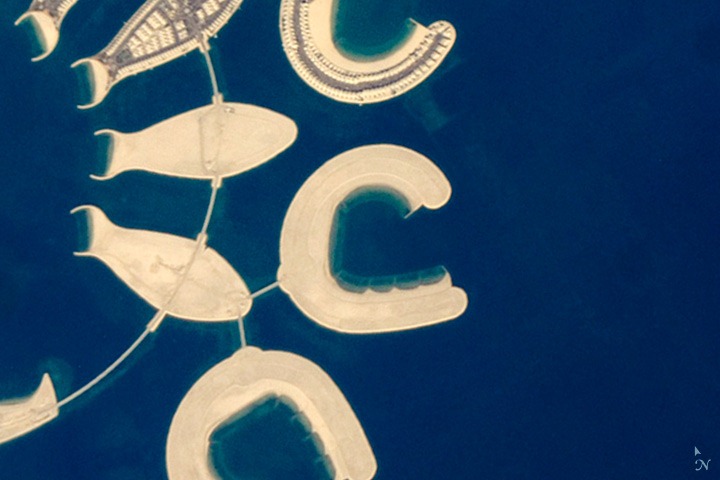
Big C, little C, what begins with C? This curving crescent of carbonate and quartz clinging to the coast. There is CloudSat and CALIPSO. Contrails from jets cruising over cumulus clouds. The Corolis force, chlorofluorocarbons, and crafty coccolithophores!

An astronaut captured this photograph of an artificial island at the southern end of Bahrain Island on January 23, 2011. The beach sand on tropical islands is mostly made up of calcium carbonate from the shells and skeletons of marine organisms.

e_newzealand

What begins with E? Earth, of course. Evaporation and the exosphere. Egypt and Eyjafjallajökull. Eskers, erratics, El Niño, and EO-1. This ephemeral entourage of algae off the east coast of an island where English is spoken!

On October 25, 2009, the Moderate Resolution Imaging Spectroradiometer (MODIS) on NASA’s Aqua satellite captured this image of a phytoplankton bloom off the coast of New Zealand.

f_tibet

Big F, little f. What begins with F? Firn-filled fjords and frozen forms on folded, fossil-filled facies of rock! Fog, fossil fuels, and faults. France, Fort Collins, and don’t forget Fiji.

The Operational Land Imager (OLI) on Landsat 8 acquired this false-color image of valleys and snow-covered mountain ranges in southeastern Tibet on August 4, 2014. Firn is a granular type of snow often found on the surface of a glacier before it has been compressed into ice

i_andamans

What begins with I? In situ measurements and infrared radiation. Ice sheets and isthmuses. Istanbul and Ilopango. This intriguing image of India’s Andaman Island after an intimidating incident involving an earthquake.

On February 10, 2007, the Moderate Resolution Imaging Spectroradiometer (MODIS) on NASA’s Terra satellite captured this image of the Andaman Islands. The thin, bright rings surrounding several of the islands are coral reefs that were lifted up by a massive earthquake near Sumatra in 2004

j_townsville

What begins with J? Jason-1 and the jet stream. Jerusalem, Jakarta, and Johnson Space Center. This jade-colored coral reef juxtaposed against the jumble of the sea.

On July 17, 2015, the Operational Land Imager on Landsat 8 captured this image of the Trunk Reef near Townsville, Australia

m_tienshan

What begins with M? The meandering Mississippi. MODIS and MISR. Mumbai, Miami, and Moscow. These medial moraines merging muck and minerals for millennia!

On August 14, 2015, the Operational Land Imager (OLI) on Landsat 8 captured this image of glaciers in the Tian Shan mountains in northeastern Kyrgyzstan. The trail of brown sediment in the middle of the uppermost glacier is a medial moraine, a term glaciologists use to describe sediment that accumulates in the middle of merging glaciers

n_northpacific

What begins with N? Numerous cloud condensation nuclei in the North Pacific! Nefarious nitrogen dioxide and NOx. The near infrared and NDVI and the Nimbus satellite. Nor’easters and the Nile at night.

On March 4, 2009, the Moderate Resolution Imaging Spectroradiometer (MODIS) on the Terra satellite captured this image of ship tracks over the Pacific. Ship emissions contain small particles that cause the clouds to form

t_liwa

What begins with T? Taal and Tolbachik. Taiga, typhoons, tornadoes, and thunderstorms. The trove of trees and towns tucked into this terrain in the United Arab Emirates.

On March 9, 2015, the Operational Land Imager (OLI) on Landsat 8 captured this image of development along two roads in the United Arab Emirates

x_leidyglacier

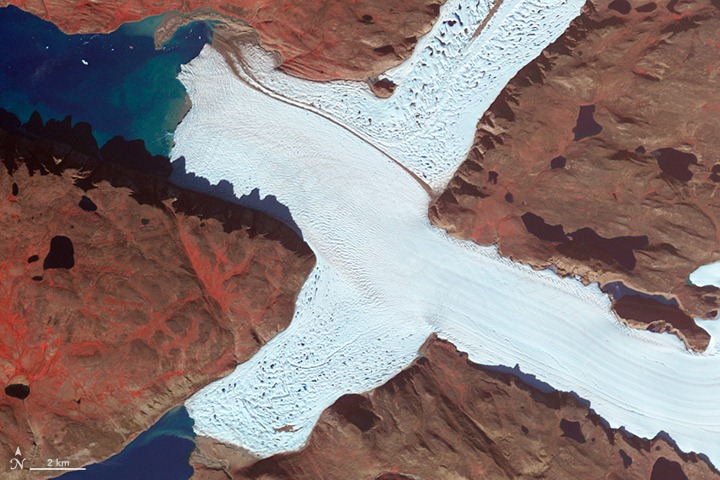
What begins with X? There are xenoliths, the xylem in xeric woodlands, and the cities of Xian and Xalapa. Not much else begins with X, so relaX and enjoy this eXcellent icy X!

On August 7, 2012, the Advanced Spaceborne Thermal Emission and Reflection Radiometer (ASTER) on NASA’s Terra satellite captured this false-color image of the northwest corner of Leidy Glacier in Greenland.

z_canada

Z, what begins with Z? Zambia and Zimbabwe. Zenith and zooplankton. Zillions of smoke particles zipping, zooming, and zigzagging above Canada!

On July 11, 2012, the Moderate Resolution Imaging Spectroradiometer (MODIS) on NASA’s Aqua satellite captured this image of wildfire smoke over Canada.

See more of the gallery on NASA’s website.

Source…..www.amusingplanet.com

Natarajan

NASA Research Could Save Commercial Airlines Billions in New Era of Aviation….

NASA wind-tunnel tests of an Active Flow Control system

Researchers with NASA’s Environmentally Responsible Aviation project coordinated wind-tunnel tests of an Active Flow Control system — tiny jets installed on a full-size aircraft vertical tail that blow air — to prove they would provide enough side force and stability that it might someday be possible to design smaller vertical tails that would reduce drag and save fuel.
Credits: NASA/Dominic Hart

The nation’s airlines could realize more than $250 billion dollars in savings in the near future thanks to green-related technologies developed and refined by NASA’s aeronautics researchers during the past six years.

These new technologies, developed under the purview of NASA’s Environmentally Responsible Aviation (ERA) project, could cut airline fuel use in half, pollution by 75 percent and noise to nearly one-eighth of today’s levels.

“If these technologies start finding their way into the airline fleet, our computer models show the economic impact could amount to $255 billion in operational savings between 2025 and 2050,” said Jaiwon Shin, NASA’s associate administrator for aeronautics research.

Created in 2009 and completed in 2015, ERA’s mission was to explore and document the feasibility, benefits and technical risk of inventive vehicle concepts and enabling technologies that would reduce aviation’s impact on the environment. Project researchers focused on eight major integrated technology demonstrations falling into three categories – airframe technology, propulsion technology and vehicle systems integration.

By the time ERA officially concluded its six-year run, NASA had invested more than $400 million, with another $250 million in-kind resources invested by industry partners who were involved in ERA from the start.

“It was challenging because we had a fixed window, a fixed budget, and all eight demonstrations needed to finish at the same time,” said Fayette Collier, ERA project manager. “We then had to synthesize all the results and complete our analysis so we could tell the world what the impact would be. We really did quite well.”

Here is a brief summary of each of the eight integrated technology demonstrations completed by the ERA researchers:

  • Tiny embedded nozzles blowing air over the surface of an airplane’s vertical tail fin showed that future aircraft could safely be designed with smaller tails, reducing weight and drag. This technology was tested using Boeing’s ecoDemonstrator 757 flying laboratory. Also flown was a test of surface coatings designed to minimize drag caused by bug residue building up on the wing’s leading edge.
  • NASA developed a new process for stitching together large sections of lightweight composite materials to create damage-tolerant structures that could be used in building uniquely shaped future aircraft that weighed as much as 20 percent less than a similar all-metal aircraft.
  • Teaming with the Air Force Research Laboratory and FlexSys Inc. of Ann Arbor, Michigan, NASA successfully tested a radical new morphing wing technology that allows an aircraft to seamlessly extend its flaps, leaving no drag-inducing, noise-enhancing gaps for air to flow through. FlexSys and Aviation Partners of Seattle already have announced plans to commercialize this technology.
  • NASA worked with General Electric to refine the design of the compressor stage of a turbine engine to improve its aerodynamic efficiency and, after testing, realized that future engines employing this technology could save 2.5 percent in fuel burn.
  • The agency worked with Pratt & Whitney on the company’s geared turbofan jet engine to mature an advanced fan design to improve propulsion efficiency and reduce noise. If introduced on the next-generation engine, the technology could reduce fuel burn by 15 percent and significantly reduce noise.
  • NASA also worked with Pratt & Whitney on an improved design for a jet engine combustor, the chamber in which fuel is burned, in an attempt to reduce the amount of nitrogen oxides produced. While the goal was to reduce generated pollution by 75 percent, tests of the new design showed reductions closer to 80 percent.
  • New design tools were developed to aid engineers in reducing noise from deployed wing flaps and landing gear during takeoffs and landings. Information from a successful wind-tunnel campaign, combined with baseline flight tests, were joined together for the first time to create computer-based simulations that could help mature future designs.
  • Significant studies were performed on a hybrid wing body concept in which the wings join the fuselage in a continuous, seamless line and the jet engines are mounted on top of the airplane in the rear. Research included wind-tunnel runs to test how well the aircraft would operate at low speeds and to find the optimal engine placement, while also minimizing fuel burn and reducing noise.

As part of the closeout work for the ERA project, information and results regarding each of these technology demonstrations were categorized and stored for future access and use by the aerospace industry, and will be discussed at the American Institute of Aeronautics and Astronautics Sci-Tech Conference in San Diego this week.

For more information about NASA aeronautics research, go to:

http://www.nasa.gov/aeronautics 

Source……….www.nasa.gov

natarajan

South India Looks Spectacular from Space. As Proved by These Tweets from the ISS…..

Selected specially for a year-long mission, American astronaut Scott Kelly has been on the International Space Station (ISS) since March 2015. Early this morning, as the ISS was passing above the Indian coast, he posted some mind-bendingly beautiful photos of South India.

Here it is (here’s what we look like) from space. SPACE, you guys.

A rare glimpse of beautiful South ! from

Embedded image permalink

  1. Sandy and green on the South coast.

    Embedded image permalink

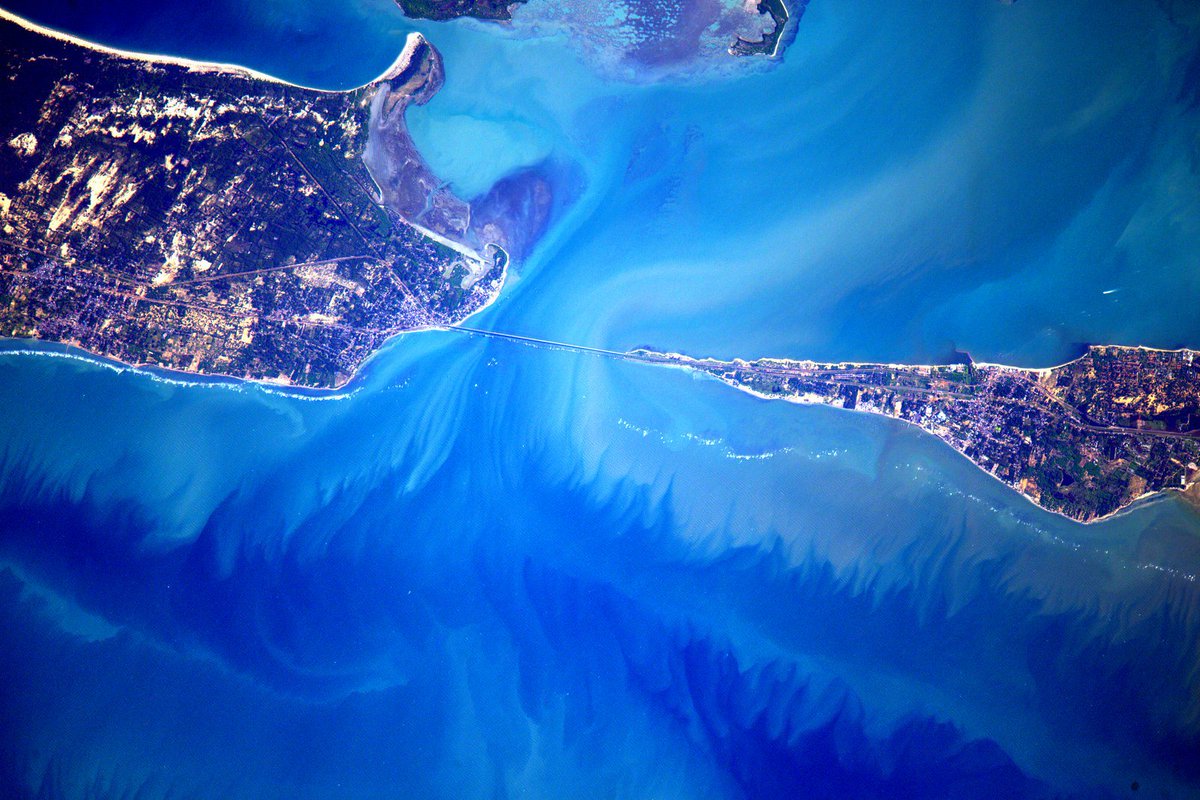
    1. The Southern tip of and its blue waters.

      Embedded image permalink

      SPECTACULAR.

      Source……..www.the betterindia.com

      Natarajan

Image of the Day….” Spectacular new image of earthrise”

A new earthrise photo, as seen from the moon by the Lunar Reconnaissance Orbiter.

Spectacular new image of earthrise seen from the moon, from NASA’s Lunar Reconnaissance Orbiter using cameras operated by Arizona State University. Africa, the south Atlantic Ocean and the eastern edge of South America can be seen. The large tan area on the upper right is the Sahara Desert. In the foreground on the moon, you are seeing the Compton crater. Read more about this image.

As seen from any one spot on the moon’s surface, Earth never rises or sets. Because one side of the moon always faces Earth, the Earth hangs relatively motionless in the lunar sky. But orbiting spacecraft can see earthrises and earthsets. This week, Arizona State University emailed us this amazing new image of an earthrise seen from the moon, along with Q-and-A with Mark Robinson, who is the principal investigator for the cameras aboard NASA’s Lunar Reconnissance Orbiter. In it, Robinson talked about this image, which was acquired by the orbiter’s camera (the LROC) in October.

Q: How did you know this image would be possible?

A: [The LROC has] taken pictures of the Earth more than 10 times in the past. We wanted to get a limb shot (showing the edge of the moon). What makes it really hard is getting the moon in the foreground … That was not by accident. We have software tools that allow us to visualize observations. We know where the spacecraft is going to be in the future … We determined from which orbits the Earth will be visible near the limb. Once we know the ground track where the Earth will be visible, we then find a view with a dramatic foreground.

Question: What are some of the pieces that had to come together to make this photo?

Answer: Just a few of the steps: You have to roll the spacecraft, in this case about 70 degrees, but the spacecraft is traveling at over 1,600 meters per second. We’re restricted in the length of one exposure time to something close to 0.4 milliseconds. You also move the spacecraft in the direction of flight so that you can get a wide enough field of view. When a spacecraft is in an elliptical orbit, the timing changes from image-to-image in an orbit. We have to compute all of that beforehand to get it exactly right … That timing has to be precisely carried out … We have to predict the temperature of the CCD (electronic equivalent of film). The Wide Angle Camera (WAC) is imaging an area multiple times while the Narrow Angle Cameras (NAC) takes just one picture. We blow up the WAC images and combine them to produce higher resolution, and then overlay this sharper image on the NAC image. We wanted the Earth to be on the horizon, and that only happens from certain areas of the moon. It’s only when the spacecraft is above the boundary between the nearside and farside that you can see the Earth behind the limb (edge of the moon).

Q: LRO has been in orbit for more than six years. If you picked the best shots to show your friends, what are they?

A: We’ve taken more than a million images. My answer changes every three days. The Apollo landing sites are fantastic. You can see the tracks the astronauts left on the surface of the moon. To me, as a scientist, it’s really great because it helps me visualize the photographs they took on the surface. The significance of the geologic context. ‘All right, now I know they got that soil sample there, and I can see what it looks like.’

Bottom line: NASA’s Lunar Reconnaissance Orbiter acquired this new image of Earthrise from the moon in October, 2015, using the orbiter’s camera (the LROC) operated by Arizona State University.

Source…..www.earthsky.org

Natarajan

The young Indians who are shooting for the Moon….

The atmosphere at the sparkling new Axiom Research Labs facility is informal and collegial.

This is not surprising, since most of Axiom’s 80-strong workforce is just out of college.

It’s also geeky. Equations, diagrams and Star Wars references are scribbled across the many whiteboards scattered around the open-plan office, a stone’s throw from the Bengaluru-Hyderabad highway.

That’s to be expected since almost everyone on campus has a science/engineering background. It’s driven: people walk quickly, conversations are brief and pointed.

The lunar rover that will traverse across the moon’s surface. Photograph: Team Indus/ Facebook

But there’s also a sense of collective excitement and plain old-fashioned fun.

People seem to enjoy themselves. The young men and women here all opted out of safe jobs and decided to shoot for the moon instead — literally.

This makes Axiom a rarity in the aerospace business. Its flagship is Team Indus.

Some time before December 31, 2017, Team Indus aims to land a vehicle on the moon.

A rover will roll out from the lander and travel at least 500 metres “along an interesting path in a deliberate manner” across the moon’s surface. That rover will then establish a data link with Earth and transmit two HDTV video broadcasts of at least eight minutes each, covering the moon landing and movement.

The mission must also receive and retransmit other data to Earth and perform a few other tasks.

That lander and rover must be designed by Team Indus. No more than 10 per cent of the necessary financing for the moon mission can come from government sources. If Team Indus pulls this off, it will fulfil the terms of the Google Lunar XPrize, or GLX, and it would be eligible to win a share of $30 million.

A prototype rover being tested on uneven surface similar to the one’s on the moon to better gauge the vehicle’s mobility. Photograph: Team Indus/ Facebook

Team Indus is the only Indian outfit out of 20-odd competitors. It has already won a milestone award of $1 million for its lunar lander design. If Team Indus does become the first team to fulfil all mission requirements, it could win $20 million. If it’s the second team, it could win $5 million.

Nobody has ever put together a privately funded lunar lander and rover and sent it to the moon.

The prize has been hanging fire now since 2007 with the deadline being extended multiple times.

But nobody on the Axiom campus — not even the guards from the security agency — seems to have the slightest doubt that Team Indus can do this.

That certainty filters down right from the top. The company has the chutzpah to declare that its “selenographic address” (“which will be functional sometime after 2015”) is Lunar Zone: Sinus Medii (0.50N Selenographic latitude, 1.50W Selenographic longitude).

For non-geeks, it means that the landing site has already been chosen.

Indeed, the facility includes a mockup of the landing spot where the local terrain has been recreated, complete with “lunar dust”, to test the rover’s performance.

The lunar rover is everything that NASA can build and more. Photograph: Team Indus/ Facebook

It started as a madcap project back in 2010. Rahul Narayan, a 40-something entrepreneur and Indian Institute of Technology-Delhi graduate wondered if the terms of GLX could be met. He talked to many of his pals who had similar backgrounds. Every one of them was captivated by the dream of going to the moon.

They persuaded GLX to accept a late entry and put together a company.

In 2011, Narayan says, they crossed an inflection point and realised the dream could become reality.

Team Indus made a presentation to K Kasturirangan, the retired chief of the Indian Space Research Organisation, or ISRO. He approved of some of the concepts in that presentation, and disagreed with others. But he thought it was possible and he promised to put in a word where it counted.

In fact, Kasturirangan was pretty enthusiastic and said that Team Indus embodied “the spirit of modern India and a flavour of its future”. A little later, Team Indus met APJ Abdul Kalam who was also extremely encouraging. Various doors started opening at that point.

The first tranches of cash were raised by the founders coming up with some money from their personal accounts.

The first employees recruited themselves. Some college students landed up, asking to be allowed to intern with the company that was then situated in Noida. They told their friends and juniors, and a pipeline was created.

Several lunar rovers that are being tested by the teams. Photograph: Team Indus/ Facebook

Dhruv Batra is one of the old-buddy network Narayan tapped. He manages project delivery. He made alternative arrangements to run his Delhi-centric business and moved to Bengaluru when Team Indus shifted out of Noida.

Ramnath Babu, who now heads the structures team for Team Indus, was based in Mumbai from where he was running his business. He moved, first to Noida and then to Bengaluru, cajoling his brother to take over his business so that he could get involved in the mission.

Babu and Batra say that absolutely everybody has stretched selflessly to help Team Indus. Equipment that they thought would take six months to fabricate was delivered in 100 days. Teams at the Space Applications Centre, Ahmedabad, and at the National Aerospace Lab, Bengaluru, worked overtime to test equipment for Team Indus.

Sheelika Ravishankar, who handles HR and other soft functions, says she originally pitched in part-time just to help set things up.

Part-time turned into full-time and she jokes that despite being the only person in Team Indus without a science/tech background, she has ended up interviewing people for the most arcane engineering functions. Ravishankar says there’s been a steady stream of boys (and a few girls) wanting to first intern and then work when they graduate.

The base of the lunar module that will land on the moon. Photograph: Team Indus/ Facebook

Most of the younger members of Team Indus went to topnotch engineering colleges. They could have gone on to do much safer (and boring) things.

Instead, these 24-year-olds spend weekends working because they really like what they’re doing.

Vishesh Vatsal practically dances with delight as he draws a squiggly flight path to explain how the landing will take place. Suranjan Mallick turns into a muffled voice under the mock-up of the lander as he explains how the paired rockets will be vectored to ensure changes in flight directions. Guruditya Sinha waves his arms in three directions as he shows how the telemetry and telecommand system will work.

There is pride alongside the passion. Everybody is well aware that Team Indus represents India. They know that winning the GLX would be seen as another big achievement for India in space.

That passion and pride may be infectious but it also needs direction. This is where the third management layer comes in. In demographic terms, Team Indus is unusual. There are the 25-year-olds who form the bulk of the project team. There are a few people in their 40s — the founders.

The rover being tested for mobility and durability. Photograph: Team Indus/ Facebook

Up above everyone, in terms of age and experience, there is the panel of technical advisers. All of them are retired ISRO personnel. PS Nair and NC Bhat worked on the Aryabhatta Project, which launched India’s first satellite way back in 1975. RV Perumal, P Natarajan and RK Sharma are the other veterans with wide ranging expertise.

Incidentally, the internal designations draw on the Star Wars universe. The founders are Jedi Masters. The tech advisers are Jedi Commanders. There are also Troopers and Skywalkers and presumably, padawans.

The unusual dynamic works brilliantly. The ISRO veterans quickly rule out approaches that are unlikely to work. They understand processes and they know how to test equipment, for instance. They are completely familiar with the Indian space ecosystem.

The Team Indus logo adorns one of their instruments. Photograph: Team Indus/ Facebook

At the same time, the veterans seem to enjoy the fresh approach of the youngsters they interact with. For their part, the youngsters (and the founders) are all praise for the “sirs” and their ability to find rapid solutions as well as do the meticulous work of testing everything.

ISRO encouraged the creation of a space-industrial complex because it tendered out to private vendors.

Although Team Indus cannot take government financing, it is relying heavily on that ecosystem to fabricate its designs and to test.

Team Indus has hired testing facilities at the Space Applications Centre and National Aerospace Laboratories.

The lander will launch on ISRO’s trusty PSLV (Polar Satellite Launch Vehicle). Again, this is where the technical advisors have come in handy — they know everybody and have ensured complete compatibility.

Everything will be designed by Team Indus and components sourced from everywhere will finally be put together at the Axiom facility.

There are three formal partners: L&T’s heavy engineering division is helping put the lander and rover together, while Sasken Communications and Tata Communications are aiding with the communications and control systems.

An artist’s recreation of the lunar lander’s opening on the moon’s surface. Photograph: Team Indus/ Facebook

There are multiple vendors: at least 120 from all over the world. The lander’s engines and rockets, for instance, may come from Japan. The solar panels may be sourced from America and the battery could be British.

The lander, which will have the rover stored inside it, will be fitted on top of a PSLV rocket that will launch the lander into earth-orbit.

The lander will then use its own engine to match orbits with the moon. It could take nine swings or even more to rendezvous. Once that is done, it will use its eight auxiliary rockets to make course corrections and land at the designated spot.

After the lander is securely down, a panel will open and the rover will roll out. The rover will then start moving around (very slowly) and recording video.

The lander will relay that video to Earth. Everything will be monitored from the earth stations.

A prototype of the lunar capsule on display. Photograph: Team Indus/ Facebook

The engineering problems are formidable. The entire landing sequence has to be pre-programmed and autonomous.

There is a lag of almost four seconds when relaying signals to the moon and back. Unlike Chandrayaan, the lander must remain in working condition because it has to relay signals. Redundancy must be built in because component failure could otherwise jeopardise the whole mission.

The equipment within the lander must be protected, not only from the physical shocks of takeoff and landing but also from the heat generated by its rockets. On the moon, internal temperatures must be controlled, though the external temperature will vary a lot.

Before getting to the moon, the lander will pass through the Van Allen radiation belt.

All the delicate electronic equipment must be radiation-hardened to keep it from getting fried. There will be periods of eclipse, when solar panels will be ineffective. The solar panels must open correctly and be properly oriented.

The young brains seen at work on the lunar module. Photograph: Team Indus/ Facebook

Narayan guesses it could take over $30 million for the mission. Axiom has raised money several times. It started with the founders pitching in.

There was a funding round in March 2015 with investors like Nandan Nilekani and Ajai Chowdhry coming in. Another round of funding is currently in progress. There is talk of a possible round of crowd-sourced corporate funding.

There are two other concurrent projects, which should eventually pay their way.

One is satellite bus development, which involves figuring out spacecraft designs that can effectively launch multiple satellites. The other is the development of high altitude long endurance drones.

Eventually, Axiom might become a profitable aerospace company that earns its bread and butter from drones and satellite buses. But GLX will be a hard act to beat — in the public imagination at least.

Source….www.rediff.com

natarajan

” Jaw-dropping images of Earth from space in 2015″

Astronauts on board the International Space Station beamed back some spectacular views of Earth this year.

The Earth Observations team at NASA’s Johnson Space Center selected the 15 best photographs, which we’ve republished here.

Astronauts aboard the International Space Station took this image of Adele Island, off Australia’s north coast, on June 11, 2015. The tiny island is only 2.9 kilometres (2 miles) long.

Astronauts aboard the International Space Station took this image of Adele Island, off Australia’s north coast, on June 11, 2015. The tiny island is only 2.9 kilometres (2 miles) long.

This image shows landscapes of the arid Sahara and the dark green marshes of Lake Chad, which stand out in the foreground.

This image shows landscapes of the arid Sahara and the dark green marshes of Lake Chad, which stand out in the foreground.

Hawaii’s Kilauea volcano is seen on the left in a photo taken in February.

Hawaii’s Kilauea volcano is seen on the left in a photo taken in February.

The peaks of Colombia’s Santa Marta are so high that trees cannot grow. The highest peak has a permanent snow cap and is the only place where snow can be seen from the tropical beaches of the Caribbean coast.

The peaks of Colombia’s Santa Marta are so high that trees cannot grow. The highest peak has a permanent snow cap and is the only place where snow can be seen from the tropical beaches of the Caribbean coast.

Southern Scandinavia is illuminated under a full moon in this image, which also features a green aurora to the north and the Baltic Sea, seen as a black patch in the lower right of the photo.

Southern Scandinavia is illuminated under a full moon in this image, which also features a green aurora to the north and the Baltic Sea, seen as a black patch in the lower right of the photo.

The Paraná River, South America’s second-largest, pours brown muddy water into a wide estuary known as the River Plate.

The Paraná River, South America’s second-largest, pours brown muddy water into a wide estuary known as the River Plate.

The snow-covered Himalaya range is seen near the China–India border.

The snow-covered Himalaya range is seen near the China–India border.

Laguna Colorada, a lake in the Bolivian Andes Mountains, lies at 4,300 metres (14,100 feet) above sea level. Algae in the water is responsible for the lake’s deep red-brown color.

Laguna Colorada, a lake in the Bolivian Andes Mountains, lies at 4,300 metres (14,100 feet) above sea level. Algae in the water is responsible for the lake's deep red-brown color.

Fish farms are seen on the coast of China’s northeast province of Liaoning.

Fish farms are seen on the coast of China’s northeast province of Liaoning.

This September image shows the winding border between Pakistan and India, one of the few places on Earth where an international boundary can be seen at night.

This September image shows the winding border between Pakistan and India, one of the few places on Earth where an international boundary can be seen at night.

Brightly-coloured salt ponds are seen on the coast of Tunisia’s port city, Sfax.

Brightly-coloured salt ponds are seen on the coast of Tunisia's port city, Sfax.

Red-brown coastal lagoons are seen on this stretch of Western Australia’s coastline, in a photo taken on June 11.

Red-brown coastal lagoons are seen on this stretch of Western Australia's coastline, in a photo taken on June 11.

This photo, taken on June 15, shows the northern tip of Massachusetts’ Cape Cod.

This photo, taken on June 15, shows the northern tip of Massachusetts' Cape Cod.

The Mekong River, Southeast Asia’s largest river, flows on the border between Thailand and Laos. Heavy monsoon rainfall at the end of July created a red-brown channel of floodwater.

The Mekong River, Southeast Asia’s largest river, flows on the border between Thailand and Laos. Heavy monsoon rainfall at the end of July created a red-brown channel of floodwater.

A red sprite — a major electrical discharge thought to occur during large thunderstorms — is captured above the white light of an active thunderstorm high over Missouri or Illinois.

A red sprite — a major electrical discharge thought to occur during large thunderstorms — is captured above the white light of an active thunderstorm high over Missouri or Illinois.

Source……..

Unusual Airport Runways Around the World….!!!

1. Gisborne
Airport, New Zealand

This North Island airport is one of the few in the
World that has a railway line running through its runway. Both the railway
And the airport are active, so let’s hope they are precise about their
Scheduling.

2. Juancho E. Yrausquin Airport, Saba Island

Blink and you might miss it. With only 400m in length, this Caribbean island has the shortest commercial

air strip on the planet. Obviously, this tiny runway is only suitable for small aircraft.

3. Courchevel Altiport, France

This airfield high in the French Alps is a convenient yet treacherous drop-off point for wealthy skiers

at the chi-chi Courchevel slopes. In fact, there are ski runs no far from the 1,762 ft (537 m) mountaintop

runway. Frequent fog, snow, ice and low clouds make it even more extreme. You’ll want to make sure your

small plane or helicopter pilot is well trained.

4. Don Mueang Airport, Thailand

There aren’t many airports in the world that have an 18 hole golf course right amongst the runways. Fore!

5. Tenzing-Hillary Airport, Nepal

If you’re planning on trekking to Mount Everest, chances are you’ll arrive via this small Nepalese airport

in Lukla. It has a short runway with a 9,334 feet (2900 meter) drop off the edge. Not for the faint of heart.

6. Agatti Aerodrome, Lakshadweep, India

This 4000 feet long island runway doesn’t leave much margin for error. A few more inches, and passengers

are going to be swimming sooner than they bargained for.

7. Barra International Airport, Scotland

Barra International Airport, on a remote northern island in Scotland, has the only beach runway for scheduled

flights in the world. At high tide, some of the runways are underwater..

8. Gibraltar International Airport

These are red lights you don’t want to run..

9. Gustaf III Airport, Saint-Barthélemy

This runway is so tiny, only planes with a maximum of 20 people can land here. That helps keep St. Barts

an exclusive upscale Caribbean haven for the rich and famous.

10. Kansai International Airport, Japan

With land at a premium in Japan, they decided to build this major airport on an artificial island offshore in

Osaka Bay. If its ocean setting doesn’t give you chills, its also regularly subjected to earthquakes, typhoons

and storm surges. Oh, and the island is also sinking. This airport’s construction and constant reinforcement

makes it the most expensive civil works project in modern history.

11. Madeira Airport, Portugal

The previous airport on this Portuguese archipelago was notoriously challenging due to its short runway

surrounded by high mountains and the ocean. So, they extended it with an impressive – yet frightening –

platform supported by 180 columns off the edge of the land.

12. Narsarsuaq Airport, Greenland

This runway is short and sweet whether you’re coming or going. It is considered one of the world’s most

challenging approaches.. Pilots have to fly up a fjord known for its turbulence and wind gusts.

13. Savannah-Hilton Head International Airport

A pair of grave makers are embedded into Runway 10 at this airport, in remembrance to the Dotson Family who

used to own the land. One of the graves dates back to 1857. The law states that next of kin need to authorize

the moving of family graves, and when they couldn’t be located, the airport engineers let them be.

14. Wellington Airport, New Zealand

This airport in New Zealand’s capital city has a short runway, so only smaller aircraft can land there.

It’s known for turbulent landings due to the channeling effect of the Cook Strait creating gusty winds.

15. Princess Juliana International Airport, Sint Maarten

This beachside airport on the Dutch side of Saint Martin is right across the street from Maho Beach. It is

known for its extremely low-altitude flyover landing approach, and tourists flock here to experience the rush

of the planes overhead. Definitely one of the craziest airport runways you got to see to believe.

16. Ice Camp Barneo, North Pole

This snowy strip not far from the North Pole is open for just 4 weeks per year. Built on a drifting ice

base, it’s a fully functional runway suitable for cargo planes like the Antonov AN-74. Perhaps Santa

Claus uses it too.


Curiosity’s 10 best images of Mars in 2015….

As of December, 2015, Curiosity has acquired over 292,000 images from Mars’ surface. Here are our picks for the top 10 images by the rover in 2015.

Strata rocks and dark sand in an area that has been named

Strata rocks and dark sand in an area that has been named ‘Kimberley.’ The strata in the foreground dip towards the base of Mount Sharp, indicating flow of water toward a basin that existed before the larger bulk of the mountain formed. The images obtained by NASA’s Curiosity rover in October, 2015, led scientists conclude there were ancient lakes on this area. Credits: NASA/JPL-Caltech/MSSS

Since its August 5-6, 2012 landing on Mars – an event known to space scientists as seven minutes of terror – NASA’s Curiosity rover has been studying the surface of Mars. Its job now is to determine whether the Gale Crater area, the area in which it landed, ever had the right conditions to support microbial life. As of December, 2015 – using its 17 cameras – Curiosity has acquired over 292,000 images from the surface of Mars. The images on this page are our picks of some of the best images captured by the rover in 2015.

Curiosity has seen a lot of layered rocks on the surface of Mars, like these amazing rocks captured on July, 2015. Credits: NASA/JPL-Caltech/MSSS

Curiosity has seen a lot of layered rocks on the surface of Mars, like these amazing rocks captured in July, 2015.Read more about this image. Credits: NASA/JPL-Caltech/MSSS

The rover mission’s official name is the Mars Science Laboratory. The rover itself is 9 feet (about 3 meters) long and 7 feet (about 2.7 meters) wide, and weighs about 2,000 pounds (900 kg).

 It is not Arizona or Utah...this is planet Mars as seen by Curiosity on September, 2015.  This image shows regions that include a long ridge teeming with hematite, an iron oxide. Just beyond is an undulating plain rich in clay minerals. And just beyond that are a multitude of rounded buttes, all high in sulfate minerals. The changing mineralogy in these layers of Mount Sharp suggests a changing environment in early Mars, though all involve exposure to water billions of years ago. Image via NASA/JPL-Caltech/MSSS

It’s not Arizona or Utah … this is planet Mars as seen by Curiosity on September, 2015. This image shows regions that include a long ridge teeming with hematite, an iron oxide. Just beyond is an undulating plain rich in clay minerals. And just beyond that are a multitude of rounded buttes, all high in sulfate minerals. The changing mineralogy in these layers of Mount Sharp suggests a changing environment in early Mars, though all involve exposure to water billions of years ago. Image via NASA/JPL-Caltech/MSSS

Sunset in Mars' Gale Crater. NASA's Curiosity Mars rover captured the sun setting on April 15, 2015 from the rover's location in Gale Crater. The color has been calibrated and white-balanced to remove camera artifacts. Mastcam sees color very similarly to what human eyes see, although it is actually a little less sensitive to blue than people are. Dust in the Martian atmosphere has fine particles that permit blue light to penetrate the atmosphere more efficiently than longer-wavelength colors. That causes the blue colors in the mixed light coming from the sun to stay closer to sun's part of the sky, compared to the wider scattering of yellow and red colors. Image via NASA/JPL-Caltech/MSSS

Sunset on Mars. The Curiosity rover captured the sun setting on April 15, 2015 from the Gale Crater. The color has been calibrated and white-balanced to remove camera artifacts. The rover’s ‘Mastcam’ sees color very similarly to what human eyes see, although it is actually a little less sensitive to blue than people are. Dust in the Martian atmosphere has fine particles that permit blue light to penetrate the atmosphere more efficiently than longer-wavelength colors. That causes the blue colors in the mixed light coming from the sun to stay closer to sun’s part of the sky, compared to the wider scattering of yellow and red colors. Image via NASA/JPL-Caltech/MSSS

Two orbiters that were already studying Mars when Curiosity arrived. They are the Mars Reconnaissance Orbiter, and Mars Odyssey. These two act as satellites, relaying pictures and data from the rover back to Earth.]

Diverse composition of mineral veins at the

Diverse composition of mineral veins at the ‘Garden City’ site investigated by Curiosity suggests multiple episodes of groundwater activity. The prominent mineral veins vary in thickness and brightness, and include: 1) thin, dark-toned fracture filling material; 2) thick, dark-toned vein material in large fractures; 3) light-toned vein material, which was deposited last. Researchers used the Mastcam and other instruments on Curiosity in March and April 2015 to study the structure and composition of mineral veins at Garden City, for information about fluids that deposited minerals in fractured rock there. Image via NASA/JPL-Caltech/MSSS

Because color images use much more data or bandwidth to be transmitted to our planet, a lot of black and white images are sent to the orbiting spacecraft that occasionally passes over t

he rover’s location for a short time. However, some color images are eventually sent.

This is an area lining the northwestern edge of Mount Sharp. The scene combines multiple images taken with the Mast Camera on NASA’s Curiosity Mars rover on Sept. 25, 2015. Dunes are larger than wind-blown ripples of sand or dust that Curiosity and other rovers have visited previously. You can see the dark dunes by clicking again after opening this panorama. Image via NASA/JPL-Caltech/MSSS

Giant antennas at California (USA), Australia and Spain compose the Deep Space Network that receives pictures and data from the Mars spacecraft as well as from other interplanetary spacecraft.

A Selfie on Mars. Curiosity extended its robotic arm and used the camera on the arm's end to capture this self portrait on October 6,2015. The image was taken at the

A selfie on Mars. Curiosity extended its robotic arm and used the camera on the arm’s end to capture this self portrait on October 6, 2015. The image was taken at the ‘Big Sky’ site, where its drill collected the mission’s fifth taste of Mount Sharp. Image via NASA/JPL-Caltech/MSSS

Dark rocks on route to Mountains. Diverse terrain is visible on this image taken on Mount Sharp on April 10, 2015. The color has been approximately white-balanced to resemble how the scene would appear under daytime lighting conditions on Earth. Image via NASA/JPL-Caltech/MSSS]

Dark rocks on route to mountains. Diverse terrain is visible on this image taken on Mount Sharp on April 10, 2015. The color has been approximately white-balanced to resemble how the scene would appear under daytime lighting conditions on Earth. Image via NASA/JPL-Caltech/MSSS

Damage on the aluminum wheels is evident after 7 miles (11.3 km) on the odometer of the Curiosity rover. Mars' terrain and diverse rocks led to more wheel damage than was expected. However scientists think the 20 inches (51 cm) wheels may permit the rover to continue its mission. Image via NASA/JPL-Caltech/MSSS

Damage on the aluminum wheels is evident after 7 miles (11.3 km) on the odometer of the Curiosity rover. Mars’ terrain and diverse rocks led to more wheel damage than was expected. However scientists think the 20 inches (51 cm) wheels may permit the rover to continue its mission. Image via NASA/JPL-Caltech/MSSS

A Solar Eclipse from Mars. Curiosity captured Phobos, one of the two small martian moons passing in front of the Sun in July, 2015. Although Phobos is only about 14 miles (22.5 km) in diameter, it orbits Mars at just 6,000 km ( 3,728 miles) which is relatively close. Image via NASA/JPL-Caltech/MSSS

A Solar Eclipse from Mars. Curiosity captured Phobos, one of the two small martian moons passing in front of the Sun in July, 2015. Although Phobos is only about 14 miles (22.5 km) in diameter, it orbits Mars at just 6,000 km ( 3,728 miles) which is relatively close. Image via NASA/JPL-Caltech/MSSS

Where is Curiosity right now? The rover is located in an area of Mount Sharp that has been named Namib dune. The rover is analyzing the composition and grain size of a ripple.

Source….www.earthsky.org

Natarajan

Image of the Day…”Zinnia Flowers @ International Space Station…”

Zinnia Flowers Starting to Grow on the International Space Station

Zinnia flowers are starting to grow in the International Space Station's Veggie facility

Zinnia flowers are starting to grow in the International Space Station’s Veggie facility as part of the VEG-01 investigation. Veggie provides lighting and nutrient supply for plants in the form of a low-cost growth chamber and planting “pillows” to provide nutrients for the root system. These plants appear larger than their ground-based counterparts and scientists expect buds to form on the larger plants soon.

The Veggie facility supports a variety of plant species that can be cultivated for educational outreach, fresh food and even recreation for crew members on long-duration missions. Previously, the facility has grown lettuce — which was consumed by the crew earlier this year — and now investigators are attempting to grow Zinnia flowers. Understanding how flowering plants grow in microgravity can be applied to growing other edible flowering plants, such as tomatoes.

Image Credit: NASA