Why Blue LEDs are Worth a Nobel Prize ….

Blue light-emitting diodes help create the glowing screens of mobile phones, computers and TVs and promises to revolutionise the way the world lights its homes and offices.

Shivanand Kanavi reports on the importance of these little lights that won the Nobel Prize this year.

White and blue light emitting diodes used as Christmas decorations in Tokyo. Photograph: Toru Hanai/Reuters

That bluish-white light glowing from the screens of most new televisions, smartphones, laptops and tablet computers?

It comes from light-emitting diodes, better known as LEDs. Many businesses light their work spaces with LEDs. More and more, LEDs light up outdoor street signs and traffic lights.

Some homeowners have begun turning to this new form of lighting to illuminate their rooms. And most cars and trucks now use these same LEDs in their tail lights.

Three scientists have now won the 2014 Nobel Prize in physics for developing the technology that has made this lighting possible.

On Tuesday, October 7, three Japan-born scientists — Isamu Akasaki, Hiroshi Amano and Shuji Nakamura — won the Nobel Prize in physics for the invention of blue light-emitting diodes — a new energy-efficient and environmentally friendly light source.

According to the Royal Swedish Academy of Sciences, the committee that bestows the honour, which includes a prize money of 8 million kronor (Rs 6.8 crore/Rs 68 million), when Nakamura, Akasaki and Amono ‘produced bright blue light beams from their semiconductors in the early 1990s, they triggered a fundamental transformation of lighting technology.’

Explaining further, the committee said, ‘The LED lamp holds great promise for increasing the quality of life for over 1.5 billion people around the world who lack access to electricity grids.’

The question now that arises is can semiconductor chips, which have revolutionised the way we live, give us light? The answer today is, it can.

Such chips for lighting are not made of silicon, which is used in electronics but more complex semiconductors, made of alloys of gallium, indium, arsenic, nitrogen, aluminum, phosphorous.

It has been known since the turn of the century that some semiconductors emit light when a current is passed through them. However, it has taken almost a hundred years for technology to do it efficiently and inexpensively.

The discovery and perfection of direct conversion of electricity into light has also led to the reverse that is the development of more efficient solar panels to convert light into electricity.

The first bright LEDs to be invented were emitting red, then orange and yellow light. However, attempts at producing green and blue LEDs were not very successful till a Japanese scientist Shuji Nakamura invented a bright blue LED and later white LED in the mid-1990s.

Nakamura’s work brightened up the whole field and intense activity ensued leading to fast growth. He worked hard with very little funding and repeated disillusionment for several years to come up with blue LEDs.

The company he worked for at that time, Nichia is today one of the world leaders in blue and white LEDs and lasers. A few years ago, he moved out of Nichia and today, is a faculty member at the University of California at Santa Barbara.

LEDs for lighting purposes have many advantages. They convert electricity much more efficiently into light than say incandescent bulbs or fluorescent lamps. In fact, 90 per cent of energy in incandescent bulbs is wasted as heat.

LEDs also last much longer — up to 1,00,000 hours — that is more than 12 years of continuous operation. Whereas in the case of incandescent lamps, they last for 1,000 hours while fluorescent lamps last for 10,000 hours.

LEDs also consume less electricity, which is why batteries in a LED flashlight, for example, seem to go on forever. These make LEDs ideal if you are in a remote area on your own, camping or even in times of natural disaster.

However, LEDs do, like with all technology, have some flaws and weaknesses.

One the brightness of LEDs — that is measured in Lumens per Watt of electrical power — is still nowhere near the standard required for high brightness lighting. Secondly, the products are still expensive and lastly, the light is extremely bright in one direction hence, a LED light directed towards your work bench or a flashlight works well but if you try to light up your room with it then you end up using too many LEDs.

Image, Below: Isamu Akasaki, Hiroshi Amano and Shuji Nakamura, this year’s Nobel Prize winners for Physics.

ALSO READ:  Trio win Nobel for invention of blue LEDs

Shivanand Kanavi  in redii.com

Natarajan

” My Name Is Prof. Sandeep Desai…Pl join me In my Mission …”

Why this Professor begs on Mumbai trains

MUMBAI 52-year-old Professor Sandeep Desai is a familiar face on Mumbai’s local trains. He goes around begging on the crowded local trains to raise funds for running English medium schools for underprivileged children in rural Maharashtra and Rajasthan. Desai has been doing this for more than two years and has raised more than 50 lakh rupees that is used to run four schools. And the fifth school in Ratnagiri district of Maharashtra is set to open next month. All this has been done because of the commuters who donate generously every time Professor Desai boards their compartment.

Raunak Mehta, a commuter on the Western Railway tells NDTV: “He has several news paper cut-outs about himself which he carries around with him. I have been travelling in this train for two years now and I see him every day, if he wasn’t genuine he wouldn’t come here every day. There are a lot of young children in India who are unable to receive education. Iif these children are getting support and are being educated because we made a small donation, then we are very grateful.”

Professor Desai says, “We are not organised as of now, but soon we will have the right people because people are now themselves taking interest in what we want to do in the future and volunteering to come up. We are not only going to have volunteers, we are also going to have some employees who will be demarcated for certain responsibilities and every year we plan to start one more school.”

Meanwhile, for the five hundred students who benefit from Professor Desai’s endeavour, it is a life changing opportunity. In Umarkhed taluka of the far-flung Yavatmal district of Maharashtra, which is in the Vidarbha region known for farmers’ suicides children spend four hours in school everyday learning, free of cost. Dhiraj Dongare, an Auto-Driver, who makes around Rs. 100 a day, says “I used to save money every day to ensure my kids get education. I never imagined I would be able to send them to an English medium school.  Professor Desai has made it possible for us to send our kids to an English medium school. He is like a god for us.”

Professor Desai however continues with his mission ever evening cajoling commuters with his talks on the trains. He says his job has just begun and there is a long road ahead. He begins his talk with these lines: “Good Afternoon to everybody, “Donating for education is the ultimate form of charity”. My name is professor Sandeep Desai, I am the founder trustee of Shlok Public Trust, in rural areas we operate English medium schools. I invite all of you’ll to join my mission.”

Professor Desai adds that he has been able to do this not only because of the generosity of commuters, but also the support from railway staff. As we reach our destination and board the train we hear him share yet another message with his fellow commuters, “If you give a man food, you only feed him for a day. If you give him education, you feed him for a lifetime.”

And as his box starts filling up with donation, Professor Desai smiles at us and says, “What is amazing is the number of people who want to do something but don’t know how to do it. And many of them are here on these local trains. I am hoping all of them will join me.”

Source::::ndtv.com

Natarajan

Fine of $1900 for Travelling in Train with a Wrong Ticket !!!

The group were caught out at Coventry station. Picture: Ben Coulson.

The group were caught out at Coventry station. Picture: Ben Coulson. Source: Flickr

A PASSENGER on a Virgin train in the UK has been slapped with a whopping $1900 fine for purchasing the wrong ticket.

According to the Birmingham Mail, the man aged in his 40s was travelling from Birmingham to London with 38 friends and family members when he was caught out by inspectors.

The problem arose because the group had purchased a London Midland ticket — a slower, cheaper option than the fast but more expensive Virgin Trains service.

Ticket inspectors discovered the group as the train reached Coventry and gave them two options: Pay a total of $1460 to travel to the next stop of Watford, or pay $1900 to travel all the way to London Euston. The party chose to pay the full amount.

Virgin is clearly clamping down people with the wrong tickets.

Virgin is clearly clamping down people with the wrong tickets. Source: Supplied

A fellow passenger told the Birmingham Mail that the moment was “heart stopping” and that the man looked “faint” when handed the bill.

“He looked a little faint and I’m not surprised really, I mean, it’s such a lot of money.

“The inspector was very matter of fact about it all and I understand he was doing his job — but it was an honest mistake,” he said.

A standard ticket from Birmingham New Street to London Euston on Virgin Trains usually costs between $37 and $150 for an adult, whereas a London Midland ticket costs between $11 and $128.

A spokesperson for Virgin Trains said the group could have saved more than $1000 if they had purchased the tickets in advance.

“Unfortunately, if passengers have booked to travel with another operator, their tickets are not valid on Virgin Trains’ services,” they said.

SOURCE:::: news.com.au

Natarajan

Lesson We Learn From Warren Buffett’s House !!!

What Warren Buffett’s House Can Teach You About Success

warren buffets housevia The Motley FoolWarren Buffett’s house.

Warren Buffett’s house is the object of endless fascination when people learn about him — and for good reason. Buffett is one of the richest people in the world; therefore, it’s always surprising to learn that he’s lived in the same house for most of his adult life.

Looking more closely, Warren Buffett’s house can teach you a lot about success and what’s important in life.

Warren Buffett bought his house in Omaha, Nebraska in 1958 for $31,500. The house is stucco, and has five bedrooms and 2.5 baths. Warren Buffett has called his house “the third best investment” he ever made, behind only wedding rings.

In reverse order, here are the biggest lessons we can learn about success from Warren Buffett’s house.

Wealth Is About What You Don’t See

What does Warren Buffet’s house tell you about how much he’s worth? Nothing.

Most people’s idea of wealth isn’t someone who has a million dollars in the bank; it’s of someone spending a million dollars. Too often, people confuse the trappings of wealth with actual wealth.

Warren Buffett is now worth an estimated $68 billion. You can’t tell how much someone is worth from his or her house or car. Wealth is about what you don’t see.

Warren Buffett’s house is the same house he originally bought; but it was not a financial investment in the sense that Warren’s goal wasn’t appreciation in value. Warren bought a house he could afford, and has called it one of his best investments because, “My family and I gained 52 years of terrific memories with more to come.”

Warren didn’t lose sight of the idea that a home is for living in rather than for speculation on housing prices. When you mix the two, bad things can happen.

Possessions Don’t Bring Happiness

One thing you may notice about Warren Buffett’s house is that there is only one. As Warren Buffett wrote in his Giving Pledge:

Some material things make my life more enjoyable; many, however, would not. I like having an expensive private plane, but owning a half-dozen homes would be a burden.

Too often, a vast collection of possessions ends up possessing its owner. The asset I most value, aside from health, is interesting, diverse, and long-standing friends.

Stocks Are Better Investments Than Real Estate In The Long Run

“All things considered, the third best investment I ever made was the purchase of my home, though I would have made far more money had I instead rented and used the purchase money to buy stocks,” says Buffett.

On a purely financial level, data shows that, over the long term, houses do not return much above inflation, while the stock market generally does. Robert Shiller has collected home price data in the U.S. as far back as 1890. On an inflation-adjusted level, home prices have not risen much.

home chartRobert Shiller

mf chart^SPX data by YCharts.

Success Has Nothing To Do With The House You Live In

There are many definitions of success, but the size of your house has nothing to do with it. While life will have its ups and downs, continuous learning, thinking for yourself, developing good habits, focusing on the long term, and having fun on the journey, is what you need to set yourself up for success in life. It’s as simple as that.

Source:::: http://www.businessinsider.com/

Natarajan

Read more: http://www.fool.com/investing/general/2014/10/04/what-warren-buffetts-house-can-teach-you-about-suc.aspx#ixzz3FKkPy7MH

Emami….Amazing Success Story….From Rs 20k to Rs 8000 Crores !!!

With the acquisition of Himani, Emami entered the mainstream personal care category in the late seventies, notes RS Agarwal.

The late 1960s were not the best of times to kick off one’s own business venture. Certainly not for two young boys, who did not hail from a business family and who were already engaged in cushy jobs in a large and respectable corporate group (Birla Group).

But then, if you love being the boss rather than being bossed around, if you have a desire to be in control, things will always be different.

And that’s exactly what happened with me and my childhood BEST FRIEND Radheshyam Goenka. So it was by choice that we left our jobs and stepped into business.

The entrepreneurial journey has never been smooth and certainly not in the initial days. We had the toughest ride in the initial years.

The greatest challenge was to get the right product line and control our losses. In 1974, we finally set up Kemco Chemicals, an ayurvedic medicine and cosmetics manufacturing unit with an initial capital of Rs 20,000.

Well, that was the beginning. The mid-70s were marked by the story of ‘the great Indian middle class’ with its growing propensity to consume and increasing purchasing power.

That was the time we rolled out Emami vanishing cream and Emami talcum powder.

We did not taste success initially.

But our failures gave us the most vital insight – if you are to capture the consumer’s mind space, there is no alternative but to stand out in the MARKET

And mind you, this particular MARKET was dominated by multinationals with deep pockets. I must also add here that the idea of standing out in the MARKET is easier said than done.

The task was even tougher because we were constrained by limited resources, a truly lean workforce.

We had to put on several hats simultaneously – strategists,MARKETERS door-to-door salesmen, payment collectors and what not. We realised (and rightly so) that the only way to survive and grow would be through innovation and introduction of new products.

For the first time in the history of Indian FMCG industry, we introduced products with imported French perfume and innovative packaging in plastic containers with imported Japanese labels that had golden motifs and printing. The strategy paid off and shortly both the products became immensely popular and by 1978, Emami vanishing cream became the market leader with 22 per cent market share and Emami talcum powder became the No.2 brand in its category in India.

We realised we were on the right track. People say the art of entrepreneurship lies in the capability of finding opportunities that others would not find, finding solutions that others can’t create and finding a silver lining and making some good out of chaos. And the same year (in 1978), we sensed a great opportunity in the century old, ailing Himani Ltd.

Himani, which had a strong brand equity in eastern India and a well laid out factory in Kolkata, was up for sale and we took a somewhat revolutionary step by acquiring that company, notwithstanding the fact that inorganic growth was not the order of the day for FMCG companies in those days.  The FINANCIAL risk was also significant.


But eventually the move proved to be a turning point for us. Subsequent to our acquisition of Himani, we saw enormous potential in the antiseptic cream MARKET, which was then monopolised by Boroline.

We were aggressive and came up with our first flagship brand Boroplus antiseptic cream from the stable of Himani in 1984.

Three years down the road, BoroPlus, the only antiseptic cream with ayurvedic ingredients, became the MARKET leader. The next decade (the 90s) was extremely eventful for Emami and we started off with the launch of our next flagship brand, another innovative product Navratna cool oil, again from the Himani stable.

It was also an industry first. The MARKET dominated by traditional hair oils, actually had a latent demand for a therapeutic oil that could also act as stress buster.

We came up with a second plant at Pondicherry to ramp up capacity. Navratna, the Rs 500 crore-plus brand today, is the MARKET leader in cool oil category in the country.

We were on a roll and in 1995, Kemco Chemicals, our first partnership firm was converted into a public limited company as Emami Ltd. In 1998, Emami Ltd was merged with Himani Ltd and its name was changed to Emami Ltd as per fresh certificate of incorporation dated September 1, 1998.

Our business strategy, over the years, has thrived on continuous ideation, innovation, spotting of the right opportunity and on-time execution.

When fairness creams were meant for women only and our peers and others never thought that men might also desire to look ‘fair’, we realised that a whopping 30 per cent of female fairness cream users were in fact men who were actually closet users.

Call it a MARKETING history or something else, in 2005, we launched Fair and Handsome, the first fairness cream for men.

Then came the acquisition of another century-old ayurvedic major, Zandu Pharmaceuticals, which has been yet another landmark and turning point in Emami’s history.

Before we finally bought over a controlling stake of 68.9 per cent in Zandu for Rs 713 crore in 2008, almost all key players in the Indian FMCG business had tried their luck and failed.

The Zandu takeover brought to our fold some of the popular and prominent brands like Zandu Balm, Zandu Chyawanprash, Zandu Kesri Jeevan, Zandu Pancharishta, Sudarshan and Nityam Churna.

The Zandu business grew rapidly, and we became debt-free within two years of the deal.

We also pioneered the concept of celebrity brand endorsement and in-film advertising to create a noise and make our products known in the market. MARKETING gurus will always recall matinee idol of yesteryears – Rajesh Khanna’s reel role as the managing director of Emami in the 1983 film Agar Tum Na Hote.

Over the years, our products have been endorsed by celebrated and acclaimed entertainment and sports personalities like Madhuri Dixit, Sri Devi, Sonakshi Sinha, Kareena Kapoor, Sachin Tendulkar, Sourav Ganguly, Mary Kom and so on. We are possibly the only brand in the country to have both Amitabh Bachchan and Shah Rukh Khan as endorsers for the same brand, Navratna.

Today, we are a homegrown multi-national with presence in 63 countries. With a group turnover of Rs 8,000 crore (Rs 80 billion) and a MARKET cap of Rs 18,000 crore (Rs 180 billion) and supported by a strong workforce of 20,000, we now stand tall, not only among Indian business conglomerates, but both Radheshyam Goenka and myself feature amongst the top Forbes 50 billionaires of India.

But what is more satisfying, as the second generation promoter directors from our two families gear up to take this Group to the next level, is the fact over the last 40 years we did not have A SINGLE  day of labour unrest.

The show, or shall I say, the battle to excel goes on.

(RS Agarwal co-founder & Joint chairman, Emami Group)

RS Agarwal

Source:   AND  Rediff.com
Natarajan

Money Lessons We Learn From ” Dussehra” !!!

Dussehra is a festival that marks the defeat of the evil king Ravana by Lord Rama who stands as a symbol of all that is good in humanity according to mythology. In some parts of India it is also celebrated as Vijayadashami or the day when the Goddess Durga defeated the demon king Mahisasura.

In Hindu tradition, Dussehra calls for big celebrations and is regarded to be a time to take a fresh perspective of life and marks the beginning of new things.

As you spruce up for Dussehra puja this year, we have a suggestion for you! How about looking at your finances in a whole new way?

In fact Dussehra has some precious financial lessons that you can implement.

Cast away your bad debt

Hindu men prepare to burn an effigy of 10-headed demon king Ravana during Dussehra festival celebrations in the western Indian city of Ahmedabad October 13, 2013. Effigies of the 10-headed Demon King Ravana are burnt on Dussehra, the Hindu festival that commemorates the triumph of Lord Rama over Ravana, marking the victory of good over evil.

Photograph: Amit Dave/Reuters

Dussehra, as we mentioned earlier, is the time when good conquers evil, so if you have too much of credit card debt and are perilously close to reaching your credit limit, focus all your energies towards the repayment of this kind of debt.

This is a debt of the worst sort and can be the real enemy of your financial plan.

Not only is it a high cost debt, as you pay a steep rate of interest on it, it will also impact your credit score negatively over the longer term.

Lead a life of financial self discipline

Lord Rama advocated a life of ‘Dharma’ meaning one has to be upright and responsible in life. The same principles should be made applicable to your finances as well.

If you are an important earning member of your family, you must apply financial discipline in a manner that you take care of your family’s needs not just at present but provide for the future as well.

This means you need to save wisely.

Just like Lord Rama, did not deter in living a life of frugality when it was required of him, you too must learn to live on less than you earn so that you save enough for future needs, like education of your children, health and other emergencies and most importantly have a comfortable and stress free retirement yourself.

Protect your finances

Dussehra is a time when the Hindu faith is renewed in the divine promise, that whenever there is evil prevailing on Earth, a saviour will be born to protect humanity. You too should take a cue from this message and learn to protect your finances.

By protection, we mean, you should have enough life, health and asset insurance.

Mostly, people get so caught up with growing their portfolio that they keep insurance at a minimum. On the contrary, it should be the other way around.

You should first assess the insurance needs of your family and then invest the surplus in other instruments to maximise your gains.

It’s a time for new beginnings

Dussehra also signifies doing away with the old and getting a new lease of life. Apply this principle to your finances as well.

If you do not have a proper financial plan chalked out according to the short term and long term financial goals you have in life, there isn’t a better time to begin!

Dussehra is a time of joy and hope, so make this Dussehra an occasion of immense joy as you vow to approach your finances from a new and fresh perspective.

The author is a credit expert with 10 years of experience in personal finance and consumer banking industry and another 7 years in credit bureau sector. Rajiv was instrumental in setting up India’s first credit bureau, Credit Information Bureau (India) Limited (CIBIL). He has also worked with Citibank, Canara Bank, HDFC Bank, IDBI Bank and Experian in various capacities.

The author is Director & Co-founder, Creditvidya.com  

SOURCE:::: Rediff.com

Natarajan

What it’s Like to Fly on the Most Lavish Suite Class !!! ….Fabulous !!!

Singapore Airlines’ luxurious suite class

IT’S an experience that most of us can only dream of — an airline suite that’s even better than first class. But Singapore-based entrepreneur and frequent flyer Derek Low was lucky enough to score the ultimate plane seat. This is his story.

In 2008, Singapore Airlines introduced Suites Class, the most luxurious class of flying that is commercially available. The Suites are exclusive to their flagship Airbus A380 planes, and they go beyond flat beds by offering enclosed private cabins with sliding doors that cocoon you in your own little lap of luxury.

It also became the first and only commercial airline with a double bed in the sky.

Carlene said the extra room increased their chances of winning “tenfold”.

The bed is incredible. Picture: Derek Low Source: Channel 9

However, the experience comes with a hefty price tag. With round-trip tickets from Singapore to the US costing up to $20,600, it’s completely unattainable for most people.

But then I remembered that most of my personal net worth exists in frequent flyer miles rather than cash. So last month, after splurging an colossal amount of miles, I booked a Suites Class flight to New York City!

This is what I experienced:

Darren was particularly vocal about the situation.

The experience begins at the airport. Picture: Derek Low Source: Channel 9

I arrived at Singapore Changi Airport and proceeded to the Singapore Airlines counters for check-in. As I joined the line, I was promptly greeted by staff: “Good evening sir, how may I help you?”

A sudden realisation hit me and I went “OH NOPE SORRY” and briskly walked away, leaving the lady puzzled. I had almost forgotten that Changi had a luxurious check-in lounge specially for First Class and Suites passengers.

Flying in the Suites also includes an invitation to The Private Room, which is “higher than first class”.

A ticket to luxury. Picture: Derek Low

A ticket to luxury. Picture: Derek Low Source: Supplied

I followed a flight attendant past what seemed to be 50—60 people in the Business Class lounge. She walked noticeably fast, seemingly afraid that I would be disgusted by the presence of the working class. Here I was transferred to another attendant who walked me through the First Class lounge, and then through a set of automatic sliding double doors before being transferred to yet another attendant.

Finally, after what seemed like 16 kilometres of secret passageways and being escorted by 3000 people, I arrived at The Private Room, where staff greeted me by name.

Inside the private room. Picture: Derek Low

Inside the private room. Picture: Derek Low Source: Supplied

I wasn’t hungry but I’ve heard rave reviews about the dining room. So I ordered a glass of champagne and had the Chicken and Mutton Satay plate … and the Baked Boston Lobster with Gruyere, Emmenthal and Cheddar.

And also the Prime Beef Burger with Foie Gras, Rocket Leaf and Fried Quail Egg. Oh, and a Mango Smoothie too.

A snack before take off. Picture: Derek Low

A snack before take off. Picture: Derek Low Source: Supplied

Completely stuffed at this point, I realised it was time for boarding. There was a dedicated jet bridge solely for Suites passengers. Standing at the end of the bridge was a flight attendant ready to greet me: “Good evening Mr Low!”

I realised that they would address me by whatever title I chose in my Singapore Airlines profile and regretted not going with President Low or Princess Derek.

I was escorted to my Suite:

Better than first class. Picture: Derek Low

Better than first class. Picture: Derek Low Source: Supplied

I picked the middle one which can be merged with the adjacent suite to form a double bed.

My home for the next few hours. Bliss ... Picture: Derek Low

My home for the next few hours. Bliss … Picture: Derek Low Source: Supplied

“Would you like a glass of Dom Pérignon, sir?” And I replied the only acceptable response to such a question: “Yes”.

The drinks are flowing. Picture: Derek Low

The drinks are flowing. Picture: Derek Low Source: Supplied

“Sir, would you like a copy of every newspaper we have on-board today?” Sure, why not.

At this point, the crew members came out to personally introduce themselves. Among them was Zaf, the chief steward. As it turns out, he’s the guy in the airline’s safety video.

Hi Zaf. Picture: Derek Low

Hi Zaf. Picture: Derek Low Source: Supplied

Zaf told me that there were only three passengers in the 12 Suites, and joked that I could have a bedroom, dining room and living room if I wanted. And so I picked my dining room.

Dom Pérignon and Iced Milo in hand, it was time to take off.

Not a bad spot to eat. Picture: Derek Low

Not a bad spot to eat. Picture: Derek Low Source: Supplied

I took this time to check out what was provided on-board the flight. Headphones from Bose, for example.

Not your average airline headphones. Picture: Derek Low

Not your average airline headphones. Picture: Derek Low Source: Supplied

A Salvatore Ferragamo amenity kit, which included a full-sized bottle of cologne.

The amenity kit. Picture: Derek Low

The amenity kit. Picture: Derek Low Source: Supplied

Everything else was Givenchy: blankets, pillows, slippers and pyjamas.

Give us the Givenchy. Picture: Derek Low

Give us the Givenchy. Picture: Derek Low Source: Supplied

As soon as the plane reached cruising altitude, I was offered another drink. Seeing that it was almost 1 AM and I was just beginning to indulge in the whole suite experience, I decided to order coffee to stay up.

I don’t know much about coffee, but I do know the Jamaican Blue Mountain costs a lot, so I ordered it. Apparently it’s “by far the most outstanding” option.

Special coffee. Picture: Derek Low

Special coffee. Picture: Derek Low Source: Supplied

I unglamorously gulped down the entire cup at once, while pretending to appreciate the finely-balanced traits of the Blue Mountain. I asked Zaf to recommend me a tea, and he quickly brought out a cup of TWG’s Paris-Singapore tea.

He knelt down next to me as I sampled it, telling me about the high quality tea leaves and the hand-sewn cotton tea bags. He told me about the fragrant cherry blossoms and red fruits infused into the tea.

He says that he has been with the airline for 19 years. Within the past three years, he has served Leonardo DiCaprio and Morgan Freeman, in Suites Class. He recommended a movie for me — The Grand BUDAPEST HOTEL, which I thoroughly enjoyed. Off the top of his head, he named the actors and talked about how brilliant their performances were.

Chilling out. Picture: Derek Low

Chilling out. Picture: Derek Low Source: Supplied

As I settled in, supper service began. Having stuffed myself with three entrees back in the lounge, I wasn’t particularly hungry so I settled for a five-course supper. For the appetiser I had the Malossol Caviar with Lobster-Fennel Salad. And after clearing the plate in three bites, I asked for a second plate.

More please. Picture: Derek Low

More please. Picture: Derek Low Source: Supplied

On to my third appetiser, I had the Duck Foie Gras with Shaved Fennel-Orange Salad, Beetroot and Mizuna.

Yum. Picture: Derek Low

Yum. Picture: Derek Low Source: Supplied

I picked the Fish Noodle Soup for main course.

There’s nothing fishy about the service. Picture: Derek Low

There’s nothing fishy about the service. Picture: Derek Low Source: Supplied

And Vanilla Bavarois with Raspberry Coulis for dessert.

Sweet. Picture: Derek Low

Sweet. Picture: Derek Low Source: Supplied

After supper, I decided to burn off the kilojoules by walking around the plane. I asked the crew if they could give me a guided tour of the A380 and they willingly obliged.

Stairway to haven. Picture: Derek Low

Stairway to haven. Picture: Derek Low Source: Supplied

When I got back to the suites, the lights were already turned down indicating it was time to sleep.

Sleep time. Picture: Derek Low

Sleep time. Picture: Derek Low Source: Supplied

In the suites, you don’t just lie on a seat that has gone flat. Instead, you step aside while the Singapore Airlines flight attendants transform your suite into a bedroom, with a mattress on top of a full-sized bed. When the adjacent suite is empty, the dividing partition can be brought down to create a double bed.

Zaf and a stewardess went about making the bed. I don’t even know how to express this process in words.

Now that’s service. Picture: Derek Low

Now that’s service. Picture: Derek Low Source: Supplied

It’s folded down. Picture: Derek Low

It’s folded down. Picture: Derek Low Source: Supplied

I jumped into bed squealing like a little girl and spent the next hour lounging in all possible positions.

So. Much. Room. Picture: Derek Low

So. Much. Room. Picture: Derek Low Source: Supplied

Bliss. Picture: Derek Low

Bliss. Picture: Derek Low Source: Supplied

Some people might say this seems to be the loneliest flight ever. And to that, I say this:

Jealous yet? Picture: Derek Low

Jealous yet? Picture: Derek Low Source: Supplied

And while you’re doing stupid things like that in the suite, you can use the “Do Not Disturb” button for privacy. Through the entire flight, the attendants check on you almost every three minutes without being intrusive or annoying. They just briskly walk past you with quick glance.

I paid a visit to the rest room to change into the pyjamas provided. It’s a rest room, what were you expecting? Ah-hem:

Now this is extravagant. Picture: Derek Low

Now this is extravagant. Picture: Derek Low Source: Supplied

There’s a seat that folds down that’s actually more comfortable than most economy class seats.

Miles better than economy. Picture: Derek Low

Miles better than economy. Picture: Derek Low Source: Supplied

And then I slept. Well, not on the toilet of course. When I woke up, I saw the clock and my heart sank. A little over three hours to Frankfurt Airport. I’d slept for six hours, thousands of dollars worth of the flight. So to cheer myself up, I asked for a chocolate and was handsomely rewarded with two.

Mmm ... chocolate. Picture: Derek Low

Mmm … chocolate. Picture: Derek Low Source: Supplied

We landed at Frankfurt for a two hour layover, and the three of us in Suites Class were escorted to the Lufthansa Senator Lounge which has a spa and hot shower. Getting back on the plane, a new crew was on-board for the final leg of the flight to New York.

It was 8am and I decided to begin the day with a Singapore Sling.

Sling away. Picture: Derek Low

Sling away. Picture: Derek Low Source: Supplied

For breakfast, I used Singapore Airlines’ Book the Cook service. You can pre-order a specific meal before the flight, which is then specially put on-board the flight for you. I had the Lobster Thermidor with Buttered Asparagus, Slow-roasted Vine-ripened Tomato, and Saffron rice. And dessert.

Time for another meal. Picture: Derek Low

Time for another meal. Picture: Derek Low Source: Supplied

When it was time to nap, I didn’t want to trouble the crew for a full double bed, so I opted for a single bed instead. The partition between the two middle suites slides up to form a wall.

Time for another snooze. Picture: Derek Low

Time for another snooze. Picture: Derek Low Source: Supplied

Besides, the single bed is plenty spacious on its own.

There’s room to move. Picture: Derek Low

There’s room to move. Picture: Derek Low Source: Supplied

Waking up, I was immediately presented with the second meal I had pre-ordered.

Could there BE more food? Picture: Derek Low

Could there BE more food? Picture: Derek Low Source: Supplied

It was the Grilled Prime Beef Fillet designed by celebrity chef Alfred Portale.

Cannot. Eat. Anymore. Picture: Derek Low

Cannot. Eat. Anymore. Picture: Derek Low Source: Supplied

As we finally landed at New York, a huge problem presented itself — I didn’t want to leave the plane. After being served Dom Pérignon in a double-suite bedroom at 36,000 feet, I’m not sure flying experiences get any better than this.

But eventually I got off the plane, because New York’s not too bad.

New York, New York! Picture: Derek Low

New York, New York! Picture: Derek Low Source: Supplied   

SOURCE:::: Derek Low in news.com.au

NATARAJAN


” No Need for India to Knock at the Doors of Elite Space Club …” !!!

The ‘New York Times’ Publishes Racist Comic About India’s Space

Mission

Last week, India became the first Asian nation to reach Mars, and the first in the world to do so on its first attempt.

The spacecraft called Mars Orbiter Mission (MOM) in English and “Mangalyaan” or “mars craft” in Hindi was launched in November and reached the orbit on Wednesday, to much jubilation from the public.

India’s first interplanetary mission is all the more creditable because, at $72 million, Mangalyaan cost just a fraction of NASA’s $670 million Maven, and $2 billion Curiosity Rover. It also cost less than to produce the film Gravity, and at Rs.7 or 11 cents, per kilometer, cost less than the per-kilometer cost of commuting by autorickshaw in most Indian cities.

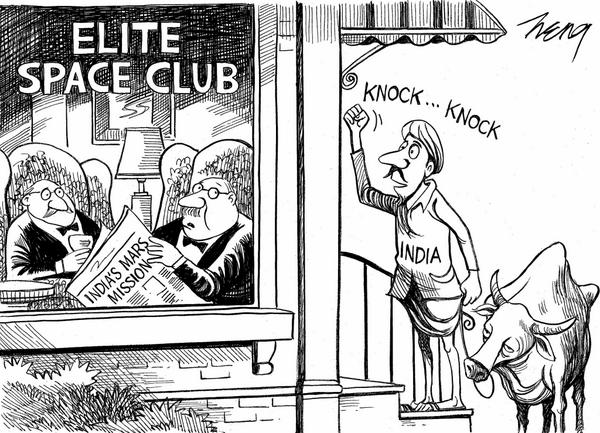
So yesterday’s New York Times’ comic by Heng, titled “India’s budget mission to Mars” seems in poor taste.

2014-09-29-racistcomic.jpg

The comic depicts a poor Indian farmer in traditional garb, accompanied by a bored-looking cow, eagerly knocking on the door of “Elite Space Club”. The two people in the elite space club drinking wine and reading about India’s mission in the papers look perturbed and hesitant to open the door. It is also worth noting that the members of the elite space club are male, white, elderly and look wealthy. Whether meant to be funny or ironic, the racial, national and classist stereotyping is apparent.

In reaching Mars, the Indian Space Research Organization (ISRO) joins the ranks of Soviet space program, NASA and European Space Agency. It not only did so on a budget, but also battling “brain drain“. It’s a commonly lamented problem that many of the country’s brightest scientists and engineers end up working internationally, and tend to shy away from research in India, especially an area like space research, because it’s not as lucrative.

The comic strip comes at the time of Indian Prime Minister, Narendra Modi’s maiden visit to the United States. Addressing a 20,000 strong crowd at Manhattan’s iconic Madison Square Garden yesterday, he emphasized India’s new role on the world stage and its growing economic clout. “When people ask if we still play with snakes in our country, I tell them that now we play with the mouse,” Mr Modi said, drawing attention to the changing stereotype of India from a nation of snake charmers to one of technical prowess.

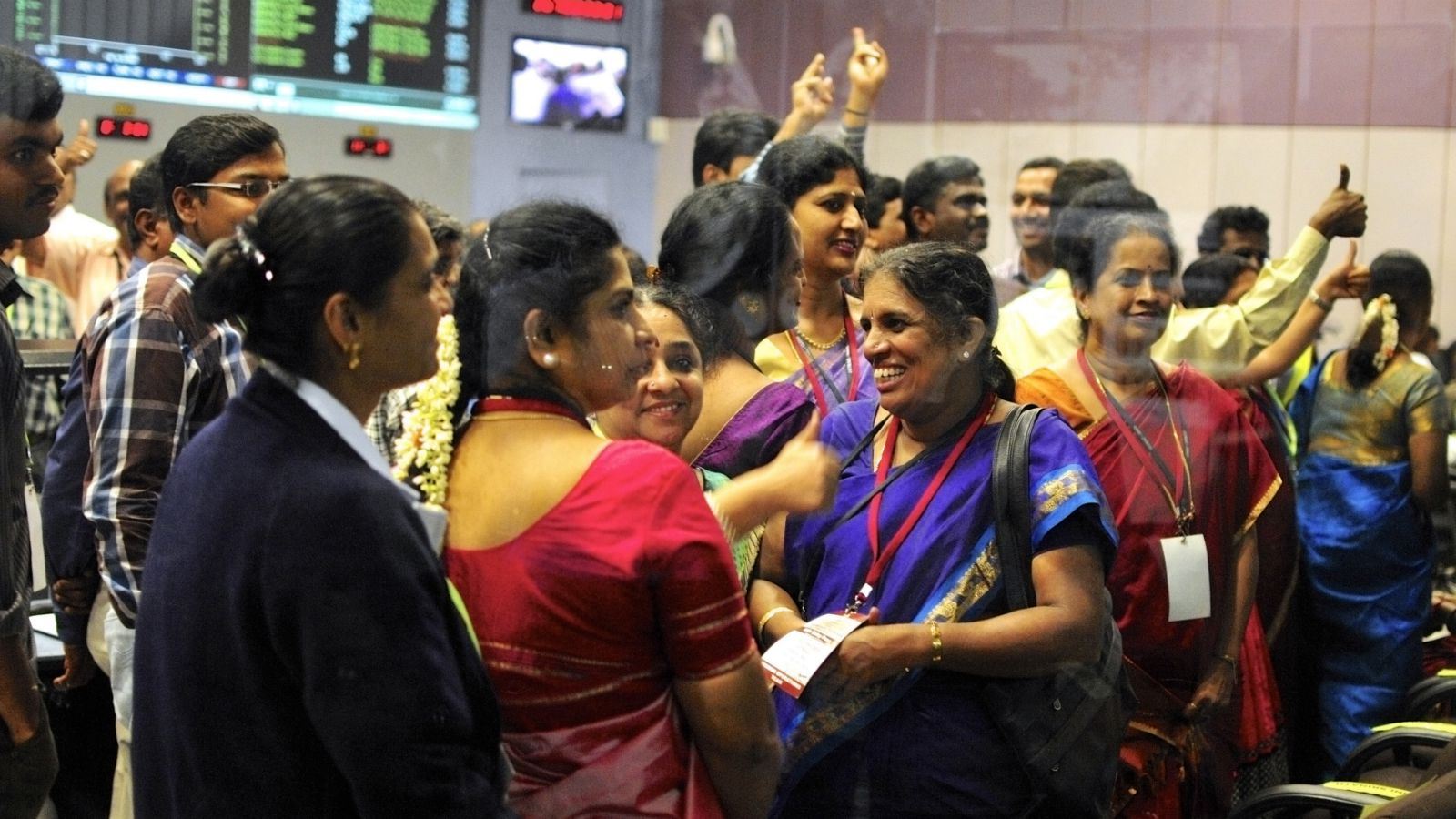
In case the Times is wondering what interplanetary-mission-heading Indian scientists look like then here you go, this is what they look like:

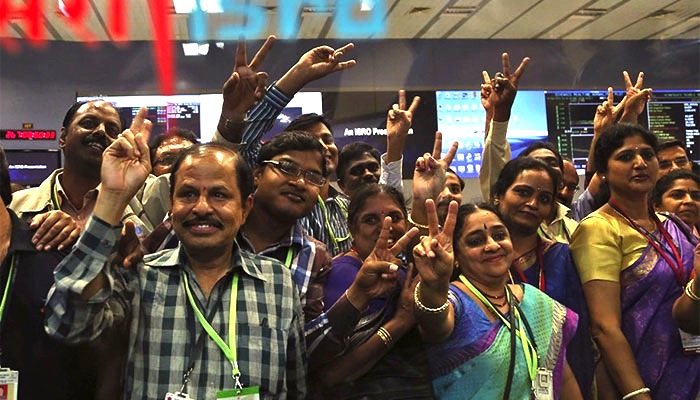
2014-09-29-isroscientists.jpg

And this:

2014-09-29-isro2.jpg

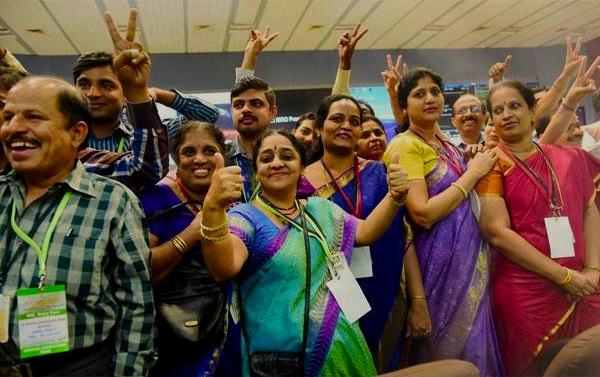
And this:

2014-09-29-isro3.jpg

The male engineers are wearing Western gear, while some of the female engineers are rocking traditional silk saris, the kind usually worn on special occasions, and jasmine flowers in their hair. On regular days, they work in full suits. There are no farm animals in sight at the ISRO office. And they certainly don’t look desperate for membership into some secret elite club. In fact, their jubilance says it all.

See, there are lots of socially and economically elite people in the world — being elite is like winning the lottery. But only a handful of human beings in history can claim to have sent a spaceship to another planet. That is brilliance and merit. That is actualizing human potential and literally moving humanity forward — like inventing the wheel, or, you know, sending a spaceship to Mars. One doesn’t have to be a rocket scientist to understand that.

SOURCE::::   IN  http://www.huffingtonpost.com/  

NATARAJAN

Nauru”s Downfall From Rich Nation to Sick Economy ….

The island of Nauru. Picture: Bradley Hunter

The island of Nauru. Picture: Bradley Hunter Source: News Limited

IT’S a deeply troubled nation that has been plunged into a nightmare scenario, struggling with a failed economy, health crisis and the destruction of its natural beauty. But life wasn’t always like this in Nauru.

At just 21 square kilometres, it’s the smallest island nation in the world and has a population of just over 10,000. Yet this former British colony, which lies approximately 4000km from Sydney in the Pacific Ocean, was once so prosperous that it was the envy of the entire world.

And it was all thanks to bird poo.

We’re not kidding. The discovery of huge deposits of fossilised bird poo that had accumulated for over 1000 years changed this nation forever. It made for an excellent fertiliser and sparked a huge mining effort, first by foreign companies, then by the islanders themselves in 1968 when they achieved independence from Britain.

By 1980 Nauru had become the wealthiest nation on the planet, per capita. A monumental achievement for such a tiny, remote island.

Secondary mining of phosphate in Nauru, 2007. Picture: Lorrie Graham

Secondary mining of phosphate in Nauru, 2007. Picture: Lorrie Graham Source: Flickr

Rolling in riches, the locals abandoned their traditional lifestyles and turned to unhealthy food, alcohol and cigarettes.

It wasn’t long before a health crisis hit, and hard.

Life expectancy plunged to just 50, while rates of diabetes, heart disease and other chronic illnesses skyrocketed along with their waistlines. In 2007, 94.5 per cent of its residents were identified by the World Health Organisation as overweight, and 71.7 per cent obese — the highest rate in the world. It was overtaken in the obesity stakes by Mexico in 2013.

These days, Nauru has the highest prevalence of type-two diabetes in the world, affecting 31 per cent of adults.

The downfall of the world’s richest country

Locals walk to fight obesity. Picture: DFAT Source: Flickr

That was just the start of their problems. The phosphates ran out in the early 1980s, along with the nation’s primary income source.

With so much of the island mined, all that was left was an environmental wasteland riddled with decay. The damage is so severe that 75 per cent of the country is uninhabitable.

While Nauru was formerly known as “Pleasant Island” due to its lavish tropical vegetation, it’s a harsh reality that it no longer lives up to this name.

A message in Nauru. Picture: Lorrie Graham

A message in Nauru. Picture: Lorrie Graham Source: Flickr

‘The effects of mining are very distinctive, because the phosphate develops within coral pinnacles, so you have to scoop the phosphate out from within the pinnacles themselves,” Professor John Connell, head of the School of Geosciences at the University of Sydney told the ABC. “So those scooped areas descend about three metres … So it produces an extraordinary landscape which is visually quite dramatic and is totally useless for anything else.”

The coral pinnacles of Nauru. Picture: Bradley Hunter

The coral pinnacles of Nauru. Picture: Bradley Hunter Source: News Limited

Locals were devastated at the loss of their once-stunning scenery.

“I wish we’d never discovered that phosphate,” Rev. James Aingimea, 84, the minister of the Nauru Congregational Church told the New York Times at the time. “I wish Nauru could be like it was before. When I was a boy, it was so beautiful. There were trees. It was green everywhere, and we could eat the fresh coconuts and breadfruit. Now I see what has happened here, and I want to cry.”

Health warnings in Nauru. Picture: DFAT

Health warnings in Nauru. Picture: DFAT Source: Flickr

Many residents had quit their jobs and went on huge spending sprees including expensive holiday and shopping trips, and importing sports cars – even a Lamborghini. So there was little cash left.

“Hardly anyone thought of investing the money. Dollar notes were even used as toilet paper,” a local told the BBC. “It was like every day was party day.”

In the years that followed, the island went virtually bankrupt. The government, who had made a series of bad investment choices, froze wages and started borrowing heavily from trusts.

The island. Picture: ARM, Wikipedia

The island. Picture: ARM, Wikipedia Source: Supplied

“A lot of money was invested in things which never actually turned out to work,” Professor John Connell, head of the School of Geosciences at the University of Sydney told the ABC. ‘For example, buildings in overseas countries, like Nauru House in Melbourne, hotels in some countries, phosphate factories, curiously, in countries like India and the Philippines, most of which never really survived.”

Now, many homes are run down, and those sports cars are rusted wrecks.

Locals enjoy a game of volleyball. Picture: DFAT

Locals enjoy a game of volleyball. Picture: DFAT Source: Flickr

With little financial options, in 2001 Nauru entered into an agreement with Australia to house a detention centre in return for foreign aid, of which they became reliant. As of this year, that amount Australia provides is $27.1 million.

Detention centre being constructed. Picture: Deidenang Clint

Detention centre being constructed. Picture: Deidenang Clint Source: Supplied

These days, for many Australians, the first thing we think of when Nauru is mentioned is the plight of asylum seekers there. But all that could soon change; the more than 1000 asylum seekers in Nauru could soon be moved to Cambodia under a new deal.

Source::::KATE SCHNEIDER, Travel Editor in news.com.au

Natarajan

5 Surprising Things That Cost More Than India’s Historic Mission To Mars !!!

India just became Asia’s first interplanetary power. The country’s Mangalyaan satellite successfully made it into orbit around Mars on Wednesday after a roughly 10-month journey. The mission comes at an astonishingly low cost of $74 million, or nearly one-tenth of the price of NASA’s MAVEN spacecraft that entered the red planet’s orbit Sunday night.

Indian Space Research Organization chief K. Radhakrishnan even called the Mars Orbiter Mission “the cheapest interplanetary mission ever to be undertaken by the world.”

Just how cheap? This graph shows a handful of surprising things that cost more than India’s Mars mission.

India Mars

Business Insider

  • The most expensive apartment ever sold in London had a price tag of $237 million. You could get three of India’s satellites for that cost, and with a better view.
  • The new F-35 fighter jet costs a jaw-dropping $160 million a pop.
  • “Gravity” starring George Clooney and Sandra Bullock cost about $100 million. That’s about one-third more than the cost of the successful Mars mission.
  • The Airbus A380 would set you back more than $400 million. You could get more than five Mangalyaan satellites for that price.


SOURCE:::: Mike Bird  in Business Insider India.com

NATARAJAN