Message for the Day…” You must Hold on to the Name of God Under any Circumstance …”

In the young-of-the-monkey type of devotion, the child must rely on its own strength to protect itself —wherever the mother jumps, the child must attach itself to its mother’s belly and hold on, even if pulled apart! So too, the devotee must stand the tests of the Lord and hold on to His name under all conditions, tirelessly, without the slightest trace of dislike or disgust, bearing the criticism and ridicule of the world and conquering the feelings of shame and defeat. An exemplary example of this type of devotion is Prahlada. In the second path, just as the kitten simply places all its burdens on the mother cat, so too, the devotee completely trusts the Lord and surrenders to Him. The mother cat holds the kitten in its mouth and transports it safely through even very narrow passages. Lakshmana is the example of this path. These two are sometimes referred to as devotion with effort (bhakthi) and self-surrender (prapatti). The former a hard path, while the latter a simple or safe path. 

Sathya Sai Baba


Meet Beno Zephine …India’s First Visually Challenged Person in IFS …Read about her Inspirational story…

The inspirational story of Beno Zephine!

Beno Zephine is 25 and she made history when she became India’s first 100 per cent visually challenged person to be inducted into the country’s elite Indian Foreign Service (IFS).

She secured 343rd rank in the 2013-14 Civil Service examination, but had to wait for a year for her appointment, as the government worked out the rules to accommodate her.

Smiling, confident, with strong views on everything, expressed in a strong voice, Beno Zephine is a probationary officer with the State Bank of India currently.

She lives with her father Luke Anthony Charles who works with the Railways and her mother, Mary Padmaja, a homemaker.

Her only brother, Bruno Xavier, works as an engineer in Canada.

This is the inspiring story of how NL Beno Zephine became an IFS officer.

Choosing an unusual name

My parents deliberated a lot on a name for me. Beno means daughter of God and Zephine means hidden treasure.

It’s an unusual name. I thought people would be curious and ask me what it meant, but not many have asked me. I like my name a lot.

A normal, happy childhood

No one in my family made a big fuss about my disability, so it was not a big thing for me.

My first memory is of going to school for the first time. I was very excited. I went to the Little Flower Convent for the Blind.

I had a very happy school life as my teachers encouraged me to do whatever I wanted to.

Public speaking as a UKG student

I was a talkative girl then and I am a talkative woman now.

I gave my first public speech when I was in upper KG; I spoke about Jawaharlal Nehru and won my first prize as a speaker – it was a steel plate.

After that, there was no stopping me. Instead of wishing me good luck, my teachers used to tell me, ‘we know you are going to bring the cup to the school’.

They were that confident about my oratorical skill and I thoroughly enjoyed speaking.

The encouragement from my teachers and their confidence in me led to my success in public speaking.

In the early days, I used to write down what I had to say and then learn it by heart. From the sixth standard onwards, I started speaking extempore. I enjoy it more than preparing a speech and I fared better.

From Jawarharlal to environmental and social issues

I would speak about conservation of wildlife, cancer, etc. My Dad used to get me books and my Mom used to read them out to me and that’s how I prepared for the speeches.

In college I was often made Master of Ceremonies and I loved it.

I enjoyed studies as much as I enjoyed speaking. I enjoyed all the subjects.

Academics wasn’t a burden, it was something I enjoyed. I had no favourites; every subject and every book was my favourite.

Studying English literature in college

After school, I joined Stella Maris College to do my degree in English literature.

I did my post graduation in English literature from Loyola College.

I enjoyed college too. I had no difficulty moving from a blind school to a normal college because at home and outside, no one treated me differently.

That gave me the confidence to face life like any other person.

Probationary Officer with the State Bank of India

As soon as I completed my MA, in 2013, I got a job as a probationary officer with SBI.

I felt empowered and independent. With my first salary, I bought a gold chain for my father and earrings for my mother.

Suddenly I felt I had grown up. That made me happy, but I also felt scared at the responsibility. But, then, that is an inevitable part of life.

I was happy that I was given the important task of NPA (Non performing assets) recovery. I managed to deliver and was called Vasool Rani!

I don’t know why but people think I am very strict. I don’t compromise on the way things have to be done. I assert myself and I value my dignity and also others’.

Wanted to be a civil servant when in the 11th standard

Till I was in tenth standard, my ambition was to become a lawyer or a lecturer.

In the eleventh standard, my dream was to be a civil servant, even though I didn’t know what it could offer me. It was just that I was interested in society and any service that was associated with society interested me.

I didn’t like people wasting water — I used to make a big fuss when someone wasted water. People made fun of me, saying, ‘Here comes the collector.’ That was one of the factors that made me interested in the civil service.

Listening to the radio and reading newspapers

I used to listen to the 9 o’clock news on All India Radio as a child. I would say it helped a lot in my success in the Civil Service Examination.

I was interested in news pertaining to the country. I was interested in economics because I was interested in whatever had a connection to the country.

Water conservation, nature, wildlife, anything that has any relevance to society interests me.

Preparing for the Civil Service Examination

I would scan the books I had to read and then put it into the computer to read. It was not possible to scan each and every book, as you have to read so many books when you prepare for the Civil Service. So my Mom used to read the books to me.

I started preparing for the examination when I was an undergraduate and made my first attempt when I was in my first year of postgraduate study, in 2012.

I couldn’t clear the Mains in my first attempt, though I thought I would.

I was disappointed for a couple of days because I was expecting a lot, but I was not demotivated.

Clearing with a good rank in the second attempt

The next time, I didn’t prepare too much as the foundation I got in the first attempt helped me.

I was not nervous or tense when the results were to be announced. I was curious to know the marks and rank.

I cleared the exam and scored a rank of 343/1022. I was happy.

Getting IFS but not immediately

My choice was the Indian Foreign Service. I was told that the IFS did not accept anyone who was 100 per cent blind.

They had to make some changes in the rules to offer me a position. I don’t know the technicalities, but that was why the procedural delay of one year happened.

Call from the Ministry of External Affairs

When I got the call from the under secretary in the ministry of external affairs to tell me that I had been selected to the IFS, I didn’t jump up and down or break into tears.

I felt responsible. I am happy that I am an emotionally balanced person.

It is good that I have become India’s first 100 per cent visually challenged person to be in the Indian Foreign Service. It gives me responsibility.

I am ready to do anything for my country. I am just clay and the Foreign Service can mould me whichever way they want.

No celebration yet

I haven’t had time to celebrate my selection yet. My friends are angry that I am only speaking to the media for the last four days.

Once all the interviews are over, I will go out with my friends to a restaurant.

Yes, I am a foodie and I love all kinds of food. Though my mother taught me to cook when I joined college, I don’t do any cooking these days. I have become lazy and I don’t get any time to cook, but I would love to cook when I get time.

Want to meet the Prime Minister

I am planning to fax a letter to the Prime Minister thanking him and requesting a meeting with him. I want to take his blessings.

Motivational speaker

Once I joined the State Bank of India and after I passed the Civil Service examination, many schools and colleges started calling me to speak to their students and motivate them.

Generally I tell students that everyone should have a goal in life but I say it differently at different places. I think I do motivate them as people love listening to me.

Do I talk about my disability and tell them that I achieved this despite my disability? It depends on the audience. If they are small children, I don’t talk about my disability at all as they will not understand it. To college students, I definitely talk about my disability.

It is not a matter of liking or not liking my disability to be referred to. It is just a fact.

I never think about my disability at all; I talk about it randomly.

At home, I was never treated as a disabled person; I am like any other person.

I don’t like being treated as a disabled person. Those who are close to me know that I don’t like sympathy.

I like to be treated like any other human being.

I talk to people quite normally and generally people respond quite normally and not with sympathy.

I am often asked what challenges I have faced in life. I can’t think of any huge challenge. Maybe I am blessed.

Thoughts on India

I look at India quite positively. We had to overcome several challenges because of the population and we have achieved so much despite all the problems.

We have this habit of looking only at the negative things. We are patriotic only when we watch cricket or when Pakistani forces are on the border.

We are not patriotic when we throw paper on the road or exploit the resources of the country.

Instead of pointing to this problem and that problem, every single person has to realise that the problem is within one self.

I don’t think changes can come overnight; they will come gradually.

It took hundreds of years for America to be what it is now. Why is it that everybody wants everything to be so good in India in such a short span of time?

Message to youngsters

Instead of moaning about what you do not have, use the resources we have. Then, those resources will create further resources.

Challenges do come, but face them and devise your own strategies.

Understand your strengths and weaknesses, only then will you be able to strengthen your strength and weaken your weakness.

It is very important to read newspapers and understand what your country is doing. If you do not do that, you do not have the right to criticise the country.

Dreams


I am a very positive person. My dreams are short term.

I create dreams and fulfil them and move on.

If there is an opportunity, I will be the first person to take it.

I don’t have any dream for myself now, but my dream for my country is to see India developing, and I see it happening.

Credits…Photographs: Sreeram Selvaraj

Shobha Warrier / Rediff.com 

Source….www.rediff.com

Natarajan

Charles Correa… India’s Greatest Architect…

Over the centuries, a sense of the sky has affected profoundly our relationship to builtform. This is why in Asia, the symbol of education has never been the Little Red Schoolhouse of North America, but the guru sitting under the tree. – Charles Correa

One of India’s greatest contemporary architects, Charles Correa passed away at 11.45pm on Tuesday in Mumbai at the age of 84. He has made some remarkable contribution in the field of architecture post independence, and has been an influential urban planner and activist. But there are so many people who don’t know about him and his career. Hence, here are few points you need to know about Charles Correa.

1. He was an alumni of Massachusetts Institute of Technology (MIT)

C-1

Charles Correa completed his schooling in Mumbai from St. Xavier’s College, University of Bombay with science stream. After that he did his Bachelors in Architecture from University of Michigan and masters form the prestigious Massachusetts Institute of Technology.

2. He has won over 10 national and international awards including Padma Vibhushan, the second highest civilian honour

C-2

His talent and hard work had won him many laurels and prestigious titles. Some of them are Padma Vibhushan, Padma Shri, Chicago Architecture Award, The Premium Imperial from Japan Society of Arts, gold medal by Royal Institutes of British Architects etc.


3. He was the chief architect of Navi Mumbai

C-3

The new city which was built across the harbour is now an urban growth center of 2 million people in extended part of Mumbai with superb planning and architecture. Correa is responsible for the entire layout and meticulous planning of the entire region which is now one of the most expensive real estates in the country. It’s is a beautiful city and he designed it.


4. He was always considerate to the needs of the urban poor and came up with a lot of low cost housing designs like ‘Tube House’

C-4

The “tube” house was first prize winner in an All-India competition for low-cost housing organised by the Gujarat Housing Board. These row-houses provided the same density -and larger living space per family. The area is formed so that the hot air rises and getaways structure at top, setting up a convection streams of characteristic ventilation. Inside the units there are no entryways; security being made by the different levels themselves, and security by the pergola-network over the inward patio. A narrow house form designed to conserve energy!

5. He was the first chairman of National Commission of Urbanization


C-5

His work was noted for his use of traditional techniques in his designs. In 1985, Prime Minister Rajiv Gandhi appointed him as the Chairman of the commission.

6. He believed in sustainable source of development and cared for the environment

C-6

In 1984, he founded the Urban Design Research Institute in Bombay, dedicated to the protection of the built environment and improvement of urban communities. In the course of the most recent four decades, Correa has done spearheading work in urban issues and minimal cost shelter in the Third World.

7. He was pro ‘open to sky spaces’

C-7

He utilized the significance of open-to-sky spaces to exploit the hotter atmosphere outsider toward the west. His utilization of the chhatri, or overhead covering, makes negligible safe house from the sun in the most blazing piece of the day, while permitting clients to appreciate being under the open sky.

The utilization of this component is found in his most praised early work, the Gandhi Smarak Sangrahalaya, a remembrance exhibition hall to Mahatma Gandhi in the Sabarmati Ashram in Ahmedabad that was finished in 1963. A measured building made up of 6 x 6 meter units, the modules are masterminded to exchange between those that are shut off by pyramidal rooftops and those that are interested in the sky. Without glass, the units are characterized by dividers and open spaces, making sections between them to lead starting with one presentation space then onto the next. The materials are those of the encompassing structures of the ashram: block dividers, stone floors and tiled rooftops. The spaces are gathered around a focal water court to cool the structures in the bone-dry warmth.

8. He was given the title of ‘India’s Greatest Architect’

C-8

Royal Institute of British Architects (RIBA) billed him as “India’s greatest architect” when it mounted an exhibition on him in 2013.

9. Some of his Indian designs

C-9

Mahatma Gandhi Memorial at the Sabarmati Ashram, Jawahar Kala Kendra in Jaipur, British Council in Delhi, Kanchenjunga Apartments in Mumbai, Bharat Bhavan in Bhopal, Sardar Vallabhbhai Patel Stadium in Ahmedabad, Salt Lake City in Kolkata are few of his many spectacular creations.

10. Some of his international designs

C-10

The Champalimaud Centre in Lisbon, Aga Khan Museum in Toronto etc. are few legendary buildings he has designed.

India lost a valuable gem. May his soul rest in peace.

source….www.storypick.com

Natarajan

Image of the Day…Tropical Storm Bill from ISS…

Tropical Storm Bill From the International Space Station

Earth from space with tropical storm visible above and space station's robotic arm below

NASA astronaut Scott Kelly (@StationCDRKelly), currently on a one-year mission to the International Space Station, took this photograph of Tropical Storm Bill in the Gulf of Mexico as it approached the coast of Texas, on June 15, 2015. Kelly wrote, “Concerned for all in its path including family, friends & colleagues.”

Image Credit: NASA

Source….www.nasa.gov

This 20 year old website Hosts Just One image Everyday…Has Millions of Fans !!!

Twenty years ago, two astrophysicists – Jerry Bonnell and Robert Nemiroff – created Astronomy Picture of the Day (APOD). The website is simple and harkens back to the days of the early web: Every post is just one image and a bit of text describing the photo, with links out to sources of information.

During its first year, in 1995, the site received about 12 visits a day. Today they’re way past a million daily visitors, according to The Verge.

The two are active researchers at the NASA Goddard Space Flight Center. How did they become guardians of the treasured website?

“So we were getting these emails that had these image attachments, sometimes about the Hubble Space Telescope, sometimes from something else, and the people sending these emails had no idea what that was. It would say, ‘Look at this, it’s colorful and something astronomical. Isn’t that cool?’ So we thought maybe something we could do was take these images and explain them one after the next,” Nemiroff told The Verge’s Sean O’Kane.

How do they chose what to feature on the site? Well, it’s a bit of personal preference:

Robert Nemiroff: I just like the stuff where you look at it and say “Wow, what’s that!” I’m somewhat jaded after 20 years. It has to work for me before I try to make it work for other people.

Jerry Bonnell: I seem to be a sucker for the big, beautiful spiral galaxy images.

Back in those days cameras with high-enough quality to take great space pictures weren’t as plentiful. They were genuinely worried that they’d run out of images to post.

As Nemiroff said:

Before we posted our first image we debated this, Jerry and I, as to whether we were going to run out of images in a few days and then say, “Well that was stupid.” But actually there were many images around even back then. And NASA’s Ranger series took tens of thousands of images of the lunar surface, so if we had to we could just start putting up other pictures of the lunar surface. “Here’s another crater that’s a little bit different than yesterday’s crater.” But we never ran out of images.

And Bonnell:

I used to have to be more proactive. I would explore what was online and available in the NASA archives online, and I would also make occasional trips to photo libraries that I could find at Goddard and NASA headquarters and look at the prints.

Now, the two-person team gets hundreds of submissions of images from their millions of fans. They still do all the work just the two of them, though:

I usually do the beginnings of the weeks and Jerry does the ends of the weeks, and Wednesday can go either way.

I will do several in a row. I’ll do most of my week maybe on Thursday or Friday, sometimes on Saturday or Sunday. Sometimes I’ll leave Wednesday to the night before in case there’s some kind of breaking news. Jerry will do the ends of the weeks, he usually waits until the night before, and works on it during the afternoon.

To celebrate the anniversary, the two re-created Johannes Vermeer’s paintings The Astronomer and The Geographer using more than 5,000 APOD images that have appeared during the last 20 years.

See Explanation.
Moving the cursor over the image will bring up an annotated version.
Clicking on the image will bring up the highest resolution version
available.

Astronomy Picture of the Day

Discover the cosmos! Each day a different image or photograph of our fascinating universe is featured, along with a brief explanation written by a professional astronomer.

2015 June 16

If you like space you can follow the APOD stream in many ways: Twitter account; Google+ page; on Facebook; on Instagram, in apps, and asubreddit.

source….Jennifer Welsh in  .www.businessinsider.in

Natarajan


Message for the Day….” Offer unto the God , the Flower of Your Heart {Hrudhya Pushpam}…


Lord Krishna incarnated to destroy evil in a handful of individuals. But now, the evil qualities are not identifiable in a small group of people. They are widespread everywhere. The scorpion has poison only in its tail; the cobra only in its fangs; but people have poison all over them! They have it in their eyes, their tongues, their mind, their intelligence, their gait, their brain – just about everywhere. You may ask, “Oh! When will this poison be counteracted and destroyed?” When the Lord enters your heart, that is the very objective He will accomplish. Offer unto the Lord, the ‘flower of your heart’ (Hrudaya Pushpam),after cleansing it thoroughly of the dust and pests (desire, anger, envy, doubt, etc.) that infest it. Without effort, can there be victory in any field? Can you become a high ranking official without the appropriate qualifications of scholarship, talent, experience and wisdom? So persevere and succeed! 

Sathya Sai Baba

Message for the Day…” Until one can rely upon his own strength , he is an Infant in the hands of God …”

Explaining the characteristics of a devotee, Rama said to Narada, “Whoever with discrimination and renunciation (viveka andvairagya), and humility and wisdom (vinaya and vijnana) is aware of the knowledge of Reality, whoever is always immersed in the contemplation of My play (leela), whoever dwells on My name at all times and under all conditions, and whoever sheds tears of love whenever the Lord’s name is heard from any lip — these are My genuine devotees.” When the infant grows up into an adult, the mother won’t pay so much attention to its safety. The Lord doesn’t pay much attention to the wise one (jnani). For the jnani, their own strength is enough. Therefore, until one can rely on one’s own strength, one must be an infant in the Lord’s hands, as a devotee of the form, right? No one can become a devotee of the Formless Supreme (Nirguna bhaktha) without having been a devotee of the form (Saguna bhakta).

Sathya Sai Baba

” When the Lights Glow …This village Thanks TWO young MEN …” !!!

India is witnessing a radical transformation where highly qualified youngsters are giving up cushy jobs to make a difference in the lives of poor people in rural areas.

Manu A B/Rediff.com tracks the success stories of some of the remarkable people who are working in remote villages to change the profile of rural India. 

Every evening when the lights glow in the huts of Gangapur village, the villagers thank two young men – Ajay Kumar and Somil Daga.

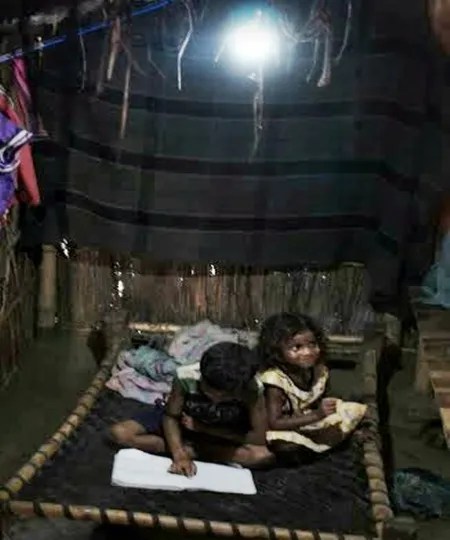
Solar lights help children study in Gangapur

For 35 poor families of the Musahar community from Gangapur village in Samastipur district of Bihar, Ajay and Somil are visionaries who literally shed light into their lives.

Till these youngsters arrived in Gangapur with their out-of–the-box solar-powered electrification project, the villagers were forced to live in an era of darkness, their children were afflicted with eye sight problems due to the stress and strain caused by long exposure to the flickering kerosene lamps

When it rained the entire village plunged into darkness for weeks as even the lamps turned damp and stopped flickering altogether.

Even for basic things like charging mobile phones, the villagers were forced to walk a good 5 kilometres to the nearest grocery store, which charged them Rs 5 for charging the phone once.

When 23-year-old Ajay and 24-year-old Somil approached them initially, the villagers couldn’t believe that these two youngsters could bring electricity to their village without setting up a thermal or hydro electric project.

The villagers had by the time given up hope as the government had turned their back even after they petitioned many times to provide electricity to their village.

Ajay Kumar (L) and Somil Doga at work.

“They were initially skeptical of the idea of bringing light to their households using sun as a source of power. The toughest part was getting the consent from villagers,’’ says Ajay Kumar, an electrical engineer from Kalinga Institute of Industrial Technology, Bhubneshwar.

It took three months to convince villagers to agree for the project. “They could not believe that electricity could be generated by setting up solar panels. It was something they had never heard of so it was difficult to make them understand,” he says.

For Ajay Kumar and Somil Doga, SBI’s Youth for India fellowship, provided a unique opportunity to work on a rural development project for a period of 13 months. They have completed 9 months now.

Somil who did his mechanical engineering from Vellore Institute of Technology also gave up good job offers to join SBI’s program.

Sharing a common passion, they decided to work together in bringing electricity in Gangapur.

It was the first time that Ajay was living in a village. It was a totally different life altogether. He too faced problems initially just as anyone new to a village.

Village life was difficult and at the same time a great learning experience. He decided to cook himself as the food they got from the small dhabas was not good enough. “At home, everything was taken care of. I never entered the kitchen but now I am an expert cook too,” says Ajay in a lighter vein.

For people in Gangapur – who worked in brick kilns and as daily wage labourers – there was no hope of a better life.

Once the villagers agreed for an alternative solution to light up their village, Ajay and Somil worked on building a low-cost decentralised solar lighting solution. The nearest town to procure the raw materials was 30 kilometers away. So for everything, they had to travel to town, which again took time.

During one foggy winter morning, I was riding the bike to the village. Unfortunately, I skidded and fell off the bike. But the timely help from villagers helped me and I escaped with just minor bruises,’’ says Ajay.

Raising funds was not too difficult. “Fortunately, we were able to raise Rs 80,000 through crowd funding to buy the panels, batteries and wiring materials. It took about 3 months to build and install the system to charge mobile phones and get electricity in all the houses. Currently, all the houses have 1-2 led lights. We have installed a mobile charging system as well. It saves them money and time as drudgery of walking to get the phone charged is gone. We have also worked out an arrangement where each family has agreed to pay Rs 40 every month towards the maintenance of the system. This money will be collected and deposited in a bank,” explains Ajay.

While Ajay Kumar designed the solar panel model for electrification, Somil helped him with the installation. Once work started in the village, anxious villagers gathered around Ajay and Somil, curious to know what is going on and how the systems will work. There had innumerable questions too. It was heartening to see their reaction, their warmth and friendly nature made work easier for the duo. Even when lights were placed inside the houses, there was a sense of excitement and doubt in the minds of the people. Finally, when they saw the houses lit up, their joy knew no bounds. It was indeed a dream come true. Ajay and Somil were overwhelmed by their compliments. Meanwhile, Ajay has also filed a patent for this innovative and cheap solar power generation system. Within 30-40 years, we will run out of conventional fuels to generate electricity. It’s high time we switched to alternative methods that are safer, cheaper and long lasting. Even in urban areas, people must build alternative solar energy systems for electricity,” advises Ajay.

It costs Rs 8,000 to set up a solar-powered system that can light up 6 LED lights which can run for about 10 hours. The same system can also power 4 lights and 1 fan.

During his spare time, Ajay also managed to teach students at nearby schools. “Though the children are smart and keen to learn, these schools lack good teachers. Quality education is very essential so that they can also come up in life. Early marriages are also big issue here. I hope more young people will take up rural development projects and make a difference in the lives of millions of people who deserve a better life. It is not as difficult as it seems to be. We all have the ability to adjust and adapt,” explains Ajay.

Ajay Kumar and Somil Daga believe in Mahatma Gandhi’s words, “The future of India lies in the villages.”

They wanted to bring light to around 40 per cent of India’s villages which still do no have electricity.

It is not a difficult task. Just like we brought electricity to Gangapur, we can light up other villages across the country,” says Ajay, almost sounding like a visionary.

To know more about Ajay’s work, you can mail him at ajay.ansha002@gmail.com

source…..www.rediff.com

Natarajan

“கொழந்தே …நான் வைத்ய சாஸ்திரம் படிச்சதி ல்லியே …” !!!

அந்தப் பையனுக்கு மிஞ்சி மிஞ்சி போனால் பதினஞ்சு, பதினாறு வயஸ்தான் இருக்கும். பாவம், தாங்க முடியாத தலைவலியால் அவதிப்பட்டான்! டாக்டர்கள், வைத்யம் இதெல்லாம் ஒரு பக்கம் அதுபாட்டுக்கு போய்க் கொண்டிருந்தாலும், அவனுக்கு பேரிடியாக ஞாபகசக்தியும் குறைந்து கொண்டே வந்தது!

சோதனை காலத்திலும் ஒரு நல்ல காலம், ஞாபகம் நன்றாக இருக்கும் போதே [“அப்போதைக்கு இப்போதே சொல்லி வைத்தேன்” என்று ஆழ்வார் பாடியது போல்] பெரியவாளிடம் வந்து கண்ணீர் விட்டான். “எனக்கு தலைவலி தாங்க முடியலே பெரியவா….அதோட மறதி ரொம்ப இருக்கு. பாடத்தை ஞாபகம் வெச்சுக்கவே முடியலே…பெரியவாதான் காப்பாத்தணும்” அழுதான்.

“கொழந்தே! நா…..வைத்யசாஸ்த்ரம் படிச்சதில்லேடா…..வேதாந்த சாஸ்த்ரந்தான் படிச்சிருக்கேன்…..”

பையன் நகருவதாக இல்லை. பெரியவாளிடம் prescription வாங்காமல் போவதாக இல்லை. அதற்கு மேல் அவனை சோதிக்க பெரியவா விரும்பவில்லை. எனவே அவனிடம், ” சரி, நான் சொல்ற வைத்யம் ரொம்ப கடுமையா இருக்குமேப்பா! ஒன்னால follow பண்ண முடியாதேடா கொழந்தே!…”

“அப்டீல்லாம் இல்லே பெரியவா……ஒங்க வார்த்தைப்படி கட்டாயம் நடக்கறேன்! ” வழி கிடைக்கும் நம்பிக்கையால் பையன் முகம் ப்ரகாஸமானது.

“ரொம்ப சந்தோஷம். அந்தக் காலத்துல, முகத்தலளவைன்னு ஒரு கணக்கு உண்டு. அதுப்படி, நாலு பெரிய்….ய்ய படில அரிசி, கோதுமை மாதிரி எதாவுது ஒரு தான்யத்தை அளந்து ஒரு பையில கட்டி,….. சபரி மலைக்கு இருமுடி கட்டிண்டு போறவாளை பாத்திருக்கியோ? அதுமாதிரி, அந்த தான்யத்தை ஒன்னோட தலையில வெச்சுண்டு, தெனோமும் ஒரு மைல் தொலைவு நடக்கணும்! செய்வியா?….முடியுமா?…”

“கட்டாயம் நடக்கறேன்…..”

“இரு இரு….இன்னும் நான் முழுக்க சொல்லி முடிக்கலே! ஒரு மைல் தொலைவு நடக்கறச்சே…யார்கிட்டயும் ஒரு வார்த்தை கூட பேசப்….டாது! சிவ நாமாவோ, ராம நாமாவோ சொல்லிண்டிருக்கணும்! அந்த தான்யத்தை அன்னன்னிக்கி எதாவுது சிவன் கோவிலுக்கோ, பெருமாள் கோவிலுக்கோ,..க்ராம தேவதை கோவிலுக்கோ எதுவானாலும் சரி, குடுத்துடணும்! இல்லாட்டா….யாராவுது ஒரு ஏழைக்கு அதைக் குடுத்துடணும்! இதுமாதிரி பதினோரு நாள் பண்ணினியானா…..ஒன்னோட தலைவலி போய்டும்; ஞாபகசக்தியும் நன்னா வ்ருத்தியாகும்…”

பையனுக்கு ஒரே சந்தோஷம் ! “நிச்சியம் நீங்க சொன்னபடி பண்றேன் பெரியவா” விழுந்து நமஸ்காரம் பண்ணிவிட்டு போனான். பெரியவாளின் அநுக்ரஹம் வேலை செய்ய ஆரம்பித்ததால், அவர் சொன்ன எதையும் மறக்காமல் ஞாபகம் வைத்துக்கொண்டு பண்ணினான். ஒரே வாரத்தில் பெரியவாளை தர்சனம் பண்ண வந்தான்…அழுது கொண்டு இல்லை! சிரித்த முகத்துடன் வந்தான்!

“பெரியவா……என் தலைவலி போய்டுத்து! டாக்டர்ல்லாம் ரொம்ப ஆச்சர்யப்பட்டா! “என்ன மருந்து சாப்ட்டே?”ன்னு கேட்டா…..பெரியவா பண்ணச் சொன்னதை சொன்னேன்….தலைல ஏதோ நரம்பு பிசகி இருந்திருக்கும், தான்யத்தோட வெயிட் ஏறினதும், அது செரியாகி இருக்கும்ன்னு சொன்னா! இன்னும் பாக்கி இருக்கறதையும் பண்ணிடறேன் பெரியவா”

அவன் சொன்னதை சிரித்துக் கொண்டே கேட்டுவிட்டு, ப்ரஸாதம் குடுத்தனுப்பினார்.

உண்மைதான்! பெரியவாளுடைய அநுக்ரஹ பாரம் தாங்காமல், பிசகின நரம்பு சரியாகிவிட்டது!

Read more: http://periva.proboards.com/thread/4538/#ixzz3d02QfHD0

Source…..www.periva.proboards.com

NATARAJAN

Message For the Day….” Remember , it is the “way of living” . the path of virtue , that keeps you in the MEMORY of People long after death …”

Lord Krishna declares in the Bhagavad Gita, “There is nothing in the three worlds that I am obliged to do, nothing unaccomplished that I have to accomplish, but I am still engaged in activity (karma)”. Lord Krishna says this, for, if God is inactive, the Cosmos will come to a grinding halt. You too, must take the lead and follow it. Translate your strength into activity along the path of duty. The young follow the lead of elders. So elders must consistently hold on to ideals and work towards their realization so that the entire universe can attain prosperity and peace. Mother Earth teaches her children this lesson of service and sacrifice. Good conduct must be the main key to the life of every being. Remember, it is the ‘way of living,’ the path of virtue, that keeps you in the memory of people long after death.

Sathya Sai Baba