Moon on the skies of Brisbane on the evening of Monday 28 sep 2015. A Perfect shot showing the beauty of nature .

Photograph taken by Senthil Natarajan , Brisbane
Source……..facebook
Natarajan
The moon is seen against the peak of the tomb of Jama Masjid in New Delhi. Picture: AFP / Chandan KhannaSource:AFP
The full moon is seen on the city skyline as Indian devotees carry statues of elephant-headed Hindu god Lord Ganesha for immersion in the Arabian Sea in Mumbai. Picture: AFP / Punit ParanjpeSource:AFP
An Indian man leans on a wall on top of a building in New Delhi as the moon does time as a backdrop. Picture: AFP / Roberto SchmidtSource:AFP
A full moon shines behind a tower of the Jama Masjid mosque in New Delhi. Picture: AFP / Roberto SchmidtSource:AFP
Source…..www.news.com.au
Natarajan
Hello pretty … the full moon rises between clouds in Berlin. Picture: AP Photo/Gero Breloer
LAST night’s spectacular full moon was a treat for many Australian skywatchers, but in other parts of the world it was merely the overture to a total lunar eclipse.
When a full or new moon makes its closest approach to Earth, that’s a supermoon. A combination of a supermoon and a total lunar eclipse has not been seen since 1982 and will not happen again until 2033.
The supermoon rises behind Glastonbury Tor in Somerset, England. Picture: Matt Cardy/Getty ImagesSource:Getty Images
A flock of birds fly by as a perigee moon, also known as a super moon, rises in Mir, Belarus. Picture: AP / Sergei GritsSource:AP
A perigee moon rises in the sky above the La Concha Beach, in San Sebastian, northern Spain. Picture: AP Photo/Alvaro BarrientosSource:AP
Although still about 220,000 miles (354,055 km) away, it was still the closest full moon of the year, about 30,000 miles (48,280km) closer than the average distance. (The moon’s orbit is far from a perfect circle.)
Skywatchers in North and South America, Europe, Africa and western Asia are expected to be able to see the lunar eclipse, when the moon, Earth and sun will be lined up, with Earth’s shadow totally obscuring the moon
The moon is seen against the peak of the tomb of Jama Masjid in New Delhi. Picture: AFP / Chandan KhannaSource:AFP
The full moon is seen on the city skyline as Indian devotees carry statues of elephant-headed Hindu god Lord Ganesha for immersion in the Arabian Sea in Mumbai. Picture: AFP / Punit ParanjpeSource:AFP
The full moon rises behind Lisbon’s St. George castle. Picture: AP / Armando FrancaSource:AP
The event is due to happen at 10.11pm on America’s east coast (12pm AEST) and the ellipse should be visible for more than an hour, weather permitting.
There won’t be another total lunar eclipse until 2018.
This eclipse marks the end of a tetrad, or series of four total lunar eclipses set six months apart. This series began in April 2014.
The 21st century will see eight of these tetrads, an uncommonly good run. From 1600 to 1900, there were none.
NASA planetary scientist Noah Petro is hoping the celestial event will ignite more interest in the moon. He is deputy project scientist for the Lunar Reconnaissance Orbiter, or LRO, which has been studying the moon from lunar orbit since 2009.
Rising big and full in Lausanne, Switzerland. Picture: AFP / Fabrice CoffriniSource:AFP
An Indian man leans on a wall on top of a building in New Delhi as the moon does time as a backdrop. Picture: AFP / Roberto SchmidtSource:AFP
A full moon shines behind a tower of the Jama Masjid mosque in New Delhi. Picture: AFP / Roberto SchmidtSource:AFP
“The moon’s a dynamic place,” Petro said Wednesday. “We’re seeing changes on the surface of the moon from LRO. We’re seeing that it’s not this static dead body in the sky … it’s this great astronomical object that we have in our backyard, essentially. So people should get out and start looking at it.”
Many stargazers, professional and amateur alike, dislike the term “supermoon,” noting the visible difference between a moon and supermoon is slight to all but the most faithful observers.
“It’s not like the difference between an ordinary man and Superman,” said Alan MacRobert, a senior editor at Sky & Telescope magazine. “It really ought to be called a tiny, slightly little bit bigger moon, rather than the supermoon.”
People watch a full moon rising in Berlin. Picture: AP Photo/Gero BreloerSource:AP
Source….www.news.com.au
Natarajan
 JustJ100 years ago, getting from America to Europe was a voyage that took several days by ocean liners. With the invention of airplanes, that travel time was significantly shortened to under 24 hours. At the apex of the era of transatlantic flight, the Concorde was able to fly 100 passengers at Mach 2.0 speeds from New York to London in just over 3.5 hours. JustJ100 years ago, getting from America to Europe was a voyage that took several days by ocean liners. With the invention of airplanes, that travel time was significantly shortened to under 24 hours. At the apex of the era of transatlantic flight, the Concorde was able to fly 100 passengers at Mach 2.0 speeds from New York to London in just over 3.5 hours. |
||||
| Sources: 1 | 2 | ||||
| Now, the European Space Agency (ESA) just greenlighted the next stage of modern transportation – the hypersonic flight. The ESA has approved a new round of funding to project LAPCAT (Long-Term Advanced Propulsion Concepts and Technologies).
Ignoring its funny name, the new plane will fly at Mach 5.0 speed (that’s five times the speed of sound!), using liquid hydrogen engines. The planes will be able to travel from England to Australia in four hours, carry 300 passengers and even fly to space in just 15 minutes. The new kind of engine is being developed by the British company Reaction Engines, who are said to invest over 60 million GBP in the development, and are going to start builing a full-scale prototype engine.
|

Since humans launched Sputnik 1 in 1957, we have polluted the once-empty space around Earth to the point that it is now becoming dangerous, according to former NASA scientist Donald Kessler.
“We’re at what we call a ‘critical density’ — where there are enough large objects in space that they will collide with one another and create small debris faster than it can be removed,” Kessler recently told Marketplace.
For nearly 20 years, Kessler (who retired very recently) lead NASA’s Orbital Debris Program Office, which keeps track of all the growing clutter around Earth.
He predicts that eventually, there will be so much space junk that leaving Earth to explore deep-space will be impossible. That includes sending satellites to distant stretches of the solar system, like Pluto, and manned-missions to Mars.
Something must be done, he says. So he’s come out of retirement to help find a solution.

Right now, more than half a million pieces of man-made space junk orbiting Earth. And about 23,000 of those pieces are the size of a softball or larger.
This junk accumulates over time as defunct satellites are left in space and meteors, as well as other man-made space debris, slam into them, generating even more, smaller bits of junk.
After these collisions, the junk doesn’t simply go flying off into space. Instead, it is trapped by Earth’s gravity, and wraps like a belt around Earth, cluttering up our path to space.
While the size of this debris is an important factor, the speed at which it zips through space is what makes it so dangerous.
At a distance of over 200 miles above Earth’s surface, objects move at about 17,500 miles per hour.
For comparison, that’s faster than a speeding bullet fired from an AK-47 assault rifle — which is about 1600 miles per hour.
Needless to say, if your spacecraft were hit with a softball-size scrap of metal travelling at 17,500 miles per hour, it could do some critical damage.
For example, in 2009, a retired Russian satellite collided with a US commercial satellite, and the results were catastrophic. The collision destroyed both satellites, adding over 2,000 pieces of space junk to that already-growing pile.

Collisions like these, together with the growing number of satellites we place into orbit, have brought us to the “critical density” that Kessler is so worried about.
Elon Musk, CEO of Tesla and SpaceX, has hopes to send 4,000 satellites into low-Earth orbit — where most of the space junk is located — to provide internet worldwide. But there’s one small problem: If Musk gets his wish, those satellites would only add to the problem.
While launching more satellites to space isn’t a great idea, it’s not the main problem. Most of the stuff we send up doesn’t come down, and it is those dead satellies that we need to focus on, Kessler said.
“The only way to [solve this problem] is to bring back the larger objects,” Kessler told Huffington Post in 2013. “If you want to stop this collision cascading process, you have to bring back satellites, and we don’t know how to do that.”
If we can’t figure out how to return large satellites to Earth, then Kessler says we’ll just have to start picking all the pieces up one-by-one — while travelling at 17,500 mph.
It won’t be an easy task.
Source…. Jessica Orwig in http://www.businessinsider .com.au
Natarajan

Normally you’d never notice it, but all tall buildings sway a little in the wind.
Scarcity of land is forcing us to build skyscrapers taller and build them on smaller and smaller bases. But the taller and the skinnier a building is, the more likely it is to sway at the top.
To minimise the swaying, developers are putting giant counterweights called tuned mass dampers (TMDs) near the top of skyscrapers. A TMD is a giant ball made of steel or concrete that weighs anywhere from 300 to 800 tons, and it’s usually suspended in the building using springs and pistons.
It looks like this in the Taipei tower in Taiwan:

On a windy day, a skyscraper over 1,000 feet tall might sway a couple of inches, according to Rowan Williams Davies and Irwin, consulting engineers. Usually that movement is imperceptible, but on a particularly breezy day, you can feel the building moving. The sway of some buildings is enough to make the tenants feel sea sick.
If the wind blows from the right, the damper swings from the left to balance out the push.
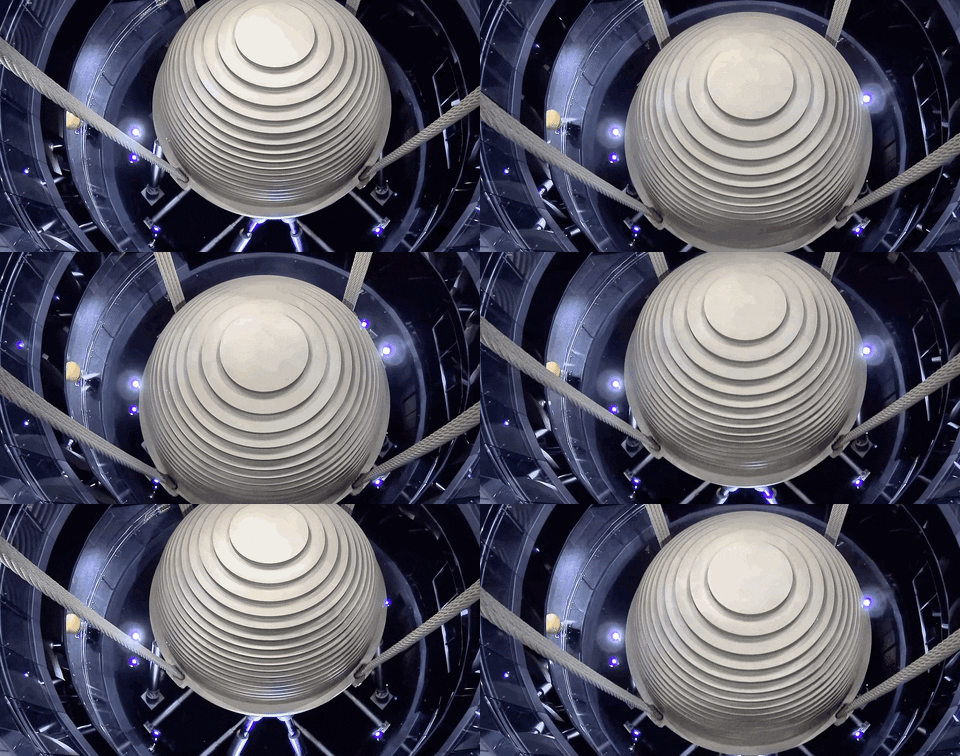
But dampers don’t really have anything to do with the structural integrity of a building, according to engineers. They’re not, say, stopping the building from falling over. They’re actually only put in place to keep the building’s occupants from feeling unnerved or getting seasick.
Back in 2004, the 1,667-foot tall Taipei 101 tower was the tallest building in the world. It’s since been eclipsed by other buildings:

It may not be the tallest building anymore, but on Saturday Aug. 8, Taipei 101 set a different record. Or rather its damper set a record when it swung a full meter to counteract 100 mph winds from Typhoon Soudelor, according to Popular Mechanics. One gust clocked in at 145 mph.
A meter might not sound that impressive. Here’s a few things to keep in mind while you watch the video footage:
1. This damper is 18 feet across.
2. It weighs 728 tons.
3. Not all of the movement in the video is from the damper itself. Some of it is the building itselfmoving around the damper.
The New York Times has a great graphic explaining how dampers work. Really though, it all boils down to simple physics.
A skyscraper is like a giant tuning fork. If you give it a good whack, like with a gust of wind or an earthquake, it will start vibrating at a set frequency. So when the tower is hit with a powerful gust of wind, the damper swings with the same frequency as the building, but in the opposite direction. It doesn’t completely stamp out the vibration, but it does keep it under control.
There’s a fairly simple equation that physicists and engineers can use to calculate how big to build the damper for each skyscraper.
Another way to think of it is to use the equation “force equals mass times acceleration”. If some force acts on a skyscraper — like wind — the occupants are going to feel some kind of acceleration. That acceleration is what causes some people to feel woozy, according to The Constructor.
It’s not so much the displacement of the building itself that contractors are concerned about — its the rate of acceleration and deceleration of the building’s sway. It’s sort of like riding in a subway car. As the train barrels down the track, you don’t feel very much. But the second the brakes kick in, you feel a jerk.
These super-tall skyscrapers are a testament to modern engineering, but lets hope that Taipei 101 record isn’t broken any time soon.
Source…..Kelly Dickerson….www.businessinsider.com and http://www.youtube.com
Natarajan
There comes a moment in every person’s life that changes the way people look at them. Skydiver Shital Mahajan is also an idol of such heroism. Holder of five world records, 14 national records and bestowed upon with Padam Shri in 2011, but Shital is still an unknown figure in India.
She is well known internationally for her skills but what hurts Shital the most is the lack of recognition in her own country. Having performed more than 655 jumps, adventure sports enthusiast Shital is a skydiving coach too. United States Parachuting Association has certified her with A, B, C and D licenses and coach ratings, which makes her eligible for skydiving all over the globe. But she still excessively depends on sponsors to stay in the sport and continues to plead the government for support.

She is known internationally for her skydiving achievements and even bestowed upon with a Padma Shri, but still Shital has no prominence among the Indian sports fraternity.
In an exclusive chat with IBNLive, the adventure-loving Shital shared her sentiments and aspirations to do her country more proud.
When and how you thought of starting skydiving? And how you turned professional in this adventure sport?
I started skydiving in the year 2002. I deliberately wanted to do something different. In our society, there is a taboo that a girl can’t do this and that. I wanted to erase that stereotypical image of a woman from people’s mind. They think a woman is supposed to serve her family, raise kids and only do household work. When I started to face similar challenges, I decided to break barriers.
Then I happened to meet one of my friends’ brother, Air Force officer Kamal Singh. I came to know about skydiving from him only. Then I took coaching from him. I wanted to do skydiving so I asked him how can I start. His answer was “since you are a civilian, you need to go abroad for skydiving as it cannot be done in India.”
Then I decided if I have no choice than to go abroad to learn, then why not at a special place like the North Pole.

Does your family support you since it involves a lot of money and one has to risk his/her life?
My parents didn’t support me initially but later on I convinced them. When I asked them I want to do skydiving, their answer was “have you gone mad! In our family no one has even travelled in an aircraft and you want to jump from it!” They said girls can’t do such dares. But I had a strong determination, so I convinced them. I clearly said, it’s my life and if I were to die, it will solely be my responsibility. They said “we can’t allow you to risk your life”. Then I started blackmailing tactics (laughs) by threatening to leave home. Girls leave their home for marriage, but I wanted to leave to sky-dive.
Tell us something about your awards and records.
Presently I have 14 national and 5 world records in my name. On 18th April 2004, I became the first woman in the world to execute a sky-dive from North Pole, and that too without any prior training. There wasn’t any land for my landing, so I had to land on an ice slope in a freezing temperature of minus 37 degrees, from a height of 2400 feet. Following my first world record, in the year 2006, I became first woman to perform sky fall from both South Pole and North Pole. Chasing achievements and records, the biggest accolade in my career came my way in the year 2011 when I was awarded the fourth highest civilian award, the Padma Shri, from the then President Pratibha Patil.
We heard that your meeting with former President Late Late APJ Abdul Kalam had a touch of both sorrow and happiness attached to it.
After my North Pole achievement, the Russian government approved me with a certificate recognising my feat, but the Indian government didn’t accept my accomplishment.
Then Sports Minister, Late Sunil Dutt, said: “There is no value of such certificates in India”. They weren’t ready to recognise my achievement. The government asked me to contact the Air Force and they sent me back to the Sports Ministry that said skydiving is not considered a sport in India.
I was heartbroken, so I decided to meet the then President, APJ Abdul Kalam. I showed him all my certificates and told him how the Sports Ministry is refusing to recognise my achievement. He said “I, the President of India, recognise your world record. Now whose recognition do you need?”
APJ said: “My secretary Ashish is here. If you get stuck in any situation, give him a call. We are always here to support you.” He was an amazing personality.
Where do you mostly practice skydiving?
I usually practice skydiving in Spain, Finland, California and Arizona (USA). There are still no proper rules and regulations for skydiving in India. I want to make all this possible in India one day.

What safety measures you take for skydiving?
FAI (Federation of Aeronautics International) is the world regulatory body for skydiving. It has set up some rules and safety measures that every skydiver has to follow. Special suits are used for skydiving that are wind proof, even protect the body in negative temperature, where body contact with open air can lead to blood clots.
When you perform a jump from 11,000 feet, only 40 seconds are there to open the parachute as you fall with a speed of 230 kmph. At this speed in a temperature like -38 degrees, hypothermia may take over the body. Our suits protect us from all this. Beneath that we wear four T-shirts and four pants, besides a helmet, two face covers and medical tapes all over the body. Only the nostrils are left open to breathe.
What runs through your mind when you are in mid-air?
In skydiving, you have just a 40-second timeframe mid-air. Either you can think or you can land safely. I give all the credit of safe landings to my subconscious mind.
While in the air, even 4-5 seconds are precious and it can affect badly. Therefore, only subconscious mind works at that point of time.
Tell us about your institute – the Phoenix Skydiving Academy.
The Maharashtra Government suggested me to open a skydiving institute in Pune. It had my roots, where I could teach and perform skydiving. So I started the Phoenix Skydiving Academy. We are active in four states – Gujarat, Karnataka, Maharashtra and Madhya Pradesh.
What is the average expense one needs to bear for skydiving?
The expense of one jump is 20 dollar in US but in India it costs 20-22 thousand rupees. We, at our institute, are trying hard to bring it to a nominal price of 9-10 thousand rupees.

What are your aspirations regarding skydiving?
I am planning for a sky fall from Australia along with hundred plus Indians. I want to associate more and more people with skydiving in India so that we can come up as a big powerhouse. I want to popularise skydiving as a sport in India.
Who do you consider as your inspiration? And how do you see future generation’s interest towards skydiving?
Current generation is very active and they are ready for adventure sports. A lot of enthusiasts want to get trained for skydiving. My inspiration is Dan Brodsky-Chenfeld (world skydiving champion, coach, author, speaker), and I feel good when my students seek inspiration from my achievements.
Source…Akash Khanna …www.ibnlive.com
Natarajan


 Take off with Natarajan