Message for the Day…” Chance, to realize God within, has been granted to you as a reward for merit acquired by you in many previous lives, so as to reach the highest goal of merging with the absolute…”

What does it mean when you say God descends as an Avatar?God out of His love, affection and compassion, comes down to the level of a human being and arouses the Divine Consciousness in humankind. When God finds that many people are desperately searching outside of themselves for God, He makes you aware of God within yourself. God is in fact the core in everyone. This chance, to realize God within, has been granted to you as a reward for merit acquired by you in many previous lives, so as to reach the highest goal of merging with the absolute. Every bird needs two wings to fly; a cart needs two wheels to be pulled along. To journey towards the highest goal, you need both faith and steadfastness – spiritual learning (vidya) and penance(tapas). Bhagavad Gita states, Knowledge of the Self (Atma Vidya) is the holiest. Knowledge (Vidya) shows the way, and the penance (tapas) makes you reach the goal. Both are necessary to attain the Ultimate.

Sathya Sai Baba

” வாரம் ஒரு கவிதை” …. ” சுடும் நினைவுகள் “….

சுடும் நினைவுகள்
…………….
…………….
தீயினால் சுட்ட புண் ஆறும் …ஆனால் ஆறாது நாவினால் சுட்ட வடு !
இது வள்ளுவன் வாக்கு !
நாவினால் சுட்ட வடு மட்டுமல்ல மறையாதது ….நம் மனசைத்  தொட்ட,
சுட்ட, சில நினைவுகளும்  அப்படித்தான் ..எப்போதும் நம்மை சுடும்
நினைவாக , ஒரு வடுவாக உருமாறும் !
நம் வாழ்வில் நாம்  சந்திக்கும் சோதனையும் பல வேதனையும்
நம்மை சுடும்
புண்ணே என்றாலும் நம்மை புடம் போட்ட தங்கமாக
மாற்றும் மருந்தும் அந்த சுடு நினைவுதான் அல்லவா !
சுட்டல்தானே பொன் சிவக்கும் … நம் வாழ்வு சிறக்க ,செழிக்க
தேவை நமக்கு ஒரு சூடு சரியான சமயத்தில் !
அது இயற்கையின் நியதியும் கூட !  இந்த நியதியை
ஒரு விதியாக விதைப்பதில் இயற்கைக்கு என்றும் இல்லை ஒரு தயக்கம்!
ஆனால் நம்மால் பிறருக்கு வரும்  சோதனையும்,  வேதனையும்
அவர்   மனத்தை முதலில் சுட்டாலும் , கட்டாயம் அவர் மீள்வார்
அந்த கட்டம் தாண்டி ….தன்   மனதில் சுட்ட புண்ணுடனும்
 சுடு நினைவுடனும் …
இதுவும் அந்த இயற்கையின் நியதியே !
பிறிதொருவர் வாழ்வில் நாம் சுட்ட புண்  நம் மனதில் ஒரு
ஆறாத , வடுவாக மாறி தினம் தினம் நம்மையே திருப்பி
சுட்டெரிக்கும் ஒரு சுடு நினைவாகும் என்பது மட்டும் உறுதி !
இது இயற்கையின் நீதி !
Credit…My Kavithai in  www.dinamani.com …Published in .Kavithai mani….on 21 dec 2015
Natarajan

5 of theWorld’s Most Festive Airports

Being in an airport during the busy holiday travel season can be stressful, but some of the biggest and best airports around the world embrace transform themselves to bring joy to your journeys.

With twinkling lights, pine-scented air, and the sound of sleigh bells, these terminals stand out with their impressive holiday cheer.

From London to Singapore, these airports outdo themselves every year with awe-inspiring displays.

No matter where you’re going this season, a trip through one of these airports is certain to put you in the holiday mood.

Los Angeles airport.JPG

5 terminals that stand out with their impressive holiday cheer.

O’Hare International Airport

O'Hare International Airport

Where: Chicago, Illinois

Expect dazzling lights and terminals filled with boughs of holly at O’Hare International Airport this season, as the airport continues its annual tradition of celebrating the holidays in style. The nation’s third-busiest airport transforms into a winter wonderland, first visible on the road leading to the terminals, where bright, LED-wrapped trees and giant stars and spheres dot the perimeter of the grounds, forming a wintry landscape. Bright wreaths are adorned on many of the overhead signs throughout the airport roads, while oversize ornaments and lights are placed throughout the arrival and departure terminals. Be sure not to miss Terminal 3, where O’Hare’s signature globe is brought to life with the help of hundreds of LED lights, garland accents, and bright doves that float overhead. Aside from the decorations, O’Hare will host school choirs, jazz and blues bands, barbershop quartets and strolling carolers on select days throughout December.

Changi Airport

Changi Airport

Where: Singapore

In addition to its normal holiday decorations, the force is strong at Changi Airport this holiday season thanks to a partnership with Disney in anticipation of Star Wars: The Force Awakens. Testing the limits of intergalactic travel, Terminal 3 welcomes a life-size X-wing Fighter, offering visitors the chance to don costumes and hop inside the iconic aircraft for a photo opportunity in the cockpit. Plan your trip accordingly: Imperial Stormtroopers and X-wing Fighter pilots make appearance at the jet Saturdays at 4 pm throughout December. Look for dozens of other fun surprises throughout the terminals, including Star Wars’ humanoid protocol droid C-3PO which teaches Star Wars phrases in ten languages, a life-sized TIE fighter, and an obstacle course for the BB-8 droid.

Heathrow Airport

Heathrow Airport]

via Fodors

Where: London, England

With an extensive roster of musicians and festive décor, Heathrow Airport welcomes visitors this holiday season with daily events that are guaranteed to spread joy. Carolers, a string quartet, and a brass band are just some of the rotating acts set to entertain travelers this season throughout the airport’s four terminals. Heathrow offers travelers the great benefit of free gift wrapping, available in all terminals. And most helpful of all, Heathrow’s friendly “gift helpers” are on hand in all terminals, expert in finding the perfect gifts for your friends and loved ones.

Zurich Airport

Zurich Airport

Where: Zürich, Switzerland

A Swiss holiday haven, Zürich Airport glistens with the glow of 510,860 LED lights and 31 Christmas trees throughout the airport this season. During the holiday season, guests are treated to a deluxe offering of events and activities in the airport which include scheduled tours of the enormous double-decker Airbus A380 operated by Singapore Airlines, an elaborate and exclusive Christmas dinner, and cookie-baking classes for kids. Pop-up stores throughout the terminals include a festive Nespresso coffee spot and fine chocolates and sweets at the Läderach pop-up.

Munich Airport

Where: Munich, Germany

Celebrating the season with the warmth and livelihood of a traditional German holiday market, the 17th Annual Winter Market returns to Munich Airport this year. Plan to spend the better part of an afternoon exploring the market’s 46 stands under the roof of the Munich Airport Center, where the sweet smell of mulled wine and roasted almonds fills the air. Arrive hungry and enjoy artisanal wurst and plenty of German beer on tap. With 450 real Christmas trees set amidst the market, the Winter Market is an ideal place to spend the most wonderful time of the year.

Source….www.businessinsider.com

Natarajan

Image of the Day…” Blue Marble Earth Image …”

New Earthrise Image from LRO spacecraft

NASA’s Lunar Reconnaissance Orbiter (LRO) recently captured a unique view of Earth from the spacecraft’s vantage point in orbit around the moon.

“The image is simply stunning,” said Noah Petro, Deputy Project Scientist for LRO at NASA’s Goddard Space Flight Center in Greenbelt, Maryland. “The image of the Earth evokes the famous ‘Blue Marble’ image taken by Astronaut Harrison Schmitt during Apollo 17, 43 years ago, which also showed Africa prominently in the picture.”

In this composite image we see Earth appear to rise over the lunar horizon from the viewpoint of the spacecraft, with the center of the Earth just off the coast of Liberia (at 4.04 degrees North, 12.44 degrees West). The large tan area in the upper right is the Sahara Desert, and just beyond is Saudi Arabia. The Atlantic and Pacific coasts of South America are visible to the left. On the moon, we get a glimpse of the crater Compton, which is located just beyond the eastern limb of the moon, on the lunar farside.

LRO was launched on June 18, 2009, and has collected a treasure trove of data with its seven powerful instruments, making an invaluable contribution to our knowledge about the moon. LRO experiences 12 earthrises every day; however the spacecraft is almost always busy imaging the lunar surface so only rarely does an opportunity arise such that its camera instrument can capture a view of Earth. Occasionally LRO points off into space to acquire observations of the extremely thin lunar atmosphere and perform instrument calibration measurements. During these movements sometimes Earth (and other planets) pass through the camera’s field of view and dramatic images such as the one shown here are acquired.

This image was composed from a series of images taken Oct. 12, when LRO was about 83 miles (134 kilometers) above the moon’s farside crater Compton. Capturing an image of the Earth and moon with LRO’s Lunar Reconnaissance Orbiter Camera (LROC) instrument is a complicated task. First the spacecraft must be rolled to the side (in this case 67 degrees), then the spacecraft slews with the direction of travel to maximize the width of the lunar horizon in LROC’s Narrow Angle Camera image. All this takes place while LRO is traveling faster than 3,580 miles per hour (over 1,600 meters per second) relative to the lunar surface below the spacecraft!

The high-resolution Narrow Angle Camera (NAC) on LRO takes black-and-white images, while the lower resolution Wide Angle Camera (WAC) takes color images, so you might wonder how we got a high-resolution picture of the Earth in color. Since the spacecraft, Earth, and moon are all in motion, we had to do some special processing to create an image that represents the view of the Earth and moon at one particular time. The final Earth image contains both WAC and NAC information. WAC provides the color, and the NAC provides high-resolution detail.

“From the Earth, the daily moonrise and moonset are always inspiring moments,” said Mark Robinson of Arizona State University in Tempe, principal investigator for LROC. “However, lunar astronauts will see something very different: viewed from the lunar surface, the Earth never rises or sets. Since the moon is tidally locked, Earth is always in the same spot above the horizon, varying only a small amount with the slight wobble of the moon. The Earth may not move across the ‘sky’, but the view is not static. Future astronauts will see the continents rotate in and out of view and the ever-changing pattern of clouds will always catch one’s eye, at least on the nearside. The Earth is never visible from the farside; imagine a sky with no Earth or moon – what will farside explorers think with no Earth overhead?”

NASA’s first Earthrise image was taken with the Lunar Orbiter 1 spacecraft in 1966. Perhaps NASA’s most iconic Earthrise photo was taken by the crew of the Apollo 8 mission as the spacecraft entered lunar orbit on Christmas Eve Dec. 24, 1968. That evening, the astronauts — Commander Frank Borman, Command Module Pilot Jim Lovell, and Lunar Module Pilot William Anders — held a live broadcast from lunar orbit, in which they showed pictures of the Earth and moon as seen from their spacecraft. Said Lovell, “The vast loneliness is awe-inspiring and it makes you realize just what you have back there on Earth.”

Source…….www.nasa.gov

Natarajan

Message For the Day….” Follow Sabari’s Example , who always thought of Rama and His happiness…”

Follow at least one of the nine modes of devotion (Sravanam, kirtanam, etc.). It doesn’t matter how wealthy or learned you are; God is concerned only with the sincerity and purity of your mind and heart and the wholeheartedness and genuine nature of your love. Valmiki was a hunter. Nandanar was of a low caste. Kuchela was a poor man. Dhruva and Prahlada were five-year-old lads. Sabari was a tribal woman, illiterate and uncivilized. But all of them won God’s Grace in abundance, because of their wholehearted devotion, love and surrender. Follow Sabari’s example, who always thought of Sri Rama and His happiness, and dedicated all her thoughts, words, and deeds to Him alone, such that her every action was transformed and sublimated into the highest penance (tapas).Meditation does not mean sitting idle in a particular posture, like posing for a photograph.  Like Sabari’s life, your life must become a continuous meditation wherever you are, and whatever you do.


Sathya Sai Baba

Message for the Day…” “Do you require light inside the house as well as outside? If yes, then place the lamp on the doorstep!” So too, if you desire to experience the illumination of peace (shanti) “

Temple worship, company of sages, adoration of the Lord and recital of His name – these are external sources of light. Meditation, austerity and reflection (dhyana, tapas andmanana) — these are sources of inner illumination. Devoid of both, how can you experience the vision of divine glory? Once Tulsidas Goswami declared, “Do you require light inside the house as well as outside? If yes, then place the lamp on the doorstep!” So too, if you desire to experience the illumination of peace (shanti) within you and also spread it out, then place the name of the Lord on the tongue, which is the doorstep of your personality! The lamp on the tongue will not flicker, fade, or be put out by any storm. It will confer peace on you as well as on all whom you meet – in fact, the entire world.” Therefore, for your salvation, evoke the vision of the form with the Lord’s name on your tongue.

Sathya Sai Baba

This is Egypt’s Only Waterfalls, And its Man-Made…

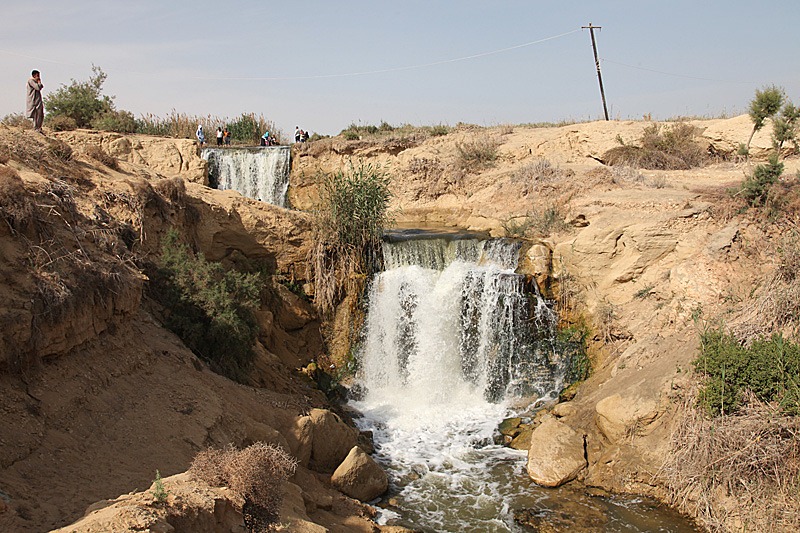
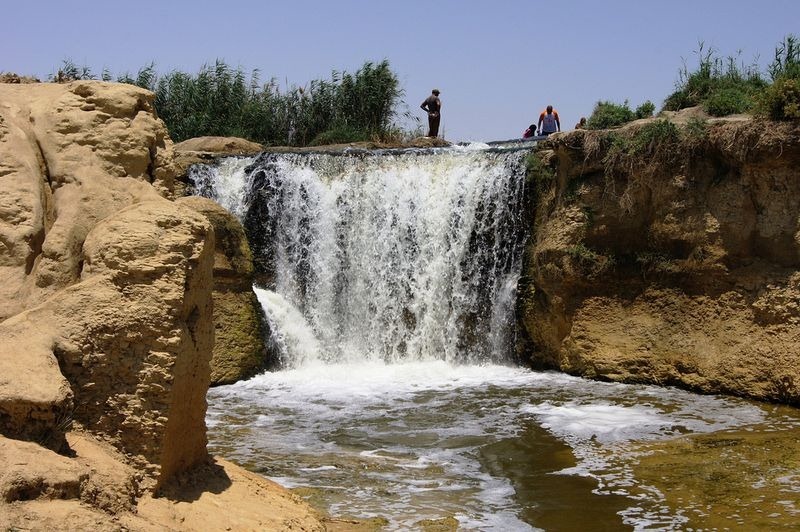
The valley of Wadi El-Rayan, 65 km southwest of Fayoum city, in Egypt, is home to two large artificial lakes created to divert excess agricultural drainage water from Fayoum oasis. It is also home to the country’s only waterfalls.

The Fayoum oasis originally drained into Lake Qarun in the north. But the lake can take only a certain volume of drainage water. Anything over this capacity and the lake level would rise and flood the surrounding land, often doing irreparable damage because of the waters high salt content. This means that the amount of water that can be used in the Fayoum is limited by the region’s maximum drainage capacity. Consequently, until recently water-intensive crops such as rice and reeds could be grown only in very small quantities. Furthermore, no new land could be reclaimed without causing swamping of existing farmland near Lake Qarun. There was a pressing need to find an alternative drainage basin, and the large depression of Wadi El Rayan was found to be suitable.

wadi-el-rayan-waterfalls-6

Photo credit: Roland Unger/Wikimedia

In 1974, a 9-kilometers open channel and an 8-kilometers tunnel were cut through the desert from the western side of the Fayoum depression to the large, dry depression of Wadi El Rayan. Drainage water now flows into Wadi El Rayan forming two large lakes. Water first reaches the northern lake and when it’s overwhelmed, a stream flows towards a deeper part of the depression, where another lake is formed. As the course of the stream was eroded, natural rocks were exposed and waterfalls formed over them.

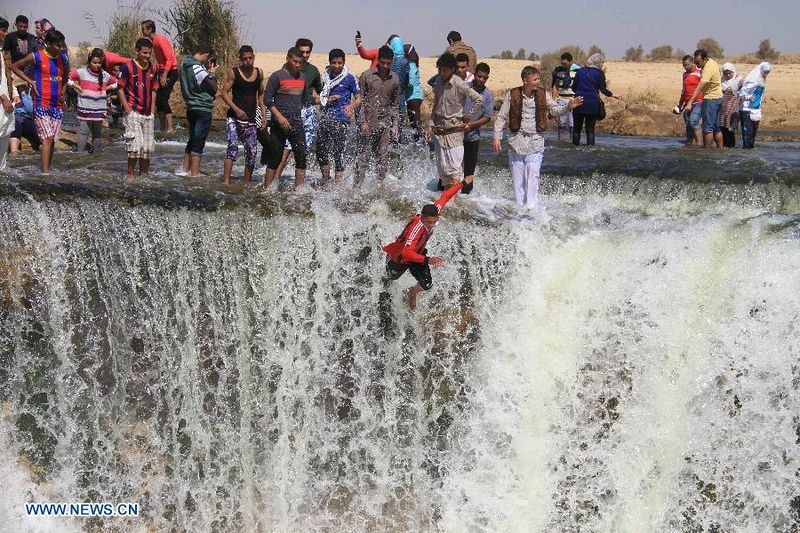
There are several cascades on the stream, none of them taller than 2 to 4 meters. Yet, they have attracted considerable attention among the local Egyptians, as many have never seen waterfalls before. The waterfalls have also been featured in many Egyptian pop videos and films. The falls, however, will not last for ever as the level of the lower lake is continually rising and the falls will exist only until the expanding surface area allows a rate of evaporation equal to the amount of water flowing into it.

The shorelines of the lakes are densely vegetated making them perfect wintering habitats for migrating birds and breeding spot for many fishes. The area is now a nature reserve and is home to the world’s sole population of Slender-horned Gazelles, as well as 8 other mammal species and 13 species of bird.

wadi-el-rayan-lake

Wadi El-Rayan Lake. Photo credit: Mohammed Moussa/Wikimedia


wadi-el-rayan-waterfalls-3

wadi-el-rayan-waterfalls-1

An Egyptian man jumps in the water of Wadi El-Rayan Waterfalls in Fayoum, Egypt, on March 6, 2015. Photo credit: Xinhua/Ahmed Gomaa

Source…..www.amusing planet.com

natarajan

Message for the Day..” Art of Spiritual Discipline….”

The attitude of the worshiper and the worshiped is the seed of devotion (bhakthi). First, the worshiper’s mind is attracted by the special qualities of the object of worship. The worshiper tries to acquire these special qualities. This is spiritual discipline (sadhana). In the early stages of spiritual discipline, the distinction between worshiper and worshiped is full, but as the spiritual discipline progresses, this feeling diminishes and, when attainment is reached, there is no distinction whatsoever. Irrespective of the object of worship one has grasped, loved and sought by spiritual discipline, one should have firm faith that the individual self(jivatma) is the supreme Lord (Paramatma). There is only one wish fit to be entertained by the aspirant: the realisation of the Lord (Iswara Sakshatkara). There is no room in the mind for any other wish.

Sathya Sai Baba

This Man Left His Job, Sold His Car and Took a Loan – Just to Make India Clean !

This cleanliness warrior resigned from his job to take the battle against garbage to cars, autorickshaws, buses, and other vehicles. His car trash bins will give income to slum dwellers while helping keep our roads clean.

India is developing fast — roads are jammed with cars, cellphones are ubiquitous, and there is talk of smart cities emerging all over the country.

But are we behaviourally developed as a nation? We still lack civic sense and spit on walls, we don’t show up for our appointments on time, we deface our historical landmarks, we rarely stick to queues when waiting, and we litter our streets indiscriminately.

Abhishek Marwaha was one of us until three years ago when he read somewhere: ‘”A person who throws his trash actually throws his humanity.”


abhishek marwaha1

Abhishek Marwaha

He then started making a conscious effort to keep his surroundings clean. His friends made fun of him when he kept dumping used tissues in his pockets or in car back pockets while travelling, instead of throwing them outside the window.

“I used to work in a travel technology firm and travelling to different countries used to be part of my job profile. I realized that we are more conscious of our habits when abroad (like littering, spitting, honking, etc.) but we tend to be careless when we are here in India. So all we need to do is one simple thing to bring a wave of change. Let’s behave in our own country the way we behave in any other foreign country,” says Abhishek.

One day, while having lunch, he found that his lunch bag was worn and could be used as a trash bin in his car. The idea stayed with him and he began to design a trash bin that is easily accessible in a car or any vehicle, even while driving. Once the design was ready, he started making cheap trash bins in bulk and contacting vendors.

spit pouches

This mission to keep India clean has today resulted in the launch of Abhishek’s online store, ujosho.com, which sells the first ever car trash bins in India.

The word UJosho is derived from the Japanese word ‘josho,’ which means ever victorious. Abhishek added a ‘U’ to indicate that we can all be victorious in the battle against littering if we do our bit to keep the nation clean.

swach bin

Swachh bin for cars

“There are an estimated 25 million cars in any Tier 1 city in India. The problem of garbage will continue to haunt us as the trash thrown from cars chokes the roadside drains and contributes to water logging and floods during rains. There is an immediate need to educate and encourage people to use this simple trash bin in their cars so that many of these issues can be resolved without intervention of civic authorities and with proper and positive participation from each one of us,” adds Abhishek

The car trash bins that Abhishek sells are not machine made. He aims to provide earnings to slum dwellers by getting them to make these trash bins by hand in bulk.

He has also experimented with giving away these bins to beggars for free and was delighted to see them selling these to car owners at traffic signals.

beggar

“You don’t have to hold a gun at the border and save the country to be truly patriotic. You can bring about change by changing yourself, your habits and your surroundings. Even if 10% of our population shares this view, it can make a difference. Maybe what I am doing is minuscule, but it will hit the root cause of the trash problem,” Abhishek says with great zeal.

According to Abhishek, installing and using the trash bin in vehicles will be good because:

1) It will help bring about a behavioral change among adults and children with respect to cleanliness, littering and spitting.

2) It will support civic authorities in ensuring optimum use of manpower in cleaning roads.

3) Trash chokes the roadside drains and contributes to water logging and floods during rains. Car trash bins will help prevent that.

Though the car trash bin is a first-of-its-kind product, Abhishek does not want to patent the idea as he wants it to spread widely. He wants other people to replicate it and make it more cost effective if possible.

happy customers\

Happy Customers!

“We also encourage people to share their ideas about cleanliness on the ‘Idea’ section of our website. If we are able to make a product from that idea, we will then give royalty on every sale of that product,” says Abhishek

To know more about Abhishek and his products, you can visit www.ujosho.com

Source….Manabhi Katoch in http://www.the betterindia .com

Natarajan

” The Man who led Chennai’s Rescue Effort …”

Soldiers join the resuce operations in Chennai

IMAGE: Soldiers join the rescue efforts in Chennai. Photograph: MoD/Twitter

‘Coordination between our 50 teams, each with a strength of 45 men, played a key role in rescuing flood-affected people in Chennai. In all, we succeeded in rescuing over 20,000 people.’

‘The NDRF, an exclusive dedicated standalone multi-disciplinary disaster response force, is the only one of its kind in the world.’

NDRF chief O P Singh on how his organisation helped rescue and relief in flood-ravaged Chennai.

NDRF chief O P Singh

National Disaster Response Force Director General O P Singh refuses to be drawn into any controversy regarding the unprecedented release of over 29,000 cusecs of water from the Chembarambakkam reservoir on the night of December 1, without having alerting the state government, the police or the power utility services.

Water experts believe this release was the main reason for the floods that devastated Chennai with the situation being made worse by the heavy rainfall.

Singh,  is a 1983 cadre Indian Police Service officer. As head of the NDRF he was responsible for the rescue of nearly 50,000 civilians during the disastrous flooding of Sringar in September last year. His organisation’s work during the Nepal earthquake earlier this year was much appreciated by the governments of Nepal and India. The NDRF was formed by an Act of Parliament in September 2014.

He spoke exclusively to Rashme Sehgal for Rediff.com

You had 50 NDRF teams working night and day to rescue people through this crisis. What has the NDRF learning curve been from this?

What we witnessed in Chennai is the phenomenon of urban flooding. It is very different from rural floods or floods in semi-urban areas. Its special feature is that as water levels start to rise, the water begins to flow in a very swift manner. This kind of urban flooding we are witness to can be described as a very recent phenomena.

We witnessed it in Mumbai ten years ago. Jammu and Kashmir was our first experience of intense urban flooding.

How did you go about tackling the situation in flood-hit Chennai?

We are the only official disaster response team in the country. We have a strength of 12 batallions of 15,000 men drawn from the Central Reserve Police Force, the Indo-Tibetan Border Police, the Border Security Force and the Central Industrial Security Force who join us for a period of deputation lasting five years.

The first two years are spent providing them very intensive and highly professional training in how to handle disaster situations in different areas, whether it be the collapse of structures, search and rescue, deep underwater diving, underwater communication, medical first responder and also how to deal with biological, radiological and nuclear emergencies.

Coordination between our 50 teams, each with a strength of 45 men, played a key role in rescuing the flood-affected people in Chennai.

In all, we succeeded in rescuing over 20,000 people.

If you spend two years training them, then why should they revert back to their earlier cadre three years later? Doesn’t all this intensive training go waste by this kind of reversion?

That is a very valid question. If you permanently keep them (in the NDRF) then they might lose their motivation. We are thinking of keeping them for a longer period and are considering the possibility of extending their deputation from five to ten years.

We are also looking at a possibility of allowing 12 per cent of our force to be kept in the NDRF on a permanent basis.

You need to remember that this is an exclusive dedicated standalone multi-disciplinary disaster response force. It is the only one of its kind in the world. They focus only on disasters and nothing else.

When there are no disasters, we spend our time trying to empower the community because the community is the first responder to a disaster. We also interact closely with the police, the fire brigade and also provide training to organisations like the NCC (National Cadet Corps), the National Service Scheme and the home guards. We are capable of reaching a disaster within 20 minutes.

Were you able to reach Chennai within 20 minutes of the flood occurring?

In Chennai, our 50 teams flew in from Bhatinda, Guwahati, Patna and Pune. We had already pre-positioned some teams around Chennai and were receiving regular reports from the Indian Meteorological Department.

You had pre-positioned your teams around Chennai prior to the massive flooding?

We had four teams that had been pre-positioned. We had teams in Cuddalore and Kanchipuram and had two teams in Puducherry. Within two to three hours of being informed about the heavy rainfall and about the release of water from the reservoir, our local battalion stationed in Ernakulam was there.

What were the immediate steps you took?

Our first steps were on how to evacuate the people who were marooned. We had to put them in boats and take them to a safer location. For that we needed divers, life jackets and boats.

In some areas there was eight to nine feet of water. Chennai airport was submerged in eight to nine feet of water. Several localities were completely submerged.

The second major problem we faced was the breakdown of power resulting in a major communication failure. People’s mobile phones had gone dead. There was also the apprehension was of people getting electrocuted.

The other problem we faced that even though people were marooned, they were not willing to leave their homes.

Why was that? Did people feel that in their absence, their homes would get looted?

People living in ground floor houses agreed to get evacuated, but those living on the first floor moved to the second floor and then onto the roof.

The settlements along the banks of the river Adyar which were all low lying areas, saw huge amounts of water collect there. Our teams found it very difficult to navigate these areas.

More than 300 people died in these floods.

A large number of these deaths took place in some hospitals because of the power failure. The ICU units in the hospitals were affected because of the lack of power.

Our 50 teams were using Quick Deployable Antennae (for satellite communications) which is a portable system and can be used both in the digital and analogue mode. But this QDA is an internal system that can be used only by us.

But on our helpline, we were getting information via SMS, e-mails and Whatsapp, and also from television channels. I was stationed in Chennai and constantly telling my response team to reach the area from where the alert had been sounded. I was acting as a link between the victim and the parent or others.

Obviously, during the flood, people were on edge, they had become nervous and very jittery. I had to keep assuring the public. It was a huge challenge to communicate and reach out to the people especially since the power facilities were down.

But our men were working round the clock. I would like to cite the example of one rescue mission that my men undertook of a woman called Deepthi who was in her final stages of pregnancy and living in the Ramapuram area. Two NDRF sub-inspectors Bijumon and Satish reached out to her in a boat, but could not load her onto a boat.

She had to finally be rescued by a chopper. The two jawans helped her climb onto a water tank from where they helped her climb her onto an IAF helicopter being flown by a team led by Wing Commander Simon and Squadron Leader Venkatraman.

The lady gave birth the next day to two twin girls and her father Mohan Raj sent me a letter commending the work done by the NDRF and hoping his twin grand-daughters would join the NDRF one day.

The NDRF received praise in Chennai, but the NDRF received criticism for its rescue operation work during the floods that hit Kashmir last year.

No, I don’t think so. The terrain of Srinagar is completely different from the terrain of Chennai. Srinagar is an extremely mountainous area. The Jhelum river had spilled over and mixed with the Dal Lake and the entire area looked like a vast sea.

The current there was very sharp and we had to use choppers. The flood water ended up dividing the old Srinagar city from the Dal Lake area. Our teams ended up rescuing 50,000 people in the operation.

Chennai used to be a dry city. But the incessant rain, unregulated construction and the release of a huge amount of water from the Chembarambakkam reservoir caused this deluge.

To go back to my earlier question, what is your learning from this deluge?

I believe we have to strengthen our response measures to meet disasters. But the long-term strategies would be to pay much greater attention to prevention and mitigation strategies. These will involve flood mapping and satellite imagery. But most important, we need to pay much greater attention to regulate development in our cities.

To take the example of Chennai, which as a city can be divided into three parts. No new construction must be allowed in the vulnerable parts of the city. The state government must take strong measures in this. I believe after witnessing two major floods that all urban construction must be regulated.

In terms of mitigation strategies, we need to construct water channels to drain out the water. More important, we need to revive the water channels that have been destroyed. We need to take very strong steps on this score.

Cities must develop resilience to face heavy rain and for that we need to take institutional measures to ensure that there can be no encroachment on marshlands, our traditional tanks and lakes that have shrunk must be restored and all the waterways that had been constructed to drain excess water must also be restored to ward off future threats.

Source…….Rashme Sehgal in http://www.rediff.com

Natarajan