The Mystery of the Margate Shell Grotto….!!!

In 1835 a labourer was digging a field just outside the English seaside town of Margate.  His work was interrupted when he thrust his spade in to the soil and it simply vanished in to the ground.  The master of the nearby Dane House School, James Newlove, was made aware of this strange disappearance.  He volunteered his young son, Joshua, for the task of being lowered, candle in hand, in to the void via a length of rope

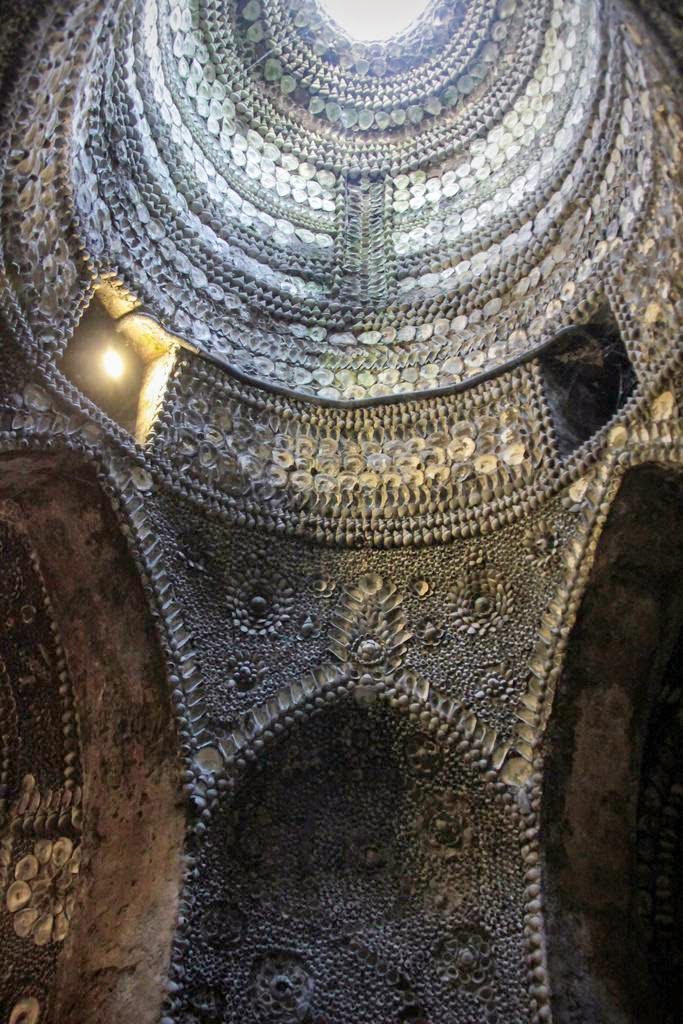
Regardless of our modern sensibilities about the health and safety of children, when Joshua was pulled back to the surface his wide-eyed tale astonished everyone. He told of a magical temple adorned in shells, hundreds, thousands… millions of them.  All told, 4.6 million.
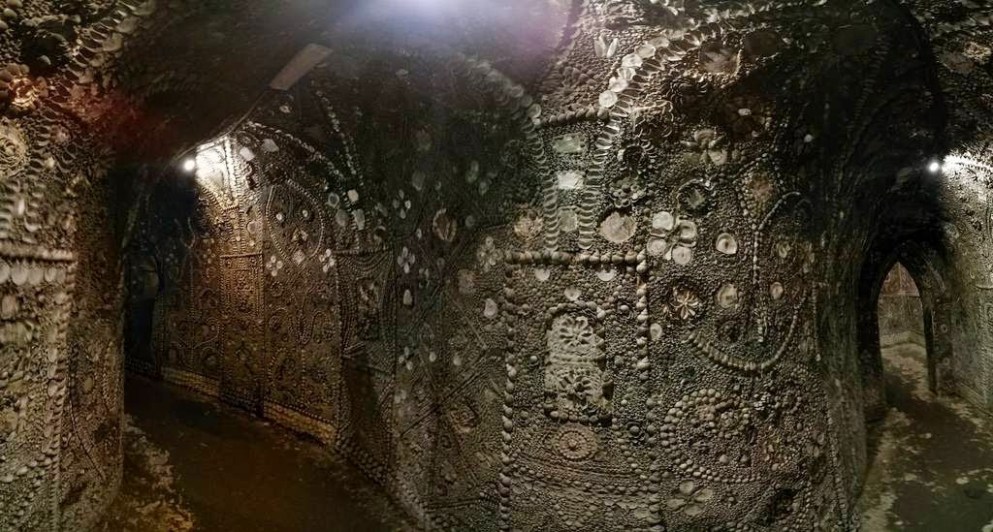
Image Credit DeadManJones

Image Credit Krondol
Joshua’s tale was nowhere near as tall as people may have at first imagined.  When the hole was widened enough for adults to enter they too witnessed the wondrous contents of the winding subterranean passageway, complete with an altar chamber and rotunda.  Newlove senior, a canny schoolmaster if ever there was one, was first to consider the financial benefits such a discovery might reap.  He hurriedly purchased the land above the mysterious chamber and began to adapt it so that visitors might enter – for a small charge of course. In 1837, just two years after its discovery, the grotto opened to a curious public.  Yet to this day debate rages (in a very English way, of course, involving polite discussion over tea and cucumber sandwiches) about it origins.
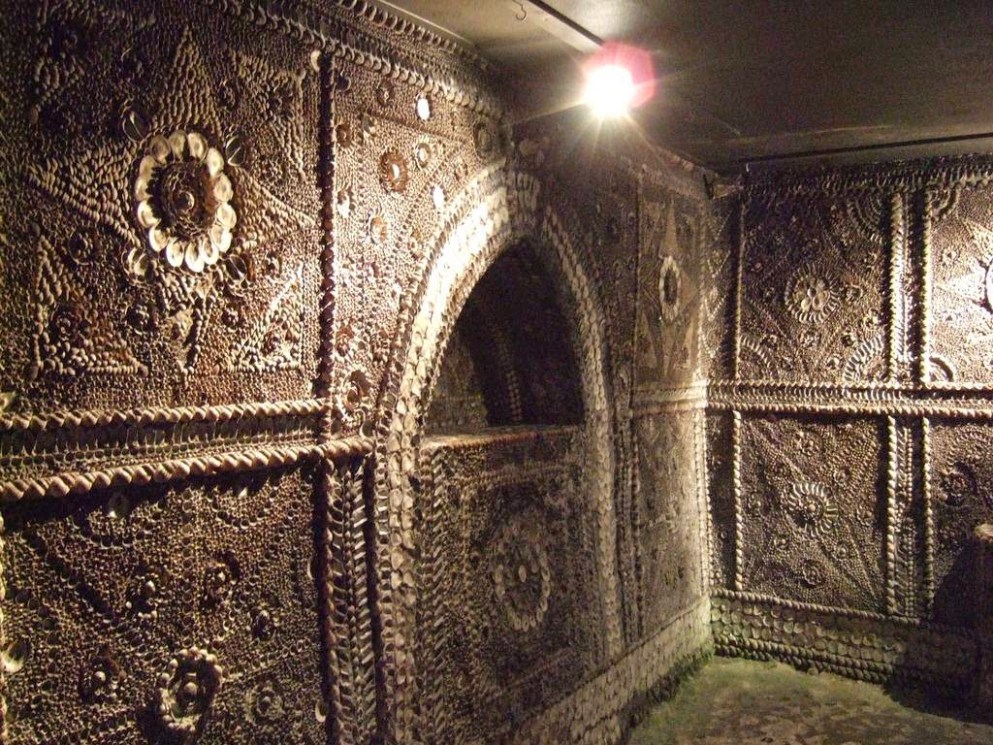
Image Credit Ben Sutherland
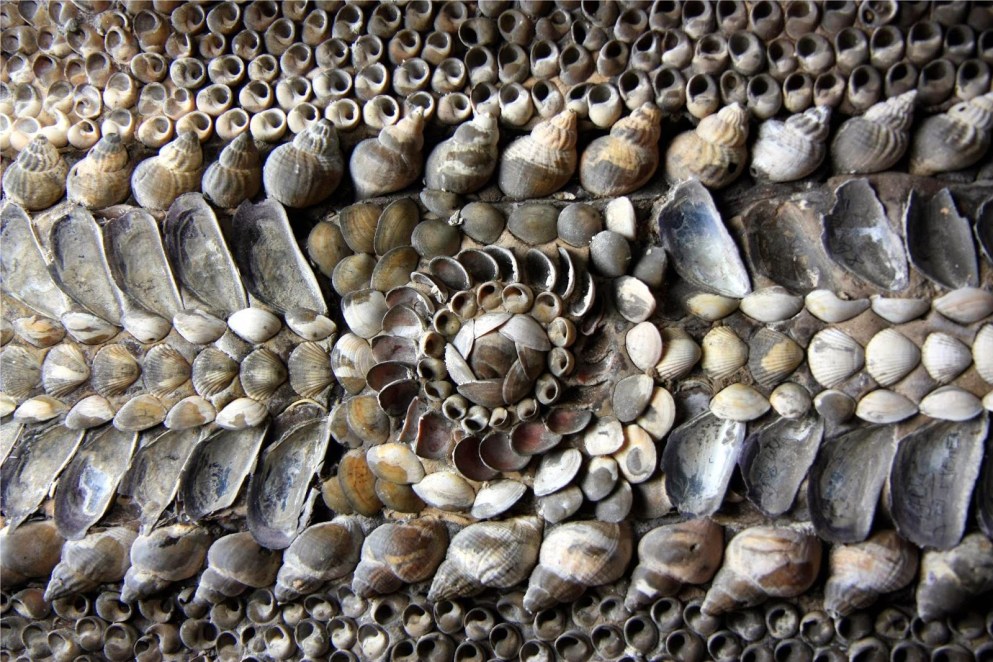
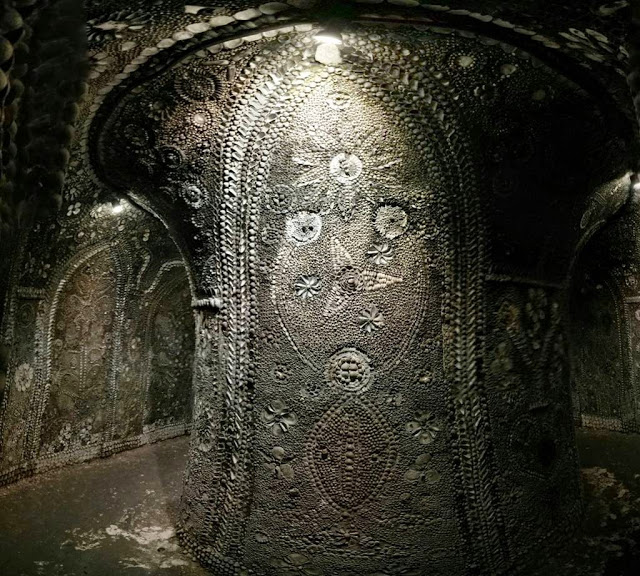
How it came to be originally built remains unexplained.  However, the 2000 square feet of mosaics, created from mussel, cockle, whelk and oyster shells have provoked a multitude of explanations none of which have been confirmed with any total surety.
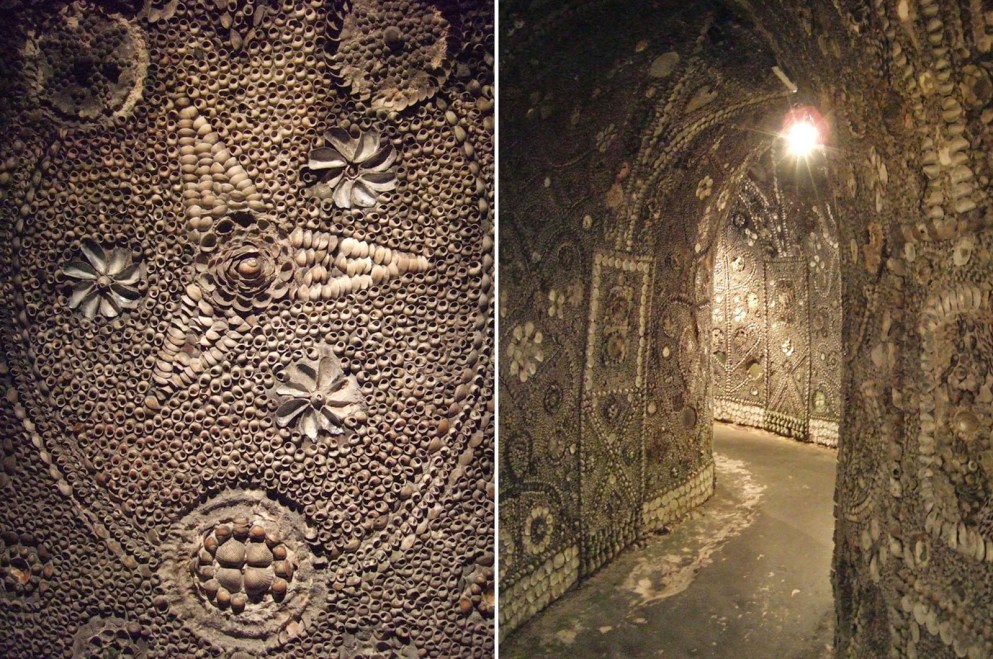
Image Credut Ben Sutherland
Shell grottoes of this type were extremely popular in the Europe of the 1700s. Many suppose that this was the result of a local bigwig embarking on the Grand Tour and returning with a desire to recreate a highlight of his or her European expedition.  Yet although this is not without the realms of possibility, the land above the grotto never formed part of any large estate, which is where you would expect such an extravagance to be positioned – close enough to the big house to easily chaperone curious guests to its confines. These visitors would be impressed both by the owner’s wealth and aesthetics because, frankly, this kind of thing was built to do both.
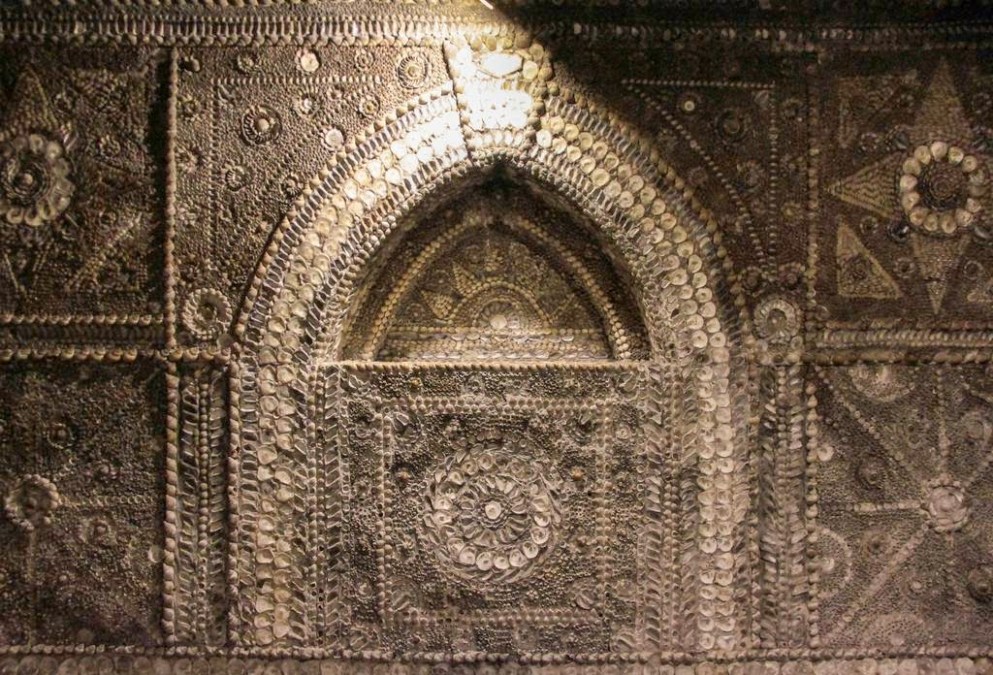
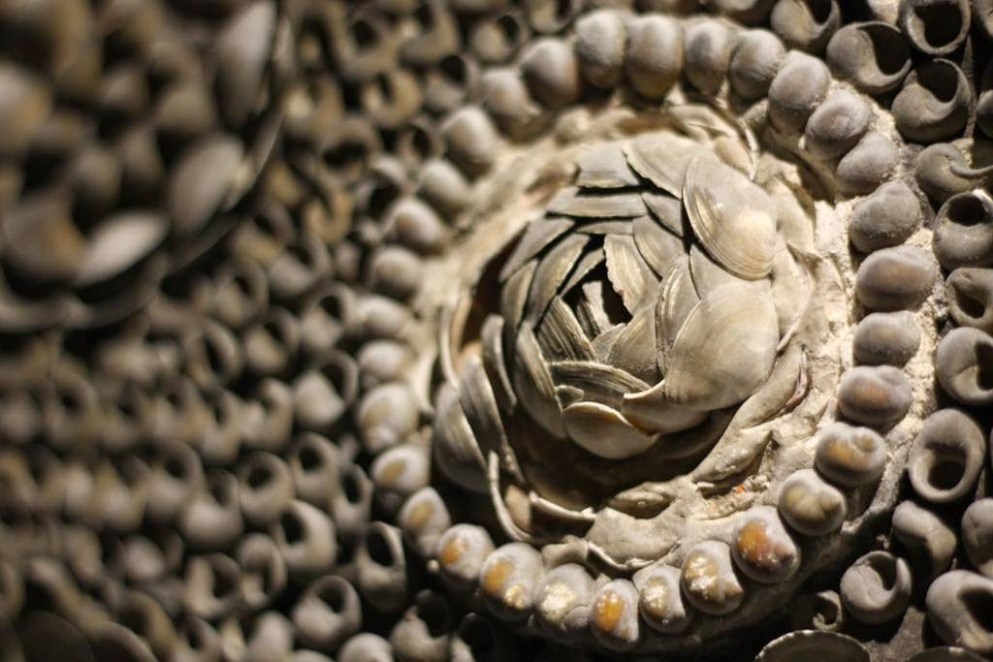
Image Credit Kotomi

Image Credit Simon Lee
Moreover, had the grotto been built in the 1700s then there would have been some vestigial local memory (or legend) of its construction.  In order to get millions of shells in to this underground passage many local people would have to have been involved in their transport.  Yet the discovery in 1835 was a surprise to all – no one stepped forward with any explanation.
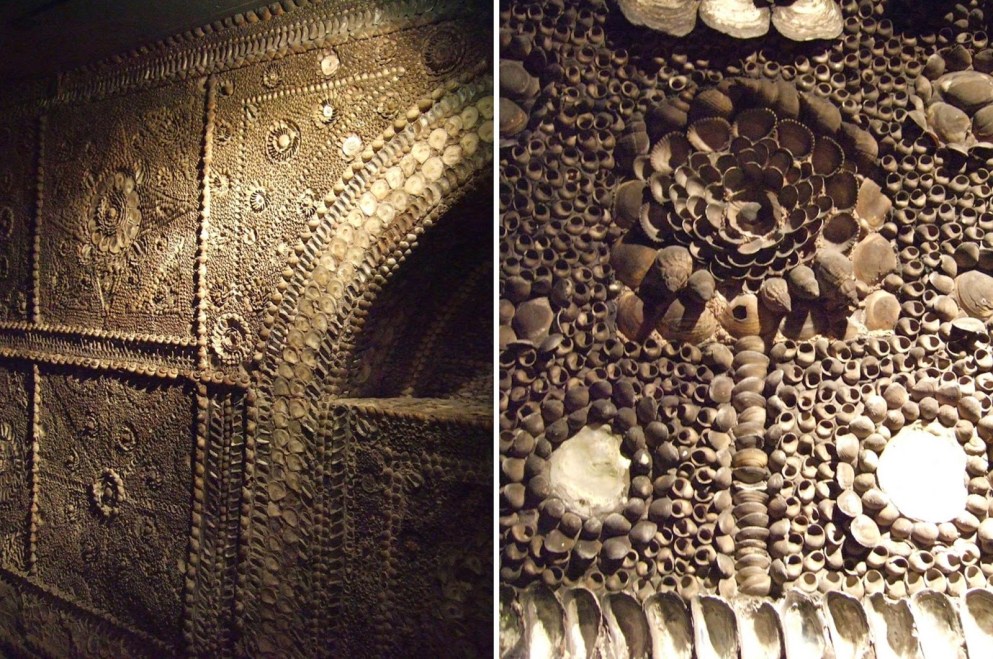
Image Credit Ben Sutherland
It has been suggested that the grotto was a smuggler’s cave – almost all the shells are British and so it could have been a hideaway made by locals for stolen and contraband goods.  Yet this idea doesn’t hold much water either. Although near to the sea, the waves remain stubbornly a number of miles away and there are no tunnels from coast to ‘cave’. Plus with a distinct lack of an escape route any smuggler would have been mad to hide their booty here – not to mention the fact that they would have had to spend more of their time decorating the place than doing any actual smuggling. So, it’s a no to that theory as well.
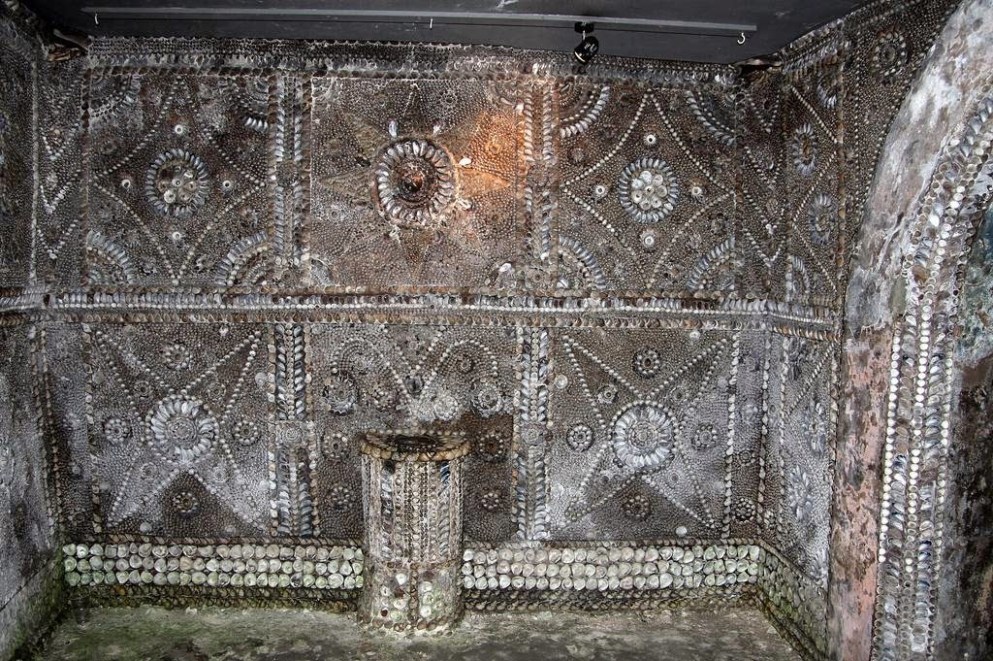
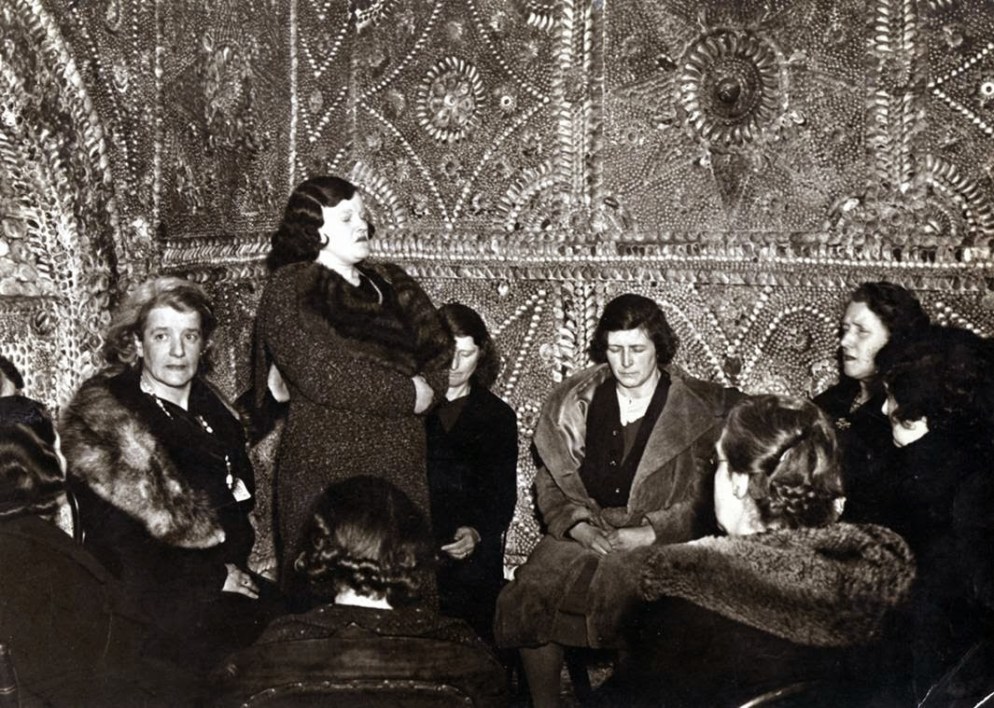
Image Credit Krondol

Could it be a Roman temple?  A remnant of dark-age rituals?  A prehistoric astronomical calendar? Make up a theory and it could well be feasible – and many have.  There have even been séances held in the grotto to try and contact the spirits of the builders, such as the one from the 1930s above.

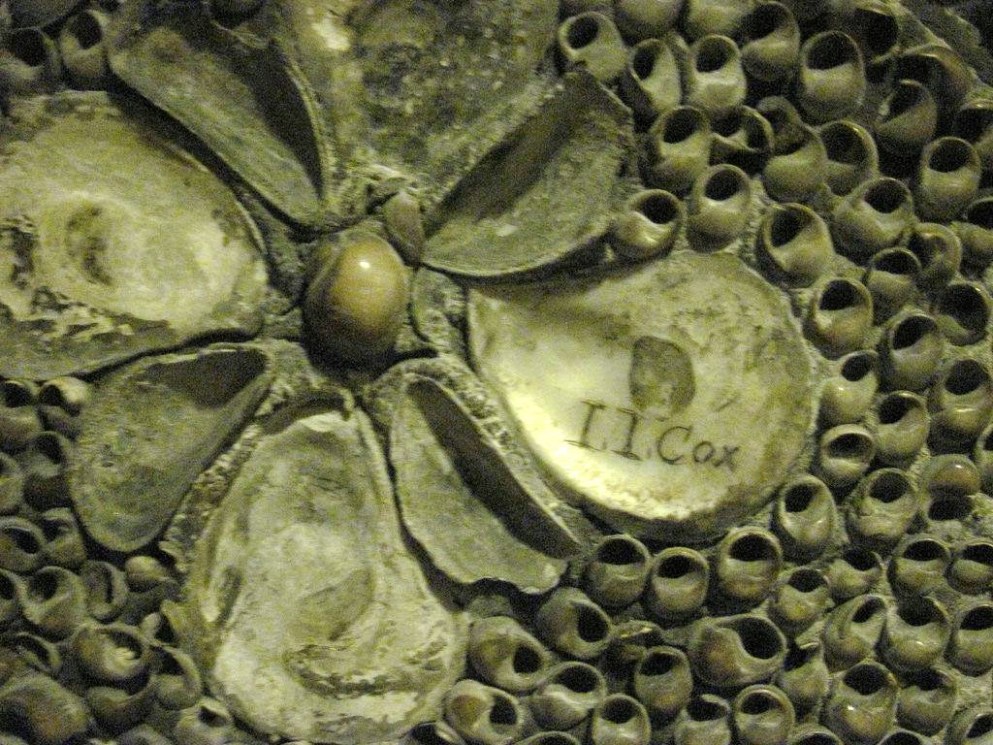
Image Credit John C Bullas

Image Credit Feribrulu
A number of the shells have been vandalised over the years by visitors.  Even though this is difficult to condone it adds an extra layer of history to the place.
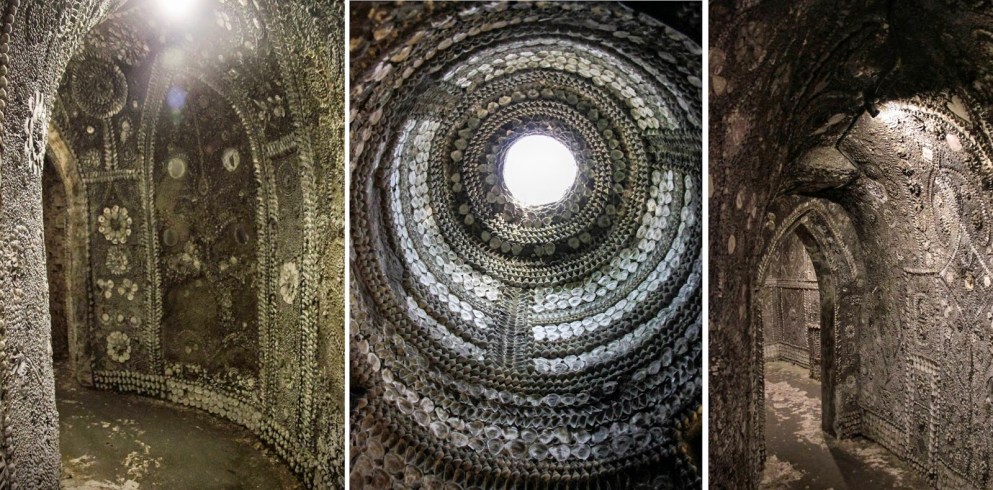
Image Credit Kotomi

 
Image Credit Mr Moss
The latest research which took place in 2006 points towards an explanation which might please Indiana Jones fans.  Mick Twyman of the Margate Historical Society put forward the suggestion that the grotto was built by the Knights Templar or their associates sometime in the middle 1100s.  He has suggested this after a painstaking measurement of angles inside the grotto (a temple now, perhaps?) and the way that the sunlight is projected in to the inside of the dome.   The altar chamber certainly looks the part of an early temple for masonic rituals. Yet this kind of theory, unlike its scientific namesake, isn’t proof – just conjecture however sensible and enlightened.
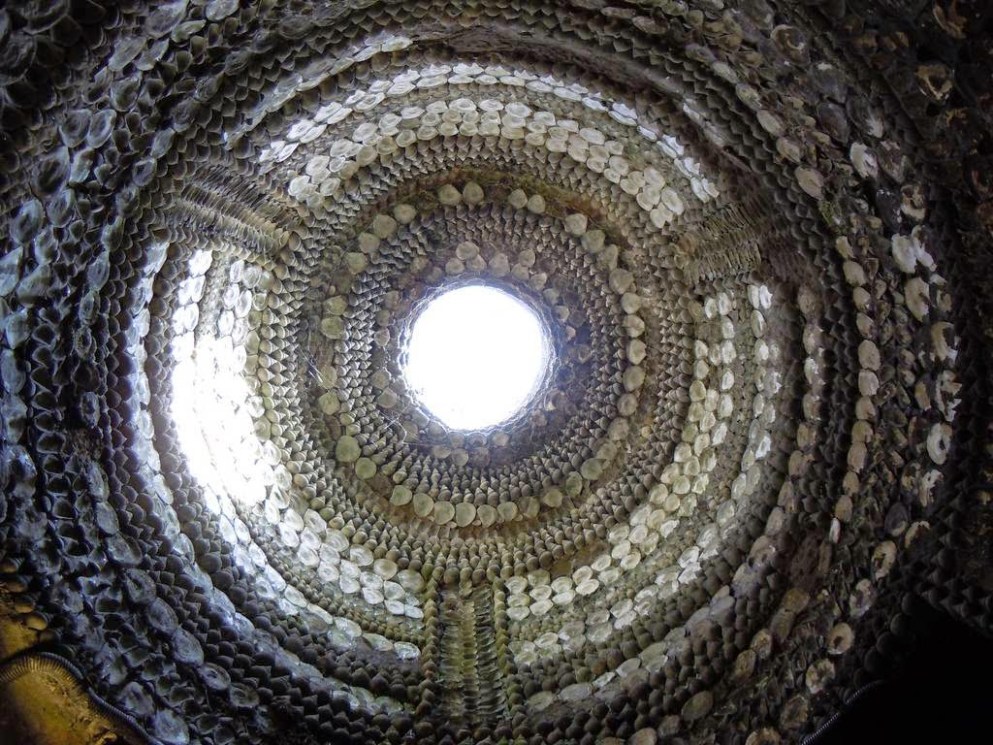
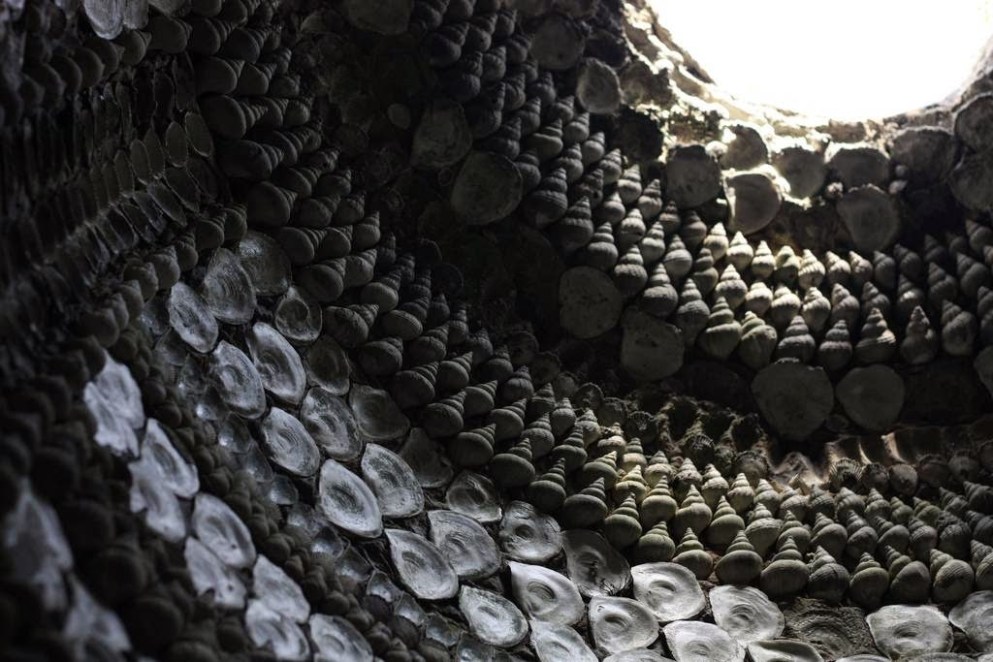
Image Credit Simon Lee
Why not get the shells carbon-dated?  This is certainly a possibility for the current owner (the grotto has always been in private hands although recent restoration work has been done in partnership with English Heritage, the charity that looks after the National Heritage Collection of the country).  However, this has been advised against for a number of reasons.  First and foremost quite a number of shell samples would be needed to ensure that dating caught the earliest shells and not just those used in previous (unknown) restoration work over the centuries.  Secondly it’s expensive and money needs to be more urgently spent on conservation rather than speculative investigation, however scientific and potentially illuminating.
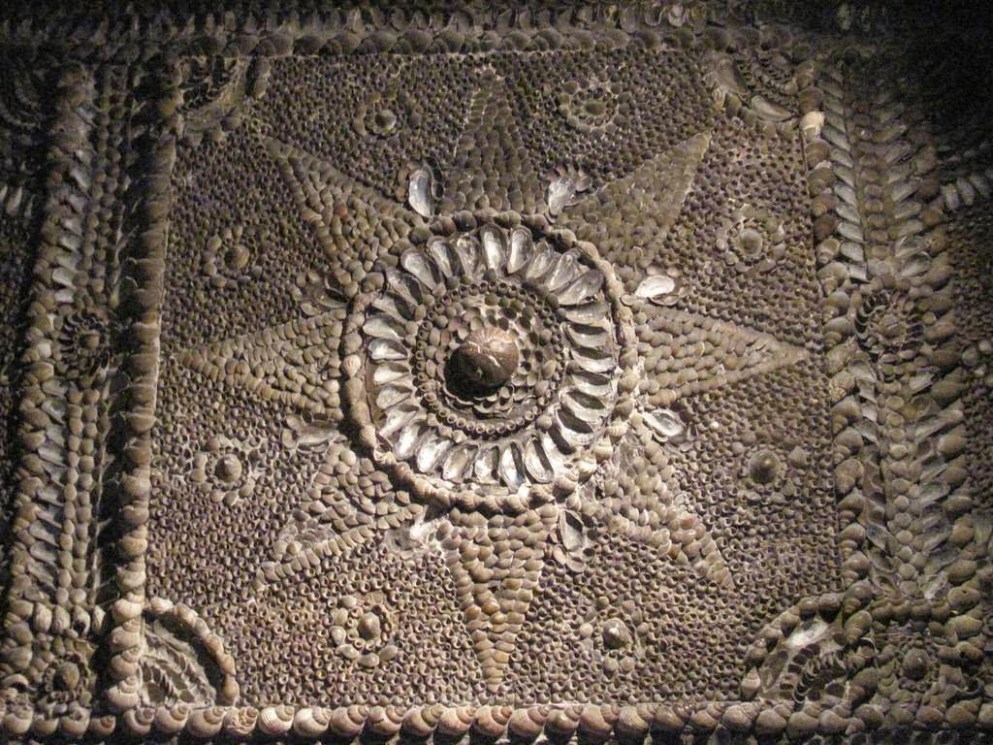
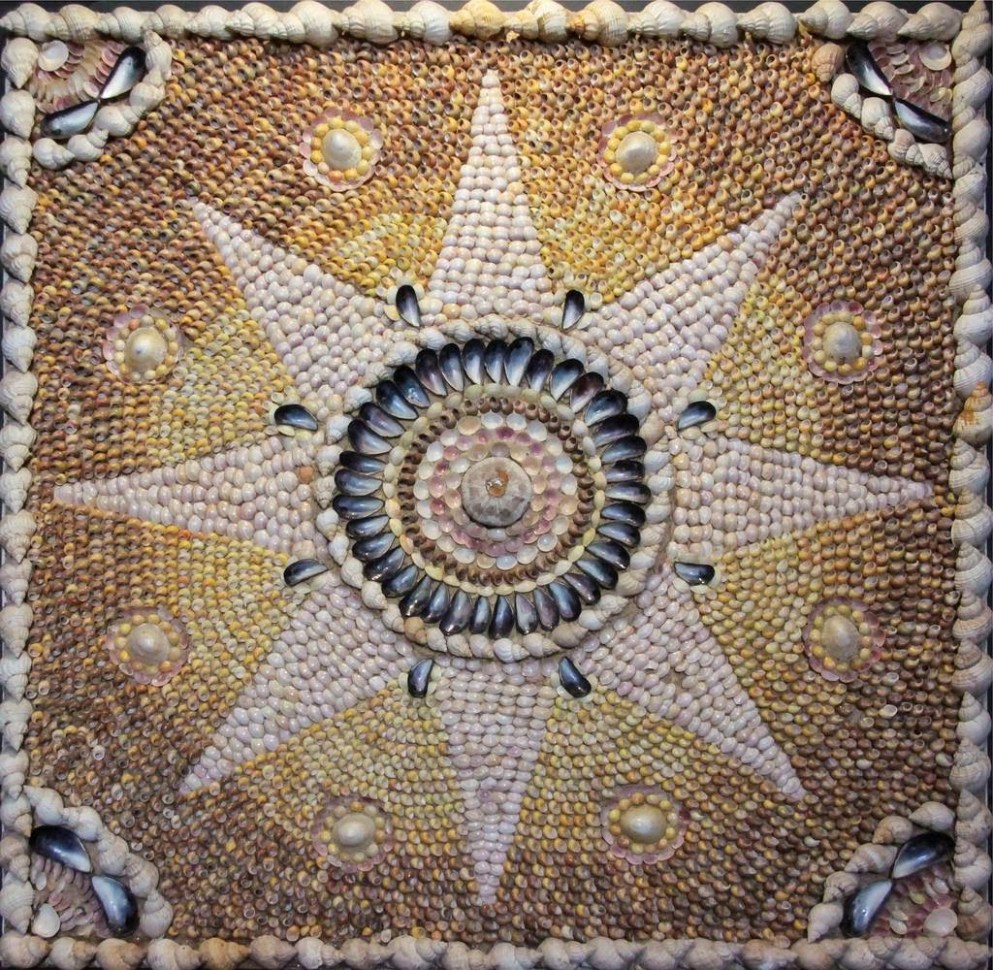
Image Credit Feribrilu

Image Credit Kotomi
How did the shells look before the decades of gas-lit exhibition and when water damage had not bleached them? A modern recreation of a panel from the grotto shows how it must have dazzled visitors in its heyday.
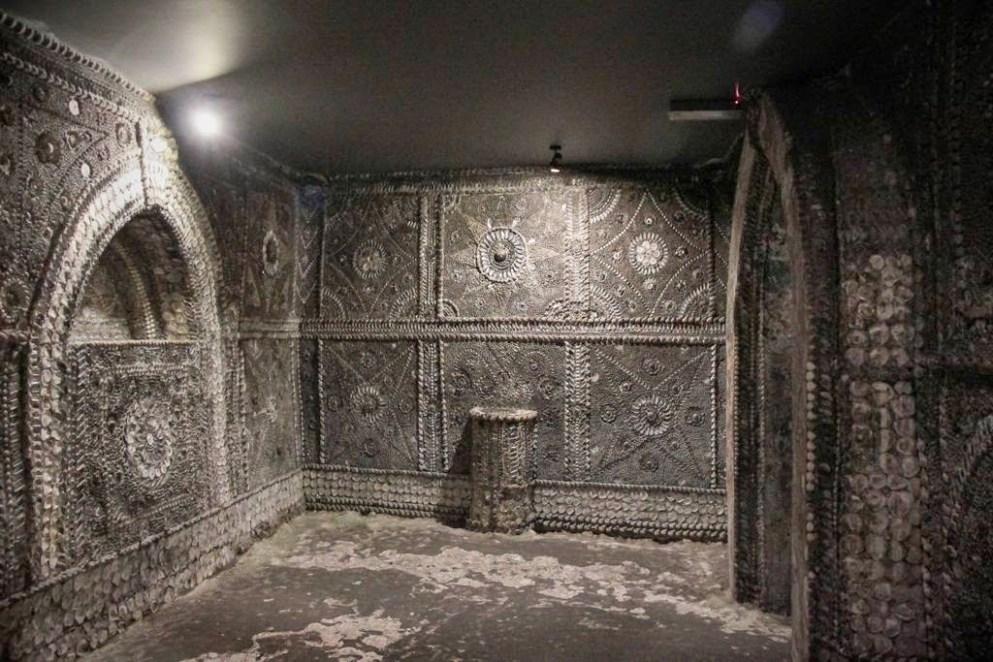
Image Credit Kotomi
Yet, perhaps it is best to leave well alone in terms of a definitive origin story.  After all, even a secure dating of the oldest shells in the grotto would only establish their age – it would hardly go any further in discovering who built the grotto and why.  Sometimes it’s simply best to allow imagination to flourish and allow visitors to create their own history for this amazing place.

If you want to visit the Margate Shell Grotto, please check out its website for opening times.

Source…….www.kuriositas.com
The picture of the c1835 schoolboy is by William McTaggart
First Image Credit DeadManJones


Natarajan

Kolkata Girl Makes It to Forbes 30 Under 30 List for Developing Pathbreaking Underwater Drones…

28-year-old Sampriti Bhattacharyya, a PhD scholar from Massachusetts Institute of Technology, has designed an underwater drone that can map ocean floors at places where GPS does not work. She is the founder of Hydroswarm – a startup that designs and markets small, autonomous drones for ocean exploration and maritime big data. These drones are shaped like an egg and are roughly the size of a football.

Sampriti, who hails from Kolkata, has been featured among Forbes’ top 30 most powerful young change agents of the world.


drone

She pursued engineering from St. Thomas’ College of Engineering & Technology in Kolkata and then went to Ohio State University to study aerospace engineering. She later switched to robotics at MIT.

The absence of any easy way to study ocean floors inspired her to create an underwater robot. As of now, remotely operated autonomous underwater vehicles (AUV) are used to explore the deep sea. They are deployed for missions like studying oil spills, environmental monitoring, search operations, etc. But AUVs are very costly and mission-oriented. They are not used to study the ocean on a day-to-day basis to understand the underwater environment better.

This is what Sampriti wants to change with Hydroswarm, by developing drones that can roam the oceans and collect data all the time.

drone1

“Underwater navigation has been a reality for many years but for advanced searches you need maps that are as refined as, say, the Google map. This is where my drone comes in. It can map the ocean, sitting on its bed, and you can zero in on the minutest objects, living or non-living. You can even map underwater pollution with the help of his drone,” she told The Times of India when she was in Kolkata for some time recently.

These drones can withstand the immense pressure in deep oceans, can cover up to 100 square meters in one hour, and can swim across the ocean floors mapping the topography, studying aquatic life, etc.

To commercialize her drone by starting a company, Sampriti joined a business programme at Harvard Business School. She was one of the top eight contenders to reach the finals of MIT $100K Entrepreneurship Competition, winning $15,000.

All pictures: Twitter

Source……..Tanaya Singh in http://www.the betterindia.com

Natarajan

The Parallel Worlds Of Puddles In Toronto…!!!

With my Instagram account I try to demonstrate that you don’t need a professional camera to take a nice picture. With the use of a smartphone, one can take a beautiful picture that tells its own story.

Many people don’t like rain, but the puddles left behind can be more than magical. Every time I see a puddle I take out my smartphone and put my camera lens as close as I can to the water and capture its parallel world. These are some of my puddle reflections I have taken in Toronto, Canada last month.

More info: Instagram

Source………Guigurui

Guigurui

Community Member  in http://www.boredpanda.com

Natarajan
Elephants Do The Most Precious Thing Every Time They See This Sanctuary Worker…!!!

Need a boost to help you power through your work week? Check out this adorable video of a group of elephants rushing over when they see their best friend — a tractor driver named Darrick, who works at theElephant Nature Park in Thailand.

Every morning when Darrick gets to work, a younger elephant named Kham La runs over for some cuddles.

We all know that elephants are brilliant, so it only makes sense that they’d recognize their favorite guy every day. What a lucky man Derrick is to have such beautiful friends to take care of!

Source……….www.viralnova.com and http://www.youtube.com

Natarajan
Australian Farmer Fights Soil Erosion With Land Art……

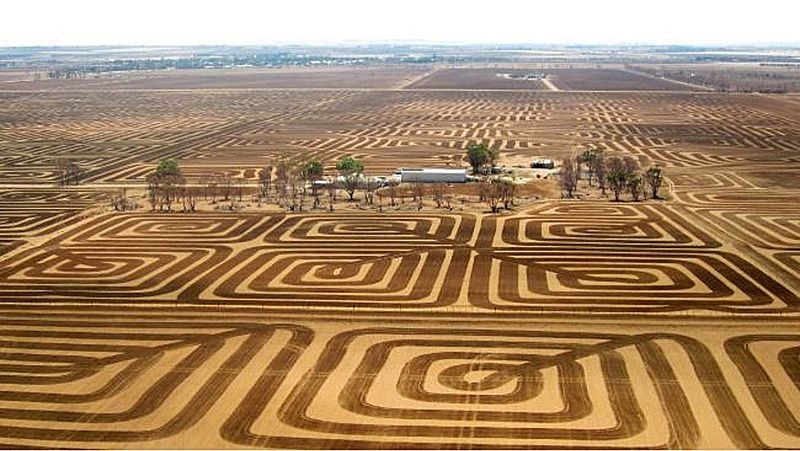
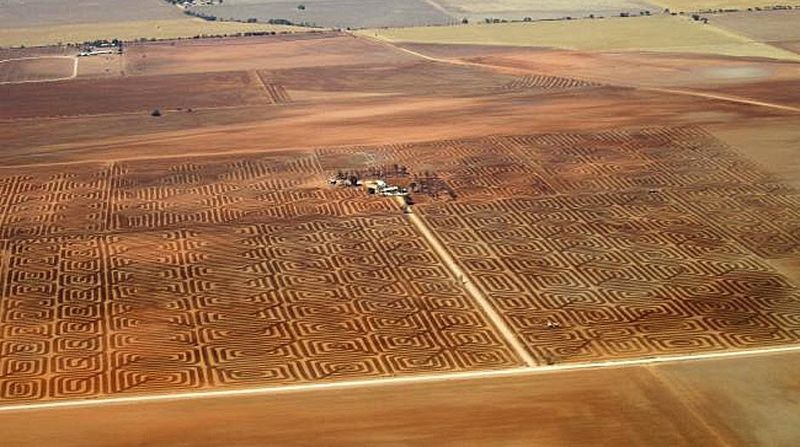
After a recent bushfire consumed all vegetation on his land, a South Australian farmer Brian Fischer decided to etch a gigantic geometric pattern on the bare ground in a bid to fight soil erosion. Without vegetation, the topsoil was vulnerable to erosion by gusting winds. So Fischer ploughed his land in a patchwork of spirals creating long furrows in the topsoil. Now no matter which direction the wind blows there will always be a furrow to catch the soil. Fischer says the pattern cost him a few days to make, but he expects to save 15 cm of topsoil that would have otherwise been lost, until the fields are green again.

The clever erosion-fighting technique came from his dad, who used it on the farm as early as 1944 during one of the worst droughts South Australia experienced. More than one million hectares of land were destroyed by a raging bushfire in Victoria, prompting some farmers to come up with this unique solution.

brian-fischer-1

Photo credit: Brian Fischer

brian-fischer-2

Photo credit: Brian Fischer

via The Guardian

Source….www.amusingplanet.com

Natarajan
How Barefoot College Trained 700 Rural Grandmothers to Be Solar Engineers & Electrified 20000 Homes…?

A vocational training college in Rajasthan, started by well known educator and activist Sanjit Bunker Roy, is responsible for lighting up the homes of thousands of poor villagers across the world.

Tilonia is a small village in Rajasthan’s Ajmer district. On the face of it, Tilonia is like any other village in India. One can see large tracts of semi-arid land, flocks of sheep on the roads, and women whose heads are covered with the pallus of brightly coloured sarees.

However, what sets Tilonia apart is that it is home to the Social Work and Research Centre, popularly known as Barefoot College. This institute is known all over the world for training rural people in vocational skills.

In the 1970s, Sanjit Bunker Roy, an educator and social activist decided to give something back to society and set up Barefoot College in Tilonia.

bunker roy

Photo source: Youtube

The college is spread over eight acres and runs completely on solar energy.

Bunker, who studied at Delhi University, says: “My elitist education almost destroyed me. In fact, the biggest reasons why the poor will always remain poor are the literate man and woman — products of the formal education system. This system makes you look down on villages.”

According to him, the formal system of education demeans and devalues the traditional knowledge and practical wisdom that the poor value. He says his real education started during his initial years in Tilonia when he was working as an unskilled labourer — blasting wells for water.

“I lived with very poor and ordinary people under the stars and heard the simple stories they had to tell of their skills, knowledge, and wisdom that books and university education can never teach you. My real education started when I saw amazing people – water diviners, traditional bonesetters and midwives – at work. That was the humble beginning of the Barefoot College,” he adds.

Though the college started with the aim of providing solutions to the water problems of rural India, its mission soon changed to sustainable development and empowerment of the marginalised. In fact, the courses offered at the institute are rooted in the Gandhian philosophy of making villages self-reliant.

“But it was not Gandhi or Marx who inspired the work of the college, but very ordinary people with grit, determination, and the amazing ability to survive with almost nothing,” says Bunker.

Students, primarily women, are selected from the poorest of villages and are taught vocational skills in different areas like solar energy, healthcare, education, handicrafts, and so on. The college provides basic health services to the villages through a team of doctors, midwives, and dentists.

It imparts education to women and children by keeping their different needs in mind. There are crèches for small children whose mothers work all day. There are night schools for children who help in the fields or tend to animals during the day. And bridge courses for those among them who wish to join day school. There is an emphasis on hands-on learning. Even the lessons offered are practical in nature. The children are taught about how democracy works, how to take care of a sick animal, how land is measured, etc.

Barefoot College is probably best known for producing hundreds of ‘barefoot’ solar engineers.

The Better India (4)

In 2003, the college decided to train illiterate rural women as solar engineers. The biggest challenge at the time was to convince donors, policy makers, as well as the male members of the community to accept the ‘impossibility’ that these women could be trained.

“Do you know why we insisted on women? Because training men is pointless. They will grow restless and go to big cities in search of jobs. Women have more patience to learn the skill. And especially since they are from poor families, they will stay back home and prove their worth to their communities,” says Bunker.

This training of women — to teach them how to install, repair, and maintain solar lighting units — did not stop in Rajasthan. Today, the institute trains women from countries like Afghanistan, Bhutan, Sierra Leone, Mozambique, Fiji, etc. It boasts of having over 700 solar ‘mamas’ in 70 of the least developed countries in the world. These women, from isolated and non-electrified villages, congregate in Rajasthan for a few months. To overcome the language barrier, they are taught through sign language.

They memorise the permutations and combinations of wires through colour codes.

The Better India (3)

Barefoot College brought three women from Afghanistan to Tilonia and trained them. After they went back, their village became the first ever solar-electrified village in the country. These women went on to train 27 others and now there are over a 100 solar-electrified villages in Afghanistan.

The College also trained grandmothers from Sierra Leone. They lit up the first village in the country with the sun’s energy.

The idea caught on and now there is a Barefoot Vocational Training Centre in Sierra Leone.

Under the India Technical Economic Cooperation Programme of the Ministry of External Affairs, the Barefoot College has trained nearly 700 rural grandmothers to be solar engineers and electrify over 20,000 houses in different countries.

Barefoot College is funded by various organisations and grants. Barefoot College applied for the HCL Grant and through this grant, it wanted to implement the Barefoot model of alternate community-based education and skill development in the five districts of Rajasthan, by empowering and educating children, women, and youth and setting up 25 crèches and 50 bridge schools in these districts. To know more about Barefoot College, contact the team on their website.

About HCL Grant

There are about 3.3 million NGOs in India doing commendable work in various areas aimed at inclusion and development. The HCL Grant has been launched to support the institutionalization of the Fifth Estate comprising individuals and institutions formed and led by the citizens of the country through the creation of strong governance frameworks and management capabilities. An endeavour of the HCL Foundation, HCL Grant envisions to build sustainable communities by supporting NGOs and individuals who are doing path-breaking work towards high impact transformation in rural India. In the first year, HCL Grant has identified the best NGOs in the area of rural education. To know more about the HCL Grant: http://www.hcl.com/hcl-grant

source……..Meryl Garcia in http://www.the betterindia.com

Natarajan
Rio Celeste, The Blue River…!!!

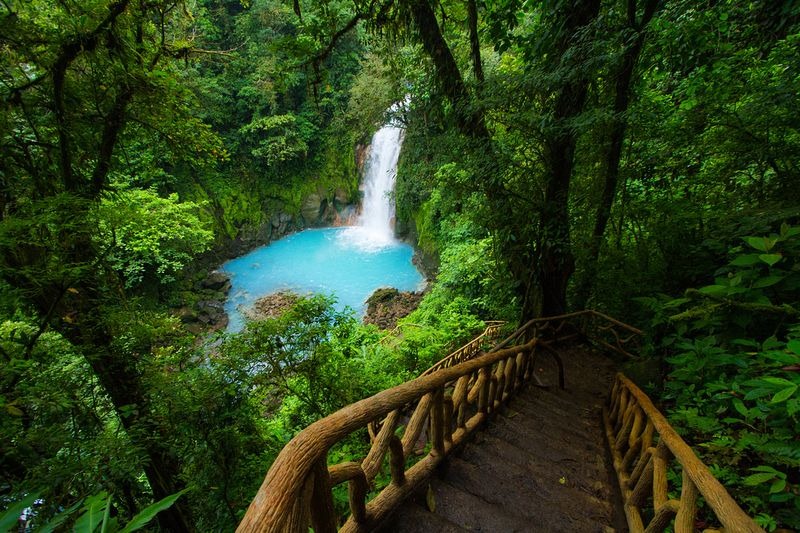
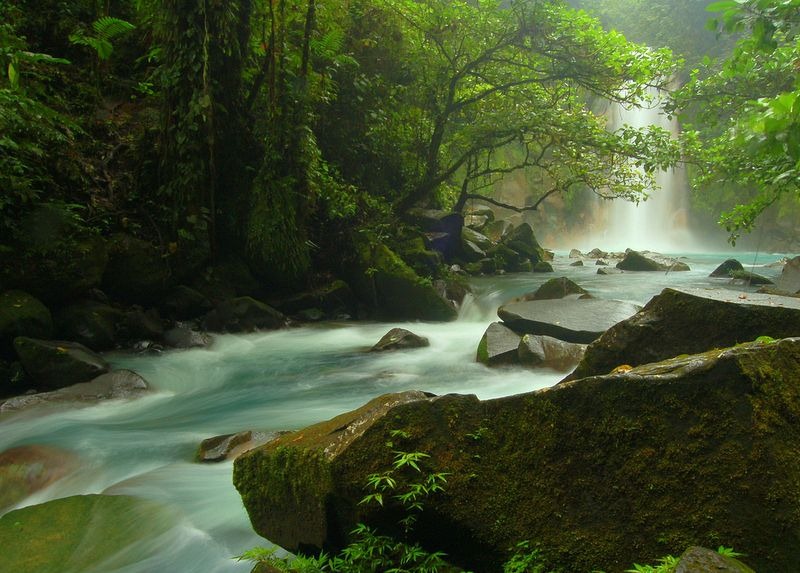
Winding through the verdant rainforest of Tenorio Volcano National Park of Costa Rica, is a bright blue river called Rio Celeste. The river is formed by the confluence of two smaller rivers called the Sour Creek and the Good View River. At precisely the point where the waters of the two completely transparent rivers meet, that the blue color starts. For that reason, this point is known as El Teñidor, which means “The Dyer” in English.

Until very recently, scientist were unable to fully explain why Río Celeste has such a distinctive turquoise coloration. Many hypotheses were put forward such as the water contained copper or calcium carbonate and sulfur, or that the river’s proximity to the Tenorio Volcano caused it have the blue color. It is now known that the blue color arises due to a physical phenomenon known as Mie scattering triggered by the presence of certain minerals in the river’s water that causes sunlight to reflect in such a manner that it gives the water its incredible hue.

rio-celeste-3

Photo credit: The Rohit/Flickr

As already mentioned, Río Celeste is fed by two rivers — Sour Creek and Good View River. The Good View River carries significant quantities of a type of whitish mineral known as aluminosilicate, that is composed of aluminum, silicon and oxygen. This is the mineral that is responsible for reflecting the blue color in sunlight. But if the mineral is also contained in the Good View River, why doesn’t it appear blue like Río Celeste? The answer lies in the size of the particles.

Researchers found that Good View River particles have a size of 184 nanometers, while in the Río Celeste the particles are much larger at 566 nm.

“This increase in size is what causes the scattering of sunlight, such that it occurs principally in the blue region of the visible spectrum. So that’s why we have that spectacular light blue color of the Rio Celeste” said Dr. Max Chavarría Vargas, lead investigator.

But why are the aluminosilicate particles in Río Celeste bigger than those in Good View River, when the particles itself came from the Good View River? It so happens that Sour Creek, the second river to join Good View River, is highly acidity due to volcanic activity (which is why it’s called Sour Creek). When these two streams mix to form Río Celeste, the drop in pH causes the aluminosilicate particles to aggregate and enlarge producing Mie scattering which gives the river a strong turquoise color.

“It’s one of those quirks of nature where one of the rivers provides mineral material with one size and the other river provides the acidic environment so that those particles grow,” said Dr. Max Chavarría Vargas.

rio-celeste-7

Photo credit: Steve Corey/Flickr

rio-celeste-5

Photo credit: The Rohit/Flickr

rio-celeste-2

Photo credit: Efrain Gonzalez Buitrago/Flickr

rio-celeste-4

Photo credit: The Rohit/Flickr

rio-celeste-1

Photo credit: Bruce Thomson/Flickr

Sources: The Costa Rica Star / Wikipedia

Source…….www.amusingplanet.com

Natarajan
Rare White Giraffe Spotted In Tanzania…!!!

This stunning giraffe has not been photoshopped, she’s real! Omo, the 15-month-old beauty whose skin looks as if it was bleached, is suffering from leucism. It’s a condition that results in a partial loss of pigmentation.

She was spotted in Tarangire National Park in Tanzania by Dr Derek Lee, founder and scientist at the Wild Nature Institute. “Omo appears to get along with the other giraffes, she has always been seen with a large group of normally coloured giraffe – they don’t seem to mind her different colouring,” he explained.

“We and our partners are working on giraffe conservation and anti-poaching to help give Omo and her relatives a better chance of survival. We hope that she lives a long life and that some day she has calves of her own.”

More info: wildnatureinstitute.org

“Omo is the only pale giraffe we are currently aware of,” said Dr Derek Lee

white-giraffe-leucism-albino-rare-animals-omo-tanzania-7

“Omo appears to get along with the other giraffes…they don’t seem to mind her different colouring”

white-giraffe-leucism-albino-rare-animals-omo-tanzania-8

“Adult giraffes are regularly poached for bush meat, and her colouration might make her a target”

white-giraffe-leucism-albino-rare-animals-omo-tanzania-9

“We and our partners are working on giraffe conservation and anti-poaching to help give Omo and her relatives a better chance of survival”

white-giraffe-leucism-albino-rare-animals-omo-tanzania-12

“We hope that she lives a long life and that some day she has calves of her own”

white-giraffe-leucism-albino-rare-animals-omo-tanzania-11

Source………www.boredpanda.com

Natarajan
Neft Dasları: A City Built On Oil Platforms…!!!

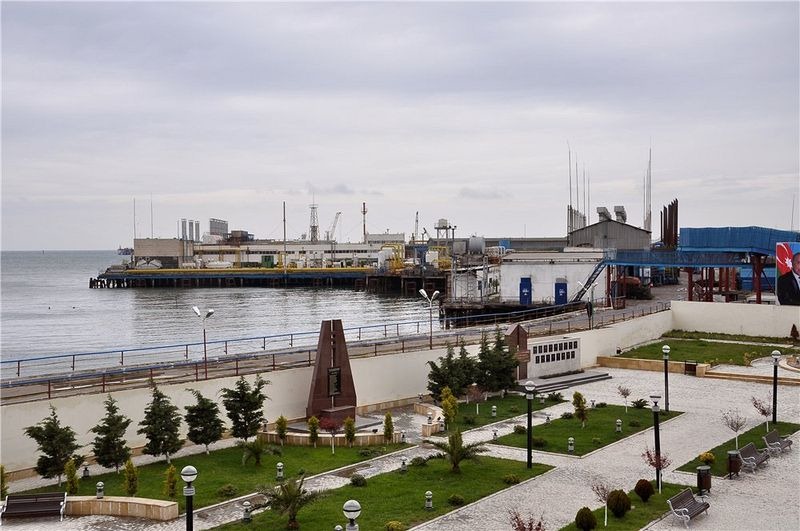
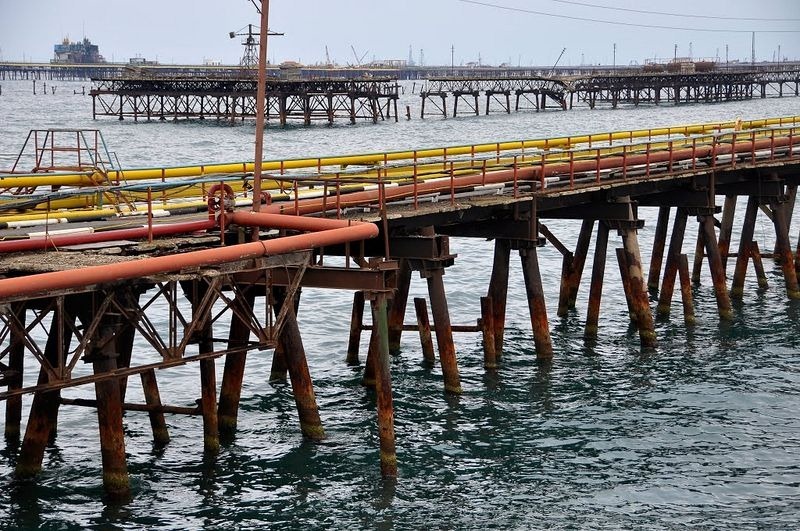
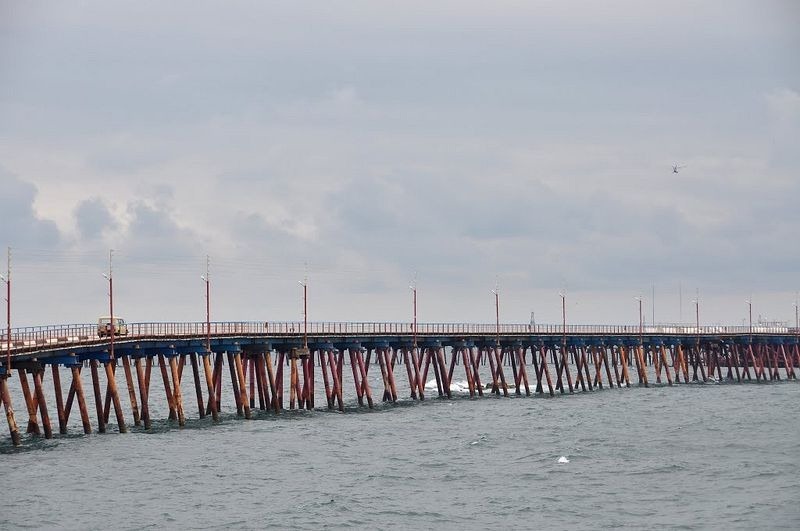
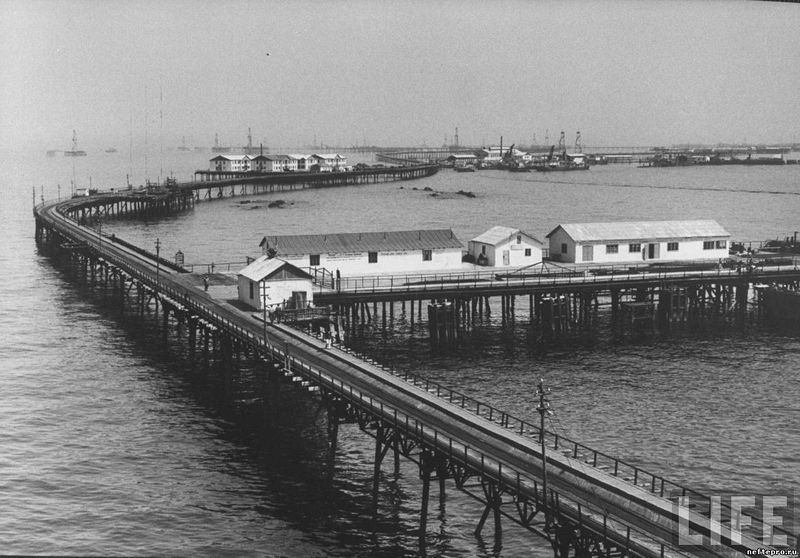
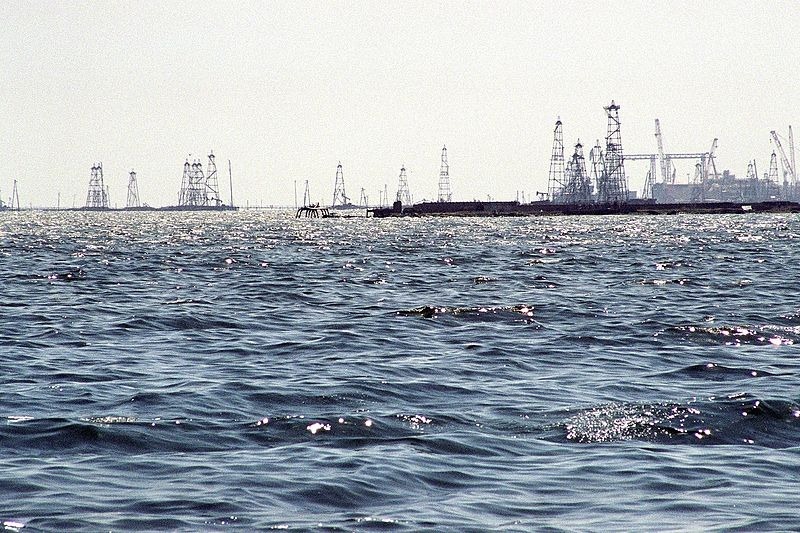
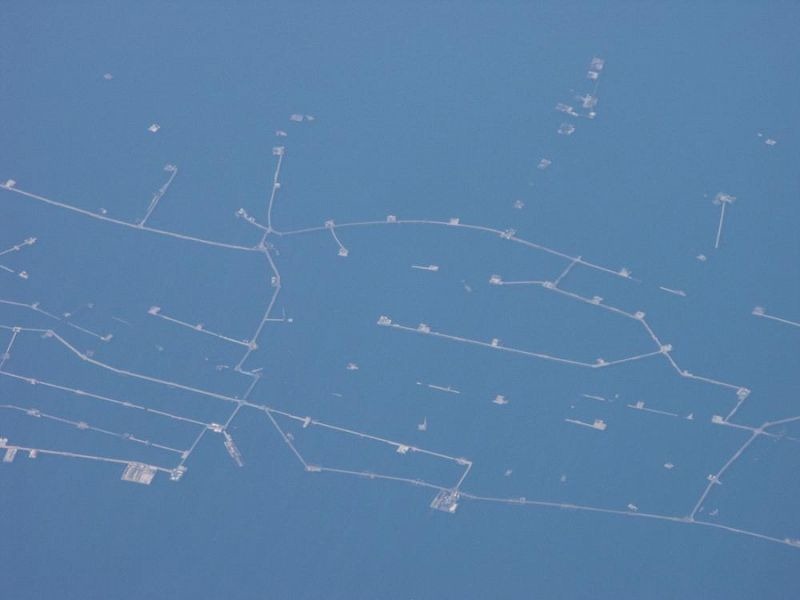
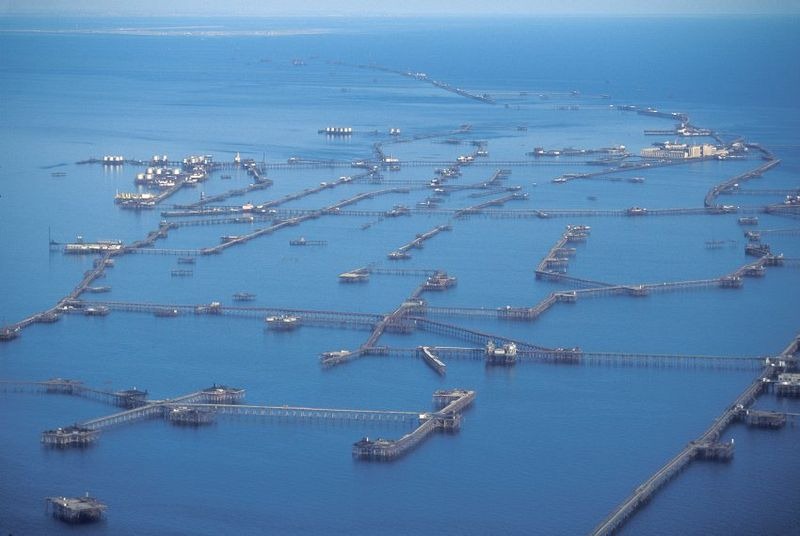
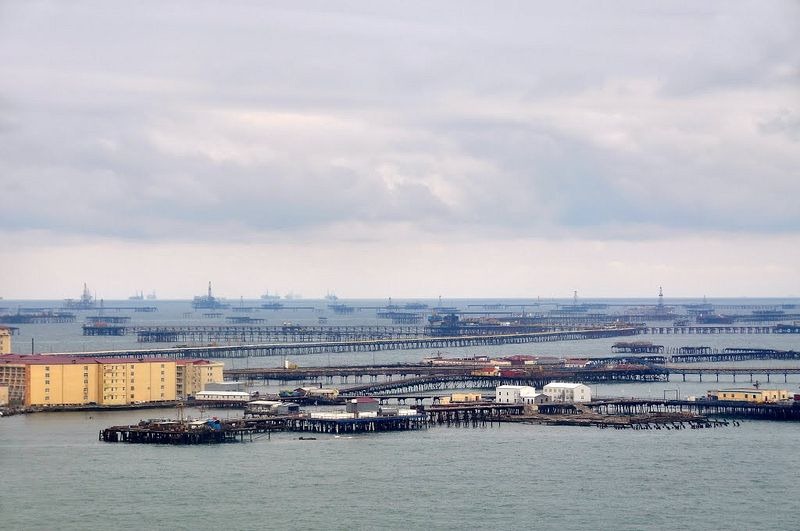
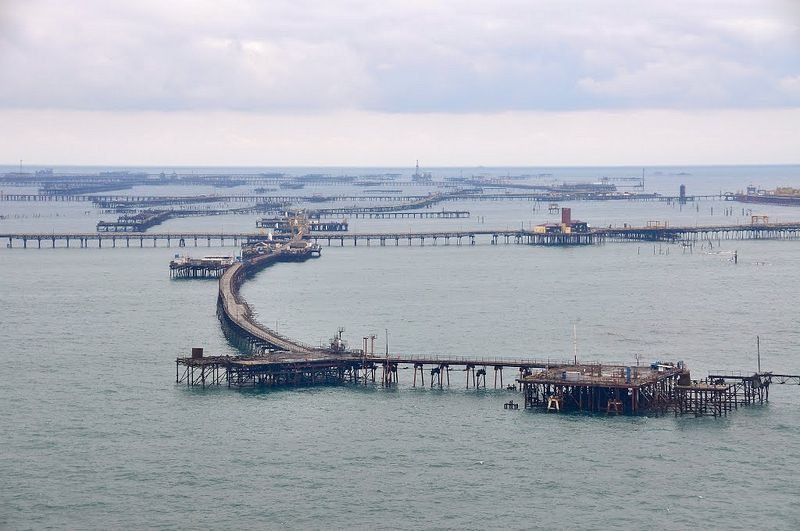
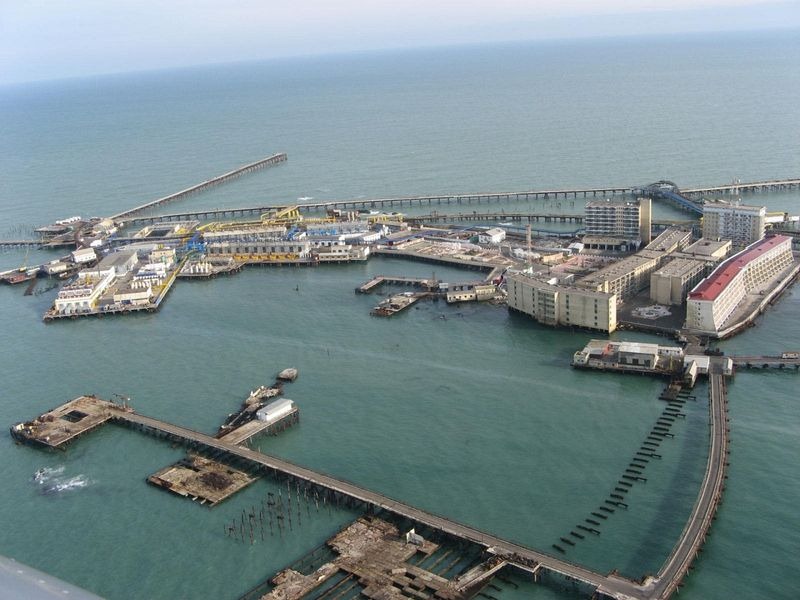
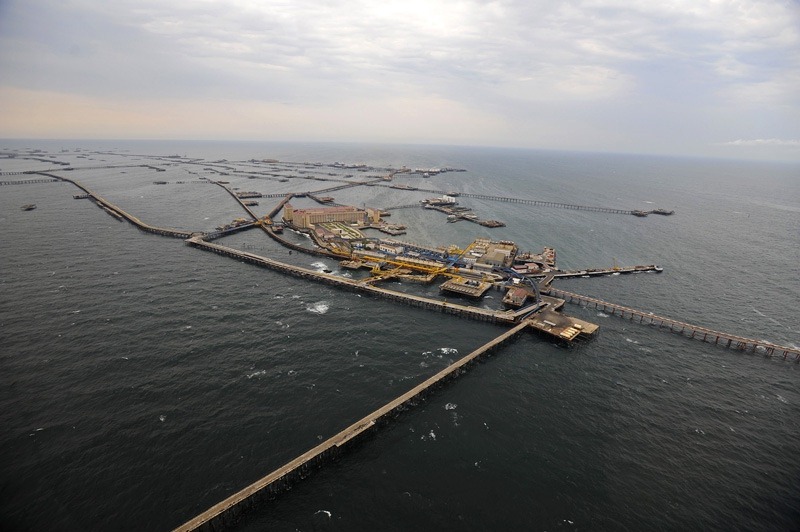
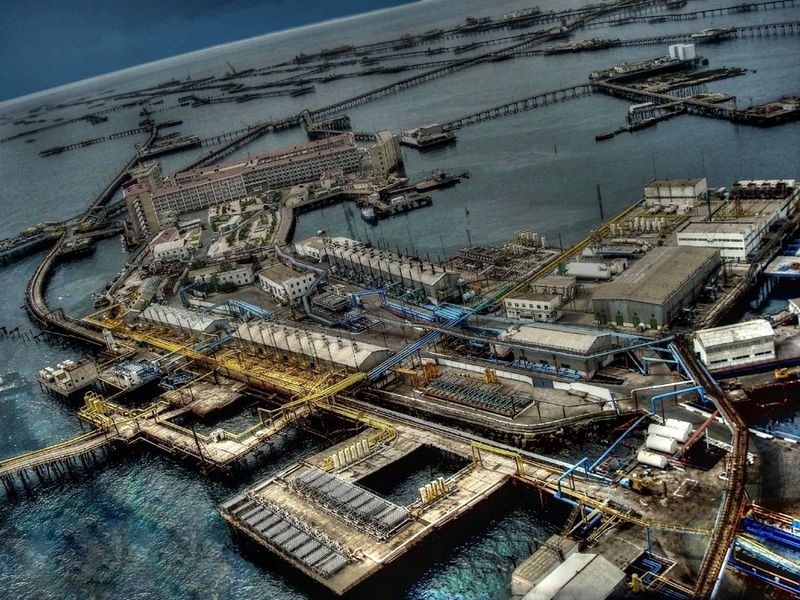
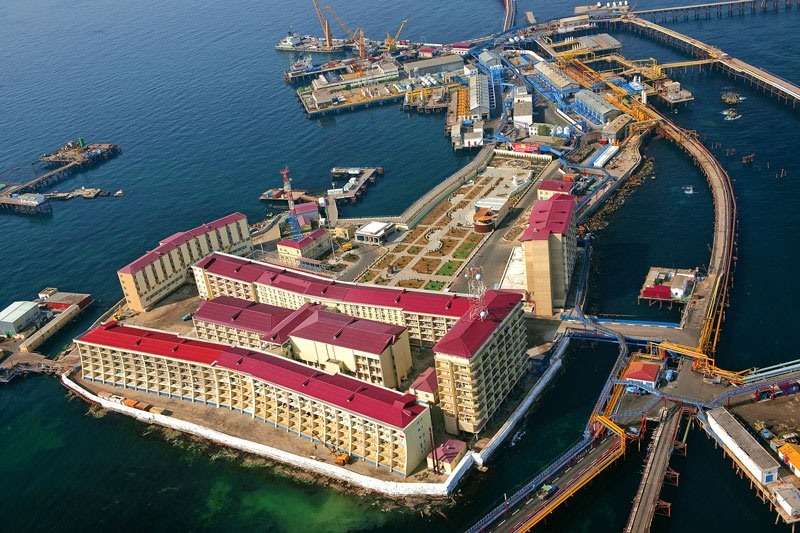
Far out into the Caspian Sea, a hundred kilometers away from the Azerbaijani capital Baku, lies one of the most incredible settlements in the world. A fully functional city of 3,000 living in a network of oil platforms and artificial islands connected by 300 km of trestle bridges. This is Neft Daslari, also known as Oil Rocks, and it lies fully within the world’s largest lake at an incredible distance of 55 km from the lake’s shore.

Azerbaijan has been famed for its rich oil resources since ancient times. There is evidence of oil drilling and actual trade in petroleum as early as the 3rd and 4th centuries. Historical accounts of the area’s oil and natural gas seepage can be found in old Arabic and Persian manuscripts, as well as in the writings of famous travellers such as Marco Polo. The Persians called the area the “Land of Fire”.
neft-dasları-18

Photo credit: geozet.ru


Modern drilling began in 1870 after Russia conquered the territory. By the start of the First World War, Azerbaijan’s oil wells were already supplying 175 million barrels of crude oil a year, or 75 percent of the country’s entire oil production. After the war, while exploring for oil in the Caspian Sea, Soviet engineers struck top-quality oil at a depth of 1,100 meters below the seabed. Shortly thereafter, the world’s first offshore oil platform was built at the spot, and Neft Daslari was born.

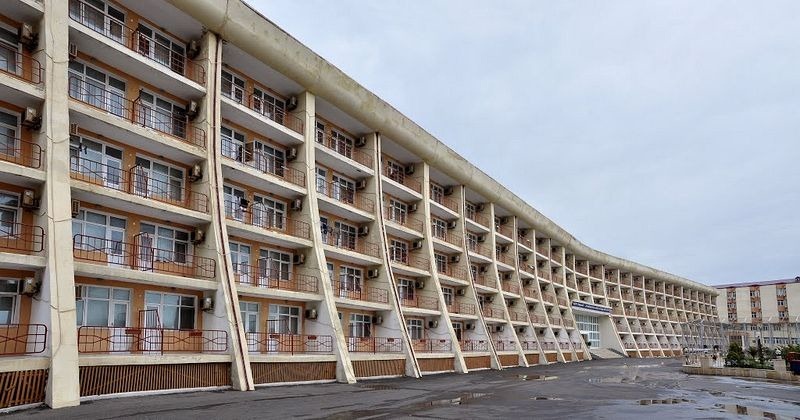
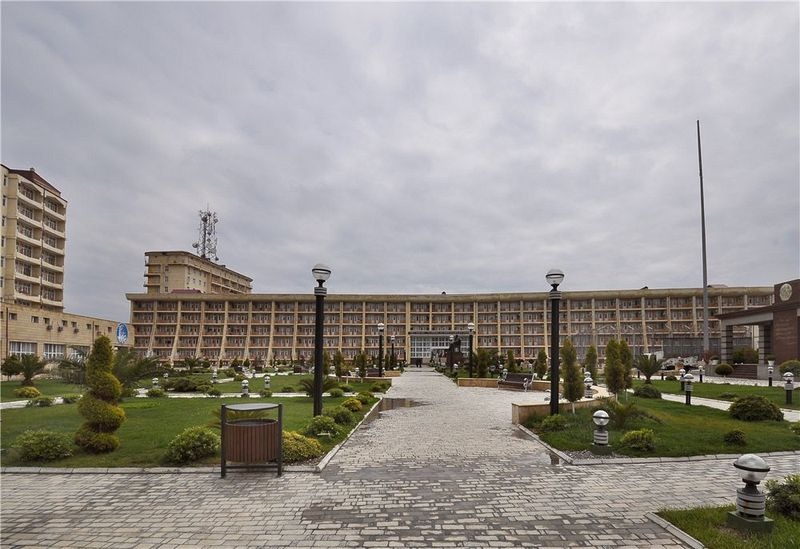
The original foundation of Neft Daslari consisted of seven sunken ships including the world’s first oil tanker. Over the decades this grew to some 2,000 drilling platforms spread in a 30-kilometer circle, joined by a network of bridge viaducts spanning 300 kilometers. Over these platforms, workers built eight-story apartment blocks, a beverage factory, soccer pitch, library, bakery, laundry, 300-seat cinema, bathhouse, vegetable garden and even a tree-lined park for which the soil was brought from the mainland. During its heydays, some 5,000 workers lived here.

Neft Daslari’s decline began with the collapse of the Soviet Union and the discovery of new oilfields elsewhere. The workforce was reduced and many oil rigs were abandoned. Neglect and lack of maintenance caused many of them to collapse into the sea. Others are in the process of crumbling. Out of the 300 kilometers of roads, only 45 kilometers remain usable, and even they have fallen into disrepair. To the government, however, the place is still the proud, closely-guarded secret it was in Soviet times. It is still very hard for foreigners to gain access to the city. You can’t even zoom into it on Google Maps.

neft-dasları-5

Photo credit: IPAAT/Panoramio

neft-dasları-6

neft-dasları-17

Photo credit: infoglaz.ru

neft-dasları-21

neft-dasları-1

Photo credit: infoglaz.ru

neft-dasları-19

Photo credit: infoglaz.ru

neft-dasları-7

Photo credit: IPAAT/Panoramio

neft-dasları-13

neft-dasları-15

neft-dasları-8

neft-dasları-11

neft-dasları-12

neft-dasları-20\

neft-dasları-3

Photo credit: geozet.ru

Sources: Spiegel / Wikipedia

Source……www.amusingplanet.com

Natarajan

Images of the Day…Animals on safari !!!

Africa promises one of the best safari experiences in the world, enabling you to see the five big wild animal groups: the lion, the leopard, the elephant, the rhino and the buffalo. Capturing a good photo of these beautiful animals is not always easy, and very often, it comes down to being at the right place at the right time. But, the pictures below are pretty incredible. So, get ready to enjoy some animal watching with this great photo series!

safari animals

Male lion ignoring a group of Thomson’s Gazelles.


safari animals

‘One day I’ll be tall like mommy’.


safari animals

Young male leopard watching the setting sun.

safari animals

Black-face Vervet monkeys as seen on safari in Tanzania

safari animals

The ‘painted wolf’, also known as the African wild dog, is Africa’s most endangered predator.


safari animals

Two male lions relaxing in the sun.

safari animals

Elephants playing in the red soil. Taken at Sheldrick Elephant Orphanage in Nairobi National Park in Kenya, Africa.


safari animals

A male lion getting some sun at the Serengeti National Park in Tanzania, Africa. This may be the best wildlife reserve in all of Africa, renowned for the variety and number of animals living in it, both predator and prey.

safari animals

A beautiful shot of two elephants at the Kruger National Park, another of Africa’s large game reserves, which covers 18,989 square kilometers (7,332 square miles), and is 360 kilometers (220 miles) long.

safari animals

Another resident of Kruger National Park slowing down traffic for a while.

Source………www.ba-bamail.com

natarajan