Watch Google CEO Sundar Pichai’s Message For PM Modi, Before His Visit To Silicon Valley…

Sundar Pichai is a name known to most Indians these days. Ever since he took a prestigious position in Google, Indians have been proud of him for inspiring so many ambitious children to dream big.

As per a report by Reuters, on September 27, Prime Minister Narendra Modi will be visiting the Silicon Valley. He will also pay a visit to the Google campus and Facebook headquarters and discuss the pressing issues that can lead to further technological development in India.

As a result, Sundar Pichai in his present capabilities as CEO of Google has extended a warm welcome to Mr. Modi. In this video shared by Google India, we see him inviting the prime minister. He also expressed that the team is very excited to meet him.

He strongly feels that PM’s visit will energize people in the Silicon Valley as well as people in India. He highlights Google’s upcoming plans and illustrates how they will help India.

Even we are looking forward to Mr. Modi’s visit to Google and we hope that it leads to many productive results!


Source….Shubhi  Dixit  in http://www.storypick.com and http://www.youtube.com

Natarajan

Here’s how much of the world would need to be covered in solar panels to power Earth…

Solar energy is a seriously underrated resource.

More power from the sun hits the Earth in a single hour than humanity uses in an entire year, yet solar only provided 0.0039% of the energy used in the US last year.

Visionaries like Elon Musk think that solar will become the biggest energy source by 2031, according to an interview with Tim Urban on Wait But Why.

But what would a world powered by solar look like?

The Earth would probably be littered with solar panels, right?

Wrong.

If solar is 20% efficient (as it has been in lab tests) at turning solar energy into power, we’d only need to cover a land area about the size of Spain to power the entire Earth renewably in 2030.

This map, from the Land Art Generator Initiative, shows just how little space that really is:

Solar panels world map

And while it’s useful in the map to show the solar installations as a square bunched together, this area could actually be spread over more space, with solar panels tucked away on rooftops and spread across deserts.

To figure this out, the folks at Land Art Generator did the following maths:

678 quadrillion Btu (the US Energy Information Administration’s estimation of global energy consumption by 2030) = 198,721,800,000,000 kilowatt-hours (simple conversion) divided by 400 kilowatt-hours of solar energy production per square meter of land (based on 20% efficiency, 70% sunshine days per year and the fact that 1,000 watts of solar energy strikes each square meter of land on Earth) = 496,805 square kilometers of solar panels (191,817 square miles)

Remember, that’s if we only relied on solar — no fossil fuel-guzzling oil, coal or natural gas. Now we just have to work on making that happen.

source…..REBECCA HARRINGTON  in http://www.businessinsider.com.au

Natarajan

All You Need to Know about VolksWagen Crisis….. Part 2….

With 11 million cars affected worldwide, €6.5 billion ($AU10.28 billion) set aside to fix the problem, and facing $US18 billion ($AU25.56 billion) in fines, the scandal enveloping Volkswagen is shaping as the largest in automotive history. So what have VW actually done, and how did they get caught?

VW’s software fix while testing

Volkswagen stand accused of fitting cars with diesel engines with a ‘defeat device’ – a chunk of software that is able to detect when the car is undergoing emissions testing, which then ensures all emission controls are fully functioning as the test takes place.

How does the car know it’s being placed into test mode? Consumer Reportsdetails how VW, and many auto-makers, have a test mode that overrides certain things like traction control. That’s because the car is placed onto a dyno and needs to operate with front wheels spinning but back wheels stationary.

Having a test mode itself wasn’t the problem, it’s that VW look to have utilised that mode to enable emissions limits.

Once the test is over, the cars cease to utilise the emission controls – which significantly reduce fuel economy – and according to the United States Environmental Protection Agency, “during normal operation, [the vehicles] emit nitrogen oxides, or NOx, at up to 40 times the standard”.

The EPA went on to explain that NOx pollution is linked to respiratory and and cardiovascular diseases, and in some cases even death.

“Using a defeat device in cars to evade clean air standards is illegal and a threat to public health,” said Cynthia Giles, Assistant Administrator for the Office of Enforcement and Compliance Assurance. “Working closely with the California Air Resources Board, EPA is committed to making sure that all automakers play by the same rules. EPA will continue to investigate these very serious matters.”

The aforementioned $US18 billion fine is based on the EPA having the power to fine $37,500 per car which isn’t up to standard, of which they estimate 482,000 have been sold in the US since 2008. Clearly, that number has risen substantially worldwide, and VW stand to lose tens of billions in recalled and refitted cars alone.

The company said in a release that the €6.5 billion “may be subject to revaluation”, and with 11 million cars to solve, one would expect that revaluation to go up.

It’s also worth noting that the EPA told VW car owners it was on the company to get their vehicles up to code, and that “although these vehicles have emissions exceeding standards, these violations do not present a safety hazard and the cars remain legal to drive and resell”.

How they got caught

While this has all blown up over the last week or so, the case against Volkswagen has been building for over a year.

However rather than a sting, the EPA got somewhat lucky in discovering the company’s systematic cheating.

In May 2014 the International Council on Clean Transport (ICCT) released a paper entitled ‘In-use emissions testing of light-duty diesel vehicles in the U.S.’.

ICCT wanted US NOx emission standards introduced in Europe, and thus employed researchers from West Virginia University to gather emission data.

“Some people have mischaracterised what our role was,” Dan Carder, interim director of the University of West Virginia’s Centre for Alternative Fuels, Engines and Emissions, told IEEE. “Some have used the phrase ‘tipped off the EPA’. But we were just working under contract.”

While the cars in the paper were referred to as ‘Vehicle A’, ‘Vehicle B’ and ‘Vehicle C’, the discovery that emissions on the road were vastly different to those under test conditions piqued the EPA’s interest.

“We presented this in a public forum in San Diego, in the spring of 2014; we said, these are two vehicles; we’re presenting what we can present,” Carder said. “And EPA people were in the audience.”

Over a year later the case was brought before Volkswagen, who were quick to admit their wrongdoing, with US chief executive Michael Horn saying on Monday the company had “totally screwed up”.

The question now is just how far up does this go? An admission of screwing up is one thing, but 11 million cars claiming to be up to 40 times cleaner than they actually are is a tremendous breach of trust, particularly in an increasingly environmentally conscious car market.

While it’s the kind of scandal that could ruin a company, VW probably have the size and pockets to handle it. In July this year VW – which also owns Audi, Bentley, Lamborghini and Porsche – was the largest-selling carmaker in the world.

Authorities the world over are now investigating whether other companies under the VW umbrella – and indeed unrelated car manufacturers – have been employing similar tactics.

The question now is just how far up does this go? An admission of screwing up is one thing, but 11 million cars claiming to be up to 40 times cleaner than they actually are is a tremendous breach of trust, particularly in an increasingly environmentally conscious car market.

While it’s the kind of scandal that could ruin a company, VW probably have the size and pockets to handle it. In July this year VW – which also owns Audi, Bentley, Lamborghini and Porsche – was the largest-selling carmaker in the world.

Authorities the world over are now investigating whether other companies under the VW umbrella – and indeed unrelated car manufacturers – have been employing similar tactics.

ABOUT THE AUTHOR

Joe was Junior Vice-President at Compu-Global-Hyper-Mega-Net until it was bought out by Bill Gates. He now subedits for Conversant Media and considers it a step up.

See more from Joe Frost

Source….www.techly.com.au

Natarajan

Clever Idea to Solve Boarding Hassles ….

PLANE designers have been racing to discover the next wave of revolutionary aircraft interiors.

Whether airlines want to save space, lighten their load or speed up boarding times, engineers have come up with dozens of solutions — and not all of them seem comfortable.

The latest seat design from US-based Molon Labe Designs claims it has the one-row-fits-all solution for airlines looking to save big money on fuel costs and make the boarding process more efficient.

The Side-Slip features a typical three-seat per row configuration, but, with the simple push of a button, the aisle seat glides over the middle seat creating a wider aisle — from the standard 19 inches to 41 inches.

“I was travelling a lot, and I was always running late and just wanted to get off the plane faster,” Hank Scott, founder and CEO of Molon Labe Designs and inventor of the Side-Slip seat, told the Denver Post.

“I just started thinking about it, and ideas popped into my head … Now the line won’t stop. Just get out of the way and let people walk around you.”

Move over ...

Move over …Source:

Side-Slip’s seat configuration not only features an adjustable aisle seat, but the middle seat is a roomier 20 inches wide. The aisle and window seats are 18 inches wide, in line with industry averages.

The flexible seats are being targeted at lower-cost airlines making multiple trips per day, usually less than three hours. Some carriers have cited turnaround time as a major obstacle to staying on schedule.

Scott believes with more an efficient boarding and deplaning process, the Slip-Seat configuration could save these airlines big money in the long run.

The US trade organisation Airlines for America estimates that every minute a plane sits docked at a gate with the engine running costs about $US81-100 ($115-143) in fuel and associated costs.

The Slip-Slide team conducted boarding efficiency trials with their aisle seats using the “sit anywhere” boarding method favoured by some airlines, and block boarding used by most carriers, with impressive results.

When the sliding seats are fully folded up, boarding efficiency is improved by 4.5 minutes during random boarding and a full 6.7 minutes — or 33 per cent — for blocking boarding. If an airline performs 1,000 turnarounds a day, 6.7 minutes amounts to nearly $957,000 saved per day — about $350 million a year.

“If you can offer a product that makes the airlines save fuel and increase revenue, and also makes the passengers more comfortable and less stressed — it’s a win-win,” said Scott.

Side-Slip debuted their seats last week to hundreds of airline executives at the annual World Low Cost Airlines Congress in London. They are currently undergoing the Federal Aviation Administration’s certification process.

This story originally appeared on Fox News.

Source……www.news.com.au

Natarajan

All You Need to Know About Volks Wagen Crisis… Part 1

VOLKSWAGEN CEO Martin Winterkorn has stepped down from the company over the emissions scandal as experts warn of an economic catastrophe bigger than Greece.

The auto behemoth is Germany’s largest car maker and biggest employer, with 270,000 people on staff.

But that is just a fraction of the number that could be affected if the fallout spreads to suppliers and other automakers in Germany — Europe’s largest economy — where nearly a million people are employed by the car industy alone.

“All of a sudden, Volkswagen has become a bigger downside risk for the German economy than the Greek debt crisis,” ING chief economist Carsten Brzeski told Reuters.

“If Volkswagen’s sales were to plunge in North America in the coming months, this would not only have an impact on the company, but on the German economy as a whole.”

The US Environmental Protection Agency says Volkswagen could face penalties reaching $AU25 billion over rigged emissions tests on its cars.

A staggering $28 billion was wiped off the company’s value this week, with some experts wondering whether it will be able to survive.

“That’s why this scandal is not a trifle. The German economy has been hit at its core,” said Michael Huether, head of Germany’s IW economic institute.

The German government has talked down the broader impact, insisting the “highly innovative and very successful industry” would remain an “important pillar” of the German economy.

In a statement announcing his departure, outgoing CEO Mr Winterkorn said he was “shocked by the events” and stunned that misconduct on such a scale was possible.

“As CEO I accept responsibility for the irregularities that have been found in diesel engines and have therefore requested the Supervisory Board to agree on terminating my function as CEO of the Volkswagen Group. I am doing this in the interests of the company even though I am not aware of any wrong doing on my part,” he said.

“Volkswagen needs a fresh start — also in terms of personnel. I am clearing the way for this fresh start with my resignation.”

Mr Winterkorn said the company must continue to seek the truth behind the scandal, saying it’s “the only way to win back trust.”

“I am convinced that the Volkswagen Group and its team will overcome this grave crisis.”

Junked: The scandal has led to threats of a ratings downgrade from Fitch which could lead to increased borrowing costs for the car maker. Michael Sohn.

Junked: The scandal has led to threats of a ratings downgrade from Fitch which could lead to increased borrowing costs for the car maker. Michael Sohn.Source:AP

The resignation caps off a horrific few days for the famed German car manufacturer after research by the International Council on Clean Transportation alleged the company used “defeat devices” on diesel cars between 2009 and 2015 to circumvent the results of emissions test. The stunning results were found after simply driving the cars on five routes and finding a huge discrepancy between their testing results and real-life performance.

On Tuesday, Volkswagen admitted 11 million of its cars around the world contained the device, a huge jump from the 482,000 initially identified by the US Environmental Protection Agency.

The company now faces fines that could run into the tens of billions of dollars in the US while other countries are launching investigations of their own. German public prosecutors are also considering launching a criminal inquiry into what went on at the company.

Mr Winterkorn initially admitted Volkswagen had “totally screwed up” and set $10 billion aside to cover the costs of the scandal. However by Wednesday pressure had become to much to bear and he finally stepped down.

The decision led to a bounce in sharemarkets for the company which saw $28 billion wiped off its value this week. Volkswagen said it will announce a new chief executive on Friday.

It’s been a rough few days for the previously beloved brand that makes the iconic beetle and golf cars. Picture: Odd Anderson.

It’s been a rough few days for the previously beloved brand that makes the iconic beetle and golf cars. Picture: Odd Anderson.Source:AFP

Nitrogen oxide gasses can cause breathing problems and lung infections in humans and in 2012 the World Health Organisation classified diesel fumes as cancer-causing. They can also damage the environment, naimals and plants and are a key contributor to global warming.

The testing revealed Volkswagen cars were spewing out up to 40 times more pollution than allowed under Environmental Protection Agency limits.

Senior Fellow at the International Council on Clean Transportation John German, who discovered the extraordinary result said they ran the program to show “US diesels are clean”.

Instead, it led to one of the biggest scandals in car manufacturing history which has left the future of the company in doubt and will likely force them to have to recall nearly 500,000 cars including the Jetta, Golf, Beetle and Audi A3 models dating back to 2009.

Source….www.news.com.au

natarajan

MY STORY: “The Day I Saw Children Paint & the Blind Play Cricket on Bengaluru Streets” …….

Bengaluru has more than 50 lakh vehicles on the street daily. Like any other metropolis, the city needs to cut back on personal modes of transport and educate its citizens to encourage public transport, cycling, and walking. For this reason, the recent open streets initiative held in all seven sectors of HSR layout was a fantastic attempt to reduce pollution caused by motorized personal vehicles.
On September 20th, the movement of all personal vehicles was banned in the HSR layout neighborhood in Bengaluru. Bangalore Metropolitan Transport Corporation (BMTC) provided additional local bus services to support the travel needs of the residents. I live in the second sector, and I think the event was a great initiative. I’d love to see more such events organised in different parts of the country.

Here are five reasons why I think the event was a great success:

image1

Open Streets Brochure

It was a great public awareness initiative. There were public buses that were plying to and from common destinations. They were also taking people back and forth towards the main roads – where they could get other public transport, or a cab/auto, or have their friends pick them up. Ambulances, fire engines and other emergency vehicles were allowed to ply without interruption. –

OpenStreets2

Various events and activities being held on the streets

  1. I’m sure there will be government or non-government organizations that will calculate the pollution levels and enumerate them, but according to me all the levels of pollution were noticeably lower wherever I went. The air felt and smelled cleaner. The noise pollution was lower too – we are so used to cars honking and loud noises as motorbikes and autos accelerate that the quiet was quite unnerving at times.


  1. We saw a street art competition. Children were sitting on the road, doing their art and colouring their books and they looked so happy. It felt really good – giving them a safe road – one day a year. We saw some children playing carrom and chess on the road. Others stood by watching and cheering.

On 19th Main, we witnessed a match of Awareness Blind Cricket. It was the first time I saw the blind play cricket with a ball that was filled with ball-bearings that jingled when it was thrown – so they could hear it and play the game with their enhanced sense of hearing. It was definitely heartwarming and a learning experience for many of us watching the match.

OpenStreets

Art Competition

  1. Yes, there were few cars and motorized two wheelers on the road. But, we mainly saw empty roads. We heard virtually no honking. And, we saw little kids walking with parents and grandparents – without holding hands. Can you imagine that? How liberating must it be for a two-year-old to not have his hand tightly clutched in an adult’s hand when he is out on the street. How stress free must that adult be feeling too?

We saw little children and their older siblings cycling (training wheels and all), skateboarding, and walking.

OpenStreets1

  1. For the first time since we’ve lived here – we walked to a restaurant for lunch. Together. As a family. And, I loved that experience too. We were chatting all the way to the restaurant. And chatting all the way back. It felt so good to reconnect with my family and we were also happy that we burned a few of the calories we had collected at lunch.

I think most of HSR layout was just a little bit healthier and happier on the night of 20th September. But, I would be remiss if I didn’t mention some of the downsides that we noticed, both personally and from some of the HSR groups on Facebook.

  1. Doctors and other emergency medical personnel were being continuously stopped and questioned. This made them late to get to their patients and clinics and that should not happen. Many of them were very upset and quite vocal about this on Facebook.

Solution: These cars could get special stickers or stick a paper on their windshield with ‘Emergency Vehicle’ written in bold. Yes, I do realise some people might misuse this – but I believe most educated people would shy away from being shamelessly dishonest.

  1. Some people who were coming back from out of town were stopped. They had to park their cars and walk in the rain with their luggage and their cranky children. That must have been quite tedious and irritating and they would certainly not appreciate the reason behind the initiative.

Solution: An initiative like ‘Open Streets’ cannot be blindly imposed on the people without reason.

The authorities/volunteers need to be empowered to make decisions based on the situation at hand. They need to have the freedom to decide whether a situation calls for bending the rules a little.

IMG_0923

  1. Friends and relatives of patients who were coming into HSR to donate blood were not allowed to enter the layout in their vehicles, causing flared tempers and delays.

Solution: As stated above, the authorities need to be sensitive in different situations. Some roads could allow vehicles, so as to prevent a complete shutdown of traffic.

  1. There were also complaints of vehicles being stopped multiple times after they had already explained their situation and secured entry of their vehicle into the layout.

Solution: Once a vehicle is allowed to pass it could be given an identifying marker (like a sticker or placard that hangs from the rear-view mirror) to prevent being stopped multiple times. People who need their vehicles to get to and from work could get a special pass in advance.

  1. Business establishments that rely on outsiders coming in to avail of their services — for example, grocery stores, petrol pumps, beauty salons, restaurants, etc. — may have seen lower revenue compared to other Sundays.

Solution: These businesses could get involved by sponsoring an activity or event. This would increase their visibility and serve as a marketing tool. The stores may also consider offering home delivery of necessities on cycles – thus bolstering their revenues a bit.

The event was an amazing initiative and should be explored in different cities all over the country.

Looks like it was the start of something beautiful

Looks like it was the start of something beautiful

null (2)

I am extremely proud that HSR was chosen as the neighborhood to pilot this event because of its “vibrant and open-minded residents,” and look forward to more days like this one. The event was definitely a success, and by fixing the issues and problems mentioned, it can move forward to becoming a successful, regular and city-wide event.

– Niharika Jadeja

About the author: Niharika Jadeja is a sixteen year old who recently graduated from Ebenezer international School. She is an avid reader and enjoys writing as well as playing the piano –

Source….www.thebetterindia.com

Natarajan


Vegetable Seller to Reputed Oncologist: How Dr. Vijayalakshmi Beat All Odds to Emerge a Winner …

Dr. Vijayalakshmi Deshmane has seen many aspects of life. From being born in what is considered a backward caste in the nation, to living in a slum; from selling vegetable to becoming a doctor – she has experienced it all, and has been giving to the society with her incredible selflessness. This is Dr. Deshmane’s story in her own words.

We often hear complaints about the mounting consultation fee that is charged by doctors. In fact, most of us question the medical world as we see it transforming into an “industry”, where annual profits have taken centre stage, and patient wellness has been pushed to the periphery. But then there are always some exceptions in every field, and here is one such person who is an exception in the field of health care.

This is the story of a woman who has seen many things in life – right from staying in a slum and selling vegetables to becoming a surgeon and cancer expert.

dr vijayalaxmi deshmane

Meet one of India’s most reputed Oncologists, Vice President of Karnataka Cancer Society, and a recipient of many awards, Dr. Vijayalakshmi Deshmane. –

Deshmane: A Unique Surname

I come from one of most backward castes in India, whose people are supposed to be stitching used footwear. My father, Baburao, was influenced by the freedom movement and believed in the empowerment of all. Though he was not formally educated, he broke the barriers of caste which were restricting his career, and learnt letters and then languages, on his own – Kannada, Marathi, Hindi and English.

I was born in 1955, followed by a brother and 6 sisters. We were 10 people living a small house which belonged to my father’s sister and was located in a slum.

Getting a single meal each day was a challenge for us, and affording basic amenities was a dream.

dr vijayalaxmi deshmane (1)

My parents did odd jobs like cutting, fetching, and selling wood, and being a coolie. Later, my father joined a mill and rose in ranks, thanks to his ability to connect with people. They fondly started calling him Deshmanya. This was when my father replaced his caste surname with Deshmanya.

I was named after Vijaya Lakshmi Pandit, sister of Pandit Nehru and the first woman to become President of the UN General Assembly. And my surname, “Deshmane”, signifies Deshmanya’s daughter.

A Moonless Night that Paved the Way for Medicine

doctors

Picture for representation only. Source: Flickr

My father had a dream that I will become a doctor and will serve the poorest of the poor. Having such dreams while living in a slum is surprising. It shows the kind of vision my father had for us. Meanwhile, my mother set up a small vegetable shop. My brother and I used to carry those vegetable on our heads to help out our mother.

I excelled in my studies, but I had sensed the end of my education after clearing the class 12 exams. I was convinced that my parents would not be able to fund my studies any further. The education of my siblings also had to be taken care of.

However, I remember that one moonless night, when my mother gave away her only ornament, her mangal sutra, to my father so that he could get a loan for my MBBS entrance exam at KMC, Hubli. I am what I am today because of the sacrifices made by my parents and siblings. Can I ever pay them back? I don’t think so!

Failing in the First Year of MBBS

Before beginning with my MBBS course, the medium for which was English, I had studied in Kannada.

Although I understood the lectures, I failed my first year because of my difficulties in facing the English exam papers. Thanks to my professors, I picked it up in the 2nd year and then there was no looking back. I went on to become the first rank holder of my university. There was a big celebration at my home when this news came.

I went on to pursue MS in surgery and started earning when I joined Kidwai Institute of Oncology as a senior resident of Surgical Oncology. I specialised in the treatment of breast cancer. Throughout my career, I have been very lucky to have the guidance, support, and love of my peers and patients. Meanwhile, my brother, Ajay Ghosh (named after famous Bengali freedom fighter), finished his LLB and started working.

On Being Just the Reason

I love my profession and believe in constant learning. I bought a photocopying machine to constantly update and maintain my own database of knowledge. I kept interacting with my patients and built a strong bond with them. While operating, I shift all the weight to God and seek His intervention for my success. I feel I am just the “nimitta” (reason) here. I’ve been shaped by my Gurus, raised by my peers, loved by my patients, and it is His willing that I am in this profession that saves and serves the society.

I have had a long career and I finally retired in 2015. But I think my work is only half done. I have been a part of numerous social drives, reach outs, awareness camps, research works, and education programs in villages. I will continue to do so, dedicating 15 days in a month to these activities. During the other 15 days, I will be providing free service and will be available at the Karnataka Cancer Society.

*****

Our ancient scriptures portray doctors as God, stating “Vaidhyo Narayano Hari”. For the first time, we witnessed why this saying is so right. A flower that blossomed in the dirt of a slum, has given so much to our society and still has so much to offer.

In order to keep the story as short as possible, we have skipped an interesting narration of how Dr. Vijayalakshmi’s sisters succeeded – 4 of them have earned their PhDs and are excelling in their fields. We wish Dr. Vijayalakshmi Deshmane and her siblings the best of health and happiness, and hope that their lives will inspire and guide many more of us.

September 23, 2015
Source….www.the betterindia.com
Natarajan


The amount of space junk around Earth has hit a ‘critical density’ — and it could be a massive problem…

Space debris 2 leo

Since humans launched Sputnik 1 in 1957, we have polluted the once-empty space around Earth to the point that it is now becoming dangerous, according to former NASA scientist Donald Kessler.

“We’re at what we call a ‘critical density’ — where there are enough large objects in space that they will collide with one another and create small debris faster than it can be removed,” Kessler recently told Marketplace.

For nearly 20 years, Kessler (who  retired  very recently) lead NASA’s Orbital Debris Program Office, which keeps track of all the growing clutter around Earth.

He predicts that eventually, there will be so much space junk that leaving Earth to explore deep-space will be impossible. That includes sending satellites to distant stretches of the solar system, like Pluto, and manned-missions to Mars.

Something must be done, he says. So he’s come out of retirement to help find a solution.

So much space stuff

Endeavour had a major impact on its radiator during STS-118. The entry hole is about 1⁄4 inch, and the exit hole is twice as large.

Right now, more than half a million pieces of man-made space junk orbiting Earth. And about 23,000 of those pieces are the size of a softball or larger.

This junk accumulates over time as defunct satellites are left in space and meteors, as well as other man-made space debris, slam into them, generating even more, smaller bits of junk.

After these collisions, the junk doesn’t simply go flying off into space. Instead, it is trapped by Earth’s gravity, and wraps like a belt around Earth, cluttering up our path to space.


While the size of this debris is an important factor, the speed at which it zips through space is what makes it so dangerous.

At a distance of over 200 miles above Earth’s surface, objects move at about 17,500 miles per hour.

For comparison, that’s faster than a speeding bullet fired from an AK-47 assault rifle — which is about 1600 miles per hour.

Needless to say, if your spacecraft were hit with a softball-size scrap of metal travelling at 17,500 miles per hour, it could do some critical damage.

For example, in 2009, a retired Russian satellite collided with a US commercial satellite, and the results were catastrophic. The collision destroyed both satellites, adding over 2,000 pieces of space junk to that already-growing pile.

A solution won’t be easy

Wall-e pixar

Collisions like these, together with the growing number of satellites we place into orbit, have brought us to the “critical density” that Kessler is so worried about.

Elon Musk, CEO of Tesla and SpaceX, has hopes to send 4,000 satellites into low-Earth orbit — where most of the space junk is located — to provide internet worldwide. But there’s one small problem: If Musk gets his wish, those satellites would only add to the problem.

While launching more satellites to space isn’t a great idea, it’s not the main problem. Most of the stuff we send up doesn’t come down, and it is those dead satellies that we need to focus on, Kessler said.

“The only way to [solve this problem] is to bring back the larger objects,” Kessler told Huffington Post in 2013. “If you want to stop this collision cascading process, you have to bring back satellites, and we don’t know how to do that.”

If we can’t figure out how to return large satellites to Earth, then Kessler says we’ll just have to start picking all the pieces up one-by-one — while travelling at 17,500 mph.

It won’t be an easy task.

Source….  Jessica  Orwig in http://www.businessinsider .com.au

Natarajan

This awesome engineering innovation keeps skyscrapers steady in a typhoon….

A design sketch of Manhattan once Two World Trade Center is complete

Normally you’d never notice it, but all tall buildings sway a little in the wind.

Scarcity of land is forcing us to build skyscrapers taller and build them on smaller and smaller bases. But the taller and the skinnier a building is, the more likely it is to sway at the top.

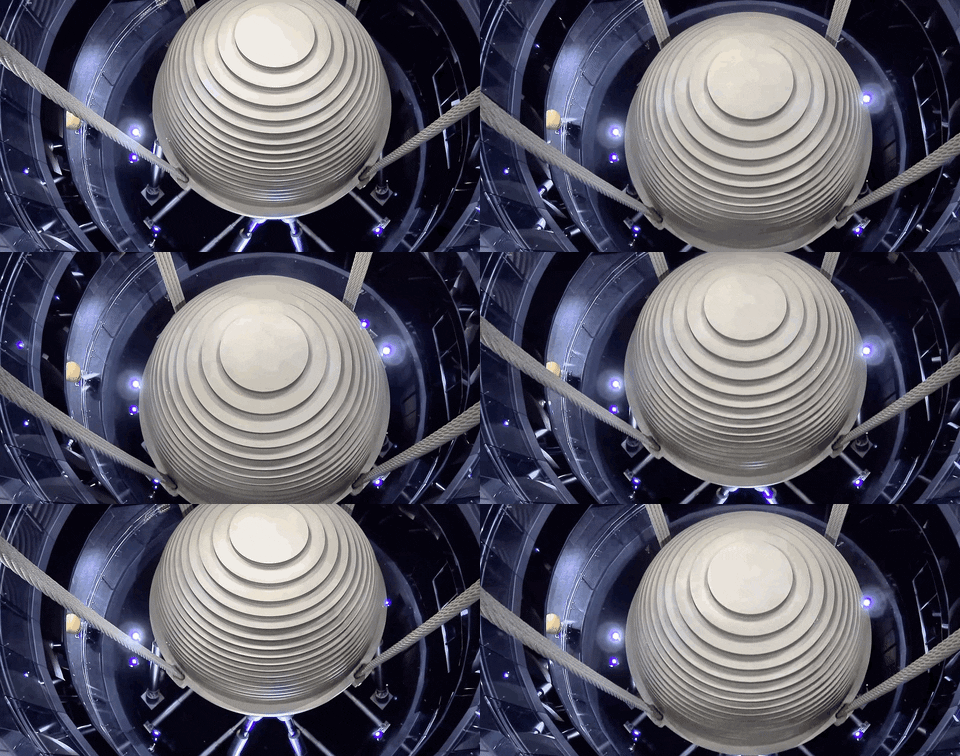
To minimise the swaying, developers are putting giant counterweights called tuned mass dampers (TMDs) near the top of skyscrapers. A TMD is a giant ball made of steel or concrete that weighs anywhere from 300 to 800 tons, and it’s usually suspended in the building using springs and pistons.

It looks like this in the Taipei tower in Taiwan:

The dampers in the Taipei tower in Taiwan.

On a windy day, a skyscraper over 1,000 feet tall might sway a couple of inches, according to Rowan Williams Davies and Irwin, consulting engineers. Usually that movement is imperceptible, but on a particularly breezy day, you can feel the building moving. The sway of some buildings is enough to make the tenants feel sea sick.

If the wind blows from the right, the damper swings from the left to balance out the push.

None animated GIF

via GIPHY

But dampers don’t really have anything to do with the structural integrity of a building, according to engineers. They’re not, say, stopping the building from falling over. They’re actually only put in place to keep the building’s occupants from feeling unnerved or getting seasick.

What about typhoon-force winds?

Back in 2004, the 1,667-foot tall Taipei 101 tower was the tallest building in the world. It’s since been eclipsed by other buildings:

It may not be the tallest building anymore, but on Saturday Aug. 8, Taipei 101 set a different record. Or rather its damper set a record when it swung a full meter to counteract 100 mph winds from Typhoon Soudelor, according to Popular Mechanics. One gust clocked in at 145 mph.

A meter might not sound that impressive. Here’s a few things to keep in mind while you watch the video footage:

1. This damper is 18 feet across.

2. It weighs 728 tons.

3. Not all of the movement in the video is from the damper itself. Some of it is the building itselfmoving around the damper.

Skyscraper physics

The New York Times has a great graphic explaining how dampers work. Really though, it all boils down to simple physics.

A skyscraper is like a giant tuning fork. If you give it a good whack, like with a gust of wind or an earthquake, it will start vibrating at a set frequency. So when the tower is hit with a powerful gust of wind, the damper swings with the same frequency as the building, but in the opposite direction. It doesn’t completely stamp out the vibration, but it does keep it under control.

There’s a fairly simple equation that physicists and engineers can use to calculate how big to build the damper for each skyscraper.

Another way to think of it is to use the equation “force equals mass times acceleration”. If some force acts on a skyscraper — like wind — the occupants are going to feel some kind of acceleration. That acceleration is what causes some people to feel woozy, according to The Constructor.

It’s not so much the displacement of the building itself that contractors are concerned about — its the rate of acceleration and deceleration of the building’s sway. It’s sort of like riding in a subway car. As the train barrels down the track, you don’t feel very much. But the second the brakes kick in, you feel a jerk.

These super-tall skyscrapers are a testament to modern engineering, but lets hope that Taipei 101 record isn’t broken any time soon.

Source…..Kelly  Dickerson….www.businessinsider.com and http://www.youtube.com

Natarajan

” Why are People Poor …” ?

But what happens when the interviewer asks some weird questions? The questions that make a student go WTF! Maybe they just check our presence of mind, but whatever be the reason, at the end of the day, those are IIM interview questions and the student is expected to answer them with a presence of mind.

So, without much further ado, let’s have a look at these quirky Q&A sessions.


Interviewer 1: Why are people poor?

Student: Not very sure, sir. Please! Any options?

Interviewer 2: Oh! But you should know. It’s because they don’t have money. It’s simple.

Student:… Apologies Sirs, but isn’t this the ‘meaning’ of being ‘poor’, and not the reason?

Interviewer 2: (zapped)

Interviewer 1 (in his excitement to go one-up): “… He’s poor because he’s not earning. Hence, no money.”

Student: “… apologies Sirs again. But is he poor because he is not earning out of laziness, or he is working and not being paid, or, is he ready to work and earn, but is not getting a job.”

Interviewer 1: Have you studied Economics in your B.Tech?

Student: “No, sir our canteen supervisor in the hostel is really poor, and he has a Master’s in Mathematics”

Result: Selected!

Credit: Sanjeeva Shukla

……………………….

Panelist: You seem to know a lot of math. What do you like in it?

Student: I like numbers, Sir.

Panelist: Ok. So tell us, what is the absolute truth?

Student: (Wow, what? Where did that come from and how is that related to numbers.) How would I know, Sir? I’m just a human being. They say God knows the absolute truth.

Panelist: Ok then, define God mathematically.

Student: Sir, God is the One. (They smile).

Result: Selected.

Credit: Nishant Agarwal

…………………..

Panelist: Spell the word COW in thirteen letters?

Candidate: Well! Caaaaouuuuuuu.

Panelist: (laughs) It’s “SEE O DOUBLE YOU”

Credit: Ulhas Sakhare

……………………….


Panelist 1 (male): What do you know about IIM Calcutta?

Student: *Gave a standard well-versed answer mostly from the content on their website*

Panelist 2 (female): Okay, tell me what do you know about IIM Bangalore?

Student (taken by surprise): Annn.. Ma’am, it is one of the best B-schools in the country. (Clueless about what more should I add)

Panelist 2: So you know more about Calcutta than Bangalore? Didn’t you get a call from IIM Bangalore?

Student: Ma’am, I do have the call from IIM Bangalore, but its interview is two weeks later. (With a poker face)

Result: Selected.

Credit: Quora

……………………

Panelist 1: So tell me Abhishek why do you have ‘1993’ in your email-id?

Student: Sir, I needed a bit more professional id as compared to my previous one.

Panelist2: So what was your previous id?

Student: Sir, it was abhishek.perfect@yahoo.com <smiling like an idiot>

<Both laughing at me>
Panelist 2: So you think you are not perfect anymore?

*Suddenly the pseudo-intellectual philosopher in me wakes up*

Student: Sir, even the air around me is not ideal, how can I be perfect.

Result: Selected.

Credit: Abhishek Rao

……………………

Source…..www.storypick.com

natarajan