This is Egypt’s Only Waterfalls, And its Man-Made…

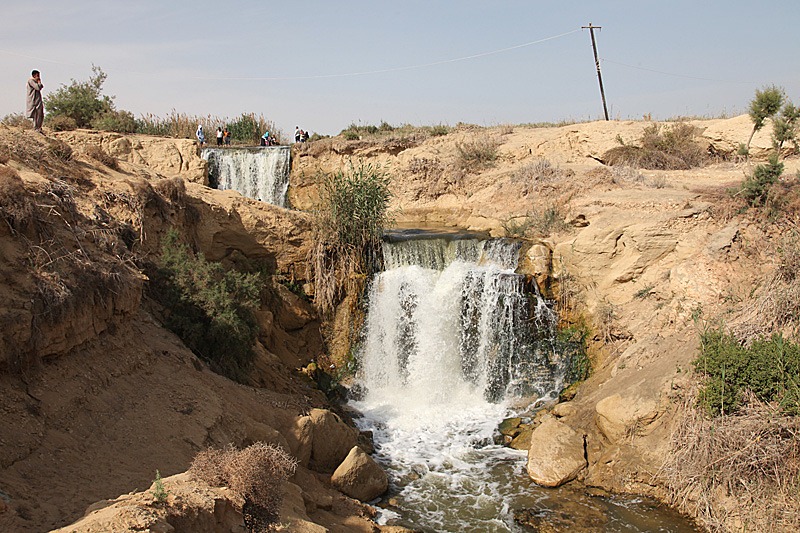
The valley of Wadi El-Rayan, 65 km southwest of Fayoum city, in Egypt, is home to two large artificial lakes created to divert excess agricultural drainage water from Fayoum oasis. It is also home to the country’s only waterfalls.

The Fayoum oasis originally drained into Lake Qarun in the north. But the lake can take only a certain volume of drainage water. Anything over this capacity and the lake level would rise and flood the surrounding land, often doing irreparable damage because of the waters high salt content. This means that the amount of water that can be used in the Fayoum is limited by the region’s maximum drainage capacity. Consequently, until recently water-intensive crops such as rice and reeds could be grown only in very small quantities. Furthermore, no new land could be reclaimed without causing swamping of existing farmland near Lake Qarun. There was a pressing need to find an alternative drainage basin, and the large depression of Wadi El Rayan was found to be suitable.
wadi-el-rayan-waterfalls-6

Photo credit: Roland Unger/Wikimedia

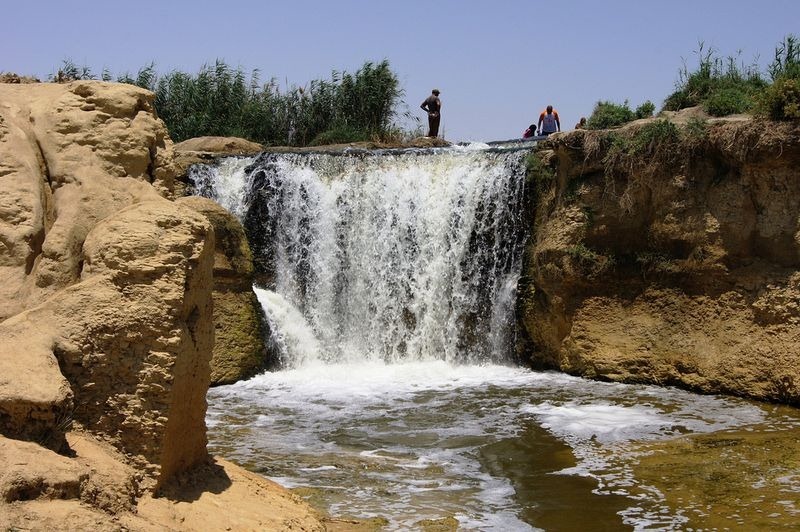
In 1974, a 9-kilometers open channel and an 8-kilometers tunnel were cut through the desert from the western side of the Fayoum depression to the large, dry depression of Wadi El Rayan. Drainage water now flows into Wadi El Rayan forming two large lakes. Water first reaches the northern lake and when it’s overwhelmed, a stream flows towards a deeper part of the depression, where another lake is formed. As the course of the stream was eroded, natural rocks were exposed and waterfalls formed over them.

There are several cascades on the stream, none of them taller than 2 to 4 meters. Yet, they have attracted considerable attention among the local Egyptians, as many have never seen waterfalls before. The waterfalls have also been featured in many Egyptian pop videos and films. The falls, however, will not last for ever as the level of the lower lake is continually rising and the falls will exist only until the expanding surface area allows a rate of evaporation equal to the amount of water flowing into it.

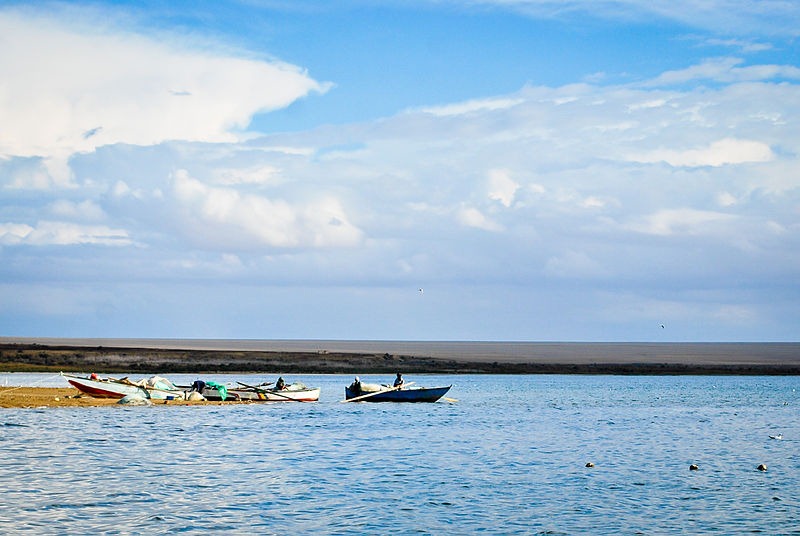
The shorelines of the lakes are densely vegetated making them perfect wintering habitats for migrating birds and breeding spot for many fishes. The area is now a nature reserve and is home to the world’s sole population of Slender-horned Gazelles, as well as 8 other mammal species and 13 species of bird.
wadi-el-rayan-lake

Wadi El-Rayan Lake. Photo credit: Mohammed Moussa/Wikimedia
 

wadi-el-rayan-waterfalls-3

wadi-el-rayan-waterfalls-1

An Egyptian man jumps in the water of Wadi El-Rayan Waterfalls in Fayoum, Egypt, on March 6, 2015. Photo credit: Xinhua/Ahmed Gomaa

Source…..www.amusing planet.com

natarajan

” Ravichandran Ashwin Rewrites Records….” !!!

Ravichandran Ashwin Rewrites Records in Nagpur Test Against South Africa

Ravichandran Ashwin picked up his 15th five-wicket haul and his fourth ten-wicket haul in just his 31st Test to help India clinch a series win over South Africa after 11 years.

Ravichandran Ashwin is currently the leading wicket-taker in 2015 with 55 wickets in just eight Tests so far.

Ravichandran Ashwin created several records during India’s magnificent victory in Nagpur against South Africa. His magnificent haul of 12/98 helped India achieve their first series win against South Africa after 11 years and it also ended the Proteas’ nine-year unbeaten series run overseas. Here is a look at other statistical achievements by Ashwin in the Nagpur Test. (Ravichandran Ashwin is the World’s Best Spinner: Sunil Gavaskar)

– Ashwin became the seventh Indian bowler to take more than 50 Test wickets in the calendar year. Harbhajan Singh and Anil Kumble have taken 50 wickets in a year three times. (No Excuses Please, India Say After South Africa Thrashing)

– Ashwin went past 50 wickets in only his eighth Test this year. This is the fastest ever by an Indian spinner in Tests, breaking the mark of nine Tests set by Vinoo Mankad in 1952. (Ashwin is Becoming World’s Envy)

– Ashwin became the first Indian bowler after seven years to take 50 wickets in the year. Harbhajan was the last Indian bowler to go past this landmark in 2008.

– He is also the fourth Indian bowler after Subhash Gupte, Harbhajan and Kumble to take six five-wicket hauls in a single year. Gupte achieved this feat in 1955 while Harbhajan and Kumble did it in 2001 and 2004 respectively.

– Ashwin is the 22nd bowler overall to take six five-wicket hauls in the calendar year. Overall, the bowlers who have the most five-wicket hauls in a year are Malcolm Marshall and Muttiah Muralitharan with nine hauls.

– The Tamil Nadu offspinner does wonders as an opener. He is only the third bowler in Test history to take eight five-wicket hauls while opening the bowling. The other two bowlers are England’s Colin Blythe and Australia’s Hugh Trumble.

-With Inputs from HR Gopala Krishna-

Source…..www.ndtv.com

Natarajan

Image of the Day….A Brighter Moon…

Dione and Enceladus

Although Dione (near) and Enceladus (far) are composed of nearly the same materials, Enceladus has a considerably higher reflectivity than Dione. As a result, it appears brighter against the dark night sky.

The surface of Enceladus (313 miles or 504 kilometers across) endures a constant rain of ice grains from its south polar jets. As a result, its surface is more like fresh, bright, snow than Dione’s (698 miles or 1123 kilometers across) older, weathered surface. As clean, fresh surfaces are left exposed in space, they slowly gather dust and radiation damage and darken in a process known as “space weathering.”

This view looks toward the leading hemisphere of Enceladus. North on Enceladus is up and rotated 1 degree to the right. The image was taken in visible light with the Cassini spacecraft narrow-angle camera on Sept. 8, 2015.

The view was acquired at a distance of approximately 52,000 miles (83,000 kilometers) from Dione. Image scale is 1,600 feet (500 meters) per pixel. The distance from Enceladus was 228,000 miles (364,000 kilometers) for an image scale of 1.4 miles (2.2 kilometers) per pixel.

The Cassini mission is a cooperative project of NASA, ESA (the European Space Agency) and the Italian Space Agency. The Jet Propulsion Laboratory, a division of the California Institute of Technology in Pasadena, manages the mission for NASA’s Science Mission Directorate, Washington. The Cassini orbiter and its two onboard cameras were designed, developed and assembled at JPL. The imaging operations center is based at the Space Science Institute in Boulder, Colorado.

For more information about the Cassini-Huygens mission visit http://saturn.jpl.nasa.gov or http://www.nasa.gov/cassini . The Cassini imaging team homepage is at http://ciclops.org .

Credit: NASA/JPL-Caltech/Space Science Institute

Source…….www.nasa.gov

Natarajan

Image of the Day…”Fingerprints of Water on the Sand.”…..

Water tracks on sandy ground with straight lines of roadways crossing the terrain

NASA astronaut Kjell Lindgren took this photograph on Nov. 11, 2015 from the International Space Station, and shared it with his followers on social media. Lindgren wrote, “The delicate fingerprints of water imprinted on the sand. The #StoryOfWater.” The area photographed is located in Oman, approximately 20 km to the west-northwest of Hamra Al Drooa.

One of the ways research on the space station benefits life on Earth is by supporting water purification efforts worldwide. Drinkable water is vital for human survival. Unfortunately, many people around the world lack access to clean water. Using technology developed for the space station, at-risk areas can gain access to advanced water filtration and purification systems, making a life-saving difference in these communities. Joint collaborations between aid organizations and NASA technology show just how effectively space research can adapt to contribute answers to global problems. The commercialization of this station-related technology has provided aid and disaster relief for communities worldwide.

Image Credit: NASA

Source….www.nasa.gov

Natarajan

Image of the Day….Crescent Pluto …

Pluto, backlit

Crescent Pluto, acquired as New Horizons sped past in July on its way deeper into the Kuiper Belt

Image via New Horizons spacecraft on July 14, 2015.

View larger. | Crescent Pluto. This world is 1,473 miles (2,370 km) wide. Image via NASA / JHU-APL / SWRI/ New Horizons spacecraft.

The New Horizons spacecraft looked back to a crescent Pluto, after sweeping past this world in July, 2015. The sun is behind Pluto in this image. New Horizons acquired the view using the Multispectral Visible Imaging Camera (MVIC) onboard.

Here, Pluto’s ice mountains Norgay Montes and Hillary Montes can be seen rising as high as approximately 11,000 feet (3,500 meters) above Pluto’s surface. The so-called Sputnik Planum within the Tombaugh Regio stretches to the horizon on the right.

The frigid, very thin, cold atmosphere is seen with layers of haze. The average surface temperature of Pluto is minus 367 Fahrenheit (minus 232 Celsius). If our own Earth cooled to the same temperatures, our oceans would freeze almost all the way down and our atmosphere would collapse and freeze into a layer of frozen gasses 35 feet (11 meters) thick.


Bottom line: As New Horizons sped past in July, it looked back to a crescent Pluto.

Source….www.earthsky.org

Natarajan

Scott Kelly on the Second Spacewalk of Expedition 45……

On Nov. 6, 2015, NASA astronauts Scott Kelly and Kjell Lindgren spent 7 hours and 48 minutes working outside the International Space Station on the 190th spacewalk in support of station assembly and maintenance. The astronauts restored the port truss (P6) ammonia cooling system to its original configuration, the main task for the spacewalk. They also returned ammonia to the desired levels in both the prime and back-up systems. The spacewalk was the second for both astronauts. Crew members have now spent a total of 1,192 hours and 4 minutes working outside the orbital laboratory.

At about an hour after the 6:22 a.m. EST start of the spacewalk, astronaut Kjell Lindgren took this photograph of Scott Kelly at work, with the station’s solar arrays visible in the background.

Image Credit: NASA

Source……www.nasa.gov
Natarajan

Looking Back: International Space Station at the Start of Expedition 1….

International Space Station in December 2000 with modules and solar arrays visible

On Nov. 2, 2000, the Expedition 1 crew — Commander William M. (Bill) Shepherd of NASA and Flight Engineer Sergei Krikalev and Soyuz Commander Yuri Gidzenko of Roscosmos — arrived at the International Space Station, marking the start of an uninterrupted human presence on the orbiting laboratory. Their Soyuz capsule made contact with the aft docking port of the station’s Zvezda Service Module at 3:21 a.m. CST while the two spacecraft were flying over the central portion of Kazakhstan. A little over one hour later at 4:23 a.m., the hatch leading into the Zvezda’s living quarters was opened, signifying the start of human occupancy of the international complex. Gidzenko and Krikalev floated into Zvezda first, at the request of the commander. Once inside the station, the crew members continued the work begun by space shuttle crews and ground controllers to bring the station to life.

Fifteen years later, 45 crewed expeditions (so far) — more than 220 people from 17 countries — have visited the station, constructed over more than 115 space flights conducted on five different types of launch vehicles. The station now measures 357 feet end-to-end and provides more livable room than a conventional six bedroom house. 22 scientific investigations were conducted during Expedition 1, while a total of 191 scientific investigations will be conducted during Expeditions 45 and 46. To date, more than 1,200 scientific results publications have been produced based on over 1,760 research investigations on the orbiting laboratory.

This Dec. 2, 2000, photograph shows the configuration of the space station at the start of Expedition 1 including the Zarya Control Module, Unity Node, Zvezda Service Module and Z1-Truss. It was taken by STS-97 crewmembers aboard shuttle Endeavour during approach to dock with the station on a mission to deliver and connect the first set of U.S.-provided solar arrays, prepare a docking port for arrival of the U.S. Laboratory Destiny and perform additional station assembly tasks. The Expedition 1 crew spent four months living and working on the station and returned to Earth aboard shuttle Discoveryon March 21, 2001.

Image Credit: NASA

Source…www.nasa.gov

Image for the Day… Spacewalk Selfie …!!!

Astronaut photograph reflected in space helmet visor during spacewalk

Expedition 45 Commander Scott Kelly took this photograph during a spacewalk on Oct. 28, 2015. Sharing the image on social media, Kelly wrote, “#SpaceWalkSelfie Back on the grid! Great first spacewalk yesterday. Now on to the next one next week. #YearInSpace”

This was the first spacewalk for both Kelly and Flight Engineer Kjell Lindgren; the two will venture outside the International Space Station for the second time on Friday, Nov. 6. The two spacewalks were scheduled around milestones in space. Today, Oct. 29, Kelly becomes the U.S. astronaut who has lived in space the longest during a single U.S. spaceflight, and on Monday, Nov. 2, the crew celebrates the 15th year of a continuous human presence in space aboard the station.

During the 7-hour and 16-minute spacewalk, Kelly and Lindgren applied a thermal cover on the Alpha Magnetic Spectrometer; applied grease to a number of components in one of the latching ends of the Canadarm2 robotic arm; and began work to rig power and data system cables for the future installation of a docking port to the station that will be used for the arrival of the Boeing Starliner CST-100 and SpaceX Crew Dragon spacecraft.

Image Credit: NASA

Source…..www.nasa.gov

natarajan

Scott Kelly Prepares For a Spacewalk….

Astronaut Scott Kelly in spacesuit during fit check inside space station

Expedition 45 Commander Scott Kelly tries on his spacesuit inside the U.S. Quest airlock of the International Space Station. Kelly and Flight Engineer Kjell Lindgren will venture outside the station for a pair of spacewalks, the first of their careers, on Wednesday, Oct. 28 and Friday, Nov. 6.

The Oct. 28 spacewalk is set to last six hours and 30 minutes after Kelly and Lindgren set their spacesuits to battery power. It will be the 32nd U.S. spacewalk, and will focus on station upgrades and maintenance tasks, including installing a thermal cover on the Alpha Magnetic Spectrometer, which is a state-of-the-art particle physics detector that has been attached to the station since 2011. NASA TV coverage will begin at 6:30 a.m. EDT.

Sharing this photograph of the spacesuit fit check with his social media followers, Kelly wrote, “Day 212 Getting my game face on for #spacewalk Thanks for sticking w me #GoodNight from @space_station! #YearInSpace”

Image Credit: NASA

Source…..www.nasa.gov

Natarajan

There’s a hidden message written on the back of this family portrait that an Apollo astronaut left on the moon…

On April 20, 1972, Apollo 16 astronaut Charles Duke took his first steps on the moon. He was 36 at the time and is the youngest human in history to ever walk on the lunar surface.

But that’s not the only achievement of Duke’s that lives on in American history.

NASA John W. Young    Astronaut Charles M. Duke Jr., Lunar Module pilot of the Apollo 16 mission, is photographed collecting lunar samples at Station no. 1 during the first Apollo 16 extravehicular activity at the Descartes landing site.

While he was on the moon, he snapped this family portrait of him, his two sons, and his wife, which remains on the moon to this day.

DUKE

On the back of the photo Duke wrote:

“This is the family of astronaut Charlie Duke from planet Earth who landed on the moon on April 20, 1972.”

Here’s a clearer copy of the photo Duke gave us. On the far left is his oldest son Charles Duke III who had just turned seven. In the front in red is his youngest son, Thomas Duke, who was five. Duke and his wife, Dorothy Meade Claiborne, are in the background:

Portrait

Courtesy of Charles Duke

“I’d always planned to leave it on the moon,” Duke told Business Insider. “So when I dropped it, it was just to show the kids that I really did leave it on the moon.”

The photo has since been featured in numerous popular photo books and is a great example of the “human side of space exploration,” Duke said.

When Duke was training to be an Apollo astronaut, he spent most of his time in Florida. But his family was stationed in Houston. As a result, the children didn’t get to see much of their father during that time.

“So, just to get the kids excited about what dad was going to do, I said ‘Would y’all like to go to the moon with me?’” Duke said. “We can take a picture of the family and so the whole family can go to the moon.”

More than 43 years have passed since Duke walked on the moon. And while the footprints that he made in the lunar soil are relatively unchanged, Duke suspects the photo is not in very good shape at this point.

“After 43 years, the temperature of the moon every month goes up to 400 degrees [Fahrenheit] in our landing area and at night it drops almost absolute zero,” Duke said. “Shrink wrap doesn’t turn out too well in those temperatures. It looked OK when I dropped it, but I never looked at it again and I would imagine it’s all faded out by now.”

Unfortunately, there is no way to determine just how faded the photo is because it’s too small for lunar satellites to spot.

Regardless, the photos “was very meaningful for the family,” Duke said. In the end, that’s all that matters, right?

Source…..JESSICA ORWIG……..www.businessinsider.com.au

Natarajan