Image of the Day…Frozen Sea Waves…. !!!

View larger. | Slushy waves on a Nantucket beach, February 20, 2015.  Photo by Jonathan Nimerfrosh.

View larger. | Slushy waves on a Nantucket beach, February 20, 2015. See the complete collection here. Photos byJonathan Nimerfroh.

Sure, the ocean freezes. But this photo of partly frozen waves – caught by photographer and surfer Jonathan Nimerfroh – fascinated even the experts

As you well know if you live there, the eastern United States has been in a deep freeze throughout February, 2015. Wave after wave of ice and snowstorms have hit the region, and NASA says that hundreds (maybe thousands) of records have been set for daily low temperatures. Now, from a photographer and surfer in Nantucket, Jonathan Nimerfroh, we have this amazing photo from February 20, 2015 of an ocean wave, just before it freezes solid. He calls it a slurpee wave.

The New York Times has a great article about this photo and these slow-moving waves of slush. Jonathan’s photo has also been on the Weather Channel and other places (I first saw it on Facebook; thanks, Beverly Spicer!). Nimerfroh told the New York Times:

I just noticed a really bizarre horizon. The snow was up to my knees, getting to the water. I saw these crazy half-frozen waves. Usually on a summer day you can hear the waves crashing, but it was absolutely silent. It was like I had earplugs in my ears.

Enjoying EarthSky so far? Sign up for our free daily newsletter today!

Of course, the ocean does freeze. Salty sea water has a lower freezing point than the ice in your home freezer, not 32 degrees F but instead about 28.4 degrees F. And it was colder than that on that day in Nantucket, somewhere around 10 degrees F. Still, these waves are something very special, and even experts commented that they had not seen them before. Helen Fricker, a glaciologist at the Scripps Institution of Oceanography in La Jolla, California, who studies the dynamics of ice flows in Antarctica, told the New York Times that a full scientific explanation was “outside her expertise.” Erin Pettit, a glaciologist at the University of Alaska, Fairbanks, added that waves in Alaska tend to break up sea ice and said:

I have never seen frozen waves like this.

Nimerfroh said he returned the following day to the same beach. That day it was a few degrees colder still and the water had completely frozen. He said:

Nothing was moving. There were no waves anymore.

Shop the complete collection of Nantucket Slurpee Wave photos at Jonathan Nimerfroh’s website.

Bottom line: Wave caught in the act of freezing at a Nantucket beach, February 2015, by Jonathan Nimerfroh.

SOURCE::: http://www.earthskynews.org

Natarajan


Message For the Day…” The Sense of ‘Mine’ is the bond of Deluding Attachment…’

A bird in flight in the sky needs two wings; a person walking needs two legs; an aspirant eager to attain liberation needs two qualities: renunciation and wisdom — renunciation of worldly desires and wisdom to become aware of the Atma. When a bird has only one wing, it can’t rise up into the sky, can it? In the same manner, if one has only renunciation or only wisdom, one cannot attain the Divine. The sense of ‘mine’ is the bond of deluding attachment. How long can one cling to what one fondles as mine? Someday you must give up everything and leave, alone and empty handed. This is the inescapable destiny. Hence give up as quickly as possible assumed relationships and artificial attachments through rigorous analysis of their nature. Attachment breeds fear and egotism. The wise will never bow to the fancies of objective desire. Constantly stick to the everlasting truth and adhere to the immortal virtues that the Atma represents.

Sathya Sai Baba

” Famous Eight or F8 Walk Technique Tips …. “

The Famous 8 (Also called as “F8″) Walk Technique

Highlights :

  • This does not need any special preparation or exercise equipment
  • It is highly beneficial when done on an empty stomach early in the morning before breakfast.
  • This is an ancient yogic fitness regime which was secretly guarded for centuries by Rishis (Saints / Sages)

Benefits :

  • It helps us avoid and treat several chronic diseases like Obesity, Diabetes, Heart attack, Kidney related disorders and diseases, High Blood Pressure, High Cholesterol and many more
  • It is recommended to do the practice everyday for at least 21 days to get the said benefits

Duration Timing of practice :

  • It is beneficial if the F8 exercise is done for 15 minutes daily before breakfast on an empty stomach
  • It is recommended to do this for about 15 minutes between 5am – 6am ( or ) 5pm – 6pm everyday for at least 21 days continuously for achieving the desired benefits

Who can do it:

  • Any adult person between the ages of 18 and 75

How to do:

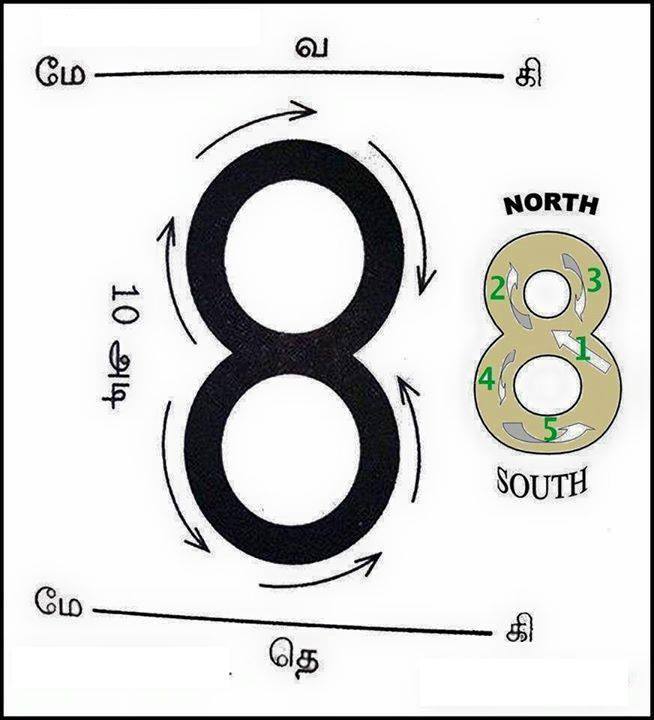
  • Mark an Eight (“8″) shaped pattern on the floor with 6 feet width and 8-12 feet in length North to South [See image below]
  • Start at the position marked as “1″ in the below picture and follow the “8″ pattern
  • Proceed from start position (“1″) and continue in the sequence 2, 3, 4, 5 and return to 1
  • One complete round is generally counted when you come back to the start position (“1″)
  • When you walk, observe your breath and go with the flow – Don’t walk too fast or too sloppy

SOURCE:::: input from a friend of mine

Natarajan

Arunima Sinha ….On the Top of the World…. Hats off To This Brave Lady …

http://inktalks.com

You Might Have watched a plenty of Motivational and Inspirational Videos and Talks …

But this Talk by Arunima Sinha  on her goal and experience is totally on a different platform.

My request to you  is to watch this video  and Listen to her talk … Also share this Video Talk with your Kids and friends …You need not listen to any Gurus …both Religious and Management… after listening to her.

HATS OF TO THIS COURAGEOUS LADY …

Natarajan

 
In April 2011, Arunima Sinha, a national level volleyball player, was thrown out of a running train by robbers who were after her gold chain. Her left leg crushed by the passing trains had to be amputated. This did not stop her from dreaming the impossible, on May 21st, 2013, Arunima summited Mount Everest. Watch as she takes us along on her journey in this passionate talk.

Please Note: This talk is available with English subtitles. Please enable YouTube Captions if the subtitles are not appearing.

ABOUT INK: INKtalks are personal narratives that get straight to the heart of issues in 18 minutes or less. We are committed to capturing and sharing breakthrough ideas, inspiring stories and surprising perspectives–for free!

Watch an INKtalk and meet the people who are designing the future–now.

Connect with us:
http://inktalks.com
http://facebook.com/inktalks
http://twitter.com/inktalks

ABOUT ARUNIMA SINHA:
Arunima is a former national level volleyball player who was thrown off a moving train in 2011. In order to save her life, the doctors had to amputate part of her left leg. In light of this event, Arunima became inspired by Yuvarj Singh, an international cricket player who successfully won his battle with cancer. As such, she was determined to climb Mount Everest. In 2013, Arunima became the first female amputee (and the first Indian amputee) to make the climb.

Arunima then went on to be the first female amputee to climb Mt. Kilamanjaro in Africa and Mt. Elbrus in Europe. She has been honoured with numerous awards and recognitions. Currently she is busy planning to open a sports academy for underprivileged and physically disabled children.

SOURCE::::: http://www.You Tube.com and ink talks.com

Natarajan

Message For the Day…” God is Always Waiting Outside Your Closed Door …”

A time may come when you become tired and weak. Then you should pray thus: “Lord, things are beyond my capacity. I am finding it difficult to do any effort. Please give me strength!” At first, God stands at a distance, watching your efforts, like the invigilator teacher watching students write answers during examination. Then when you shed attachment to sensual pleasures (bhoga) and take to good deeds and selfless service, God comes nearer to you. Like the Sun, He waits outside your closed door. Like a servant who knows their master’s rights and their own limitations, God doesn’t bang the door but simply waits outside. When one opens the door just a little, like the Sun, God rushes in and promptly drives darkness out from within. So all you need is the discrimination (viveka) to pray and the spiritual wisdom (jnana) to remember Him.

Sathya Sai Baba

” MARS once had More Water Than Earth”s Arctic Ocean….”

NASA Research Suggests Mars Once Had More Water than Earth’s Arctic Ocean

Mars once held more water than Earth's Arctic Ocean

NASA scientists have determined that a primitive ocean on Mars held more water than Earth’s Arctic Ocean and that the Red Planet has lost 87 percent of that water to space.
Image Credit:
NASA/GSFC

A primitive ocean on Mars held more water than Earth’s Arctic Ocean, according to NASA scientists who, using ground-based observatories, measured water signatures in the Red Planet’s atmosphere.

Scientists have been searching for answers to why this vast water supply left the surface. Details of the observations and computations appear in Thursday’s edition of Science magazine.

“Our study provides a solid estimate of how much water Mars once had, by determining how much water was lost to space,” said Geronimo Villanueva, a scientist at NASA’s Goddard Space Flight Center in Greenbelt, Maryland, and lead author of the new paper. “With this work, we can better understand the history of water on Mars.”

Perhaps about 4.3 billion years ago, Mars would have had enough water to cover its entire surface in a liquid layer about 450 feet (137 meters) deep. More likely, the water would have formed an ocean occupying almost half of Mars’ northern hemisphere, in some regions reaching depths greater than a mile (1.6 kilometers).

The new estimate is based on detailed observations made at the European Southern Observatory’s Very Large Telescope in Chile, and the W.M. Keck Observatory and NASA Infrared Telescope Facility in Hawaii. With these powerful instruments, the researchers distinguished the chemical signatures of two slightly different forms of water in Mars’ atmosphere. One is the familiar H2O. The other is HDO, a naturally occurring variation in which one hydrogen is replaced by a heavier form, called deuterium.

By comparing the ratio of HDO to H2O in water on Mars today and comparing it with the ratio in water trapped in a Mars meteorite dating from about 4.5 billion years ago, scientists can measure the subsequent atmospheric changes and determine how much water has escaped into space.

The team mapped H2O and HDO levels several times over nearly six years, which is equal to approximately three Martian years. The resulting data produced global snapshots of each compound, as well as their ratio. These first-of-their-kind maps reveal regional variations called microclimates and seasonal changes, even though modern Mars is essentially a desert.

The research team was especially interested in regions near Mars’ north and south poles, because the polar ice caps hold the planet’s largest known water reservoir. The water stored there is thought to capture the evolution of Mars’ water during the wet Noachian period, which ended about 3.7 billion years ago, to the present.

From the measurements of atmospheric water in the near-polar region, the researchers determined the enrichment, or relative amounts of the two types of water, in the planet’s permanent ice caps. The enrichment of the ice caps told them how much water Mars must have lost – a volume 6.5 times larger than the volume in the polar caps now. That means the volume of Mars’ early ocean must have been at least 20 million cubic kilometers (5 million cubic miles).

Based on the surface of Mars today, a likely location for this water would be in the Northern Plains, considered a good candidate because of the low-lying ground. An ancient ocean there would have covered 19 percent of the planet’s surface. By comparison, the Atlantic Ocean occupies 17 percent of Earth’s surface.

“With Mars losing that much water, the planet was very likely wet for a longer period of time than was previously thought, suggesting it might have been habitable for longer,” said Michael Mumma, a senior scientist at Goddard and the second author on the paper.

NASA is studying Mars with a host of spacecraft and rovers under the agency’s Mars Exploration Program, including the Opportunity and Curiosity rovers, Odyssey and Mars Reconnaissance Orbiter spacecraft, and the MAVEN orbiter, which arrived at the Red Planet in September 2014 to study the planet’s upper atmosphere.

In 2016, a Mars lander mission called InSight will launch to take a first look into the deep interior of Mars. The agency also is participating in ESA’s (European Space Agency) 2016 and 2018 ExoMars missions, including providing telecommunication radios to ESA’s 2016 orbiter and a critical element of the astrobiology instrument on the 2018 ExoMars rover. NASA’s next rover, heading to Mars in 2020, will carry instruments to conduct unprecedented science and exploration technology investigations on the Red Planet.

NASA’s Mars Exploration Program seeks to characterize and understand Mars as a dynamic system, including its present and past environment, climate cycles, geology and biological potential. In parallel, NASA is developing the human spaceflight capabilities needed for future round-trip missions to Mars in the 2030s.

To view a video of this finding, visit:

http://youtu.be/WH8kHncLZwM 

SOURCE:::::;www.nasa.gov

Natarajan

Image of the Day…. Smallest Full Moon On March 5 2015…

Curtis Beaird in south Georgia captured this shot.

EarthSky Facebook friend Curtis Beaird in south Georgia captured the shot above.

Tonight’s full moon is the smallest full moon of the year. We’ve heard it called the micro-moon or mini-moon. This March 5, 2015 full moon lies about 50,000 kilometers (30,000 miles) farther away from Earth than will the year’s closest full moon – the full supermoon and Northern Hemisphere’s Harvest Moon – on September 28. The March 5 moon is the year’s farthest full moon because full moon and lunar apogee – the moon’s farthest point in its monthly orbit – both fall on the same date.

Every year has a closest full moon, of course. The mini-moon returns about one month and 18 days later with each passing year, meaning that, in 2016, the year’s smallest full moon will come on April 22. In 2017, it’ll come June 9. In 2018, the year’s smallest full moon will come on July 27. And so on, no doubt until our earthly calendars are long forgotten.

By the way, as an aside, mark your calendar for that September 28, 2015 full moon – the Harvest moon – and closest full moon of this year. It’ll also stage a total eclipse of the moon, which some will call a Blood Moon eclipse. It concludes a series of four straight total lunar eclipses that started on April 15, 2014.

The crest of the moon’s full phase comes on March 5, 2015 at precisely 18:05 Universal Time.

Although the full moon occurs at the same instant all around the world, our clocks read differently in different time zones. In the United States, the moon turns exactly full onThursday, March 5, at 1:05 p.m. EST, 12:05 p.m. CST, 11:05 a.m. MST or 10:05 a.m. PST. So the Americas won’t see the moon at the instant it turns full because it happens during the daytime hours, when the moon is below the horizon and under our feet.

The moon looks full for several days around full moon.  William Vann caught this rising almost-full moon on March 4, 2015.

The moon looks full for several days around full moon. William Vann submitted this shot. It’s the rising almost-full moon on March 4, 2015.

No matter where you live worldwide, look for the full moon tonight, lighting up the nighttime from Thursday nightfall until dawn Friday. As with any moon at the vicinity of full moon, tonight’s moon rises in the east at early evening, climbs highest in the sky around midnight and sets in the west in the vicinity of sunrise.

In North America, we often call the March full moon by the names of Sap Moon, Crow Moon, Worm Moon or Lenten Moon. But in recent years, we’ve also heard the term mini-moon to describe the year’s smallest full moon. It’s not a name (like Sap Moon). It’s not bound to a particular month or season. It’s just a term to describe the year’s smallest moon.

What is a mini-moon or micro-moon? Like most astronomers, we at EarthSky have always referred to the year’s smallest full moon as an apogee full moon. The terms mini-moon andmicro-moon stem from popular culture. They roll off the tongue more easily than apogee full moon. As some indication of the appellation’s growing popularity, we’ve found that theNASA Astronomy Photo of the Day and timeanddate.org sites both like to call the smallest full moon a micro-moon.

Billie C. Barb caught this shot of the rising moon on March 4, 2015 from the state of Washington, saying it was

Billie C. Barb submitted this photo of the rising moon on March 4, 2015 from the state of Washington, saying it was “. . . a love affair between the moon and the evergreens.”

Bottom line: The micro-moon or mini-moon – smallest full moon of 2015 – comes on March 5, 2015 It lies about 50,000 kilometers (30,000 miles) farther away from Earth than will the full moon supermoon of September 28, 2015.

SOURCE:::: http://www.earhskynews.org

Natarajan

Message For the Day…” One has to Conquer the sense of Me , Mine and the Emotions of Lust and Anger …”

Desire and bondage to the objects desired and the plans to secure them are attributes of the individualised selves, not of the Self or Atma resident in the body. The sense of me and mine and the emotions of lust and anger originate in the body-mind complex. Only when this complex is conquered and outgrown can true virtue emanate and manifest. The sense of ‘doer’ and ‘enjoyer’, of ‘agentship’, might appear to affect the Atma, but they are not part of the genuine nature of the Atma. Things get mirrored and produce images, but the mirror is not tarnished or even affected thereby. It remains as clear as it was. So too, a virtuous person might be subjected to some contaminating activities due to a backlog of acts in previous lives, but they cannot obstruct the person’s present nature or activities. The virtuous person has these genuine, basic attributes: purity, serenity, joy and is ever cheerful.

Sathya Sai Baba

HolikaDahan and The Stories Related to the Festival….” Victory of Good Over Evil “

The festival of Holi is associated with different mythological and spiritual stories. Out of the many tales, the most prominent is that of a devotee – Prahlad, his father Hiranyakashyap and Hiranyakashyap’s sister Holika. This story behind holika dahan is a testament to the power of bhakti (devotion).

King Hiranyakashyap worshiped Lord Brahma for years and, with penance he was able to impress him. Lord Brahma granted wishes of the king which were:

– King Hiranyakashyap cannot be killed by human being or an animal

– He will not die either in his home or outside the home

– He will not die in the day or at night

– He will not die either by astra or shastra (weapons)

– King Hiranyakashyap will not die either on land or in the sea or in the air

With such blessings the king had become invincible and wanted people in his kingdom to preach him as God. Everyone did except King Hiranyakashyap’s son Prahlad who preached Lord Vishnu. Offended by his son’s disobedience, King Hiranyakashyap decided to kill Prahlad and made several attempts too. All his attempts went in vain as Prahlad was saved by Lord Vishnu each time. King Hiranyakashyap then asked Holika, his sister, to kill Prahlad. Holika had a gift – she could not be harmed or burned by fire. Holika’s blessing was in the form of a shawl, which would protect her. As asked by her brother, Holika get herself seated in the flames with Prahlad on her lap to kill him. All the while Prahlad kept chanting Lord Vishnu’s name. As soon as the fire soared, the blessed shawl of Holika fluttered away to cover Prahlad. In this way, Prahlad lived and Holika burnt and died. This is how Holi gets its name from Holika and is celebrated as a festival that marks the victory and power of bhakti (devotion).

In some parts of the country, story of Pootana or Putana is also prevalent as the reason to celebrate Holi. The demon king Kansa (uncle of Krishna) feared getting killed one day by Lord Krishna. Kansa sent Putana to kill Krishna through her poisonous breast milk. She came to baby Krishna and started feeding of her poisonous milk. Lord Krishna, knowing her demonic intentions, sucked out Putana’s life-force while she fed him her milk and she turned into her original giant and scary form. Lord Krishna sucked all her blood until Putana was killed. It is said that it was the night of Holi when Putana was killed and Lord Krishna proved his greatness. Some who view the origin of festivals from seasonal cycles believe that Putana represents winter and her death the cessation and end of winter.

We can follow whichever story behind celebrating Holi but all the stories have the same crux – Victory of good over evil. In 2015, Holika Dahan is being celebrated on 5th March.

HOLI  GREETINGS TO ALL

source::::www.in.lifestyle.yahoo.com

Natarajan


With Home Remedies , Feel at Home … And Relax…

Effective Home Remedies for an Aching Throat

The throat itches, is swollen and burning, and even the simple act of swallowing becomes a scary prospect? You’re not alone! Throat aches are some of the most common phenomenon as we move into the winter season.

Here are 10 ways you can calm that aching throat down without having to go see a doctor:

1. Keep your nasal passageways open
 
Doctors agree that two of the most common causes of throat pain are the buildup of snot and dryness, that occur mostly from breathing too much through the mouth when the nasal passageways are closed.
There are materials that fight nose congestion, especially those containing Pseudofrin (no need to doctor’s note) which will help open the nasal passageways.
Using nose sprays (with a salt water solution) may also help keep those passageways open and breathing easier.
2.  Home remedies to gargle with:
 
Salt Water: This is the old favorite, and you can create it by mixing 1/4 teaspoon of salt in 1 cup of warm water (the warmer the better, within your tolerance levels, don’t let it get cold or loses effectiveness). If you have it at home, this is a good time to add 1 tablespoon of Listerine for its germ killing benefits. This you gargle several times a day, and will help you to rinse and neutralize acids in your throat. You will notice that the burning sensation is going down and the area will usually start to heal. Don’t let up on the gargling.
Raspberry Tea: Pour a glass of boiling water on 2 tea spoons of raspberry dried leaves, soak for 10 minutes and then filter. You can add 1 tea spoon of apple vinegar and/or honey, and then gargle 4 times a day.
Sage Leaves: Mix 1 spoon of sage leaves with 1 cup of boiling water, soak for 10 minutes and then filter.  You can add 1 tea spoon of apple vinegar and/or honey, and then gargle 4 times a day.
Turmeric: For a burning sensation in your throat, mix 1 cup of boiling water with 1/2 a spoon of turmeric (anti inflammation) and 1/2 a spoon of salt. Gargle twice a day. If you hate gargling, you can also mix 1/2 a spoon of turmeric with 1 glass of hot milk, and slowly sip it.
Hot sauce and water: Hot peppers containt a material called capsicum which alleviates pain and reduce inflammation. You can prepare this by grinding a cayenne pepper and adding 5 shakes of the ground material to a cup of hot water. Warning: it WILL burn, buy try to gargle this every 15-30 minutes and see if it does the trick.

When the body is aching and weak, logic dictates that you rest. Same goes for throat ache. It’s very important to save up your energy, to allow the body to fight the infection. If the throat pain doesn’t require medical attention, resting will help cut down the healing time.

3. Horseradish Cocktail
 

A traditional Russian remedy: Mix 1 cup of hot water with 1 table spoon of pure horseradish (or a horseradish root) with 1 table spoon of honey and 1 table spoon of cloves. Sip slowly over the course of an hour.
4. Vinegar

A useful home remedy based on apple vinegar: Take 1 cup of hot water and mix 1 table spoon of honey and 1 table spoon of apple vinegar.  Sip slowly without letting the liquid cool down. Drink as often as possible.
For gargling: Mix 1 spoon of salt, 1/2 a cup of vinegar and 1 cup of hot water. Drink every 15 minutes as needed.
* Be sure to melt the salt in the vinegar before adding the water.
5.  Rest
 
What does resting have to do with a sore throat? A lot. While you rest, your body has more energy to fight the infection in your throat. If you’ve taken some of our home remedies, be sure to rest between to give your body a fighting chance.
6. Citrus Fruits
 
Lemon Juice: Mix 1 cup of hot water with 1 table spoon of honey and 1
table spoon of squeezed lemon juice. Sip slowly.
Lime Juice: Mix 1 table spoon of lime juice with 1 table spoon of honey in hot water, and drink as needed.
7. Steam 
 
An old remedy for an aching throat is a steam tent. Sit with your face over a steaming bowl of hot water and cover your head with a towel to keep the steam in. Add 1-2 drops of Eucalyptus extract for a much greater help.
8. Lozenges
 
Some doctors say that sugar can help reduce throat ache and accompanying cough, but even Lozenges without sugar can calm down an aching throat by keeping your mouth and throat moist, which will make you feel less pain.

9. Popsicles

An ice popsicle can calm down a burning throat. Make sure you aren’t sucking on the popsicle, but cutting small pieces and letting them melt in your mouth.
10. Drink plenty of liquids
This may go without saying, but when you suffer from an aching throat, you should drink at least 8-10 cups of water a day (preferably not cold water). This will keep your throat well oiled, will prevent the dry feeling you get and even aid the fight against inflammation.

SOURCE:::: http://www.ba-bamail.com

Natarajan