Out on 99 …But 100 in Second Innings … !!!


Murali Vijay  India opener Murali Vijay avoids a high ball during Day 1 of the second Test against Australia at the Gabba. Photograph: Cameron Spencer/Getty Images

How often do we see a batsman get out on 99 and score a hundred in his next innings in Test cricket?

Murali Vijay is only the eighth batsman (on the ninth occasion) to do so. Rajneesh Gupta provides the details.

Murali Vijay carried his sublime form into the Brisbane Test. He was unfortunate to miss out on a well-deserved hundred at Adelaide, falling short by just one run. He, however, made amends by reaching the three-figure mark on the opening day of the second Test against Australia at the Gabba on Wednesday.

Scorecard

How often do we see a batsman get out on 99 and score a hundred in his next innings in Test cricket?

Photos from Gabba Test, Day 1

India opener Vijay is only the eighth batsman (on the ninth occasion) to do so.

Interestingly, four of the eight batsmen are Indians, Sourav Ganguly being the only one to do so more than once.

The details:

Batsmen getting out on 99 and scoring a hundred in next innings

Batsman

Score

Opponent Venue

Year

Geoff Boycott (Eng)

99

West Indies Port-of-Spain

1974

112

West Indies Port-of-Spain

1974

Richie Richardson (WI)

99

India Port-of-Spain

1989

156

India Kingston

1989

Michael Slater (Aus)

99

New Zealand Perth

1993

168

New Zealand Hobart

1993

Sourav Ganguly (Ind)

99

Sri Lanka Nagpur

1997

173

Sri Lanka Mumbai WS

1997

Inzamam-ul-Haq (Pak)

99

Sri Lanka Lahore

2002

329

New Zealand Lahore

2002

Sourav Ganguly (Ind)

99

England Nottingham

2002

128

England Leeds

2002

Virender Sehwag (Ind)

99

Sri Lanka Colombo SSC

2010

109

Sri Lanka Colombo PSS

2010

MS Dhoni (Ind)

99

England Nagpur

2012

224

Australia Chennai

2013

Murali Vijay (Ind)

99

Australia Adelaide

2014

144

Australia Brisbane

2014

Note: Ganguly had a sequence of 109, 99 and 173 in 1997.

Inzamam did so against different opponents at the same ground.

Boycott remains the only batsman to score a hundred after a 99 in the same Test. 

Vijay is the first opening batsman from a visiting side to score a hundred on the first day of a Test at Brisbane.

The previous best was a paltry 83 by West Indian Joey Carew in 1968.

His 144 is now the fourth highest by a visiting opening batsman on the first day of any Test in Australia.

Former teammate Virender Sehwag tops the list.

The details: 

Most runs by an opening batsman on first day of a Test vs Australia in Australia

Runs

Batsman For Venue

Season

195

Virender Sehwag Ind Melbourne

 2003-04

185

’Bill’ Barber Eng Sydney

 1965-66

177

Michael Vaughan Eng Adelaide

 2002-03

144

Murali Vijay Ind Brisbane

2014-15

141

Herbert Sutcliffe Eng Melbourne

 1924-25

Vijay is only the sixth Indian batsman to score a hundred on the opening day of a Test in Australia. The complete list:

Most runs by an Indian batsman on opening day of a Test in Australia

Runs

Batsman Venue

 Season

195

Virender Sehwag Melbourne

 2003-04

144

Murali Vijay Brisbane

2014-15

132

Sunil Gavaskar Sydney

 1985-86

124

Sachin Tendulkar Adelaide

 2007-08

116

Krish Srikkanth Sydney

 1985-86

114

Gundappa Viswanath Melbourne

 1980-81

-RAJNEESH GUPTA

Rajneesh Gupta

Natarajan

Interesting Facts about ISRO’s Largest Rocket…GSLV Mark III…!!!

Image: GSLV Mark III on the night ahead of its launch at Sriharikota, near Chennai. Photograph: ISRO/Twitter

The successful launch of GSLV Mark III makes ISRO self reliant in launching heavier communication satellites

The Indian Space Research Organisation on Thursday launched its first experimental suborbital flight.

This was the test launch for ISRO heaviest and upgraded rocket, the GSLV Mark III, which is carrying the Crew Module Atmospheric Re-entry Experiment (CARE).

The flight took off from ISRO’s space station Sriharikota, near Chennai. Here are five things you need to know about the GSLV Mark III mission.

1) After its successful Mars mission, this is ISRO’s next step to put a man in space.

2) The Rs 155 crore mission has twin purposes — the main purpose is to test the rocket’s atmospheric flight stability with around 4-tonne luggage. The second is to study the re-entry characteristics of the crew module called Crew Module Atmospheric Re-entry Experiment.

3) Other critical technologies are also to be developed for ISRO’s manned mission. These are being developed parallelly at other centres. But recovery of the capsule from out of atmosphere will be the first to be tested.

4) GSLV Mark III is the heaviest next generation rocket, conceived and designed to make ISRO self reliant in launching heavier communication satellites of INSAT-4 class, which weigh 4,500 to 5,000 kg. Once operational, this rocket will have the capability to ferry four-tonne class of Insat series of communication satellites, which are currently being launched through Arianespace.

5) This is the second mission of the GSLV rocket during the last four years after two such launches failed in 2010.

SOURCE::::www.rediff.com

Natarajan

Hot Seat Contestant Turns “Dumbest Millionaire” In a Show !!!


Burger Ring Question
Australia’s Dumbest Millionaire Contestant
EPIC GAME SHOW FAIL
Hot Seat contestant loses on first and easiest question
THOSE playing along at home while watching popular game show Hot Seat were left wondering how the first contestant got her answer so wrong on Tuesday night.

SOURCE:::: http://www.You Tube.com

Natarajan

Image of the Day…. ” A Fiery Sunset…”

New Zealand sunset

A fiery sunset last week at Styx Mill Reserve in Christchurch, New Zealand. Photo by On Location Photography.

Photo credit: On Location Photography

The Styx Mill Conservation Reserve in the city of Christchurch, New Zealand, extends along the Styx River for nearly 1.6 kilometers (about a mile).

See more pics from On Location Photography

SOURCE:::: http://www.earthsky.org

Natarajan

Is There Life on Mars ?… Question Remains….

Questions of life on Mars revive with methane spike

Curiosity rover has now measured a dramatic spike in methane, an organic chemical, in the Martian air, plus other organic molecules in a Martian rock.

The first definitive detection of Martian organic chemicals in material on the surface of Mars came from analysis by NASA's Curiosity Mars rover of sample powder from this mudstone target,

The mystery of whether Mars has or ever had life got a boost today (December 16, 2014) when NASA announced that its Curiosity rover – which landed on Mars in August, 2012 – has measured a tenfold spike in methane in the atmosphere around the rover. NASA scientists made the announcement at the annual meeting of the American Geophysical Union in San Francisco. The journal Science also published these results today.

Methane is an organic chemical, and it’s conceivable, although far from certain, methane-belching microbes on Mars might be responsible for the spike.

Overall, researchers said, methane levels recorded by Curiosity’s onboard Sample Analysis at Mars (SAM) are lower than expected.

However, for about a two-month period in late 2013 and early 2014, researchers did observe a temporary and dramatic increase in methane in the Martian air around the rover.

NASA scientists are quick to point out that the source of the methane on Mars could be either biological or non-biological. For example, a non-biological source of the methane might be an interaction between water and rock.

At the same time, for the first time ever, the rover has detected other organic molecules in a rock-powder sample collected by drilling into a rock on Mars, which scientists have dubbed Cumberland. Organic molecules, which contain carbon and usually hydrogen, are chemical building blocks of life (although they can exist without the presence of life). NASA says it’s the first definitive detection of organics in surface materials of Mars. These Martian organics could either have formed on Mars or been delivered to Mars by meteorites, scientists say.

Is there life on Mars today, or was there ever life on Mars? These results don’t prove either speculation. However, said John Grotzinger, Curiosity project scientist of the California Institute of Technology in Pasadena:

We will keep working on the puzzles these findings present. Can we learn more about the active chemistry causing such fluctuations in the amount of methane in the atmosphere? Can we choose rock targets where identifiable organics have been preserved?

NASA says that Curiosity is:

… one element of NASA’s ongoing Mars research and preparation for a human mission to Mars in the 2030s.

Read more about Curiosity’s measurement of a methane spike on Mars.

Bottom line: Mars Curiosity rover measures a dramatic spike in methane and detects other organic molecules in a rock-powder sample collected by the robotic laboratory’s drill.

SOURCE:::: http://www.earthsky.org

Natarajan

This Day in Science… Wright Brothers’ First Flight !!!

December 17, 1903. On this date, two Ohio brothers – Wilbur and Orville Wright – made the first bonafide, manned, controlled, heavier-than-air flight. It was the first airplane, and it took off at 10:35 a.m. with Orville Wright on board as pilot. He flew their vehicle, called theFlyer, for 12 seconds over 120 feet (about 37 meters) of sandy ground just outside Kitty Hawk, North Carolina.

One of the world’s most famous early photographs serves to commemorate the flight.

The Wright brothers' airplane on its first powered flight on December 17, 1903.  Via Library of Congress.

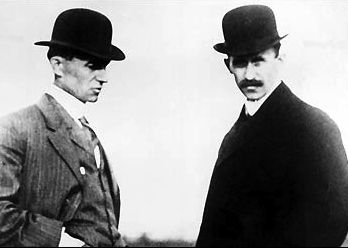
Wilbur and Orville Wright.

Two years later, the Wrights wrote in a patent application that their airplane design:

… provide[s] means for guiding the machine both vertically and horizontally … combining lightness, strength, convenience of construction, and certain other advantages.

Were the Wright brothers always destined for the skies? It’s known that their father gave them a rubber-band-powered flying toy when they were still children. The toy was made of cork and bamboo, with a paper body.

By 1899 – when Wilbur was 33 years old and Orville was 28 – the brothers were already learning everything they could about the science of aeronautics and the history of attempted human flight. Their first airplane were gliders, which they tested on the long, isolated beaches of Kitty Hawk. By 1902, they had built a glider that could be manned and controlled by a human pilot. It held a world record for gliding over 600 feet (nearly 200 meters).

Their first powered aircraft had a 40-foot (12-meter) wingspan, weighed 750 lbs, and had a 12-horsepower engine.

That first flight in December 1903 marked the beginning of a new era of global travel and relatedness.

By the way, at the time they received their patent for their airplane in 1906, several other aviators of the day claimed to have been the first to use the Wrights’ method of turning the airplane by warping or twisting the wings. But this part of the design, too, was included in the Wrights’ patent. In 2013, a story came to light about another would-be aviator, Gustave Whitehead, whose first flight supposedly beat the Wright brothers by two years. Thus far, that story has not been supported and is not accepted by aviation scholars.

Bottom line: The first airplane soared for 12 seconds over 120 feet (about 37 meters) of sandy ground just outside Kitty Hawk, North Carolina on December 17, 1903.

SOURCE:::: http://www.earthsky.org

Natarajan

Image of the Day…Sunset Over the Gulf of Mexico…

Sunset Over the Gulf of Mexico

From the International Space Station, Expedition 42 Flight Engineer Terry W. Virts took this photograph of the Gulf of Mexico and U.S. Gulf Coast at sunset and posted it to social media on Dec. 14, 2014.

The space station and its crew orbit Earth from an altitude of 220 miles, traveling at a speed of approximately 17,500 miles per hour. Because the station completes each trip around the globe in about 92 minutes, the crew experiences 16 sunrises and sunsets each day.

Image Credit: NASA/Terry Virts 

SOURCE::::www.nasa.gov

Natarajan

Image of the Day…Mars Exploration Rover opportunity …

 Opportunity Pausing at a Bright Outcrop on Endeavour Rim, Sol 3854

NASA’s Mars Exploration Rover Opportunity is continuing its traverse southward on the western rim of Endeavour Crater during the fall of 2014, stopping to investigate targets of scientific interest along way.  This view is from Opportunity’s front hazard avoidance camera on Nov. 26, 2014, during the 3,854th Martian day, or sol, of the rover’s work on Mars. This camera is mounted low on the rover and has a wide-angle lens.

The scene includes Opportunity’s robotic arm, called the “instrument deployment device,” at upper left. Portions of the pale bedrock exposed on the ground in front of the rover are within the arm’s reach. Researchers used instruments on the arm to examine a target called “Calera” on this patch of bedrock.  The wheel tracks in the scene are from the drive — in reverse — to this location, a drive of 32.5 feet (9.9 meters) on Sol 3846 (Nov. 18, 2014).

Image Credit: NASA/JPL-Caltech  

SOURCE:::: http://www.nasa.gov

Natarajan

” Early Mona Lisa ” …Identical Twin of the One in Louvre !!!

‘Early Mona Lisa’: Unveiling the one-in-a-million identical twin to Leonardo da Vinci painting

Scientific tests suggest Da Vinci started working on the ‘Early Mona Lisa’ in 1503, ten years before the one in the Louvre

A second painting of the Mona Lisa thought to be produced a decade earlier than the one on display in the Paris Louvre has been unveiled in Singapore.

Scientific tests suggest that Leonardo da Vinci started working on the “Early Mona Lisa” in 1503, ten years before the one in the Louvre, but left it unfinished.

It was acquired by an English nobleman in 1778. But it was not until 1913 that Hugh Blaker, an art connoisseur, rediscovered the portrait. He brought the artwork back to his studio in Isleworth, south-west London, to restore it.

The work, which shows a younger woman against a different backdrop from the more familiar version, changed hands several times before it was passed to an international consortium in 2008.

The painting was presented to the media in 2012 by the Mona Lisa Foundation, which had compiled 35 years of research and tests. It published more findings the following year, leading most da Vinci scholars to believe that the second Mona Lisa is indeed the Italian’s work of art.

The painting will be on exhibit at Singapore’s Arts House until February 11 next year and is expected to reach Europe later in the year.

SOURCE:::: Kunal Dutta in http://www.independent.co.uk

Natarajan

Story of Rock Garden as Revealed by its Creator Nek Chand Who Has Turned 90 !!!…

His statues have ended up in museums around the world. AFP PHOTO/NARINDER NANU.

His statues have ended up in museums around the world. AFP PHOTO/NARINDER NANU. Source: AFP

DEEP inside his massive garden of handmade waterfalls and sculptures, Nek Chand recalls toiling away secretly in the dead of night for a staggering 18 years to create his wonderland in north India.

Riding his bicycle after dark to a state-owned forest, Chand spent night after night clearing patches of ground and transforming the landscape into a majestic garden that would eventually cover eight hectares.

Waterfalls, gardens and sculptures dot the serene environment. Source: AFP/NARINDER NANU

Waterfalls, gardens and sculptures dot the serene environment. Source: AFP/NARINDER NANU Source: AFP

“I started building this garden as a hobby” in the 1950s, Chand told AFP in a rare interview on the eve of his 90th birthday on Monday.

“For 18 years nobody came to know. There was a forest here, who would come here and what for? There were no roads to come and go,” Chand said nostalgically, seated in the garden that has become a major tourist attraction, drawing thousands of visitors a day.

Indian visitors in the Rock Garden, built by self-taught Indian artist Nek Chand Saini ov

Indian visitors in the Rock Garden, built by self-taught Indian artist Nek Chand Saini over the course of 18 years AFP/NARINDER NANU. Source: AFP

After the deadly violence and upheaval of partition in 1947, India set about building a capital for Punjab state, carved out of a region that stretched across the border into newly formed Pakistan.

From the tonnes of building materials and rubbish that followed, Chand carefully collected what he considered gems while working as a lowly roads inspector in the upcoming Chandigarh city.

Pottery pieces, glass, tiles and even broken bathroom sinks were used to make sculptures of men and women, fairies and demons, elephants, monkeys and gods.

Pottery pieces, glass, tiles and broken household items wre used to create this wonderlan

Pottery pieces, glass, tiles and broken household items wre used to create this wonderland. AFP PHOTO/NARINDER NANU Source: AFP

“I had many ideas, I was thinking all the time. I began carrying all the material on my bicycle and collecting it here,” Chand said of his garden of mosaic pathways, hidden chambers and courtyards.

“I did three to four rounds on my cycle each day. I saw beauty and art in what people said was junk.”

‘Like reliving Willy Wonka’

When his secret was finally discovered in 1976, authorities threatened demolition, claiming Chand had violated strict land laws.

But an amazed public rallied behind him, leading to his appointment as head of the newly opened Rock Garden of Chandigarh.

Chand stepped up his creation of hundreds of sculptures — mostly made from broken household material and discarded personal items including electric sockets, switches, bangles and bicycle frames.

Riding his bicycle after dark to a state-owned forest, Chand spent night after night clea

Riding his bicycle after dark to a state-owned forest, Chand spent night after night clearing patches of ground and transforming the landscape into a majestic garden AFP/NARINDER NANU. Source: AFP

Some made of broken glass bangles show girls dancing, others of ceramic pieces depict men at a party pouring glasses of whiskey.

Ticket sales grew as word of the secret garden spread, with some 3,000 people from across the country and overseas now wandering through daily.

“It’s so amazing. It’s something like reliving Willy Wonka and the Chocolate Factory,” Jasmine Paul, a resident of Vancouver who was holidaying in India, told AFP.

“It is just like the fairy tales that you grow up reading.” With no formal education in art or sculpture, Chand drew inspiration from his childhood when he played near a river flowing through his village in what is now Muslim-majority Pakistan.

Sculptures made from discarded household items. AFP PHOTO/NARINDER NANU

Sculptures made from discarded household items. AFP PHOTO/NARINDER NANU Source: AFP

Chand and his family were forced to flee across the border during partition because they were Hindus, finally settling in Chandigarh, the shared capital of Punjab and Haryana states.

“That is why there is a childlike quality to the sculptures,” said Alan Cesarno, a British volunteer with the Nek Chand Foundation that was set up in 1997 to raise funds for the garden’s upkeep.

“When you look around you realise that it is actually a child’s version of a fantasy kingdom,” he told AFP standing next to one of the several waterfalls.

Self-taught Indian artist Nek Chand Saini on the eve of his 90th birthday. AFP PHOTO/NARI

Self-taught Indian artist Nek Chand Saini on the eve of his 90th birthday. AFP PHOTO/NARINDER NANU. Source: AFP

Conservation challenges

Chand’s statues have found their way into museums across the world, including at the National Children’s Museum in Washington, the American Folk Art Museum in New York and the RIBA gallery in Liverpool in 2007.

Back home, the garden is facing conservation challenges, including a lack of funds from the state government which takes the ticket sales, according to volunteers.

Vandalism has been reported more than once and enthusiastic visitors often climb or lean on the structures, damaging their fragile pieces.

“In a country known more for slums and garbage dumps, the rock garden stands as an exceptional example,” said Mani Dhillon, a volunteer involved in the garden’s upkeep.

“It is perhaps the only place of its kind in the entire world. The administration and the people must realise its importance, they must come forward and save it before it’s too late,” she told AFP.

Magical waterfalls enchant its visitors. AFP PHOTO/NARINDER NANU

Magical waterfalls enchant its visitors. AFP PHOTO/NARINDER NANU Source: AFP

While Chand still oversees the garden as its founding head with near daily visits, his age and failing eyesight mean he can no longer spend the long hours needed to create new sculptures.

He is however undaunted by the challenges facing his more than half a century’s work, saying he has faith in God from which he draws his strength.

“I am not scared of anything. Had I been scared, how would I have worked in the dead of the night in the jungle?”

SOURCE:::: http://www.news.com.au

Natarajan