Allerton Bywater is a village in the city of Leeds, in West Yorkshire, England. The River Aire, popular with swans, flows through it.

Allerton Bywater is a village in the city of Leeds, in West Yorkshire, England. The River Aire, popular with swans, flows through it.
Vera Kiss said she hadn’t planned on catching this seagull when she aimed toward these crepuscular rays over the sea.
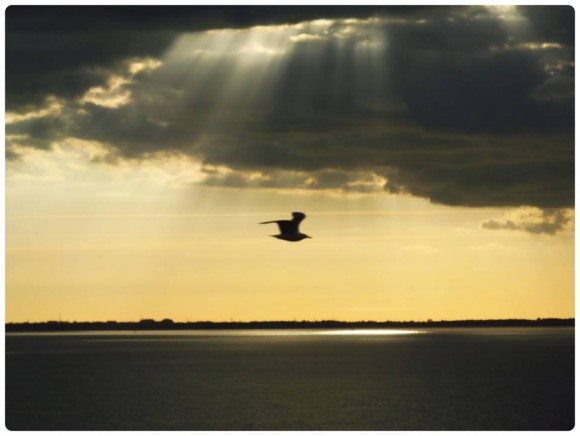
Photo taken by Vera Kiss in July 2014
Source:::: Earth Sky News
Natarajan

Carlos Garcia Rawlins/Reuters
A man walks inside the Simon Bolivar airport in La Guaira, outside Caracas.
As if flying wasn’t bad enough these days (we even have to keep our cellphones pre-charged now, egh), one airport has taken air travel to its most comical (read:worst) : Simon Bolivar International Airport is charging passengers for clean air, starting this month.
Well, really what they’re doing is charging flyers for the right to breathe clean air, in the form of a tax — not that that’s much better, really.
From July onwards, anyone flying to or from Simon Bolivar International Airport of Maiquetia in Caracas is going to have spend 125 bolivars — roughly $20, depending on the highly variable exchange rate — on what the airport has called a “breathing tax.”
Ostensibly, the fee is in order to pay for a “state-of-the-art” air purification system, which “deodorizes” and “sanitizes” the building (just how smelly and dirty was it before, you have to wonder). It’s the first of its kind in South America, the ministry of water and air transport boasts, and will help “protect the health of travelers.”
If you’re thinking that this sounds suspiciously like a pricey air conditioning unit, you’re not alone. The move has caused a furor on social media in Venezuela, where people are already pretty unhappy with the government of Nicolas Maduro.
Recently, Maduro’s office has put in place certain currency controls that have stopped international airlines — like Delta and American Airlines, for example — from repatriating what they make from selling tickets in Venezuela. What this has meant is that Delta, American, United and Canada Air have all severely cut down their flights to the country — which, as you can imagine, has not been so good for Maiquetia Airport’s revenues.
“We are isolated as airlines have reduced flights to the U.S. by more than 80 percent,” Jesus Ernesto Ortiz, president of Caracas travel agency Happy Tour Group, told Bloomberg earlier this week. “Venezuela is going to receive less flights than Cuba or Haiti. It is the first time the Venezuela airlines sector is facing a crisis like that.”
Well, it certainly puts Easyjet’s fees into perspective, if nothing else.
Source:::: Business Insider .com
Natarajan
That bright meteor over Australia – seen by many – was likely the reentry of the upper state of a Soyuz rocket, launched two days earlier. over

UPDATE JULY 10 AT 1815 UTC (1:15 P.M. CDT). Experts are now reporting that today’s bright meteor – widely reported over southeastern Australia today (July 10, 2014) – was not a piece of natural space debris, but instead was the reentry of the upper state of a Soyuz rocket, launched on July 8. It seems the meteor was part of the vehicle used to launch Russia’s second Meteor-M weather satellite. Jonathan McDowell (@planet4589), an astronomer at the Harvard-Smithsonian Center for Astrophysics, tweeted that the Australian meteor was:
… Object 40077, 3rd stage from Meteor-M launch, reentered over Australia at about 1145 UTC Jul 10
Daniel Fischer (@cosmos4u) pointed out that time and location of the Australian meteor event appear to match the last TIP (Tracking and Impact Prediction) message for the reentry. And, as Fischer pointed out on Twitter just now:
He’s talking about the video below, caught by in Australia via mobile phone. You can see that the meteor does take awhile to streak across the sky, and, indeed, in verbal reports of the meteor from earlier today, people were commenting on how slow it was.
Thursday night in Australia, reports of a very bright and slow-moving shooting star flooded into the Brisbane Times, which covers the widely populated states of Victoria and New South Wales in southeastern Australia. People in the city of Melbourne, Australia’s second-largest city, also reported a bright object streaking through the sky. The Sun Herald in Melbourne reported:
Social media lit up when the unusual spectacle was seen at around 10pm.
The object – described by witnesses as like a flame – was reported to be flying rapidly.
Charmaine Harris from Thornbury said it lasted more than a minute.
The Australia Bureau of Meteorology, which received reports of the July 10 meteor around 10 p.m., at first said it could be natural debris from space or artificial space junk. Now, it appears it was space junk.
Aviation Week reported on the launch of a Russian Soyuz-2.1b rocket with a Fregat upper stage – carrying a Russian weather satellite and six small spacecraft to orbit on July 8. According to Aviation Week, liftoff took place at 9:58 p.m. local time from the Baikonur Cosmodrome in Kazakhstan.
They said this satellite – Russia’s second Meteor-M weather satellite – is designed to monitor global hydrometeorological data for weather forecasting and to gather data on the ozone and radiation environment in near-Earth space. It will also measure sea-surface temperature, monitoring icy conditions at the poles for navigation. The satellite itself, presumably still safely in orbit, has a design life of five years.
Bottom line: A bright meteor was seen by many in Australia around 10 p.m. local time on July 10, 2014. Experts are now reporting that the meteor was not a piece of natural space debris, but instead was the reentry of the upper state of a Soyuz rocket, launched on july8.
Source:::: Earth sky news
Natarajan

The moon has reached the crest of its full phase. The full moon crested this morning (July 12, 2014) at 6:25 a.m. CDT. (11:25 UTC). Saturday night’s moon will still look full, however, and it’ll be closest to Earth for this month. The moon’s perigee or closest point comes at at 3:37 a.m. CDT (8:27 UTC) Sunday morning, July 13. For all of us, around the world, the moon on both Friday and Saturday night rise around the time of sunset and set at dawn.
Thus on July 12 we have the first full moon after the June 21 solstice. Around this time of year, in North America, buck deer start growing antlers, thunder storms rage and farmers struggle to pile up hay in their barns. Thus, according to folklore, we call this full moon the Buck Moon, Thunder Moon or Hay Moon. The July 2014 full moon is also the first of three full-moon supermoons in 2014. Previously, we had two supermoons in January – on January 1 and 30 – but they were new-moon supermoons. The full moons on July 12, August 10 and September 9 all enjoy the supermoon designation because the centers of these full moons and the center of Earth are less than 361,863 kilometers (224,851 miles) apart. The closest supermoon of the year comes with the August 10 full moon, presenting a moon that’s only 356,896 kilometers (221,765 miles) from Earth.
Because it’s a supermoon, and relatively close to Earth, expect higher-than-usual tides in the days ahead.
Source:::: Earth sky news
Natarajan

Often called the grand old lady of Bollywood, she last appeared in Sanjay Leela Bhansali’s Saawariya(with Ranbir Kapoor and Sonam Kapoor) in 2007. She acted in hits like Cheeni Kum (with Amitabh Bachchan), Dil Se (with Shah Rukh Khan and Manisha Koirala), Veer Zaara (Shah Rukh and Preity Zinta), Hum Dil De Chuke Sanam (Salman Khan and Aishwarya Rai) and Bend It Like Beckham.
Born on April 27, 1912 in Saharanpur in Uttar Pradesh in a traditional Muslim family, Sehgal, third of her seven siblings, grew up in Chakrata near Dehradun and was sent to Lahore to pursue her higher education.
As a dancer, she performed across Japan, Egypt, Europe and the U.S.. She married scientist, painter and dancer Kameshwar Sehgal in August 1942. The couple had two children, Kiran and Pavan. Kameshwar died in 1952 and Zohra raised the children all by herself.
On her return from foreign trips, Sehgal had to don the burqa while studying in Lahore’s prestigious Queen Mary College, meant for daughters of aristocratic families, an institution where strict purdah was observed and males invited to speak there were put behind a screen.
Considered the doyenne of Indian theatre, Ms. Sehgal acted with Indian People’s Theatre Association (IPTA) and Prithviraj Kapoor’s Prithvi Theatre for 14 years. In 1946, she debuted in IPTA’s first film production Dharti Ke Lal, which dealt with the Bengal famine. She also acted in another IPTA film — Chetan Anand’s Neecha Nagar.
She choreographed for a few Hindi films as well, including classics like Guru Dutt’s Baazi (1951) and the dream sequence song in Raj Kapoor’s film Awaara.
Sehgal moved to London on a drama scholarship in 1962, where she appeared in many TV productions including The Jewel in the Crown, Tandoori Nights, My Beautiful Laundrette and The Raj Quartet.

Born Sahibzadi Zohra Begum Mumtaz-Ullah Khan on April 27, 1912 in Saharanpur, Uttar Pradesh, Zohra Sehgal began her career as a dancer with Uday Shankar in 1935 and performed across Japan, Egypt, Europe and the U.S. In this April 2012 photo, Zohra Sehgal reacts while cutting a cake on her 100th birthday in New Delhi. Photo: PTI


2014 has been a great year for noctilucent, or night-shining, clouds, seen at high latitudes only from about mid-May to August. Wondrous, if you can catch them!
A parent’s love for their child knows no boundaries, and this is true both of us and of our animal friends. In these heartwarming photos of animal parenting, you’ll recognize many of the same tender and stressful childhood moments that you may have also experienced as a parent or a child.
Ecologists tend to separate animals into two groups based on their parenting – the r and K categories. The K category includes animals like elephants, cats, and us – animals that have relatively few offspring with longer gestational periods. Their fewer offspring require more focused care, and for a longer time – the sort of parenting we’re used to. Parents from the r category go for quantity over quality, with many offspring that grow quickly and individually have small chances of survival.


Image credits: Anton Belovodchenko

Image credits: dailymail.co.uk

Image credits: Jeanette DiAnda

Image credits: Igor Shpilenok

Image credits: Ric Seet

Image credits: pensivesquirrel.wordpress.com

Image credits: Marco Mattiussi

Image credits: Jan Pelcman

Image credits: Laurie Rubin

Image credits: Michael Milicia

Image credits: Chuck Babbitt

Image credits: hqwide.com

Image credits: Tin Man

Image credits: dailymail.co.uk

Image credits: Wolfgang von Vietinghoff

Image credits: Udayan Rao Pawar

Image credits: Daniel Münger

Image credits: dailymail.co.uk

Image credits: Andre Pretorius

Image credits: Frederique Olivier/John Downer Productions

Image credits: imgur.com

Image credits: Jim Ridley

Image credits: Michael Nichols

Image credits: Edwin Kats
A parent’s love for their child knows no boundaries, and this is true both of us and of our animal friends. In these heartwarming photos of animal parenting, you’ll recognize many of the same tender and stressful childhood moments that you may have also experienced as a parent or a child.
Ecologists tend to separate animals into two groups based on their parenting – the r and K categories. The K category includes animals like elephants, cats, and us – animals that have relatively few offspring with longer gestational periods. Their fewer offspring require more focused care, and for a longer time – the sort of parenting we’re used to. Parents from the r category go for quantity over quality, with many offspring that grow quickly and individually have small chances of survival.
Image credits: Anton Belovodchenko
Image credits: dailymail.co.uk
Image credits: Jeanette DiAnda
Image credits: Igor Shpilenok
Image credits: Ric Seet
Image credits: pensivesquirrel.wordpress.com
Image credits: Marco Mattiussi
Image credits: Jan Pelcman
Image credits: Laurie Rubin
Image credits: Michael Milicia
Image credits: Chuck Babbitt
Image credits: hqwide.com
Image credits: Tin Man
Image credits: dailymail.co.uk
Image credits: Wolfgang von Vietinghoff
Image credits: Udayan Rao Pawar
Image credits: Daniel Münger
Image credits: dailymail.co.uk
Image credits: Andre Pretorius
Image credits: Frederique Olivier/John Downer Productions
Image credits: imgur.com
Image credits: Jim Ridley
Image credits: Michael Nichols
Image credits: Edwin Kats
Source::::www.boredpanda.com
Natarajan

This isn’t the Arctic. It isn’t Greenland. It’s Pakistan. At 63 kilometers (39 miles) in length, Baltoro Glacier in Pakistan is one of the longest glaciers outside the polar regions.
Source:::Earth sky news
Natarajan