This awesome engineering innovation keeps skyscrapers steady in a typhoon….

A design sketch of Manhattan once Two World Trade Center is complete

Normally you’d never notice it, but all tall buildings sway a little in the wind.

Scarcity of land is forcing us to build skyscrapers taller and build them on smaller and smaller bases. But the taller and the skinnier a building is, the more likely it is to sway at the top.

To minimise the swaying, developers are putting giant counterweights called tuned mass dampers (TMDs) near the top of skyscrapers. A TMD is a giant ball made of steel or concrete that weighs anywhere from 300 to 800 tons, and it’s usually suspended in the building using springs and pistons.

It looks like this in the Taipei tower in Taiwan:

The dampers in the Taipei tower in Taiwan.

On a windy day, a skyscraper over 1,000 feet tall might sway a couple of inches, according to Rowan Williams Davies and Irwin, consulting engineers. Usually that movement is imperceptible, but on a particularly breezy day, you can feel the building moving. The sway of some buildings is enough to make the tenants feel sea sick.

If the wind blows from the right, the damper swings from the left to balance out the push.
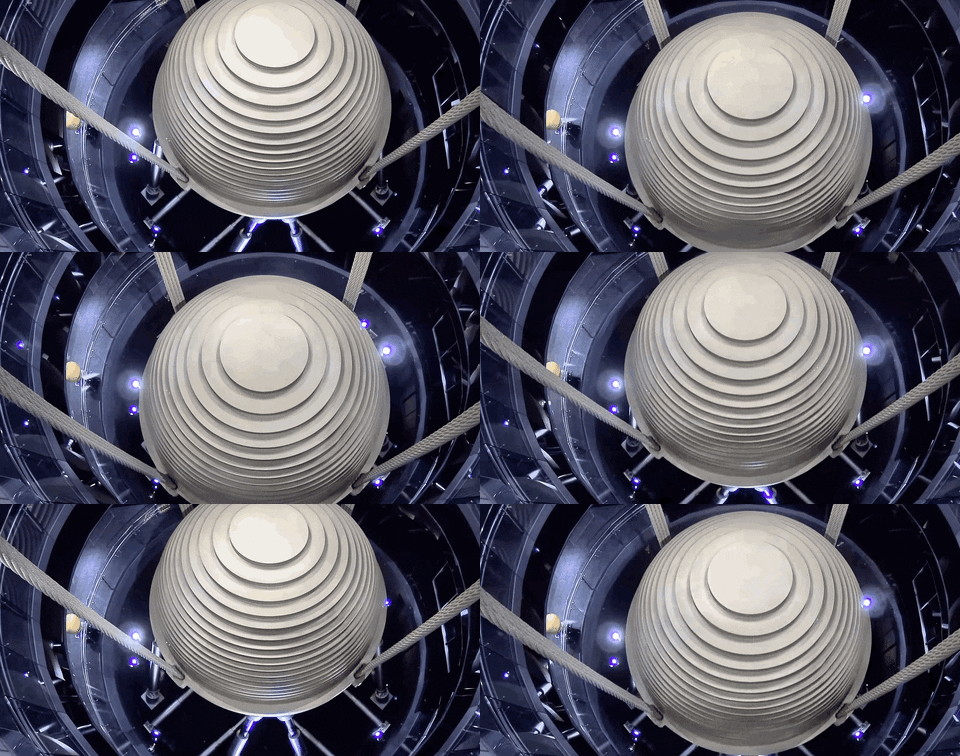
None animated GIF

via GIPHY

But dampers don’t really have anything to do with the structural integrity of a building, according to engineers. They’re not, say, stopping the building from falling over. They’re actually only put in place to keep the building’s occupants from feeling unnerved or getting seasick.

What about typhoon-force winds?

Back in 2004, the 1,667-foot tall Taipei 101 tower was the tallest building in the world. It’s since been eclipsed by other buildings:

It may not be the tallest building anymore, but on Saturday Aug. 8, Taipei 101 set a different record. Or rather its damper set a record when it swung a full meter to counteract 100 mph winds from Typhoon Soudelor, according to Popular Mechanics. One gust clocked in at 145 mph.

A meter might not sound that impressive. Here’s a few things to keep in mind while you watch the video footage:

1. This damper is 18 feet across.

2. It weighs 728 tons.

3. Not all of the movement in the video is from the damper itself. Some of it is the building itselfmoving around the damper.

Skyscraper physics

The New York Times has a great graphic explaining how dampers work. Really though, it all boils down to simple physics.

A skyscraper is like a giant tuning fork. If you give it a good whack, like with a gust of wind or an earthquake, it will start vibrating at a set frequency. So when the tower is hit with a powerful gust of wind, the damper swings with the same frequency as the building, but in the opposite direction. It doesn’t completely stamp out the vibration, but it does keep it under control.

There’s a fairly simple equation that physicists and engineers can use to calculate how big to build the damper for each skyscraper.

Another way to think of it is to use the equation “force equals mass times acceleration”. If some force acts on a skyscraper — like wind — the occupants are going to feel some kind of acceleration. That acceleration is what causes some people to feel woozy, according to The Constructor.

It’s not so much the displacement of the building itself that contractors are concerned about — its the rate of acceleration and deceleration of the building’s sway. It’s sort of like riding in a subway car. As the train barrels down the track, you don’t feel very much. But the second the brakes kick in, you feel a jerk.

These super-tall skyscrapers are a testament to modern engineering, but lets hope that Taipei 101 record isn’t broken any time soon.

Source…..Kelly  Dickerson….www.businessinsider.com and http://www.youtube.com

Natarajan

Is Shital Mahajan India’s most unknown sportsperson even with five world records…?

There comes a moment in every person’s life that changes the way people look at them. Skydiver Shital Mahajan is also an idol of such heroism. Holder of five world records, 14 national records and bestowed upon with Padam Shri in 2011, but Shital is still an unknown figure in India.

She is well known internationally for her skills but what hurts Shital the most is the lack of recognition in her own country. Having performed more than 655 jumps, adventure sports enthusiast Shital is a skydiving coach too. United States Parachuting Association has certified her with A, B, C and D licenses and coach ratings, which makes her eligible for skydiving all over the globe. But she still excessively depends on sponsors to stay in the sport and continues to plead the government for support.


She is known internationally for her skydiving achievements and even bestowed upon with a Padma Shri, but still Shital has no prominence among the Indian sports fraternity.

In an exclusive chat with IBNLive, the adventure-loving Shital shared her sentiments and aspirations to do her country more proud.

When and how you thought of starting skydiving? And how you turned professional in this adventure sport?

I started skydiving in the year 2002. I deliberately wanted to do something different. In our society, there is a taboo that a girl can’t do this and that. I wanted to erase that stereotypical image of a woman from people’s mind. They think a woman is supposed to serve her family, raise kids and only do household work. When I started to face similar challenges, I decided to break barriers.

Then I happened to meet one of my friends’ brother, Air Force officer Kamal Singh. I came to know about skydiving from him only. Then I took coaching from him. I wanted to do skydiving so I asked him how can I start. His answer was “since you are a civilian, you need to go abroad for skydiving as it cannot be done in India.”

Then I decided if I have no choice than to go abroad to learn, then why not at a special place like the North Pole.

Does your family support you since it involves a lot of money and one has to risk his/her life?

My parents didn’t support me initially but later on I convinced them. When I asked them I want to do skydiving, their answer was “have you gone mad! In our family no one has even travelled in an aircraft and you want to jump from it!” They said girls can’t do such dares. But I had a strong determination, so I convinced them. I clearly said, it’s my life and if I were to die, it will solely be my responsibility. They said “we can’t allow you to risk your life”. Then I started blackmailing tactics (laughs) by threatening to leave home. Girls leave their home for marriage, but I wanted to leave to sky-dive.

Tell us something about your awards and records.

Presently I have 14 national and 5 world records in my name. On 18th April 2004, I became the first woman in the world to execute a sky-dive from North Pole, and that too without any prior training. There wasn’t any land for my landing, so I had to land on an ice slope in a freezing temperature of minus 37 degrees, from a height of 2400 feet. Following my first world record, in the year 2006, I became first woman to perform sky fall from both South Pole and North Pole. Chasing achievements and records, the biggest accolade in my career came my way in the year 2011 when I was awarded the fourth highest civilian award, the Padma Shri, from the then President Pratibha Patil.

We heard that your meeting with former President Late Late APJ Abdul Kalam had a touch of both sorrow and happiness attached to it.

After my North Pole achievement, the Russian government approved me with a certificate recognising my feat, but the Indian government didn’t accept my accomplishment.

Then Sports Minister, Late Sunil Dutt, said: “There is no value of such certificates in India”. They weren’t ready to recognise my achievement. The government asked me to contact the Air Force and they sent me back to the Sports Ministry that said skydiving is not considered a sport in India.

I was heartbroken, so I decided to meet the then President, APJ Abdul Kalam. I showed him all my certificates and told him how the Sports Ministry is refusing to recognise my achievement. He said “I, the President of India, recognise your world record. Now whose recognition do you need?”

APJ said: “My secretary Ashish is here. If you get stuck in any situation, give him a call. We are always here to support you.” He was an amazing personality.

Where do you mostly practice skydiving?

I usually practice skydiving in Spain, Finland, California and Arizona (USA). There are still no proper rules and regulations for skydiving in India. I want to make all this possible in India one day.

What safety measures you take for skydiving?

FAI (Federation of Aeronautics International) is the world regulatory body for skydiving. It has set up some rules and safety measures that every skydiver has to follow. Special suits are used for skydiving that are wind proof, even protect the body in negative temperature, where body contact with open air can lead to blood clots.

When you perform a jump from 11,000 feet, only 40 seconds are there to open the parachute as you fall with a speed of 230 kmph. At this speed in a temperature like -38 degrees, hypothermia may take over the body. Our suits protect us from all this. Beneath that we wear four T-shirts and four pants, besides a helmet, two face covers and medical tapes all over the body. Only the nostrils are left open to breathe.

What runs through your mind when you are in mid-air?

In skydiving, you have just a 40-second timeframe mid-air. Either you can think or you can land safely. I give all the credit of safe landings to my subconscious mind.

While in the air, even 4-5 seconds are precious and it can affect badly. Therefore, only subconscious mind works at that point of time.

Tell us about your institute – the Phoenix Skydiving Academy.

The Maharashtra Government suggested me to open a skydiving institute in Pune. It had my roots, where I could teach and perform skydiving. So I started the Phoenix Skydiving Academy. We are active in four states – Gujarat, Karnataka, Maharashtra and Madhya Pradesh.

What is the average expense one needs to bear for skydiving?

The expense of one jump is 20 dollar in US but in India it costs 20-22 thousand rupees. We, at our institute, are trying hard to bring it to a nominal price of 9-10 thousand rupees.

What are your aspirations regarding skydiving?

I am planning for a sky fall from Australia along with hundred plus Indians. I want to associate more and more people with skydiving in India so that we can come up as a big powerhouse. I want to popularise skydiving as a sport in India.

Who do you consider as your inspiration? And how do you see future generation’s interest towards skydiving?

Current generation is very active and they are ready for adventure sports. A lot of enthusiasts want to get trained for skydiving. My inspiration is Dan Brodsky-Chenfeld (world skydiving champion, coach, author, speaker), and I feel good when my students seek inspiration from my achievements.

Source…Akash Khanna …www.ibnlive.com

Natarajan

This Chinese Bride is ‘Most Beautiful’ and Not Because of How She Looks…….

This Chinese Bride is 'Most Beautiful' and Not Because of How She Looks

Pictures of the rescue, with Ms Guo all dressed up, have been circulated on the Chinese social networking site, Sina Weibo. Image courtesy: Facebook/CCTV News

A young Chinese bride-to-be has been hailed as a heroine after rushing to the rescue of a drowning man – midway through a wedding photoshoot. Guo Yuanyuan was busy posing for the camera in a beautiful dress at a seaside resort in China’s Dalian city when she spotted the man drowning and instantly sprinted towards him, dress and all.

Ms Guo turned out to be a nurse at the Dalian Central Hospital. She pulled the swimmer to the shore after he had a heart attack while in the water and administered CPR, reports CCTV News.

Pictures of the rescue, with Ms Guo all dressed up,  have been circulated on the Chinese social networking site, Sina Weibo. According to CCTV News, Guo Yuanyuan has now been dubbed “zuimeixinniang,” which means “most beautiful bride.”

Photo Credit: Facebook/CCTVNews
According to the Mirror, her proud would-be spouse Liu Chuang told local media that she ran faster than him to save the man’s life.
Source….www.ndtv.com
Natarajan

Odisha girl wins top award at Google Science Fair……..

Lalita Prasida, 13 used corn cobs to clean waste water, for which she won ‘The Community Impact’ Award at 2015 Google Science Fair. 

Lalitha Prasida Sripada Srisai

A 13-year-old girl from Odisha won the 2015 Google Science Fair, ‘The Community Impact’ Award on Monday, September 21 hosted by Google in Mountain View, California in partnership with the Scientific American that sponsored the Community Impact award, LEGO Education, National Geographic and Virgin Galactic.

Lalita Prasida Sripada Srisai , a 9th grader at the Delhi Public School in Damanjodi, Odisha received $10,000 and will get a year of mentoring from Scientific American for her project that makes a practical difference in the community by addressing an environmental, health or resources challenge.

Her project, ‘Low Cost Bio- Adsorbent’ aims to clean waste water by flowing through different layers of Corn cobs which is a cost-effective and simple technique of cleaning water.

She uses corn cobs in her project.

Corn cobs, she says, are useful for immobilising the contaminants in domestic and industrial effluents, and in ponds,reservoirs and water tanks as well.

Her experiment (diagram below) shows that Corn cobs could clean water up to 70 to 80 per cent because they are suitable adsorbents and have high mechanical strength, rigidity and porosity.

Lalita Prasida's Low Cost Bio Adsorbent project diagram

Started five years ago the Google Science Fair is a an annual global online competition for students ages 13 to 18, and honours a project that makes a practical difference in a community by addressing anenvironmental, health or resources challenge.

The grand Google Science Fair prize of $50,000 was won by an Americanstudent Olivia Hallisey, 16 to detect Ebola.

Also partners of annual Google Science Fair Awards are LEGO Education, National Geographic and Virgin Galactic and offer mentoring to the winners year round.


Anurudh Ganesan

Anurudh Ganesan15, of United States, won the Lego Education Builder award.

The award is given to a student who uses an innovative, hands-on approach to solve some of the greatest engineering challenges.

His project titled ‘Vaxxwagon: An Innovative eco-friendly No Ice, No electric, active refrigeration system for last-leg vaccine transportation’ is about vaccine transportation to remote locationsthat requires both ice-packs and electricity which is a major problem in developing countries.

His existing prototype costs less than $100.

He has also applied for its patent and was placed 3rd at National Geography Bee in Maryland.

Ganesan will travel the LEGO Group headquarters in Billund, Denmark and will have access to work with a LEGO Education executive for six months as a mentor to learn how to launch a business and the art of entrepreneurship.

Deepika Kurup

Deepika Kurup  17, of United States won the National Geographic Explorer Award given to a a project in the natural sciences.

Her project was focused on to find solution for the world’s clean water problem.

According to the World Health Organization, one-ninth of the global population lacks access to clean water, and 500,000 children die every year because of water related diseases.

Kurup, a senior at Nashua High School South in Nashua, New Hampshire, will travel on a 10-day National Geographic Expedition to the Galapagos Archipelago, ‘Darwin’s living laboratory’ and home to an abundance of wildlife.

Kurup project titled, “Novel photocatalytic previous composites for removing multiple classes of toxins from water,” shows that the photocatalytic water purification technology developed in her research is safe and environmentally-friendly, as it does not produce any toxic byproducts.

The purification process uses only solar energy, so it’s cost effective.

Pranav Sivakumar

Pranav Sivakumar 15, United States, received the Virgin Galactic Pioneer Award given for innovation in the area of space and physics.

Sivakumar’s project focuses on an automated search for gravitationally lensed quasars in theSloan Digital Sky Survey (SDSS).

In his report he said, “I report an automated method for finding and characterising gravitationally lensed quasars in the SDSS.”

The survey data was utilised to examine the properties of target quasars and their neighbours to determine whether these two SDSS objects were images of the same quasar.

The algorithm not only identified 56 lensed quasars reported in the literature but alsoidentified 109 new high-probability candidates.

Krtin Nirhiyanandam

Krtin Nithiyanandam , 14, United Kingdom, won the Scientific American Innovator Award, honoured for a project in the pure sciences.

He received $25,000 and a year of mentoring.

Nithiyanandam through the project shows the developing and earlier diagnosis of minimally-invasive diagnosis of Alzheimer’s disease.

He has developed a quantum dot probe that can potentially cross the blood-brain barrier and be used as a more sensitive, non-invasive diagnostic tool for the earlier diagnosis of Alzheimer’s.

Girish Kumar

Girish Kumar 17 of Singapore, won the Google Technologist Award for helping improve learning through auto-generated study questions.

For the project, Kumar developed an algorithm that would pick sentences from an assigned text and convert them to questions.

This, he evaluated with a group of students for its effectiveness before submitting to Google.

All images courtesy: Google Science Fair

Source……www.rediff.com

Natarajan

This Collector Has 1 Lakh Followers on Facebook. And He Interacts with Them Everyday…

Prasanth Nair, the Kozhikode District Collector, is well known for his active presence on social media. With more than one lakh followers on Facebook, this government official makes sure that residents get a chance to interact with him whenever they want. He also conducts many campaigns to solve various local issues.

“Thank you 1,00,000 compassionate hearts,” says the cover image of a Facebook page called ‘Collector, Kozhikode‘. It is page which is personally handled by Prashanth Nair, the collector who heads the Kozhikode district administration in Kerala.

He has more than one lakh followers, and the page is full of recent updates, and numerous interactions.

Prashanth Nair1

Source: Facebook

It is one of the very few social media pages of government officials where all the comments are answered. Issues are discussed here, campaigns are conducted and a lot of activity keeps taking place almost every day.

In spite of being criticized several times by politicians for his highly visible presence on social media, this government official has no plans to stop. He represents those administrators who want to reach out and remain connected with as many people as possible in this digitised world.

The page helps him solve many problems for the people of Kozhikode as well. It is full of photographs of campaigns asking people to take action in many different ways. One will also find people writing about their complaints and the issues they face in their residential areas. And the best part is that all queries, suggestions and comments are answered without fail, by Prashanth.

One of the very famous campaigns on his page is called ‘Operation Sulaimani’, which was started with the aim of addressing the issue of hunger in urban areas.

Through this project, he offers Sulaimani Coupons to people in the city who cannot afford a meal for various reasons. This could be anyone, people who are poor, or a traveller who suddenly finds that he/she does not have the required money to buy food instantly. These coupons are taken into consideration by a large number of restaurants in the city and are distributed at outlets run by student volunteers, at shops and government offices, and taluk and village offices. The restaurants which offer food in return for a coupon, get the equivalent money reimbursed from an account maintained by the campaign implementing agency.

He also conducted an online campaign to improve the facilities of Kuthiravattom mental hospital. Other than that, ‘Project 4N’ was an initiative started by him to fix potholes on roads. Then there was a campaign against urinating in public places – the ‘Trimoothri Photo Contest’, where he asked people to send in photographs of people seen urinating. All these campaigns got wide traction on the page.

But all of this has not been easy for the officer. Recently, Kozhikode District Congress Committee (DCC) president K.C. Abu, complained that the collector is spending a lot of time on social media and does not have time to receive phone calls. But Prashant simply says that he on Facebook to talk to the citizens and solve their. He believes that social media platforms are additional places to interact with citizens as much as possible.

“The people are out there in social media, so we need to be there. It’s as simple as that. Pasting notices on the notice boards of the village office is no longer the way to reach out to the public. Social media as a platform makes administration more transparent, seamless, fast, publicly accountable, and ‘informal’,” he told The Indian Express.

Source……..Tanaya Singh…www.the better india.com

Natarajan


Image of the Day…” Upside-down Rainbow…”

Brief, beautiful circumzenithal arc

Circumzenithal arcs are sometimes referred to as “upside-down rainbows” or “a smile in the sky.”

View larger. | Photo by Amanda Cross.

Amanda Cross in Lancashire, UK, submitted these photos to EarthSky. They show the beautiful sky phenomenon known as a circumzenithal arc. Amanda wrote:

Sun halo spotted on the school run, dashed home for camera then the circumzenithal arc appeared above, smiling. Worth dashing home for! Smiling in the sky, upside down rainbow 🙂

Only lasted 10 minutes then it was gone, brief but beautiful.

Photo by Amanda Cross.

Les Cowley of the great website Atmospheric Optics says of these graceful and colorful arcs:

The circumzenithal arc, CZA, is the most beautiful of all the halos. The first sighting is always a surprise, an ethereal rainbow fled from its watery origins and wrapped improbably about the zenith …

Look straight up near to the zenith [overhead point in your sky] when the sun if fairly low and especially if sundogs are visible. The center of the bow always sunwards and red is on the outside.

Les says that the most ideal time to see a circumzenithal arc is when the sun is at a height of 22 degrees in the sky. Look here to see Les Cowley’s illustration of the various kinds of halo phenomena, related to circumzenithal arcs.

Bottom line: Photo from September, 2015 – Lancashire, UK – of a circumzenithal arc. They’re sometimes called upside-down rainbows, or “a smile in the sky.”

Source…..www.earthskynews.org

Natarajan

Prayers to Mother Earth….A Teacher of all Time

Nature is quiet, yet powerful. Nature is proud, yet humble. Nature is complicated, but simple in its actions. Nature is always there, and you cannot avoid it. Our planet is an open book, it’s got nothing to hide from us. There’s actually no limit to what it can teach us about life. Here are some statements of appreciation we ought to give to the best and most important teacher of all time – Earth.

Earth, teach me quiet

– as the grasses are still with new light.

Earth, Teach Me


Earth, teach me suffering

– as old stones suffer with memory.

Earth, Teach Me


Earth, teach me humility

– as blossoms are humble with beginning.

Earth, Teach Me


Earth, teach me love and care 

– as mothers nurture their young.

Earth, Teach Me


Earth, teach me courage

– as the tree that stands alone.

Earth, Teach Me


Earth, teach me acceptance

– as the leaves that die each fall.

Earth, Teach Me


Earth, teach me renewal

– as the seed that rises in the spring.

Earth, Teach Me


Earth, teach me to forget myself

– as melted snow forgets its life.

Earth, Teach Me


Earth, nothing and no one can teach me more than you do.

I will always look up to you.

Source..www.ba-bamail.com

Natarajan

A Rare Picture of Snubfin Dolphin in Australia…

A rare Australian snubfin dolphin taking a leisurely backstroke off Hinchinbrook Island National Park. PICTURE: QUEENSLAND NATIONAL PARKS

RANGERS have spotted a snubfin dolphin frolicking off north Queensland’s Hinchinbrook Island in a small pod, in an extremely rare sighting of the vulnerable species.

Queensland Parks and Wildlife Service Ranger Emma Schmidt has been working in the waters off the island for 12 years, but has only encountered the sociable mammals twice.

“They are very rare, so this photo was just pure luck,” Ms Schmidt said.

“We were heading to Sunken Reef Bay and I noticed a pod of about 10 Indo-Pacific humpback dolphins and among them was this cute little snubby.

“It was playing and mucking around jumping out of the water and in the photo it looks like it’s smiling.”

Ms Schmidt said while the animals were difficult to find, the Hinchinbrook Channel was a regular snubfin pod hotspot.

“They like the sheltered inshore waters rather than out of the reef.

“They are very shy, but there is one charter operator who regularly sees a pod,” she said.

Snubfin dolphins are Australia's only endemic dolphin and are at risk of being put on the endangered list. This one was spotted off the coast of Northern Western Australia by the World Wildlife Fund. Pic Deb Thiele/WWF.

Snubfin dolphins are Australia’s only endemic dolphin and are at risk of being put on the endangered list. This one was spotted off the coast of Northern Western Australia by the World Wildlife Fund. Pic Deb Thiele/WWF.Source:News Limited

Source….www.news.com.au

Natarajan

Raspberry Pi Kits for School Children in Kerala…..

Children in Kerala will enjoy high quality computer science education as the state government has taken a very useful step to ensure that both government as well as aided schools are able to provide better computer science education to the students. This, they are doing with the help of advanced technology like the Raspberry Pi kits for children. Here’s more.

The Kerala government has launched two school-projects with the aim of teaching basic computer science to students in a better manner.

These are the ‘Learn to Code’ project, which is in the second phase of execution, and the ‘Electronics@School’ project which was launched this Saturday.

Photo Credit: Esme Vos/Flickr

The ‘Learn to Code‘ project was launched in February by the Chief Minister Oommen Chandy. In the pilot phase of the project, 2,500 selected students of class eight were given Raspberry Pi kits and were trained in programming by IT experts.

The Raspberry Pi is a computer developed by an UK-based firm to help in the teaching basic computer science at schools.

It is a low cost, credit card sized computer, which gets plugged into a display unit (like a monitor or TV), and uses a simple keyboard and mouse for operation.

raspi

Photo Credit: Clive Darra/Flickr

It performs the basic functions of a desktop and can be used for things like word processing, playing games and watching videos. It can also be used for internet surfing besides helping children learn programming in languages like Scratch and Python. Each kit costs Rs. 4,324 and includes a Raspberry Pi B+ board, enclosure, 8GB SD card, HDMI cable, HDMI-to-VGA cable, USB keyboard and USB mouse.

The project is being implemented by the Technopark Technology Business Incubator (TTBI) in association with Kerala’s IT@School project, and Kochi-based mobile internet technology incubator Startup Village. The complete project aims to distribute 10,000 kits to selected students annually, and that will be followed by training and mentorship sessions.

“We require skilled employees for India to become a manufacturing powerhouse, who can build products for industries such as electronics and ICT. To build these products, we need excellent coders and they are the key to building startups which will turn into billion dollar companies,” IT Principal Secretary P.H. Kurian said.

During the inauguration of the ‘Electronics@School’ project, the Chief Minister said that 10,000 students will be selected on the basis of merit and they will get the Raspberry Pi kits. Other than that, the government will take steps to provide these kits to every government and aided school to help in common coding practice. The second phase of the project was flagged off with the distribution of these kits to 7,500 schoolchildren.

Under Electronics@School project, kits for hands-on training in basic electronics will be provided to selected children. The kit is based on the simple concept of puzzle solving that helps students understand electronics through a trial and error method. Thus, children can make simple electronic items.

“This year government will distribute 6,000 Electronics kit to various Schools across the State. The Electronics Kit is aligned with the Physics curriculum of classes 9 and 10”, said state Minister for IT and Industries P K Kunhalikkutty.

A coding competition was also conducted in the first stage of the ‘Learn to Code’ project; the awards for which was given during the inauguration. The Education Minister PK Abdu Rabb also said that both the ‘Learn to Code’ and ‘Electronics@School’ projects would be made part of the curriculum.

The Raspberry Pi kit distribution is the first such project in India and currently the only state-sponsored programme of its kind in the world.

Source…..Tanaya Singh…..www.the betterindia.com

Natarajan

100 Families in This Village Bring in Just One Ganpati Idol for Celebrations Since 55 Years…

In these days of increasing water pollution due to the large number of Ganpati idols used during Ganesh Chaturthi celebrations every year, there is one village that is setting a brilliant example of how the festival can be celebrated the eco-friendly way.

The residents of Agroli village in Navi Mumbai have been practicing a very unique tradition since the past 55 years.

Ganesh Chaturthi celebrations in this village are marked by an extraordinary rule that every family abides by, and is happy to follow. They celebrate the festival with the concept of ‘One village, one Ganpati’.

Thus, in a village of about a hundred families, only one common Ganpati idol is brought in, and the festival is celebrated by one and all.

agroli

Picture for representation only. Credit: Manil Gupta/Flickr

The villagers hence contribute to the betterment of the environment in their own way as they reduce the number of idols used during the festival from 100 to just one. The ‘One village, one Ganpati‘ concept was initiated in 1961 by a villager named Bhau Sakharam Patil. Since then, this custom is being followed under the leadership of Agroli Sarvajanik Ganeshotsav Mandal formed by the villagers.

Prior to this idea, every house in the village used to bring in an idol of their own. To fulfil the religious practices, some families even had to take large loans from landlords living in the nearby villages. Most of them were unable to repay the loan, or had to undergo several difficulties to pay it back. Thus, Bhau Sakharam Patil, the leader of salt workers in the villages, decided to start community celebrations to cut the unnecessary expenditure during the festive season.

What started with the simple mission of saving money, has now turned into a major eco-friendly initiative, and is successfully propagating the Swachh Bharat mission.

“Imbibing Lokmanya Tilak’s teachings of social get-togethers, we have continued the practice in the true Indian spirit,” said Datta Kambotkar, a member of the mandal, to the Times of India.

Thus, every family chips in with a sum of Rs. 500-700 and they participate in the prayers together. The celebrations include five days of cultural events in which local kids get a chance to showcase their talent. This is followed by devotional programs till the tenth day of the festival, and villagers of different caste and creed also join in.

 Source….Tanaya Singh …www.the better india.com

Natarajan