
source::::glasbergen.com
natarajan
source::::glasbergen.com
natarajan
A Good one for Reblog !!!
natarajan

You may also like these


___________
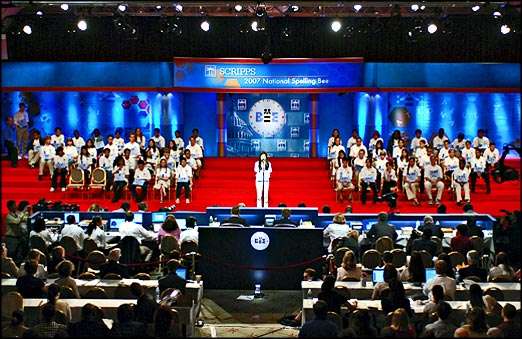 Today I found out what the “bee” in “spelling bee” means.
While no one knows exactly where the word derives from, the “bee” in “spelling bee” simply means something to the effect of “gathering” or “get together”. The earliest documented case of this word appearing with this meaning was in 1769, referring to a “spinning bee”, where people would gather to protest purchasing goods from Britain due to the high taxes on those items.
Other gatherings that were commonly labeled with “bee” were: apple bee, logging bee, quilting bee, barn bee, hanging bee, sewing bee, field bee, and corn husking bee, among others. Basically, any sort of major competition or work gathering, with a specific task in mind tended to get the “bee” label added on the end. With many of these bees being tedious work events, it was also customary to serve refreshments and provide entertainment at the end of the task.
The first documented case of a spelling bee called such was in 1825. However, it is likely that there were spelling bees before this date. This was simply the first time someone seems to have written down in print that has survived to today “spelling bee”.
There are a variety of theories as to where this word derives from. It was long thought that it simply came from the similarity between insect bees working together towards a specific task and a gathering of people to accomplish some task. However, this etymology has no specific documented evidence to support it; rather, simply stems from making a logical leap.
The popular theory among etymologists today is that it is more likely that the actual origin of “bee”, in the sense of “gathering”, derives from the Old English bēn (prayer / favor). This, in turn, gave rise to the Middle English “bene”, which had more or less the same meaning as bēn except now adding “an extra service by a tenant to his lord”. Finally, this resulted in “bean” meaning “help given by neighbors”. The British dialectic version of this word is then “bee”.
source:::: today i foundout .com
natarajan
The Riddle That 80% of Kindergartners Answered Correctly, but Only 17% of Stanford Seniors Got Right-Fiction!
e rumor…
A simple riddle with a simple answer that was allegedly reported on Paul Harvey…and that Kindergartners answered more correctly than university seniors.
The Truth
The riddle has been around for a long time, but there is no evidence that research was ever conducted on the comparative answers of Kindergartners and Stanford University seniors.
There is also no evidence that this was reported on Paul Harvey.
The riddle:
What is greater than God, More evil than the devil, The poor have it,
The rich don’t need it, And if you eat it, you’ll die?
The answer to the riddle is “nothing.”
Nothing is greater than God.
Nothing is more evil than the Devil.
The poor have nothing.
The rich need nothing.
And if you eat nothing, you’ll die.
A real example of the eRumor as it has appeared on the Internet:
Paul Harvey RIDDLE:
When asked this riddle, 80% of kindergarten kids got the answer,
compared to 17% of Stanford University seniors.
What is greater than God, More evil than the devil, The poor have it,
The rich need it, And if you eat it, you’ll die?
source ::::truth or fiction.com
natarajan
The word geek, once used as a slurto describe a person with unfashionable interests or a social misfit, has now been declared the ‘word of the year’ by the Collins online dictionary.
The dictionary has also changed the definition of geek to “a person who is very knowledgeable and enthusiastic about a specific subject.”
Collins has already added ‘geekery’, ‘geek chic’ and ‘geekdom’ to the dictionary’s fold.
While ‘geek chic’ refers to a fashion style believed to be characteristic of geeks, ‘geekery’ means preoccupation with, or great knowledge about, a subject, according to the the dictionary.
“For those of us born into a pre-internet world ‘geek’ meant ‘a boring and unattractive social misfit – who tends to smell slightly gamey at close quarters,” the dictionary said on its website.
“But times change, even if we don’t change with them and what Collins first included as a secondary definition in 2003 – ‘A person who is preoccupied with or very knowledgeable about computing’ – has long since overtaken the original.
“Now the meaning has changed again and the new definition will read ‘a person who is knowledgeable and enthusiastic about a specific subject’,” Collins said on its website.
Last month, Oxford Dictionaries named selfie – “a photograph that one has taken of oneself, typically one taken with a smartphone or webcam and uploaded to a social media website” as the word of the year.
Geek has seen an interesting transformation in meaning over the last couple of decades.
According to Oxford Dictionaries, the word used to be a cruel and critical label attached to clever, but socially awkward, people – such as computer or science geeks.
However, in the 1990s, the computer industry helped many geeks to achieve great success, and the wider perception of geeks began to shift.
Source: silicon india net
natarajan
A “Must Watch” video link…
source:::::you tube..
natarajan

Uthradom Tirunal Marthanda Varma
Kerala lost one of the last links with its royal past with the passing away of Uthradom Tirunal Marthanda Varma, head of the royal family of erstwhile Travancore, in the early hours of Monday. 16 Dec.2013. . Mr. Varma, a witness to the transformation from imperial rule to a democratic polity, was a common presence in the social and cultural scene of the city.
He had stood guard over the age-old traditions, rites and rituals of Sree Padmanabhaswamy Temple ever since 1991, when he was anointed the trustee and “dasa” of the temple following the death of his elder brother and last sovereign of Travancore, Sree Chithira Tirunal Balarama Varma. Mr. Varma, born as the younger son of Maharani Sethuparvathi Bayi and Ravi Varma Koyi Thampuran on March 22, 1922, was educated in the Kowdiar Palace by a group of 14 tutors in various subjects. He later graduated from the then Travancore University with Economics, Politics and History as specialisations in 1943. He was the recipient of the Moncombu Aandi Iyer Gold Medal for the best student in Sanskrit.
source :::::Mahesh Krishnamurthy in Sage of Kanchi Blog and Youtube and The Hindu
natarajan


