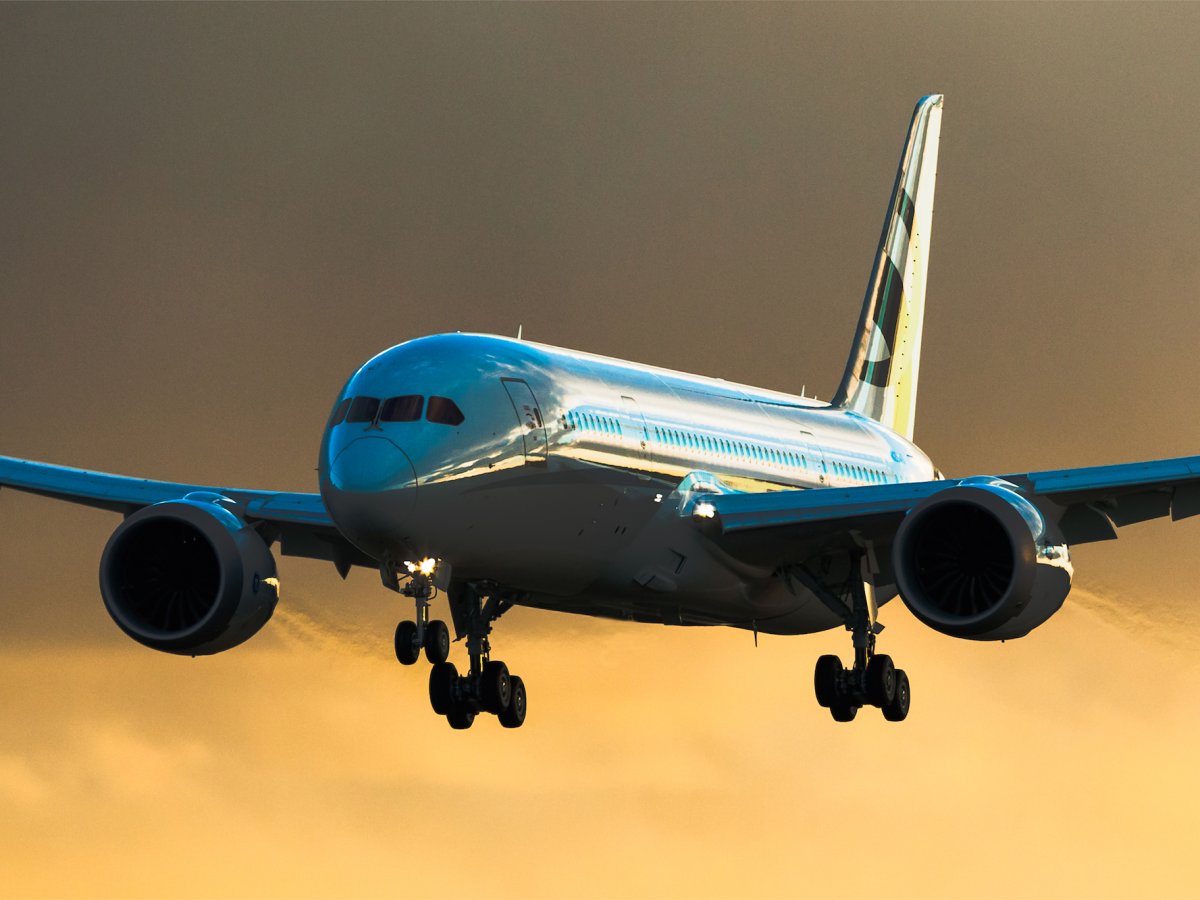
This $300 million airliner is the hottest new trend in private jets….

image

Kestrel Aviation Management   Boeing 787-8 BBJ.

In July, China’s HNA Aviation Group will welcome a shiny new Boeing 787-8 Dreamliner to its fleet.

This plane is special because it is the first 787 Dreamliner to be built purely as a private jet.

HNA’s new Dreamliner is symbolic of a hot new trend in private and corporate aviation — long-range, mid-size, wide-body airliners.

“It’s an emerging market that didn’t really exist in the past,” Kestrel Aviation Management CEO Stephen Vella told Business Insider. Kestrel oversaw the design, engineering, and fabrication of HNA’s new Dreamliner which has an estimated total cost topping $300 million.

Airbus and Boeing have long offered versions of its airliners to private customers under their Airbus Corporate Jet and Boeing Business Jet programs. However, buyers of these airliner-based private jets have long gravitated to either four-engine, jumbo jets like the Boeing 747 or smaller, narrow-body jets such as the Airbus A320.

“The market is traditionally separated into two buckets,” Vella said. “The big Boeing 747s and Airbus A340s primarily catered to heads of state while the smaller Airbus A320 and Boeing 737s are popular corporate runabouts as well as secondary planes in government fleets.”
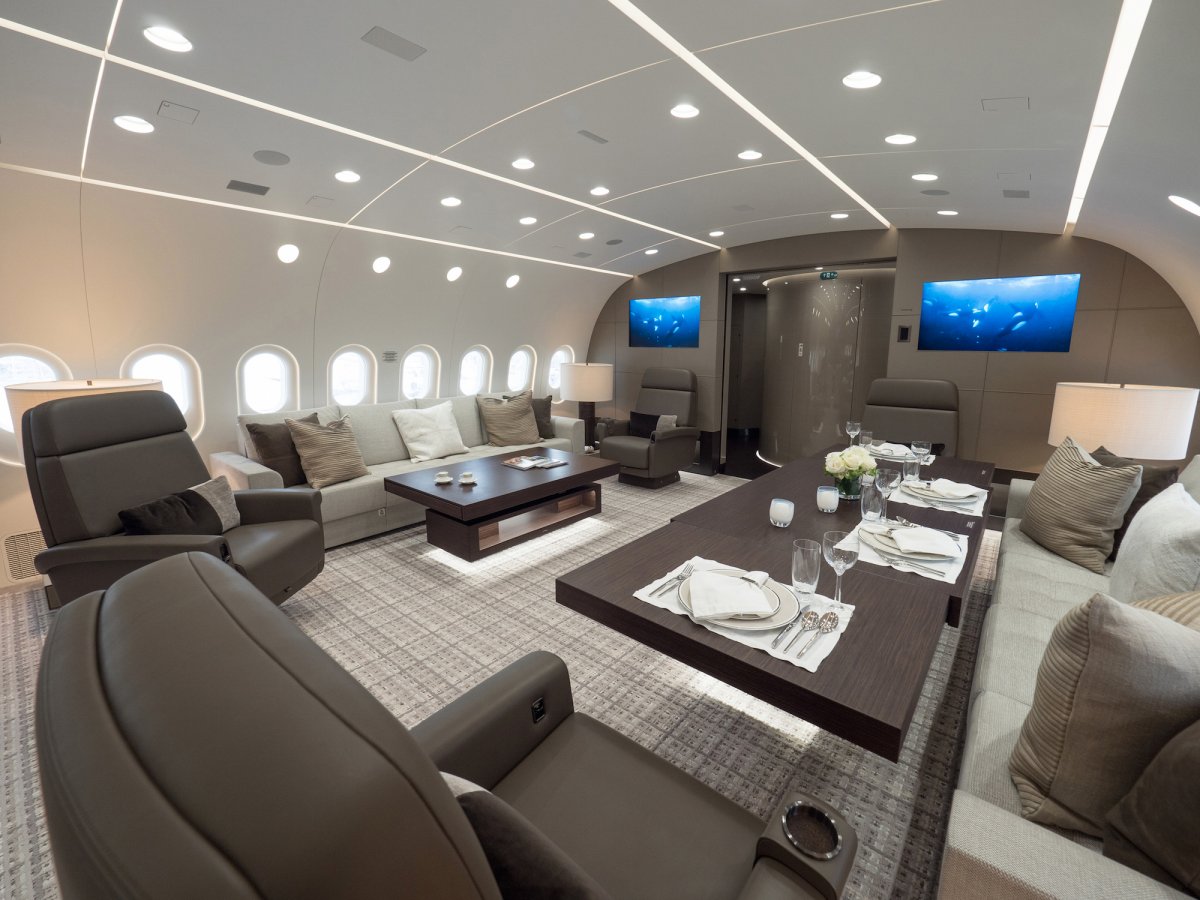
image (1)


Boeing 787-8 BBJ interior.

Although twin-engine, mid-size, wide-body jets such as the Boeing 767 and the Airbus A330 have long been available, they never quite caught on with the private jet crowd.

However, in recently years, ultra high-end private jet customers have become increasingly interested in the new generation mid-size, wide-body planes such as the Dreamliner and Airbus A350.

What’s changed?

According to Vella, several factors led to the shift.

First, leading business men and heads of state are generally pressed for time. As a result, they prefer be to able to fly anywhere they need to go non-stop. Until recently, this simply wasn’t possible in a twin-engined jet. The traditional thinking in the aviation dictates that there’s safety in the number of engines a plane has.

Regulating bodies such as the US Federal Aviation Administration have even placed limits on which ultra-long-range intercontinental routes twin-engine jets can fly. As a result, government and corporate clients looking for a plane which the range and capability to go anywhere in the world had to turn to four-engined jumbos.

However, with the incredible reliability of modern turbofan engines, the regulatory limitations on twin-engined jets have essentially been wiped out. Now, planes such as the A350 and the 787 can fly anywhere the owner requires, but in a slightly smaller and more affordable package. For instance, HNA’s new state-of-the-art composite Boeing has a range of 9,800 miles even when packed with passengers, luggage, and fuel. A similarly outfitted A350 ACJ will be able to delivery that type performance as well.

“You can fly between virtually any two points on the globe,” Vella said of the Dreamliner.

Secondly, the price of crude oil has fallen dramatically over the past two years. Even though cheaper fuel makes buying and operating a thirsty, four-engined, jumbo jet much more attractive, low crude prices have also cut dramatically into the income of Middle Eastern governments. Unfortunately for the 747 BBJ, they are also some of the plane’s biggest customers.

According to Vella, all major Middle Eastern governments such as Saudi Arabia, operate large royal fleets, many of which are jumbo jets, for elite members of the ruling family and officials to use.

Over the next decade or so, these fleets with need to be updated. Vella, whose company has bought and sold more than $50 billion worth of commercial and private jets, believes the Middle Eastern clientele are ready to do some belt-tightening and downsize to smaller planes.

Finally, another factor that has benefited the Dreamliner-sized jet is the increasing public sensitivity towards political largess. Unlike the US, where the plane that operates as Air Force One is held in high esteem and seen as a symbol of national power, the public in many countries view a large presidential aircraft as a sign of political over indulgence.

According to Vella, this is a particularly sensitive issue in Europe. However, a smaller aircraft with the performance capabilities of a jumbo, but in a less attention-getting package is a reasonable alternative.

“The mid-size jets have less ramp presence,” Vella said. “They offer the owner much more discretion.”

After all, it’s hard to arrive discretely in a jumbo jet no matter where you go. Even at the world’s busiest international airports, an aircraft the size of a 747 or Airbus A380 is conspicuous.

But all of this requires some perspective. Even the “smaller” 787 BBJ is still an absolutely massive aircraft. At 186 ft. long, even Donald Trump’s converted Boeing 757 is dwarfed by the new Dreamliner. And with 2,400 sq. ft. of living space, it offers the same amount of room as an average American suburban home.

What’s coming

According to the long-time aviation executive, over the next 15-20 years, demand from just the Middle East for Boeing 787-sized private jets will top 30 aircraft. That may not sound like many planes, but at more than $300 million a pop, that’s about $10 billion in business from just a handful of customers.

In fact, Vella believes demand from East Asia will be just as intense over that period of time.

“Because of the high number of long distance and (trans-oceanic) flights the customers make, these are the perfect planes for Asia,” Vella added.

Whether the market for these mid-size, twin-engine wide-body private jets actually skyrockets remain to be seen. But with the unprecedented level of advanced technology, luxury, and performance it can offer, they are an undeniably attractive option for the right buyer.

Source…..BENJAMIN ZHANG   in http://www.businessinsider.com.au

Natarajan

Worlds Safest Airlines …Top 20….” Qantas is in Top of the list for the 3rd Year ” …

qantasjessrqst

Nervous flyer?  Just want to know you’re traveling with a reliable airline? Find out who are the world’s safest airlines.

AirlineRatings.com, the world’s only safety and product rating website, which was launched in June 2013, has announced its top twenty safest airlines and top ten safest low cost airlines for 2016 from the 407 it monitors.

Top of the list for the third year is Australia’s Qantas, which has a fatality free record in the jet era – an extraordinary record. Making up the remainder of the top twenty in alphabetical order are: Air New Zealand, Alaska Airlines, All Nippon Airlines, American Airlines, Cathay Pacific Airways, Emirates, Etihad Airways, EVA Air, Finnair, Hawaiian Airlines, Japan Airlines, KLM, Lufthansa, Scandinavian Airline System, Singapore Airlines, Swiss, United Airlines, Virgin Atlantic and Virgin Australia.

AirlineRatings.com’s rating system takes into account a range of factors related to audits from aviation’s governing bodies and lead associations as well as government audits and the airline’s fatality record. AirlineRating.com’s editorial team, one of the world’s most awarded and experienced, also examined each airline’s operational history, incident records and operational excellence to arrive at its top twenty safest airlines.

The AirlineRatings.com top twenty have always been at the forefront of safety innovation and launching of new aircraft and these airlines have become a byword for excellence. Responding to public interest, the AirlineRatings.com editors also identified their top ten safest low cost airlines.

They are in alphabetical order: Aer Lingus, Flybe, HK Express, Jetblue, Jetstar AustraliaThomas Cook, TUI Fly, Virgin AmericaVolaris and Westjet.

Unlike a number of low cost carriers, these airlines have all passed the stringent International Air Transport Association Operational Safety Audit (IOSA) and have excellent safety records.
Of the 407 airlines surveyed, 148 have the top seven-star safety ranking but almost 50 have just three stars or less. There are 10 airlines with only one star and these airlines are from Indonesia, Nepal and Surinam.

In selecting Qantas as the world’s safest airline AirlineRatings.com editors noted that over its 95-year history the world’s oldest continuously operating airline has amassed an extraordinary record of firsts in operations and safety and is now accepted as the industry’s most experienced carrier.

The Australian airline has been a leader in: the development of the Future Air Navigation System; the Flight Data Recorder to monitor plane and later crew performance; automatic landings using Global Navigation Satellite System as well as precision approaches around mountains in cloud using RNP. Qantas was the lead airline with real time monitoring of its engines across its fleet using satellite communications, which has enabled the airline to detect problems before they become a major safety issue.

Last year was a disturbing year for airline safety with some tragic and bizarre accidents such as the high profile GermanWings and Metrojet disasters. However according to Aviation-Safety.net data, the 16 accidents in 2015 with 560 fatalities were below the 10-year average of 31 accidents and 714 fatalities. Last year was also a significant improvement over 2014 when there were 21 fatal accidents with 986 fatalities.

Balancing these numbers the world’s airlines carried a record 3.6 billion passengers on 34 million flights in 2015.

Flashback 50 years and there were a staggering 87 crashes killing 1,597 when airlines carried only 141 million passengers – 5 per cent of today’s number.

– See more at: http://www.airlineratings.com/news/630/who-are-the-worlds-safest-airlines-for-2016#sthash.d2MKORhu.dpuf

Source….www.airlineratings.com

Natarajan

Image of the Day….. ” Mars thro’ Hubble Space telescope “…..!!!


New Hubble image of Mars

New Hubble Space Telescope image of Mars, in honor of the planet’s May 22 opposition, when our planet Earth will sweep between the Red Planet and the sun.

View larger. | Mars, as it was observed by the Hubble Space Telescope on May 12, 2016, shortly before its opposition on May 22. Read more about this image from Hubble. Image via NASA, ESA, Hubble Heritage Team, J. Bell, M. Wolff.

On May 19, 2016, the Hubble Space Telescope released this new image of Mars. It’s in honor of the upcoming passage of Earth between Mars and the sun this weekend, when Mars will be closer and brighter than at any time in the last 10 years.

Mars’ nearness to Earth in our sky right now makes it appear each evening as a very bright reddish “star.” It’s ascending in the eastern sky each night as the sun is sinking below the western horizon.

Mars is lots of fun to view with the eye, and astrophotographers around the globe will be trying to captured its photo. Follow the links below to learn more about this 2016 opposition of Mars and remember to watch for it!                                                             Mars-2016-Hubble-e1463679260844

source…..www.earthsky.org

Natarajan


World’s First UFO Landing Pad, and the First Landing….!!!

St. Paul, Alberta, a small town in east-central Alberta, Canada has the world’s first official UFO Landing Pad which was built in 1967 to celebrate Canada’s centennial. The 130 ton concrete structure consists of a raised platform with a map of Canada embossed on the back stop, consisting of stones provided by each province of Canada. The pad also contains a time capsule to be opened on the 100-year anniversary of the pad’s opening in 2067. A sign beside the pad reads:

The area under the World’s First UFO Landing Pad was designated international by the Town of St. Paul as a symbol of our faith that mankind will maintain the outer universe free from national wars and strife. That future travel in space will be safe for all intergalactic beings, all visitors from earth or otherwise are welcome to this territory and to the Town of St. Paul.

Source….www.amusimgplanet.com….Natarajan

ufo-landing-pad (3)[6]

Image of the Day…” Where Red Mars looks Blue …” !!!

Where red Mars looks blue

Most images of Mars show colors homogenized by red dust and regolith. This infrared-red-blue color image shows Mars’ bedrock … and many colors.


Mars is the red planet, but it turns out that many images we see of it show Mars’ colors ashomogenized by the this world’s reddish dust and regolith. This new image from the HiRISE camera on NASA’s Mars Reconnaissance Orbiter – taken on February 5, 2016 – shows fantastic colors on Mars.

HiRISE stands for High Resolution Imaging Science Experiment, and the camera team explained:

Here the bedrock is very well exposed, except where there are sand dunes.

The rocks also have diverse compositions, which produce different colors in HiRISE infrared-red-blue color images.

View larger. | The Nili Fossae region on Mars – one of Mars’ most colorful places – located on the northwest rim of Isidis impact basin. Image via NASA/JPL-Caltech/Univ. of Arizona.


mars-blue-Nili-Fossae-region-2016-Mars-Reconnaissance-Orbiter-1-e1462717138291 Source…www.earthsky.org

Natarajan

Image of the Day….”Airplane crossing Sun’s face …” !!!


While preparing on Sunday to watch today’s transit – an event Mercury crosses the face of our sun – Helio C. Vital caught an airplane doing the same.

Photo taken May 8, 2016 by Helio C. Vital.

Helio C. Vital in Rio de Janeiro, Brazil, wrote late Sunday night:

Brazil will be in the front row to watch the whole transit of Mercury on Monday.

This photo shows the sun less than 16 hours before Mercury starts to pass in front of our vital star. To make things even more exciting, as I was filming the sun in preparation for Monday’s rare event, a plane just happened to transit it, like Mercury will be doing. How nice!

Source……..www.earthsky.org

Natarajan


888ae0af-febf-4073-8f12-78d41f0fe638

Image of the Day… Morning Sunglint Over the Pacific…!!!

Sunglint and clouds over the ocean photographed from low Earth orbit

This Earth observation composite image from the International Space Station captures morning sunglint and low clouds over the central Pacific Ocean. The image was put together at the Johnson Space Center in Houston, from a series of photographs taken by Expedition 47 Commander Jeff Williams on March 25, 2016.

Image Credit: NASA

source….www.nasa.gov

Natarajan

The story of the World War II gunner who fell 22,000 feet without a parachute and lived…

Paratroopers make a big deal about jumping out of planes from 800 feet, but U.S. Army Air Force Staff Sgt. Alan Magee fell out of a plane at 22,000 feet without a parachute while the plane was on fire.

And he lived.

ball turret gunner

Magee was a ball turret gunner in a B-17 named “Snap! Crackle! Pop!” after the three mascots for Rice Krispies cereal. That plane, along with others from the 360th Squadron, was sent to bomb German torpedo stores in St. Nazaire, France on Jan. 3, 1943.

During the mission, the plane was shot by anti-aircraft guns and became a ball of flames. Magee climbed into the fuselage to get his chute and bail out, but it had been shredded by the flak. As Magee was trying to figure out a new plan, a second flak burst tore through the aircraft and then a fighter blasted it with machine gun fire.

b17 bomber liberty belle


Magee was knocked unconscious and thrown from the aircraft. When he woke up, he was falling through the air with nothing but a prayer.

Magee told God, “I don’t wish to die because I know nothing of life,” according to reports from the 303rd Bomb Group.

Magee, struggling with a shortage of oxygen and likely in shock from the events of the past few minutes, passed out again and God seemingly answered his prayer. The young noncommissioned officer fell into the town of St. Nazaire and through the glass roof of the train station. He was later found dangling on the steel girders that supported the ceiling.

The glass had slowed his fall and he regained consciousness as German soldiers took him to medical care. Magee’s right leg and ankle were broken, he had 28 wounds from shrapnel and glass, and his right arm was cut nearly the whole way off. He had also suffered numerous internal injuries.

“I owe the German military doctor who treated me a debt of gratitude,” Magee said. “He told me, ‘we are enemies, but I am first a doctor and I will do my best to save your arm.'”

GErman prison camp wwii

French POWs at work at a farm in Westscheid bei Mennighüffen.

Magee was able to keep his arm and eventually made a full recovery. He spent most of the rest of the war as a POW.

In 1995, Magee was invited back to France as part of a ceremony sponsored by French citizens to thank Allied service members for their efforts in the war. Magee was able to see monuments to the crew of Snap! Crackle! Pop!, including the nose art which had been used as a Nazi trophy until after the war when a French man recovered it. It was restored in 1989.

Magee died in 2003.

Read the original article on We Are The Mighty. Copyright 2016. Follow We Are The Mighty on Twitter.

Source….www.businessinsider.com

Natarajan

Image of the Day…” Liftoff at NASA’s 16th Annual Student Launch Challenge…”

Liftoff of one of dozens of high-powered rockets during the 16th annual Student Launch challenge, April 16, near NASA Marshall

One of dozens of high-powered rockets lifts off on April 16, 2016, during NASA’s 16th annual Student Launch challenge, held near Marshall Space Flight Center in Huntsville, Alabama from April 13-16.

Nearly 50 middle and high school, college and university teams from 22 states competed in the challenge, demonstrating advanced aerospace and engineering skills related to real-world activities and programs on NASA’s Journey to Mars. Teams spent the past eight months building and testing rockets designed to fly to an altitude of one mile, deploy an automated parachute system, and land safe enough for reuse, while other teams also designed scientific payloads for data collection during flight.

Preliminary winners for Student Launch were announced during an awards ceremony April 16, at the U.S. Space & Rocket Center in Huntsville, and hosted by Orbital ATK. The overall winners of Student Launch will be announced in early May, as the final calculations are still under review for accuracy.

Image Credit: NASA/MSFC/Charles Beason

 Source……..www.nasa.gov
Natarajan

Image of the Day…Mars Rover Opportunity up high ….!!!

Mars rover up high, spies a dust devil

After making the steep-ever climb of any rover on Mars, Opportunity looked back along its own tracks toward a swirling Martian dust devil in the valley below.

From its perch high on a ridge, NASA's Mars Exploration Rover Opportunity recorded this image of a Martian dust devil twisting through the valley below. The view looks back at the rover's tracks leading up the north-facing slope of

View larger. | From high on a ridge, NASA’s Mars rover Opportunity recorded this image of a swirling Martian dust devil on March 31. Image via NASA/JPL-Caltech.

During its recent uphill drive to the top of Knudsen Ridge on Mars, the tilt of the Mars Opportunity rover reached 32 degrees, the steepest-ever for any rover on Mars. In this image – taken on March 31, 2016, the 4,332nd Martian day, or sol, of the rover’s work on Mars – you’re looking backwards along the rover’s tracks, with its camera aimed toward a dust devil twisting through the valley below.

In the image, the rover – which was launched from Earth in 2003 – has just climbed the north-facing slope of Knudsen Ridge on Mars. The ridge forms part of the southern edge of Marathon Valley.

Why is NASA’s image in black and white, by the way? It’s because it was taken with the Navcam on Opportunity, a camera that’s essential for enabling the rover to make its way across the surface of this alien world … but which doesn’t have a color camera.

Look below to see how artist Don Davis remedied the lack of color with some processing here on Earth:

Color-processed view of Opportunity's great dust devil shot, by artist Don Davis.  Read more about this image on Davis' Facebook page.

Color view of Opportunity’s great dust devil shot, by artist Don Davis. Read more on Davis’ Facebook page.

NASA commented:

Dust devils were a common sight for Opportunity’s twin rover, Spirit, in its outpost at Gusev Crater, but Opportunity has seen them only rarely.

Just as on Earth, a dust devil is created by a rising, rotating column of hot air. When the column whirls fast enough, it picks up tiny grains of dust from the ground, making the vortex visible.

Artist's concept of the rover Opportunity on Mars. This rover - and its twin rover Spirit - were launched from Earth in 2003. Image via NASA

Artist’s concept of the rover Opportunity on Mars. This rover – and its twin rover Spirit – were launched from Earth in 2003. Image via NASA

Bottom line: Mars Opportunity rover image of a dust devil, from a perch on Knudsen Ridge on Mars, part of the southern edge of Marathon Valley, acquired on March 31, 2016, the 4,332nd Martian day, or sol, of the rover’s work on Mars.

Source….www.earthsky.org

Natarajan