Airbus Beluga …. World”s Weirdest Looking Plane !!!

Airbus’ Beluga celebrates 20 years in the air

IT’S the world’s weirdest looking aircraft. The aptly named Airbus Beluga, also known as the A300-600ST Super Transporter, is the whale of the skies and provides a unique way of transporting oversized cargo.

Developed to carry sections of Airbus aircraft from different production sites around Europe to their finally assembly line in Toulouse, France and Hamburg, it is also used to transport special delivery items.

The fleet of five Beluga aircraft perform more than 60 flights each week and each plane can carry a load of 47 tonnes over a range of 1667 kilometres.

This is how you transport your oversized luggage.

This is how you transport your oversized luggage. Source: AP

Its special cargo has included a famous painting from the Musee du Louvres in Paris to Tokyo, helicopters to Australia and a 17.6 metre long chemical tank weighing 39 tonnes.

Space hardware manufacturers also use the Beluga for transporting its space station modules, launch vehicle hardware and delicate satellites as the aircraft can provide temperature controlled conditions for its sensitive cargo.

The Beluga is operated by a three-member crew including two pilots and a loadmaster and has one of the biggest cargo holds of any civil or military aircraft flying today.

Transporting the tail piece of a China Southern plane. Picture: Airbus.

Transporting the tail piece of a China Southern plane. Picture: Airbus. Source: Supplied

The specially designed plane is used to transport military equipment. Picture: Airbus.

The specially designed plane is used to transport military equipment. Picture: Airbus. Source: Supplied

Just a little top heavy. Picture: Airbus.

Just a little top heavy. Picture: Airbus. Source: Supplied

It is specially used for transporting spacecraft. Picture: Airbus.

It is specially used for transporting spacecraft. Picture: Airbus. Source: Supplied

Inside the Beluga sits an aircraft tail piece. Picture: Airbus.

Inside the Beluga sits an aircraft tail piece. Picture: Airbus. Source: Supplied

Aircraft pieces arriving at Toulouse, France. Picture: Airbus.

Aircraft pieces arriving at Toulouse, France. Picture: Airbus. Source: Supplied

A plane inside a plane.

A plane inside a plane. Source: AFP   

SOURCE::: news.com.au

Natarajan

Message For the Day…” See Yourself as Your Self Unrelated To Others or Objects…”

Arjuna entered the battlefield, fully equipped and fanatically determined to destroy his enemies. But when he took his position in the battlefield, he saw ‘my teachers’, ‘my grandfather’, ‘my kinsmen’, ‘my cousins’, etc. and he was moved so much by this sense of ‘I’ and ‘mine’ that he discarded the bow and desired to return to the forest and beg for the rest of his life, than fight the war. The ‘I’ that has really nothing to do with earthly possessions, blinded him. Lord Krishna taught Bhagavad Gita and removed this delusion (moha). The lesson for you is “Be unmoved by duality”. Let not defeat or success affect your inner calm and inner joy. See yourself as your Self unrelated to others or the objective world. When you know your real Self, you are liberated! That is Moksha. Liberation (Moksha) is not a five-star HOTEL or a deluxe resort. It is just the awareness of your reality and the rejection of all contrary conceptions.  

Sathya Sai Baba


” No Need for India to Knock at the Doors of Elite Space Club …” !!!

The ‘New York Times’ Publishes Racist Comic About India’s Space

Mission

Last week, India became the first Asian nation to reach Mars, and the first in the world to do so on its first attempt.

The spacecraft called Mars Orbiter Mission (MOM) in English and “Mangalyaan” or “mars craft” in Hindi was launched in November and reached the orbit on Wednesday, to much jubilation from the public.

India’s first interplanetary mission is all the more creditable because, at $72 million, Mangalyaan cost just a fraction of NASA’s $670 million Maven, and $2 billion Curiosity Rover. It also cost less than to produce the film Gravity, and at Rs.7 or 11 cents, per kilometer, cost less than the per-kilometer cost of commuting by autorickshaw in most Indian cities.

So yesterday’s New York Times’ comic by Heng, titled “India’s budget mission to Mars” seems in poor taste.

2014-09-29-racistcomic.jpg

The comic depicts a poor Indian farmer in traditional garb, accompanied by a bored-looking cow, eagerly knocking on the door of “Elite Space Club”. The two people in the elite space club drinking wine and reading about India’s mission in the papers look perturbed and hesitant to open the door. It is also worth noting that the members of the elite space club are male, white, elderly and look wealthy. Whether meant to be funny or ironic, the racial, national and classist stereotyping is apparent.

In reaching Mars, the Indian Space Research Organization (ISRO) joins the ranks of Soviet space program, NASA and European Space Agency. It not only did so on a budget, but also battling “brain drain“. It’s a commonly lamented problem that many of the country’s brightest scientists and engineers end up working internationally, and tend to shy away from research in India, especially an area like space research, because it’s not as lucrative.

The comic strip comes at the time of Indian Prime Minister, Narendra Modi’s maiden visit to the United States. Addressing a 20,000 strong crowd at Manhattan’s iconic Madison Square Garden yesterday, he emphasized India’s new role on the world stage and its growing economic clout. “When people ask if we still play with snakes in our country, I tell them that now we play with the mouse,” Mr Modi said, drawing attention to the changing stereotype of India from a nation of snake charmers to one of technical prowess.

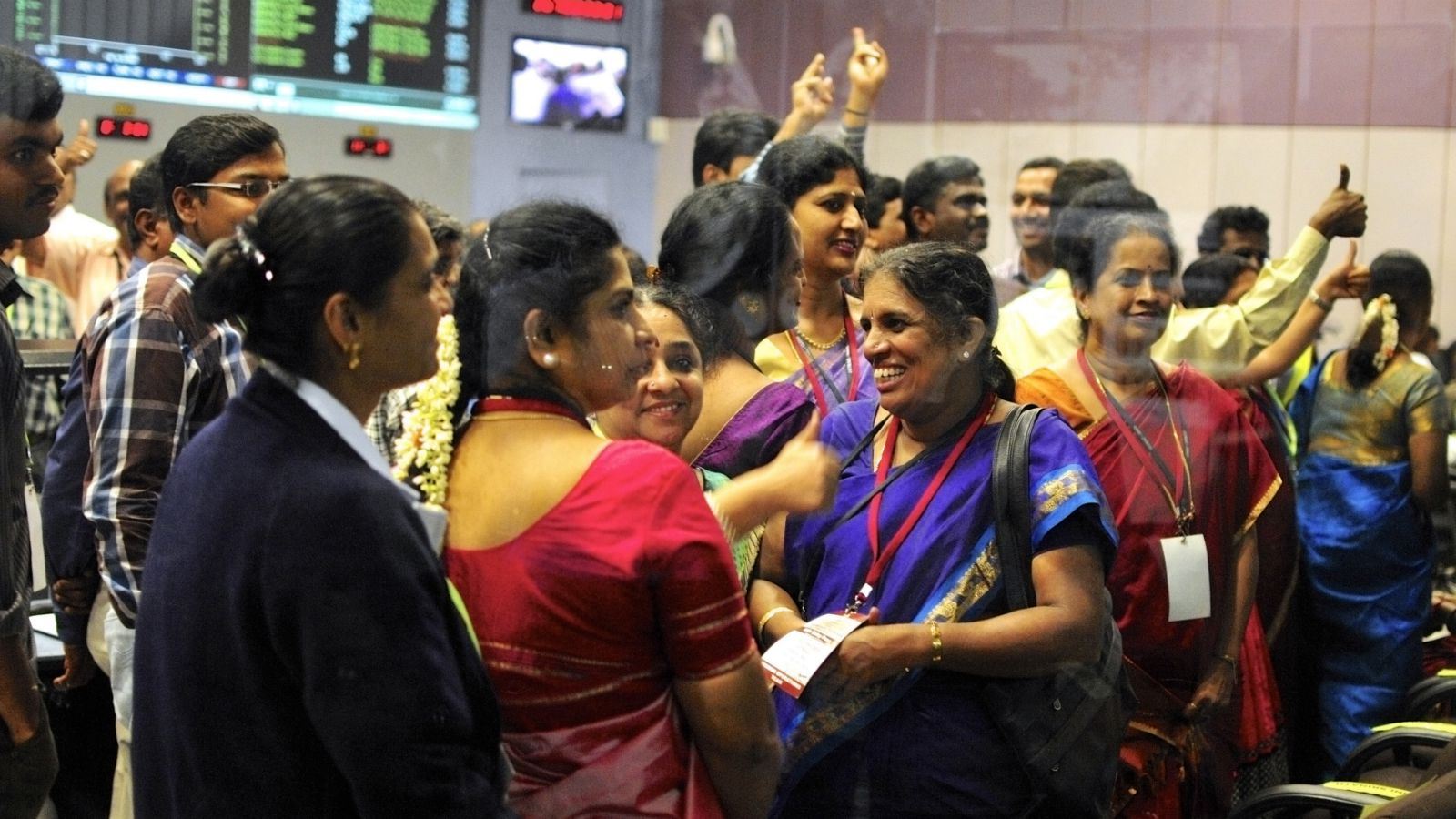
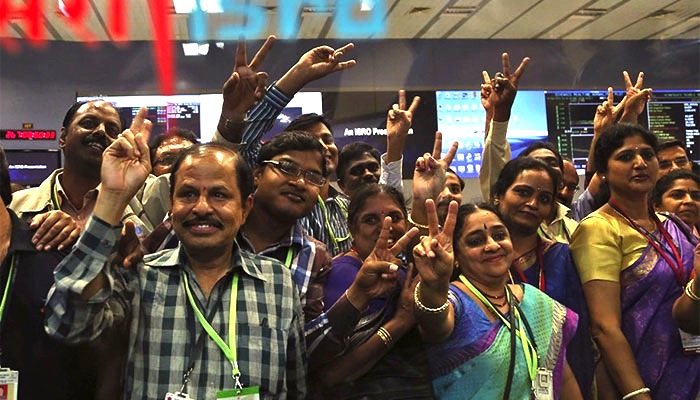
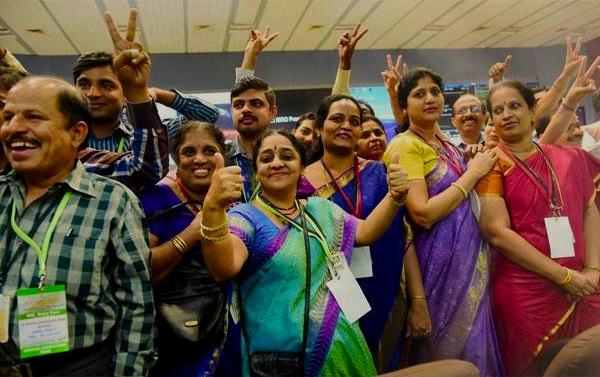
In case the Times is wondering what interplanetary-mission-heading Indian scientists look like then here you go, this is what they look like:

2014-09-29-isroscientists.jpg

And this:

2014-09-29-isro2.jpg

And this:

2014-09-29-isro3.jpg

The male engineers are wearing Western gear, while some of the female engineers are rocking traditional silk saris, the kind usually worn on special occasions, and jasmine flowers in their hair. On regular days, they work in full suits. There are no farm animals in sight at the ISRO office. And they certainly don’t look desperate for membership into some secret elite club. In fact, their jubilance says it all.

See, there are lots of socially and economically elite people in the world — being elite is like winning the lottery. But only a handful of human beings in history can claim to have sent a spaceship to another planet. That is brilliance and merit. That is actualizing human potential and literally moving humanity forward — like inventing the wheel, or, you know, sending a spaceship to Mars. One doesn’t have to be a rocket scientist to understand that.

SOURCE::::   IN  http://www.huffingtonpost.com/  

NATARAJAN

Management Lessons From India’s MANGALYAAN …

Management lessons from Isro’s Mangalyaan

India’s Polar Satellite Launch Vehicle, carrying the Mars orbiter, takes off from Sriharikota. Photo: Reuters/Isro

The resounding success of India’s Mars mission holds many lessons. Experts discuss the learning from the way the Indian Space Research Organisation (Isro) put its craft in the Mars orbit. Make a quality product R.D. Chandak, managing director and chief executive officer, KEC International The successful Mars Orbiter Mission, or the Mangalyaan, by Isro has many lessons for Indian manufacturers, says Chandak. The mission has shown that Indian companies can make a quality product at a competitive price, he says. To make India a manufacturing hub, Indian companies will have to make quality products on time, manage the logistics and produce at a very competitive cost, adds Chandak. Building the right team to deliver such projects is important. “Selecting the right team just doesn’t mean selecting the most qualified people; it also means selecting highly committed people,” he says. Teams also need to be empowered so that they can take critical decisions and ensure timely delivery of the project, he adds. Innovation is another major learning from the Mars mission. “Innovations need not be big advances in technology, but many small ones such as those that help reduce costs are important for corporates,” says Chandak. Every project has a certain amount of risk involved, and identifying the risks and managing them is important, he says. Time management, which is of paramount importance when executing such a project, is another lesson. “India wanted to send the Mars orbiter before China could. Having achieved the mission in a very strict time frame, it is a big example for Indian corporates in project management,” adds Chandak. It is also important for companies to learn not only from their own mistakes, but also from the mistakes of others, he says. Encourage team work Vinamra Shastri, partner, Grant Thornton India The scope of what a firm’s management can learn from the Mangalyaan project is very vast, says Shastri. However, there are a few takeaways that stand out. The mission became successful due to the collective effort and intelligence of stakeholders, not their individual genius, he says. Similarly, companies should consider encouraging teamwork and collaboration rather than pursuing individuals. “Every organization has people with different aptitude and skills. It is the responsibility of the senior leadership to ensure that they identify competencies and encourage teamwork,” says Shastri, adding the management should focus not only on the high performers, as different perspectives will only lead to more informed decision-making, resulting in better chances of success. Having a higher purpose for being in business is yet another key element, differentiating companies. Organizational goals should have a “higher purpose”—something which is unique and relevant, with which every stakeholder can relate to and have an emotional connect. A great example, he says, is the Tata group that has achieved more than its business goals. It stands for trust and responsibility. Similarly, the Mangalyaan project was launched not just to put India ahead of others in space research. Again, while Indian culture is appreciated on a personal or family level, the culture followed by Indian firms is often criticized by many. Mangalyaan could not be managed so efficiently within the specified time frame if the Indian Space Research Organisation did not have the right work culture, says Shastri. “(Management guru) Peter Drucker has said culture eats strategy for breakfast. Strategies formulated can only be executed when the work culture is conducive,” he adds. Plan for success, not failure K.G. Vishwanath, independent consultant The first lesson for Indian companies from the Mangalyaan Mars orbiter is to plan for success, not failure, says K.G. Vishwanath, an independent consultant and former Jet Airways (India) Ltd vice-president (investor relations). Vishwanath was part of the Jet Airways team that struck a deal to sell a 24% stake in the airline to Etihad Airways PJSC for $379 million. “Secondly, Isro had planned its production units across the country meticulously and tapped the best talent accompanied by the best planning tools,” he says. “They were not ready for taking any chances. They were planning not to fail. This is an inspiring lesson for any company and their boards.” Vishwanath says the third key lesson was about teamwork while handling egos. “Isro put all the team into one with a single objective. When a company stands together as one to achieve an objective, nothing can stop them and Mangalyaan proves that,” he says. He observes that choosing a team was purely based on merits irrespective of gender differences. “They just stood as one to accomplish the objectives,” he adds. “The last lesson is about passion. If you are doing anything, do it with passion. There are several examples of companies that have succeeded in the toughest MARKET conditions by showing inimitable passion,” he says. “Not to forget, Mangalyaan was accomplished with the lowest cost. It proves that while focusing on cheap cost, quality can still be maintained. Indigenous manufacturing means superior quality. That’s what we need now at a time when the nation is building a manufacturing base competing with China,” Vishwanath adds.

Read more at: http://www.livemint.com/Specials/3Y72VG1WlFbM5lBv7N1hSJ/Management-lessons-from-Isros-Mangalyaan.html?utm_source=copy

Source:::: Livemint.com

NATARAJAN

” What a Brilliant Way to Communicate an Important Message ” !!!


Kudos Volkswagen. What a brilliant way to communicate how risky it is to use mobile phones while driving.

 Everyone needs to see this one – WORTH SHOWING TO THE WHOLE FAMILY
This is pretty awesome, and it only takes a second!
A Hong Kong movie theater asked its patrons to leave their cellphones ON as they entered the movie house. 
Then they ran an eye opening ad produced by Volkswagen.  

Source :::: You Tube

Natarajan

Joke of the Day…” Where is My Sunday Paper …? “

“WHERE is my SUNDAY paper?!”


The irate customer calling the newspaper office, loudly demanded to know where her Sunday edition was.

“Madam,” said the newspaper employee, “today is Saturday. The Sunday paper is not delivered until tomorrow, on SUNDAY!”

There was quite a long pause on the other end of the phone, followed by a ray of recognition as she was heard to mutter, …..

“Well, damn, that explains why no one was at church either.”

 Source::: Input from a friend of mine

Natarajan

Image of the Day…. Images of MARS sent by India”s MOM …

Mars and its atmosphere, seen by MOM spacecraft

Two early images from India’s MOM spacecraft. One shows an edge of Mars, with the planet’s tenuous atmosphere above. The other shows the whole planet. Beautiful!

India's Mars Orbiter Mission (MOM) captured this image of the

The world applauded India last week as its maiden interplanetary spacecraft – the Mars Orbiter Mission, or MOM – achieved orbit around the Red Planet. Here are some of the first images transmitted from MOM. At top, a gorgeous shot of the limb, or edge, of Mars with the tenuous Martian atmosphere silhouetted against the blackness of space. The Indian Space Research Organization (ISRO), India’s space agency, released this image on September 25, 2014, about a day after MOM arrived.

ISRO announced that MOM successfully entered into an orbit around planet Mars on September 24, 2014 at 7:30 a.m. India Standard Time (02:00 UTC; 20:00 EDT in the U.S. on September 23). MOM carries five instrument suite whose mission is to study the surface and atmosphere of Mars with a particular emphasis on measuring the methane in the Martian atmosphere: a key indicator of microbial life.

Image via Mars Orbiter Mission

Above is another beauty from MOM, acquired on September 28, 2014.

The Schiaparelli Basin (460 kilometers / 286 miles wide) is visible just below right, of dead center. To the left is the Meridiani Terra with Meridiani Planum where NASA’s Opportunity rover is still operating almost flawlessly after 10 years on Mars.

Oxia Palus is clearly visible as is Chryse Planitia where the Viking 1 lander touched down in July 1976 and also the Ares Vallis, where the Mars Pathfinder successfully landed in July 1997.

Syrtis Major is visible towards the right limb.

Bottom line: Here are some early images from India’s MOM spacecraft. One shows the limb of Mars, with its tenuous atmosphere above. The other shows the whole planet, with a dust storm visible in the planet’s northern hemisphere. Beautiful!

SOURCE:::: earth sky news

Natarajan

More Than ” An Apple A Day …” ….Other Benefits Of Apple one Should Know !!!

Apples are one of the world’s most favorite fruits, and it’s easy to see why: They’re delicious, healthy and come in a variety of colors and sizes. Did you know, however, that apples are also incredibly useful? Here are 13 more uses for apples that you possibly didn’t know:
Apples
1. Migraine Relief

If you suffer from migraines, you know that it’s hard to even describe the level of pain and discomfort caused by one. Recent studies show that smelling a green apple helps relieve some of the uneasiness caused by the migraine.

2. Prevent Sugar from Crystallizing

Brown sugar is much healthier (and arguably – tastier) than white sugar. The only problem with it, is that it tends to clump and crystalize. To prevent this from happening, put a piece of apple in a small fabric pouch and put it in the same container as the sugar. The apple will absorb the moisture that causes the clumping.

3. Accelerate Ripening of Fruits

Some fruits emit a gas called Ethylene that hastens the ripening of other fruits. If you want those avocados and bananas to be ready faster, put a whole apple next to them and it will do the job!

Apples
4. Preserve Baked Goods

Bread and cakes tend to dry out quickly, even when kept in sealed containers. To prevent them from drying out, put half an apple into the container you keep the pastry in!

5. General Cleaner

Instead of using those chemical-filled industrial cleaners, why not make your own effective, antiseptic, deodorizing cleaner? Simply mix equal amounts of apple-cider vinegar and water into a spray bottle, and there you have it!

6. Natural Sweetener

Apples are an excellent replacement for sugar, as they add their unique flavor without overpowering the dish/drink. Apples contain fructose, which is healthier than white sugar and even more than artificial sweeteners! Try adding grated apples to dishes instead of sugar and you’ll be amazed!

7. Facial Mask

Apples contain a structural heteropolysaccharide called Pectin, which helps your facial skin. To use it as a mask – grate it and mix with honey, then apply the mixture to your face. Let it sit for about 15-20 minutes, then wash it off.

Apples
8. Prevent Nausea

Many people suffer from motion sickness while riding in a car, but eating a green apple can help reduce the feeling of nausea.

9. Treat Allergies

Apples contain a chemical called Quercetin, which helps the immune system limit the amount of histamines it produces during an allergic reaction. Histamines are what causes the allergic symptoms, so reducing their amount will help ease your allergies.

10. Make a Fancy Drink

In recent years, flavored vodka has become quite popular, but its price can be much higher than of regular vodka. If you fancy some apple-flavored vodka, simply follow this recipe:

  • Cut some apples and put them in a sealable jar
  • Cover the apples in vodka, seal the jar and it let sit for a few days
  • If the taste is not yet to your liking, simply let it sit until it does
Apples
11. Doggy Treats

While there are many foods you shouldn’t give your dog, apples happen to be one of the healthiest and most recommended fruits for dogs. Apples are much healthier than processed dog-treats, but be sure to avoid giving your dog the core! Apple seeds contain cyanide which is very poisonous for humans and dogs alike.

12. Flea Treatment

Apple-cider vinegar is incredibly effective at getting rid of fleas. Mix equal amounts of water and vinegar, apply it to your pet’s fur and gently massage it into the skin. The vinegar will chase away the fleas quickly and effectively.

13. Fix Over-Salted Food

If you happen to add too-much salt to a dish you’re making, just cut a few pieces of apple and put them in the pot. The apple will absorb the salt without damaging the flavor of the dish.

Source: Emily H.

Joke of the Day…”Take a clean Plate …” !!!

Two bachelors, Larry and Frank were out to dinner. The conversation drifted from office, sports to politics and then to cooking. “I got a cook book once” said Larry. “But I couldn’t do anything with it.” “Too much fancy stuff in it, huh?” asked Frank. “You said it, Larry replied, nodding. “Every one of those recipes began the same way: “Take a clean plate…”

……………………………

A boy is about to go on his first date, and is nervous about what to talk about. He asks his father for advice. The father replies: “My son, there are three subjects that always work. These are food, family, and philosophy.”The boy picks up his date and they go to a soda fountain. Ice cream sodas in front of them, they stare at each other for a long time, as the boy’s nervousness builds. He remembers his father’s advice, and chooses the first topic. He asks the girl: “Do you like potato pancakes?” She says “No,” and the silence returns.

After a few more uncomfortable minutes, the boy thinks of his father’s suggestion and turns to the second item on the list. He asks, “Do you have a brother?” Again, the girl says “No” and there is silence once again.

The boy then plays his last card. He thinks of his father’s advice and asks the girl the following question: “If you had a brother, would he like potato pancakes?”

SOURCE::: Joke a day.com

Natarajan