The Leipzig/Halle Airport, sometimes called Schkeuditz Airport, is located in Schkeuditz, Germany and serves both Leipzig and Halle – two of the largest cities in the country. Lack of space required the modern airport terminal structure to spill over the adjacent motorway and railway that intersects the runway at right angles. To make room for the runway without affecting vehicular traffic on motorway A14 and rail traffic, three bridges were constructed over the motorway and the tracks, that allowed the parallel runways to extend to their full length of 3.6 km. These bridges are called Taxiways. Aircrafts would taxi on these taxiways at the time of takeoff and landing, while vehicles ply on the motorway below.
Taxiway E7 and E8 on the east are used as one way taxis and connect the terminal with the northern runway, while the third taxiway W1 in the west is used in both direction.
Potholes on the streets of almost all cities in India don’t just make our rides uncomfortable, but also cause fatal accidents. According to the Road Accident Report (2014) published by the Road Transport and Highways Ministry, 6,672 people lost their lives due to potholes and badly designed speed breakers last year.
However, if the ministry goes ahead with its latest proposal of using thermocol fill in place of soil as the base for construction, pothole complaints can soon be resolved.
In a meeting headed by Union Minister Nitin Gadkari last month, the ministry asked some consultancy firms to submit cost analysis report of the use of Geofoam for construction on highways, in comparison with the conventional soil fills. An expert committee was constituted earlier this year to recommend new materials for construction of highways.
Geofoam is primarily used to provide lightweight void fill on highways, during road constructions, for building embankments, parking lots constructions, etc. It is basically expanded polystyrene (EPS) or extruded polystyrene (XPS) manufactured into large lightweight blocks. Polystyrene is one of the most widely used plastics around the world. And EPS is a rigid closed-cell foam structure made of pre-expanded polystyrene beads. It is widely used for manufacturing daily utility goods like plates, boxes, bowls, packaging material, etc. XPS also consists of closed cells, and it provides higher stiffness to materials it is used in, like craft and architectural models.
Countries like Europe, Japan, and the US have been using Geofoam for road construction. In India, the Border Road Organization has been using it for constructing roads on difficult terrains. Geofoam requires less manpower as it is all about lifting the sheets and placing them at the required spot. It is approximately 1% the weight of soil and less than 10% the weight of other lightweight fill alternatives. Because of being so light, Geofoam also reduces the weight applied on the underlying soil or solid structure. It can also be easily cut and shaped as per the requirement giving engineers the freedom to be more specific about the design. Additionally, it is very durable and does not break down. So the material does not spread to the surrounding soil thereby keeping a check on pollution.
Keeping these advantages in mind, the ministry has issued an order that project reports for all future road construction projects should consider alternative design combinations. With the use of thermocol, a brand of Geofoam, the cost of road repairs can be reduced by 30 percent, and the time required can also be significantly decreased.
“The best part is that Geofoam is 100 times lighter than the soil and does not expand or contract with changing temperatures like extreme winter or heat. It does not get washed away by floods or landslides. We are using large amounts of healthy soil for road construction, which could be avoided if we use Geofoam,” a senior ministry official told The Indian Express. –
A Council of Scientific and Industrial Research (CSIR) lab in Lucknow launched a scientifically validated anti-diabetes herbal drug called BGR-34.
The drug is a based on Ayurveda, and is meant to treat type-II diabetes mellitus. It is basically a combination of natural extracts obtained from plants.
Two CSIR laboratories have jointly developed BGR-34. The two labs are the National Botanical Research Institute (NBRI) and Central Institute for Medicinal and Aromatic Plant (CIMAP). It was launched on Oct. 25, which is also the 62nd annual day of NBRI.
“The drug has extracts from four plants mentioned in Ayurveda and that makes it safe,” Dr AKS Rawat, senior principal scientist at NBRI told The Times of India.
According to reports, the drug is animal tested and scientific studies show that it is safe with no side effects. Clinical trials of the drug have also shown a 67% success rate. Hence, while other herbal drugs for diabetes are already available in the market, this one is backed by scientific validation. According to a report in Live Mint, the drug was approved by AYUSH, the ministry for traditional Indian medicines. It has been tested on 1,000 patients over a period 18 months across Delhi, Himachal Pradesh, Haryana, Punjab and Karnataka.
The functions of BGR-34 include the following:
It boosts the immune system
Works as antioxidant
Helps maintain normal blood glucose levels
Reduces chances of complications caused by persistent high blood glucose levels
Improves the quality of life for patients with high blood sugar levels
In February last year, Vice-President Hamid Ansari had already launched the drug at Vigyan Bhawan in New Delhi. But now it has been launched commercially to be manufactured and sold by M/s Aimil Pharmaceuticals Pvt Ltd, New Delhi.
According to V S Kapoor, marketing head of Aimil Pharmaceuticals for UP and Delhi, the drug will be available in the market soon, in about 15 days. The estimated price is said to be Rs. 500 for 100 tablets. He also added that the drug will be sold in Delhi and Himachal Pradesh to begin with, and they will reach out to doctors through medical representatives to explain its benefits.
About 90% of cases of diabetes are type II diabetes, while the other 10% are primarily diabetes mellitus type 1 and gestational diabetes. The primary cause of type II diabetes is considered to be obesity, and it is also found in people who are genetically predisposed to the disease.
CSIR, which developed the drug, is an autonomous body and India’s largest research and development (R&D) organisation. It includes 37 laboratories and 39 field stations spread across the nation, with a total of over 17,000 people.
Ever since the Wright Brothers managed to get their Wright flyer airborne in 1903, the history of aviation has been dotted with a number of fascinating, landmark moments. This list will run through 14 of the most innovative, important and incredible airplanes ever to grace the skies, and tell the remarkable stories that made them such trailblazing groundbreakers.
The Wright Flyer is famous for being the first airplane to successfully take flight. Designed and built by pioneering inventors and entrepreneurs Orville and Wilbur Wright, it achieved its feat on the beaches of Kitty Hawk, when Orville Wright piloted the airborne plane for 12 short seconds, covering 120 feet. The flight may have been short, but it was to prove one of the moments of the century, and the brothers toured with their plane to show off their achievements to skeptical audiences throughout the world. It was during this tour that they flew about Le Mans in France and kick-started an aviation revolution across Europe that was to change the world.
The Lockheed SR71 Blackbird was a long range, strategic reconnaissance aircraft operated by the US Air Force. Despite the fact that the Blackbird last flew in 1999, it still holds the record for the fastest flight speed ever recorded by an air-breathing manned aircraft at 2,193.2mph (3,529kph), a record that it has held – remarkably – since 1976. It once flew from London to New York (a distance of 3461.53 miles or 5,570.79km) in a ridiculously fast 1 hour 54 minutes in 1972, but Incredible speed was not the Blackbird’s only selling point. Throughout its commission it was also the highest flying plane in the world, capable of flying at an altitude of 85,069 feet or 25,929m. Of course, these attributes were not just for show, they helped the plane carry out crucial reconnaissance missions without detection, and evade missile fire when under attack.
3. Spitfire
The only plane to be manufactured throughout World War II
The Supermarine Spitfire was used extensively by the British Royal Air Force and other Allied countries during and beyond World War II. It has achieved iconic status for its role during the Battle of Britain when used by heavily outnumbered allied pilots to repel invaders from the German Luftwaffe. It was also produced in greater numbers than any other British aircraft, and was the only plane to be continuously manufactured throughout the war. It remained in production until 1954.
The Wright Brothers had proved that man’s dream of flying could become reality, but it was left to a tiny plane called the Benoist XIV to bring that dream to the paying market. The small plane was specifically designed in the hope of carrying passengers, but suffered problems in its early days. The summer of 1913 saw its first attempts to establish itself as a passenger plane, but the plan failed and the aircraft was a wrecked. It wasn’t until the winter of 1914 that the designer Thomas Benoist partnered with businessman Percival Fansler to offer commercial flights between the Florida cities of St Petersburg and Tampa. Finally, on January 10th 1914 pilot Tony Jannus flew former St Petersburg mayor Abram C. Pheil across the route for the princely sum of $400.00. Although regular flights were priced at $5.00, Pheil had paid more at auction for the honor of being the very first passenger.
The de Havilland Comet is regarded as both a trailblazer and a tragedy by aviation historians. It was the first jet-powered passenger plane, capable of cruising at high altitudes – and brought with it new levels of comfort and fresh possibilities for passenger flights. However, the Comet was beset by design faults leading to a number of awful accidents including three incidents in 1954 where planes broke up in mid-air. The tragedies ushered in a new era of extensive accident investigation and informed future aircraft design testing as engineers learned from the mistakes made by the Comet’s designers, including the use of catastrophically inadequate airframes.
The German built Messerschmitt Me 262 become the first jet-powered fighter aircraft when it was first commissioned in 1942, bolstering the Luftwaffe fleet in the middle of World War II. Allied attacks on fuel supplies and problems with the reliability of the engines meant that its impact on the direction of the War was not as great as the German military hoped, and it was not in production for very long. However, its jet engines offered a degree of maneuverability and speed that was not replicated elsewhere at the time, and its design would inspire future military aircraft into the jet-powered age.
7. Gossamer Albatross
The first human powered aircraft to cross the English Channel
At first glance, you could be forgiven for thinking that the Gossamer Albatross was the product of aviation experimentation in the early 20th century. However, it was actually designed and built in the late 1970s. Paul B. McGready was the man behind the concept, and the Albatross was intended as a man-powered craft capable of long distance travel. On June 12th 1979, it achieved its ultimate goal when amateur cyclist and keen pilot Bryan Allen successfully flew it from England to France in 2 hours 49 minutes, reaching a top speed of 18mph. The super-lightweight composition of the Albatross has gone on to inspire the design of solar powered electric aircraft seen today.
8. Cirrus SR22
The first plane to have a life-saving ‘whole-airplane parachute’
The Cirrus SR22 has been the best selling single-engine, four-seater aircraft since it was introduced in 2001 – and for good reason. It features a composite construction fitted with a parachute that works on the entire plane. The parachute system has saved well over 100 lives over the course of the Cirrus’s production run, and has given confidence to budding pilots who can take the controls without the same levels of danger associated with other light aircraft. 19 year old Ryan Campbell flew in a Cirrus when he became the youngest pilot to fly around the world in 2014.
Concorde is one of only two supersonic jets to ever carry commercial passengers and became synonymous with luxury travel and wealth. It first flew in 1969, but was not actually the first of its type – the Soviet built Tupolev Tu-144 beat it into flight by two months and the two types of plane were to be pitted in a commercial battle for years to follow. However, it was Concorde’s distinctive design that became best known throughout most of the world, and it remains an iconic symbol of aviation history today, even though it took its last flight (in a blaze of publicity) in 2003.
The MQ-1 Predator was the first ‘unmanned aerial vehicle’ (more commonly known as ‘drone’) to be used in conflict. It is capable of being piloted remotely for up to 14 hours, monitoring its target and completing missions before returning to base. The plane has been used on reconnaissance missions primarily but is also capable of firing missiles, making it a trailblazer for a new era of drone warfare that is changing the face of military conflict.
The Blériot XI was designed and piloted by Frenchman Louis Blériot, becoming the first aircraft to successfully fly the 22 miles of the English channel on July 25th 1909. The accomplishment was one of the foremost achievements of the ‘pioneer era’ of aviation in the early 20th century, and sees Blériot take his place alongside the likes of the Wright Brothers as one of the most influential innovators of early aircraft design. His achievements changed the way aviation was viewed and inspired the famous ‘Britain is no longer an island’ headline from British newspaper the Daily Express once news of the successful Channel crossing broke.
The Boeing 747 was the original ‘jumbo jet’ built to transport more passengers than ever to faraway vacations. Much of the increase was provided by the ‘upper deck’, typically reserved for first class passengers. For 37 years it held the record for passenger capacity, after being originally introduced in 1970, and its design was even more impressive considering engineers had to hand-draw 75,000 technical sketches in the days before computers could do the job for them. The design was so good, in fact, that further advancements stalled and commercial passenger aviation remained unchanged for a number of years.
The Bell X-1 was the product of a research experiment by the National Advisory Committee for Aeronautics and the US Air Force, designed in 1944 and built in 1945. It was intended to break the sound barrier, and it did, achieving the first Mach 1 flight ever on October 14th 1947, in a plane pilot Chuck Yeager named Glamorous Glennis after his wife. The legacy of the Bell X-1 was vast as the research techniques informed future designs of supersonic aircraft and the flight data was crucial to American military design in the latter half of the 20th century.
Solar Impulse represents the fruits of a Swiss led project to build a solar powered aircraft capable of flying long distances. The project has been in development since 2003 and has achieved a number of successes, included manned test flights, a continental flight across the USA and a re-design that saw the development of Solar Impulse 2, a second model that is currently on a round-the-world trip conducted in 13 stages over two years. As of the 23rd of October 2015, Solar Impulse 2 has completed 8 of those stages and sits in Hawaii ready to complete the final 5 stages of its journey back to Abu Dhabi, from where its journey began in March 2015.
An Indian organization has come up with a technology that can help increase internet connectivity and take it to the rural parts of the nation as well.
A postal stamp-sized chip, called Pruthvi might have the potential to connect India’s rural population to the internet.
Developed by the Bangalore-based semiconductor firm, Saankhya Labs, the chip powers a system called Meghdoot that can use television White Space to transmit internet to many households.
Picture for representation only. Photo Credit: Matt Laskowski/Flickr
White Space refers to the underutilised portion of the radio frequency spectrum. According a report in CNET, networks often leave a buffer between channels for safety purposes. Thus, large portions of the spectrum, usually in the 470 MHz to 790 MHz band, allocated for television broadcasting are unused or wasted, like the spectrum traditionally used for over-the-air transmission using TV towers and rooftop antennas. These spaces are at a lower frequency, and therefore a longer wavelength. This gives the signal a longer range, which can be used to deliver fairly low-speed Internet access over a wide area.
Saankhya Labs was founded in 2007 by Parag Naik, Hemant Mallapur and Vishwakumara Kayargadde. Pruthvi’s use is to allow Meghdoot to connect to a user-side modem to translate the white space signals to the more common internet bands that smartphones, tablets and computers use.
This technology can provide internet for up to a radius of 10-15 km depending on the height of the antenna tower and transmission power. The range can also be increased.
Saankhya labs is set to carry out field trials across the country in collaboration with IIT-Bombay, IIT-Delhi and IIT-Hyderabad. Discussions with Microsoft are also going on with the view of conducting trials in at Srikakulam in Andhra Pradesh.
“World over regulatory authorities are using or planning to use this spectrum for their respective connectivity programmes. India can take the lead in both technology and the markets for TV White Space-based broadband delivery,” Parag Naik, CEO and co-founder of Saankhya Labs, told The Economic Times.
The chip is crucial in today’s times when the country is taking various measures to increase the impact of digital India, and also when various technology companies are working on similar goals. Saankhya Labs has now joined the likes of Google, Facebook and Microsoft.
The Meghdoot product line is also compliant to the Wi-FAR standard. This makes it suitable for use in other countries as well. The organization is also engaged with partners in the Philippines, the US and Singapore for trials.
“I am a very proud Indian and I want to see our country succeed,” says Naveen Tewari, chief executive of mobile advertising giant InMobi.
“I thought if I could do something from here that can be successful, maybe I’ll have a small role in creating great companies out of India that can compete with the iconic companies in Silicon Valley.”
It’s fair to say that eight years after starting the company with three co-graduates from the prestigious Indian Institute of Technology, Kanpur, Mr Tewari has done just that.
Today InMobi, based in Bangalore, India, is the third largest player in the fast-growing mobile advertising industry, with only Facebook and Google outstripping it.
The company has 24 offices in 17 countries and employs more than 900 people. Last year it posted 720 billion mobile adverts on the phones of more than a billion users.
In just a few years he hopes they will send adverts to 2.5 billion people every day.
Naveen Tewari’s family hoped he would pursue a career in academia
”That level of ability for us to touch so many lives and impact their decision-making is a huge responsibility,” says Mr Newari.
“I want to ensure we deliver value to them.”
Smartphone revolution
The advertising giant has grown quickly because of the fast proliferation of smartphones and tablets across the world.
“InMobi creates audience networks for advertisers to reach through mobile devices,” explains Ian Maude, the director of digital media at Enders Analysis.
InMobi places adverts on smartphone content apps such as games
“These companies sign up digital publishers, like app makers, so they can access their audiences, package them up and sell them on to advertisers.”
India is the world’s third-largest smartphone market and many users are upgrading to smartphones for the first time from basic handsets.
Chinese mobile companies, like Xiaomi, OnePlus and Coolpad, are now investing in India, providing competition for home-grown brands, such as Micromax and Karbonn, as well as for global giants Samsung and Apple.
”InMobi is directly relevant to what is happening in India at a macro point of view because of its distribution and ability to access people on mobile devices, which people in India are adopting very quickly,” says Eileen Burbidge, who invests in technology companies for Passion Capital.
Global gamble
It has not been a clear road to global success for Mr Tewari and co-founders Abhay Singhal, Amit Gupta and Mohit Saxena.
The company was originally called mKhoj and offered a search engine that worked via text message.
In 2009, with mKhoj failing to take off, they rebranded as InMobi, funding the new business with credit card debt.
The gamble quickly paid off – that year InMobi became the largest mobile ad network in South Africa and opened offices in Europe, expanding to North America the following year.
InMobi has 24 offices around the world but is headquartered in Bangalore
“People asked us why are you building this as a global business when there is no past success like this,” Mr Tewari says.
“But we said we think we can make it happen; we have a great product and there is a market for it. Logic suggested that if we looked at the past we shouldn’t go for it, but my gut suggested that we should. We went for it and we are successful.
”You have to make decisions with 10% of the available information. If you had 100% information then decision-making would be very easy,” he adds.
Tech ambition
Mr Tewari says the turning point in his career was when he got to work with a venture capital firm in Silicon Valley during his summer breaks from his MBA [Master of Business Administration] at Harvard Business School.
”It was my first introduction to the world of start-ups and I learnt that I could make a difference, define the vision and actually make things happen.”
His chosen career path was a disappointment to some of his more academic family members.
”Everyone was disappointed when I did not go down the path of doing a PhD and taking up something with potential at the Indian Institutes of Technology.
“Now what I do is very different and it’s a big change,” he says.
It’s fun, it’s creative and it’s colourful – the interior of one taxi in Mumbai that is upholstered in fabric printed with the Indian sign language. Meet the designer who wants to not only popularise the language but also instil a desire in people to learn it.
“Sign language is a pretty cool language and all of us should learn it. There are so many deaf and mute people in India. If you don’t know their language you are missing out on the chance of having a conversation with them,” says Harshit Vishwakarma, a 23-year-old visual communication design graduate from Delhi, who wants to popularise sign language.
And with this in mind, he recently designed the interior of a taxi in Mumbai in a very creative way, which will not only help people become aware about the language but also learn some of the hand gestures that are used by deaf and mute people.
Harshit got together with the team of Taxi Fabric – an organization that enables designers and taxi drivers to come together and create beautiful art with a social purpose in Mumbai taxis – and upholstered a taxi with colourful fabric that has the alphabets A-Z in sign language printed on it.
Harshit was inspired to select this design theme by an incident from his college days.
“My college in Delhi conducted a program for deaf and mute students, along with hearing people, in the same classroom. We wanted to talk to those students but had no idea how. There was a language barrier, which led to the formation of two communities in college. The deaf and mute students would hang out with each other and I never really got a chance to interact with them,” he recalls.
Harshit’s fascination with the sign language did not leave him after college either. He arranged to meet a lady who works as a sign language interpreter with Doordarshan. It was in this meeting that he got to learn more about the Indian sign language, which is, apparently, very different from other sign languages across the globe.
“While the American sign language utilises one hand, the Indian sign language, which has been inspired by the British sign language, utilises two hands. It has about 5,000 words,” he says.
Harshit’s background in visual communication got him very interested in the details of the sign language because it is all about visuals, gestures, and expressions.
“I started learning the language, and found it to be so much fun. I felt that people would love to learn it…some even told me that they would be very interested. Other than talking to people with hearing impairments, it can also be used as a secret language among friends, or to communicate in places where you need to be silent – like libraries, or under water, or in places with loud music, and a lot more,” says Harshit, who strongly believes that if there is a good resource bank for people to learn the language, they will definitely try to learn it.
Harshit did not want to just create a visual resource, like a booklet of the sign language, which people would have to purchase.
Let’s talk He wanted to think of a better idea of how to embed sign language in the daily lives of people and make them realise the importance of learning it. –
“The basic idea was to make sign language cool. I did not want people to learn it out of sympathy but to learn it because they don’t want to miss a conversation with people who cannot hear or speak,” he explains.
This was when the idea of contacting Taxi Fabric struck Harshit.
Taxi Fabric is a project that was initiated by Mumbai-based designer Sanket Avlani in 2013. The idea behind this project is three fold:
• To convert the fabric used inside taxis into a canvas for designers to showcase their talent.
• To transform the unaccounted time that people spend in Mumbai taxis into a visually appealing experience.
• To communicate a social message, like Harshit’s for instance, in the process.
The way the project works is that designers think of the design they want to implement inside a taxi, prepare it, and get it printed on polyester-based canvas.
After this, the taxi goes to a workshop in Mumbai where the new fabric is fitted. Taxi Fabric funds the entire exercise with the help of crowd funding.
“Design, as a profession, is not well understood in India. For people here, something designer means something expensive. But that’s not true. People don’t realise how design can contribute to the social and cultural development of a city. How problems can be solved with design. Designers like me face the problem of explaining to people what we do for a living. Thus, Taxi Fabric is a great way of using a taxi, which is a very democratic mode of transportation, to take designers out of the galleries and put them inside the city,” says Harshit
His own sign language project, says Harshit, is a reflection of the mission of Taxi Fabric – it showcases his talent, uses the unaccounted time of people travelling in taxis, and communicates a social message to both deaf people and those who can hear.
“People usually have about 10 minutes to spare in a taxi. I wanted to design the taxi in a way that those 10 minutes would be enough for them to be introduced to a new language. And I tried to do this in the most colourful manner so that the language could be presented in a fun way.”
After several sleepless nights, Harshit finished his project – from design to execution – in just 10 days. He wanted to get the taxi ready and take it to a school for deaf and mute children on Sept. 25, World Deaf Day. And he did.
The school children were exhilarated to see a taxi that highlighted their language in such a beautiful way. –
They had ideas of their own – some wanted the same thing to be done inside aeroplanes and others took the phone number of the taxi driver asking if they could call him the next time they wanted to go out.
“It was an overwhelming moment for us. The driver too was overjoyed,” says Harshit.
“It is very important for people to learn the basic set of signs of this language; then they can derive more signs from them. I am exploring other ways of popularising the Indian sign language now,” concludes Harshit.
If every home in Bengaluru cooked 5 additional meals, would it ensure that the hungry don’t go to bed on an empty stomach? Here’s a community initiative that’s going to find out.
“This Dusshera, my aim is to try and ease Bangalore’s hunger problem.” So begins Mahita Fernandez’ post on the Facebook group Feed Your Neighbour.
The idea for the initiative, Feed Your Neighbour (FYN), came to Mahita in the wee hours of a night when she woke up hungry.
She says, “I woke up with a rumbling stomach around 3 am and felt thankful that I had food to eat. I then thought about the thousands in Bengaluru who are probably hungry and have nothing to eat. The very next morning, I put down the idea on paper and created the group to reach out to people.”
The Facebook group has since been joined by over 1,300 people.
Through the FYN initiative, Mahita aims to mobilise the community to cook and share food with the homeless and hungry in Bengaluru. The initiative, which will run from October 12-22, 2015, hopes to rally a minimum of 2,000 people who are willing to cook five extra meals each day. The food will then be distributed to the needy. This would also mean that across the eleven-day period, the initiative will have ensured that 1 lakh people do not go to bed on an empty stomach.
How does Feed Your Neighbour work?
While the FYN initiative primarily aims to do its part to ease Bengaluru’s hunger problem, it also hopes to build a sense of community among Bengalureans by giving them an opportunity to make a difference to the lives of those in need, via a ripple effect.
The initiative is simple – those interested in participating are required to cook a minimum of five meals which they will have to drop off at a particular point in their neighbourhood.
From here, volunteers will pick up the food and deliver them to the homeless and hungry.
Picture for representation only. Credit: vahrehvah.com
Mahita says that so far, around 900 people have agreed to provide food, and 75 others have signed up as volunteers to distribute the food. She is also looking for more volunteers to identify distribution points, and actually pick up and drop off the food. In addition, she is also looking for coordinators who can help with liaising with the volunteers, verifying the distribution points, etc. More details on this can be found here.
For those interested in being a part of the FYN initiative, here’s how you can get on board.
• Drop an SMS to +91 99723 24458 or a mail to feedyourneighbour@gmail.com with your name, locality, mobile number, email ID and what you would like to volunteer as.
• Those volunteering to cook are expected to cook a minimum of five packs of any rice-based dish like pulav, bisi bele bath, lemon rice, etc.
• Packing material will be provided so that quantities are standardised.
• The packed food will need to be dropped off at a designated point by 7 pm each day.
• From here, volunteers will distribute the food to the needy in various parts of the city.
Those people who are neither able to cook nor volunteer their time, but wish to be a part of the FYN initiative, can do so by donating money or by spreading the word. The funds collected will be used to purchase packing material, hire transportation for the pickup and distribution of food, etc. Mahita adds that if there is any excess money remaining after October 22, she will continue to distribute food to the needy till the money runs out.
How will the logistics be managed?
Picture for representation only. Credit: Terry Feuerborn/pixabay.com
In addition to mobilising the community to cook, Mahita is also currently working with volunteers to identify areas where the food can be distributed. Most of the food that is collected from a particular neighbourhood, will be distributed in that neighbourhood itself.
Mahita clarifies, “There are some areas like MG road and Lavelle road from where people want to donate food. However, these areas do not have a proliferation of the homeless. We’re planning to distribute the food collected from such areas, elsewhere.”
She also adds that while most of the food will be distributed to people on the streets, homes for the destitute, beggars’ homes, slums etc. are also being looked at. She mentions how one of the volunteers suggested a colony of Metro workers in South Bengaluru as one of the distribution points.
Ask Mahita why she has targeted dinner time, and she responds, “Most volunteers are likely to be busy during the day with their jobs and home chores. And considering we are rolling this out during Dussehra, pujas even. Also, many of the people who we are distributing the food to are possibly employed, whether they are daily wage labourers or beggars. Dinner time is probably the most convenient for both our volunteers, and the people who we are looking to help out.”
Food to be packed in eco-friendly material
Picture for representation only. Credit: Terry Feuerborn/Flickr
Mahita says that as far as possible, people are being handed eco-friendly material to pack the food.
“We are looking at giving out the food in boxes made from cardboard or other recyclable material,” she says. “However, there are some darshinis who have also agreed to send food. We can inform them, but we don’t really have control over what kind of packing material they will use.”
In addition, at the time of distributing the food, volunteers are being asked to inform the people who come to collect the food to dispose of the waste responsibly. Mahita hopes that educating them about this aspect will also sensitise them about proper waste management in the long run.
Mahita also believes that it is unlikely that there will be excess food. She says, “No matter how many people volunteer, the number of people who can do with a good meal will always be more. So we will ensure that the food reaches as many people as possible.”
She also expects that the number of people who come to collect the food is bound to increase over the ten days, as word gets out. Should this happen, she is in talks with caterers and darshinis who can help supply the additional food at subsidised costs.
To know more about the Feed Your Neighbour initiative and be a part of it, click here.
Written by Ganga Madappa for Women’s Feature Service (WFS) and republished here in arrangement with Citizen Matters. The story was originally published here. (c) Oorvani Foundation/Open Media Initiative. –
The Taxi Fabric project gives local designers a new vehicle to show off their work.
The bright pink interior of this taxi, by artist Pranita Kocharekar, reflects the diversity of Mumbai.(Taxi Fabric)
When you hop into a taxi, there isn’t usually much to look at except out the window. But one graphic designer wants to change that by turning cabs in Mumbai into canvasses for emerging artists.
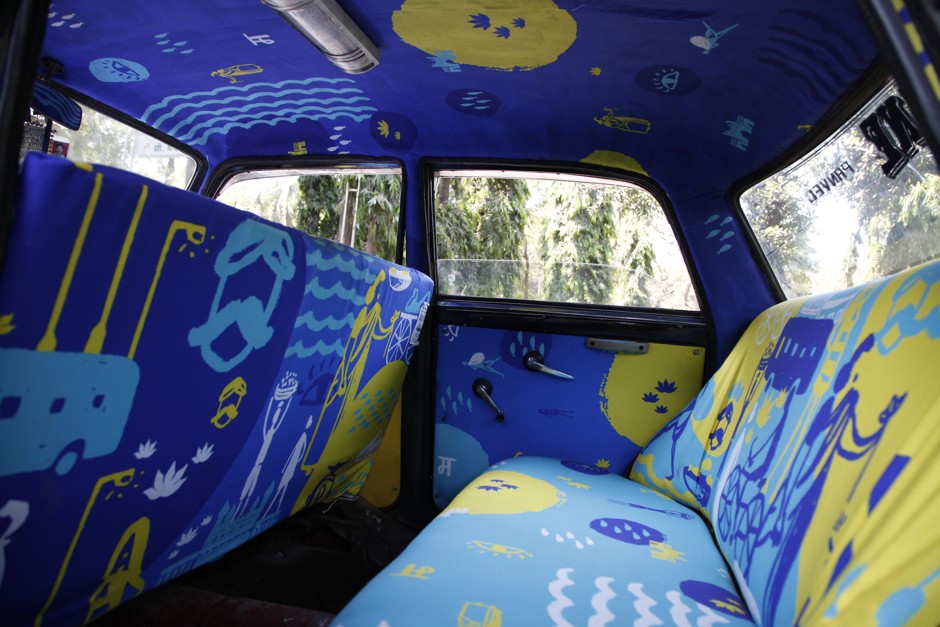
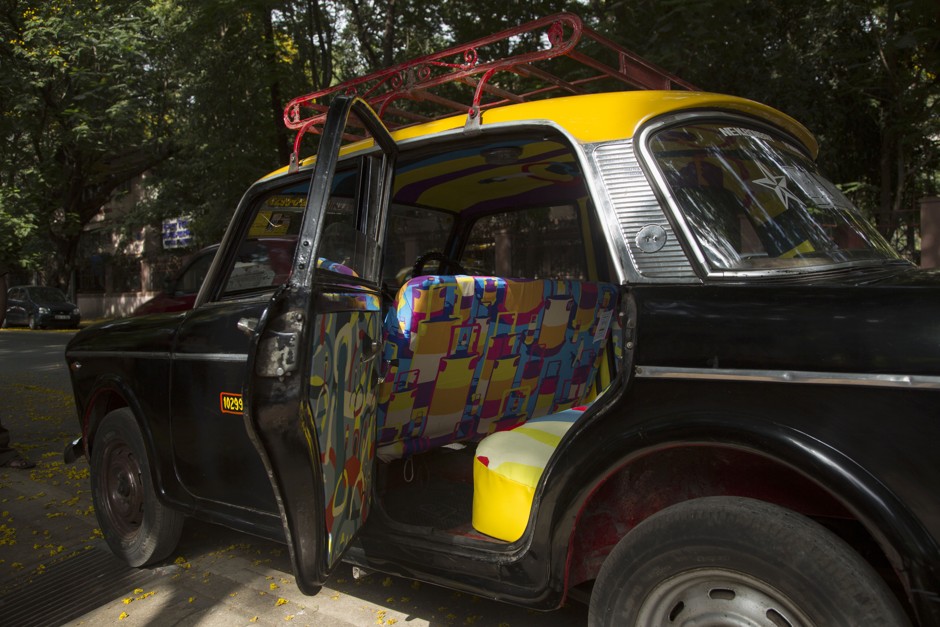
Sanket Avlani is the founder of Taxi Fabric, a project that has already turned seven of the city’s 50,000-plus taxicabs into works of arts. The interior of each taxi, from the ceiling and doors to the seats, has been specially designed by local Mumbai designers, and the designs themselves are inspired by India’s most populous city.
Take the latest taxi to get Taxi Fabric’s special treatment—the design, by 25-year-old typographer and designer Pavithra Dikshit, features jasmine flowers, peppers, and lemons against an eye-popping green background. Called “Urban Garden,” it’s Dikshit’s way of paying homage to Mumbai’s disappearing green space.
“As a fast-growing metropolis, it has building and buildings coming up in every space,” says Dikshit. “The green color is shrinking, so I wanted my taxi to show to all the green things around you.”
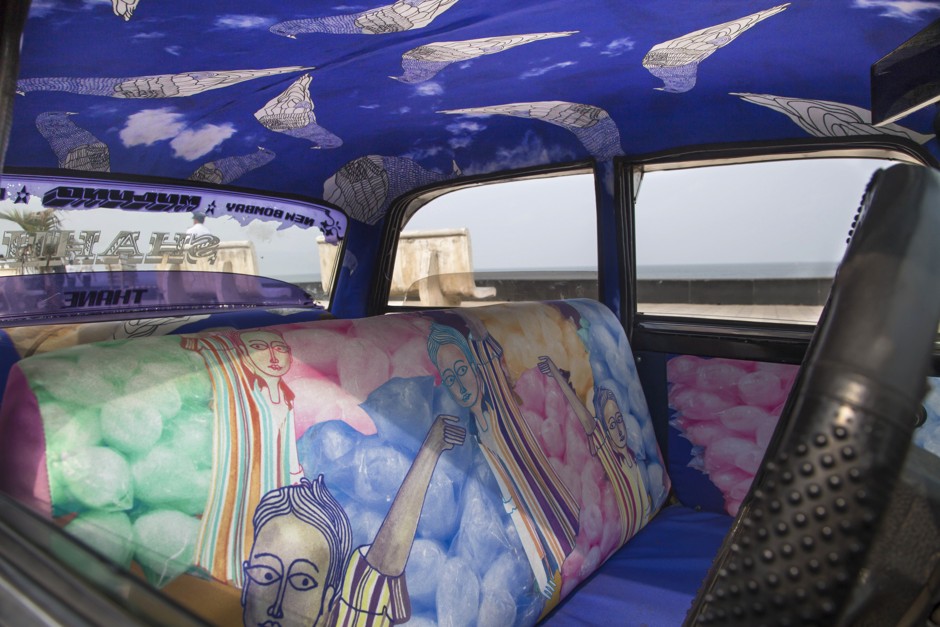
Other designs were inspired the daily life of a Mumbaikar—the different people you meet on the streets, from businessmen to children to vegetable vendors; and the personal stories of the cab drivers themselves.
Mumbai has a relatively small design community and an even smaller appreciation for the profession, says Avlani, who grew up in Mumbai and now works in London. “The design world is very small there, and most of the designers know each other,” he says. “If you wish to study design in India, not many people would understand or encourage it as much as they would in Europe or the United States.”
His hope is that the project will help spark conversation about the designs between taxi drivers and passengers. For Avlani, the iconic black-and-yellow taxis are the perfect medium because they’re everywhere.
”It’s so easy for people taking those taxis to react to those designs if the stories they tell are those that they recognize,” Avlani says. “If even the driver gets excited about it, it’s a win-win for everybody.”
As funding continues to trickle in from Taxi Fabric’s Kickstarter campaign, which runs until August 10, Avlani and his team hope to give at least 20 more cabs a special makeover by the end of the year.
Young designers and students who want to participate can submit a portfolioto the Taxi Fabric team, who will then select artists to work with. “We gauge if the designer can handle a project like this and if they can bring something new, and if the have their own style,” he says. Once accepted, artists will work with the team and, in some cases, cab drivers who want to be part of the program, to come up with a unique design.
The concept itself isn’t entirely new. It’s common for taxi drivers in Mumbai to customized their cars with colorful seat covers, eye-popping window decorations, lights, and little trinkets on the dashboard. “The taxi is like a desk at work. They spend their whole day in it so for them, it has to look interesting,”says Dikshit. “They don’t think that it attracts extra customers or anything, but it makes themselves feel good about spending [time] in it daily.”
But the bright pink, vibrant blue, and lively green colors that Taxi Fabric designers bring to cabs are a big step up from what drivers typically choose for their interior. Many drivers, Dikshit says, just go with fabric that’s already available at textile markets. “They’re very dull in color, like brown and maroon,” she says. “That’s how it’s always been, and nobody has the time to think about, ‘What if [the seat] is yellow?’”
Boring fabric doesn’t generate conversation, which Dikshit sees as a missed opportunity. “The drivers have their own stories, and they’re happy to discuss everything from politics to religion to traffic, to who they are as people,” she says. “You can almost consider them an extended part of the city landscape.”
Designed by Tasneem Amiruddin, this taxi art design reflects the daily life of a Mumbaikar. (Taxi Fabric)
A design by Taxi Fabric creator Sanket Avlani pays homage to “dawaballas,” who deliver hundreds of thousands of hot lunches across the city every day. (Taxi Fabric)
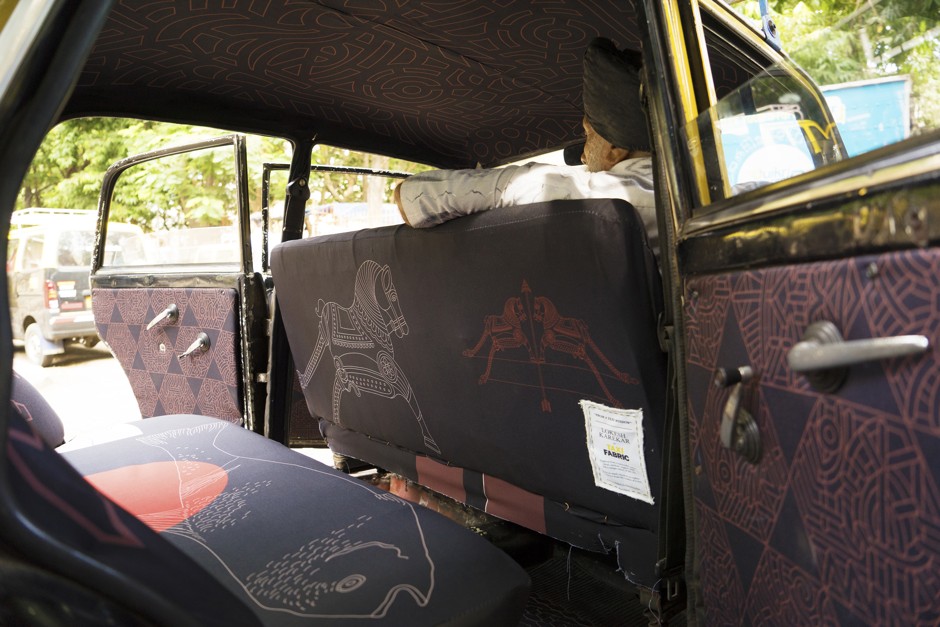
Artist Lokesh Karekar went for a minimalist design inspired by the 1980s. (Taxi Fabric)
Guarav Ogale wanted his design to reflect the life of the taxi’s driver. (Taxi Fabric)
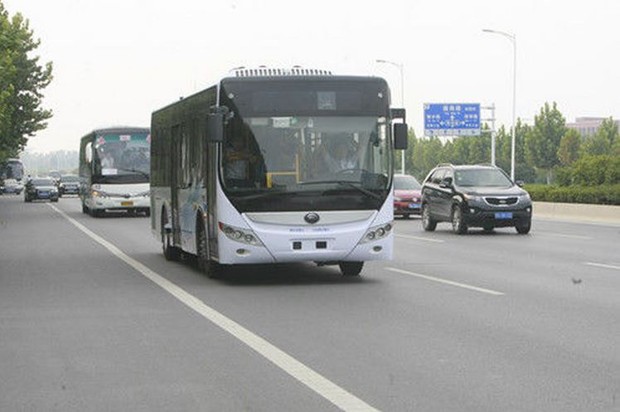
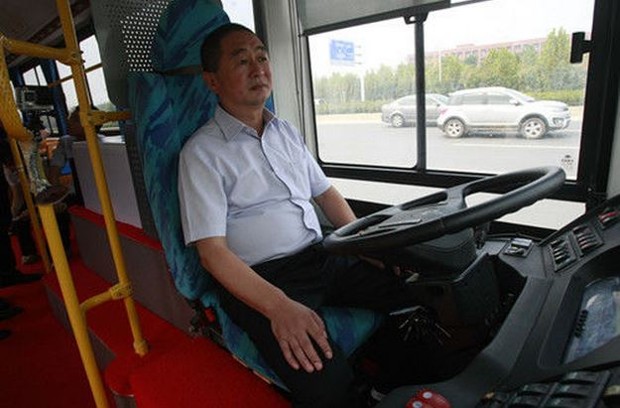
Look again. The dude behind the wheel is stretching his arms up like he’s dunking on someone—perhaps the execs at Google and Apple, as this thing is the “world’s first driverless bus,” according to manufacturer Yutong.
While tech companies in America have focused on personal automated cars, China has gone big with what could be the beginning of mass, unmanned bus transit. The spacious vehicle, unveiled at the end of August after three years of development, recently managed a 20-mile trip through the crowded city of Zhengzhou without crashing into other motorists or bursting into flames. That same driver stayed behind the wheel, true, but maybe as technology progresses he’ll be replaced with a Johnny-Cab robot.
The bus maneuvers with the help of cameras, laser radars, and a master controller that tells it to go faster and stop at signals. Yutong says in a press release it masterfully handled the road during one of its test drives:
With a distance of 32.6 km, the intercity road from Zhengzhou to Kaifeng has 26 traffic lights in total. Despite this and busy traffic, Yutong driverless bus successfully completed a series of highly complex driving acts, such as automatic lane change, overtake, and responding traffic lights. Without any human assistance, the bus arrived at its destination with its highest speed reaching 68 km/h (42 mph). According to some experts, the much improved active safety standard is the biggest advantage of unmanned vehicles as they are very likely to eliminate all kinds of traffic accidents.
The manufacturer also says the bus has an efficient driving style—one “that can only be attained by years of experience of an attentive and careful driver”—that will reduce energy waste and thus make the ride environmentally friendly. The company plans to put it through more tests, including running it on race lanes, before proceeding with real-world applications.
A reporting crew with RTtook a spin on the bus last week. Have a look at the view from the front seat:


 Take off with Natarajan