Message For the Day…” Let the Actions Performed by People be Sacred…”

People experience pleasure and pain, sorrow and difficulties in this world. When they experience pleasure, they say it is due to their deservedness (prapti). When they undergo difficulties, they attribute it to their destiny. Really speaking, both pleasure and pain are the result of one’s own actions (karma). As are the feelings that drive action, so is the result (Yad bhavam tad bhavati). Every human being in this world has to perform some kind of karma. Hence let the actions (karma) performed by people be sacred. The celebration of Dasara is meant to purify the actions performed by the five senses of action and the five senses of perception (dasendriyas). Devi, who is the personification of energy, is the driving force behind all actions. Hence everyone must worship the Trinity of Durga (goddess of energy), Lakshmi (goddess of all kinds of wealth), and Saraswathi (goddess of education and intellect) during this festival of Dasara.

Sathya Sai Baba

Why Cell Phones are Called so ? ….

 Fascinating Cell Phone Related Facts You Probably Didn’t Know

martin-cooper1) The Name: “Cellular phones,” or more common today “cell phones,” get their name from the fact that areas served by towers are divided up into “cells.”  The first use of the word “cellular” in this fashion was in 1977.  The first documented use of the word “cell phone” was in 1984.

2) The First: On April 3, 1973, a Motorola employee, Martin Cooper, publicly demonstrated the world’s first handheld mobile phone by placing a call to Joel Engel, the head of research at AT&T’s Bell Labs using the phone.  Engel and his team were Cooper’s chief rival and had also been attempting to make the world’s first handheld mobile phone. As Cooper stated, “As I walked down the street while talking on the phone, sophisticated New Yorkers gaped at the sight of someone actually moving around while making a phone call. Remember that in 1973, there weren’t cordless telephones, let alone cellular phones. I made numerous calls, including one where I crossed the street while talking to a New York radio reporter – probably one of the more dangerous things I have ever done in my life.”

3) The Phone: This first handheld cell phone weighed 2.4 pounds and was 9 x 5 x 1.75 inches in size. For reference, the iPhone 6 is 5.44 x 2.64 x 0.27 inches and weighs just 129 grams (0.28 pounds) This first handheld cell phone also had only 20 minutes of battery life when talking, but as Martin Cooper stated “that wasn’t really a big problem because you couldn’t hold that phone up for that long.” Once the phone battery was drained, it took approximately 10 hours to charge back up fully.

4) The Fanboys: Although Apple’s iPhones generally receive the most hype and publicity, world-wide approximately 88.3% of all mobile phones in use today are not iPhones.  Further, Android is king by far in terms of OS used on smart phones with a whopping 84.7% market share according to Business Insider (August 15, 2014).

5) The Fear: The fear of having no cell phone signal or otherwise being unable to make or receive cell phone calls is called Nomophobia.

texting6)  The Phalanges: The fingers you use to interact with your cell phone don’t actually contain any muscles, at least not ones used to move fingers. (Technically fingers contain many tiny arrector pili muscles, but these have nothing to do with movement of fingers, but rather are attached to hair follicles and can make the hairs on your fingers stand out straight.)

So if there are no muscles in our fingers to move them, how do they move? Short answer: magic… err, tendons and ligaments. Longer answer: Each finger consists of three bones (phalanges). In our bodies, tendons generally connect muscle to bone, and ligaments generally connect bone to bone. The tendons that control the bones in our fingers are attached to 17 muscles in the palm of your hand and 18 in your forearm, with none of the muscles extending into the fingers.

7) The Texts: Over 9 trillion text messages were sent in 2013.  That equates to about 1,200 text messages per person on the planet per year. However, text messaging numbers are starting to decline as people more and more use apps like WhatsApp, iMessage, etc. to communicate. Further, the number of text messages still pales in comparison to the number of emails sent per year, which is estimated at over 100 trillion.

8) The Fastest: According to the Guinness World Records, the current fastest texter in the world is Sonja Kristiansen of Norway who was able to text the following message in 37.28 seconds (fastest to date):  “The razor-toothed piranhas of the general Serrasalmus and Pygocentrus are the most ferocious freshwater fish in the world. In reality, they seldom attack a human.”  If you can beat that time, you might want to give Guinness World Records a call.

9) The Antiques: A type of car based non-handheld mobile phone has been around since the 1940s, but was more a novelty item than practical and generally needed significant enough power that you could only use one with the engine running.

cell-phone-hospital10) They Myth: Contrary to popular belief, cellphones used in a normal way do not create enough electromagnetic interference to cause problems with hospital equipment. It was once thought that they created false alarms, incorrect equipment readings, and subsequent errors in treatment.  This myth was based on a highly publicized study done in 1993 that offered no actual direct evidence that this was happening, just several doctor’s suspicions that it was happening.  An actual scientific study by the Mayo Clinic in 2005 busted this myth, as did another done in 2007.  Not only this, but, funny enough, according to a survey of anesthesiologists, having a cell phone to use while treating patients resulted in about 22% fewer medical errors than when they had to delay communicating with someone about something pertaining to their patient.

11) The Most: The top 5 countries in the world with the most currently active cell phones are: China: 1.2 billion phones; India: 904 million phones; U.S. 327 million phones; Brazil: 276 million phones; and Russia: 256 million phones. That said, the highest number of active phones per person for a country is Montenegro at 192.5% or nearly two phones per person.  The runner up on that list is Hong Kong at 187.9%.

ambulance12) The Problem: Cell and VoIP phones have introduced some new problems to the old 9-1-1 and Enhanced 9-1-1 system, namely trying to figure out where the person in question is making the phone call from. For cell phones, the FCC requires very strict location parameters either via GPS tracking of the cell phone or by cell network location. In the former case, it needs to be accurate to within 150 meters for a minimum of 90% of the 9-1-1 calls and within 50 meters for a minimum of 67% of the calls.  In the latter network location case, it needs to be accurate to within 300 meters for 90% of the calls and 100 meters for 67% of the calls.  It is expected that over time the FCC will continue to require these systems to be more and more accurate.

A shift to cell phone usage has introduced the possibility of texting 9-1-1 to receive help. While the system is still being rolled out, many carriers such as AT&T, Sprint, T-Mobile, and Verizon now support this and it is expected that all will support it by December 31, 2014.  To get around the problem of the individual sending the text knowing whether the texting 9-1-1 system is available in their area, if you send one where this isn’t available yet, you should receive an automatic response text message telling you it’s not available.

13) The Gap: It was a full 10 years after public demonstration of the first handheld cell phone in 1973 before the first commercial handheld cell phone, the DynaTAC 8000x (“Dynamic Adaptive Total Area Coverage”), hit the market on March 6, 1983.  This phone weighed “only” 1.1 pounds, had 30 minutes of battery life (8 hours of standby), and was initially priced at $3,995, which is about $9300 today. It took another seven years to reach one million cell phone subscribers, hitting that figure in 1990. Today, billions of phones are currently in use and there are far more handheld mobile phone subscribers than there are wired phone subscribers.

coopers-law14) The Law: Martin Cooper also has a “law” named after him.  Cooper’s Law states that our technology is advancing at such a rate that the number of different wireless communications possible in one location, at the same time will double every 30 months.  This “law” has held true since the first transmission by Guglielmo Marconi in 1895.  To illustrate, due to the method of transmitting this first signal, with a spark gap transmitter, it took up most of the radio spectrum to send this signal.  So the technology at that time more or less just allowed for one signal to be sent at any given time at a certain location.  Further, given the number of square miles Marconi’s first transmitter blanketed, only about 50 separate signals could have been sent at one time on the entire planet without interfering with one another. Since then, every 30 months, the number of signals that can be transmitted at one time in one location has approximately doubled.

droid15) The Droids You’re Looking For: The word “droid” is a registered trademark of Lucasfilm Ltd. Shortly before Verizon launched their “DROID” line of mobile devices, Lucasfilm Ltd. swept in and filed a trademark on October 9, 2009 for the term “Droid”.  Specifically claiming the term for: “Wireless communications devices, including, mobile phones, cell phones, hand held devices and personal digital assistants, accessories and parts therefor, and related computer software and wireless telecommunications programs; mobile digital electronic devices for the sending and receiving of telephone calls, electronic mail, and other digital data, for use as a digital format audio player, and for use as a handheld computer, electronic organizer, electronic notepad, and digital camera; downloadable ring tones and screen savers; cameras, pagers and calling cards.” As a result of this, Verizon pays Lucasfilm Ltd. an undisclosed sum for the rights to use this word as a brand name.

SOURCE:::::today i found out.com

Natarajan

Image of the Day….Self -Portrait…!!!

Astrophotographer’s self-portrait

A famous shot by Ansel Adams inspired this photo by Daniel McVey.

Photo by Daniel McVey, September 2014.  Visit Daniel McVey's website.

Daniel McVey in Summit County, Colorado has contributed some of the most beautiful images to our pages. He posted this one on EarthSky Facebook and wrote:

Inspired in part by a photo of Ansel Adams on his “Woody.”

Taken on a private ranch in South Park, Colorado. Green airglow visible.


Visit Daniel McVey on Facebook or at his website.

SOURCE::::: earth sky news

Natarajan

” இவர் பெரிய ‘பில்டர்’…உனக்கு தெரியுமா …? ”

“ஆயிரம் கன்றுக்குட்டிகள் நடுவில் ஒரு தாய்ப்பசு

தன் கன்றை அடையாளம் கண்டுகொள்ளாதா, என்ன?

Featured Image -- 11217

(வலையில் படித்தது)

ஒரு வைதிகர், எளிய வாழ்க்கை, போதுமென்ற

மனமே பொன் செய்யும் மருந்து.

கோயில் திருப்பணிகளில் மிகவும் ஆர்வம்.

தன் கிராமத்திலுள்ள பிள்ளையார் கோயில்,

மாரியம்மன் கோயில்,சிவன் கோயில்

எல்லாவற்றுக்கும் அரும்பாடுபட்டுத்

திருப்பணிகள் செய்தார்.

பெரிய தொகை நன்கொடை கொடுப்பவர்கள் கூட

அவரிடமிருந்து ரசீது எதிர்பார்க்கமாட்டார்கள்.

அவ்வளவு சுத்தம். அவருடைய சேவையை அண்டை

கிராமத்தார்களும் பயன்படுத்திக் கொண்டார்கள்.

ஒரு வயற்காட்டில் ஒரு பெரிய சிவலிங்கம்

தன்னந்தனியாக வெயிலில் காய்ந்து, குளிரில்

நடுங்கிக் கொண்டிருந்தார். இந்த வைதிகர்

முயற்சியால் இப்போது அவர் (சிவலிங்கம்)

மழை-காற்றுக்கு அஞ்சாமல்,கருவறையில்

கோயில் கொண்டுள்ளார்.

இப்படி எத்தனையோ கோயில்கள்.

ஆனால்,வைதிகர் எந்தக் கும்பாபிஷேகத்திலும்

தன்னை முன்னிலைப்படுத்திக் கொண்டதில்லை.

கூட்டத்தில் ஒரு மூலையில் ஒண்டிக்கொண்டு நிற்பார்!

தம்பட்டமே இல்லாத இவரைப் பற்றிப்

பெரியவாளுக்கு தெரிந்திருந்தது.

‘எப்படி?’ என்றெல்லாம் கேட்கக்கூடாது.

அது சிவரகசியம்!

அந்த வைதிகர் அடிக்கடி ஸ்ரீமடத்துக்கு வருபவர் அல்லர்.

அவருக்கு ஓய்வு கிடைத்தால்தானே வெளியே போவதற்கு!

அவர் வழி அப்பர் வழி, ஆமாம். Upper வழி.

உழவாரப் பணி, கோபுரங்களில் வேலை,நாலைந்து

பையன்களை உடன் வைத்துக்கொண்டு

சந்தடி இல்லாமல் சிவத்தொண்டு செய்வார்.

ஒருதடவை பெரியவாள் தரிசனத்துக்கு வந்தார்.

பெரியவாளை வந்தனம் செய்துவிட்டு ஓரமாக

நின்றார். வழக்கமான ஊர்-பேர் விசாரணைகூடச்

செய்யவில்லை பெரியவாள்.

அந்தச் சமயத்தில் பரம பக்தர்களான பணக்காரத்

தம்பதிகள் வந்து வந்தனம் செய்துவிட்டு எழுந்தார்கள்.

பெரியவாள், தொண்டருக்கு என்ன குறிப்பு

கொடுத்தாரோ, தெரியாது.விலையுயர்ந்த

ஒரு சால்வையைக் கொண்டுவந்து தட்டில்

வைத்தார் ஓர் அணுக்கத் தொண்டர்.பெரியவாள்,

அந்தப் பணக்காரப் பக்தரை அழைத்து, அந்தச்

சால்வையை, வைதிக பக்தருக்குப் போர்த்தச்

சொன்னார்கள்.

எல்லோருக்குமே வியப்பாக இருந்தது.

இந்த வைதிகர் என்ன, அவ்வளவு பெரிய

பண்டிதரா? யாகம் செய்தவரா..?

பெரியவா பணக்காரரிடம் சொன்னார்கள்.

“இவரைப் பார்த்திருக்கிறாயோ?”

“இல்லை”

“இவர் அட்ரஸ் தெரியுமோ?”

“தெரியாது”

“எனக்குத் தெரியும்! சொல்லட்டுமா?”

(என்ன குறும்பு!)

“சாஸ்திரிகள் கேர் ஆஃப் சிவன் கோயில்!

இவர் பெரிய Builder.என்ன? பல சிவன்களுக்கு

வீடு கட்டிக் கொடுத்திருக்கிறார்…!”

பக்தர்கள் கூட்டம் நெகிழ்ந்து உருகியது.

ஒரு பத்திரிகையில்கூட இவர் புகைப்படத்தைப்

பார்த்ததில்லையே…

“இவர் சிவப்பழம்…பிரசாதத்தோட நெறய்ய

பழங்கள் கொடு…”

அறிமுகமே இல்லாத இவர், தூய சிவப்பணியாளர்

என்பது பெரியவாளுக்கு எப்படித் தெரிந்தது?.

அது எந்தவகை ஸித்தி?

ஆயிரம் கன்றுக்குட்டிகள் நடுவில் ஒரு தாய்ப்பசு

தன் கன்றை அடையாளம் கண்டுகொள்ளாதா, என்ன?

SOURCE:::: http://www.periva.proboards.com

Natarajan

Read more: http://periva.proboards.com/thread/8060/#ixzz3Eu6M6EaW

Airbus Beluga …. World”s Weirdest Looking Plane !!!

Airbus’ Beluga celebrates 20 years in the air

IT’S the world’s weirdest looking aircraft. The aptly named Airbus Beluga, also known as the A300-600ST Super Transporter, is the whale of the skies and provides a unique way of transporting oversized cargo.

Developed to carry sections of Airbus aircraft from different production sites around Europe to their finally assembly line in Toulouse, France and Hamburg, it is also used to transport special delivery items.

The fleet of five Beluga aircraft perform more than 60 flights each week and each plane can carry a load of 47 tonnes over a range of 1667 kilometres.

This is how you transport your oversized luggage.

This is how you transport your oversized luggage. Source: AP

Its special cargo has included a famous painting from the Musee du Louvres in Paris to Tokyo, helicopters to Australia and a 17.6 metre long chemical tank weighing 39 tonnes.

Space hardware manufacturers also use the Beluga for transporting its space station modules, launch vehicle hardware and delicate satellites as the aircraft can provide temperature controlled conditions for its sensitive cargo.

The Beluga is operated by a three-member crew including two pilots and a loadmaster and has one of the biggest cargo holds of any civil or military aircraft flying today.

Transporting the tail piece of a China Southern plane. Picture: Airbus.

Transporting the tail piece of a China Southern plane. Picture: Airbus. Source: Supplied

The specially designed plane is used to transport military equipment. Picture: Airbus.

The specially designed plane is used to transport military equipment. Picture: Airbus. Source: Supplied

Just a little top heavy. Picture: Airbus.

Just a little top heavy. Picture: Airbus. Source: Supplied

It is specially used for transporting spacecraft. Picture: Airbus.

It is specially used for transporting spacecraft. Picture: Airbus. Source: Supplied

Inside the Beluga sits an aircraft tail piece. Picture: Airbus.

Inside the Beluga sits an aircraft tail piece. Picture: Airbus. Source: Supplied

Aircraft pieces arriving at Toulouse, France. Picture: Airbus.

Aircraft pieces arriving at Toulouse, France. Picture: Airbus. Source: Supplied

A plane inside a plane.

A plane inside a plane. Source: AFP   

SOURCE::: news.com.au

Natarajan

Message For the Day…” See Yourself as Your Self Unrelated To Others or Objects…”

Arjuna entered the battlefield, fully equipped and fanatically determined to destroy his enemies. But when he took his position in the battlefield, he saw ‘my teachers’, ‘my grandfather’, ‘my kinsmen’, ‘my cousins’, etc. and he was moved so much by this sense of ‘I’ and ‘mine’ that he discarded the bow and desired to return to the forest and beg for the rest of his life, than fight the war. The ‘I’ that has really nothing to do with earthly possessions, blinded him. Lord Krishna taught Bhagavad Gita and removed this delusion (moha). The lesson for you is “Be unmoved by duality”. Let not defeat or success affect your inner calm and inner joy. See yourself as your Self unrelated to others or the objective world. When you know your real Self, you are liberated! That is Moksha. Liberation (Moksha) is not a five-star HOTEL or a deluxe resort. It is just the awareness of your reality and the rejection of all contrary conceptions.  

Sathya Sai Baba


” No Need for India to Knock at the Doors of Elite Space Club …” !!!

The ‘New York Times’ Publishes Racist Comic About India’s Space

Mission

Last week, India became the first Asian nation to reach Mars, and the first in the world to do so on its first attempt.

The spacecraft called Mars Orbiter Mission (MOM) in English and “Mangalyaan” or “mars craft” in Hindi was launched in November and reached the orbit on Wednesday, to much jubilation from the public.

India’s first interplanetary mission is all the more creditable because, at $72 million, Mangalyaan cost just a fraction of NASA’s $670 million Maven, and $2 billion Curiosity Rover. It also cost less than to produce the film Gravity, and at Rs.7 or 11 cents, per kilometer, cost less than the per-kilometer cost of commuting by autorickshaw in most Indian cities.

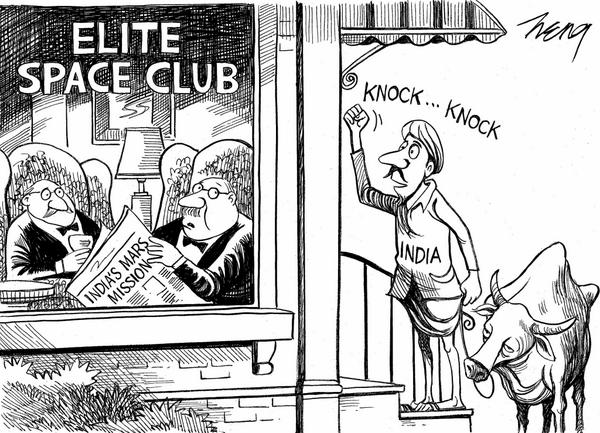
So yesterday’s New York Times’ comic by Heng, titled “India’s budget mission to Mars” seems in poor taste.

2014-09-29-racistcomic.jpg

The comic depicts a poor Indian farmer in traditional garb, accompanied by a bored-looking cow, eagerly knocking on the door of “Elite Space Club”. The two people in the elite space club drinking wine and reading about India’s mission in the papers look perturbed and hesitant to open the door. It is also worth noting that the members of the elite space club are male, white, elderly and look wealthy. Whether meant to be funny or ironic, the racial, national and classist stereotyping is apparent.

In reaching Mars, the Indian Space Research Organization (ISRO) joins the ranks of Soviet space program, NASA and European Space Agency. It not only did so on a budget, but also battling “brain drain“. It’s a commonly lamented problem that many of the country’s brightest scientists and engineers end up working internationally, and tend to shy away from research in India, especially an area like space research, because it’s not as lucrative.

The comic strip comes at the time of Indian Prime Minister, Narendra Modi’s maiden visit to the United States. Addressing a 20,000 strong crowd at Manhattan’s iconic Madison Square Garden yesterday, he emphasized India’s new role on the world stage and its growing economic clout. “When people ask if we still play with snakes in our country, I tell them that now we play with the mouse,” Mr Modi said, drawing attention to the changing stereotype of India from a nation of snake charmers to one of technical prowess.

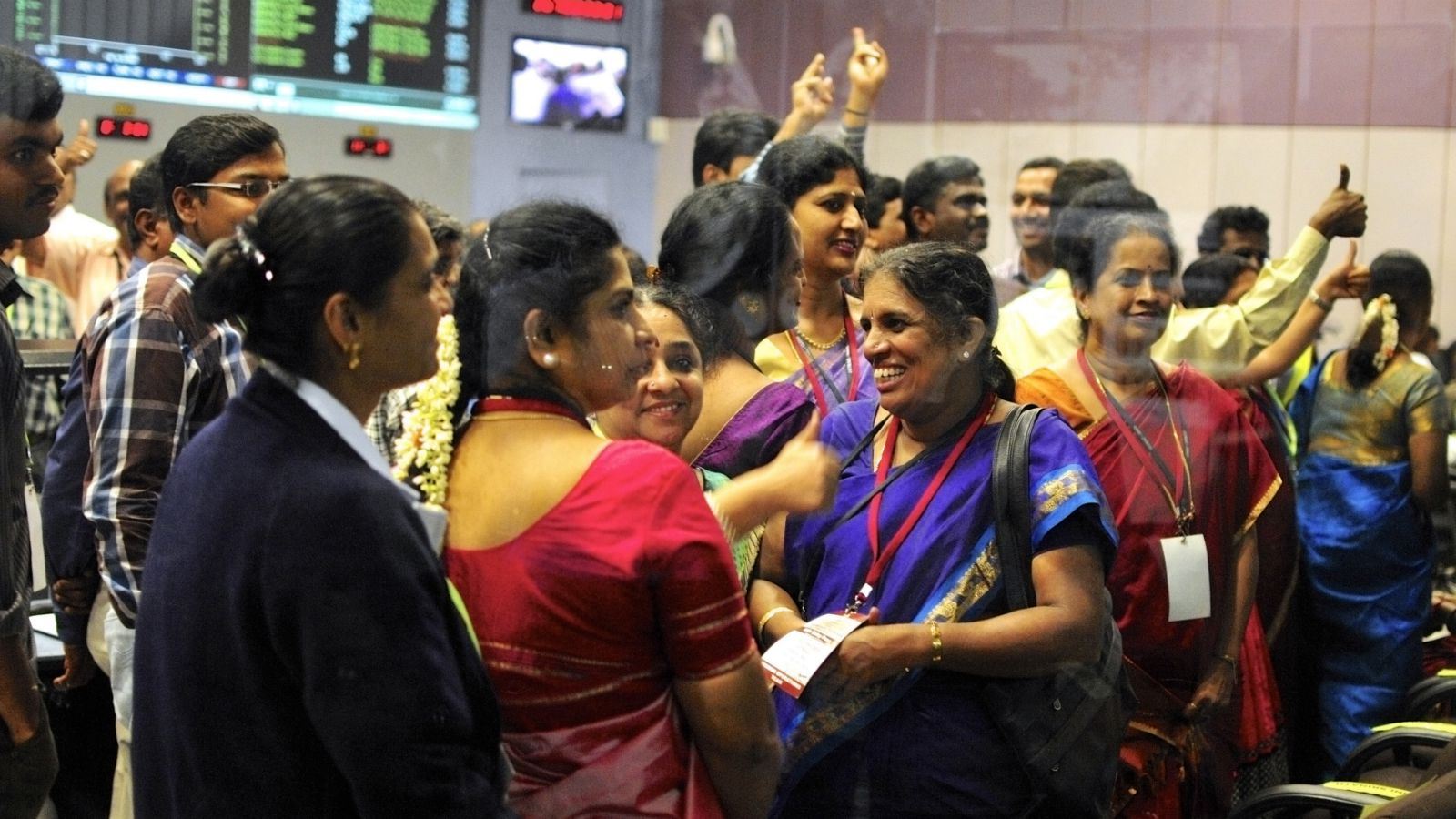
In case the Times is wondering what interplanetary-mission-heading Indian scientists look like then here you go, this is what they look like:

2014-09-29-isroscientists.jpg

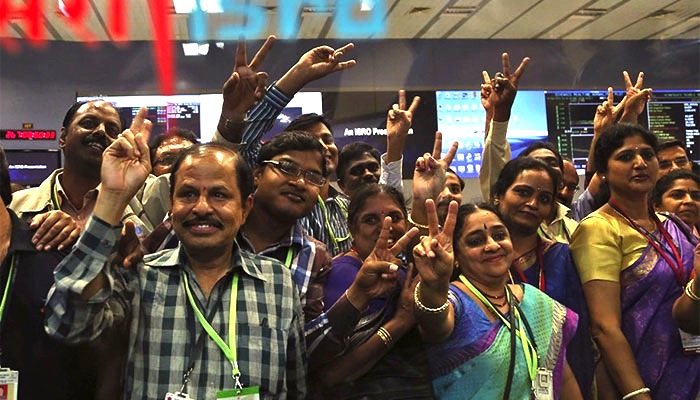
And this:

2014-09-29-isro2.jpg

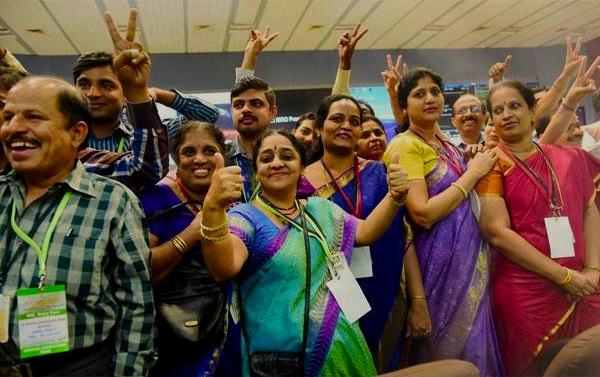
And this:

2014-09-29-isro3.jpg

The male engineers are wearing Western gear, while some of the female engineers are rocking traditional silk saris, the kind usually worn on special occasions, and jasmine flowers in their hair. On regular days, they work in full suits. There are no farm animals in sight at the ISRO office. And they certainly don’t look desperate for membership into some secret elite club. In fact, their jubilance says it all.

See, there are lots of socially and economically elite people in the world — being elite is like winning the lottery. But only a handful of human beings in history can claim to have sent a spaceship to another planet. That is brilliance and merit. That is actualizing human potential and literally moving humanity forward — like inventing the wheel, or, you know, sending a spaceship to Mars. One doesn’t have to be a rocket scientist to understand that.

SOURCE::::   IN  http://www.huffingtonpost.com/  

NATARAJAN

Management Lessons From India’s MANGALYAAN …

Management lessons from Isro’s Mangalyaan

India’s Polar Satellite Launch Vehicle, carrying the Mars orbiter, takes off from Sriharikota. Photo: Reuters/Isro

The resounding success of India’s Mars mission holds many lessons. Experts discuss the learning from the way the Indian Space Research Organisation (Isro) put its craft in the Mars orbit. Make a quality product R.D. Chandak, managing director and chief executive officer, KEC International The successful Mars Orbiter Mission, or the Mangalyaan, by Isro has many lessons for Indian manufacturers, says Chandak. The mission has shown that Indian companies can make a quality product at a competitive price, he says. To make India a manufacturing hub, Indian companies will have to make quality products on time, manage the logistics and produce at a very competitive cost, adds Chandak. Building the right team to deliver such projects is important. “Selecting the right team just doesn’t mean selecting the most qualified people; it also means selecting highly committed people,” he says. Teams also need to be empowered so that they can take critical decisions and ensure timely delivery of the project, he adds. Innovation is another major learning from the Mars mission. “Innovations need not be big advances in technology, but many small ones such as those that help reduce costs are important for corporates,” says Chandak. Every project has a certain amount of risk involved, and identifying the risks and managing them is important, he says. Time management, which is of paramount importance when executing such a project, is another lesson. “India wanted to send the Mars orbiter before China could. Having achieved the mission in a very strict time frame, it is a big example for Indian corporates in project management,” adds Chandak. It is also important for companies to learn not only from their own mistakes, but also from the mistakes of others, he says. Encourage team work Vinamra Shastri, partner, Grant Thornton India The scope of what a firm’s management can learn from the Mangalyaan project is very vast, says Shastri. However, there are a few takeaways that stand out. The mission became successful due to the collective effort and intelligence of stakeholders, not their individual genius, he says. Similarly, companies should consider encouraging teamwork and collaboration rather than pursuing individuals. “Every organization has people with different aptitude and skills. It is the responsibility of the senior leadership to ensure that they identify competencies and encourage teamwork,” says Shastri, adding the management should focus not only on the high performers, as different perspectives will only lead to more informed decision-making, resulting in better chances of success. Having a higher purpose for being in business is yet another key element, differentiating companies. Organizational goals should have a “higher purpose”—something which is unique and relevant, with which every stakeholder can relate to and have an emotional connect. A great example, he says, is the Tata group that has achieved more than its business goals. It stands for trust and responsibility. Similarly, the Mangalyaan project was launched not just to put India ahead of others in space research. Again, while Indian culture is appreciated on a personal or family level, the culture followed by Indian firms is often criticized by many. Mangalyaan could not be managed so efficiently within the specified time frame if the Indian Space Research Organisation did not have the right work culture, says Shastri. “(Management guru) Peter Drucker has said culture eats strategy for breakfast. Strategies formulated can only be executed when the work culture is conducive,” he adds. Plan for success, not failure K.G. Vishwanath, independent consultant The first lesson for Indian companies from the Mangalyaan Mars orbiter is to plan for success, not failure, says K.G. Vishwanath, an independent consultant and former Jet Airways (India) Ltd vice-president (investor relations). Vishwanath was part of the Jet Airways team that struck a deal to sell a 24% stake in the airline to Etihad Airways PJSC for $379 million. “Secondly, Isro had planned its production units across the country meticulously and tapped the best talent accompanied by the best planning tools,” he says. “They were not ready for taking any chances. They were planning not to fail. This is an inspiring lesson for any company and their boards.” Vishwanath says the third key lesson was about teamwork while handling egos. “Isro put all the team into one with a single objective. When a company stands together as one to achieve an objective, nothing can stop them and Mangalyaan proves that,” he says. He observes that choosing a team was purely based on merits irrespective of gender differences. “They just stood as one to accomplish the objectives,” he adds. “The last lesson is about passion. If you are doing anything, do it with passion. There are several examples of companies that have succeeded in the toughest MARKET conditions by showing inimitable passion,” he says. “Not to forget, Mangalyaan was accomplished with the lowest cost. It proves that while focusing on cheap cost, quality can still be maintained. Indigenous manufacturing means superior quality. That’s what we need now at a time when the nation is building a manufacturing base competing with China,” Vishwanath adds.

Read more at: http://www.livemint.com/Specials/3Y72VG1WlFbM5lBv7N1hSJ/Management-lessons-from-Isros-Mangalyaan.html?utm_source=copy

Source:::: Livemint.com

NATARAJAN

” What a Brilliant Way to Communicate an Important Message ” !!!


Kudos Volkswagen. What a brilliant way to communicate how risky it is to use mobile phones while driving.

 Everyone needs to see this one – WORTH SHOWING TO THE WHOLE FAMILY
This is pretty awesome, and it only takes a second!
A Hong Kong movie theater asked its patrons to leave their cellphones ON as they entered the movie house. 
Then they ran an eye opening ad produced by Volkswagen.  

Source :::: You Tube

Natarajan

Image of the Day…. Images of MARS sent by India”s MOM …

Mars and its atmosphere, seen by MOM spacecraft

Two early images from India’s MOM spacecraft. One shows an edge of Mars, with the planet’s tenuous atmosphere above. The other shows the whole planet. Beautiful!

India's Mars Orbiter Mission (MOM) captured this image of the

The world applauded India last week as its maiden interplanetary spacecraft – the Mars Orbiter Mission, or MOM – achieved orbit around the Red Planet. Here are some of the first images transmitted from MOM. At top, a gorgeous shot of the limb, or edge, of Mars with the tenuous Martian atmosphere silhouetted against the blackness of space. The Indian Space Research Organization (ISRO), India’s space agency, released this image on September 25, 2014, about a day after MOM arrived.

ISRO announced that MOM successfully entered into an orbit around planet Mars on September 24, 2014 at 7:30 a.m. India Standard Time (02:00 UTC; 20:00 EDT in the U.S. on September 23). MOM carries five instrument suite whose mission is to study the surface and atmosphere of Mars with a particular emphasis on measuring the methane in the Martian atmosphere: a key indicator of microbial life.

Image via Mars Orbiter Mission

Above is another beauty from MOM, acquired on September 28, 2014.

The Schiaparelli Basin (460 kilometers / 286 miles wide) is visible just below right, of dead center. To the left is the Meridiani Terra with Meridiani Planum where NASA’s Opportunity rover is still operating almost flawlessly after 10 years on Mars.

Oxia Palus is clearly visible as is Chryse Planitia where the Viking 1 lander touched down in July 1976 and also the Ares Vallis, where the Mars Pathfinder successfully landed in July 1997.

Syrtis Major is visible towards the right limb.

Bottom line: Here are some early images from India’s MOM spacecraft. One shows the limb of Mars, with its tenuous atmosphere above. The other shows the whole planet, with a dust storm visible in the planet’s northern hemisphere. Beautiful!

SOURCE:::: earth sky news

Natarajan