Solar-Powered Plane on Its First ” Round-The-World ” Flight !!!!

Solar-powered plane begins first round-the-world flight

Swiss plane Solar Impulse 2 landed Monday in Muscat, Oman, the first stopover in the attempt to fly around the world powered by the sun alone. Follow the flight.

Image credit: solarimpulse.com

Image credit: solarimpulse.com

A Swiss plane called Solar Impulse 2 took off from Abu Dhabi, United Arab Emirates Monday morning (March 9, 2015) and later landed at its first stopover in Muscat, Oman. Solar Impulse 2 is the first plane to attempt to fly around the world without a drop of fuel, powered by the sun alone.

Solar Impulse founder Andre Borschberg was the pilot Monday morning at take-off. Borschberg will trade piloting with Solar Impulse co-founder Bertrand Piccard during stop-overs on the months-long journey, expected to end in late July or early August.

You can track the plane’s progress on the Solar Impulse website.

You can also follow Solar Impulse on Twitter or FlightRadar 24.


The solar-powered plane Solar Impluse 2 lands at the Al-Bateen airport in Emirati capital Abu Dhabi on March 2, 2015.

The solar-powered plane Solar Impluse 2 lands at the Al-Bateen airport in Emirati capital Abu Dhabi on March 2, 2015.

The Solar Impulse 2 is made of carbon fiber and has 17,248 solar cells built into the plane’s 236-foot (72-meter) wingspan. The solar cells recharge four lithium polymer batteries. Solar Impulse’s wingspan is larger than that of the Boeing 747, but the plane weighs only around 5,070 pounds (2300 kg) – about as much as a minivan.

On Tuesday, the plane will head for Ahmedabad, India, and after India, to China and Myanmar. The next leg is across the Pacific to land in Hawaii. Then it will head to Phoenix, Arizona, and New York City. The path across the Atlantic will depend on the weather and could include a stop in southern Europe or Morocco before ending in Abu Dhabi.

SOURCE::::: http://www.earthskynews.org

Natarajan

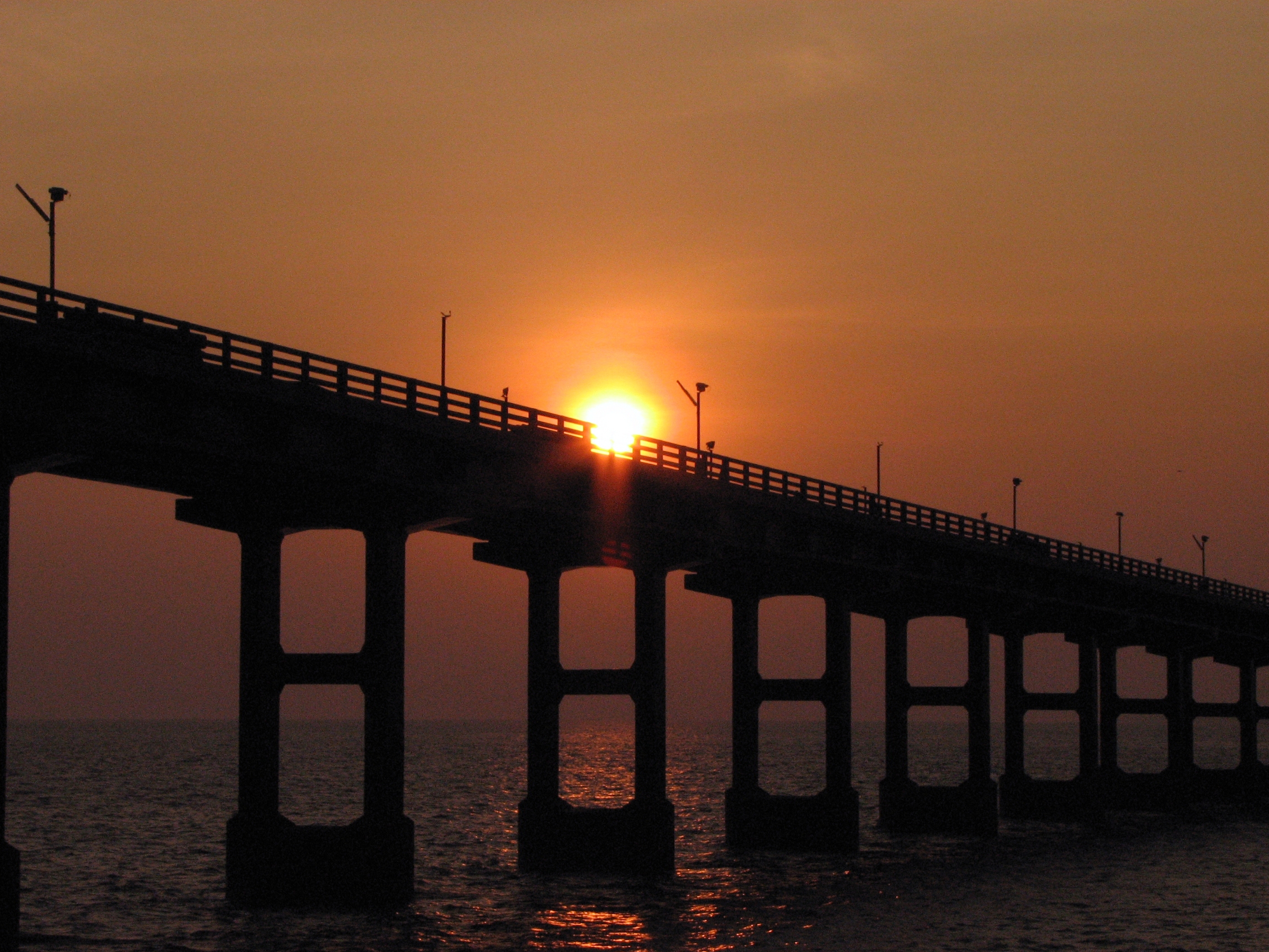
Pamban Bridge… A Fascinating One !!!


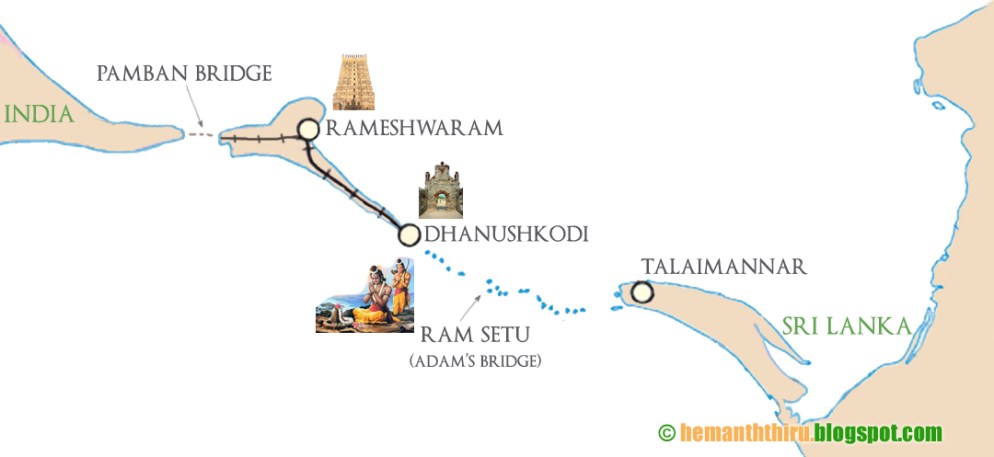
Pamban Bridge (named after the place at one end) lies between Indian main land
and Rameswaram island. It was the longest sea bridge for almost a century in India
(built in 1914) until Worli – Bandra sea bridge was built in Mumbai a few years ago.
Now it is the second.

Besides this, it is also a cantilever bridge that opens up in the middle to allow
ships to pass by like the Tower Bridge in London.

It was damaged in a cyclone in 1964 and was restored in just 46 days by E Sreedharan
the father of Delhi Metro.That cyclone had however damaged the link from Pamban to
Dhanuskodi town that vanished in the cyclone, thereby cutting the rail link between India
and Sri Lanka. Along with it went away the name Boat Mail for Madras – Dhanuskodi train.
Boat mail ? yes, because from Dhanuskodi, the passengers used to take a ferry to
Thalaimannar in Sri Lanka and continued their onward train journey all the way to Colombo.
Since the Madras train connected to a boat at the end of the journey, it was called
Boat Mail. This train was also known as Indo Ceylon Express in very early days.
https://i0.wp.com/static.panoramio.com/photos/large/41963310.jpg
https://i0.wp.com/i1.trekearth.com/photos/18313/img_2671.jpg
https://i0.wp.com/www.ramnad.tn.nic.in/images/Final_Scissors%20Bridge%20001.jpg
SOURCE:::: iNPUT FROM A FRIEND OF MINE
Natarajan

Magical Flight Of Starling Murmuration… Watch the Startling Video Clip… !!!

Watching a Starling Murmuration in Flight Is Simply Magical….

A flock of starlings is called a murmuration. These flocks may include other species of starlings and sometimes species from other families. This sociality is particularly evident in the their roosting behaviour; in the non-breeding season some roosts can number in the thousands of birds. They will travel many miles to get to their food, and all stay together for the warmth and safety of a large groups. Their movements are so precise, so coordinated, that the group of thousands seems like a single entity, moving this way and that. It’s a sight to see for all nature lovers, and one of the many miracles of life.

At dusk on a winter evening in southern England a flock of 200,000 European starlings congregate to soar in breathtaking formations before roosting for the night. These incredible displays of aerial precision and biological engineering are captured in this memorable sequence from FLIGHT: THE GENIUS OF BIRDS.

SOURCE::::www.you tube.com

Natarajan

Image of the Day…Frozen Sea Waves…. !!!

View larger. | Slushy waves on a Nantucket beach, February 20, 2015.  Photo by Jonathan Nimerfrosh.

View larger. | Slushy waves on a Nantucket beach, February 20, 2015. See the complete collection here. Photos byJonathan Nimerfroh.

Sure, the ocean freezes. But this photo of partly frozen waves – caught by photographer and surfer Jonathan Nimerfroh – fascinated even the experts

As you well know if you live there, the eastern United States has been in a deep freeze throughout February, 2015. Wave after wave of ice and snowstorms have hit the region, and NASA says that hundreds (maybe thousands) of records have been set for daily low temperatures. Now, from a photographer and surfer in Nantucket, Jonathan Nimerfroh, we have this amazing photo from February 20, 2015 of an ocean wave, just before it freezes solid. He calls it a slurpee wave.

The New York Times has a great article about this photo and these slow-moving waves of slush. Jonathan’s photo has also been on the Weather Channel and other places (I first saw it on Facebook; thanks, Beverly Spicer!). Nimerfroh told the New York Times:

I just noticed a really bizarre horizon. The snow was up to my knees, getting to the water. I saw these crazy half-frozen waves. Usually on a summer day you can hear the waves crashing, but it was absolutely silent. It was like I had earplugs in my ears.

Enjoying EarthSky so far? Sign up for our free daily newsletter today!

Of course, the ocean does freeze. Salty sea water has a lower freezing point than the ice in your home freezer, not 32 degrees F but instead about 28.4 degrees F. And it was colder than that on that day in Nantucket, somewhere around 10 degrees F. Still, these waves are something very special, and even experts commented that they had not seen them before. Helen Fricker, a glaciologist at the Scripps Institution of Oceanography in La Jolla, California, who studies the dynamics of ice flows in Antarctica, told the New York Times that a full scientific explanation was “outside her expertise.” Erin Pettit, a glaciologist at the University of Alaska, Fairbanks, added that waves in Alaska tend to break up sea ice and said:

I have never seen frozen waves like this.

Nimerfroh said he returned the following day to the same beach. That day it was a few degrees colder still and the water had completely frozen. He said:

Nothing was moving. There were no waves anymore.

Shop the complete collection of Nantucket Slurpee Wave photos at Jonathan Nimerfroh’s website.

Bottom line: Wave caught in the act of freezing at a Nantucket beach, February 2015, by Jonathan Nimerfroh.

SOURCE::: http://www.earthskynews.org

Natarajan


Image For The Day…. Dwarf Planet Ceres as Seen From Dawn Spacecraft Of NASA…

NASA’s Dawn spacecraft has become the first mission to achieve orbit around a dwarf planet. The spacecraft was approximately 38,000 miles (61,000) kilometers from Ceres when it was captured by the dwarf planet’s gravity at about 4:39 a.m. PST (7:39 a.m. EST) Friday, March 6.

This image of Ceres was taken by the Dawn spacecraft on March 1, just a few days before the mission achieved orbit around the previously unexplored world. The image shows Ceres as a crescent, mostly in shadow because the spacecraft’s trajectory put it on a side of Ceres that faces away from the sun until mid-April. When Dawn emerges from Ceres’ dark side, it will deliver ever-sharper images as it spirals to lower orbits around the planet.

The image was obtained at a distance of about 30,000 miles (about 48,000 kilometers) at a sun-Ceres-spacecraft angle, or phase angle, of 123 degrees. Image scale on Ceres is 1.9 miles (2.9 kilometers) per pixel. Ceres has an average diameter of about 590 miles (950 kilometers).

Dawn’s mission is managed by NASA’s Jet Propulsion Laboratory, Pasadena, California, for NASA’s Science Mission Directorate in Washington. Dawn is a project of the directorate’s Discovery Program, managed by NASA’s Marshall Space Flight Center in Huntsville, Alabama. The University of California, Los Angeles, is responsible for overall Dawn mission science. Orbital ATK Inc., in Dulles, Virginia, designed and built the spacecraft. The German Aerospace Center, the Max Planck Institute for Solar System Research, the Italian Space Agency and the Italian National Astrophysical Institute are international partners on the mission team. For a complete list of acknowledgments, http://dawn.jpl.nasa.gov/mission.

Image Credit: NASA/JPL-Caltech/UCLA/MPS/DLR/IDA 

SOURCE:::: http://www.nasa.gov

Natarajan

Arunima Sinha ….On the Top of the World…. Hats off To This Brave Lady …

http://inktalks.com

You Might Have watched a plenty of Motivational and Inspirational Videos and Talks …

But this Talk by Arunima Sinha  on her goal and experience is totally on a different platform.

My request to you  is to watch this video  and Listen to her talk … Also share this Video Talk with your Kids and friends …You need not listen to any Gurus …both Religious and Management… after listening to her.

HATS OF TO THIS COURAGEOUS LADY …

Natarajan

 
In April 2011, Arunima Sinha, a national level volleyball player, was thrown out of a running train by robbers who were after her gold chain. Her left leg crushed by the passing trains had to be amputated. This did not stop her from dreaming the impossible, on May 21st, 2013, Arunima summited Mount Everest. Watch as she takes us along on her journey in this passionate talk.

Please Note: This talk is available with English subtitles. Please enable YouTube Captions if the subtitles are not appearing.

ABOUT INK: INKtalks are personal narratives that get straight to the heart of issues in 18 minutes or less. We are committed to capturing and sharing breakthrough ideas, inspiring stories and surprising perspectives–for free!

Watch an INKtalk and meet the people who are designing the future–now.

Connect with us:
http://inktalks.com
http://facebook.com/inktalks
http://twitter.com/inktalks

ABOUT ARUNIMA SINHA:
Arunima is a former national level volleyball player who was thrown off a moving train in 2011. In order to save her life, the doctors had to amputate part of her left leg. In light of this event, Arunima became inspired by Yuvarj Singh, an international cricket player who successfully won his battle with cancer. As such, she was determined to climb Mount Everest. In 2013, Arunima became the first female amputee (and the first Indian amputee) to make the climb.

Arunima then went on to be the first female amputee to climb Mt. Kilamanjaro in Africa and Mt. Elbrus in Europe. She has been honoured with numerous awards and recognitions. Currently she is busy planning to open a sports academy for underprivileged and physically disabled children.

SOURCE::::: http://www.You Tube.com and ink talks.com

Natarajan

Himalayas From 20000 Feet ….A Video Clip …


The Himalayas From 20,000 Feet

It isn’t easy to film at 20,000 feet, but the aerial cinema experts at Teton Gravity Research have outdone themselves in this video of the world’s highest mountains.

This first ultra HD footage of the Himalayas is shot from above 20,000 ft. with the GSS C520 system, the most advanced gyro-stabilized camera system in the world.

It was shot from a helicopter with a crew flying from Kathmandu at 4,600 ft. up to 24,000 ft. on supplemental oxygen. The images of Mt. Everest, Ama Dablam, and Lhotse are so clear and sharp it’s like nothing we’ve ever seen.

SOURCE:::: http://www.you tube .com and http://www.yougottobekidding.wordpress.com

Natarajan


“Harrison Ford is Not Only a Reel Hero… But A Real Hero …” !!!

Harrison Ford showed he takes flying as seriously as acting when he crashed

Officials examine Harrison Ford's vintage airplane on the Penmar Golf Course in Los Angeles, where he crash-landed it on Thursday.

DAMIAN DOVARGANES / THE ASSOCIATED PRESS

Officials examine Harrison Ford’s vintage airplane on the Penmar Golf Course in Los Angeles, where he crash-landed it on Thursday.

Harrison Ford is a hero.

Harrison Fords Jules Verne Award (cropped).JPG

If you said this to his face, of course, he’d scowl. He’d tap his Breitling Aerospace watch and give you 30 seconds to explain. Then you’d back up two steps and nervously recallhis brush with death on Thursday.

“Well, Mr. Ford, when the engine in your Ryan Aeronautical ST3KR conked out after takeoff from Santa Monica Airport, you made an emergency landing on a golf course. You steered away from houses and roadways. You were as cool as Han Solo, as focused as Indiana Jones. Strapped inside that vintage two-seater, you glided to safety without killing yourself or anyone on the ground. Just imagine if . . . ”

“. . . What’s your point?” Ford would cut you off, sounding a bit like his villainous character Dr. Norman Spencer in What Lies Beneath. “I’m no hero. I just take flying very seriously.”

The post-shock reaction to the crash, in which Ford was injured but is expected to fully recover, was predictable. There were stories suggesting the 72-year-old is a real lifedaredevil. There were headlines that wondered if the actor had “the experience to pilot the vintage WWII plane that crashed.”

This is what we do when a celebrity crashes. We theorize, speculate, inculpate, deconstruct and ask pointed questions. The exercise gets foggy and more feverish when those accidents are fatal. In 1997, John Denver was killed after crashing his experimental Rutan Long-EZ plane in Monterey Bay. Two years later, John F. Kennedy Jr., his wife Carolyn Bessette and her sister Lauren died when the Piper Saratoga he was piloting went down in the Atlantic.

We know travelling on a commercial airliner is now safer than at any time since the dawn of powered flight. An MIT study in 2013 concluded a person could fly every day for 123,000 years before getting into a fatal crash. But fear is not rational. And statistics are of cold comfort when we see footage of mishaps, as on Thursday morning when Delta Flight 1086 skidded off an icy runway at LaGuardia Airport.

Meanwhile, Sunday marks a grim anniversary: it has been one year since Malaysia Airlines Flight 370 vanished without a trace.

Accidents happen. Conditions in the sky and on the ground can be unpredictable. Pilots are not immune to error. There can be deadly mechanical failures, especially in aircraft not equipped with the automated systems and safety redundancies and sophisticated navigation computers found in commercial fleets.

Five years ago, a pilot died after his Cessna crashed eerily close to where Ford touched down near the eighth hole at Penmar Golf Course. Santa Monica Airport, where celebrities such as Tom Cruise and Arnold Schwarzenegger keep their planes, has been the point of departure or arrival for at least a dozen crashes since 1989.

So why is Ford a hero? Because during a terrifying few seconds, when everything could have gone terribly wrong, he calmly did everything right. He was flying a plane that was built in the same year he was born.

But as it turns out, Ford is a great pilot for the same reason he’s a great actor: he takes it seriously.

He immerses himself in the process. He masters the small details. He is respectful of the machines he controls and the physical laws he cannot. As he observed in a non-daredevil way in 1998: “Flying attracted me as a chance to develop a skill, build a body of knowledge, not as a way to seek danger. I try to observe a distinction between exciting and scary.”

That distinction has revealed itself in previous close calls.

In 1999, a number of experts were stunned when Ford walked away unscathed after crash-landing his helicopter during a training exercise in California. The next year, he made an emergency landing at Lincoln Municipal Airport in Nebraska due to wind shear. One official who witnessed Ford’s deft handling of the twin-engine Beechcraft Bonanza said: “He’s either very experienced or darn lucky.”

But this isn’t a binary equation. Ford is now both. And that he’s used his love of flying to help others — including rescuing a hiker in Idaho in 2000 and, the following year,finding a missing a Boy Scout in Yellowstone National Park — is proof Hollywood is not just a toxic sinkhole of ego and greed and narcissism.

Hidden behind the fame, lurking behind some of the most memorable characters of our time, stand real heroes.

vmenon@thestar.ca 

SOURCE::::: vinay menon , columnist in http://www.the star.com and http://www.you tube.com

Natarajan

” MARS once had More Water Than Earth”s Arctic Ocean….”

NASA Research Suggests Mars Once Had More Water than Earth’s Arctic Ocean

Mars once held more water than Earth's Arctic Ocean

NASA scientists have determined that a primitive ocean on Mars held more water than Earth’s Arctic Ocean and that the Red Planet has lost 87 percent of that water to space.
Image Credit:
NASA/GSFC

A primitive ocean on Mars held more water than Earth’s Arctic Ocean, according to NASA scientists who, using ground-based observatories, measured water signatures in the Red Planet’s atmosphere.

Scientists have been searching for answers to why this vast water supply left the surface. Details of the observations and computations appear in Thursday’s edition of Science magazine.

“Our study provides a solid estimate of how much water Mars once had, by determining how much water was lost to space,” said Geronimo Villanueva, a scientist at NASA’s Goddard Space Flight Center in Greenbelt, Maryland, and lead author of the new paper. “With this work, we can better understand the history of water on Mars.”

Perhaps about 4.3 billion years ago, Mars would have had enough water to cover its entire surface in a liquid layer about 450 feet (137 meters) deep. More likely, the water would have formed an ocean occupying almost half of Mars’ northern hemisphere, in some regions reaching depths greater than a mile (1.6 kilometers).

The new estimate is based on detailed observations made at the European Southern Observatory’s Very Large Telescope in Chile, and the W.M. Keck Observatory and NASA Infrared Telescope Facility in Hawaii. With these powerful instruments, the researchers distinguished the chemical signatures of two slightly different forms of water in Mars’ atmosphere. One is the familiar H2O. The other is HDO, a naturally occurring variation in which one hydrogen is replaced by a heavier form, called deuterium.

By comparing the ratio of HDO to H2O in water on Mars today and comparing it with the ratio in water trapped in a Mars meteorite dating from about 4.5 billion years ago, scientists can measure the subsequent atmospheric changes and determine how much water has escaped into space.

The team mapped H2O and HDO levels several times over nearly six years, which is equal to approximately three Martian years. The resulting data produced global snapshots of each compound, as well as their ratio. These first-of-their-kind maps reveal regional variations called microclimates and seasonal changes, even though modern Mars is essentially a desert.

The research team was especially interested in regions near Mars’ north and south poles, because the polar ice caps hold the planet’s largest known water reservoir. The water stored there is thought to capture the evolution of Mars’ water during the wet Noachian period, which ended about 3.7 billion years ago, to the present.

From the measurements of atmospheric water in the near-polar region, the researchers determined the enrichment, or relative amounts of the two types of water, in the planet’s permanent ice caps. The enrichment of the ice caps told them how much water Mars must have lost – a volume 6.5 times larger than the volume in the polar caps now. That means the volume of Mars’ early ocean must have been at least 20 million cubic kilometers (5 million cubic miles).

Based on the surface of Mars today, a likely location for this water would be in the Northern Plains, considered a good candidate because of the low-lying ground. An ancient ocean there would have covered 19 percent of the planet’s surface. By comparison, the Atlantic Ocean occupies 17 percent of Earth’s surface.

“With Mars losing that much water, the planet was very likely wet for a longer period of time than was previously thought, suggesting it might have been habitable for longer,” said Michael Mumma, a senior scientist at Goddard and the second author on the paper.

NASA is studying Mars with a host of spacecraft and rovers under the agency’s Mars Exploration Program, including the Opportunity and Curiosity rovers, Odyssey and Mars Reconnaissance Orbiter spacecraft, and the MAVEN orbiter, which arrived at the Red Planet in September 2014 to study the planet’s upper atmosphere.

In 2016, a Mars lander mission called InSight will launch to take a first look into the deep interior of Mars. The agency also is participating in ESA’s (European Space Agency) 2016 and 2018 ExoMars missions, including providing telecommunication radios to ESA’s 2016 orbiter and a critical element of the astrobiology instrument on the 2018 ExoMars rover. NASA’s next rover, heading to Mars in 2020, will carry instruments to conduct unprecedented science and exploration technology investigations on the Red Planet.

NASA’s Mars Exploration Program seeks to characterize and understand Mars as a dynamic system, including its present and past environment, climate cycles, geology and biological potential. In parallel, NASA is developing the human spaceflight capabilities needed for future round-trip missions to Mars in the 2030s.

To view a video of this finding, visit:

http://youtu.be/WH8kHncLZwM 

SOURCE:::::;www.nasa.gov

Natarajan