Boeing 787-9 Dreamliner Combat Style Flying at Farnborough 2014.
SOURCE:::: http://www.YouTube.com
Natarajan
Jan 8 2015
SOURCE:::: http://www.YouTube.com
Natarajan
Jan 8 2015
First thing’s first, we need to trundle out the boring but critical post-crash disclaimer: It is a bad idea to speculate too broadly on the how-and-why so soon after an air disaster.

Almost always the initial hunches and theories end up totally off-base or at best incomplete. We live in an age when people want and expect instant answers, but that just isn’t possible with plane crashes.
It often takes months or even years before a cause is nailed down. In some cases we never learn for sure what happened.
That said, a seeming red flag in Sunday’s AirAsia disappearance is the weather. Could the Airbus A320, flying from the busy Indonesian city of Surabaya to Singapore, have wandered inadvertently into a violent thunderstorm and suffered some kind of catastrophic malfunction or structural failure? It’s possible.
I’ll point out that flying into thunderstorms is about the biggest no-no in all of commercial aviation. The crew had asked for a weather-related altitude change shortly before the disappearance, a request that was denied by air traffic control — presumably because of traffic constraints. This isn’t terribly unusual; pilots ask for altitude changes and route deviations all the time, and not always are they granted. However, that does not mean the AirAsia crew had no choice but to plow headlong into a storm. Worst-case, the crew always reserves the right to do what it needs to do, with or without permission. I cannot imagine the pilots willingly flew into what, on the radar screen, would have been a bright red splotch of potentially dangerous airspace. Perhaps a patch of weather that the pilots presumed would be manageable turned out to be otherwise? We don’t know.
Some are drawing comparisons between this incident and the 2009 Air France tragedy. They occurred under somewhat similar circumstances, and the media is eager to link these recent incidents together and wring some scary significance out of them. Some commentators have noted, for instance, that both planes were built by Airbus. I understand the temptation here, but this is extremely premature, and it’s unlikely that the aircraft model played a significant role. Remember that basically half of all the commercial jetliners in the sky are Airbus models.
An even bigger red herring is the fact that the pilots made no distress call. Several news outlets have brought this up. Effectively it means nothing. Communicating with air traffic control is pretty far down the task hierarchy when dealing with an emergency. The pilots’ priority is to control the airplane and deal with whatever malfunction or urgency is at hand. Talking to ATC comes later, if it’s practical.
So, the year appears to be closing on a tragic note. That’s a shame, seeing that 2013 was the safest year in the history of modern commercial aviation. Not to sound flip, but we can’t expect every year to be the safest, and it’s important to look at the broader context. This year will be something of a correction, but over the past ten or fifteen years the rate of fatal accidents, per miles flown, has been steadily falling. The International Civil Aviation Organization (ICAO) reports that for every million flights, the chance of a crash is one-sixth what it was in 1980, even with more than double the number of planes in the air.
Whenever people bring up the less-than-stellar accident record for 2014, I remind them of how bad things used to be. In 1985, 27 — twenty seven! — serious aviation accidents killed almost 2,500 people. That included the JAL crash outside Tokyo with 520 fatalities; the Arrow Air disaster in Newfoundland that killed 240 American servicemen, and the Air-India bombing over the North Atlantic with 329 dead. Two of history’s ten worst disasters happened within two months of each other! That’s a bad year.
Headquartered in Kuala-Lumpur, Malaysia, AirAsia is the largest low-fares airline in Asia, and one of the biggest in the world. It operates about 70 aircraft, all of them A320s, on routes around Indonesia, Thailand, Malaysia and beyond. (AirAsia X is the airline’s long-haul affiliate, and operates the larger A330.) I flew AirAsia between Bangkok and Phuket a few years ago. For what it’s worth, except for a delay on the outbound leg, its operation struck me as no more or less professional than that of any other major airline.
Asia, by the way, is now the world’s biggest and busiest air travel market, having surpassed both North America and Europe.
This article originally appeared at AskThePilot.com.
SOURCE::::
http://www.businessinsider .com
Natarajan
Read more: http://www.askthepilot.com/airasia-flight-missing/#ixzz3NQpTxsKx

An AirAsia plane went missing during a flight to Singapore shortly after asking to deviate from its planned flight path because of bad weather.
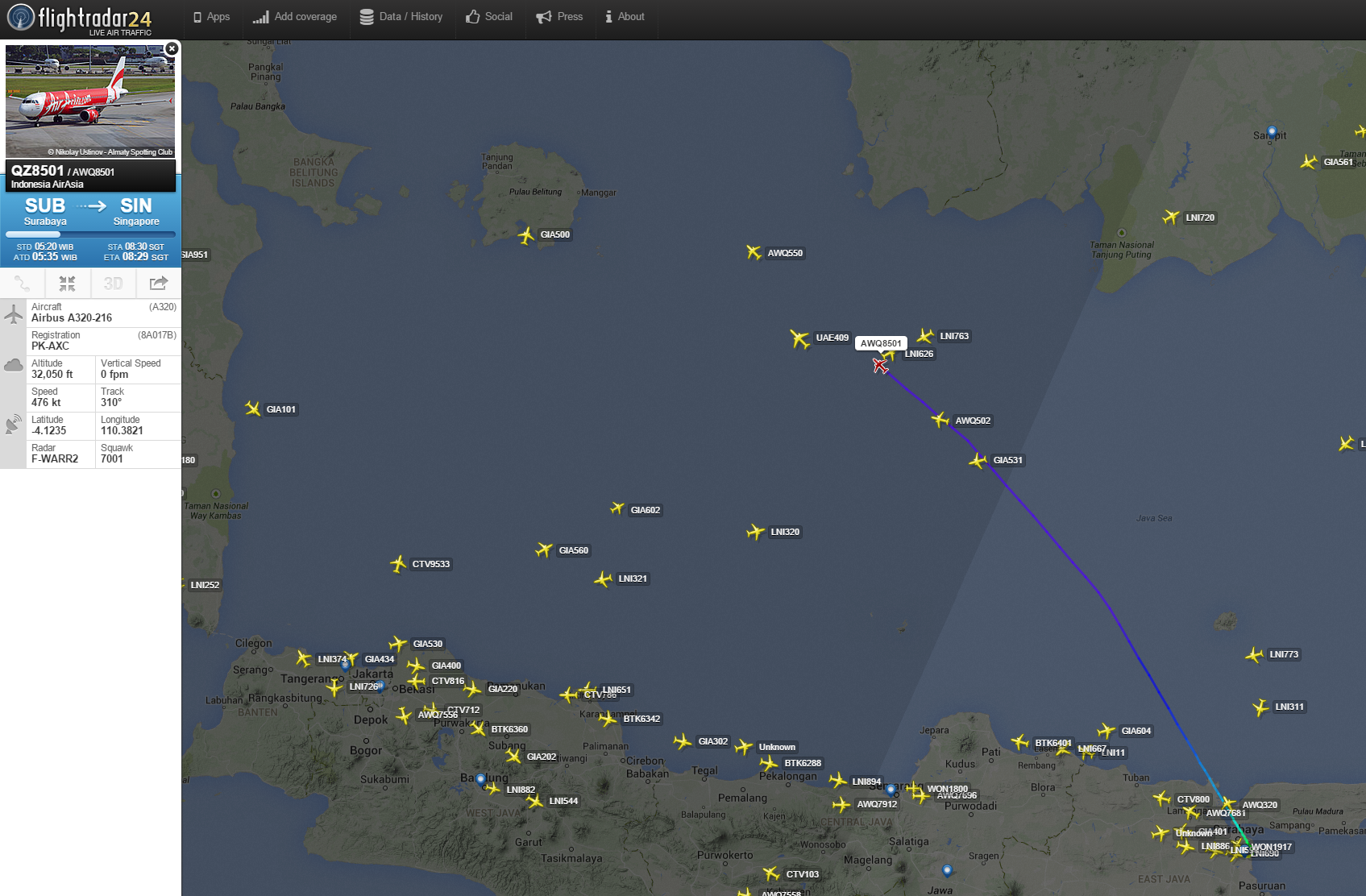
AirAsia flight QZ 8501 lost contact with air traffic control at about 6:17 a.m. on Sunday, about halfway through the flight from Surabaya, Indonesia to Singapore. The plane is thought to have crashed near the Indonesian island of Belitung, but search and rescue teams have yet to find any wreckage.
Satellite imagery from the area where the plane went missing showed severe thunderstorms around the time it disappeared:
CNN meteorologist Derek Van Dam said “lines of very heavy thunderstorms” were present when the plane was in the air, but also pointed out that “turbulence doesn’t necessarily bring down aeroplanes.”
The search and rescue operation has been suspended overnight. Singapore’s air force and navy is helping with the operation to locate the plane.
Here’s where it lost contact with air traffic control:

155 Indonesians are on board the plane, along with three people from South Korea, and one from Singapare, Britain, Malaysia, and France. Of those passengers, 16 are children and one is an infant.
The missing plane is an Airbus A320-200, a popular and generally reliable model. The plane is about six years old and is operated by AirAsia’s Indonesian affiliate, which the Malaysia-based company holds a 48.9% stake in, CNN reports
SOURCE::: PAMELA ENGEL in http://www.busionessinsider.com.au
Natarajan
The U.S. Accidentally Dropped An Atomic Bomb On South Carolina In 1958 !!!
The Cold War is over, but there are still plenty of remnants from its troubles across the American landscape. One major reminder of this era is the crater in Mars Bluffs, South Carolina, where the Air Force accidentally dropped an atomic bomb in 1958. This site was one of the biggest military blunders of the entire Cold War. It’s a miracle that no one was killed.

Via: Atlas Obscura
Talk about a big “oopsie.” I can’t believe the flight crew didn’t think to check if the bomb was secured properly before taking off. This could have kicked off World War III if the bomb was actually armed with its nuclear rod. What a simple mistake. Luckily, we’re all around now to laugh about it.
Dietmar Eckell travels the world to photograph plane wrecks where everyone survived. He told BBC Culture why he decided to find crashes with happy endings.

Fairchild C-82A Packet, Alaska
January 1965, Alaska. A Fairchild C-82 is flying above the Arctic Circle when it encounters trouble. “The plane’s electric system failed and they crash-landed in the night in the tundra forest, cutting down many trees. They survived at -45 degrees Celsius by making a big fire from the wood they had cut. It is very remote up there: they were really lucky that the fire was spotted by another plane three days later and they were rescued.” German photographer Dietmar Eckell is describing one of the stories he discovered while researching his Happy End project, which records plane crashes that had no fatalities. He has even been contacted by those who survived: raising the money to print a book of the photos last year, he was contacted by the pilot of this Fairchild C-82. “He sent me an email to thank me for writing down his story and documenting his plane almost 50 years after the crash.”

Cessna 310, Australia
Eckell became interested in documenting wrecks where everyone survived after he had his own crash: flying a paraglider with an engine to take aerial shots over the Mojave Desert in California, he went into a tailspin and landed alone with a broken ankle. “While recovering from surgery I had time to search the internet for crash landings in remote locations with no fatalities.” He makes sure they were happy endings before he documents them: “I found planes where all survived the landing but a few started walking and were never found – if [even] one passenger did not make it, the plane is not included in the series.”

Grumman Hu-16 Albatross, Mexico
He finds the planes online, via “pilot forums, archives, accident reports and websites about World War Two history”. Pinpointing the exact location can be tricky. “Once the story is confirmed I try to find it on Google Earth. If the resolution is not good enough I ask at the local airport and most of the time pilots can help. Sometimes I have to hire a plane to search from above. Then I hike out there.” This plane is on a beach 70km south of Puerto Escondido. Eckell photographed it in September 2010, six years after it crashed: “It was half sunk and already broken in two pieces. On the pictures I saw [online] from 2006 … the engines looked like they would still work. But in four years the Pacific had done massive damage.” He happened to be shooting when a storm was passing. “The clouds were changing every minute. The scenery looked unreal through the viewer of my camera … more like a painting – surreal – with different lines of clouds towards the horizon.” It might not be there for much longer. “With the force of the waves the wreck is disappearing fast.”

Bristol Type 170 Freighter, Northwest Territories, Canada
Eckell has even tracked down planes that locals don’t know about. “One time I needed a float plane to get to a lake 400km away and could not afford a charter. After three days I found a retired pilot who was willing to take me there – although he did not believe that I had the location of an abandoned plane that he had never heard of in his 30 years as a local pilot. He was very surprised when we found the plane in great condition resting on the side of the lake, where it had been since 1956.”

Avro Shackleton, Western Sahara
The journey on foot to a plane can be hard-going. “Physically the hikes through swamps with all your gear are tough because your feet are wet all day, there are mosquitos and every kilometre feels like 5km.” He remembers his attempt to reach this plane in Western Sahara as particularly dangerous. “It’s in an area that is controlled by Polisario rebels. After a 30-hour car ride from Morocco to Mauritania and a 26-hour ride on an ore train, I got to a mining town and there had to convince the local Polisario leader to take me over the border to the Western Sahara. I had the plane’s GPS location and we drove cross country to avoid getting caught by the Mauritanian military. We had a very old car and after an hour it developed a flat tyre; but everything worked out and I got great shots of an Avro Shackleton. What I found interesting was that the same rebel group also rescued the 19 passengers in 1994.”

Douglas C-53 Skytrooper, Australia
Happy End is part of a longer-term project, called Restwert. “It started in the days before GPS when I was riding my motorbike in the remote Sahara following track descriptions with a map and compass. Some of the described landmarks along the way were car wrecks.” After photographing these ‘landmark wrecks’, Eckell went on to document abandoned mobile homes in the Mojave Desert. “With my photography I try to create curiosity for the story behind the picture.” This is one of the planes he has photographed most recently. It was forced to land in 1942 when the pilot missed the airport and ran out of fuel.

Douglas C-47 Skytrain, Yukon, Canada
There is an eerie dissonance between the wrecks and the majestic landscapes in the background, one that Eckell exploits to tell his story. “My ‘restwert’ photography is about abandoned objects forgotten in nowhere. When viewers see a photograph of a plane resting on a mountain or a tank sitting on a coral reef they want to know what happened … ‘Restwert’ is German for ‘residual value’ – the material value is written off, but the beauty, stories, and associations they trigger remain. I document these objects before nature takes them back to preserve their memory.” Ten people survived when this plane flew into the side of a mountain in February 1950. Eckell has visited the site twice. “I spent two hours at the wreck and still cannot imagine how they survived in February 1950 with temperatures in the -40s up there.”

Curtiss C-46 Commando, Manitoba, Canada
He sees the wrecks as beautiful, both because they represent a happy ending and because many of the planes have survived the ravages of nature. “Old airplanes, like the DC-3 or Curtiss Commando, are design classics and timeless beauties. Aluminium does not erode so they still look pretty good even after 70 years in the bush.” Eckell draws on artists from a different age. “I was inspired by the shipwreck painters of the Romantic period and in my photography also look for dramatic skies, late light or fall colours.”

B-24 Liberator, Papua New Guinea
“The locals in Papua New Guinea called this wreck ‘Swamp Ghost’,” says Eckell, who photographed it in March 2013. “When we arrived a heavy rain started and we had to hide under the wing for over an hour.” Trying to get the shot he wanted from a high vantage point, he climbed a tree. “Soon after I noticed that it was the home of giant ants. By the time I could get to a decent shot position they were all over me and it was difficult to focus.” The B-24 was forced to land in a sago swamp in October 1943, after running low on fuel after a bombing mission. The crew successfully parachuted to the ground, and the two pilots were unhurt in the crash landing.

Curtiss C-46 Commando, Manitoba, Canada
“I was in Calgary documenting the abandoned Olympic Ski Jump,” says Eckell, describing his journey to photograph this plane, which crashed near Churchill in 1979. “I took my octocopter which got a lot of attention from the biologists on the train who work at the Polar Bear Research Centre in Churchill. It’s not a good idea to walk out to the wreck – this is polar bear country and they are hungry in summer because they haven’t eaten anything since the ice melted.” He got a lift from a local, and took the pictures quickly. “The plane is sitting on huge rocks – the crew was lucky to crash in November with snow softening the impact.”
SOURCE:::: Fiona Macdonald in http://www.bbc.com
Natarajan


While some people are allergic to nuts, Cho Hyun-ah’s concern was more that the nuts – macadamias in this case – had been given to her without her asking for them.
She was also furious, reports claim, that the nuts had been handed to her without a plate.
Cho Hyun-ah, who had been travelling in first class, held up the plane while claiming that the steward in question was incapable of keeping passengers safe.
The man was subsequently taken off the flight which was due to travel from New York to Seoul on Friday
The plane was already taxing down the runway when the offending nuts were produced but the pilot then returned to the terminal JFK airport.
The switch in staff added an 11-minute delay to the journey for the plane’s 250 passengers.
Cho is the eldest daughter of Cho Yang-ho and herself an executive vice president of South Korea’s national carrier.
The airline told Korea Times that checking of quality of service was one of Cho’s jobs, as she is in charge of in-flight service for the carrier.
A spokesman for the main opposition party in South Korea said: “Why did she have to make all that fuss because of some stupid macadamia nuts? She soiled the reputation of our flag carrier.”
 Cho Hyun-ah is executive vice president of Korean Air
Korea’s transport ministry is apparently looking into the incident to determine whether Cho’s actions, in demanding the plane turn around, infringed aviation law.
source::::http://www.telegraph.co.uk/
Natarajan
We’ve taken a look at the top 20 airports in the world in terms of passenger numbers, for December 2014.

The biggest change comes from Atlanta, which was top in December 2013 and despite reporting a 1.5% growth has been overtaken by Beijing Capital International Airport. Istanbul and Dubai International have seen big rises, while Shanghai Pudong is the fastest growing airport according to our analysis. The three main Asian hubs – Bangkok, Jakarta and Singapore have all seen declines. Denver International Airport reaches the top 20, which is the destination for Routes America’s 2015!
1. Beijing Capital International Airport (PEK) – 4,794,291
The airport is the busiest airport in Asia, and is home to the second-largest passenger terminal in the world. Terminal 1 covers 60,000m2; Terminal 2 covers an area of 336,000m2 and is able to handle 26,500,000 passengers yearly. Terminal 3 covers a huge 986,000m2 (244 acres). The passenger numbers have risen a massive 10.5 percent in comparison to December 2013 figures.
2. Hartsfield – Jackson, Atlanta Airport (ATL) – 4,599,874
The terminal complex measures 130 acres or 6.8 million square feet and includes domestic and international concourses. The airport comprises of 207 gates – 167 of which are domestic, and 40 international. Hartsfield has its own underground system, which on average carries more than 200,000 passengers per day.
3. Haneda Airport, Tokyo (HND) – 4,433,928
A third terminal to allow for international flights was completed in October 2010 as well as a fourth runway, which was constructed to increase the airport’s operational capacity from 285,000 movements to 407,000 movements per year. The airport is the first in Japan to receive 5-star status in the Global Airport Ranking conducted by Skytrax.

4. Dubai International Airport (DXB) – 4,261,485
Dubai International has registered a 10.4 percent increase in passenger numbers in December 2014 in comparison to December 2013. Construction of a third terminal began in 2004, and the terminal opened in 2008 after a two-year delay. The airport constructed an extra 29 gates capable of handling the Airbus A380 before its arrival.
5. London Heathrow Airport (LHR) – 3,805,009
The five-terminal airport spans across 12.14 square kilometres. The first phase of a new Terminal 2 complex was opened in 2014, and Terminal 5 was voted Skytrax World’s Best Airport Terminal in the Annual World Airport Awards, 2014.
6. Los Angeles International Airport (LAX) – 3,581,733
The airport offers 692 daily flights to 85 domestic cities and 928 weekly nonstop flights to 67 cities in 34 countries. The airport has 119 gates spanning across nine terminals, one of which – the Tom Bradley International Terminal, which is named after the first African-American and longest-serving mayor of Los Angeles (20 years).
7. Hong Kong International Airport (HKG) – 3,482,573
Hong Kong International is undergoing some development, with the construction of a new 20 gate passenger concourse to be built in 2 phases for completion between 2015 and 2020. In 2013, HKIA handled 59.9 million passengers, 4.12 million tonnes of cargo and 372,040 flight movements.
8. Chicago O’Hare International Airport (ORD) – 3,462,693
The eight-runway airport has a total of 189 gates across four terminals. The entire O’Hare International Airport complex spans over 7,000 acres and has the capacity to move 2,400 passengers per hour.
9. Dallas/Fort Worth Airport (DFW) – 3,283,093
Dallas/Fort Worth International Airport has five terminals totalling 165 gates. The airport is currently undergoing renovation work with the replacement of infrastructure, and easier parking, security and baggage reclaim, with Terminal A nearing completion.
10. Soekarno–Hatta (Jakarta) International Airport (CGK) – 3,252,159
The airport is expected to serve 62 million passengers per year, with a third runway being built in 2015. There will be an increase in apron capacity from 125 airplanes to 174 airplanes. By 2015, additional upgrades are expected to increase the airport’s capacity to 75 million passengers.

11. Singapore Changi Airport (SIN) – 3,168,437
Changi Airport is a major air hub in Asia, Serving more than 100 international airlines flying to some 300 cities in about 70 countries and territories worldwide, the airport handled more than 53.7 million passengers in 2013. A flight takes off or lands at Changi roughly once every 90 seconds.
12. Kuala Lumpur International Airport (KUL) – 3,116,072
The airport has three buildings that make up the terminal complex, the Satellite Building which handles international travellers, the Contact Pier which serves Malaysia Airlines passengers, and the Main Terminal.
13. Paris Charles De Gaulle Airport (CDG) – 3,113,579
There are three terminals at Paris Charles de Gaulle Airport, and in 2013, the airport handled 62,052,917 passengers and 497,763 aircraft movements. It is the second busiest airport in Europe after London Heathrow.
14. Shanghai Pudong Airport (PVG) – 3,046,694
The passenger complex consists of two terminals, with a third terminal expected to open in 2015. The airport is a hub for both Shanghai Airlines and China Eastern Airlines and hosts over 40 million passengers annually.
15. Istanbul Atatürk Airport (IST) – 2,970,455
Istanbul Atatürk Airport has four terminals and three runways, with plans for a fourth. The Istanbul greater metropolitan area is expected to have a demand of 35 million international passengers and 25 million domestic passengers annually by the year 2015.
16. Guangzhou Baiyun International Airport (CAN) – 2,907,632
In 2013, Guangzhou Baiyun International Airport was China’s second busiest and world’s 16th busiest airport by passenger traffic, with 52,450,262 passengers handled. As for cargo traffic, the airport was the third busiest in China and the 18th busiest worldwide.

17. Suvarnabhumi Airport (Bangkok International – BKK) – 2,864,854
There are two runways and seven four-storey concourse buildings. The airport can accommodate 45 million passengers per year, 76 flights per hour, and three-million tons of cargo per year.
18. Frankfurt Airport (FRA) – 2,828,133
The airport sees over 52 million international passengers, and has two terminals, with a third under construction. Frankfurt Airport is the third busiest in Europe, after London Heathrow and Paris Charles De Gaulle.
19. John F. Kennedy Airport (JFK) – 2,771,749
Over ninety airlines operate out of JFK. It is the base of operations for JetBlue Airways and is a major international gateway hub for American Airlines and Delta Air Lines. JFK covers 4,930 acres, including 880 acres in the Central Terminal Area. The airport has more than 30 miles of roadway.
20. Denver International Airport (DEN) – 2,552,974
The airport’s runway – 16R/34L is the longest public use runway in the United States. Denver Airport opened in 1995 and in less than 20 years has become a major transportation hub handling over 50 million passengers annually. The airport has a two-sided main terminal and three concourses, A, B and C. Denver will be host to the Routes Americas 2015 event. Now in its 8th year, Routes Americas is the essential event for all aviation based companies who wish to conduct business to, from and within the region.

LaGuardia Airport opened in New York 75 years ago today, and has since handled countless millions of passengers – including Marilyn Monroe – and 26,722,183 in 2013. But it’s still some way off being the world’s oldest.

Albany International
Founded: 1928
Passengers in 2013: 2,393,506
While an airport was established in Albany, New York, in 1909, with early aviation pioneers such as Amelia Earhart and Charles Lindbergh stopping there, the airport was moved to the current site in 1928.

Minneapolis-St. Paul International Airport, US
Founded: 1920
Passengers in 2013: 33,897,335
Visited by Howard Hughes on his round-the-world flight in 1938, Minneapolis-St. Paul is currently served by 14 airlines, with Delta being by far its biggest customer.

Sydney (Kingsford Smith) Airport, Australia
Founded: 1920
Passengers in 2013: 36,964,734
Established in 1920, with regular flights starting in 1924, Sydney Kingsford Smith remains the only major hub to serve the city and is the headquarters of Qantas.
Paris-Le Bourget Airport, France
Founded: 1919
Passengers in 2013: general aviation traffic only.
The French capital’s only airport until work began on Paris-Orly in 1932, Le Bourget is where Hitler began his one and only tour of Paris in June 1940. It closed to international traffic in 1977 and regional traffic in 1980, but hosts the Paris Air Show every two years. Pictured here is Charles Lindbergh.

Amsterdam Airport Schiphol, The Netherlands
Founded: 1916
Passengers in 2013: 52,527,699
The busiest of the world’s elderly airports, Amsterdam Schiphol was established as a military airbase in 1916 and has been used by civilian aircraft since 1920.

Rome Ciampino Airport, Italy
Founded: 1916
Passengers in 2013: 4,749,251
Opened in 1916 and here seen welcoming Laurence Olivier and Vivien Leigh, Ciampino suffered decades of stagnation following the opening of Leonardo da Vinci-Fiumicino Airport in 1960, but was revitalised by low-cost carriers. Ryanair now operates almost every service to and from the airport.
Picture: GETTY

Don Mueang International Airport, Bangkok, Thailand
Founded: 1914
Passengers in 2013: 16,479,227
A major US command hub during the Vietnam War, Don Mueang was closed for several months in 2011 due to flooding.

Bremen Airport, Germany
Founded: 1913
Passengers in 2012: 2,447,001
Early customers at Bremen included KLM, the world’s oldest airline. It was used as an airbase by the US army from 1945 until 1949.

Bucharest Aurel Vlaicu Airport, Romania
Founded: 1912
Passengers in 2013: 6,036 The hub for the airline TAROM during the communist period, Aurel Vlaicu is now solely used by charter flights and private jets.

Shoreham Airport, UK
Founded: 1911
Passengers in 2013: 1,500 (approximately)
Britain’s oldest continuously operating airport, found in Sussex, is now used solely by light aircraft.
Note: the site of Blackpool Airport was first used for aviation in 1909, but soon became a racecourse and then a military hospital. Flights did not resume until the 1930s.

Hamburg Airport, Germany
Founded: 1911
Passengers in 2013: 13,502,939
Opened in January 1911, Hamburg Airport was used as a staging area during the Berlin Airlift in 1948.

College Park Airport, Maryland, US
Founded: 1909
Passengers in 2013: general aviation traffic only.
Known as “the cradle of aviation”, this was where the first aeroplane – a Wright Type A biplane – was uncrated and assembled on October 7, 1909.
SOURCE:::: http://www.telegraph.co.uk/
Natarajan





 Take off with Natarajan