|
A teenage boy had just passed his driving test and asked his father when they’d be able to have a discussion about using the car.
His father said he’d make a deal with his son. “You need to bring your grades up from a C to a B-average, study the Bible, and get a haircut. Then we’ll talk about the car.’
The boy thought about that for a moment, decided he’d settle for the offer, and they came to an agreement.
After about six weeks, his father said: “Son, you’ve brought your grades up and I’ve observed that you have been studying the Bible, but I’m disappointed you haven’t cut your hair yet.”
The boy said: “You know, Dad, I’ve been thinking about that, and I’ve noticed in my studies of the Bible that Samson had long hair, John the Baptist had long hair, Moses had long hair – and there’s even strong evidence that Jesus had long hair!”
The dad nods wisely, then leans over and whispers to his son:
“Did you also notice they walked everywhere?“
Source…..www.ba-bamail.com
Natarajan
|
cheerful attitude
How to Boost Your Self Confidence…. ?
When I was young, I was a very happy kid. I played around with other children, had many friends, and while I was slightly shy, I still had no problem talking to people. As I grew up, I learned that being chubby and smart made people dislike me for my appearance and envy me for my intelligence. As they began to shun me, I became quite lonely and withdrew to my room and my computer to ease the pain.
I had a few friends, and they made life a little brighter, but I was still unhappy and felt so bad about how I looked, also dumbing myself down so people would like me. By the time I was 18, nature helped me out. I grew into my body, and suddenly I wasn’t fat anymore, but that chubby little kid was still there in the back of my mind.
The young, hurt child inside of me kept me insecure about my looks, as well as forced me to play dumb, with the fear that I’ll lose friends and be lonely again if I was perceived to be too smart. I was failing school because I didn’t want to seem smart, I was failing at my love life because I had no self-confidence, and I started to believe that nothing other than bleakness awaited me in my future.
Lucky for me, I managed to pull myself out of the mire and learned a few ways to boost my self-confidence. I’m now happy, married and have a career that I love. I’m also blessed with many friends who love me for who I am. It’s now my turn to help those who might still be having problems with their own self-confidence by showing you a few methods to boost it.
First, you should identify what you’re good at: We are all good at one thing at least, so find what you can do well. You might not be the best in that field, but as long as you do what you do well, you can improve and take pride in your expertise.
Try expressing yourself through a form of art you like – this is a real confidence booster and a great way to meet like-minded people. Friends who share your interests can make you feel more accomplished and push you forward.
If you can’t think of anything you’re good at, think of something you’d like to do – then go and do it! It doesn’t matter if you succeed or fail, trying is the most important step!
Once you’ve taken that first step, you’ll be amazed at how much better you feel, and your confidence will start to grow.
Second, you must take pride in your good qualities: Yes, being humble is important, but if you’re good at something, don’t be embarrassed about it. Celebrate it and be happy that you possess such qualities – they make you a better person. Remember – you can take pride in your accomplishments and behavior while still retaining your humility.
If you start doubting yourself because of one weakness or another, remember that you have good qualities and strengths, and those are the things that define you, rather than your weaknesses.
Third, identify your insecurities: What do you think is holding you back? Is it that little voice in the back of your head? The way you look? Something you’re ashamed of? Find whatever it is that’s dragging you down and write it on a piece of paper. By giving it a name and writing it down on a piece of paper, you make it a tangible object. Next, TEAR THE PAPER UP! This is a psychological trick that makes your brain think that you’re ripping up the actual weakness.
Next, talk about it: Find a loved one or a friend that you trust and bare your soul. Sharing lightens the burden, and another person can offer perspective, pointing out things you might have missed. This is what friends and family are for! Even if that person can’t help you solve the problem, just talking about it can help.
Don’t let past mistakes bring you down: We all make mistakes constantly, but wallowing in self-pity after you make one only serves to make you feel bad about yourself. It’s a crippling behavior that ruins self-confidence and prevents you from actually learning from the mistake (believe me, I’ve been there too many times!). Remember that most billionaires had several failed business and moments when they thought it was all over for them, but they never let it stop them getting to where they wanted to be.
Turn negative into positive: The song goes: “when you’re smiling – the whole world smiles with you”, and it can’t be more accurate. Avoid the Debbie Downers and Negative Nancys. When you surround yourself with negative thoughts and people, you dictate the conversation of your life. If you keep telling yourself ‘no’ – you’ll never hear a ‘yes.’ Look for the silver lining in every situation. Finding a positive spin in a negative situation will help you get through hard times and identify opportunities in bad situations.
Avoid comparisons: Yes, there’s always someone better – they can be richer, prettier, in better shape, etc. That doesn’t mean you can’t strive to improve – instead of looking at people you think are “better” than you, look at how you can improve. You might not be as fit as that person in the gym, but if you keep exercising, you’ll lose weight, look better and feel better. Don’t be jealous of that person at work who seems smarter than you – find what you might be doing that needs improvement and work on that. Strive for improvement, not perfection.
Be grateful: When someone compliments you, take the compliment and thank the person. There’s nothing wrong with it and it doesn’t make you seem boastful. Usually, when someone compliments you, they’re showing appreciation of you. When you refuse to accept the compliment, you’re rejecting someone’s honest appreciation .
Help others: Many studies have shown that when we help others, it releases dopamine in our brain, making us happier. When you help other people, it gives you a sense of control, purpose and benevolence, and all three are amazing confidence-boosters.
Make eye contact: When you’re talking to another person, avoid looking at the ground or away. It sends a message that your confidence is low or that you don’t want to talk to them. Make eye contact instead – it shows them that you value them and makes them respond in kind, creating a positive cycle that builds confidence.
Take care of yourself: Personal grooming is a huge factor in confidence building. When you groom yourself and dress well, people say you “look like a million dollars”. Whether we admit it or not, our self-worth is influenced by our looks, so looking better makes us feel better!
| Spend time with loved ones: Avoid people who make you feel negativity and spend more time with those who encourage and support you. These people build you up, push you on and help you grow confidence in yourself and in your actions.
Don’t fear the unknown: Sticking to what you know will make your world a small and gray place. Try new things instead – take on new challenges, meet new people and try new food. It might not all work out perfectly, but you’ll gain experience, knowledge and maybe pick up a few new friends along the way. |
| Source….Jonathan P. in www. ba-bamail.com
Natarajan
|
” I survived …So can You …” Says Ankur Mishra !!!
Hailing from a village having no electricity, this techie now runs two start-ups, educates his community, gives TED Talks and is on his third novel. This is Ankur Mishra’s journey.

Ankur Mishra exudes the kind of lucid candour and sincerity that can only be mustered by someone who has lived a life in every season, flavour and shade that India has to offer — for he has walked a thousand miles and chronicled many adventures.
Don’t take him for any other small-town boy with big dreams — for this entrepreneur, social worker, writer, poet and traveller went a step ahead, brought on his finest masonry to also build his road block by block.
Growing up in a village
Ankur grew up in a “pure” small village in Uttar Pradesh, as he likes to put it. “I say ‘pure’, because there was no electricity, and was surrounded by the mountains and a river.
“The school was small and the teachers, harsh. Coming from a very poor family, I almost didn’t get an education, had it not been for the God-given gift of scholarship. Even then, I read English in Class VI for the first time,” he explains.
Some incidents in school left an impression on him.
This catapulted him into action at the raw age of 16, with his ‘baba,’ one of the few members in his family that were literate, by his side.
A headstart
“I had experienced first-hand the impact that the right or wrong teacher could have on a child. Whether it was the moment when I was slapped by a teacher for merely standing up to read the board properly, or the general disinterest that was apparent in so many of the teachers at the village school, our school systems were lacking quality and soul,” he says.
Whilst in Class XII, Ankur felt that his weekends and all that free time could find much better use, so he started an initiative called Unique Educational Group.
He approached several heads of institutions and volunteered to take weekly sessions with students on subjects like Maths and Science. “Maths is my favourite. Kids are very keen to learn counting using different techniques, and I teach them the practical use of mathematics — how they can help their parents in budgeting, time management etc.,” he explains.
Starting out with two village schools, the students’ vigour and eager anticipation of their sessions made them locally famous, and within two years, their weeks had to be split between 17 villages and around 100 schools — something Ankur pulled off completely with his pocket money.
When the time came for Ankur to leave the village behind for his career, the same model was met with indifference from students in cities; but Ankur is keen on setting up in Gurgaon, where he now sips his beloved tea with 10 students weekly, alongside running his early-stage start-up.
First date with a computer

Believe it or not, this seasoned techie laid his claim to the computer only when he entered college for his BTech.
He worked for several MNCs including Microsoft after college as a programmer and developer, but he felt like his ‘tech-geekdom’ had another calling, namely, to help non-techies join the techwagon.
With Digital India especially, Ankur saw great value in helping non-techies “get” the web and do more business using it. Foreantech — ‘a start-up for start-ups,’ became his way of helping start-ups at designing, development and marketing, all at one place. “Today’s start-ups have a big headache of resources, especially, developers and designers.
“I wanted to solve this problem. When a start-up comes to us, their digital worries become ours,”Ankur explains.
The one-year-old company has successfully accomplished about 100 projects with start-ups like Wingo and Baniyagiri, as well as some government assignments.
Love with tech, but flirting with the quill
Scarring experiences from his school days encouraged Ankur to become a storyteller, and he began by publishing an expose on teachers when he was only 16.
The response was amazing and gratifying,according to Ankur, motivating him to write for newspapers and magazines over various social and political issues, until he decided to cast an even wider net, and debut as a novelist. He wrote two books — his first Love Still and l Flirt, his second Kshanik Kahaniyon Ki Ek Virasat,which was better received, and his upcoming one Love at Metro.
He also recently published a collection of Hindi poems.
Ankur started a website called Kavishala.in for poets to have an online mehfil of sorts. Only a month old, 50 poets have already contributed over 100 works to it.
Passing on the torch, and spreading the fire
Brimming with life — experiences of making it as a literate engineer, entrepreneur and multi-lingual writer from a powerless village, Ankur knew he must enlighten those seeking inspiration. “I have never really been afraid of speaking in public platforms,”he notes.
He speaks as a grassroots expert on politics, technology, and society, and has graced the stage at over 25 seminars and events like TedxPatna, Ignite Jaipur, Microsoft Tech Days, UEN Summit Patna etc.
The 25-year-old firework feels that ups and downs are just the way life is. “If I, a predominantly Hindi speaker, can now speak on big stages, write books, blogs and more on such a wide level, anyone can. Alone in an alien city, with barely enough funds to keep me fed, I survived. So can you,”Ankur concludes.
Source……..www.rediff.com
Natarajan
Image of the Day…” Snow Goose Moon” …!!!

Migrating geese in front of the moon, caught in Fairfield, Montana by John Ashley. Visit John Ashely Fine Art.
John Ashley of Montana caught this image on the morning of March 26, 2016. He wrote:
Migrating snow geese lift off at dawn on Saturday, leaving Freezeout Lake and flying past the 92% gibbous moon on their way to nearby agricultural fields for a morning feed.
Source…..www.earthsky.org
Natarajan
Clingstone: The House on The Rock…!!!
Perched on top of a small, rocky island in Narragansett Bay, near Jamestown, Rhode Island, the United States, is a three-story, cedar shingle mansion built by Philadelphia socialite Joseph Lovering Wharton in 1905. Wharton had built the house as an act of defiance after the government seized his land and summer home that he had in the Fort Wetherill area in south Jamestown, to enlarge the fort at the end of the 1800s. Angered at being ousted from his property, Wharton decided to build a house where no one could bother him, and Clingstone happened. One source claims that the name “Clingstone” was suggested when someone remarked that it was “a peach of a house”. Clingstone is a botanical term for fruits that has a hard stone-like seed inside. Or perhaps, the name is a reference to the way the house clings to the rock.

Photo credit: mansion-homes.com
In spite of its perilious location in the sea, the Clingstone has managed to survive more than a hundred years, weathering countless storms and hurricanes. Originally there was a long stone jetty with gymnasts’ rings and bars, but it was blown away by the Great Hurricane of 1938. The house itself, which sits only 20 feet above sea level, survived with minimal damage. Now Clingstone’s current owner, Henry Wood, a distant cousin of Wharton, regularly goes out to Clingstone with his three grown sons to watch the yearly hurricanes in action.
Henry Wood, who is a Boston-based architect, had bought the house in 1961. It had been lying vacant for two decades after the death of Wharton’s widow in 1941. When Wood acquired it, the house was in a shabby condition with all its windows smashed, the floors rotten and covered with pigeon droppings, and the roof mostly gone.
Wood and his sons take pride in their environment-friendly renovations of the house. The house is totally off the power grid. A windmill on the roof provides electricity, while photovoltaic cells charge a bank of batteries in the basement for additional power. Rainwater collected from the roof into a 3,000-gallon cistern provide water for washing and cleaning. Drinking water comes from a sea-water filtration system. Water is heated by solar panels. The house even has a composting toilet. The compost is then used to fertilize the garden.
Although refitting the house with green technology has certainly been expensive, Wood has managed to cut corners by acquiring furnishings from thrift shops or yard sales. Windows, light fixtures and doorknobs were scavenged from old buildings that were torn down. The long cypress dining room table was retrieved from the bottom of a cistern.
Today, the house has 23 rooms, including 10 bedrooms and five bathrooms. Visible from the shores, the house is known by locals as “The House on a Rock”.
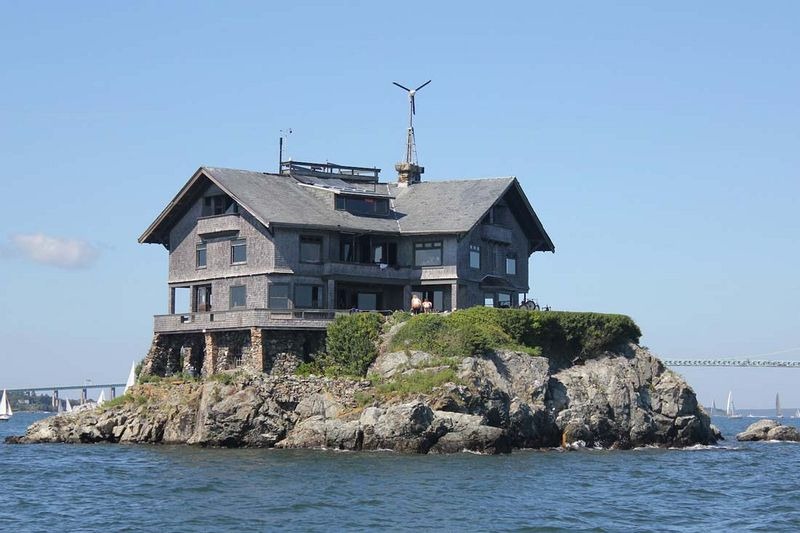
Photo credit: mansion-homes.com
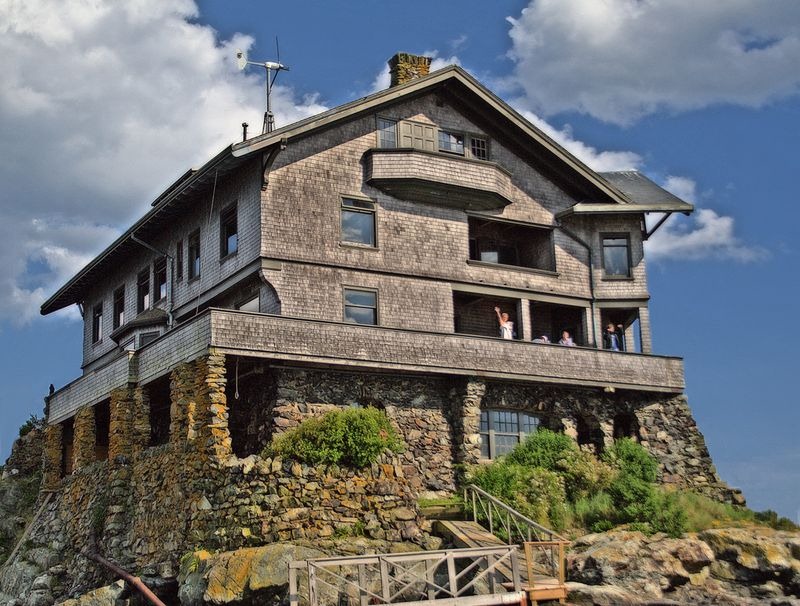
Photo credit: G.E.Long/Flickr
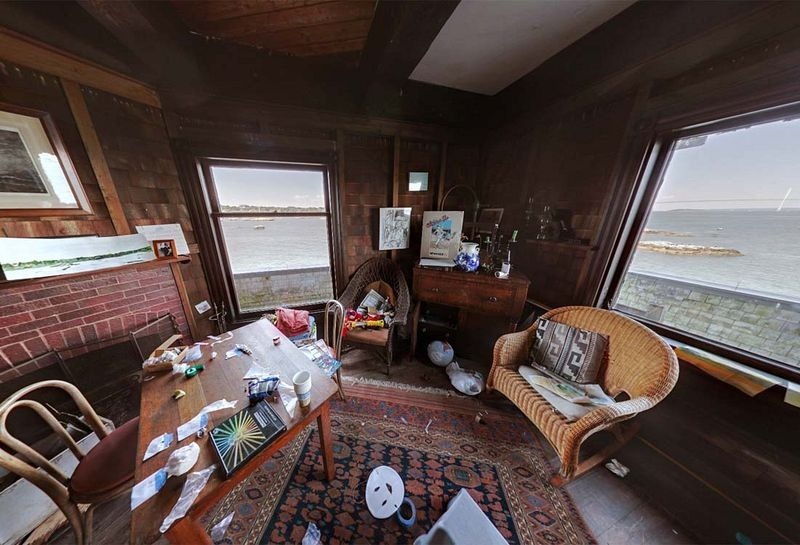
Photo credit: mansion-homes.com
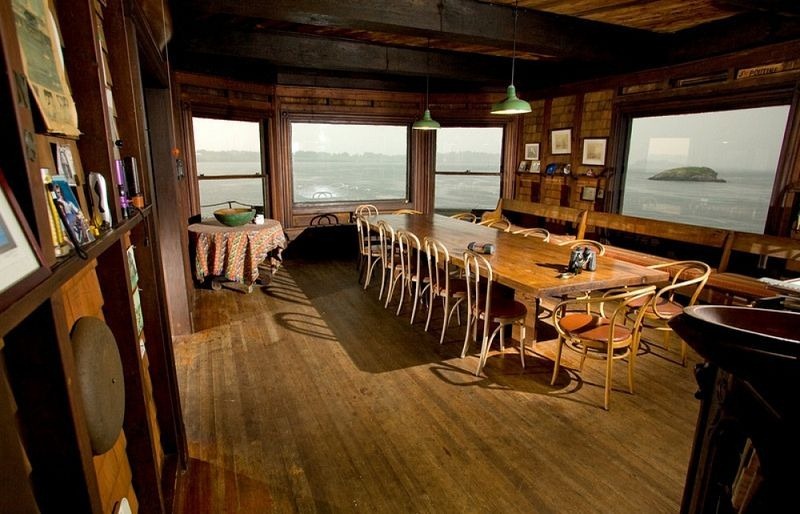
Photo credit: Eric Jacobs

Photo credit: mansion-homes.com
Source…..www.amusingplanet.com
Natarajan
Cabin Pressure and Oxygen Supply Aboard Commercial Aircraft….
How Cabin Pressure and Oxygen Supplies are Maintained Aboard Commercial Aircraft
 Because the economics of having large oxygen tanks aboard airliners simply doesn’t work out (not to mention that the air quality inside the plane would rapidly become unpleasant if fresh air wasn’t constantly supplied, regardless of the oxygen levels), commercial airplanes have a very clever system installed to solve the problem of ultra-low pressure atmosphere at cruising altitudes.
In most modern airliners (the Boeing 787 Dreamliner not withstanding), outside air is “bled off” from the compressor stage of the turbine engines and eventually piped into the passenger areas. However, a bit of processing is needed first as the compressed air is extremely hot (on the order of nearly 400 degrees Fahrenheit
or 200 degrees Celsius) at this stage. Thus, before it enters the passenger compartment, it is first allowed to expand and is run through a heat exchanger and air cycle system to cool it off sufficiently. This system also can work as a heater, with some of the hot air mixed in with the cooled air to regulate cabin temperature.
 Once cooled and filtered, the pressurized air, which now has sufficient oxygen density to keep people happily conscious, is piped into the cabin area, usually at levels around 12 psi (about equivalent to atmospheric pressure at 7,000 feet). Why 12 psi instead of something like sea-level pressures of about 14.7 psi? 12 psi is sufficient for the majority of passengers while simultaneously reducing the structural strain on the aircraft itself over something like sea level atmospheric pressures.
As for the air already in the cabin, this is vented out through an outflow valve (or multiple valves in larger aircraft), usually located near the rear of the plane. (FunNote: Before smoking was banned on commercial aircraft, the area around this outflow valve was generally stained dark brown from tobacco smoke.)
This outflow valve opens and closes automatically to maintain a steady pressure inside the cabin, while the entire system is ensuring that fresh air is continually being piped into and eventually blown out of the aircraft. In fact, while many complain of airplanes seeming “stuffy,” this system ensures that all the air in the aircraft is being completely replaced on average every 2-3 minutes. Yes, that means that your car, house or office is likely significantly more “stuffy” than a commercial airplane flying at 35,000 feet.
(Note: the Boeing 787 Dreamliner handles cabin pressurization a little differently, using a modernized version of the old, somewhat inefficient, electric compressor system seen on many older aircraft.)
Unfortunately, sometimes planes lose cabin pressure. Whatever the cause, the loss of pressure (usually set at atmospheric pressures past 14,000 ft) will result in oxygen masks deploying. From here, useful consciousness may only last as little as 5-15 seconds, depending on remaining cabin pressure, which is why it’s critical to immediately put your mask on, rather than helping someone else first. You can help them much better when you’re not unconscious or dead.
So how do these airline oxygen masks actually work? It turns out, the economics of having a centralized oxygen tank to provide even emergency oxygen for passengers likewise simply doesn’t add up. Similarly, having tiny individual pressurized oxygen tanks also isn’t feasible. In fact, these masks aren’t hooked up to any tank or air line at all. So how are you able to breathe oxygen through them?
Science.
While designs can vary slightly, in general, when you pull on the device to place it over your face, the tug on the mask’s lanyard releases a spring-loaded mechanism that sets off a small explosive charge. (Yep.) The resulting spark triggers a mixture of lead styphnate and tetracene to generate heat, which will eventually cause a chemical reaction that produces oxygen for your mask. (This is why they tell you to tug on the mask to get the oxygen flowing- you’ve got to set off the explosive charge to get the whole thing going.)
That’s right. What you breathe through the mask didn’t begin as pure oxygen. Rather, the plane is equipped with numerous small chemical oxygen generators (also known as “oxygen candles,” about the size of a small package of tennis balls) which contain a mixture of mostly sodium chlorate (NaClO3), less than 5% barium peroxide (BaO2) and less than 1% potassium perchlorate (KClO4). When these chemicals are heated by the lead styphnate and tetracene, each undergoes a reaction that ultimately results in a fair bit of filtered, life sustaining oxygen running through the tube to you.
Of course, you might also smell a faint burning odor, but this is nothing to be alarmed about; it just assures you that the system is working. In fact, if the plane is actually on fire, the masks usually won’t deploy, so as not to make the fire worse with the extra oxygen.
This brings us to the question of why the plastic bag on the breathing apparatus won’t necessarily inflate as you’re using the device. More than just cosmetic, the bags serve as something of a reservoir for oxygen. If you aren’t taking a breath at all (and have a good seal with the mask tight against your face) the bag keeps the precious, continuously flowing oxygen from escaping into the thin air around you, enabling more of the collected oxygen to be taken in when you do take a breath. When this is happening, or you are breathing out with the valves on the mask releasing much of the used air, the bag may begin to inflate as oxygen collects. When you breathe in, it will deflate.
So why won’t it always inflate at least a little to show its working? To begin with, you may not have a great seal with the mask on your face, particularly if you have facial hair. This will allow any produced oxygen (and air you exhale) to more readily escape. (As long as the mask is reasonably secure on your face,
this should still provide you with sufficient oxygen to get by on as long as the plane isn’t flying above 40,000 feet and the pilot does his or her job and gets the plane down below 10,000 feet as rapidly as safely possible.)
Even if you have a good seal, however, the rate at which the oxygen is generated is often not enough to fully inflate the masks’ bag before you take deep, potentially panicky breaths, deflating it. This is simply because the oxygen generation isn’t on-demand (for the passengers anyway), but simply a continuous-flow production of oxygen.
Despite the potentially slow production, the chemical oxygen generators do provide oxygen at a sufficient rate to sustain passengers, generally designed such that peak oxygen production occurs right away (when the plane may be at very high altitude) with the oxygen production rates tailing off over the course of approximately 12-20 minutes before the system burns itself out.
This should be long enough for the pilots to get the plane low enough so that the air pressure is high enough for (relatively) normal atmospheric breathing. And if you’ve ever been lucky enough to be in this sort of situation, you know that those pilots can get the plane from altitudes like 35,000+ feet to safer atmospheric levels alarmingly quickly in an emergency; while it may not be literally true, it at least can seem like roller coasters have nothing on them, which is a good thing in this case.
Source….www.today i foundout.com
natarajan
Top 10 Airports in the World ….Singapore Changi International Airport takes the Crown for the 4th Year in row…
1. Singapore Changi International Airport (SIN)Yearly passengers: 54 million
Previous rank: 1
Why it’s awesome: For the fourth year in a row, Changi takes the crown as the world’s best airport. Changi serves as home to Singapore Airlines, Silkair, and Tigerair and is the 16th busiest airport in the world.
The Singaporean airport has received praise from flyers for its beautiful architecture, efficient operation, luxurious amenities, and broad offering of dining and shopping options.
Flyers passing through are treated to movie theaters, a multimedia entertainment deck, spas, and a wild corkscrew slide.
2.. Incheon International Airport (ICN)
Yearly passengers: 41.7 million
Previous rank: 2
Why it’s awesome: Once again, Incheon is the world’s second best airport. Located on an island just outside of the South Korean capital, Incheon is home base to Korean Air and is the 24th-busiest airport in the world. It opened in 2001.
Incheon’s highly regarded facilities feature an array of shopping and dining options, in addition to a bevy of cultural performances. The airport even has a Korean culture museum.
3. Munich Airport (MUC)
Yearly passengers: 38.7 million
Previous rank: 3
Why it’s awesome: Located northeast of downtown Munich, MUC is one of the busiest airports in Europe and the second-busiest in Germany, after Frankfurt.
Munich serves as a major hub for Air Berlin, Lufthansa, and Condor and it features airy glass-heavy architecture. A nearby visitors park features minigolf and a display of historic aircraft.
4. Tokyo Haneda International Airport (HND)
Yearly passengers: 72.8 million
Previous rank: 5
Why it’s awesome: Haneda is one of two major international airports that serve the Tokyo area. Located a few miles away from the heart of the Japanese capital, Haneda has proved to be a popular port of entry for business travelers and tourists.
The world’s fourth-busiest airport, Haneda is know for its service efficiency, cleanliness, and shopping.
5. Hong Kong International Airport (HKG)
Yearly passengers: 63.1 million
Previous rank: 4
Why it’s awesome: Built on an artificial island off the coast of Hong Kong, HKG has become one of the most popular facilities in the world since it opened in 1998.
One of the busiest airports in Asia, Hong Kong International serves as the home to Cathay Pacific, Hong Kong Airlines, and Dragonair.
Be sure to play a round at the SkyCity Nine Eagles golf course near Terminal 2.
6. Central Japan International Airport (NGO)
Yearly passengers: 9.8 million
Previous rank: 7
Why it’s awesome: Built on an artificial island in the middle of Ise Bay near the city of Nagoya, Central Japan International — also known as Centrair — serves as a focus city for Japan Airlines and ANA.
Centrair holds the distinction as the best regional airport in the world.
It has a 1,000-foot-long sky deck where passengers can watch ships sail into Nagoya Port. There’s also a traditional Japanese bathhouse where you can have a relaxing soak while watching the sunset over the bay.
7. Zurich Airport (ZRH)
Yearly passengers: 25.5 million
Previous rank: 6
Why it’s awesome: Just eight miles from the heart of Zurich, the airport serves as the home for Swiss International Air Lines and as a hub linking Switzerland’s largest city with the rest of the country.
For passengers with an extended layover, Zurich Airport offers bicycle and inline-skate rentals and excursions to the Swiss Museum of Transport Lucerne.
8. London Heathrow Airport (LHR)
Yearly passengers: 73.4 million
Previous rank: 8
Why it’s awesome: Heathrow is the world’s third-busiest airport and the largest of the five primary airports serving London.
Heathrow is in the midst of a major renovation with the addition of a brand new Terminal 2 building. It’s eight-year-old Terminal 5 building was named the best airport terminal in the world by Skytrax.
Heathrow serves as the main hub for British Airways and Virgin Atlantic.
9. Kansai International Airport (KIX)
Yearly passengers: 20 million
Previous rank: 12
Why it’s awesome: Located on an artificial island in the Osaka Bay, Kansai International is a major hub for ANA and Japan Airlines.
Reviewers on Skytrax praised Kansai for its modern architecture, spotless facilities, and helpful staff. The airport also boasts a Sky View observation deck that affords passengers spectacular views of incoming and outgoing flights.
10. Doha Hamad International Airport (DOH)
Yearly passengers: 30 million
Previous rank: 22
Why it’s awesome: Hamad International opened for business in 2014 and is now home to Qatar Airways.
The airport and its two terminals sit on 5,400 acres of land and cost $16 billion to construct. Skytrax describes the facility as the “the most architecturally significant terminal complex in the world, as well as being the most luxurious.
Source: Skytrax World Airport Awards.
http://www.worldairportawards.com
Natarajan
The Black Dot: A Beautiful and Inspiring Story…!!!
This beautiful story has a simple, yet important message. I hope as many people as possible give it a read. I know I am happy I read it, as it gave me a few things to think about in my own life. Sometimes it is the simplest of stories that make us ponder the most.


Source…..www.ba-bamail.com
Natarajan
Secret Rooms Inside Abandoned Sewers….!!!
Italian street artist Biancoshock has just finished installing a couple of secret, miniature rooms, hidden under manhole covers, inside an abandoned sewer somewhere in the streets of Milan. This satiric “intervention” —a word that the artist uses for all his artworks— was inspired by the hundreds of people who are forced to live in extreme conditions, such as inside sewers, as in Bucharest where some 600 people live underground. Biancoshock calls this tiny project “Borderlife”.
If some problems can not be avoided, make them comfortable. -Biancoshock



via Colossal
Source…..www.amusingplanet.com
Natarajan
“I’d Given up on Returning to India After 18 Years Abroad. But This Year Something Changed.”
From dreaming about returning to India one day after she had to shift to the US with her family, to reaching a stage where she could no longer find that cherished connection with her country, to falling in love with it all over again – this is the story of Jessica Sinha and how Kolkata showed her a different India.
I was 10 when I moved to the U.S. and have lived abroad for over 18 years now. Leaving was the most difficult thing for me to do every time I visited India in the first eight years of moving to the U.S. I would bite my lip hoping the pain would hold back the tears. My last memory of India would be of the last song that played on the radio before we arrived at Indira Gandhi International Airport. Each year I vowed – I’ll be back someday, I’ll live here eventually. With no plans of when, where, and how, I continued to dream about it.
But after those first eight years, it never felt the same again. My relatives grew distant. Their excitement on seeing us dwindled every year. I found myself struggling with the basic things – showering, going to the bathroom, shopping, getting to places on my own, taking the bus, etc. Even my Indian looks and perfect Hindi couldn’t help hide the fact that I had no clue about anything in India. I was just a guest to my relatives now – a guest who visited once a year.
I grew up and started feeling unsafe in my country, cringing every time I read another news article about another rape case. Every trip from then on was the same. We would arrive in Delhi, go home, stay home. Then we would take the car and driver, visit relatives and family friends, and come back home again. We went to the mall once in a while, but the charm of India that I was delighted about once…it remained only in my heart. Everything and everyone I connected with, seemed to have almost never existed and my dream of moving to India started fading, right in front of my eyes.
This month I went back to India, Kolkata this time, with my Bengali husband for our first India trip after marriage. And something changed in the 14 days I spent there. A fire that I thought was long put out, sparked again. I saw a different country:

Mornings here begin with the sweet cooing of the Koyal. This city wakes up later than many others, but by 7-8 am, I can hear elderly neighbours chattering, gargling, or fighting a cough. The kitchen stoves come alive and the scraping of metal palta against the kadais marks the beginning of a new day. The smell of mouth-watering spices slowly fills the corridors of the building and escapes into the alleys.
Someone blows a long note on the conch shell over the sound of bells and muffles of Bengali prayers.

I walk up to the roof and get a glimpse of the sun. The buildings, painted yellow or light blue or pink sometimes, bear brown-black streaks from past rains. Some rooftops have bent clotheslines holding long saris that flow in the cool morning breeze. Somehow, the unfolded sari speaks to me. It floats freely like a kite, but is held safely by the clothesline.
With the distant sound of koyals, I sweep into a daydream where every single day in India feels as this moment does.

Back inside the flat, my mother-in-law brings out tea for the three of us, herself, my husband, and I; and we all decide to sit in the balcony. The balconies, windows, doors, any openings into the flat, are all protected by grills. There is something about the grills that’s uniquely classic and nostalgic. I think back to my childhood in Delhi – every night the community watchman would walk around the block, blowing his whistle loud and clear as he ran his baton across the park fence.
I look out into the streets and though it is mostly empty at this time, I know that the morning has already begun in many homes. Every balcony is a window into a different life. I look across to the building on the right and find an elderly man sitting in his balcony with a cup of chai and his parrot. In another window there’s a woman pulling down the dry clothes from the clothesline, hung the day before.
A sip of my tea. I wonder if my mother-in-law sees what I see. On days when she’s feeling hot, tired, and wants to take a break, does she look out like I do? Does she see the different lives as I do? And in those quiet tranquil moments when she does, does the world outside beckon to her? Does she see the ever turning wheels of time in Kolkata? Does she savour the endless festivities of every day? Even if a dispirited heart was to look out this balcony, it would find peace in knowing that it is not alone.
I’m not sure how the rest of India has fared since 1997, but Kolkata seems to be stalled in a time and place, which I dreamed about in my thoughts. It remains culturally rich and enticing. There is no confused blend of the western influences and eastern culture. I heard no heart-wrenching stories, saw no soul-searching individuals. I saw no street corners engulfed in conversations of unfulfilled ambitions. I saw hope in a newly-wed couple’s humble home, gratification in the everyday affairs, modesty of character, and a satisfaction with life as it is.
– Jessica Sinha
Source…..www.the betterindia.com
Natarajan
 Take off with Natarajan