One has only a short span of life on earth. But even in this short life one can attain divine bliss, by wisely and carefully using the time. Two people, same in appearance, ostensibly of the same mould, and also grown under the same conditions, but one turns out to be an angel while the other stays on with one’s animal nature. What’s the reason for this differential development? Habits, behaviour formed out of these habits, and the character into which that behaviour has solidified. People are creatures of character. To a superficial observer, life appears to be a rotation of eating and drinking, toiling, and sleeping. But verily life has a much greater meaning, and a deeper significance. Life is a sacrifice (yajna). Each little act is an offering to the Lord. If the day is spent in deeds performed in this spirit of surrender, what else can sleep be except total immersion in the Godhead (samadhi)?
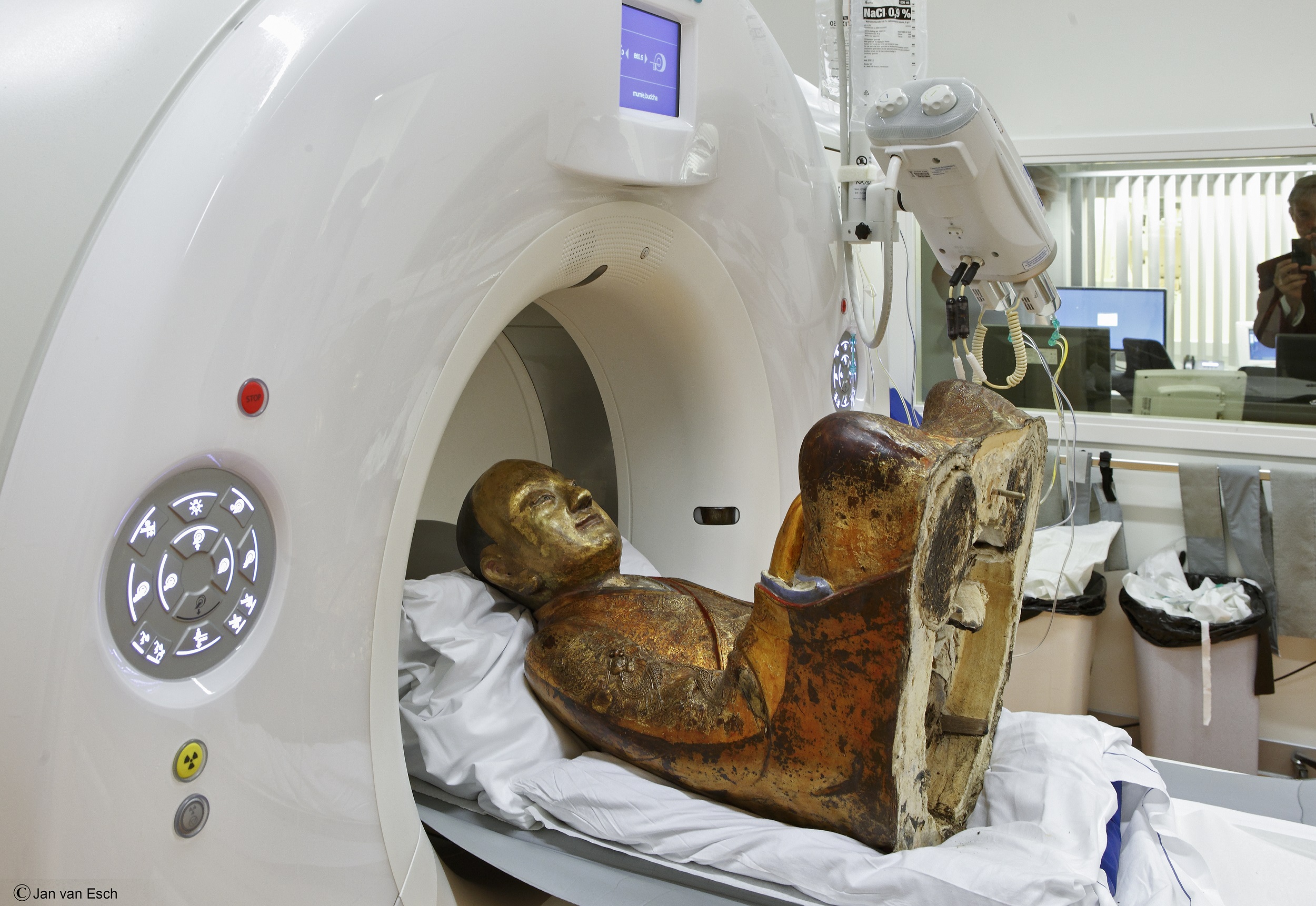
The mummified remains of a monk have been revealed inside a nearly 1,000-year old Chinese statue of a Buddha.
The mummy inside the gold-painted papier-mâché statue is believed to be that of Liuquan, a Buddhist master of the Chinese Meditation School who died around the year 1100, researchers said. It’s the only Chinese Buddhist mummy to undergo scientific research in the West.
The statue was on display last year at the Drents Museum as part of an exhibit on mummies. It was an cited as an example of self-mummification, an excruciating, years-long process of meditation, starvation, dehydration and poisoning that some Buddhist monks undertook to achieve enlightenment and veneration.
When the exhibit ended in August, a CT scan at the Meander Medical Center in the Netherlands revealed the seated skeleton. Samples taken from organ cavities provided one big surprise: paper scraps printed with ancient Chinese characters indicating the high-status monk may have been worshiped as a Buddha.
A CT scan has revealed a mummified Chinese monk inside a Buddha statue. The remains date back about 1,000 years. Video provided by Newsy Newslook
The finding was first reported in December but did not get wide notice. Irish Archaeology carried a report over the weekend, which apparently started the news ball rolling.
But the revelation is not, as some reports claim, “a shocking discovery,” The History Blog notes: “It was known to be inside the statue all along … that’s why it was sent to the Drents Museum in the first place as part of the Mummies exhibition.”
The mummy’s existence was discovered in 1996 when the statue was being restored in the Netherlands, Live Science writes, explaining what was found, how its age was determined and when the first detailed skeletal imaging was performed.
DNA tests were conducted on bone samples, and the Dutch team plans to publish its finding in a forthcoming monograph.
Researchers still have not determined whether the monk mummified himself, a practice that was also widespread in Japan and that was outlawed in the 19th century. If he did, the process was gruesome, asAncient Origins explains:
For the first 1,000 days, the monks ceased all food except nuts, seeds, fruits and berries and they engaged in extensive physical activity to strip themselves of all body fat. For the next one thousand days, their diet was restricted to just bark and roots. Near the end of this period, they would drink poisonous tea made from the sap of the Urushi tree, which caused vomiting and a rapid loss of body fluids. It also acted as a preservative and killed off maggots and bacteria that would cause the body to decay after death.
In the final stage, after more than six years of torturous preparation, the monk would lock himself in a stone tomb barely larger than his body, where he would go into a state of meditation. He was seated in the lotus position, a position he would not move from until he died. A small air tube provided oxygen to the tomb. Each day, the monk rang a bell to let the outside world know he was still alive. When the bell stopped ringing, the tube was removed and the tomb sealed for the final thousand day period of the ritual.
At the end of this period, the tomb would be opened to see if the monk was successful in mummifying himself. If the body was found in a preserved state, the monk was raised to the status of Buddha, his body was removed from the tomb and he was placed in a temple where he was worshiped and revered. If the body had decomposed, the monk was resealed in his tomb and respected for his endurance, but not worshiped
If you find yourself in Budapest before May, the Buddha mummy statue is on display at the Hungarian Natural History Museum.
SOURCE::::: Michael Winter, USA TODAY …www.usatoday.com
We must clearly understand the meaning of ‘death’ and ‘immortality’. We regard death as synonymous with all kinds of strength in the body being lost. In other words, death is the ebbing away of the life force from the body. If the life force remains in the body forever, we regard that situation as immortality. This is incorrect. To be able to completely identify oneself with the aspect of God and completely forget the aspect of the body is true immortality. If at all times we are totally immersed only in the thought of the body and its comforts, and forget the aspect of Atma, that is death. It is only when we are able to clearly recognise the connection between birth and death that the sacred desire for securing immortality will sprout in us. There is birth and death for the body, but there is no birth or death for the Atma. To be able to understand this eternity of theAtma is the real meaning of attaining immortality.
If your minds revel in external objects and in purposeless observation and criticism of the outside world, how then can it be trained to be steadfast? Ask yourself this question: ‘Great souls (mahatmas) and sages were also people like me. If they could attain perfection, so can I if I follow their method. What profit do I get spending my time in discovering the faults and weakness of others?’ Thus the first spiritual practice (sadhana) is to search for the faults and weaknesses within yourself, and to strive to correct them and become perfect. The unceasing toil of each succeeding day has as its aim and justification this consummation: to make one’s last days sweet and pleasant. But each day also has its evening. If the day is spent in good deeds, then the evening blesses us with deep sleep, invigorating refreshing sleep, the sleep which is said to be akin to samadhi.
Awards recognise airports with the best passenger service
Incheon International Airport won best airport for the Asia-Pacific region and best airport by size. Source: Getty Images
BALLOTS have been cast and the results are in. After surveying more than 550,000 passengers, the Airports Council International (ACI) has announced the winners of the 2014 Airport Service Quality (ASQ) Awards.
Reported in FlyerTalk, the trade group’s annual awards recognise the best of the best in airport passenger service, measuring 34 key service indicators.
“Airports are more than simply points of departure and arrival,” said Angela Gittens, director general of ACI World. “They are complex businesses in their own right. As such, a focus on serving the passenger has become increasingly important to ensuring success.”
Gittens noted there were many repeat airports on the list of winners, as well as many “new faces” that suggest promising changes.
Incheon International Airport in South Korea won for the Asia-Pacific region.Source: Supplied
First-place winners by category are as follows:
Best Airport by Region
Africa — Sir Seewoosagur Ramgoolam International Airport (MRU)
Asia-Pacific — Incheon International Airport (ICN)
Europe — Keflavík International Airport (KEF)
Latin America-Caribbean — José Joaquín de Olmedo International Airport (GYE)
Middle East — Queen Alia International Airport (AMM)
North America — Indianapolis International Airport (IND)
Keflavík International Airport was voted the best airport in the European region. Picture: Super Jet International.Source:Flickr
Best Airport by Size (Passengers per Year)
2 to 5 Million — José Joaquín de Olmedo International Airport (GYE)
5 to 15 Million — Haikou Meilan International Airport (HAK)
15 to 25 Million — Gimpo International Airport (GMP)
25 to 40 Million — Indira Gandhi International Airport (DEL)
Over 40 Million — Incheon International Airport (ICN)
Indira Gandhi International Airport made the cut for the best airport by size. AFP PHOTO/RAVEENDRANSource: AFP
Best Small Airport (Fewer Than 2 Million Passengers) by Region
Africa — Upington Airport (UTN)
Asia-Pacific — Langkawi International Airport (LGK)
Europe — Murcia-San Javier Airport (MJV)
Latin America-Caribbean — Bachigualato Federal International Airport (CUL)
North America — Victoria International Airport (YYJ)
Victoria International Airport was the best small airport in North America. Picture: Andy M. Smith.Source: Flickr
Best Improvement by Region
Africa — Sir Seewoosagur Ramgoolam International Airport (MRU)
Asia-Pacific — Netaji Subhas Chandra Bose International Airport (CCU)
Europe — Pulkovo International Airport (LED)
Latin America-Caribbean — Las Américas International Airport (SDQ)
North America — San Antonio International Airport (SAT)
A new passenger terminal building of Pulkovo International Airport made it best airport by improvement for the Europe region.Source: Getty Images
The lion, though crowned as the king of the forest, turns back every few steps while walking through the woods, because it is afraid of being pursued. Fear in the mind will make your vision falter. Violence within the heart distorts the vision and distracts the sight. Be vigilant! You must practice and develop impartial vision. All creation must appear equally auspicious in your eyes. You must look upon all with as much love and faith as they have in themselves, for absolutely nothing is evil in creation – no, not even an iota! Evil appears as such only through faulty vision. Creation is colored only by the nature of the glasses you wear. By itself, every creation is eternally pure and holy. Hence you must cultivate one-pointed steadfastness (ekagrata) in whatever you do. Impartial vision (sama-drishti) is auspicious vision (subha-drishti).
Raising a child puts parents in complex situations and presents them with many challenges. Nowadays there is a greater awareness of the importance of interpersonal communication within the family unit. It often feels like many of the old barriers between parents and their offspring have been torn down, especially when compared to the previous generation.
The tone parents use with their kids, as well as what they say requires ongoing sensitivity and awareness. There are times when you think that what you tell your child is exactly what they need to hear, but end up causing damage rather than encouraging them. The following are the ten most commonly used sentences parents say to their kids but shouldn’t.
1. “Hurry up!”Your son finally learned to tie his shoelaces on his own, but it takes a very long time, your daughter is playing with her breakfast instead of eating it, and both of them are going to be late for school. Being a good parent, you want to make sure they’re not late for school, so you blurt out a “hurry up!”. Instead of getting them to speed up, you’re actually causing them stress. Soften your tone and say “let’s hurry” instead. This tells your child that you’re on the same team rather than making them feel like you’re blaming them. An even better option would be to turn it into a game (“Let’s see who finishes their breakfast fastest!”).
2. “You’re okay.”
When your child is in distress and crying, your parental instinct will tell you to reassure them by telling them that it’s okay. The only problem is, that when you tell them they’re okay, the message they get is that you are ignoring their distress. The reason your kid is crying is because they are not ok. What you should do instead is give them a hug and acknowledge their situation (“That was a scary moment”), and then ask them if they want a kiss or a Band-Aid to make it better.
3. “Practice makes perfect.”The core of the saying is true – the more time you devote to learning a skill, the better you will become at it. However, the message your child is hearing is “what you’re doing is not perfect”. It puts pressure on your child to excel out of fear of disappointing you. Children beat themselves up feeling like they keep practicing, yet they’re still not good enough. The way to encourage your child to improve is by showing them how great improving feels, giving them a sense of pride in their own advancement.
4. “I’m on a diet.”
It’s great to stay healthy, but your kid doesn’t need to hear about it. Whether you’re checking your weight every day, calling yourself “fat” or repeating the “I’m on a diet” mantra – your child hears it, and it may lead to them developing an unhealthy body image. You can lead by example and say “I’m eating healthy because I like how it feels” or “It’s a lovely day, I think I’ll go for a run.” Using this type of phrasing will encourage your child to join you in a positive way.
5. “Great job.”
You may think that using such generic affirmation phrases helps build your child’s confidence, but research has shown that it actually makes them dependent on your affirmation instead of their own motivation. Congratulate your kid when they earned it and be more specific (“You were really good at sharing today” or “Nice pass, I like how you looked for your teammates”).
6. “Let me help.”How many times have you seen your kid struggling with a task or a game and rushed to their aid? Even though the intention is good, doing it too soon can undermine your child’s independence and cause them to always look at others for answers. Your best way to help them is to ask guiding questions such as “Do you think that piece should go there? Why do you think that? Okay, let’s try it.”
7. “We can’t afford that.”
Every parent had to endure their child begging for something at the store, and often the easiest way out is to state money trouble. The only problem is that your child interprets that as you not being responsible, or that the family unit is in financial danger, which leads to stress. It will also cause anger if you then buy something expensive for the house, making them feel like their needs are unimportant to you. You can tell them that you won’t buy them the toy or candy that they want because you’re “saving money for more important things”. If your child persists in the matter, it can be a great doorway into a conversation about finance and saving.
8. “No dessert until you finish your meal.”
This phrase teaches the kid the value of the dessert rather than the meal. It makes the child want the dessert more and feel like the meal is nothing but an obstruction. The correct phrasing is similar but subtly different: “First we eat our meal, then we eat the dessert”. It may sound the same, but it doesn’t make the meal feel like punishment, but rather like a natural step.
9. “Don’t talk to strangers.”While this is sound advice, it’s difficult for a young child to understand. Children associate “stranger” with a scary or unpleasant person, and might be encouraged to talk to someone who is nice to them. You may also drive your kid away from policemen and other civil servants they don’t know who may be able to help them. Add to that the fact that many child abductions occur by someone the child has previously known, and you have a rule of thumb that isn’t effective. The correct way to protect them, is to ask them “What do you do if a person you don’t know offers you candy and a ride home?” and let them explain to you the proper course of action and correct them if needed. It is also recommended to repeat this safety mantra: “If anyone makes you feel scared, confused, or sad, you need to tell me straight away.”
10. “Be careful.”
Using this phrase when you see your child doing something potentially dangerous can distract them and actively cause an accident. The correct course of action is to move quietly and calmly closer to them while keeping an eye on what they’re doing.
This date in science: John Glenn first American to orbit Earth
John Glenn and Friendship 7
On February 20, 1962, John Glenn became the first American to orbit the Earth. He made three turns around the planet before returning safely.
February 20, 1962. John Glenn became the first American to orbit the Earth on this date. He made three turns around the planet before returning safely in his space capsule, which was called Friendship 7. He followed two Russian cosmonauts in making this early orbit of our planet: Yuri Gagarin ( April 1961) and Gherman Titov (August 1961).
While Glenn was in orbit, NASA controllers received an indication that the heat shield on his craft had come loose. They instructed Glenn not to jettison the rockets underneath the heat shield during re-entry, because the rockets might be able to hold the shield in place. Fortunately, the indication turned out to be a false alarm.
Glenn returned to space at age 77 aboard the space shuttle Discovery in 1995, making him the oldest person to fly in space. His mission’s primary scientific aim at that time was to study the effects of spaceflight on seniors.
John Glenn climbs into the Friendship 7 spacecraft just before making his first trip into space on February 20, 1962. Photo via NASA
John Glenn and Friendship 7
Here’s What John Glenn saw on February 20, 1962. Just 5 minutes and 44 seconds after launch, Glenn offered his first words about the view from his porthole: “This is Friendship 7. Can see clear back; a big cloud pattern way back across towards the Cape. Beautiful sight.” Three hours later, at the beginning of his third orbit, Glenn photographed this panoramic view of Florida from the Georgia border (right, under clouds) to just north of Cape Canaveral. His American homeland was 162 miles (260 kilometers) below. “I have the Cape in sight down there,” he noted to mission controllers. “It looks real fine from up here. I can see the whole state of Florida just laid out like on a map. Beautiful.” Image via NASA
Here’s what John Glenn saw on February 20, 1962. Just 5 minutes and 44 seconds after launch, Glenn offered his first words about the view from his porthole: “This is Friendship 7. Can see clear back; a big cloud pattern way back across towards the Cape. Beautiful sight.” Three hours later, at the beginning of his third orbit, Glenn photographed this panoramic view of Florida from the Georgia border (right, under clouds) to just north of Cape Canaveral. His American homeland was 162 miles (260 kilometers) below. “I have the Cape in sight down there,” he noted to mission controllers. “It looks real fine from up here. I can see the whole state of Florida just laid out like on a map. Beautiful.” Image via NASA
Bottom line: John Glenn became the first American to orbit Earth on February 20, 1962. His space capsule was called Friendship 7.
Bottom line: John Glenn became the first American to orbit Earth on February 20, 1962. His space capsule was called Friendship 7.
Happiness generally relates to bodily comforts and is transient. Such temporary pleasure comes to us for a few moments but very soon plunges us into deep sorrow. But the kind of bliss that one gets through the Soul (Atma) is permanent, pure and selfless. Hence spiritual education (Brahma Vidya)advocates that love must be cultivated for love’s sake only. You must not express love to merely obtain material benefits. If love is showered to win temporary benefits, then it will last for a very short time only. Divine Atmasymbolises eternal truth and is permanent. Therefore Prema attached to Atmawill be true and permanent. This infinite love and eternal truth is present in every being (jīva). If we focus on developing love and truth for its own sake, then we will experience bliss supreme. That is why the Upanishads advocate Selfless Love as ‘Satyasya satyaṃ’ or the Truth of truths.
Books and facilities for mind-training are available in plenty, and at very cheap prices. The heaps of books that lie around cannot succeed in penetrating the heavy binding and emerge as light in you. For, just as God is hidden by the mountain ranges of lust, anger, envy, and selfishness within, the sun of wisdom is also hidden in the books. Though books and reading habits have spread to all corners of the earth, we can’t say that culture or wisdom has increased; the human is still not far from the ape. An attractive binding, title and beautiful pictures are what the reader seeks; these are transitory pleasures which give momentary contentment. Aimless reading of all and sundry books will confuse you and confer no peace. Hence discriminate, select and read books that contain life histories of saints and sages, and those that aid in the contemplation of the Divine. Practice what you read. Then you will realise truth and enjoy everlasting bliss.