In Nepal, Every Dog Has Its “Day”. Literally……!!!

Dog Festival Nepal Sprinkled

Most dog owners would do just about anything for their canine companions. In Nepal, Hindu populations take that affection to another level.

Coinciding with the traditional Hindu festival of Diwali, the people of Nepal reserve the second day of the annual five-day Tihar Festival to honor man’s best friend. On this day — called Kukur Tihar, or “worship of the dogs” — participants pay tribute to the divine attachment between humans and their faithful, four-legged companions.

Dogs play a significant role in Hindu mythology. Sarama — the mother of dogs — assists the ruler of Heaven, with dogs guarding the gates to the afterlife. Thus during the festival, all dogs – even strays – enjoy special treats, are decorated with malla (garlands of marigold), and colorful head markings to denote their sacredness. The markings, called tika, also serve to bless all who encounter the dog.

Dogs aren’t the only animals honored during the festival, though. Worshipers also pay tribute to cows (which signify wealth and prosperity) and crows, to which people make food offerings in order to deter sadness, grief and to banish death from their homes.

The festivals of Tihar are meant to commemorate not just the sacred bond humans hold with their creator, but also the divine in our relationships with living beings on Earth — something of which we should all take note from time to time.

This year, the Tihar Festival begins on November 9th. In the meantime, enjoy these photos of Kukur Tihars past:

Dog Festival Nepal Garland On

A patient pup receives a garland of bright orange marigolds. Source: Connect Citizen


Dog Festival Nepal Sitting Up

This jaunty little guy joins the police dogs in putting on a show. Source: Imgur

Dog Festival Nepal Paint

The vermilion-colored dye nearly covers almost the whole face of this adored dog. Source: Imgur

Dog Festival Nepal Tongue

Perhaps this sweet guy’s mouth is watering at the anticipation of his treats. Source: Reuters

Dog Festival Nepal Kid

It must be uplifting to see so many appreciated dogs around the city; both strays and those with homes. Source:ofenmacher

Dog festival Nepal welcome

Man’s best friend deserves all the love and respect in the world, every day. Source: AP Photo/Binod Joshi

By By on October 5, 2015 in

Source….www.all-that-is-interesting.com

Natarajan

Finding Indian food in ‘alien’ land….

Finding Indian food in 'alien' land

Long vacations in the UK, US and south-east Asia no longer involve the culinary nightmares of 20 years ago for Indian tourists. When they tire of bland local fare, there’s no dearth of Indian restaurants, run by the vast Indian diaspora and reasonably authentic, to get a taste of home.

The news, though, is that these destinations are becoming passé. Increasingly, it’s to countries in Indo-China, the Balkans, West Asia (the parts that are still peaceful, that is) and South America to which rich and upper middle-class Indians are heading to spend the generous forex allowance the Indian government now permits.

But as a Vietnamese restaurateur once told me, “Indians no eat all foods; velly big ploblem”. True enough, Indians with their many particularities of diet can find mealtimes a chore in many countries off the regular tourist beat. Yet where many Indians go boldly, can be far behind?
As the listing here shows, there are Indian options available in cities from Dubrovnik to Peru for tourists who are so inclined. The names can be misleading, however: Oh Calcutta in Auckland, an award-winning restaurant, bears no resemblance to the well-known Bengali restaurant chain in India.

The restaurant, run by a chef called Meena Anand, has the standard north Indian/Mughlai fare. This, sadly, is true of almost all the menus on offer — the infinite varieties of the Indian sub-continent are largely absent. In Luang Prabang, the stunning UN heritage town in Laos, Nisha restaurant will give you an authentic dhaba experience: it offers, among other things, aloo ghobi, aloo mutter, “Dhal Fry” and rotis. It could be a comforting break from a bewildering local menu that may contain: dog, frog and, yes, even beef!

A gourmet itinerary


Vietnam
Mumtaz Restaurant
Ho Chi Minh City


Foodshop 45
Hanoi


Laos
Nisha Restaurant
Luang Prabang


Taj Mahal Restaurant
Vientiane


Cambodia
Dosa Corner
Phnom Penh


Taste Budz
Phnom Penh
Samsara
Siem Reap
Croatia
Royal Indian Restaurant
Zagreb
Incredible India Cuisine
Dubrovnik
Iran
Taj Mahal
Tehran
Jordan
Tandoori Oven
Amman
Peru
Guru Kebab & Curry
Lima
Brazil
Taj Bar
Iguasu
Gopala Hari
Sao Paulo
Veggie Govinda
Rio
Mexico
El Tandoor
Mexico City
New Zealand
Oh Calcutta
Auckland
Chilis Bistro and Tandoor
Wellington
Maharaja Indian Restaurant
Christchurch
The Spice Room
Christchurch
China
Masala Art
Shanghai
Punjabi Indian Restaurant
Beijing
South Africa
Royal Punjab
Johannesburg
Bukhara
Cape Town
Portugal
Passage to India
Lisbon
Data courtesy: Ashish Chadha, group managing partner, Leisure Ways, New Delhi
 Source…www.business-standard.com
Natarajan

” Childhood is Wonderful …No Matter Wherever You Go …” !!!

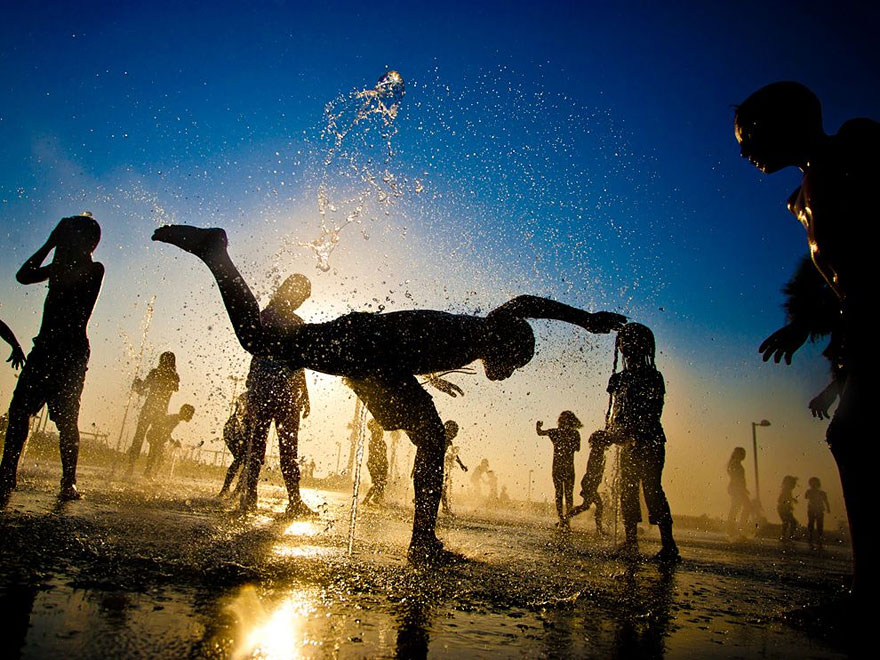
No matter their cultural background, no matter their economic situation, kids will always find imaginative ways to have fun. Their wild imaginations and magical childhood moments, when captured on camera by talented photographers, can make for truly wonderful photos. These 33 images we collected will prove that childhood can be wonderful no matter where you go.

Many in the Western world fear that technology is making today’s children lose touch with nature and with their own creativity, and while there are arguments to be made for the intellectual stimulation that apps and programs for children can bring, there’s also something to be said for simply playing with a stick in the mud or chasing dandelion seeds though an open meadow.

For better or worse, the children in these photos seem entirely content making their own fun. For us adults, it’s important not to let our world-weary and jaded experience stifle our childish hopefulness and imagination!

Indonesia

Image credits: Ipoenk Graphic

children-around-the-world-70

Image credits: Agoes Antara

Image credits: I Gede Lila Kantiana

Image credits: Gede Lila Kantiana

Russia

Image credits: Светлана Квашинa

Image credits: Elena Shumilova

Burkina Faso

Image credits: Òscar Tardío

Myanmar

children-around-the-world-65

Image credits: Chan Kwok Hung

Tajikistan

Image credits: Damon Lynch

India

children-around-the-world-60

Image credits: Sandee Pachetan

chidren-playing-around-the-world-55

Image Credits: Sudharsan Ravikumar

Image credits: Mukund Images

Vietnam

chidren-playing-around-the-world-51

Image Credits: HT KëñShi

Ghana

children-around-the-world-61

Image credits: Terry White

Estonia

children-around-the-world-54

mage credits: Elika Hunt

Thailand

Image credits: Sarawut Intarob

Image credits: Sarawut Intarob

Image credits: Sarawut Intarob

South Africa

children-around-the-world-55

Image credits: Muhammed Muheisen

children-around-the-world-60

Source: tinosoriano.com

Peru

children-around-the-world-52

Image credits: Enrique Castro-Mendivil

Ethiopia

children-around-the-world-50

Image credits: Csilla Zelko

Italy

children-around-the-world-61

Image credits: Michael Potyomin

Israel

children-around-the-world-64

Image credits: Dima Vazinovich

USA

Image credits: Jake Olson

Indonesia #2

Image credits: Rio Rinaldi Rachmatullah

Image credits: James Khoo

children-around-the-world-53

Image credits: Hendrik Priyanto

chidren-playing-around-the-world-50

Image Credits: Mio Cade

Uganda

Image credits: John Van Den Hende

Romania

Image credits: Elena Simona Craciun

Russia

Image credits: Elena Shumilova

Source…..www.boredpanda.com

natarajan


How a Mobile App Is Bringing Better Maternal Health Care to Rural Karnataka in India….

An Auxiliary Nurse Midwife (ANM) is often the first point of contact between a health centre and a mother or expectant mother in India. She takes care of activities as basic as registration of pregnant women to more advanced interventions like routine immunization, identifying medical complications and providing referrals. An ANM has a lot of responsibilities and this simple, mobile-based intervention, Suyojana, enables her to effectively carry out her duties.

Rohini, from Chamrajnagar, Karnataka, is an Auxiliary Nurse Midwife (ANM), working in rural areas of the state. Despite the fact that she is proactive and interested in her work, Rohini often finds herself struggling to remain on top of all the information required to serve her patients effectively. From tracking crucial health parameters to scheduling important visits for critical cases, Rohini finds herself swamped with details that she is unable to handle in an organized manner.

Recently, however, Rohini began using Suyojana, a mobile-based application that improves the decision-making processes in maternal and child care activities undertaken by ANMs.

“The Suyojana application guides me from one step to another, within examinations and investigations, and does not let me skip a single step. This has made my work way more organized and systematic. The application has also made it very easy to identify high-risk cases and refer the patients on time to better facilities. The tool helps me take the right decisions at the right time,” says Rohini.

ANMs can keep track of their patients in a better way and also take necessary actions on time.


ANMs can keep track of their patients in a better way and also take necessary actions on time. –

Rohini is just one among several ANMs who have benefitted from the simple technology, Suyojana, launched by Swasti, a health resource centre established to provide health services to socially backward communities, in collaboration with D-Tree International and Karuna Trust.

“Swasti has been working in this field for 11 years now and work on improving different aspects of public health. Since ANMs do such important work at the grassroots level, we thought it was necessary to make decision-making easier for them through this mobile intervention,” says Shama Karkal, Director, Swasti.

The issue

The app does not let an ANM update her patients' profile until all the fields in the app are filled.

The app does not let an ANM update her patients’ profile until all the fields in the app are filled. –

As par-medical professionals who are closest to the rural communities, ANMs play a crucial role. They are required to use their knowledge in order to take requisite actions on time.

Though ANMs undergo training, many times they are unaware of the basic practices they should follow. Shama recalls that ANMs met during the pilot did not carry blood pressure or weighing machines during home visits. “Everyone assumes that they know what they are doing. Even ANMs are not aware of what they could do better and there is no system to monitor the quality of the care they provide.

Without the application, ANMs can skip many of the examinations and other critical components of an ante-natal or post-natal visit.

This results in incomplete and in-accurate health monitoring of pregnant women and children.

The solution 

This is where Suyojana plays a crucial role. This mobile-based clinical-decision support system (DSS) provides ANMs with consistent guidance with antenatal care (ANC), postnatal care (PNC), and neonatal care.

The mobile app takes ANMs through all the procedures and guidelines to identify the person’s conditions and provides options for decision making. The app uses the national guidelines maternal and neonatal care to guide the ANM. The app also allowsANMs to track patients they have visited, their expected clinic visit dates, their medication, etc. This also helps ANMs to identify those women who are due for their next appointment, both in-clinic visits and home visits.

“The app has various forms which ANMs complete during different visits. The forms in the application include registration, antenatal history (for ANC clients), pregnancy outcome (for PNC clients), danger signs, physical examination, investigation tests, intervention, and counselling. Basic care and monitoring of the child is also included — from foetal heart rate to neonatal danger signs, pre-referral treatments and home-based new-born care counselling. Required fields in the app must be completed in order to complete the visit and record it. This way, every aspect of the care provided is tracked,” says Shama.

With the app the ANMs do not need to maintain multiple registers. The app generates the standard reports which can be further customized.

Another interesting aspect of the app is that it also runs offline and synchronizes with the server using general packet radio service (GPRS) for back up, reporting and analysis.

The impact

With the app the ANMs do not need to maintain multiple registers.

With the app the ANMs do not need to maintain multiple registers.

Thanks to the easily available data, a supervisor can track the details from the server and can identify maternal health trends in a particular area. This way ANMs can also take expert advice from remote locations and can decide the next step they need to take on time.

“This application will help us in quickly referring a complicated case to higher public health facilities and will replace the cumbersome procedure of checking registers and day books. All we would be required to do is click on the app to get all the details. This would be a great relief for us and reduce our workload,” says Saraswathi, yet another ANM from Karnataka.

The interesting initiative, which was launched as a pilot project in March 2014 in Chamarajanagar district, involved 31 ANMs in four districts of Karnataka, including Chamarajanagar, Ramanagara, Bijapur, and Chikkaballapur.

To make the app more user-friendly, all the information is available in Kannada. The ANMs are first given formal training before they actually start using this app. Once the training is complete, ANMs using this app and sync the data collected by them on a regular basis. There is also a full-time supervisor who assists the ANMs in case of difficulties.

“We launched it on mobile phones since they are easier to use and are more handy. Currently, we install the app on the mobile phones of ANMs and it is not available for the general public to use,” says Shama.

Though the simple mobile app looks like a feasible solution to address difficulties of ANMs and the quality of care provided by them, the team is still struggling to have it accepted with the government.

The pilot was funded by D-Tree International, has a small team of four members, who are looking forward to expanding the initiative to cover many more districts and ANMs.

To know more about the initiative, contact Angela at – angela@swasti.org or check out their website.

Source…..Shreya Pareek….www.the betterindia.com

Natarajan

Message for the Day…” Follow the Righteous Way of Life to Reach the Road of Self Realisation…”

Sathya Sai Baba

People everywhere are degrading themselves from their status as children of eternity (amrita-putra) to that of children of futility (anrita-putra)! Holding nectar in their grasp, they are drinking the poison of sensual pleasure. Neglecting the joy of contemplation of the fundamental divine reality of the universe, they are entangling themselves in the external trappings of this objective world of appearances. This immortal dharma (amrita-dharma) is described in the Upanishads, and since the Gita is the kernel of the Upanishads, the same is emphasized in the Gita too. The Gita teaches Arjuna to develop certain qualities that help the practice of the Atma Dharma (the righteousness that springs from the True Self). These are delineated in verses 13 to 20 of Chapter 12. The dharmic (righteous) way of life is like the very breath; it is the road to self-realization. Those who walk along it are dear to the Lord.

Prague Astronomical Clock: 5 Fast Facts You Need to Know…This Historical Clock Turns 605 Today…9 Oct 2015…

Prague astronomical clock Photos

She doesn’t look a day over 600, but on October 9, the Prague astronomical clock celebrates its 605th birthday. To celebrate this joyous occasion, Google has put up a very nice Google Doodle.The company writes in the page about the drawing that “Despite over a half a millennium of wear and a brush with disaster in WWII, much of its original machinery remains intact, making it the oldest functioning clock of its kind in the world.” The company adds, “Today’s Doodle honors a magnificent achievement in medieval engineering and a cultural landmark whose symbolism, design, and intermittent repairs are a remarkable catalogue of Europe’s past.”

Here’s what you need to know:

1. Legend Says That the City of Prague Suffers if the Clock Is Neglected


According to Prague City Line, the entire city will suffer if the 605-year-old clock is ever neglected and falls into disrepair. The clock is located in the city’s famed Old Town Square. One of the clock’s symbols, a skeleton, which represents death, will nod its head when it deems that the device has been neglected and that it’s time for Prague to suffer.


2. The Clock Was Severely Damaged by the Nazis During the Prague Uprising


The clock pictured in July 1966. (Getty)

As the Allies cruised to victory in the final days of World War II in 1945, the Nazis began sabotaging their equipment as well the historical buildings of Prague. As a result, the clock didn’t function until 1948 when it was repaired.


3. You Can View the Inside of the Clock on Google Streetview

(Getty)

Thanks to Google, you don’t have to bring yourself all the way to Prague’s Old Town (but you should, it’s beautiful). You can view the inner workings of the clock on Google Street View.Obviously, you can also check out the outside area, too, and remind yourself why you should go to Prague.


4. One of the Clock’s Designers Was a Catholic Priest & a Scientist

Otakar Zamecnik works on parts of the clock in Prague, 08 September 2005. The Old Town Square Astronomical Clock was taken a part for a two-month restoration. The Clock will be fully functional in the beginning of November 2005. (Getty)

The clock was first constructed in 1410 by two men, Mikulas of Kadan, and Catholic priest and scientist Jan Sindel. He was the astronomer in the duo with Mikulas being the more functional clockmaker. The influence of religion can be observed around the clock, with the 12 apostles, the skeleton representing death, as well as a miser carrying a bag of gold representing the deadly sin of greed.

5. The Clock Is Older Than Joan of Arc

Joan of Arc Photos

The clock was functioning for two years before Joan of Arc was born. It’s nearly a century older than William Shakespeare. Not only that, but it’s fully 310 years older than the United States of America.

Source….


Here’s what it’s like to live in space….

A $US150-billion contraption floating 270 miles above Earth is one of the most impressive achievements of humankind.

It’s called the International Space Station (ISS), and a rotating astronaut crew has occupied it since 2000. The work of those astronauts has yielded some incredible scientific insights.

Astronaut is not a profession where you get to go home at the end of the day though. One ticket from Earth to the ISS costs about $US70 million, so normally each crew lives and works on the station for a six-month shift.

Right now NASA astronaut Scott Kelly and Russian cosmonaut Mikhail Kornienko are in the middle of a year-long shift aboard the ISS. They will be the first humans to spend a consecutive year living in space.

But what is it like to actually live on the ISS?

The first step to living in space is getting there. All astronauts hitch a ride to the ISS on board a giant space shuttle that launches from Russia.

NASA

The shuttle takes astronauts all the way up to the ISS, which floats about 250 miles above the planet.

NASA

The station is a system of labs, living quarters, and control rooms, and it spans about the length of a football field. A rotating crew of six astronauts share the space.

NASA

The ISS is hurtling around the Earth at about 17,150 miles per hour. That extreme velocity puts the ISS in a constant free fall around the planet.

So everything on board experiences weightlessness, including the astronauts.

So they get around the station by floating. Which means sometimes it’s too hard to resist the temptation to strike a Superman pose.

Weightlessness causes a lot of weird problems though — the kind of problems we never experience here on Earth thanks to gravity.

NASA

For example, sweat doesn’t evaporate. Instead, it pools on astronauts’ bodies, so they are constantly toweling off sweat. You can see sweat droplets escape from this astronaut’s towel after he wipes his head.

If objects escape inside the ISS, they can float away, get lodged in equipment, and cause malfunctions.

For example, even small tasks like clipping your nails become a problem. Astronauts clip them near a vent, so that tiny pieces of nail don’t end up floating all over the station.

RAW Embed

Water is also difficult to manage. It likes to stick together in a big blob.

So washing and showering is a challenge. Astronauts squirt a few lines of water on their skin and hair and then use no-rinse soap and shampoo to clean themselves.

The station only gets resupplied every few months, so astronauts have to be mindful of their supplies. Luckily, over 90% of the water on board gets recycled and reused.

That includes everything from dirty wash water, water from astronauts’ breath, and yes, even urine is recycled. It’s all sent through this high-tech water filter on board.

YouTube/Canadian Space Agency

The water is perfectly safe to drink after it’s run through the filter (it’s actually cleaner than the water we drink on Earth), but many astronauts say they try not to think about it too much when they refill their water pouches.

YouTube/Canadian Space Agency

Getting back to that urine thing, ‘How do you go to the bathroom?’ is one of the most common questions astronauts get.

YouTube/ESA

If you’re going number one, it gets sucked into this tube through the yellow nozzle.

YouTube/ESA

Things are little more complicated when you need to go number two. There’s a tiny seat, a container for the waste, and a suction pump.

YouTube/ESA

Once you do your business and suction it away, you have to change out the ‘poop bag’ for the next person.

YouTube/ESA

Still, all the complications that come from weightlessness don’t get in the way of what astronauts are really there for. They spend most of their time working on various research projects and repairing the station.

NASA

Sometimes that even involves venturing out into the dangerous vacuum of space. Trips outside the station are called ‘spacewalks,’ and they take a lot of preparation and safety training.

NASA

One wrong move and an astronaut could just float off into the vacuum of space (like George Clooney in ‘Gravity’). They also have to watch for leaks in the spacesuits that protect them from the bitterly cold temperatures and radiation in space.

NASA

When they aren’t working, astronauts still have to stick to a pretty tight schedule. They have mandatory workouts so they don’t lose too much muscle mass in the weightless environment. (Since they don’t have to fight gravity, they get a lot less exercise while moving around.)

You can easily lift hundreds of pounds in a weightless environment, so astronauts have a cleverly designed machine for weight lifting.

After a good work out, you gonna eat. Space meals are stored in dehydrated packets. Once you add a little water, dinner is served.

And the menu isn’t half bad. Here’s an astronaut enjoying a milkshake.

NASA

After dinner it’s time for bed. The middle section of the station is where most of the crew sleeps. Labs and work spaces make up the rest of the structure, and the giant yellow panels collect sunlight to help power everything.

YouTube/Canadian Space Agency

Each astronaut has their own tiny room that includes a work space and a sleeping bag strapped to the wall. You can see on the screens that it appears astronaut Scott Kelly is chatting on Facebook.

NASA

Sleeping in space is hard to get used to since you don’t feel the sensation of lying down. Astronauts zip themselves into a sleeping bag every night so they don’t float around in their sleep.

And they have to keep careful track of their sleep schedule since days don’t pass the same on the ISS as they do on Earth. The station is whizzing around the planet so quickly that the crew sees about 16 sunrises and sunsets during a 24-hour Earth day.

NASA

When it’s time to return to Earth, a shuttle flies up to the station to pick up the astronauts. Then they parachute back down to Earth in a landing pod.

NASA

Astronauts are a little wobbly on their feet when they first land, but it doesn’t take long to readjust to a weighted environment.

NASA

Living on the ISS is no picnic, but it’s a once in a lifetime opportunity. Most astronauts say they wouldn’t trade the experience for anything.

Natarajan

This is the change London Heathrow Airport has been waiting for…

Heathrow Skitch

London’s Heathrow Airport is one of the busiest hubs in the world and serves as a major connecting point for traffic between Asia and Africa with North America.

As Britain’s main international airport, Heathrow has been working hard to upgrade its facilities. In recent years, the airport has opened two brand new terminal buildings and have conducted significant renovations to others.

However, the greatest constraint on the airport has been it’s lack of runways. Although more than 72 million passengers pass through Heathrow every year, the facility still operates using just two runways.

However, if Heathrow’s latest expansion plans are approved, things are about to change for airport.

At first, the airport wasn’t much to look at. Its passenger terminals were just tents.

Heathrow Airport

By the 1960s, the airport’s permanent terminal buildings entered service. Heathrow also abandoned its ‘Star of David’ layout, keeping only the northern and southern runways.

Heathrow development came just in time for the arrival of the jet set! Along with celebrities such as The Beatles and …

Today, the airport is the primary international hub serving London and much of England.

Flickr/Tony Hisgett

The airport is home to Virgin Atlantic Airways and …

Heathrow Airport

… British Airways.

… Terminal 5 facilities

But what hasn’t changed in the last half century are its two runways.

But that may be ready for an update if the Airport’s new expansion proposal is approved this December.

The expansion would include a third runway built at the north of the airport; it would increase Heathrow’s capacity from 470,000 flights a year to 740,000.

The airport also wants to build a new terminal to the west of Terminal 5.

The expansion would also dramatically alter Heathrow’s central terminal area.

The transformed central terminal area will feature new hotels, office buildings and …

… green space for passengers.

The new hotel facilities will be located just a few minutes away from the terminals.

The proposed development plan also calls for improvements to road and rail access to the airport.

The expansion of London Heathrow has been a contentious topic. Although there have been discussions about building a completely new airport for decades, the British government recommended improvements to Heathrow as the preferred way to increase airport capacity.

source….BENJAMIN ZHANG  in http://www.businessinsider .com.au

Natarajan


India Shares It’s Border With 7 Nations. Here’s How The Separating Lines Look Like…

When you think of India’s international border with neighbouring countries, what is the first thing that comes to your mind? Armed soldiers? Fences? Or maybe barbed wires?

Most of the time when you are in front of our international borders, the only indication that you get is a sign that says ‘Welcome to …’ or ‘Indian territory ends’.

The international border of India is the third largest in the world after China and Russia.  Not just that, the borders of India are one of the most sensitive borders of the world along with extreme climatic conditions.

Through this article, I am presenting you some images of Indian borders with Pakistan, China, Nepal, Bhutan, Myanmar, Sri Lanka and Bangladesh.

1. India-Pakistan International Borders

The border runs from the Line of Control (LoC) in the north to Wagah which partitions the Indian state of Punjab and Punjab province of Pakistan in the east. And in the west, India shares its border in Barmer Border in Rajasthan and Sir Creek Border in Gujarat.

(i) In Jammu & Kashmir, India shares its border with Pakistan in POK and Suchetgarh.

India-1 (1)

ii) LOC (Line of Control)

India-1 (2)

(iii) This is the India-Pakistan Rajasthan border in the west.

India-1 (3)

(iv) Here’s how the Gujarat border of India-Pakistan looks like

278839583

(v) The evening flag lowering ceremony at the Wagah border.

India-1 (5)

vi) One of the very few beautiful international boundaries visible after dark.

India-1 (7)

(vii) The border, floodlit for surveillance purposes, looks like this at night.

India-1 (8)

2. India-Myanmar International Borders

Four Northeast Indian states –  Arunachal Pradesh, Nagaland, Mizoram and Manipur share their borders with Burma:

(i) Moreh in Manipur…

india-myanmar-manipur-border

(ii) This is Champhai in Mizoram.

india-myanmar-mizoram-border

(iii) The two countries also meet at the hilly untamed region of Nagaland.

india-myanmar-nagaland-border

3. India-Nepal International Borders

Nepal shares its boundaries with India in Uttarakhand and Sikkim in the north-east. Uttar Pradesh and Bihar are the other two states where they share their borders.

(i) In Uttarakhand, the border is mainly used for trading and other commercial purposes.

india-nepal-uttarakhand-border

(ii) There is one more border in Bihar.

india-nepal-bihar-border

ii) …and in Uttar Pradesh too.

india-nepal-up-border

4. India-Sri Lanka International Borders

Indi-Srilanka-Border-(1)

India and Sri Lanka form the shortest land border in the world. The length of the border between these two countries is 100 meters. Both the countries are joined by a narrow stretch of Adam’s Bridge.

5. India – China International Borders

India shares some of the most historic and famous borderlines with China which happen to be popular tourist destinations as well.

(i) First China meets India at Chumar, Ladakh.

india-china-tibet-border

(ii) ..then in the paradise of Himachal Pradesh.

india-china-himachal-border

(iii) Even in Uttarakhand, the two countries share the border area.

india-china-uttarakhand-border

(iv) In Sikkim, they meet again at the Nathula Pass.

india-china-sikkim-border

6. India-Bhutan International Borders

India shares a 699-km long border with one of the happiest countries in the world, Bhutan along Sikkim, West Bengal, Assam and Arunachal Pradesh.

(i) First they meet at Sikkim.

india-bhutan-sikkim-border

(ii) Then at Bumthang, Arunachal Pradesh.

india-bhutan-ap-border

7. India-Bangladesh International Borders

The border between India and Bangladesh (4,096 Km) is the fifth-longest land border in the world. At first India meets Bangladesh at Kishanganj.

(i) After that, they meet at West Bengal.

IND-BD-BORDER

ii) Also, they share an international border in Meghalaya

india-bangladesh-meghalaya-border-1024x768

(iii) Mizoram.

india-bangladesh-mizoram-border

(iv) …and Tripura.

india-bangladesh-tripura-border


Source….Shuvro Ghoshal…www.storypick.com

Natarajan