The Man We Should Thank for Hi Speed WiFi and 4 G…

Meet Joseph Paulraj, a pioneer of MIMO wireless communications, a technology breakthrough that has revolutionised high speed wireless delivery of multimedia services for billions of people across the globe.

 “Though I initiated this concept, there are thousands of engineers and researchers all over the world who have made research advances and developed products that we all use. I was just a small spark that lit a pretty big fire,” says Joseph Paulraj on his achievement.

It has been an incredible journey for Arogyaswami Joseph Paulraj, Professor (Emeritus), Stanford University, California who started his career in the Indian Navy.

Winner of the prestigious $100,000 Marconi Prize for 2014, considered the Nobel Prize of Information Technology, Joseph Paulraj has done India proud with this award.

The Marconi Society, founded 50 years ago by Gioia Marconi Braga, annually recognises one or more scientists who — like her father, radio inventor Guglielmo Marconi — pursue advances in communications and IT for the social, economic and cultural development of all humanity.

Dr Paulraj is known as the father of MIMO (Multiple Input, Multiple Output) — the idea of using multiple antennas at both the transmitting and receiving stations that is at the heart of high-speed WiFi and 4G mobile systems — and has revolutionised high speed wireless delivery of multimedia services for billions of people across the globe.

The big value of MIMO is that it multiplies radio spectrum, a precious and a limited resource.

‘Every WiFi router and 4G phone today uses the MIMO technology pioneered by him,’ Professor Sir David Payne, chairman, Marconi Society, and director, Optoelectronics Research Centre, University of Southampton, said in a press statement.

‘MIMO will soon be pervasive in all wireless devices. Moreover, Paulraj’s work has provided fertile ground for thousands of researchers to explore and advance MIMO’s potential to enhance wireless spectrum efficiency.’

N R Narayana Murthy, executive chairman, Infosys, said in statement that Professor Paulraj ‘revolutionised wireless technology, bringing a lasting benefit to mankind.’

Paulraj joins the elite group of IT pioneers like Tim Berners-Lee, inventor of the World Wide Web; Vint Cerf, considered one of the fathers of the Internet; Larry Page, co-founder, Google; and Marty Hellman, inventor of Public Key Cryptography.

“I feel truly honoured. I was fortunate to come up with the idea,” Paulraj told Rediff.com. “Though I initiated this concept, there are now ten of thousands of engineers and researchers all over the world that have made research advances and developed products that we all use. I was just a small spark that lit a pretty big fire.”

But to get the small spark required to light a big fire, he had to deal with a lot of push back and skepticism before getting his technology to the point where now there are about 14,000 research papers surrounding it of which he and students have written only about 300.

“It has been a lot of work, but it has all been worthwhile because MIMO is a very important technology,” he said. Paulraj not only invented and developed MIMO, he also gave India a world-class sonar technology.

Advanced Panoramic Sonar Hull mounted (APSOH), which his team developed, remains one of India’s truly world-class achievements in electronics. The ship-borne sonar system, which performs active ranging, passive listening, auto tracking of targets and classification, is used by the Indian Navy, where Paulraj began his career.

Paulraj said he always worked on research and development assignments during his 25-year Navy stint.

As part of the electrical engineering branch, his training focused on practical skills for maintaining weapons systems, but he wanted more and taught himself subjects like control theory, information theory and signal processing, said the Marconi Society.

Impressed, the Navy sent him to the Indian Institute of Technology-Delhi, for an MS programme in 1969.

Paulraj performed so well at IIT that he caught the eye of an influential professor of electrical engineering who convinced the Navy to allow Paulraj to switch to the PhD programme.

Paulraj had just two years to wrap up his research for the doctoral programme, but that opportunity changed his life.

It was there that he met Thomas Kailath, the man whose book, Linear Systems, is considered one of the most referenced books on the subject. The Pune-born Hitachi America Professor of Engineering, Emeritus, Stanford University, visited IIT-Delhi to deliver a few lectures.

Inspired by those lectures, Paulraj went on to make fundamental advances in non-linear estimation theory using tools from Ito calculus and stochastic diffusion theory. He earned his PhD for his work on non-linear estimation theory.

He returned to the Navy where he was eventually asked to lead the sonar development project that resulted in APSOH.

As a reward for his work on this, Paulraj was given a two-year sabbatical to explore new areas, and he earned a visiting scientist slot in a group working with Kailath, despite, he said, some initial scepticism from the latter.

At Stanford, Dr Paulraj worked on a multiple signals directions of arrival estimation problem that had a long history of advancements using a spectrum approach. He discovered a new method called ESPRIT (Estimation of Signal Parameters via Rotational Invariance Techniques).

“This work became very well known and led to a mini-revolution in the field,” Paulraj said. “Coming to Stanford was one of the most fortunate breaks in my life, I am very grateful to Professor Kailath for the huge opportunity.”

After two years, in 1986, Dr Paulraj returned to India where the Navy assigned him to serve as founding director for three major labs — Center for Artificial Intelligence and Robotics; Center for Development of Advanced Computing, Bengaluru Center; and Central Research Labs of Bharat Electronics.

But by 1991, the bureaucratic difficulties of operating in government labs had begun to take their toll on Paulraj. With the Navy’s consent, he took early retirement and returned to Stanford.

Kailath told Rediff.com, “I have known Paul since his IIT-Delhi days and brought him to Stanford and after a struggle got him a Professor (Research) appointment. He is a remarkable individual — strong in theory (not unusual for academics), but also very capable in practical technology.”

‘At Stanford, while awaiting a faculty appointment, Paulraj worked on signal separation experiments for airborne reconnaissance,’ the Marconi Society said in its announcement.

‘He noticed something surprising: In the presence of scattering, co-channel wireless signals from closely spaced transmit sources were often separable by an adaptive receiver antenna array.’

‘A few days later, sitting in a barber shop, he had an idea for increasing throughput in wireless systems using multiple transmit and receive antennas (MIMO). Paul applied for a US patent titled ‘Distributed Transmit — Directional Receive DTDR’ (with his then supervisor Prof Kailath as co-inventor) in February 1992 and the patent was granted in September 1994.’

John Cioffi, a Stanford colleague and the inventor of DSL technology, called Dr Paulraj’s capability ‘almost unparalleled in the world.’

‘But what impresses me most,’ he said in a statement, ‘is how Paul endured the tremendous, pressure, turmoil and stress of people saying his ideas weren’t going to work, and persevered until he found success.’

He remembers the scepticism Paulraj faced about MIMO’s practical feasibility, and his belief in the technology.

Paulraj took leave from Stanford in 1998 to found Gigabit Wireless, now known as Iospan Wireless Inc, and built a MIMO-based commercial system. He used his savings to build the MIMO radio, which finally made venture capital firms take notice.

Within three years he had proven MIMO’s worth in typical cellular applications and in another two years Intel Corp had acquired Iospan’s technology.

With Intel, Dr Paulraj worked on the development of WiMAX mobile standards. He continued this work with the co-founding of Beceem Communications, which became a world leader in WIMAX semiconductors before being acquired by Broadcom Corp.

Dr Paulraj told Rediff.com, “The best thing that happened to me was Stanford. It was a huge opportunity for me, but it was a loss for India. I was successful within the Indian R&D system and could have contributed much more if I had persevered there.”

Paulraj, who today straddles an academic and industry role, lives on the Stanford campus with his wife, but remains a frequent visitor to India. And when he goes back he sees the burning need for the country to build its own telecommunications technology industry.

“India imports almost all of its commercial high technology from commercial jets, to laptop and cell phones to MRI equipment and we are paying a big price for doing so,” he said. “Not only is our import bill huge (approximately $200 billion) in 2014, and probably unsustainable in the long  term, such total reliance on technology imports is a national security vulnerability since telecom networks underlie many systems — transportation, power grid, and banking/ finance.”

“Moreover the country has so much talent that could be used to build a high-tech industry. India needs somebody with great vision and determination to make us a leader in high technology. China and Korea have done it. We can do it.”

He said he hoped to find more ways to contribute personally to that goal.

Dr Paulraj, who received the IEEE Alexandre Graham Bell Medal in 2011, will receive the Marconi Prize at a ceremony in Washington, DC in fall, becoming the only India-born scientist to receive the two top global IT awards.

The Marconi Prize will include a $100,000 prize that he plans to gift back to the Marconi Society.

Source::::Rediff.com

Natarajan


Things To Learn From Our Kids …!!!

Children laugh around 300 times a day whereas adults laugh less than 20. That’s quite a difference! Of course, with growing up comes responsibilities and challenges and not all of these make us want to roll about laughing. However there are still many things that we can learn from our little ones that when implemented into our own lives, can be a real game changer.

1) Play!

Taking time out to do something fun – just for the sake of it, is actually amazing for stimulating your brain and creative juices.

It takes you out of your everyday mindset and has a wonderful way of reigniting your perception and outlook. Also, why is it so weird to think as adults we can’t randomly go and climb a tree or jump around like crazy? Or anything that we feel compelled to do but don’t because we think it’s silly or immature? And what’s to say that we can’t ‘play’ in our professional lives either? Wouldn’t it be great to instead of having the weekly sit-down meeting in an uninspiring office, do the meeting whilst going for a walk, or playing a game of frisbee (or whatever you think might be fun)? Getting outside and moving is so good for boosting energy, brain and endorphin levels and I think not only would the meetings be more enjoyable but the outcomes, ideas and actions would be far more radical too!

2) Failure isn’t an option

When a baby tries to take its first steps, it doesn’t fall down and then declare itself a failure. It just gets back up and keeps on going. The baby’s legs will wobble but it will keep persisting until it walks. You’ll see the determination on the child’s face but there’ll be no internal ‘I can’t do this, I’m a failure, I’m going to give up’ dialogue. As adults there’s a lot we can take from that.

3) Stay curious

For children, the world and everything in it is a big adventure. Children are fascinated by even those little things that as adults, we’re so used to taking for granted. In fact, children are far more mindful and live in the moment because of this. Despite the fact that many things in the world aren’t new to us as adults, there are millions of new places, people and experiences that we’ve yet to discover – just like children. So why not make it a regular part of your life to take off on a new adventure – be it as big or little as you want. Try something different and really experience it right in the moment!

4) Forget and move on

Children have this wonderful way of kicking up a fuss about something be it a toy they can’t have right there and then or a certain food that they’re not allowed, and then just completely forgetting about it five minutes later and moving on. They don’t stress about it. As adults, although we express that initial fuss in a different way, we cling onto why something didn’t work out, which manifests itself in blame, anger, bitterness or even jealousy. All very negative and energy sucking emotions! If something hasn’t worked out, let it go and move on.

5) Don’t judge

Particularly when they reach school, children only judge other children based on what they’ve been told, observed or learned from adults and external influences. Initially though, children take each situation or person they meet completely at face value. They’re not concerned about visual appearance and they don’t look for flaws. They don’t assess and then decide if they want to engage or interact; it’s just natural. Whilst it’s perhaps unrealistic to be completely like this as adults, we can still always remind ourselves the importance of not prematurely judging a person or a situation.

And finally, laugh more! Laughing can change your mood in a heartbeat! In many situations, it really can be the best medicine. Giving yourself permission to have fun and laugh more can really enhance your life in so many ways.


Source::::: http://www.dumblittleman.com/

Natarajan

One of the Biggest Mysteries Yet to be Solved…

The real identity of Benjamin Kyle

Who do you think you are?

Who do you think you are? Source: Supplied

In 2004, A man that would soon adopt the name Benjaman Kyle woke up outside of a Burger King in Georgia without any clothes, any ID, or any memories.

He was diagnosed with retrograde amnesia, unable to remember who he was, and with no identification, unable to find out. Now, if this was like any other story about amnesia, it would have probably resolved itself soon afterwards. But the trouble was, authorities couldn’t identify him either.

Local and state police failed to discover him in any known records despite an exhaustive search. And then in 2007, the FBI became involved, but were also unable to identify him, making him the only US citizen in history listed as missing despite his whereabouts being known.

One particularly unfortunate side effect of not having your own identity is that, without a social security number, he is unable to obtain full-time employment, and without memory of any past skills or disciplines, the problem is only amplified.

After a student documentary was created about Benjaman, news media picked up the story, which attracted the attention of local business owners.

One of the owners OFFERED him a job washing dishes, a job which he is still working today. This enabled him to move out of the woods where he was sleeping, and into an air-conditioned shed, where he now stays. But his true identity and past remain a mystery to this day.


Source::::: news.com.au

Natarajan

” Who is Real Guru…” ?

“Once Sri Chandrasekhara Saraswati Swami of Kanchi Mutt (Sri Periva) had camped in North India. The then Prime Minister, Smt. Indira Gandhi, came to have His darshan.

The Prime Minister of India placed a similar question in front of Sri Periva, “If you would pinpoint the persons who, in the name of spirituality, lead the people in a wrong way I will take action against them.”

Sri Periva laughed and said, “No! It should not be handled in this manner. Those who approach such fake swamis will themselves, after a time, understand their standard of maturity.”

Sri Periva knew that this reply did not satisfy Smt. Indira Gandhi. Someone had OFFERED a basket full of mangoes to Periva. It contained many unripe and a few ripe fruits.

Many devotees waited outside for Sri Periva’s darshan. Sri Periva instructed the attendants to bring a child from amongst these devotees. A child of about 5 years was brought to Him. Pointing to the basket Periva smilingly said to the child, “Take whatever you want.” After a search the child picked up a ripe fruit.

Sri Periva pointed out to Smt.Indira Gandhi who was watching this, “Just as the way a child knows what is ripe and what is unripe, so too would those who go out in search of Truth recognize a true Mahan at some point of their life.”

Source: blog.periva.org

Natarajan

Read more: http://www.periva.proboards.com/thread/3014#ixzz3CMEQ84Xt

Airline Pax is Lucky to be Alive After Suffering a Mid-Air Heart Attack…

An airline passenger is lucky to be alive after he suffered a mid-air heart attack during a long-haul flight and was saved by three fellow travellers.

The man was midway through a flight from Canada to Hong Kong when he complained of chest pains and his heart suddenly stopped beating.

Luckily, a doctor, a pharmacist and a policeman trained in first aid were all on board and, with the help of crew, kept him alive.

A man suffered a heart attack while flying from Canada to Hong Kong last month, but his life was saved by a doctor, a pharmacist and a policeman who were on board

A man suffered a heart attack while flying from Canada to Hong Kong last month, but his life was saved by a doctor, a pharmacist and a policeman who were on board

He has now made a full recovery in a case which is being used as an example of why portable defibrillators should be carried on all flights.

The dramatic incident, which happened last month, came to light after the doctor involved reported it to the British Medical Journal, which called the episode ‘a remarkable story of survival against all the odds’.

Dr Dave Monks, an anaesthesiologist who has worked at the Royal Free Hospital in London, said the man was taken ill hundreds of miles from the nearest airport in some of the most remote airspace on earth.

Dr Monks said the man told him of striking pains moving from his chest to his head.

The passenger then lost consciousness and had no pulse, causing Dr Monks to ask other passengers for help.

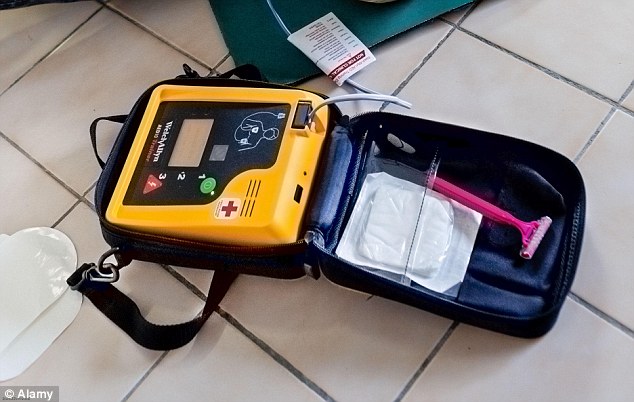
Luckily, a pharmacist who had worked in an intensive care unit and a trained policeman came forward and, using a portable defibrillator, they gave the man an electric shock to get his heart pumping again.

The doctor involved said the incident highlighted the importance of having defibrillators on flights and in training as many people as possible in how to use them

The doctor involved said the incident highlighted the importance of having defibrillators on flights and in training as many people as possible in how to use them

When the man’s health again deteriorated, the brave trio kept him alive using adrenaline from the plane’s medical kit.

The pilot of the aircraft then landed in Beijing, China and the man was rushed to a nearby hospital. Remarkably, he was discharged 10 days later having made a complete recovery.

Dr Monks told Live Science: ‘This guy was extremely fortunate to have this team there.

‘These guys just happened to be on the plane and even with the [basic medical skills] they had, they were able to perform a quite dramatic and sophisticated critical care resuscitation.’

He said the episode shows the importance of keeping defibrillators on passenger planes and training people in first aid.

He cited research that shows people are more likely to have heart attacks on flights due to stress, disturbed sleep patterns and lower levels of oxygen.

One study suggests about 1,000 passengers per year experience sudden cardiac arrest while on flights.

SOURCE:::::mailonline.com

Natarajan

Read more: http://www.dailymail.co.uk/news/article-2743043/Aircraft-passenger-having-heart-attack-flight-saved-doctor-policeman-pharmacist-board.html#ixzz3CLZNuKWD
Follow us: @MailOnline on Twitter | DailyMail on Facebook

Do You Know How ” Dry Cleaning ” Process Works ? …

How Dry Cleaning Works and Who Invented It

dry-cleaningWhat happens to clothes after being dropped off at the dry cleaners is a mystery to most. We know that our clothes come back a whole lot cleaner than when we dropped them off, but how? And who first got the bright idea to clean clothing without water?

The earliest records of professional dry cleaning go all the way back to the Ancient Romans.  For instance, dry cleaning shops were discovered in the ruins of Pompeii, a Roman city buried by the eruption of Mount Vesuvius in 79 AD. Those cleaners, known as fullers, used a type of clay known as fuller’s earth along with lye and ammonia (derived from urine) in order to remove stains such as dirt and sweat from clothing. That process proved pretty effective for any fabric too delicate for normal washing or stains that refused to budge. (In fact, the industry was so prominent that there were taxes on collecting urine.  Fullers generally used animal urine and would also maintain urine collecting pots at public bathrooms.)

As for more modern methods, the biggest revolution in dry cleaning came around in the early 19th century.  Traditionally, Jean Baptiste Jolly of France is generally named the father of modern dry cleaning. The story goes that in 1825, a careless maid knocked over a lamp and spilled turpentine on a dirty tablecloth. Jolly noticed that once the turpentine dried, the stains that had marred the fabric were gone. He conducted an experiment where he bathed the entire tablecloth in a bathtub filled with turpentine and found that it came clean once it dried. Whether a maid and an accident really had anything to do with it or not, Jolly used this method when he opened the often claimed first modern dry cleaning shop, “Teinturerier Jolly Belin”, in Paris.

However a patent for a process called “dry scouring” was filed with the U.S. Patent Office in 1821, four years before Jolly’s discovery. A man by the name of Thomas Jennings was a clothier and a tailor in New York, and soon the first African American to be granted a patent in the United States. (Previous to this, it was ruled that slave owners were the rightful owner of any inventions made by their slaves and could then patent those inventions under their own names.  Jennings, however, was a free man.)

So while working as a clothier, he, like so many others in his profession, was familiar with the age old customer complaint that they could not clean their more delicate clothes once they’d become stained because the fabric wouldn’t hold up to traditional washing and scrubbing. Jennings, thus, began experimenting with different cleaning solutions and processes before discovering the process he named “dry scouring.” His method was a hit and not only made him extremely wealthy, but allowed him to buy his wife and children out of slavery, as well as fund numerous abolitionist efforts.

As for the exact method he used, this has been lost to history as his patent (U.S. Patent 3306x) was destroyed in an 1836 fire. What we do know is that after Jennings, other dry cleaners during the 19th century used things like turpentine, benzene, kerosene, gasoline, and petrol as solvents in the process of dry cleaning clothes. These solvents made dry cleaning a dangerous business. Turpentine caused clothes to smell even after being cleaned, and benzene could be toxic to dry cleaners or customers if left on the clothes. But all of these solvents posed the bigger problem of being highly flammable. The danger of clothes and even the building catching fire was so great that most cities refused to allow dry cleaning to occur in the business districts. In the United Kingdom, for example, dry cleaners had smaller satellite stores in the city where they took in customers’ clothes and then those clothes were transported to a “factory” outside of the city limits where the dry cleaning took place.

The major risk of clothes and buildings catching on fire because of the flammable solvents led to dry cleaners searching for a safer alternative. Chlorinated solvents gained popularity in the early 20th century, quickly leaving the flammable solvents in the dust. They removed stains just as well as petroleum-based cleaners without the risk of causing the clothes or factories to catch fire. That also meant dry cleaners could move their cleaning facilities back into cities and eliminated the need to transport clothes back and forth between two locations.

A chlorine-based solvent with the chemical name tetrachloroethylene, or sometimes called perchloroethylene, became the go-to solvent for dry cleaners in the 1930s. Originally discovered in 1821 by Michael Faraday, “perc” could not only be used in relatively compact dry cleaning machines, but also did a better job of cleaning than any of the other solvents of the day; it’s still the chemical of choice for most dry cleaners today.

While perc is considered much safer than most solvents used by dry cleaners in the past, the Environmental Protection Agency (EPA) in the United States is working to phase the solvent out of the industry. The EPA claims that while wearing clothes treated with perc does not appear to be dangerous, perc can be dangerous if accidentally released into the environment as it’s toxic to plants and animals. Additionally, the EPA also notes that sustained exposure to perc, such as by workers in the industry, can cause health issues with the nervous system, including potentially drastically increased chances of developing Parkinson’s Disease. There are also studies done by the EPA that indicate perc may be a carcinogen. The International Agency for Research on Cancer also classifies the chemical as a “Group 2A carcinogen,” meaning in their opinion, it’s probably carcinogenic.

So how exactly is this chemical used to dry clean clothes? The process of dry cleaning fabric can vary between dry cleaning companies; however, the general method is as so: before placing the clothing item in the machines, workers pre-treat stains by hand, as well as remove any materials that aren’t suitable for dry cleaning (for instance buttons made of materials that may dissolve in perc are removed). The machine works in a similar fashion to normal, in-home washing machines. It agitates the garments and adds in the solvents as it goes, cycling the solution through the machine and a filter as the clothing is agitated.  Temperature is also typically controlled at around 86 degrees Fahrenheit.

Next, the garments are either dried in the same machine or workers move them to a separate machine. During the drying cycle, the temperature is raised to about 140 degrees Fahrenheit, which helps the chemicals evaporate off the clothes faster, while still being low enough not to damage the clothing.  In the end, approximately 99.9% of the chemicals used are removed from the dry cleaned item and recycled for use again in cleaning.

Once the clothes are dry, workers press the clothes, potentially stitch back on any items that had to be taken off, and put the clothing into plastic bags for customer pick-up.

SOURCE:::: Today i foundout.com

Natarajan

Need For Better Teachers …Points to Ponder on Teachers Day…

The most recent reports including the UNESCO-Education for All 2014 and ASER have all painted a grim picture of the state of primary education in the country. Among the many reasons cited, the lack of well trained and motivated teachers seems to be the most critical to the dismal education scene in India.

Akshara Foundation reached out to 10 people from all walks of life who gave 10 reasons on why we need to elevate the status of the teaching profession in India.

1. Ashwini Ponnappa

1-Ashwin

Indian shuttler and silver winner at the Commonwealth Games 2014 in Glasgow.


2. Usha Vishwanath

2-Usha

At the age of 80, Usha is an active social worker


3. Vasundhara Das

3-Vasundhara

Vasundhara is an Indian singer, actress, composer, entrepreneur, speaker, songwriter and environmental activist.


4. Saad Khan

4-Saad

Saad is an Indian film director, screenwriter and acting teacher.


5. Vikram  Nalagampalli

5-Vikram

Vikram founded a portal that bridges the gap between voters and electoral candidates.


6. MJ Pijosh

6-Pijosh

Music Jockey from Radio One.


7. Amin

7-Amin

Amin is a student at Seva Bharat Trust Govt Schools, Vivek Nagar and recently participated in the All India Robot Olympiad.


8. Aarti Mohan

8-Aarti

Aarti is the Chief Editor at an online magazine in India.


9. Chef Manu Chandra

9-Manu

Partner at The Fatty Bao & Monkey Bar and Executive Chef Olive Beach.


10. Bhavana Rajendran

10-Bhavana

Bhavana  is a social development researcher and an exceptional theatre artiste.

Each of these pithily drafted points pay a humble tribute to the spirit of pedagogy, to the warrior who fights the societal battle all alone in a classroom with bare walls, rickety benches, chipped blackboards and children who have little but a spirit to break through the innumerable barriers.

A good teacher is like a candle – it consumes itself to light the way for others ~Mustafa   

SOURCE::::Storypick

Natarajan

வணக்கம் ஆயிரம் என் அன்பு ஆசிரியருக்கு …

A Tribute to my Dear Teacher BRO.ANSELM on TEACHERS DAY…5th September

Natarajan

Bro.Anselm ….My Teacher ….a Friend , Philosopher and Guide to me ….

Image

Dear Brother..

Every year , on this DAY..5 SEP….Teachers Day… i used to talk to you over Phone and seek your Blessings …. For the third year in a row , I miss that call today . I MISS YOU … Brother…

I send my Regards and Respests to You on this TEACHERS DAY, …. thro ” this Blog Post . I am sure Your Blessings and Good Wishes are always available in plenty to me and my family on this Day …and for many more days to come ….

with affectionate Regards,

Your “Raja’ ….Natarajan.

BRO.ANSELM … My Teacher

….In 1965 at my age of 15 he handed over my SSLC BOOK in person to me and wished me well….The bond between me and my teacher however continued further… I was so emotionally attached to him that we used to be in touch with each other till the Christmas in 2012. …When i talked to him after receiving his affectionate Christmas card in DEC2012, he was telling me that he would be meeting me in Feb 2013, at chennai when he comes down to Chennai from Yercaud for his medical checkup.

Perhaps this is the first time , he was not able to keep up his words ….One of Santhome Montford Brothers called me on the night of 7 Jan2013 and told me that our affectionate BRO.ANSELM has left all of us in lurch and merged with JESUS on 7th evening at Yearcud Montford School.

He was not only my Teacher….but a Good Friend, Philosopher and Guide at all times ….I am sure many of his students would miss him a lot like me.. on this DAY….

Here is a Poetical Tribute to that Great Personality.

அன்பும் அறிவும் பண்புடன் பாசமும்
ஒன்றுக்கு ஒன்று குறையாமல்
என்றும் எங்க வாழ்வில் இருக்க
அன்றே வழி காட்டிய ஆசான் அய்யா நீ !!!
பள்ளி கணக்கில் கூட்டலும் கழித்தலும் உண்டு
ஆனால் வாழ்க்கையின் ஒழுக்க கணக்கில் கூட்டலும்
பெருக்கலும் மட்டுமே என்று சொன்னவன் அய்யா நீ !!!!
உன் மாணவன் நான் …இன்றும் உன் மாணவன்தான் !!!!
நீ சொல்லி கொடுத்த ஒழுக்க கணக்கில் இருந்து சிறிதும்
வழுக்காமல் நான் இருக்க நீதானே காரணம் அய்யா !!!!!
அழகான உன் கையெழுத்து எவ்வளவு பேர்
தலை எழுத்தை மாற்றி இருக்கு …உனக்கு தெரியுமா அய்யா !!!
எந்த வயசிலும் உன் கண்டிப்பும் கனிவும் உனக்கு ஒரு அடையாளம் !!!!
வருடம் தப்பாமல் எனக்கு கிடைக்கும் உன்னுடைய கிறிஸ்துமஸ்
வாழ்த்து அட்டை , எனக்கு ஆண்டவன் பிரசாதம் !!!!
‘ராஜா ..ராஜா ” என்று நீ என்னை கூப்பிடும்போது உன்
அன்பு சாம்ராஜ்யத்தின் ராஜாவாக நான் இருப்பேனே அய்யா !!!!
உன்னுடைய Presence எப்போதும் இருக்கும் என்று நான்
எண்ணிய வேளையில் காலத்தின் கரும்பலகை சொல்கிறது
எனக்கு… நீ ABSENT என்று !!!!!
நீ இல்லாத இந்த உலகம் வெறுமை வெறுமை ..இது
நிச்சயம் கொடுமை கொடுமை !!!!
பளிச்சென்று ஒரு பதில் வேண்டும் எனக்கு ….நீ
எப்போ மீண்டும் PRESENT ஆவாய் அய்யா!!!!!
Natarajan

Incredible India…Land Of More Mysteries and Magic !!!


Travelling in India is like a roller-coaster ride, thrilling and unforgettable. India has something to offer to every traveller: scenic beauty, beaches, mountains, fauna, adventure sports, LUXURY HOTELS, historical monuments, a cultural treat for all the senses… The experience will leave you a little exhausted; because in every moment, there’s so much to live.

If you think you’ve seen everything there is to see, you couldn’t be more wrong. India isn’t called Incredible India for nothing. This wonderful land is riddled with more mysteries and astonishing things than Alice or Dorothy could ever have imagined.

Sometimes uncanny and sometimes uplifting, India is full of surprises. Every corner of this wonderland has something waiting to be unraveled, just like these:


 Levitating Stone – Shivapur, Maharashtra

Somewhere in Pune, in a quaint little hamlet called Shivapur, lies the Hazrat Qamar Ali Darvesh that has a magical story to tell. The current shrine was a gymnasium, 800 years ago. A Sufi saint called Qamar Ali was taunted by the wrestlers there. The saint placed a spell on the rocks that were used for body-building. The 70 kg rock can only be lifted by 11 finger tips touching it and calling out his name loudly. Till date, the Stone of Qamar Ali can be magically lifted by chanting his name!


 Mass Bird Suicide – Jatinga, Assam

The idyllic village of Jatinga is snugly nestled amongst the Borail Hills of Assam. Every monsoon, this scenic village witnesses an uncanny phenomenon. Between September and October, especially during dark and foggy nights, hundreds of migratory birds fly full speed towards trees and buildings, crashing to death. This ‘mass bird suicide’ was first brought to global attention by famous naturalist E.P. Gee in the 1960s. Ever since, it has remained one of the world’s unsolved mysteries.


 The Curious Case Of Twins – Kodinhi (Kerala) and Umri (near Allahabad)

Kodinhi, a sleepy little town tucked away in the Malappuram district of Kerala, has managed to baffle scientists across the world. In a population of 2000, Kodinhi has 350 pairs of identical twins! It has rightfully earned the title of ‘Twin Town.’ 6 pairs of twins in every 1000 births is considered a high twinning rate. Kodinhi has a rate of 42 twins per 1000 births. This means, almost every family in Kodinhi has more than one pair of twins!

Mohammedpur Umri village, near Allahabad has a similar tale to tell. With over 60 pairs of identical twins in a total population of 900, Umri’s twinning rate is 300 times the national average, and perhaps the highest in the world. Researchers believe that the cause might lie in the genes, but for others, it is the divine hand.


 Get pulled uphill by magnetic force – Magnetic Hill, Ladakh

At an altitude of 11000 feet above sea level, Magnetic Hill is one of the must-see things on the way to Leh. It is known to have magnetic power that can pull a car towards itself even when the ignition is off.  It is a thrilling experience, but in reality, it is only an optical illusion caused by gravity hill. Magnetic Hill is one of the world’s recognized gravity hills.


Home to the notorious Cream – Malana, Himachal Pradesh

Located in the north-east of the Kullu Valley, Malana is also known as the ‘Little Greece of India’, because the locals believe that they are descendants of Alexander-the-Great himself! This ancient village is cut off from the rest of the world, and they follow an indigenous political system.  There are only about a hundred houses in this village, but it is home to Malana Cream, the finest quality and most potent charas ever produced.

Source


 Asia’s Cleanest Village – Mawlynnong, Meghalaya

Mawlynnong Village in Cherrapunji is popularly called ‘God’s Own Garden.’ It has won international accolades for being Asia’s Cleanest Village. It is a community-based effort for promoting eco-tourism. It is interesting to note that this village has a 100% literacy rate and most villagers speak English fluently. Mawlynnong boasts of other amazing sights like waterfalls, Living Roots Bridge and a Balancing Rock.


 Village Without Doors – Shani Shignapur, Maharashtra

Located 35 kms from Ahmednagar, Maharashtra, Shani Shinagpur village is known for its popular Shani temple. This village has never witnessed any crime, and that is attributed to the blessings of Shani Dev. The villagers have full faith in their god, and have completely entrusted their safety into his hands. That is why homes and commercial buildings in this village has no doors, or even a door frame. Taking note of the near-zero crime rate, the UCO Bank has also opened a ‘lock-less’ branch in this village, the first of its kind in India.


 Temple Of Rats – Karni Mata Temple, Rajasthan

A little town called Deshnok, 30 kms from Bikaner, holds an intriguing sight: the Karni Mata Temple, home to over 20,000 rats. ‘Kabbas’ as they are called, these rats are worshipped because it is believed that they are reincarnated family members of Karni Mata. White mice are revered even more because they are considered to be Karni Mata and her sons.


Land of Snakes – Shetpal, Maharashtra

Shetpal village in Sholapur district of Maharashtra, is known for snake worship. This village has a custom that can be only described as frightful. Each house in this village has a resting place for Cobras in the rafters of their ceilings. No cases of snake bites have been reported in this village despite snakes moving about freely in every household.


Dining with the Dead – New Lucky Restaurant, Ahmedabad

Now, here’s something that is morbid and fascinating at the same time. The New Lucky Restaurant has an ambience to kill for. This coffee house is built on a centuries-old Muslim cemetery. The graves lie between the tables, and are said to belong to a 16th CE Sufi saint. The restaurant is always bustling with guests and the owner says that the graves are his lucky mascots.


India’s Highest and Most Tragic Waterfall- Nohkalikai Falls, Meghalaya

At a height of 1115 feet, the Nohkalikai Falls near Cherrapunji is India’s highest plunge waterfall. Fed naturally by rainwater, this waterfall is named after the tragic tale of a woman called Ka Likai. After the death of her husband, Ka  Likai remarried. But her new husband was extremely jealous of her love for her daughter.  He murderd the daughter, and to hide the evidence, cooked up her remains into a meal. Kali Kai searched high and low for her daughter but cannot find her. Her husband OFFERS her the meal, as she is exhausted. After eating, she discovers to her horror, the daughter’s fingers lying in basket filled with betel-nuts. Grieved and anguished, she throws herself off the cliff, giving the waterfall its name, ‘Nohkalikai‘ meaning ‘Fall of Ka Likai.’


Hanging Pillar – Lepakshi, Andhra Pradesh

The small historical village of Lepakshi is home to many ancient relics and architectural marvels. One of them is the Hanging Pillar of the Lepakshi temple. Amongst the 70 pillars of the temple, one hangs without any support! Visitors pass objects under the pillar to check if the claim is true. According to locals, passing objects under the pillar brings prosperity to one’s life.


World’s largest River Island – Majuli, Assam

Located on the mighty Bramaputra, Majuli, the world’s largest river island, is a celebration of the creations of God and man. The scenic beauty of this island is the closest one can feel to the heavens. Majuli is also a popular cultural hotspot for various schools of thought that propagate the teachings of Srimanta Shankardev.


The Eternal Flame – Jwala Ji Temple, Kangra

Throughout the year, people visit the Jwala Ji Temple of Kangra to seek blessings from the Goddess. In the centre of the temple, a hollowed stone holds a flame that has been burning for hundreds of years. According to the legend, Lord Shiva’s wife, Sati, immolated herself in anguish when her father disrespected her husband. A furious Shiva danced the Tandav Nritya carrying the burnt corpse. In doing so, she fell into 51 parts and landed on the earth. Each of these locations turned into a religious shrine for the Hindus. The Jwala Ji of Kangra is believed to be Sati’s fiery tongue.


 World’s Highest Tea Estate – Kolukkumalai, Tamil Nadu

Kolukkumalai Tea Estate is an hour and half long drive from MUNNAR. Towering at a height of 8000 feet above sea level, this tea estate rises above the plains of Tamil Nadu, heralded by beautiful rugged mountains on all sides. It’s hard to decide which is more breath-taking: the scenic landscape or the flavourful teas produced here.


 The Motorcycle God – Bullet Baba Shrine, Bandai, Rajasthan

If there is any place in the world where you’ll come across a shrine where flowers and liquor bottles are offered to a motorcycle, it has to be in India! At Bandai, Jodhpur, Om Singh Rathore died when he crashed his Bullet into a tree while riding drunk. The police claimed the bike and took it to the station. The next day, the bike was found at the spot of the accident. They brought it back to the station, emptied the fuel tank and chained it. Yet the bike miraculously found its way back to accident spot the next day. The motorcycle was moved permanently to the location and the Om Baba (or Bullet Baba as it is popularly called) Shrine was erected. Every day many passers-by come to OFFER their prayers. The spirit of Om Banna is believed to protect travellers.


20. World’s Largest Monolithic Statue – Gomateshwara Statue, Shravanabelagola, Karnataka

The monolithic statue of Gomateshwara, also known as Bahubali, at Shravanabelagola, towers above all else at 60 feet. Carved out of a single block of granite, it is so large, it can be seen even from 30 kms away. Gomateshwara was a Jain saint, who according to legend, was the first human in his half time cycle to attain liberation. The monolith was built by Chamundaraya, a minister of the Ganga Dynasty between 978 and 993 CE and is one of the most important pilgrimage sites for Jains across the world. Standing at the feet of this massive monolith, looking up, you’ll understand how big the world really is, and how small we are in comparison.


 Half-Sized Taj Replica – Bibi Ka Maqbara, Aurangabad

They say imitation is best form of flattery. The ‘Mini Taj’ proves the point. Built in the late 17th CE, within less than 30 years of its original inspiration, this modest monument has often been called ‘Poor Man’s Taj.’ It was commissioned by Aurangzeb and built by one of his sons, Prince Azam Shah, in memory of his mother, the Emperor’s  first wife. Though it fades in comparison to its majestic inspiration, the Bibi Ka Maqbara emanates a certain charming humility.


Living Roots Bridge – Cherrapunji, Meghalaya

In Cherrapunji, Meghalaya, man has befriended nature and cajoled it into bending to his ways. People build bridges, but the Khasis of Meghalaya, they grow bridges. Ficus Elastica or the Rubber Tree produces strong secondary roots from their trunks. These  have been trained to grow in a particular direction using betel-nut trunks, forming sturdy, living bridges over decades. Some of these bridges are more than a hundred feet long. The Umshiang Double Decker Bridge is truly one of a kind in the entire world. Some ancient root bridges are over 500 years old.


 World’s Widest Banyan Tree – Botanical Garden, Howrah

Near Kolkata, at the Acharya Jagadish Chandra Bose Botanical Garden, Howrah, lies another living proof nature’s powerful glory. The 1250 year old Great Banyan Tree, with a canopy covering an area of 4 acres, is considered the widest tree in the world. After being struck by lightning, the tree was diseased. The trunk had to be removed in 1925. It continues to live without its main trunk, and has 3300 aerial roots reaching down to the ground. What appears to be a forest is actually one single tree. In his mind’s eye, I’m sure this what Frost saw when he said, ‘Lovely, dark and deep…’


 World’s Only Floating Lake – Loktak Lake, Manipur

The largest freshwater lake in India’s North-East, the Loktak Lake is a sight to behold. Because of its floating phumdis, it has been named the world’s only floating lake. Apart from its scenic beauty, this lake plays a big role in Manipur’s economy, serving as a source for hydropower generation, irrigation, drinking water supply and source of livelihood for local fishermen. The largest of all the phumdis, or floating islands on Loktak, is the Keibul Lamjao National Park, the last natural refuge of the endangered Manipur Brow-Antlered deer.


Dog Temple – Channapatna, Karnataka

A community in Channapatna’s Ramanagar district has erected an unusual temple in honour of man’s best friend. Pujas are conducted seeking blessings of the Dog God. According to locals, the dog is considered good-natured and loyal, but at times he is also formidable. This Dog God is believed to work alongside the village diety.


 Gravity Defying Palace – Bada Imambara, Lucknow

This architectural wonder dates back to the 18th CE. Nawab Asaf Ud Daulah created this marvel, blending European and Arabic architecture in perfect harmony. The central arched hall is 50 metres long and about three stories high, hanging without the support of any pillars or beams! The main hall is known for the architecture of the labyrinth or bhul-bhulaiya, with more than 1000 narrow staircase passages. The Imambara complex also houses lush gardens, a spectacular mosque and a baoli.


Floating Stones – Rameshwaram, Tamil Nadu

Located on Pamban Island, and separated from the Indian mainland by the Pamban Channel, the little town of Rameshwaram has great significance in Hindu mythology. It is from here that Rama is believed to have built a bridge across to Lanka to rescue Sita. Stones used to build this bridge had Rama’s name engraved on them and they never sank in water. The curious fact is that such ‘floating stones’ are still found around Rameshwaram!


 Red Rain – Idukki, Kerala

Apart from its delectable coastal curry, Idduki is also known for a strange phenomenon called ‘Red Rain’. The first incident of Red Rain was recorded as early as 1818. Ever since, Idukki has witness this unusual sight intermittently. Idukki has been classified a ‘Red Region’. In Hinduism, red rain is the wrath of the Gods, punishing sinners. It signals a wave of destruction and woe. Some believe the killing of innocents leads to red rain. Scientists are yet to come up with an explanation.


Rural Olympics – Kila Raipur, Ludhiana

During February every year, Kila Raipur village in Ludhiana is buzzing with energy. Locals and tourists come together to witness a recreational sports meet of farmers in and around Kila.  The Rural Olympics was a brainchild of philantropist Inder Singh Grewal. It was conceived as early as 1933. Bullock racing, tent pegging, Gatka, camels, mules and dog races are the main attractions. Punjabi folklore and cultural festivities also grace the event, making it a truly exhilarating experience.


 Temple of the Visa God- Balaji Temple, Chilkur, Hyderabad

Some Gods bring you prosperity, some grant you protection, but the 21st CE God of the Balaji Temple in Chilkur, on the outskirts of Hyderabad, has the power to grant you a Visa to the US! Now popular as Visa Balaji Temple, many dollar-driven people, even those from other religions, come here to take the blessings of Visa Balaji before their Visa interviews. If they get a visa, they must keep their vow and take 108 rounds of the inner shrine. Laugh if you want, but this is one admirable example of an old world existing in a new one.


One life just isn’t enough to see all that there is to see in Incredible  India…..

SOURCE:::: SONALI MUSHAHARY  in http://www.scoopwhoop.com

Natarajan