This Giant Indian Railway Bridge Is Going to Be the Highest of Its Kind in the World !

You might have seen many extraordinary marvels of engineering. But this project will definitely make your jaw drop.

chenab bridge

We’re talking about the massive single-arch bridge being constructed over the Chenab River, between Bakkal and Kauri in Jammu and Kashmir.

chenab bridge

The bridge is 1,315 meters long, 359 meters high, and will be the tallest railway bridge in the world.

chenab bridge

Quick fact: It will be 35 meters higher than the Eiffel Tower!

chenab bridge

Located at such steep slopes, one can only imagine the level of skill it took to design and construct this engineering masterpiece.

Watch this video that explains the mind-blowing construction of the bridge and how India is creating a masterpiece that is one of its kind in the world.

Source……..Shreya Pareek  in http://www.the betterindia.com

Natarajan

Message For the Day…” The path of dharma mandates that you give up hatred against others and cultivate mutual concord and amity…”

Whatever you are dealing with, you must first grasp its real meaning. Then, you have to cultivate it daily, for your benefit. By this means, wisdom grows and lasting joy is earned. The two basic things everyone must be super clear are dharma and karma (action). Righteousness(Dharma) has no prejudice or partiality; it is imbued with truth and justice. So if you choose to adhere to dharma, you must see that you never go against it. It is wrong to deviate from it. The path of dharma mandates that you give up hatred against others and cultivate mutual concord and amity. Through concord and amity, the world will grow, day by day, into a place of happiness. If these practices are well established, the world will be free from disquiet, indiscipline, disorder, and injustice. The wise, who are impartial and unprejudiced and have resolved to follow Dharma, must walk on the path of truth (sathya).

Sathya Sai Baba

Space Station Fly over of British Columbia’s Coast Mountains…

Snowcapped rocky mountain range on the coast photographed from orbit

ESA astronaut Tim Peake (@astro_timpeake) took this photograph over the west coast of Canada from the International Space Station on Dec. 31, 2015, and shared it with his Twitter followers on Jan. 5, writing, “I was lucky enough to fly a helicopter in these Rocky Mountains once – I’m a bit higher this time! #Principia”

The photograph shows Canada’s Coast Range of mountains, with King Island and Burke Channel in the center. The Pacific Ocean is visible at the bottom and north is to the left.

Image Credit: ESA/NASA

Source……www.nasa.gov.in

Natarajan

Message for the Day…”Among Sacrifices [yajnas], I am the Repetition of Name(nama-yajnas)”…Lord Krishna in Gita…

Lord Krishna declared in the Gita, “Among sacrifices(yajnas), I am the repetition of the name (nama-yajna).” For curing grief and earning joy, temples where the name of God can be remembered are very essential. Remembering the name (smarana) grants bliss; there is nothing more fruitful, charming or blissful than this activity! Sage Vyasa wondered, “Having the great yet simple name, on the ever available tongue, and the temple where His enchanting image is installed so that people can sing His glory in an exalted voice… why should people hasten toward the gates of hell?” So too, Saint Tulsidas, who lived constantly in the temple and sang of the joy he tasted, lamented, “Alas! When people give up the name and the temple, and seek peace and joy in other places, I am reminded of the foolishness of those who forsake the rich and tasty fare on their plates and beg with outstretched hands for the remains from other’s plates!”

Sathya Sai Baba

The Unique Flower Auction at Aalsmeer…….

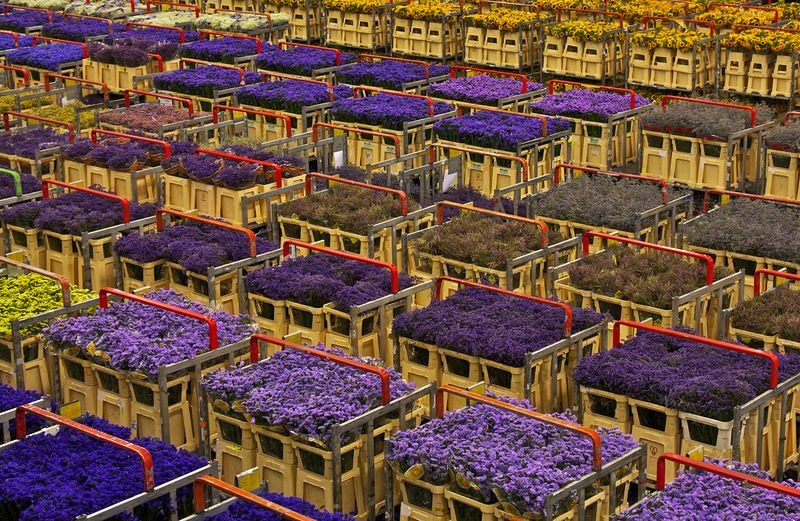
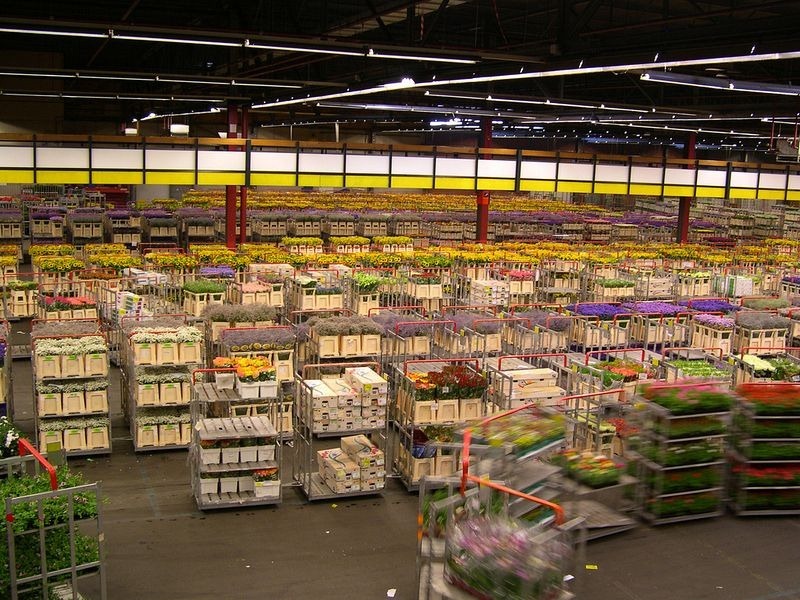
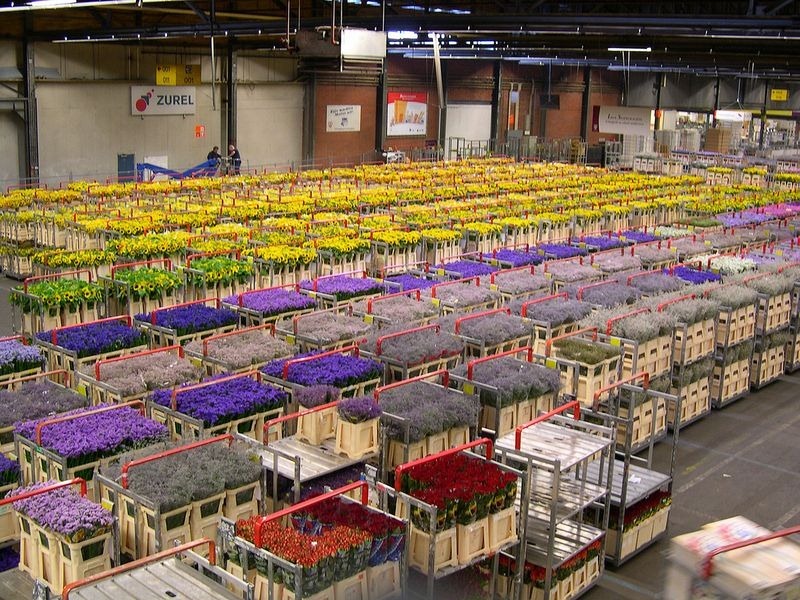
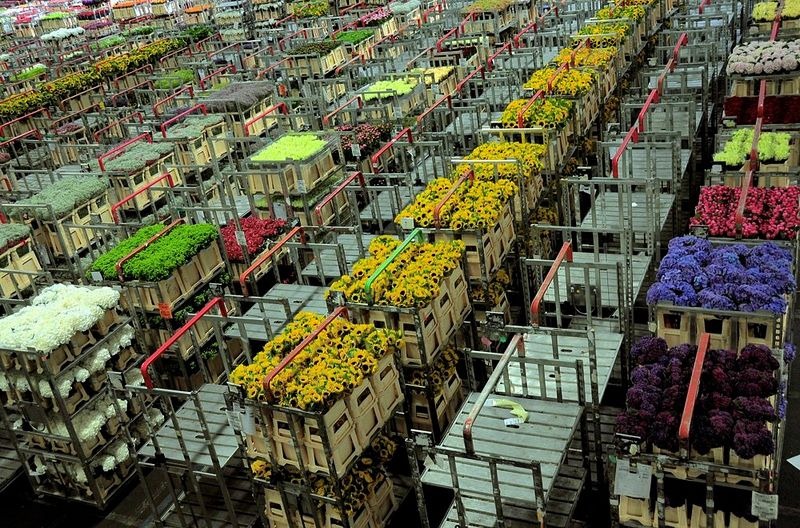
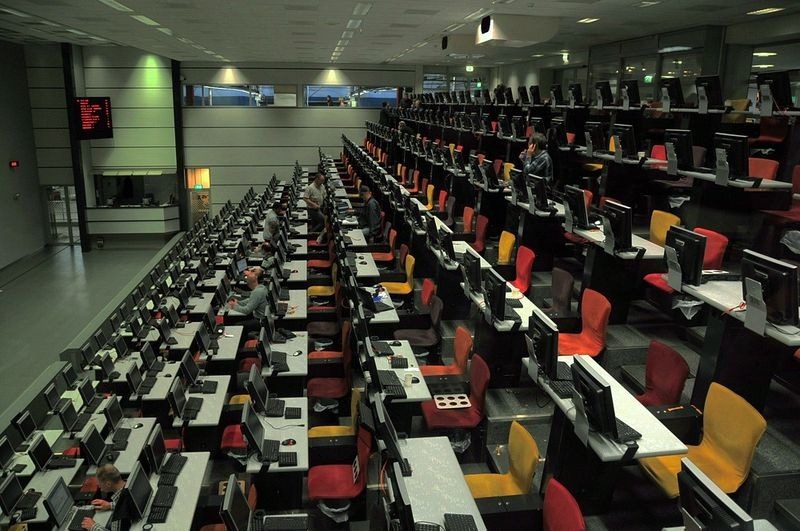
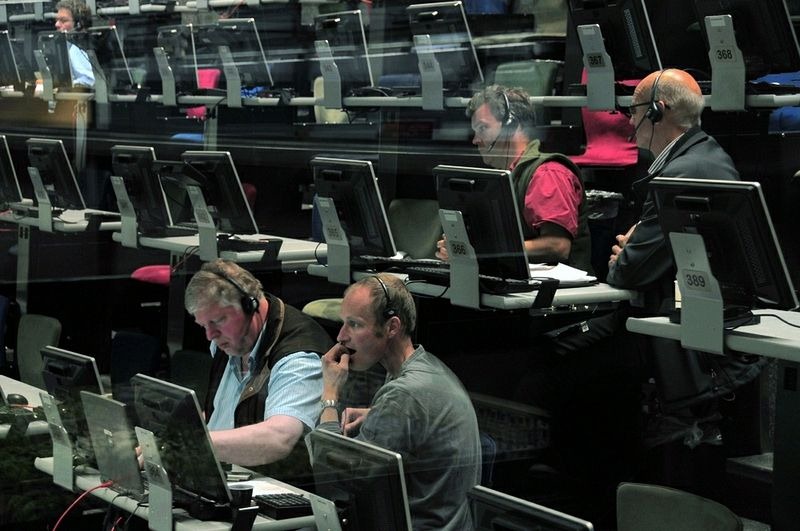
The Aalsmeer Flower Auction or Bloemenveiling Aalsmeer in Dutch, takes place in the town of Aalsmeer in North Holland near Amsterdam Schiphol Airport, and is by far the busiest and largest floral market in the world. Everyday 20 million flowers arrive here from all over the world. Whilst a large majority of the flowers sold here are from the Netherlands, many come from far off places like Ecuador, Colombia, Ethiopia, and Kenya. The warehouse itself, where the trading takes place, is the largest building by footprint in the world, covering 518,000 square meters or 243 acres.

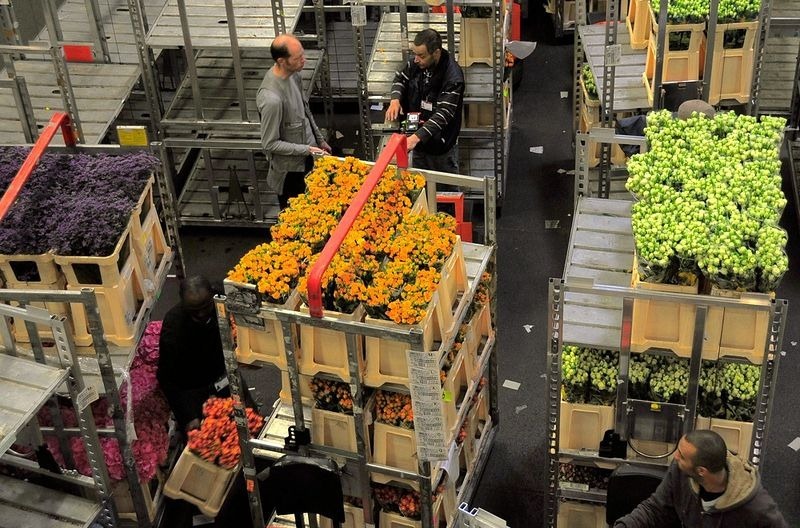
Flowers arrive the night before the auction, at around 10 PM, and are cooled and sorted during the night. The auction starts early morning. Carts of flowers are presented to the buyers, one at a time, while they bid on them. The flowers get bought and distributed almost immediately. By late afternoon, all the flowers will have moved out and the warehouse prepared for the next round.

aalsmeer-flower-auction-3

Crates of flowers waiting to be auctioned off at Aalsmeer Flower Auction. Photo credit: CGP Grey


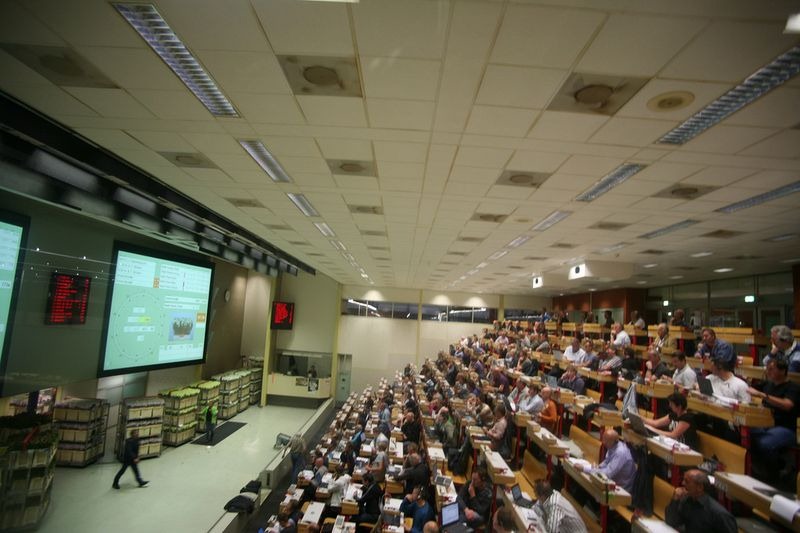
Flowers in Aalsmeer are sold using the infamous Dutch auction system. The price is set high and a clock starts ticking down from 100. As time falls, so does the price of the cart. The first person to make a bid gets the cart. Anyone buying too fast risks overpay, but those waiting too long for the price to drop may go home empty handed. This unique system was invented in the 17th century for selling Dutch tulip bulbs, and is based on a pricing system devised by Nobel prize winning economist William Vickrey. The ingenuity of the Dutch auction ensures that flowers are sold off quickly while extracting the highest price out of the dealer who wants the lot the most.

The bidding process can be seen on the large screens inside the auction room. Visitors are allowed but neither them nor buyers can get close to the flowers. The most interesting aspect of the Aalsmeer flower market is seeing the logistics in action, rather than admiring flowers up close. The closest one can get to the flowers are from two elevated walkways high above the busy warehouse. The actual trading can be observed through soundproof windows high above two auction rooms.

aalsmeer-flower-auction-1

aalsmeer-flower-auction-2

aalsmeer-flower-auction-5

Photo credit: faungg’s photos/Flickr


aalsmeer-flower-auction-4

The auction room. Photo credit: faungg’s photos/Flickr

aalsmeer-flower-auction-7

Photo credit: faungg’s photos/Flickr

aalsmeer-flower-auction-11

An auction in progress. Photo credit: bert knottenbeld/Flickr

aalsmeer-flower-auction-6

Photo credit: faungg’s photos/Flickr

aalsmeer-flower-auction-10

Photo credit: bert knottenbeld/Flickr


Sources: European Traveller / Flower Experts / Investor Words

Source….www.amusingplanet.com

Natarajan

The Alphabets From Space…!!!

In July 2012, while working on a story about wildfires, NASA’s science writer and social media manager Adam P. Voiland spotted a V-shaped plume of smoke caused by a wildfire in the Caribou Mountains in northern Alberta, Canada. That image made him wonder if there are other alphabets hidden among the millions of photos of earth’s surface taken by NASA’s satellites. It was a mammoth task, so he enlisted the internet in the ambitious project.  With the help of readers and colleagues, Voiland started collecting images of ephemeral features like clouds, phytoplankton blooms, and dust clouds that formed shapes reminiscent of letters. Now, over three years later, his search is completed and the results are exceedingly beautiful and educational.

space-alphabets

Some letters, like O and C, were easy to find,” said Voiland. “Others—A, B, and R—were maddeningly difficult.”

After he had tracked down all the letters, he wrote playful captions for each photos inspired by Dr. Seuss which he was reading to his son.

Here is a selection of alphabets from the gallery.

b_hollabend

Bonjour B, what begins with B? Biomass and boreal forests. Beirut, Barcelona, and Brasília. A bunch of babbling birds bunched up along Holla Bend.

On August 4, 2014, the Operational Land Imager (OLI) on Landsat 8 acquired this image of the Arkansas River and the Holla Bend Wildlife Refuge. In the winter, it is common for the refuge to host 100,000 ducks and geese at once.
c-space-alphabet

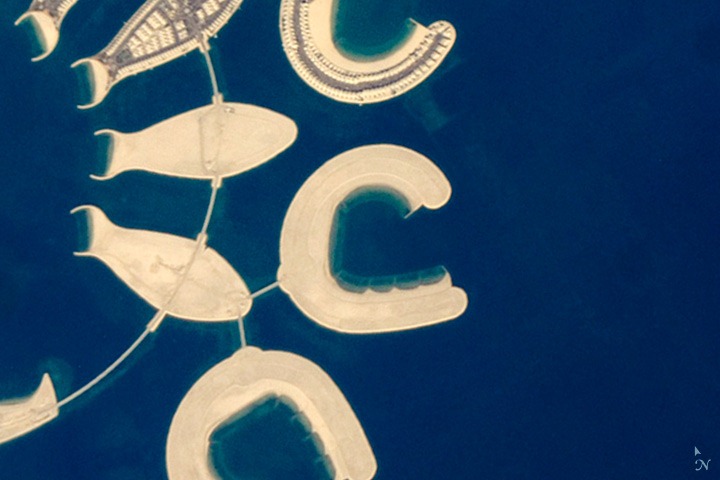
Big C, little C, what begins with C? This curving crescent of carbonate and quartz clinging to the coast. There is CloudSat and CALIPSO. Contrails from jets cruising over cumulus clouds. The Corolis force, chlorofluorocarbons, and crafty coccolithophores!

An astronaut captured this photograph of an artificial island at the southern end of Bahrain Island on January 23, 2011. The beach sand on tropical islands is mostly made up of calcium carbonate from the shells and skeletons of marine organisms.

e_newzealand

What begins with E? Earth, of course. Evaporation and the exosphere. Egypt and Eyjafjallajökull. Eskers, erratics, El Niño, and EO-1. This ephemeral entourage of algae off the east coast of an island where English is spoken!

On October 25, 2009, the Moderate Resolution Imaging Spectroradiometer (MODIS) on NASA’s Aqua satellite captured this image of a phytoplankton bloom off the coast of New Zealand.

f_tibet

Big F, little f. What begins with F? Firn-filled fjords and frozen forms on folded, fossil-filled facies of rock! Fog, fossil fuels, and faults. France, Fort Collins, and don’t forget Fiji.

The Operational Land Imager (OLI) on Landsat 8 acquired this false-color image of valleys and snow-covered mountain ranges in southeastern Tibet on August 4, 2014. Firn is a granular type of snow often found on the surface of a glacier before it has been compressed into ice

i_andamans

What begins with I? In situ measurements and infrared radiation. Ice sheets and isthmuses. Istanbul and Ilopango. This intriguing image of India’s Andaman Island after an intimidating incident involving an earthquake.

On February 10, 2007, the Moderate Resolution Imaging Spectroradiometer (MODIS) on NASA’s Terra satellite captured this image of the Andaman Islands. The thin, bright rings surrounding several of the islands are coral reefs that were lifted up by a massive earthquake near Sumatra in 2004

j_townsville

What begins with J? Jason-1 and the jet stream. Jerusalem, Jakarta, and Johnson Space Center. This jade-colored coral reef juxtaposed against the jumble of the sea.

On July 17, 2015, the Operational Land Imager on Landsat 8 captured this image of the Trunk Reef near Townsville, Australia

m_tienshan

What begins with M? The meandering Mississippi. MODIS and MISR. Mumbai, Miami, and Moscow. These medial moraines merging muck and minerals for millennia!

On August 14, 2015, the Operational Land Imager (OLI) on Landsat 8 captured this image of glaciers in the Tian Shan mountains in northeastern Kyrgyzstan. The trail of brown sediment in the middle of the uppermost glacier is a medial moraine, a term glaciologists use to describe sediment that accumulates in the middle of merging glaciers

n_northpacific

What begins with N? Numerous cloud condensation nuclei in the North Pacific! Nefarious nitrogen dioxide and NOx. The near infrared and NDVI and the Nimbus satellite. Nor’easters and the Nile at night.

On March 4, 2009, the Moderate Resolution Imaging Spectroradiometer (MODIS) on the Terra satellite captured this image of ship tracks over the Pacific. Ship emissions contain small particles that cause the clouds to form

t_liwa

What begins with T? Taal and Tolbachik. Taiga, typhoons, tornadoes, and thunderstorms. The trove of trees and towns tucked into this terrain in the United Arab Emirates.

On March 9, 2015, the Operational Land Imager (OLI) on Landsat 8 captured this image of development along two roads in the United Arab Emirates
x_leidyglacier

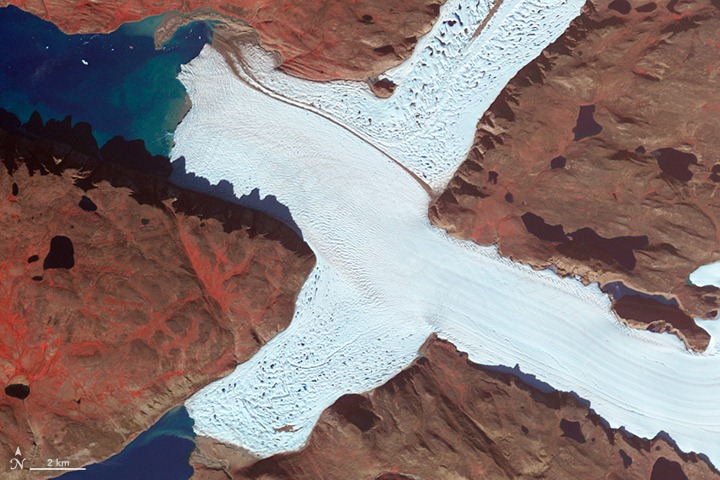
What begins with X? There are xenoliths, the xylem in xeric woodlands, and the cities of Xian and Xalapa. Not much else begins with X, so relaX and enjoy this eXcellent icy X!

On August 7, 2012, the Advanced Spaceborne Thermal Emission and Reflection Radiometer (ASTER) on NASA’s Terra satellite captured this false-color image of the northwest corner of Leidy Glacier in Greenland.

z_canada

Z, what begins with Z? Zambia and Zimbabwe. Zenith and zooplankton. Zillions of smoke particles zipping, zooming, and zigzagging above Canada!

On July 11, 2012, the Moderate Resolution Imaging Spectroradiometer (MODIS) on NASA’s Aqua satellite captured this image of wildfire smoke over Canada.

See more of the gallery on NASA’s website.

Source…..www.amusingplanet.com

Natarajan

Asia’s Largest Man-Made Waterfall Opens in China…

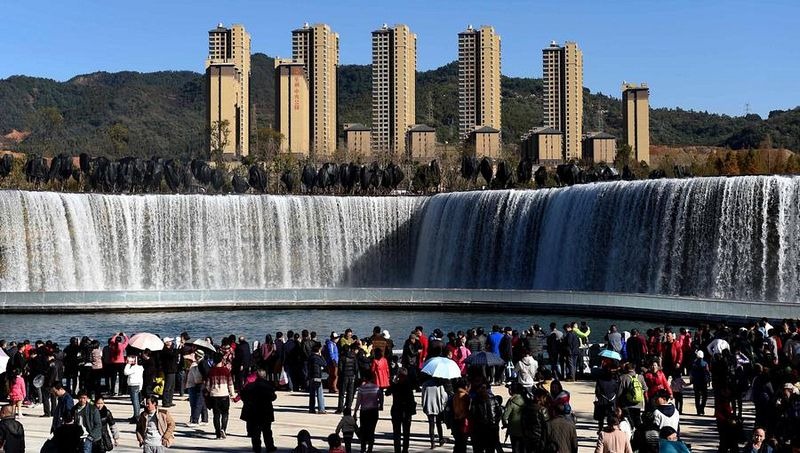
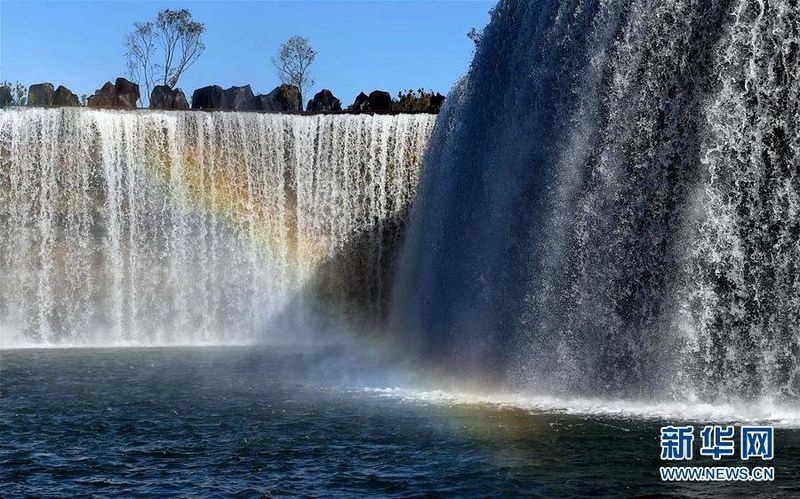
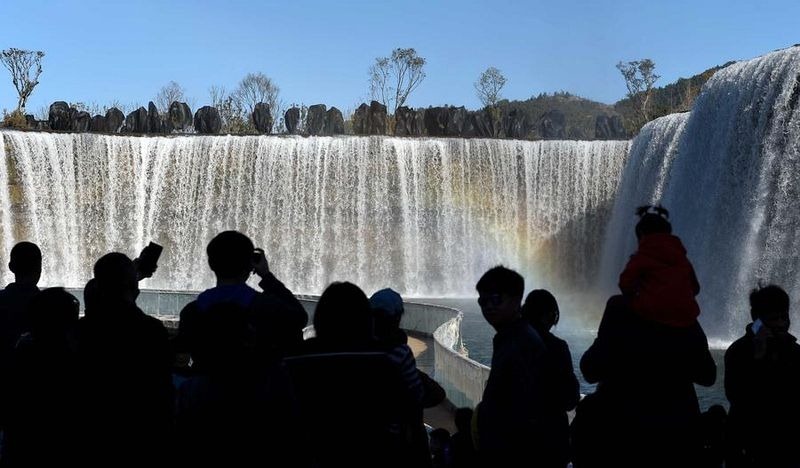
The largest man-made waterfall in Asia has opened to the public in Kunming in China’s Yunnan Province. The waterfalls is 12.5 meters high and 400 meters wide, and was created as part of a project designed to divert water from the Niulan River into Dianchi Lake, the biggest freshwater lake in Yunnan. The diversion will not only help reduce flooding in the Niulan River but will also function as a water supply for emergencies. The project took two years to finish at a cost of 1.1 billion yuan (roughly 170 million US dollars). A park was created around the waterfalls for public viewing free of charge.

china-artificial-waterfall-kunming-4

china-artificial-waterfall-kunming-2

china-artificial-waterfall-kunming-3

Source….www.amusingplanet.com

natarajan

NASA Research Could Save Commercial Airlines Billions in New Era of Aviation….

NASA wind-tunnel tests of an Active Flow Control system

Researchers with NASA’s Environmentally Responsible Aviation project coordinated wind-tunnel tests of an Active Flow Control system — tiny jets installed on a full-size aircraft vertical tail that blow air — to prove they would provide enough side force and stability that it might someday be possible to design smaller vertical tails that would reduce drag and save fuel.
Credits: NASA/Dominic Hart

The nation’s airlines could realize more than $250 billion dollars in savings in the near future thanks to green-related technologies developed and refined by NASA’s aeronautics researchers during the past six years.

These new technologies, developed under the purview of NASA’s Environmentally Responsible Aviation (ERA) project, could cut airline fuel use in half, pollution by 75 percent and noise to nearly one-eighth of today’s levels.

“If these technologies start finding their way into the airline fleet, our computer models show the economic impact could amount to $255 billion in operational savings between 2025 and 2050,” said Jaiwon Shin, NASA’s associate administrator for aeronautics research.

Created in 2009 and completed in 2015, ERA’s mission was to explore and document the feasibility, benefits and technical risk of inventive vehicle concepts and enabling technologies that would reduce aviation’s impact on the environment. Project researchers focused on eight major integrated technology demonstrations falling into three categories – airframe technology, propulsion technology and vehicle systems integration.

By the time ERA officially concluded its six-year run, NASA had invested more than $400 million, with another $250 million in-kind resources invested by industry partners who were involved in ERA from the start.

“It was challenging because we had a fixed window, a fixed budget, and all eight demonstrations needed to finish at the same time,” said Fayette Collier, ERA project manager. “We then had to synthesize all the results and complete our analysis so we could tell the world what the impact would be. We really did quite well.”

Here is a brief summary of each of the eight integrated technology demonstrations completed by the ERA researchers:

  • Tiny embedded nozzles blowing air over the surface of an airplane’s vertical tail fin showed that future aircraft could safely be designed with smaller tails, reducing weight and drag. This technology was tested using Boeing’s ecoDemonstrator 757 flying laboratory. Also flown was a test of surface coatings designed to minimize drag caused by bug residue building up on the wing’s leading edge.
  • NASA developed a new process for stitching together large sections of lightweight composite materials to create damage-tolerant structures that could be used in building uniquely shaped future aircraft that weighed as much as 20 percent less than a similar all-metal aircraft.
  • Teaming with the Air Force Research Laboratory and FlexSys Inc. of Ann Arbor, Michigan, NASA successfully tested a radical new morphing wing technology that allows an aircraft to seamlessly extend its flaps, leaving no drag-inducing, noise-enhancing gaps for air to flow through. FlexSys and Aviation Partners of Seattle already have announced plans to commercialize this technology.
  • NASA worked with General Electric to refine the design of the compressor stage of a turbine engine to improve its aerodynamic efficiency and, after testing, realized that future engines employing this technology could save 2.5 percent in fuel burn.
  • The agency worked with Pratt & Whitney on the company’s geared turbofan jet engine to mature an advanced fan design to improve propulsion efficiency and reduce noise. If introduced on the next-generation engine, the technology could reduce fuel burn by 15 percent and significantly reduce noise.
  • NASA also worked with Pratt & Whitney on an improved design for a jet engine combustor, the chamber in which fuel is burned, in an attempt to reduce the amount of nitrogen oxides produced. While the goal was to reduce generated pollution by 75 percent, tests of the new design showed reductions closer to 80 percent.
  • New design tools were developed to aid engineers in reducing noise from deployed wing flaps and landing gear during takeoffs and landings. Information from a successful wind-tunnel campaign, combined with baseline flight tests, were joined together for the first time to create computer-based simulations that could help mature future designs.
  • Significant studies were performed on a hybrid wing body concept in which the wings join the fuselage in a continuous, seamless line and the jet engines are mounted on top of the airplane in the rear. Research included wind-tunnel runs to test how well the aircraft would operate at low speeds and to find the optimal engine placement, while also minimizing fuel burn and reducing noise.

As part of the closeout work for the ERA project, information and results regarding each of these technology demonstrations were categorized and stored for future access and use by the aerospace industry, and will be discussed at the American Institute of Aeronautics and Astronautics Sci-Tech Conference in San Diego this week.

For more information about NASA aeronautics research, go to:

http://www.nasa.gov/aeronautics 

Source……….www.nasa.gov

natarajan

” Never underestimate your Mother …” !!!

Never underestimate Moms!

Things were going exactly as Srinivasan had feared, his Mother would come in from India and crush his American way of life under her strong South Indian influence. For a genetic scientist like Vasu, as Srinivasan was called by his friends, the only kind of order was disorder. So consumed he was by his research that the world and it’s affairs mattered little to him. When his last girlfriend walked out on him, “Find a girl on planet Srinivasan,” she had screamed as she stomped out.

Now Vasu’s Mother had taken over the administration of the planet. It irritated him, this milk at night and chyawanprash every morning. “Have you been wearing the same pair of Jeans for the past three days?” Mother was beginning her morning interrogation.

Vasu stared at the hot idlis in front of him, the chywanprash to follow and the wardrobe interrogation that had begun. Something snapped in his mind. “Mom I love you and I love that you come all the way from India to take care of me but please don’t fuss over me! It irritates me!  And then I cannot work!”

His Mother did not really care if Vasu was upset, “The idlis are getting cold,” was her matter of fact response.

“You don’t really care, do you Mom?”

“I care about you Vasu. The work you do is alright. If you don’t do it, someone else will do it.”
“Mom, I am a genetic scientist. I am working on the evolution of man. Theory of evolution, Charles Darwin, have you heard of him? ” Vasu was exasperated with her unwillingness to understand.

His Mother sat down next to him and smiled, “I know Darwin, Vasu. I also know that what you think he discovered, was old news in India.”

“Yeah sure Mom!” Vasu said with sarcasm.

“Well if you are too smart then listen to this,” his Mother countered.” Have you heard of the Dashavatara ? The ten avataras of Vishnu ?” Vasu nodded. “Then let me tell you what you and Mr. Darwin don’t know.

The first avatara was the Matsya avatara, it means the fish. That is because life began in the water. Is that not right ?” Vasu began to listen with a little more attention..

“Then came the Kurma avatara, which means the tortoise, because life moved from the water to the land. The amphibian. So the Tortoise denoted the evolution from sea to land.

Third was the Varaha avatara, the wild boar, which meant wild animals with not much intellect, you call them the Dinosaurs, correct ?” Vasu nodded wide eyed.

“The fourth avatara was the Narasimha avatars, half man and half animal, the evolution from wild animals to intelligent beings.

Fifth was the Vamana avatara, the midget or the dwarf, who could grow really tall. Do you know why that is so ? Because there were two kinds of humans, Homo Erectus and the Homo Sapiens and Homo Sapiens won that battle.” Vasu could see that his Mother was in full flow and he was stupefied.

“The Sixth avatara was Parshurama, the man who wielded the axe, the man who was a cave and forest dweller. Angry, and not social but the seventh avatara was Ram, the first thinking social being, who laid out the laws of society and the basis of all relationships.

The eighth avatara was Krishna, the statesman, the politician, the lover who played the game of the society and taught how to live and thrive in the social structure.

The Ninth avatara,was Balarama the man who rose from Narasimha and found man’s true nature.

And finally, my boy, will come Kalki, the man you are working on. The man who will be genetically supreme.”

The last Avatar is yet to appear, and in many versions of the mythology, the ninth incarnation is mentioned as Lord Buddha. But this is a much later addition done at a time when the concept of Dashavatara was already fully developed.

Vasu looked at his Mother speechless. “This is amazing Mom, how did you.. This makes sense !”

“Yes it does Vasu ! Now have your chyawanaprash ! ”

source……input from a friend of mine
Natarajan

Message for the Day…” Only one who has so filled themselves with love and who lives in the light of that love deserves to be called human.”

Humans are full of love (prema). Their hearts are springs of mercy. They are endowed with true speech. Peace is the characteristic of the mind of humans. It is the innate quality of the mind. Do not search for peace outside. Just as gold and silver lie hidden under the earth, and pearl and coral under the sea, peace and joy lie hidden in the activities of the mind. If you desire to acquire these hidden treasures, dive deep and turn your mental activities inward, you will become full of love. Only one who has so filled themselves with love and who lives in the light of that love deserves to be called human. Those devoid of love are demons and monsters. Within every man, the holy quality of love is ever present, without change. It is one and indivisible. Those saturated with love are incapable of spite, selfishness, injustice, wrong, and misconduc

Sathya Sai Baba