What it’s Like to Fly on the Most Lavish Suite Class !!! ….Fabulous !!!

Singapore Airlines’ luxurious suite class

IT’S an experience that most of us can only dream of — an airline suite that’s even better than first class. But Singapore-based entrepreneur and frequent flyer Derek Low was lucky enough to score the ultimate plane seat. This is his story.

In 2008, Singapore Airlines introduced Suites Class, the most luxurious class of flying that is commercially available. The Suites are exclusive to their flagship Airbus A380 planes, and they go beyond flat beds by offering enclosed private cabins with sliding doors that cocoon you in your own little lap of luxury.

It also became the first and only commercial airline with a double bed in the sky.

Carlene said the extra room increased their chances of winning “tenfold”.

The bed is incredible. Picture: Derek Low Source: Channel 9

However, the experience comes with a hefty price tag. With round-trip tickets from Singapore to the US costing up to $20,600, it’s completely unattainable for most people.

But then I remembered that most of my personal net worth exists in frequent flyer miles rather than cash. So last month, after splurging an colossal amount of miles, I booked a Suites Class flight to New York City!

This is what I experienced:

Darren was particularly vocal about the situation.

The experience begins at the airport. Picture: Derek Low Source: Channel 9

I arrived at Singapore Changi Airport and proceeded to the Singapore Airlines counters for check-in. As I joined the line, I was promptly greeted by staff: “Good evening sir, how may I help you?”

A sudden realisation hit me and I went “OH NOPE SORRY” and briskly walked away, leaving the lady puzzled. I had almost forgotten that Changi had a luxurious check-in lounge specially for First Class and Suites passengers.

Flying in the Suites also includes an invitation to The Private Room, which is “higher than first class”.

A ticket to luxury. Picture: Derek Low

A ticket to luxury. Picture: Derek Low Source: Supplied

I followed a flight attendant past what seemed to be 50—60 people in the Business Class lounge. She walked noticeably fast, seemingly afraid that I would be disgusted by the presence of the working class. Here I was transferred to another attendant who walked me through the First Class lounge, and then through a set of automatic sliding double doors before being transferred to yet another attendant.

Finally, after what seemed like 16 kilometres of secret passageways and being escorted by 3000 people, I arrived at The Private Room, where staff greeted me by name.

Inside the private room. Picture: Derek Low

Inside the private room. Picture: Derek Low Source: Supplied

I wasn’t hungry but I’ve heard rave reviews about the dining room. So I ordered a glass of champagne and had the Chicken and Mutton Satay plate … and the Baked Boston Lobster with Gruyere, Emmenthal and Cheddar.

And also the Prime Beef Burger with Foie Gras, Rocket Leaf and Fried Quail Egg. Oh, and a Mango Smoothie too.

A snack before take off. Picture: Derek Low

A snack before take off. Picture: Derek Low Source: Supplied

Completely stuffed at this point, I realised it was time for boarding. There was a dedicated jet bridge solely for Suites passengers. Standing at the end of the bridge was a flight attendant ready to greet me: “Good evening Mr Low!”

I realised that they would address me by whatever title I chose in my Singapore Airlines profile and regretted not going with President Low or Princess Derek.

I was escorted to my Suite:

Better than first class. Picture: Derek Low

Better than first class. Picture: Derek Low Source: Supplied

I picked the middle one which can be merged with the adjacent suite to form a double bed.

My home for the next few hours. Bliss ... Picture: Derek Low

My home for the next few hours. Bliss … Picture: Derek Low Source: Supplied

“Would you like a glass of Dom Pérignon, sir?” And I replied the only acceptable response to such a question: “Yes”.

The drinks are flowing. Picture: Derek Low

The drinks are flowing. Picture: Derek Low Source: Supplied

“Sir, would you like a copy of every newspaper we have on-board today?” Sure, why not.

At this point, the crew members came out to personally introduce themselves. Among them was Zaf, the chief steward. As it turns out, he’s the guy in the airline’s safety video.

Hi Zaf. Picture: Derek Low

Hi Zaf. Picture: Derek Low Source: Supplied

Zaf told me that there were only three passengers in the 12 Suites, and joked that I could have a bedroom, dining room and living room if I wanted. And so I picked my dining room.

Dom Pérignon and Iced Milo in hand, it was time to take off.

Not a bad spot to eat. Picture: Derek Low

Not a bad spot to eat. Picture: Derek Low Source: Supplied

I took this time to check out what was provided on-board the flight. Headphones from Bose, for example.

Not your average airline headphones. Picture: Derek Low

Not your average airline headphones. Picture: Derek Low Source: Supplied

A Salvatore Ferragamo amenity kit, which included a full-sized bottle of cologne.

The amenity kit. Picture: Derek Low

The amenity kit. Picture: Derek Low Source: Supplied

Everything else was Givenchy: blankets, pillows, slippers and pyjamas.

Give us the Givenchy. Picture: Derek Low

Give us the Givenchy. Picture: Derek Low Source: Supplied

As soon as the plane reached cruising altitude, I was offered another drink. Seeing that it was almost 1 AM and I was just beginning to indulge in the whole suite experience, I decided to order coffee to stay up.

I don’t know much about coffee, but I do know the Jamaican Blue Mountain costs a lot, so I ordered it. Apparently it’s “by far the most outstanding” option.

Special coffee. Picture: Derek Low

Special coffee. Picture: Derek Low Source: Supplied

I unglamorously gulped down the entire cup at once, while pretending to appreciate the finely-balanced traits of the Blue Mountain. I asked Zaf to recommend me a tea, and he quickly brought out a cup of TWG’s Paris-Singapore tea.

He knelt down next to me as I sampled it, telling me about the high quality tea leaves and the hand-sewn cotton tea bags. He told me about the fragrant cherry blossoms and red fruits infused into the tea.

He says that he has been with the airline for 19 years. Within the past three years, he has served Leonardo DiCaprio and Morgan Freeman, in Suites Class. He recommended a movie for me — The Grand BUDAPEST HOTEL, which I thoroughly enjoyed. Off the top of his head, he named the actors and talked about how brilliant their performances were.

Chilling out. Picture: Derek Low

Chilling out. Picture: Derek Low Source: Supplied

As I settled in, supper service began. Having stuffed myself with three entrees back in the lounge, I wasn’t particularly hungry so I settled for a five-course supper. For the appetiser I had the Malossol Caviar with Lobster-Fennel Salad. And after clearing the plate in three bites, I asked for a second plate.

More please. Picture: Derek Low

More please. Picture: Derek Low Source: Supplied

On to my third appetiser, I had the Duck Foie Gras with Shaved Fennel-Orange Salad, Beetroot and Mizuna.

Yum. Picture: Derek Low

Yum. Picture: Derek Low Source: Supplied

I picked the Fish Noodle Soup for main course.

There’s nothing fishy about the service. Picture: Derek Low

There’s nothing fishy about the service. Picture: Derek Low Source: Supplied

And Vanilla Bavarois with Raspberry Coulis for dessert.

Sweet. Picture: Derek Low

Sweet. Picture: Derek Low Source: Supplied

After supper, I decided to burn off the kilojoules by walking around the plane. I asked the crew if they could give me a guided tour of the A380 and they willingly obliged.

Stairway to haven. Picture: Derek Low

Stairway to haven. Picture: Derek Low Source: Supplied

When I got back to the suites, the lights were already turned down indicating it was time to sleep.

Sleep time. Picture: Derek Low

Sleep time. Picture: Derek Low Source: Supplied

In the suites, you don’t just lie on a seat that has gone flat. Instead, you step aside while the Singapore Airlines flight attendants transform your suite into a bedroom, with a mattress on top of a full-sized bed. When the adjacent suite is empty, the dividing partition can be brought down to create a double bed.

Zaf and a stewardess went about making the bed. I don’t even know how to express this process in words.

Now that’s service. Picture: Derek Low

Now that’s service. Picture: Derek Low Source: Supplied

It’s folded down. Picture: Derek Low

It’s folded down. Picture: Derek Low Source: Supplied

I jumped into bed squealing like a little girl and spent the next hour lounging in all possible positions.

So. Much. Room. Picture: Derek Low

So. Much. Room. Picture: Derek Low Source: Supplied

Bliss. Picture: Derek Low

Bliss. Picture: Derek Low Source: Supplied

Some people might say this seems to be the loneliest flight ever. And to that, I say this:

Jealous yet? Picture: Derek Low

Jealous yet? Picture: Derek Low Source: Supplied

And while you’re doing stupid things like that in the suite, you can use the “Do Not Disturb” button for privacy. Through the entire flight, the attendants check on you almost every three minutes without being intrusive or annoying. They just briskly walk past you with quick glance.

I paid a visit to the rest room to change into the pyjamas provided. It’s a rest room, what were you expecting? Ah-hem:

Now this is extravagant. Picture: Derek Low

Now this is extravagant. Picture: Derek Low Source: Supplied

There’s a seat that folds down that’s actually more comfortable than most economy class seats.

Miles better than economy. Picture: Derek Low

Miles better than economy. Picture: Derek Low Source: Supplied

And then I slept. Well, not on the toilet of course. When I woke up, I saw the clock and my heart sank. A little over three hours to Frankfurt Airport. I’d slept for six hours, thousands of dollars worth of the flight. So to cheer myself up, I asked for a chocolate and was handsomely rewarded with two.

Mmm ... chocolate. Picture: Derek Low

Mmm … chocolate. Picture: Derek Low Source: Supplied

We landed at Frankfurt for a two hour layover, and the three of us in Suites Class were escorted to the Lufthansa Senator Lounge which has a spa and hot shower. Getting back on the plane, a new crew was on-board for the final leg of the flight to New York.

It was 8am and I decided to begin the day with a Singapore Sling.

Sling away. Picture: Derek Low

Sling away. Picture: Derek Low Source: Supplied

For breakfast, I used Singapore Airlines’ Book the Cook service. You can pre-order a specific meal before the flight, which is then specially put on-board the flight for you. I had the Lobster Thermidor with Buttered Asparagus, Slow-roasted Vine-ripened Tomato, and Saffron rice. And dessert.

Time for another meal. Picture: Derek Low

Time for another meal. Picture: Derek Low Source: Supplied

When it was time to nap, I didn’t want to trouble the crew for a full double bed, so I opted for a single bed instead. The partition between the two middle suites slides up to form a wall.

Time for another snooze. Picture: Derek Low

Time for another snooze. Picture: Derek Low Source: Supplied

Besides, the single bed is plenty spacious on its own.

There’s room to move. Picture: Derek Low

There’s room to move. Picture: Derek Low Source: Supplied

Waking up, I was immediately presented with the second meal I had pre-ordered.

Could there BE more food? Picture: Derek Low

Could there BE more food? Picture: Derek Low Source: Supplied

It was the Grilled Prime Beef Fillet designed by celebrity chef Alfred Portale.

Cannot. Eat. Anymore. Picture: Derek Low

Cannot. Eat. Anymore. Picture: Derek Low Source: Supplied

As we finally landed at New York, a huge problem presented itself — I didn’t want to leave the plane. After being served Dom Pérignon in a double-suite bedroom at 36,000 feet, I’m not sure flying experiences get any better than this.

But eventually I got off the plane, because New York’s not too bad.

New York, New York! Picture: Derek Low

New York, New York! Picture: Derek Low Source: Supplied   

SOURCE:::: Derek Low in news.com.au

NATARAJAN


Airbus Beluga …. World”s Weirdest Looking Plane !!!

Airbus’ Beluga celebrates 20 years in the air

IT’S the world’s weirdest looking aircraft. The aptly named Airbus Beluga, also known as the A300-600ST Super Transporter, is the whale of the skies and provides a unique way of transporting oversized cargo.

Developed to carry sections of Airbus aircraft from different production sites around Europe to their finally assembly line in Toulouse, France and Hamburg, it is also used to transport special delivery items.

The fleet of five Beluga aircraft perform more than 60 flights each week and each plane can carry a load of 47 tonnes over a range of 1667 kilometres.

This is how you transport your oversized luggage.

This is how you transport your oversized luggage. Source: AP

Its special cargo has included a famous painting from the Musee du Louvres in Paris to Tokyo, helicopters to Australia and a 17.6 metre long chemical tank weighing 39 tonnes.

Space hardware manufacturers also use the Beluga for transporting its space station modules, launch vehicle hardware and delicate satellites as the aircraft can provide temperature controlled conditions for its sensitive cargo.

The Beluga is operated by a three-member crew including two pilots and a loadmaster and has one of the biggest cargo holds of any civil or military aircraft flying today.

Transporting the tail piece of a China Southern plane. Picture: Airbus.

Transporting the tail piece of a China Southern plane. Picture: Airbus. Source: Supplied

The specially designed plane is used to transport military equipment. Picture: Airbus.

The specially designed plane is used to transport military equipment. Picture: Airbus. Source: Supplied

Just a little top heavy. Picture: Airbus.

Just a little top heavy. Picture: Airbus. Source: Supplied

It is specially used for transporting spacecraft. Picture: Airbus.

It is specially used for transporting spacecraft. Picture: Airbus. Source: Supplied

Inside the Beluga sits an aircraft tail piece. Picture: Airbus.

Inside the Beluga sits an aircraft tail piece. Picture: Airbus. Source: Supplied

Aircraft pieces arriving at Toulouse, France. Picture: Airbus.

Aircraft pieces arriving at Toulouse, France. Picture: Airbus. Source: Supplied

A plane inside a plane.

A plane inside a plane. Source: AFP   

SOURCE::: news.com.au

Natarajan

” No Need for India to Knock at the Doors of Elite Space Club …” !!!

The ‘New York Times’ Publishes Racist Comic About India’s Space

Mission

Last week, India became the first Asian nation to reach Mars, and the first in the world to do so on its first attempt.

The spacecraft called Mars Orbiter Mission (MOM) in English and “Mangalyaan” or “mars craft” in Hindi was launched in November and reached the orbit on Wednesday, to much jubilation from the public.

India’s first interplanetary mission is all the more creditable because, at $72 million, Mangalyaan cost just a fraction of NASA’s $670 million Maven, and $2 billion Curiosity Rover. It also cost less than to produce the film Gravity, and at Rs.7 or 11 cents, per kilometer, cost less than the per-kilometer cost of commuting by autorickshaw in most Indian cities.

So yesterday’s New York Times’ comic by Heng, titled “India’s budget mission to Mars” seems in poor taste.

2014-09-29-racistcomic.jpg

The comic depicts a poor Indian farmer in traditional garb, accompanied by a bored-looking cow, eagerly knocking on the door of “Elite Space Club”. The two people in the elite space club drinking wine and reading about India’s mission in the papers look perturbed and hesitant to open the door. It is also worth noting that the members of the elite space club are male, white, elderly and look wealthy. Whether meant to be funny or ironic, the racial, national and classist stereotyping is apparent.

In reaching Mars, the Indian Space Research Organization (ISRO) joins the ranks of Soviet space program, NASA and European Space Agency. It not only did so on a budget, but also battling “brain drain“. It’s a commonly lamented problem that many of the country’s brightest scientists and engineers end up working internationally, and tend to shy away from research in India, especially an area like space research, because it’s not as lucrative.

The comic strip comes at the time of Indian Prime Minister, Narendra Modi’s maiden visit to the United States. Addressing a 20,000 strong crowd at Manhattan’s iconic Madison Square Garden yesterday, he emphasized India’s new role on the world stage and its growing economic clout. “When people ask if we still play with snakes in our country, I tell them that now we play with the mouse,” Mr Modi said, drawing attention to the changing stereotype of India from a nation of snake charmers to one of technical prowess.

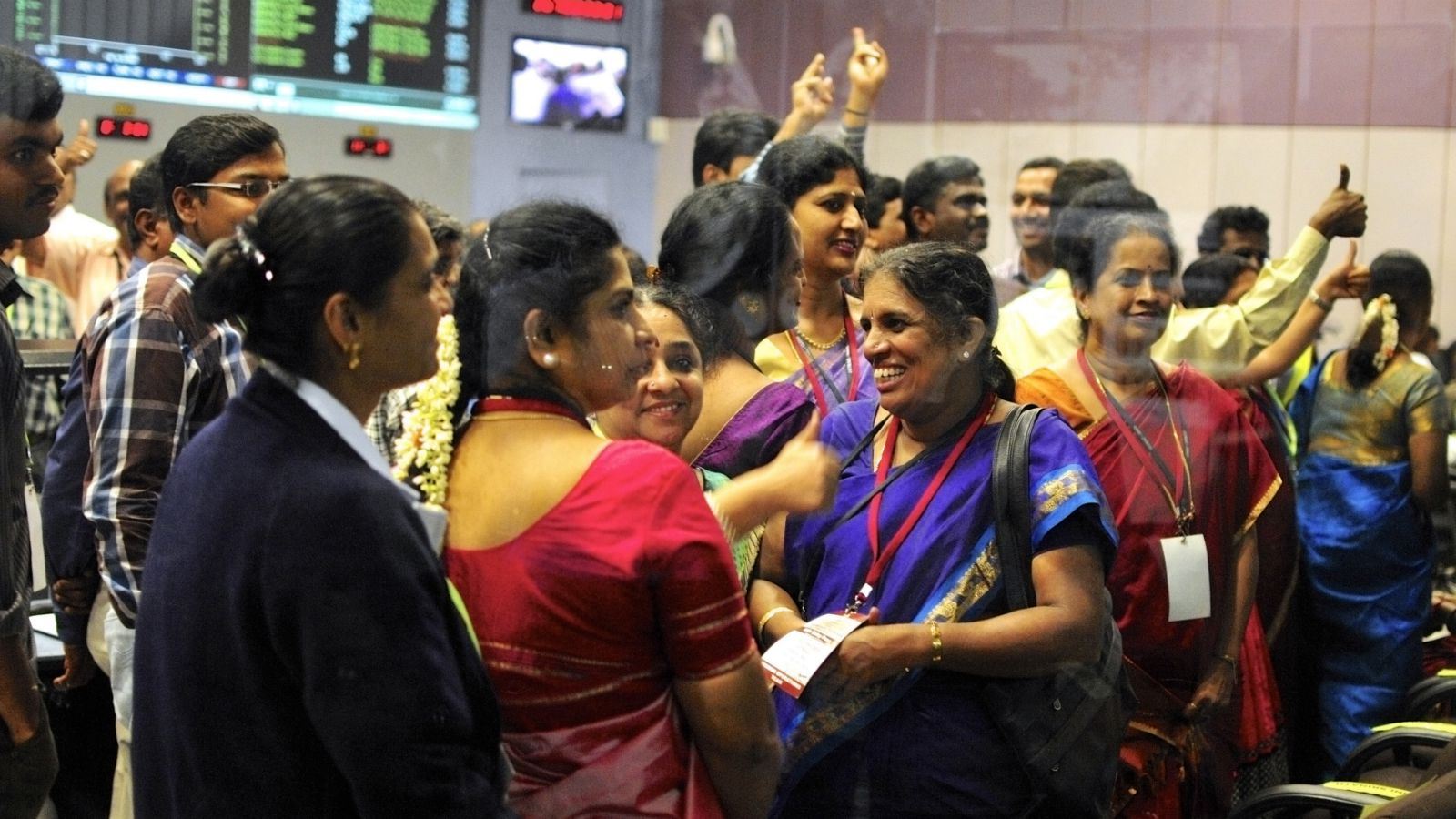
In case the Times is wondering what interplanetary-mission-heading Indian scientists look like then here you go, this is what they look like:

2014-09-29-isroscientists.jpg

And this:

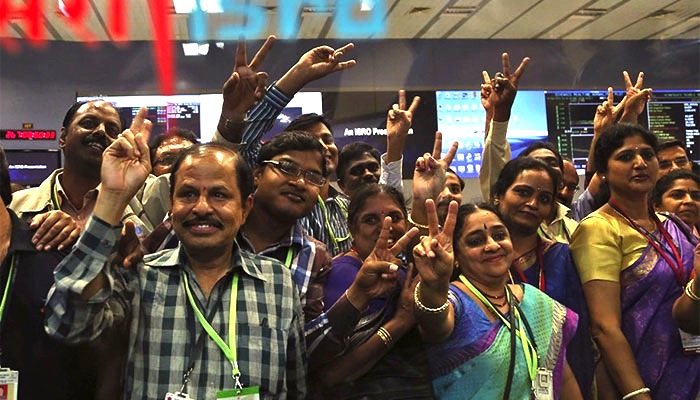
2014-09-29-isro2.jpg

And this:

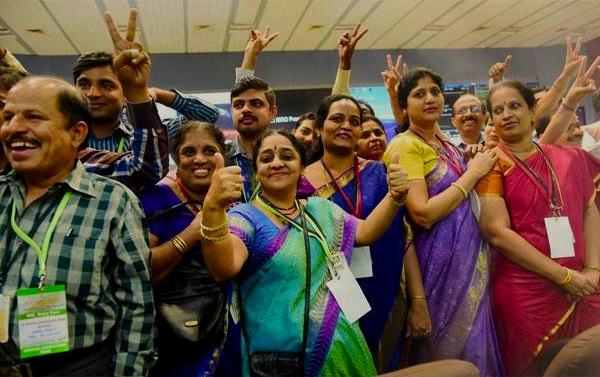
2014-09-29-isro3.jpg

The male engineers are wearing Western gear, while some of the female engineers are rocking traditional silk saris, the kind usually worn on special occasions, and jasmine flowers in their hair. On regular days, they work in full suits. There are no farm animals in sight at the ISRO office. And they certainly don’t look desperate for membership into some secret elite club. In fact, their jubilance says it all.

See, there are lots of socially and economically elite people in the world — being elite is like winning the lottery. But only a handful of human beings in history can claim to have sent a spaceship to another planet. That is brilliance and merit. That is actualizing human potential and literally moving humanity forward — like inventing the wheel, or, you know, sending a spaceship to Mars. One doesn’t have to be a rocket scientist to understand that.

SOURCE::::   IN  http://www.huffingtonpost.com/  

NATARAJAN

Management Lessons From India’s MANGALYAAN …

Management lessons from Isro’s Mangalyaan

India’s Polar Satellite Launch Vehicle, carrying the Mars orbiter, takes off from Sriharikota. Photo: Reuters/Isro

The resounding success of India’s Mars mission holds many lessons. Experts discuss the learning from the way the Indian Space Research Organisation (Isro) put its craft in the Mars orbit. Make a quality product R.D. Chandak, managing director and chief executive officer, KEC International The successful Mars Orbiter Mission, or the Mangalyaan, by Isro has many lessons for Indian manufacturers, says Chandak. The mission has shown that Indian companies can make a quality product at a competitive price, he says. To make India a manufacturing hub, Indian companies will have to make quality products on time, manage the logistics and produce at a very competitive cost, adds Chandak. Building the right team to deliver such projects is important. “Selecting the right team just doesn’t mean selecting the most qualified people; it also means selecting highly committed people,” he says. Teams also need to be empowered so that they can take critical decisions and ensure timely delivery of the project, he adds. Innovation is another major learning from the Mars mission. “Innovations need not be big advances in technology, but many small ones such as those that help reduce costs are important for corporates,” says Chandak. Every project has a certain amount of risk involved, and identifying the risks and managing them is important, he says. Time management, which is of paramount importance when executing such a project, is another lesson. “India wanted to send the Mars orbiter before China could. Having achieved the mission in a very strict time frame, it is a big example for Indian corporates in project management,” adds Chandak. It is also important for companies to learn not only from their own mistakes, but also from the mistakes of others, he says. Encourage team work Vinamra Shastri, partner, Grant Thornton India The scope of what a firm’s management can learn from the Mangalyaan project is very vast, says Shastri. However, there are a few takeaways that stand out. The mission became successful due to the collective effort and intelligence of stakeholders, not their individual genius, he says. Similarly, companies should consider encouraging teamwork and collaboration rather than pursuing individuals. “Every organization has people with different aptitude and skills. It is the responsibility of the senior leadership to ensure that they identify competencies and encourage teamwork,” says Shastri, adding the management should focus not only on the high performers, as different perspectives will only lead to more informed decision-making, resulting in better chances of success. Having a higher purpose for being in business is yet another key element, differentiating companies. Organizational goals should have a “higher purpose”—something which is unique and relevant, with which every stakeholder can relate to and have an emotional connect. A great example, he says, is the Tata group that has achieved more than its business goals. It stands for trust and responsibility. Similarly, the Mangalyaan project was launched not just to put India ahead of others in space research. Again, while Indian culture is appreciated on a personal or family level, the culture followed by Indian firms is often criticized by many. Mangalyaan could not be managed so efficiently within the specified time frame if the Indian Space Research Organisation did not have the right work culture, says Shastri. “(Management guru) Peter Drucker has said culture eats strategy for breakfast. Strategies formulated can only be executed when the work culture is conducive,” he adds. Plan for success, not failure K.G. Vishwanath, independent consultant The first lesson for Indian companies from the Mangalyaan Mars orbiter is to plan for success, not failure, says K.G. Vishwanath, an independent consultant and former Jet Airways (India) Ltd vice-president (investor relations). Vishwanath was part of the Jet Airways team that struck a deal to sell a 24% stake in the airline to Etihad Airways PJSC for $379 million. “Secondly, Isro had planned its production units across the country meticulously and tapped the best talent accompanied by the best planning tools,” he says. “They were not ready for taking any chances. They were planning not to fail. This is an inspiring lesson for any company and their boards.” Vishwanath says the third key lesson was about teamwork while handling egos. “Isro put all the team into one with a single objective. When a company stands together as one to achieve an objective, nothing can stop them and Mangalyaan proves that,” he says. He observes that choosing a team was purely based on merits irrespective of gender differences. “They just stood as one to accomplish the objectives,” he adds. “The last lesson is about passion. If you are doing anything, do it with passion. There are several examples of companies that have succeeded in the toughest MARKET conditions by showing inimitable passion,” he says. “Not to forget, Mangalyaan was accomplished with the lowest cost. It proves that while focusing on cheap cost, quality can still be maintained. Indigenous manufacturing means superior quality. That’s what we need now at a time when the nation is building a manufacturing base competing with China,” Vishwanath adds.

Read more at: http://www.livemint.com/Specials/3Y72VG1WlFbM5lBv7N1hSJ/Management-lessons-from-Isros-Mangalyaan.html?utm_source=copy

Source:::: Livemint.com

NATARAJAN

Image of the Day…. Images of MARS sent by India”s MOM …

Mars and its atmosphere, seen by MOM spacecraft

Two early images from India’s MOM spacecraft. One shows an edge of Mars, with the planet’s tenuous atmosphere above. The other shows the whole planet. Beautiful!

India's Mars Orbiter Mission (MOM) captured this image of the

The world applauded India last week as its maiden interplanetary spacecraft – the Mars Orbiter Mission, or MOM – achieved orbit around the Red Planet. Here are some of the first images transmitted from MOM. At top, a gorgeous shot of the limb, or edge, of Mars with the tenuous Martian atmosphere silhouetted against the blackness of space. The Indian Space Research Organization (ISRO), India’s space agency, released this image on September 25, 2014, about a day after MOM arrived.

ISRO announced that MOM successfully entered into an orbit around planet Mars on September 24, 2014 at 7:30 a.m. India Standard Time (02:00 UTC; 20:00 EDT in the U.S. on September 23). MOM carries five instrument suite whose mission is to study the surface and atmosphere of Mars with a particular emphasis on measuring the methane in the Martian atmosphere: a key indicator of microbial life.

Image via Mars Orbiter Mission

Above is another beauty from MOM, acquired on September 28, 2014.

The Schiaparelli Basin (460 kilometers / 286 miles wide) is visible just below right, of dead center. To the left is the Meridiani Terra with Meridiani Planum where NASA’s Opportunity rover is still operating almost flawlessly after 10 years on Mars.

Oxia Palus is clearly visible as is Chryse Planitia where the Viking 1 lander touched down in July 1976 and also the Ares Vallis, where the Mars Pathfinder successfully landed in July 1997.

Syrtis Major is visible towards the right limb.

Bottom line: Here are some early images from India’s MOM spacecraft. One shows the limb of Mars, with its tenuous atmosphere above. The other shows the whole planet, with a dust storm visible in the planet’s northern hemisphere. Beautiful!

SOURCE:::: earth sky news

Natarajan

What happens when you flush a toilet on a plane? …!!!

What Really Happens When You Flush on an Airplane?

AHHH, aeroplane bathrooms. If only they all looked like the fancy lavs in Emirates’ first-class cabins, which even have showers. Sadly, the cattle-class facilities are usually a little more, well, cozy and humble.

But the aeroplane toilet, no matter if it’s in first class or economy, is something to celebrate. Really.

Next time you pay a visit to the bathroom mid-flight, spare a thought for inventor James Kemper. In a masterpiece of aviation engineering, he conceived the vacuum toilet — something for which every airline passenger since the 1980s should be thankful.

So how does it work? If you think this is what happens when you flush at 35,000 feet …

… think again! The plane in this video has actually been converted to fight fires — so, that’s just the aircraft doing its job — not a toilet flushing!

The typical household toilet relies on a combination of water and gravity to flush, but Kemper’s invention uses a vacuum to suck the non-stick (just like a modern day frying pan) bowl clear of its contents.

The Emirates bathroom.

The Emirates bathroom. Source: AFP

That really loud sound you hear when you flush is the vacuum suctioning waste away. Toilets typically secrete a little sanitising solution during the suction process for hygiene and odour-busting.

Removing all that water from the equation not only helped cut turbulence-induced spills, but also greatly reduced the amount of weight a plane needed to carry.

Contrary to urban myth, that “waste” isn’t then flushed out of the plane in midair. It’s actually stored in a tank in the bottom of the plane. A sanitation crew at the airport empties the tank after arrival.


Be thankful there even are toilets on planes!

A history of plane toilets:

• 1982: First vacuum toilet is installed by Boeing.

• 1975: James Kemper patents the vacuum toilet.

• 1958: Inflight lavatories adopt flush toilets.

• 1945: First fixed toilet bowl appears on a long-haul passenger plane.

• 1930s: First separate plane lavatory installed with removable toilet bowls.

• Pre-1930s: Empty buckets at the back of the planes used as toilets, or no toilet facilities were available at all.

Written by insider city guide series Hg2 and was sourced via Cheapflights.  

Source:::: BRETT ACKROYD,  in Cheapflights…. news.com.au

Natarajan

World”s Longest Flight On Biggest Plane ….

A380 pushing the limits

QANTAS is making aviation history today as the world’s largest passenger aircraft, the superjumbo A380, starts flying the world’s longest route — a non-stop trip lasting nearly 16 hours.

Well, it’s 14 hours 50 minutes to get from Sydney to Dallas/Fort Worth, but a longer 15 hours 30 minutes to return.

Passengers travelling on the route are now privy to the glam and size of the increasingly popular A380 with Qantas operating six direct return services per week.

Qantas Group CEO Alan Joyce says the move reflect the airline’s history of endurance, setting records and connecting Australians to the world.

“Today, Qantas is leading the way again with the introduction of the world’s largest passenger aircraft on the world’s longest route, Sydney to Dallas/Fort Worth, with a flying time of almost 16 hours,” Mr Joyce said this morning at a media conference at Sydney Airport.

So what’s the attraction of arriving in the boot/scooting cowboy-laden city?

“Since starting on the route in 2011 the feedback from our corporate customers, especially those in the resources, technology and agricultural sectors, tells us they like flying into the Dallas hub because it gets them closer to their final destination in the US and offers great onward connections.

“The Dallas/Fort Worth service offers direct access right into the heart of the US with over 50 connections to all US major cities all within four hours, including Orlando, Boston and Houston.”

Qantas recently announced increased services to the US, and will now offer 41 services per week to North America. About half of these services are operated by A380 aircraft and the other half by B747s with A380-style interiors.

Alan Joyce at the meeting event today.

Alan Joyce at the meeting event today. Source: NewsComAu

Mr Joyce said introducing A380 services between Sydney and Dallas/Fort Worth, which is the only direct flight from Australia to inland United States, would provide enhance the customer experience and boost capacity.

“We know our customers will value the comfort of the A380 on this route,” he said. “It’s also a vote of confidence in Qantas’s business going forward.

“Not only will the A380 increase seats on the route by more than 10 per cent each week, it will also provide us with greater fuel efficiency and the range to operate the return service direct back to Sydney.

Dallas, here we come.

Dallas, here we come. Source: News Limited

“Our customers also now have the choice of four cabins to both Los Angeles and Dallas/Fort Worth as we introduce our Marc Newson designed First Class Suites on the Dallas/Fort Worth route for the first time.”

The new A380 service will also create further opportunities for both tourism and TRADE between Australia and the US.

“Dallas/Fort Worth is home to our partner American Airlines, and it’s the perfect hub for both business and leisure travellers heading in either direction across the Pacific.”

Mr Joyce said the fall in the Australian dollar actually has a positive impact on its international business.

“Sure there is always an impact in fuel prices but luckily we have seen a decrease in fuel prices of late regardless.”


The world’s longest flights in distance include The Sydney — Dallas/Fort Worth leg at 13,804km followed by Delta’s Johannesburg to Atlanta at 13,582km and Emirates Dubai — Los Angeles at 13,420km.

In 1989, Qantas operated the world’s longest non-stop delivery flight, when it flew a Boeing B747-400 from London to Sydney in 21 hours. Meanwhile Qantas holds the record for the longest regular commercial flight time-wise, set in 1944 from Perth to Sri Lanka.

The new flight replaces the current Boeing 747-400ER aircraft used on the route. The A380 will step up to a daily service over the 2014-2015 summer holiday season, from December 9 2014 to January 20 2015.

DFW airport is upgrading one terminal with three extra aerobridges to load passengers on the double-decker jet, while Qantas’ partner Emirates is set to begin A380 flights between DFW and Dubai from October 1.

Qantas’ existing flights between Melbourne, Dubai and London will be retimed to make room for these extra A380 services.

“This schedule change unlocks more A380 flying time that we can use on the Dallas route, and now offers four times the number of onward connections to Europe because of the new arrival time of the Melbourne flight into Dubai,” adds Qantas CEO Alan Joyce.

Qantas says the current mix of Boeing 747 and Airbus A380 flights from Sydney to Hong Kong will also face “adjustments”, although the airline hasn’t yet revealed whether the A380 will disappear from Asia entirely.

Fun flying facts:

• The Qantas A380 carries 323,000 litres of fuel, equivalent to eight backyard swimming pools.

• The Qantas A380 is fitted with a First, Business, Premium Economy and Economy cabin offering 484 seats, (14 First, 64 Business, 35 Premium Economy and 371 Economy).

• Qantas is the larger purchaser of Australian wines.

• The A380 delivers up to 10 per cent improvement in fuel efficiency and carbon emissions per revenue tonne kilometre, than most of today’s largest passenger jets.

• Qantas began flying to Dallas Fort Worth in May 2011 and is the only carrier to operate direct services from Australia to Dallas/Fort Worth.

The writer is flying as a guest of Qantas.Follow Melissa’s (mis)adventures to Texas on Instagram and Twitter @melissahoyer.   

Source:::: MELISSA HOYER  in news.com.au

Natarajan

Image of the Day…Curiosity Rover Drilling Mars Mountain…

Curiosity rover drill pulls first taste from Mars mountain

The mission’s emphasis has changed from drive, drive, drive to systematic layer-by-layer investigation. “Curiosity flew hundreds of millions of miles to do this.”

This image from the Mars Hand Lens Imager (MAHLI) camera on NASA's Curiosity Mars rover shows the first sample-collection hole drilled in Mount Sharp, the layered mountain that is the science destination of the rover's extended mission. Image credit: NASA/JPL-Caltech/MSSS

NASA’s Curiosity Mars rover has collected its first taste of the layered mountain whose scientific allure drew the mission to choose this part of Mars as a landing site.

Late Wednesday, September 24, the rover’s hammering drill chewed about 2.6 inches (6.7 centimeters) deep into a basal-layer outcrop on Mount Sharp and collected a powdered-rock sample. Data and images received early Thursday at NASA’s Jet Propulsion Laboratory, Pasadena, California, confirmed success of this operation. The powder collected by the drilling is temporarily held within the sample-handling mechanism on the rover’s arm.

This southeastward-looking vista from the Mast Camera (Mastcam) on NASA's Curiosity Mars rover shows the

After landing on Mars in August 2012 but before beginning the drive toward Mount Sharp, Curiosity spent much of the mission’s first year productively studying in the Yellowknife Bay area, an area much closer to the landing site, but in the opposite direction.

From Yellowknife Bay to the base of Mount Sharp, Curiosity drove more than 5 miles (8 kilometers) in about 15 months, with pauses at a few science waypoints. The emphasis in mission operations has now changed from drive, drive, drive to systematic layer-by-layer investigation.

Jennifer Trosper of JPL is Curiosity Deputy Project Manager. She saud:

We’re putting on the brakes to study this amazing mountain.Curiosity flew hundreds of millions of miles to do this.

By investigating the shapes and chemical ingredients in the rock features, the team hopes to gain information about the possible composition of fluids at this Martian location long ago. Ashwin Vasavada of JPL is Curiosity Deputy Project Scientist. Vasavada said:

This drilling target is at the lowest part of the base layer of the mountain, and from here we plan to examine the higher, younger layers exposed in the nearby hills. This first look at rocks we believe to underlie Mount Sharp is exciting because it will begin to form a picture of the environment at the time the mountain formed, and what led to its growth.

Read more from NASA


SOURCE::::Earth sky news

Natarajan

” Why Aluminium Foil is Shinier on one side …” ?

Why Aluminum Foil is Shinier on One Side Than the Other

aluminum-foilThe most abundant metal in the Earth’s crust, aluminum naturally occurs as a compound with other elements, such as aluminum oxide or potassium aluminum sulfate. As such, it was not isolated as a separate element until 1825 when a Danish chemist, Hans Christian Oersted, was able to produce a small amount.

By 1845, a German chemist, Friedrich Wöhler, had perfected a way of producing enough aluminum to be able to study it. In 1854, the French chemist, Henri Étienne Sainte-Claire Deville improved on Wöhler’s method and developed a process to commercially produce the element, although it still remained expensive, even more than gold.

Other improvements were made independently by chemists Charles Martin Hall (American) and Paul L.T. Héroult (French) in 1886, and by Karl Joseph Bayer (Austrian) in 1888. As a result, sufficiently large quantities of aluminum oxide were now able to be produced from bauxite, and then aluminum could easily be obtained from the aluminum oxide.

This greatly reduced the cost of aluminum, and in 1888, Charles Martin Hall formed the precursor to the Aluminum Company of America (Alcoa), the Pittsburgh Reduction Company. Production methods continued to improve and by 1909, the Pittsburgh company’s output was at 41,000 kg per day. By 1910, the first manufacturing plant for the production of aluminum foil opened in Emmishofen, Switzerland by Dr. Lauber, Neher & Cie.

So why is aluminum foil shiny on one side and not as much on the other? In what is called the Bayer Process, after pure molten aluminum is obtained from aluminum oxide, it is placed in furnaces with a small amount of other elements (typically the final product will be between 99.8% and 99.9% aluminum). This liquid is then poured into “chill casting devices where it cools into large slabs called ‘ingots.’” Next the ingot is treated with heat (annealed), and then rolled between heavy rollers.

This initial foil is sent through still more rollers, several times, until it reaches the desired thinness. For the type of foil that is bright on one side and matte on the other, it is so thin that during some of the last rollings, two sheets of the thin foil must be placed together lest they tear or crimp during the final rolling of the sheets.

One consequence of this is that while the sides that touch the highly polished rollers are burnished to a bright finish, the inner sides that touch the other aluminum foil remain matte.

Bonus Foil Facts:

  • More than just packaging, aluminum can be used to polish silver: after lining a deep pan with foil, cover it with cold water and add a couple of teaspoons of salt and your silverware. Chemistry (magic) will remove the tarnish. A similar process can be used to clean jewelry, except exchange the cold water for hot, and the salt for a tablespoon of laundry detergent. Likewise, a sheet of aluminum foil underneath freshly polished silverware will deter tarnishing.
  • Scissors can be sharpened by cutting through several layers of aluminum foil a few times.

SOURCE::::: Today i found out .com

Natarajan

The Most Entertaining Airports In The World …

Here are seven international airports that go beyond free Wi-Fi and luggage carts to offer truly entertaining amenities.

Amsterdam Airport Schiphol, Haarlemmermeer, Netherlands

Amsterdam Airport SchipholFlickr/ajay_suresh

Amsterdam Schiphol Airport highlights: “Holland Boulevard,” a library, Dutch Kitchen restaurant, a museum, and Holland CASINO.

Changi International Airport, Changi, Singapore

changi slideFlickr/wongjunhao

Changi International Airport highlights: Nature trails, gardens, a four-story slide, a rooftop pool, and a movie theater (free admission).

Munich Airport, Munich, Germany

Munich AirportMunich Airport

Munich Airport highlights: Airbrau brewery and restaurant, free surfing lessons in the outdoor wave pool (summer only), volleyball tournaments, and a Christmas MARKET.

Incheon International Airport, Incheon, South Korea

incheon airportFlickr/zionorbi

Incheon International Airport highlights: “Spa on Air” sauna, Thai massage, the Ice Forest skating rink, a movie theater, gardens, and traditional musical performances.

Hong Kong International Airport, Chek Lap Kok, Hong Kong

Hong Kong International AirportHong Kong International Airport

Hong Kong International Airport highlights: A nine-hole golf course, the Aviation Discovery Center, the Dream Come True Education Park, and an IMAX theater.

Vancouver International Airport, Richmond, British Columbia

vancouver airportFlickr/alanchan

Vancouver International Airport highlights: A 114,000-liter aquarium and a jellyfish exhibit.

Zurich Airport, Zurich, Switzerland

zurich airportFlickr/patrick_nouhailler

Zurich Airport highlights: Observation decks and a miniature airport for children.

This article originally appeared at SmarterTravel.

SOURCE::: Business insider.com

Natarajan

Read more: http://www.smartertravel.com/photo-galleries/editorial/the-worlds-seven-most-entertaining-airports.html#ixzz3ENucJlFf