A Priceless Lesson From A.P.J. Abdul Kalam On The Power Of Change…


Excerpted from a book by A.P.J Abdul Kalam:

Dear friends, I strongly feel that no youth today needs to fear about the future. Why? The ignited mind of the youth is the most powerful resource on the Earth.

Let me give you some examples of those who made a change in their lives and became true ignited minds.
A unique experience happened when I went to Madurai to inaugurate the Paediatric Oncology Cancer unit at Meenakshi Mission Hospital on 7 January 2011. After I completed the task, suddenly one person from the audience approached me and his face looked familiar. When he came closer, I found out that he was once my driver when I was the Director of Defence Research and Development Lab (DRDL) at Hyderabad in 1982–92. His name is V. Kathiresan, and he had worked with me day and night for those ten years. During that time, I noticed, he was always reading some books, newspapers and journals during his waiting time in the car. That dedication had attracted me and I asked him a question. ‘Why do you read during your leisure time?’ He replied that his children used to ask him lot of questions. Since he didn’t always know the answer, he would study whenever time permitted in order to give them the best answers. The spirit of learning in him impressed me and I told him to study formally through distance education and gave him some free time to attend the course and complete his 10+2 and then to apply for higher education. He took that as a challenge and kept on studying and upgraded his educational qualifications. He did B.A. (History), then he did M.A. (History) and then he did M.A. (Political Science) and completed his B.Ed and then M.Ed and he worked with me up to 1992. Thereafter he registered for his doctoral studies and got his PhD in 2001. He joined the Education Department of Tamil Nadu government and served there for a number of years. In 2010, he became an assistant professor in the Government Arts College at Mellur near Madurai.

When I was invited to address the students of UPMS School, Kovilpatti, I again met Professor Kathiresan who was sitting on the dais. I introduced Professor Kathiresan to the gathering and brought out how he, a native of that same town, has transformed himself, earned a doctorate and was teaching in a college after two decades of hard work. This incident cheered the entire young audience.

Friends, I visualize a scene. A school having about 50 teachers and 750 students. It is a place of beauty and for fostering creativity and learning. How is it possible? It is because the school management and the Principal selected the teachers who love teaching, who treat the students as their children or grandchildren. The children see the teachers as role models not only in teaching but how they conduct their lives. Above all, I see an environment in which there is nothing like a good student, average student or poor student. The whole school and teacher system is involved in generating students who perform to their best. And above all, what should be the traits the teacher should possess based on teachers’ life both inside the class room and outside the school? When good teachers walk among them, the students should feel the heat of knowledge and the purity of their lives radiate from them. This race of teachers should multiply.

As a child moves towards teenage and then adulthood, his carefree attitude is slowly taken over by many pressures. What will I do after my education? Will I get a proper employment?

Teachers and parents should preserve the happy smiles on the faces of their children even when they complete their school education. The student should feel confident that ‘I can do it’. He or she should have the self-esteem and the capability to become an employment generator. This transformation can only be brought about by a teacher who has the vision to transform.

I have always liked to sit in a class. When I visit schools and colleges in India and abroad, I like to see how teachers teach and students interact in the classroom. Recently, I was in Andhra Pradesh, in a one-teacher school classroom. The school had classes only up to the fifth grade. I was with the students and the teacher was teaching. How happy were the children? The teacher was telling the young students, ‘Dear children, you see the full moon, the beautiful scene in the sky brings smiles and cheers. Remember, as you smile the family also smiles. How many of you keep your parents happy?’ The whole class lifted their hands. They said, they would do it. I also lifted my hand along with the students.

Another experience was during my visit to UAE. I inaugurated an Indian school in Dubai. When the preparation was going on for the inaugural function, I was moving from place to place in the school. I visited classrooms where students from class five and six were being taught. As soon as the teacher saw me, she asked me to take the class. So I started interacting with the students. Instead of loading them with the lessons. I asked them how many planets does our sun have? Many hands went up. One girl said, there are nine planets and some students said, there are eight planets. I said the right answer is eight planets, since the ninth planet Pluto has been removed from the list of planets, because it does not meet the criteria of a planet, in size, weight and orbital motion. I asked, ‘Tell me, which is our planet?’ There was a chorus in reply, ‘Earth’. Then I asked, ‘Who will talk about the Earth?’ One sixth class student got up and said, ‘Our Earth rotates on its own axis.’ Many students said, ‘It takes 24 hours for one orbit that’s how we get day and night.’ I was very pleased with the knowledge of the young on the solar system. Then I asked the class, what does the Earth do, there was pin drop silence. Again a fifth class student said, ‘Earth orbits around the sun.’ How much time it takes to complete the one orbit? Many hands went up, they said 365 days. Our sun belongs to which galaxy? Only one boy responded, ‘Milky Way’. How much time our sun takes for one orbit of our galaxy? No response. Of course, it is difficult. I gave the answer: 200 million years. The children had a great surprise. I was impressed with the class and greeted them and left.

I am giving you these examples to illustrate, how students can be encouraged to build their self-confidence. I am sure teachers may adopt several methods to make the class dynamic and creative for promoting sustained interest among the students.

(From Address at Villa Nazreth English Medium School and other schools, Aryanad, Thiruvananthapuram, 22 February 2015 and Address and interaction with the students of CRPF Public School, Hakimpet, Telangana, 20 March 2015)


Source….http://www.youthkiawaaz.com/2016/10/apj-abdul-kalam-life-lessons-for-youth/

Natarajan

WHY WE SAY “O’CLOCK”…?


The practice of saying “o’clock” is simply a remnant of simpler times when clocks weren’t very prevalent and people told time by a variety of means, depending on where they were and what references were available.

Generally, of course, the Sun was used as a reference point, with solar time being slightly different than clock time. Clocks divide the time evenly, whereas, by solar time, hour lengths vary somewhat based on a variety of factors, like what season it is.

Thus, to distinguish the fact that one was referencing a clock’s time, rather than something like a sundial, as early as the fourteenth century one would say something like, “It is six of the clock,” which later got slurred down to “six o’clock” sometime around the sixteenth or seventeenth centuries. In those centuries, it was also somewhat common to just drop the “o’” altogether and just say something like “six clock.”

Using the form of “o’clock” particularly increased in popularity around the eighteenth century when it became common to do a similar slurring in the names of many things such as “Will-o’-the wisp” from “Will of the wisp” (stemming from a legend of an evil blacksmith named Will Smith, with “wisp” meaning “torch”) and “Jack-o’-lantern” from “Jack of the lantern” (which originally just meant “man of the lantern” with “Jack,” at the time, being the generic “any man” name. Later, either this or the Irish legend of “Stingy Jack” got this name transferred to referring to carved pumpkins with lit candles inside).

While today with clocks being ubiquitous and few people, if anybody, telling direct time by the Sun, it isn’t necessary in most cases to specify we are referencing time from clocks, but the practice of saying “o’clock” has stuck around anyway.

Bonus Fact:

  • The word “clock” is thought to have originally derived from the Medieval Latin “clocca,” meaning “bell,” referencing the ringing of the bells on early town clocks, which would let everyone in a community know what time it was.
  • Contrary to popular belief, the clock tower in London commonly called “Big Ben” is not named “Big Ben.”  Rather, it is named “Elizabeth Tower,” after Queen Elizabeth II; named such during her Diamond Jubilee (the 2012 60th anniversary of her accession to the throne).  Before that, it was just called “Clock Tower.” So why is it so often called “Big Ben”?  That is due to the great bell inside the tower that chimes the hour out and goes by that name.  Over time this has morphed into many calling the clock tower itself that even today, despite the recent, very public, name change.
  • The Tower of the Winds in Athens, which lies right under the Acropolis, is thought to be the first clock tower in history, constructed sometime between the 2nd century BC to 50 BC.  It contained eight sundials and a water clock, along with a wind vane.
  • If you’ve ever wondered what a.m. and p.m. stand for, wonder no more: a.m. stands for “ante meridiem,” which is Latin for “before midday”; p.m. stands for “post meridiem,” which is Latin for “after midday.”
  • The International Space Station orbits about 354 kilometers (220 miles) above the Earth and travels at approximately  27,700 km/hr (17,211 mph), so it takes about 92 minutes to circle the Earth once. For this reason, every 45 minutes the astronauts on-board see a sunrise or a sunset, with a total of 15 – 16 of each every 24 hours.

Source…..www.today i foundout .com

Natarajan

DO YOU KNOW …?


2 lakh to 3300 crore: The BYJU’s Classes success story…Meet Byju Raveendran!


‘A business cannot be driven by the passion to make money, the passion to change society is far more important.’
‘After a certain point, what value has money to a person?’

30byjus-classes-2

A son of teachers, teaching never fascinated Byju Raveendran when he was young. His passion was sports.

After working for a couple of years as a globetrotting service engineer for a shipping firm, Byju became a teacher by accident.

On holiday, he helped some friends pass the Common Aptitude Test entrance examination.

From then on, requests started pouring in from friends of friends, and their friends. In no time, ‘Byju’s classes’ became so popular that he quit his job and flying from one city to another to take classes.

His classrooms grew from a single room, to a hall, and then an auditorium and at one point even a stadium!

He launched the BYJU’s Learning App for school students in 2015. The learning app also coaches for CAT, the civil services examination, the Joint Entrance Examination (JEE), the National Eligibility and Entrance Test (NEET), the Graduate Record Examination (GRE) and the Graduate Management Admission Test (GMAT).

The idea appealed to many investors and in 2016 alone, venture capital firm Sequoia Capital and Belgian investment firm Sofina invested $75 million (approximately Rs 500 crore/Rs 5 billion) into the firm. This was the largest fundraising in the education start-up segment in India.

The latest investment into Byju’s firm (September 2016) is the $50 million (Rs 332 crore/Rs 3.32 billion) from the Chan Zuckerberg Initiative, the philanthropic organisation created by Facebook founder Mark Zuckerberg and his wife Dr Priscilla Chan in 2015.

Byju spoke with Rediff.com‘s Shobha Warrier about his wonderful journey from mechanical engineer to successful entrepreneur.

Growing up in a village in Kerala

I grew up in Azhikode, a small village in Kannur, Kerala, the bastion of Communism.

I do not know whether it was the influence of Communism or the face of any typical village, the social fabric was very closely knit and people were politically and socially active.

Both my parents were teachers at the school I studied. My father Raveendran was a physics teacher and my mother Shobhanavalli taught maths. I grew up in a joint family where my father’s brother and sister and their children also lived.

Normally, children of teachers are pressured to concentrate on academics, but my parents were so open minded that they let me participate and excel in sports which was my major passion as a student.

Other than life skills, they never gave me any coaching in any subject. Though some of my teachers used to complain to my parents that I was missing a lot of classes due to my sports activities, they supported me to pursue what I liked.

In Kannur, football is a passion for everyone, but I played almost every sport available when in school, and football, cricket and table tennis at the university level.

‘I had my education in a Malayalam medium school and I learnt English on my own, mainly by listening to cricket commentary.’

It was quite common that many students who studied in Malayalam medium schools felt inferior in front of those who studied in English medium schools while in college.

My father’s influence was tremendous in my life as he let me be free of the confinement of classrooms and I feel you learn a lot more outside the classrooms than inside.

The biggest lessons I learnt from my sporting days were how to lead a team, teamwork, and how to perform under pressure. All these helped me immensely when I became an entrepreneur.

In addition, I learnt the value of controlled aggression, how to be extremely positive and that losing and winning are both part of the game.

We played games for fun and not in the structured way most kids play these days. Unlike children who play video games inside their homes, those who run around and played outdoor games learn a lot more life skills.

There is no substitute for playing outdoor games with other children.

Though I played sports well, I did not have any ambition to be a cricketer or a football player. I played games because I enjoyed playing them. In fact, I enjoy every moment of my life; I do not do anything expecting anything in return. Maybe I inherited this attitude from my father who is super cool about everything in life.

The choices in front of all the students at that time were either be an engineer or a doctor, and I chose to study engineering. One reason why I chose engineering was I knew I would get more time to play as medicine students hardly got time to play sports.

From a village in Kerala to travelling around the world

After studying mechanical engineering, I got a job in a multinational shipping firm and started travelling all around the world as a service engineer.

It was a very challenging and exciting job and as I travelled to new places, I became more and more aspirational.

If anyone had asked me at that time whether I would be an entrepreneur in the future, I would have said, no. The desire to be an entrepreneur never even crossed my mind.

After two years of working, I was on holiday in Bangalore, where many of friends worked. It so happened that they were preparing for the CAT exam then and as I was good at maths, they asked for my help.

While I helped them prepare, I also wrote the exam just for fun and see how I fared. To my surprise, I scored in the 100th percentile, but I had no plans to do an MBA in an IIM. My friends also did well and some of them even got admission at the IIMs.

I was back in India again in 2005 on holiday. This time, more friends of my friends came to me for help to prepare for the CAT exams. I was in Bangalore for six weeks and I might have trained more than 1,000 students during the period.

‘As the numbers grew, the venue moved from the terrace of a friend’s house to a classroom, and then to an auditorium.’

The initial workshops were free and students paid for advanced workshops once they liked it.

Because of the enormous response to my teaching, I didn’t go back to my job after that.

Once I started teaching, I realised that I enjoyed teaching tremendously which I was not aware of till then.

Becoming a full time teacher

When I decided to resign from my highly paid job and start teaching, my parents supported me. Never once did they question me. They supported all the decisions I took, like not joining an IIM, quitting my job to start teaching while there were many people who questioned my parents’ indulgence of me.

In those days, I taught CAT aspirants on weekends while I prepared myself on weekdays by trying to come up with innovative ways to solve problems.

I travelled to Pune, Delhi, Chennai and Mumbai during the weekends and in no time I had to add five more cities on weekdays due to constant demand.

Wherever I went, I addressed packed auditoriums; a few times, I ran classes in a stadium. As time passed by, I even took maths workshops for 20,000 students at one time.

I became a popular teacher and I was doing this all by myself. It was an overwhelming experience when thousands of students wait eagerly in various cities for your classes.

Sometimes I wondered whether I deserved the kind of respect and importance they gave me.

Funnily, a person who had never addressed any group of even ten during my school or college days was taking classes to thousands of them in auditoriums.

‘When you take classes in stadiums, teaching gets elevated to become almost like a performance art.’

Soon I started making lots of money, much more than I ever thought I would make as a teacher. As I was a one-man army then, I didn’t have to spend any money on anything except my own efforts.

In 2009, I made videos of my lectures and used V-SAT to beam them to students in 45 cities where I could not travel to.

Byju’s Classes becomes a brand

My classes were referred to as Byju’s Classes from the time my classes became popular.

In 2007, without me knowing, the brand name Byju’s Classes was created by my students and I decided to capitalise on the brand name later. I didn’t want to lose the popularity and the good name the brand had achieved.

In 2011, the idea to form a team came from some of my students who contacted me after finishing their courses at various IIMs. We started the company Think and Learn with 25 to 30 people, but the team grew in numbers every month to more than 1,000 today.

The product our company planned to create was content for school students and the decision to move from CAT to creating content for school students came from my observation of the students I taught.

I felt that most of the students lacked conceptual clarity and a proper foundation. I found that there was a huge gap in how the subjects could be learnt and how they were taught. That is why I wanted to create something that could fill the gap.

Looking back, I feel I excelled in exams because I wrote exams for fun, the same way I played games.

‘Exams never intimidated me. There was no stress or pressure to perform well in the exams. I looked at exams as a part of the learning process.’

Instead of memorising stuff, I used to learn the concepts well, something I found was lacking in many of my students. So, I decided to target the crucial years in a student’s life from the 8th to the 12th standard.

Today, my classes begin for 4th standard children; they are in maths, physics, chemistry and biology.

Maths and science are two subjects for which I had special attitude and I enjoyed both, especially solving maths problems. I never learnt maths and science to write exams. I loved learning on my own and understanding the concepts.

I noticed then and even now that majority of the students learn a subject to score good marks. You lose the pleasure you derive from solving, say a maths problem, by studying for the exam. These students don’t realise the fun they are losing out on by studying only to score high marks.

I was a Maths Olympiad winner in school only because I enjoyed solving maths problems.

The problem with our education system is that it gives more importance to breadth than depth.

We tend to create many generalists and very few specialists.

They tell you to work hard on your weaknesses.

On the contrary, I would argue that you should also build on your strengths!

Asking questions is the key to a student’s success. You see 2-3-year-olds learning things by asking questions all the time, but as they grow, adults discourage them from asking questions.

‘I feel all schools should encourage students to ask questions. Your thought process is alive only when you ask the right questions.’

I love maths and sports equally and it’s tough for me to choose one. My love for maths has helped me a lot in life. For example, I used my strength in solving maths problems to start my own company, attract investors and on a lighter note, even impress the girl I loved to become my wife.

From 2011 to 2015, we immersed ourselves in creating content mainly for school students from classes 6 to 12.

Our content is very contextual and visual. Instead of focusing on the whats of learning, we pay attention to the whys and hows as well.

We created each chapter in a subject like a movie. And it’s not just me; a lot more teachers take classes these days.

We have a 150 strong content team, a 200 member media team to make it into interesting videos and a technology team of 150 to personalise it. In all, we are a 500-member product development team now.

By August 2015, Byju’s Learning App was ready to be launched, and in one year, we have had 5.5 million downloads with 250,000 plus students using it on an annual subscription basis.

We have also found that students spend an average of 40 minutes per session and more than 90 per cent of the students who came on board last year renewed their subscription, acknowledging the fact that they benefited from the learning programme.

Investment over the years


We didn’t invest much initially; the Rs 2 lakh (Rs 200,000) I invested first came from what I made from my classes.

The first investment came in 2013 when Mohandas Pai and Ranjan Pai decided to invest Rs 50 crore (Rs 500 million) in Byju’s Classes.

It was after Ranjan Pai saw how students at the Manipal Institute of Technology attended our video classes in large numbers. We used the money to scale up the team and accelerate product development.

The latest and the most publicised investment was the $50 million invested by the Chan Zuckerberg Initiative. I do not know how we came on to their radar. I assume it must be through some reference.

Two things got them excited in our company: The first was how we use technology to personalise learning and the second was the impact our app has had on students not just in cities, but also in small towns.

Naturally, I was very excited to be noticed by one of the world’s most dynamic young entrepreneurs.

Social impact

With a father who is a Communist, and having grown up in a village in Kannur, money is not really important to me. I am more concerned and interested in seeing our app make a strong social impact.

I didn’t have any drive or passion to start a business, but when I started teaching, I realised that it was my passion and it gave me a lot of satisfaction and enjoyment.

When my classes started creating an impact, it became a business proposition.

‘In the sector that we are in, the real fun is not in creating a billion dollar company but changing the way millions of students learn.’

The most satisfying aspect for me is that we are able to reach out to tens of thousands of students.

I always say I am a teacher by choice and an entrepreneur by chance.

Making money has never been a priority for me, but giving something back to society is. That’s why I take care of the education and healthcare of the underprivileged in my village.

I grew up there and I feel it is my duty to help others come up in life.

I am of the opinion that a business cannot be driven by the passion to make money. The passion to change society is far more important.

After a certain point, what value has money to a person?

Shobha Warrier / Rediff.com

Natarajan


12 Health Myths We Shouldn’t Believe …!!!


We all know the excitement that we experience when we read about some wonderful health benefit we never knew about. And to be sure, many of these stories are true and genuinely important. But that doesn’t mean a few myths and lies haven’t slipped through the net over the years. Here is a list of 12 ‘health facts’ that for one reason of another are either misleading or downright false.

1. You can lose loads of weight doing yoga.

Yoga can provide you with many rich benefits. It’s relaxing, strengthening and even empowering, however it is not very aerobic at all. Some have suggested trying the so called ‘power yoga’ as a more intense alternative, yet even this will only burn 300 calories per 90-minute session. Furthermore, these sessions do not increase your metabolic rate (the number of calories you burn while at rest), post workout.

If you do use yoga, or are thinking of doing so, remember to supplement this worthwhile activity with other cardiovascular exercises. Balance, as ever, is the key.

2. Running damages your knees.
A study conducted by Stanford University has found that those who have run regularly for many years have knees as healthy as those who haven’t. The only time running might cause trouble for your knees is when there is a previously existing knee complaint that is aggravated by the sudden workout. If your knees are already fine, don’t let them put you off running.
3. Up to 90% of your body heat escapes through your head.
The real amount of heat you lose from your head is much closer to 10% since the head only accounts for this amount of your body’s surface area. Therefore, if the rest of your body (90%) is covered up with clothing during winter, but your head is bare, this area is more greatly exposed to heat loss. However, this would still account for even less than 50% of the heat you emit.

So, by all means, continue to wear a hat. But don’t fall for this 90% myth.

4. Bathroom scales show you much fat you’ve burned.
You should bear in mind that scales only really give you a snapshot of your weight at a certain time. Your weight can be effected by the amount of water in your system, the size of your last meal, or the amount of bloating you have. Furthermore, many people are surprised to find that a new lifestyle designed to improve their health will actually see their weight increase. This is because muscle is denser and weightier than fat.

So, if you have been exercising to lose weight, you should be prepared for a slight disappointment. However, even though you may gain weight, you will be getting slimmer, but your scale will not show this.

5. Microwaves give you cancer.
Microwave ovens are certainly a little terrifying thanks to the magnetic field they generate. However, the amount of energy this produces is not nearly enough to make a dent on your genetic material. The type of radiation used is ‘non-ionizing’, which also doesn’t affect a change in your cells. If you think about it, a microwave also does not alter the food it cooks either. It just heats it up. There is, therefore, no evidence that microwaves cause cancer.
6. The 5-second rule.
When we are talking about minute bacteria contamination, time is not very important. It only takes milliseconds for food to become contaminated once contact is made. Therefore, rather than fixating on the amount of time your food has spent on the floor, think instead of the environment it is in. Environment is a far greater factor than anything else.
7. You can be detoxified by drinking a juice cleanse.
Juice fasts are one of the latest health crazes that you’ve probably heard a good deal about. What they require is that you only consume the juices, cutting out all other foods for a certain time, in order to rid your body of toxins and induce other health benefits. However, the benefits that accrue have not been shown to go beyond the feel-good factor of the placebo effect.

The reason it helps lose weight is because it’s a fast that eliminates protein from your diet. This reduces both fat and muscle from your body. The important thing to grasp is that your body already has a perfect detoxifying system, utilizing your kidneys, liver and digestive tract. Drinking fiber-free juices all day, in place of real food, may actually be contributing to a worsening of your health.

8. To stay healthy we should drink eight glasses of water every day.
Although drinking too much water can lead to fatal water intoxication, eight glasses is not too much. The number though is quite strange, since no one can say where this recommendation came from. Among healthy people there is nothing to say that drinking eight glasses per day will have any positive effect at all.

However, as with all such myths, there is a grain of truth, since if you drink plenty of water, you will not feel the need to drink much worse beverages instead. High sugar drinks boost our calorie intake to dangerous levels.

When it comes to drinking water, the best advice is to drink when you feel thirsty – unless your doctor tells you otherwise.

9. Diabetes is caused by sugar.
It’s commonly believed that consuming too much sugar leads to this disease, but the truth is much more complicated. Type 1 diabetes is entirely genetic, and is not caused by diet whatsoever. Type 2 diabetes is caused by both genetic factors and lifestyle factors. Though certain sugary drinks are said to be culprits when it comes to increasing the risk of diabetes, this is not just because of the sugar content, but because of the sugar content allied to the high-calorie count.

Obesity and generally poor eating habits are a greater predictor of diabetes than sugar is.

10. High-fructose corn syrup is much more dangerous for you than natural sugars.
It’s enough said that high-fructose corn syrup should be avoided like the plague. However, scientists agree that when it comes to processing, energy and byproducts, corn syrup has the same effects as any other natural sugar. The only reason that high-fructose corn syrup may be considered less healthy is that it contains more sugar per serving than natural sugars, such as honey. Therefore, if used in concentrated doses, there is no difference.
11. Echinacea fixes colds and reduces the symptoms.
Most of the early promise that studies once showed about the effectiveness of this plant has been unfulfilled. There is, in fact, no evidence of any kind that Echinacea does anything at all to soothe or banish away your cold or its symptoms. Recent clinical trials have not found any reason for you to purchase medication with this ingredient.
12. Green tea is full of antioxidants, helps weight-loss, is safe and healthy.
The grain of truth contained in this health myth is that fresh green tea leaves do have some health benefits, and contain plenty of antioxidants. The problem is not with these fresh leaves, instead it’s with powders and extracts. Incredibly, Consumer Reports magazine includes Green Tea Powder Extract as one of its 15 ingredients we should always avoid. They say it can cause dizzy spells, increased blood pressure, ringing in the ears, liver damage and even death.
This is all because the powder is more potent than the original leaves. The process of concentration and synthesis produces troubling effects in people with pre-existing conditions, particularly if they use the tea frequently.

Furthermore, one should be aware that tea also contains a lot of caffeine, to which some people can be quite sensitive (remember that caffeine was not a part of many European people’s diets for thousands of years).

Source….www.ba-bamail.com
Natarajan

வாரம் ஒரு கவிதை …” எழுத்து “…!


எழுத்து
……….
எண்ணங்களின் பிரதி பலிப்பே
ஒருவன்  எழுதும் கவிதையும்  , கதையும் !
உறங்கும் மக்களையும்  நாட்டையும் உலுக்கி
அவர்தம்  உரிமைக்கு குரல் கொடுக்க வைப்பதும்
அந்த  எழுத்தின் சக்தியே !
ஒருவன் தலை எழுத்தை மாற்றும் சக்தியும் உண்டு
அந்த எண்ணுக்கும் எழுத்துக்கும் !
ஒரு கையெழுத்தின் மதிப்பைக் கூட்டுவதும்
அதே எண் , எழுத்தின் சக்திதான் !
எழுத்தாணி காலம் முதல் இன்றைய மின்னஞ்சல்
யுகம் வரை எண்ணும்  எழுத்தும், இமையும்
விழியுமே  ஒரு  மனிதனுக்கு !
Natarajan  in http://www.dinamani.com dated 3rd Oct 2016
Natarajan

A 17 YEAR OLD GIRL SURVIVED A 2 MILE FALL WITHOUT A PARACHUTE, THEN TREKKED ALONE 10 DAYS THROUGH THE PERUVIAN RAINFOREST..

juliane-koepcke

Today I found out that a 17 year old girl survived a 2 mile fall from a plane without a parachute, then trekked alone 10 days through the Peruvian rainforest.

On Christmas Eve, 1971, just a few hours after attending her high school graduation, 17 year old Juliane Koepcke and her mother, Maria, got on a flight from Lima, Peru to Pucallpa. The two were headed out to join Juliane’s father, Hans-Wilhelm, a famous German zoologist who was working at a remote research station in the rainforest.

Approximately 30 minutes into the flight, the plane entered very thick, black clouds. “The clouds became darker and darker and the flight became more turbulent. Then we were in the midst of pitch-black clouds and a proper storm with thunder and lightning,” said Koepcke. “It was pitch-black all around us and there was constant lightning. Then I saw a glistening light on the right wing… The motor was hit by lightning. ”

While planes get struck by lightning all the time with no real problems ensuing, this time there was a big problem.  Directly after the wing was struck, the aircraft was ripped apart, largely thanks to the fact that the Electra aircraft they were on wasn’t built for flying in heavy turbulence to begin with, due to its very rigid wings. Contrary to what is often reported, Koepcke states the wing “definitely didn’t explode.”  Rather, the plane was simply ripped apart in the air after the wing fell off.

The last words Koepcke ever heard from her mother were when the lightning struck the wing, “it’s all over”… LIES!!!  Well, at least for her daughter (and technically not the immediate end for her mother either, as you’ll soon see). Still strapped to her seat, Juliane Koepcke was ejected from the aircraft and fell approximately 2 miles into the dense Peruvian rainforest.

I heard the incredibly loud motor and people screaming and then the plane fell extremely steeply. And then it was calm—incredibly calm compared with the noise before that. I could only hear the wind in my ears. I was still attached to my seat. My mother and the man sitting by the aisle had both been propelled out of their seats. I was free-falling, that’s what I registered for sure. I was in a tailspin. I saw the forest beneath me—like ‘green cauliflower, like broccoli,’ is how I described it later on. Then I lost consciousness and regained it only way later, the next day.

Koepcke became the sole survivor of Lansa flight 508, all 91 other passengers and crew died. It isn’t known what exact factors played into Juliane’s surviving the fall. Some have speculated that her fall was slowed by the row of seats she was strapped to rotating like a helicopter, and then helped cushion her landing thanks to striking the dense forest on her way down.  The actual cushion of her seat itself also likely played a small role.

Whatever the case, over the next 19 hours or so, Koepcke lapsed in and out of consciousness and at some point unknown to her, she managed to unstrap herself from her seat and crawl under it, she thinks as a response to rain.  Finally, at 9am, she became lucid and in somewhat of a daze took stock of her situation. She was lying on the ground, dressed in only a sleeveless mini-dress and was missing one of her sandals and glasses.  While she didn’t realize all her injuries at the time, she had survived the fall with a broken collar bone; a torn ACL; one of her eyes swollen shut; her capillaries in her eyes had popped (due to rapid decompression from the plane); a strained vertebrae in her neck; a partially fractured shin; and several deep cuts on her arms and legs.

It took her half the day just to be able to stand without getting too dizzy, but eventually she managed it and at first set out to find her mother, searching for a full day before giving up. During her search for her mother, though, she did find a bag of candy, which was her only food she had during her journey, and more importantly, a stream.  Her father had once given her the very good advice that if she were ever lost in the rainforest and came across a stream or river, she should follow it downstream; because people tend to live on or near water, following a river long enough, should get you to civilization eventually.

She then set out.  She knew from experience that snakes particularly liked to lay camouflaged under dry leaves, so when she wasn’t walking in the water, she used her one shoe, thrown before her, to test the ground for snakes and the like (she couldn’t see very well due to missing her glasses).  Luckily, she never encountered any, that she saw at least. She walked as much as possible in the river as it was an easier way to go, rather than through the dense foliage. Of course, this came with hazards of its own.

Within a couple days, she started hearing King vultures around her, the sound of which she recognized from living at her parent’s research station a year and a half before, only about 30 miles from where the plane crashed.  Because King vultures usually only land when there is carrion around, she figured there must be dead bodies about that they were feeding on, but at first didn’t encounter any.  On the fourth day, she finally spotted some; three other passengers still strapped to their seats and rammed several feet, headfirst into the ground.

I couldn’t really see that much, only people’s feet pointing up. I poked their feet with a stick. I couldn’t touch the dead bodies. I couldn’t smell anything and they hadn’t been eaten yet or started to decay. I mean, sure, decay must have started, but I couldn’t notice it. I could tell it was a woman because she had polished toenails and the others must have been two men, judging by their pants and shoes. I moved on after a while, but in the first moment after finding them, it was like I was paralyzed.

During her trek, several of her wounds became infected and a large cut on her right arm was infested with maggots.  This is something she’d seen happen to her dog before, with near disastrous results for the dog.  Try as she might, though, she couldn’t manage to get the maggots out as they were too deep in the wound.  “I had this ring that was open on one side that you could squeeze together, and I tried with that. It didn’t work because the hole was so deep. So I tried with a stick, but that didn’t work either.”

On the tenth day she came across a boat, which in her delirious state at this point, she thought was a mirage until she finally came up to it and touched it. Next to the boat was a path, which she crawled up (at this point being extremely weak, making walking up the path somewhat difficult).  At the end of the path was a small hut that was being used by lumbermen. Empty at the time, she found an outboard motor and some diesel fuel in a barrel.

She used a tube to suck out some of the fuel from the barrel and put that on her wound that was maggot infested, something her father had done to her dog, though with kerosene.  Albeit extremely painful, this worked and most of the maggots, while initially trying to burrow deeper into her arm, eventually came to the surface and she was able pick them out.

She then tried to sleep in the hut, but found the ground to be much too hard, so she went back down to the river side and laid in the sand.  The next day, she woke up and, hearing frogs all around her, tried to catch some to eat.  Luckily for her she was unable to as they were poisonous dart frogs.  At this point, she was debating whether to take the boat or not, something she didn’t want to do as it was stealing, but ultimately decided to spend the night at the hut.

She ended up not having to do so alone, though, because she soon heard voices, “like hearing angels’ voices”.  Three people came out of the forest and spotted her. At first they thought she was a “Yemanjá”, a type of blond, pale skinned water spirit. “When they saw me, they were pretty freaked out.” However, she explained what had happened and how she got there, and they had heard of the plane crash, so accepted her tale.  They then fed her and cared for her wounds as best they could and took her downstream on about a seven hour boat ride to a lumber station/village. (who says the deforestation of the rainforest is all bad?  That’s one life that would have ended had there been no lumbermen about) 😉

Once there, a local pilot knew of some missionaries nearby running a hospital in Pucuallpa.  The pilot took her on what must have been a freaky, for Juliane, 15 minute flight to the hospital and the day after her rescue, she was reunited with her father.  She then helped the search parties locate the crash site. On January 12th, they finally discovered her mother’s body. Like Juliane, her mother apparently survived the fall. However, her injuries prevented her from moving and she ended up dying several days later.

Now known as Juliane Diller, she has a PhD in Zoology and is a librarian at the Bacarian State Zoological Collection in Munich. Her autobiography “When I Fell From The Sky” (“Als ich vom Himmel fiel”) was released on March 10, 2011 and she received the Corine Literature Prize for her publication in 2011.

Bonus Facts:

  • According to the Guardian newspaper, there have been well over 20 documented cases of single survivors of civilian air crashes. The military also has many documented cases of similar events. According to David Learmount, an air safety expert, young, fit male passengers who sit in rear seats (note: Juliane and her mother were sitting in the second to last row of seats) and are frequent travelers are statistically more likely to survive an accident. When asked about why being a frequent traveler helps, Learmount states, it is likely because they “know where the exits are”.
  • The average number of deaths per year for commercial air carriers is just 138. That means you have a 1 in 2 million chance of being killed if you chose to fly, or 1 in 11 million for the average American.
  • The chance of being killed in a car crash is 1 in 7,700. The chance of being killed in a motorcycle accident is 1 in 91,500. If you think that these numbers make it sound like motorcycles are a safer way to travel, you have to consider that more people are likely travel in a car versus a motorcycle. To illustrate, the number of deaths per 100 million vehicle miles is 1.3 for a car, and 31.3 for a motorcycle. Wear your helmets kids!
  • You are statistically more likely to die in a railroad accident than a bicycle accident. On average, 931 people die each year in railroad accidents and 695 die in bicycle accidents. The odds are 1 in 306,000 for railroads and 1 in 410,000 for bicycles.
  • The two riskiest portions of a flight are during takeoff and landing; 75% of all crashes occur during these two phases of the flight. This is mainly due to the fact that takeoff demands the most from an airplane and landing demands the most from the cockpit crew. Save your prayers for just before these points during your travel.
  • If these numbers are beginning to scare you, don’t worry. Over the past 30 years, there has been a 10 fold increase in the number of miles flown before a fatal accident. Also, consider that from 1983 to 2000 there were just 568 commercial plane crashes in the world. 53,487 people were involved in those crashes and 51,207 survived to tell the tale.
  • Professor Ed Galea, of the University of Greenwich, is a world expert in aviation safety. His tips for helping you survive a plane crash are as follows:
    1. Do not push the button on your safety belt to try and undo it. You have to pull it. Most people in a panic will tend to push the belts button as if they were traveling in a car.
    2. Adopt the brace position (head in your lap). This will prevent you from flying forward and striking the seat in front of you.
    3. Count the seat rows between you and the exit when you get on a plane. Most crashes end up with a fire and resulting smoke. The smoke may make it difficult or impossible to see and should you take a deep breath, may kill you. By feeling, and counting the seat-backs you will know which row is the exit and be able to get there quickly.
    4. Make a plan prior to take-off, every time you fly. This should include: where the flight attendants are that can help you escape, the number of rows and locations of all the exits nearest you, and have a plan of how to get to each one.
    5. Do not inflate your life jacket inside the aircraft. This will increase your body size and make it more difficult to escape.

Source…..www.today i foundout.com

Natarajan


ஏரி காத்த அருண்…….!!!

e_1475133384

சென்னை மாம்பலம்வாசிகளுக்கு மேட்லி சாலை சப்வேவை ஒட்டி இருக்கும் கோதண்டராமர் கோயில் குளம் வெகு பிரபலம். அதன் புகழுக்கு தன் அசுத்தமும் ஒரு காரணம். இப்போதுபோய் பாருங்கள். குப்பைகளும் கழிவுகளும் நீக்கப்பட்டு, ஆகாயத் தாமரைகள் அகற்றப்பட்டு, கரைகள் உயர்த்தப்பட்டு, திடீரென்று புதுப்பொலிவோடு புனிதமும் காக்கப்பட்டுள்ளது. இந்த அசத்தல் மாற்றத்துக்கு அசல் காரணம், 26 வயதான அருண் கிருஷ்ணமூர்த்தி. கூகுள் நிறுவன வேலையை விட்டுவிட்டு ஏரி, குளங்களைக் காப்பதில் ஒன்பது வருடங்களாகக் கலக்கிக் கொண்டிருக்கிறார் அருண். இதற்கெனவே ‘என்விரான்மென்டலிஸ்ட் பௌண்டேஷன் அஃப் இந்தியா’ என்ற அமைப்பை நிறுவியுள்ளார். அவரிடம் பேசினோம்:

மொத்தம் எத்தனை ஏரி, குளங்களை மீட்டிருப்பீர்கள்?
சென்னை, கோவை, ஹைதராபாத், தில்லி, புதுச்சேரி ஆகிய ஊர்களில் மொத்தம் 39 ஏரிகளையும் 41 குளங்களையும் சுத்தப்படுத்தி இருக்கோம். இதை நான் மட்டுமே செய்யலை. என்னோட கிட்டத்தட்ட 900 வாலண்டியர்கள் இருக்காங்க. அவங்கதான் எல்லாத்தையும் செய்யறாங்க…

எப்படி இதையெல்லாம் ஆரம்பிச்சீங்க?
சின்ன வயசிலேர்ந்தே பறவைகள் மீது ஆர்வம் அதிகம். ஆந்திரா பூர்வீகம். ஆனால், சென்னை முடிச்சூரில்தான் வளர்ந்தேன். கீழ்க்கட்டளை பகுதியில் உள்ள பள்ளிக்கரணை சதுப்பு நிலப் பகுதியின் இயற்கை எழில் கொஞ்சும் அழகைப் பார்த்து வளர்ந்தவன். இதற்குக் கீழ்க்கட்டளை ஏரி தான் நீராதாரம். ஏரி நிறைந்து வழியும்போது ஏகப்பட்ட பறவைகளும் மீன்களும் ஆமைகளும் கண்ணில் படும். சின்ன வயதில் பார்த்த காட்சிகள் தற்போது இல்லை. ஏரி இருந்த இடத்தில் குப்பைகள் மண்டிக் கிடக்கின்றன.
இதைச் சுத்தப்படுத்தி மீண்டும் எழில் கொஞ்சும் ஏரியாகப் பார்க்கவேண்டும் என்ற எண்ணத்தில்தான் இயற்கை ஆர்வம் என்னும் முளைவிட்டது. ஹைதராபாத்துல கூகுள் வேலை செஞ்சுக்கிட்டு இருந்தப்பவே ஒரு ஏரியைத் தூர்வாரினோம். அப்புறம் அதையே ஏன் எல்லா இடங்களிலேயும் செய்யக் கூடாதுன்னு தோணுச்சு. வேலையை விட்டுட்டு நண்பர்களின் உதவியோடு இதைச் செய்யறேன்.

எப்படி திட்டமிடறீங்க?
ரொம்ப மோசமா இருக்கற ஏரி, குளங்களையோ, ஆக்கிரமிப்பு, கேஸுன்னு இருக்கக்கூடிய இடங்களையோ தொடறதில்லை. தூர்வாரி கிளீன் செஞ்சா காப்பாத்த முடியும்னு தோணக்கூடிய ஏரி, குளங்களை எடுத்துக்கறோம். அதுவும் அந்த நீர்நிலைகளைச் சுத்தி இருக்கிற மக்களே எங்ககிட்ட கேட்டாங்கன்னா உடனடியா எடுத்துக்கறோம்.
முதல்ல நேரா போய்ப் பார்த்துட்டு, என்னவிமான வேலைகள் செய்யணும்னு அசெஸ் பண்ணுவோம். அப்புறம், எங்களோட ஃபேஸ்புக் பேஜ்ல, வெப்சைட்டுல, மொபைல் ஆப்கள்ல புதன்கிழமை தோறும் விவரங்களைப் போட்டுடுவோம். யார் யாரெல்லாம் ஆர்வமாக இருப்பாங்களோ, அவங்க எல்லாரும் அந்தந்த ஸ்பாட்டுக்கு வந்துடுவாங்க.

வாலண்டியர்களுக்கு என்ன வசதி செய்து தர்றீங்க?
ஒண்ணுமே இல்ல. விருப்பப்படறவங்க தங்களோட சொந்தச் செலவுல நேரே ஸ்பாட்டுக்கு வந்துடுவாங்க. அவங்களுக்கு முகத்துல போட்டுக்கிற மாஸ்க், கிளவுஸ், சுத்தப்படுத்தத் தேவையான கருவிகள்தான் நாங்க கொடுக்கறோம். உள்ளூர் அதிகாரிகள் கிட்ட சொல்லி, சுத்தப்படுத்தத் தேவையான பர்மிஷனை வாங்கறது மட்டும்தான் எங்க பொறுப்பு.
காலையில் ஏழு மணியிலேருந்து பதினோரு மணி வரை வேலை, பப்ளிசிட்டி இல்லை, சின்சியரா, கௌரவம் பார்க்காமல், சுத்தமான சேவை மனப்பான்மையோட வர்றவங்க மட்டும்தான் இங்கே இருக்காங்க.

யாரெல்லாம் ஆர்வம் காட்டறாங்க?
நிறைய பேருக்கு இதுபோன்ற வேலைகளில் ஈடுபடணும்கற ஆசை இருக்கு. ஸ்கூல், காலேஜ் ஸ்டூடண்ட்ஸ் வராங்க; காக்னிஸண்ட், போர்டு நிறுவன ஊழியர்கள் வராங்க, இளைஞர்கள் முதல் முதியவர்கள் வரை வராங்க, நம்ம ஊர், நம்ம தண்ணீர், நாமதான் இதைக் காப்பாத்தணுங்கற உத்வேகத்தோட வருவாங்க. பல பேர், வெளியூர்லேருந்தெல்லாம் கூட வந்து வேலை செய்வாங்க. அவங்களுக்குள்ள அப்படியொரு நட்பும் பந்தமும் ஏற்பட்டுப் போச்சு. ஒவ்வொரு ஸ்பாட்லேயும் சுமார் நாற்பது முதல் ஐம்பது பேர் கூடிடுவாங்க.

வெளியூர், வெளி மாநிலங்கள்ளேயும் வேலை செய்றீங்களா?
ஆமாம், முதல்ல, ஒவ்வொரு ஞாயிற்றுக் கிழமையும் ஒரே ஒரு ஏரி அல்லது குளத்தை கிளீன் செய்யற வேலையைப் பார்ப்போம். படிப்படியா, இப்போ ஒவ்வொரு ஊர்லேருந்தும் ஆர்வலர்கள் வந்து எங்களோட இணைஞ்சுக்கிட்டாங்க. இப்ப ஞாயிறு மட்டுமல்லாமல் சனிக்கிழமையும் வேலை செய்யறோம். ஒரு ஊர்ல மட்டுமல்ல, ஒரே சமயத்துல பல ஊர்கள்ல வேலை செய்யறோம். இவர்களையெல்லாம் ஒருங்கிணைக்கறதே எனக்கு முக்கிய வேலை.

அரசு ரீதியான உதவிகள் கிடைக்குதா?
தாராளமா, இதோ இந்த மாம்பலம் குளத்துல ஏராளமான ஆகாயத் தாமரைச் செடிகள். சென்னை மாநகராட்சிதான் லாரிகள் கொடுத்தாங்க, அவங்க தான் எடுத்துக்கிட்டுப் போனால்க. அதேபோல் பல ஊர்கள்ல பஞ்சாயத்துப் போர்டுகள் உதவியிருக்கு. தலைவர்கள் உதவியிருக்காங்க.

கிளீன் பண்ணிட்டு வந்துட்டா மட்டும் போதுமா?
போதாது. அதனாலதான், உள்ளூர் மக்களுடைய உதவியை நாடறோம். அவங்கதான் தொடர்ந்து குப்பை போடாமலும், அசுத்தங்கள் சேராமலும் பார்த்துக்கணும். அதுக்கு என்ன செய்யணும்ங்கறதையும் அவங்களுக்கு சொல்லிக் கொடுக்கறோம்.

அடுத்தடுத்த திட்டங்கள்?
ஏற்கெனவே இருக்கிற நகரங்களோடு புதிய ஊர்களிலேயும் ஏரி, குளங்களைச் சுத்தப்படுத்த மக்கள் கூப்பிட்டுக்கிட்டே இருக்காங்க. தஞ்சாவூர், வல்லம், கும்பகோணம், ஒரத்தநாடு ஆகிய ஊர்களைச் சேர்ந்த விவசாயச் சங்கங்கள் எங்களைக் கூப்பிட்டு இருக்காங்க. அவங்க ஒத்துழைப்போட அங்கே இரக்கிற நீர்நிலைகளைக் காப்பாத்தணும். திருவனந்தபுரம், குறிஞ்சிப்பாடியிலேர்ந்தும் அழைப்பு வந்திருக்கு.

பிரச்னைகளைச் சந்திச்சதில்லையா?
அப்படிச் சொல்லமாட்டேன். அதையெல்லாம் தடைகளா நினைக்கிறதில்ல. பாடங்களா எடுத்துக்கறேன். சமூகத்திலிருந்துதான் மாற்றங்கள் ஏற்படணும். அதுவும் நீர்நிலைகளை அசுத்தப்படுத்தாமல் காப்பாற்ற வேண்டியது நம்மோட பொறுப்பு பல பள்ளிகள், கல்லூரிகளுக்கப் போய் இதைப் பற்றிப் பேசறேன். தொண்டர்களின் பலம் கூடக்கூட, இன்னும் பல ஏரிகளையும் குளங்களையும் காப்பாற்ற முடியுங்கற நம்பிக்கை எனக்கு இருக்கு

ஆர். வெங்கடேஷ்  in http://www.dinamalar.com  based  on  an input from Kalki 

Natarajan


மரச்செக்கரைத்து எண்ணெய் எடுக்கும் பட்டதாரிகள்….

e_1474005951

நம் முந்தைய தலைமுறை வரை, மரச்செக்கில் அரைத்து எடுத்த எண்ணெயால் சமைத்த உணவுகளை உண்டு, ஆரோக்கியமாக இருந்தனர். ஆனால், இன்றோ, எண்ணெய் என்று எழுதியதை படித்தாலே, ஏகப்பட்ட நோய்க்கு ஆளாகி விடுகிறோம்.
‘சுத்திகரிக்கப்பட்டது’ என்ற பெயருடன் வரும் எண்ணைகள் எல்லாம், உண்மையில், மனித ஆயுளை குறைக்கும் அல்லது குலைக்கும் எண்ணெய்களே!
இதனாலேயே, ‘செக்கு எண்ணெய் உபயோகியுங்கள்…’ என்று பொத்தாம் பொதுவாக சொல்லி வருகின்றனர். செக்கு எண்ணெய்க்கும், மரச்செக்கு எண்ணெய்க்கும் பெரிய வித்தியாசம் உண்டு.
இரும்புச்செக்கில், 350 டிகிரி வெப்பத்தில் அரைத்து, தானியத்திலுள்ள உயிர்ச்சத்துக்கள் அனைத்தையும் கொலை செய்து, ஒரு மோசமான திரவமாக பிழிந்து எடுப்பதை தான், செக்கு எண்ணெய் என்று கூறி, விற்கின்றனர், பலர். இது, நம் உடல் நலத்திற்கு உதவாது.
மரச்செக்கில் எண்ணெய் ஆட்டும் போது, அதிகபட்சம், 35 டிகிரி வெப்பம் மட்டுமே இருக்கும். இதில், உயிர்ச்சத்துக்கள் அதன் தன்மையை இழப்பதில்லை. இதுவே நம் உடலுக்கும், உயிருக்கும் முழு நன்மை வழங்கும் எண்ணெய்.
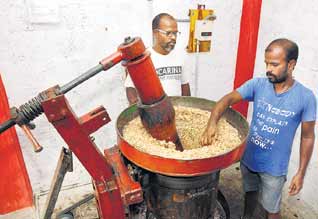
மரத்தாலான செக்கை பயன்படுத்தி, பாரம்பரிய முறையில் எண்ணெய் தயாரித்து, விற்பனை செய்கின்றனர், திருச்சியைச் சேர்ந்த சகோதரர்கள் இருவர்.
திருச்சி, தாராநல்லூர், எஸ்.வி.ஆர்., கார்டன் பகுதியில், ஆஸ்பெஸ்டாஸ் கூரை வேயப்பட்ட சிறிய கட்டடத்தில், மரத்தினாலான செக்கு வைத்துள்ளனர், எஸ்.அகஸ்டின் ராஜா மற்றும் எஸ்.ஜான்பால் ராஜிவ்.
பட்டதாரிகளான இவர்கள், சமையல் எண்ணெய் கலப்படம் தொடர்பான செய்திகளை படித்து, ஆரோக்கியத்துக்கு கேடு விளைவிக்காத சமையல் எண்ணெயை நாமே உற்பத்தி செய்வோம் என, முடிவெடுத்துள்ளனர். இதையடுத்து, சிறிய கட்டடத்தில் மரச்செக்கு அமைத்து, எள், தேங்காய் மற்றும் கடலையை செக்கில் தனித் தனியே ஆட்டிப் பிழிந்து, எண்ணெய் எடுத்து, வியாபாரம் செய்து வருகின்றனர்.
சந்தையில் விற்பனையாகும், பிற சமையல் எண்ணெய்களின் விலையை விட, இதன் விலை கூடுதலாக இருந்தாலும், வாடிக்கையாளர்கள் மத்தியில், நல்ல வரவேற்பு கிடைத்துள்ளது.
இதுகுறித்து அகஸ்டின் ராஜா கூறுகையில், ‘நம் முன்னோர் செக்கில் பிழிந்தெடுக்கும் எண்ணெயை, அப்படியே பயன்படுத்தினர். உடற்பயிற்சி முடிந்ததும், ஒரு கிண்ணம் நல்ல எண்ணெய் குடிக்கும் வழக்கத்தையும் கடைப்பிடித்தனர். உணவுக்கு மட்டுமின்றி, குளியலுக்கும், மசாஜ் செய்யவும் நல்லெண்ணெய் பயன்படுத்தியதால், மூட்டுவலி பிரச்னையின்றி வாழ்ந்தனர். அதனாலேயே, எள் எண்ணெய் என்பதற்கு பதிலாக, நல்ல எண்ணெய் என்று குறிப்பிட்டனர்.
‘அதனால் தான், நாங்களும் பாரம்பரியத்தை காக்கும் வகையில், மரத்தாலான செக்கு அமைக்க முடிவு செய்தோம். வேம்பு மரத்தில் உலக்கையும், வாகை மரத்தில் உரலும் கொண்ட செக்கு அமைத்து, மின்மோட்டார் உதவியுடன், செக்கை இயக்குகிறோம்.
‘முதலீட்டுக்கு ஏற்ப, சொற்ப லாபத்தில், விற்பனை செய்கிறோம். இயந்திரத்தில் எண்ணெய் பிழியும் போது, அது மூலப்பொருளை நன்றாகப் பிழிந்து விடுவதால், அதில் கிடைக்கும் புண்ணாக்கில், உயிர்ச் சத்துகள் மிஞ்சாது. ஆனால், மரச்செக்கில், மெதுவாக எண்ணெய் பிழிவதால், 80 சதவீதம் மட்டுமே எண்ணெய் கிடைக்கிறது. இதனால், பிழிந்தெடுக்கப்படும் எண்ணெய் அடர்த்தியாகவும், நிறமாகவும், மணமாகவும் இருக்கும். மேலும், அதில் உடல் ஆரோக்கியத்துக்கு தேவையான ஊட்டச்சத்துகளும் அதிகமிருக்கும். இதில் கிடைக்கும் புண்ணாக்கிலும், உயிர்ச்சத்துகள் எஞ்சியுள்ளதால், அதை உண்ணும் கால்நடைகளுக்கும் ஆரோக்கியத்தைக் கொடுக்கிறது.
‘மரத்தாலான செக்கை பயன்படுத்தி, எண்ணெய் ஆட்டும் முறை குறித்து, இலவசமாக கற்றுத் தருகிறோம்…’ என்றார்.
சகோதரர்கள் இருவரின் உடலிருந்தும் வழிவது வியர்வையா, எண்ணெயா என்று தெரியாத அளவிற்கு, கடுமையாக உழைக்கும் இவர்களது உழைப்பிற்கு பின் இருக்கும் லட்சியமும், சமூக அக்கறையும், இவர்களை நிச்சயம் உயர்ந்த இடத்திற்கு கொண்டு செல்லும்!
இவர்களை வாழ்த்த நினைத்தால், தொடர்பு கொள்ள வேண்டிய எண்: 96777 90080.

Source….
எல்.முருகராஜ்  in http://www.dinamalar.com

natarajan