Natarajan
Source…https://www.gsb.stanford.edu/
The passage of time can make even the most steadfast of facts to no longer be true. For instance, it was once believed that doctors didn’t need to wash their hands before surgery, but it’s now known that doing so is imperative in order to prevent infection. Take a look at 8 supposed facts that aren’t really true:
1. THEN: America won its independence on July 4, 1776.
NOW: America didn’t officially gain independence until 1783.
2. THEN: George Washington’s teeth were made of wood.
NOW: His teeth were actually human teeth from his slaves. Some were made from ivory.
A set of dentures worn by George Washington are kept at the Mount Vernon plantation house museum. They’re fashioned out of ivory and human teeth, with the human teeth being purchased from slaves that sold them to dentists to make some money in the 18th Century. Apparently Washington paid just one-third of the going rate for the teeth. It’s likely that Washington had his dentures implanted into his jaw.
3. THEN: Pluto is a planet.
NOW: Pluto isn’t a planet.
4. THEN: Diamond is the hardest substance.
NOW: Ultra-hard nano-twinned cubic boron nitride is the hardest substance.
It’s been known that there are two substances that are harder than diamond since 2009. These substances, known as wurtzite boron nitride and lonsdaleite, are 18% and 58% better at resisting indentation than diamond respectively. The only problem is that they’re both quite unstable and rare elements. Yet another substance that’s even harder than the aforementioned two was discovered by researchers in 2013. Called ultra-hard nano-twinned cubic boron nitride, it essentially consists of boron nitride particles that have been reorganized into the shape of a layered onion
5. THEN: Witches in Salem were burned at the stake.
NOW: They were actually hanged.
The notorious Salem Witch Trials are widely believed to have involved suspected witches being burned at the stake, but it never actually happened – they were hanged instead. When the Trials were taking place, the US state of New England still followed English law, which dictated that witchcraft was punishable by hanging as opposed to burning at the stake. The confusion arises from the European church calling witchcraft heresy, an offense which was punishable by burning at the stake.
6. THEN: Israelite slaves built the pyramids.
NOW: Egyptian workers built the pyramids themselves.
7. THEN: Folding a piece of paper more than seven times is mathematically impossible.
NOW: The record stands at 13 folds.
8. THEN: The Great Wall of China is the only man-made structure visible from space.
NOW: Many man-made places are actually visible from space.
This so-called “fact” gets regurgitated to third-graders the world over, but there’s actually nothing factual about it at all. In 2003, a Chinese astronaut shattered the myth by confirming that the Great Wall of China wasn’t actually visible from space. In contrast, the lights of large cities, major roadways, bridges, and airports can be seen from space.
Source….www.ba-bamail.com
Natarajan
For nearly thirty years until the end of the Cold War, Berlin lay divided both physically and ideologically by the infamous Berlin Wall that snaked through the now united German capital. The wall was erected mainly to prevent East Germans from defecting to the West. Citizens from East Germany were strictly forbidden to travel to the other side. West Germans and citizens of other countries, however, could visit East Germany after applying for a visa.
The 155-km long wall had nine border crossings that allowed visitors from the West, Allied personnel, foreigners etc. into the Soviet controlled East Berlin. The most famous of this crossings was the checkpoint at the corner of Friedrichstraße and Zimmerstraße, named Checkpoint Charlie.
The name Charlie comes from the letter C in the NATO phonetic alphabet—Alpha, Bravo, Charlie and so on. Similarly, the border crossing at Helmstedt-Marienborn was nicknamed Checkpoint Alpha, and the one at Dreilinden-Drewitz was called Checkpoint Bravo. Checkpoint Charlie was the third opened by the Allies around Berlin.
Checkpoint Charlie became the most famous crossing point between East and West Germany, and it was the only gateway through which Allied diplomats, military personnel and foreign tourists could pass into Berlin’s Soviet sector. Despite its importance, the Allies did not try to erect any permanent buildings here. A small wooden shed with a couple of sandbags was all that stood. Although this was replaced by a larger metal building in the 1980s, the Allies kept their operations deliberately simple as a way of symbolizing their view that the Berlin Wall was not a legitimate border. Things were different on the East German side of the checkpoint, with guard towers, cement barriers and a shed where departing vehicles and their occupants were meticulously searched for potential fugitives.
Checkpoint Charlie was the most visible checkpoint on the Berlin Wall. A small café opened right on the checkpoint became very popular among Allied officials, armed forces and foreigners alike because it provided an excellent viewing point to look into East Berlin while having something to eat and drink.
Checkpoint Charlie also attracted many desperate East Germans looking to flee to the West. In its early years, the checkpoint was blocked only by a gate and one escapee smashed a car through the flimsy barrier. Another escapee simply sped underneath the checkpoint’s vehicle barrier after removing his convertible’s windshield to lower the car’s height. In another famous but unsuccessful attempt, a teenager named Peter Fechter was shot to death by East German guards when he tried to escape to the other side. As he bled to death, his body tangled on the barbed wire, the American soldiers could only watch. Checkpoint Charlie was also the site of the famous tank confrontation in October 1961 when American and Soviet tanks took up position on either side of the gate.
After the Berlin Wall came down and the East and West were united, the guardhouse was removed and is now on display in the open-air museum of the Allied Museum in Berlin-Zehlendorf. A replica of the guardhouse complete with actors dressed in military uniform and posing as Allied guards now stand where the original checkpoint once stood. Today, it is one of Berlin’s primary tourist attractions.
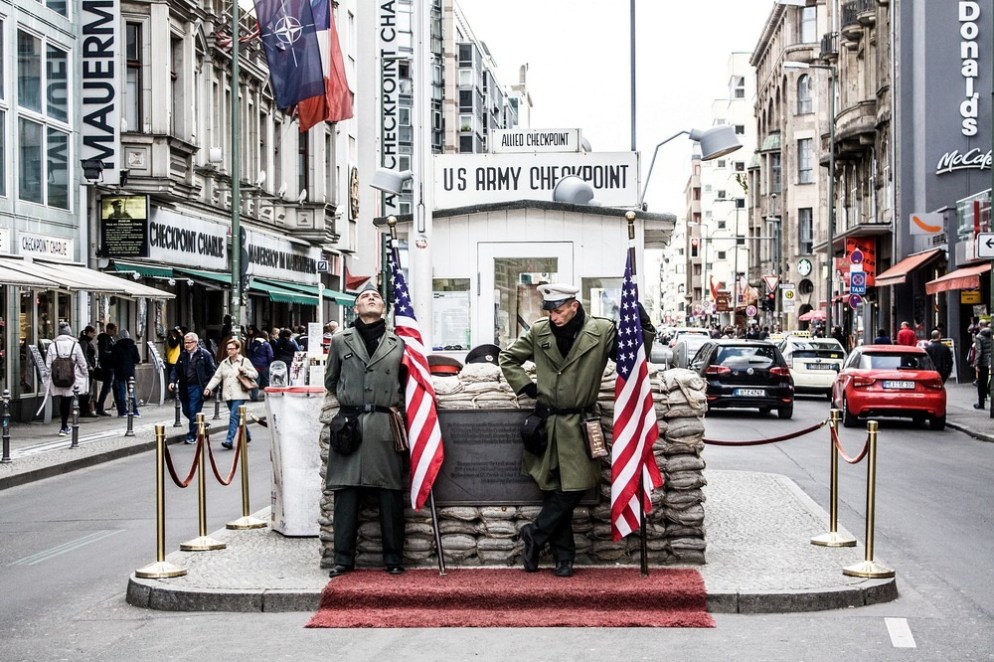
Two actors dressed as Cold War circa American guards stand at a replica of Checkpoint Charlie in Berlin. Photo credit: Shadowgate/Flickr
Source : Kaushik in www. amusingplanet.com
Natarajan
The Bermuda Triangle is a large area of ocean between Florida, Puerto Rico, and Bermuda. Over the last few centuries, it’s thought that dozens of ships and planes have disappeared under mysterious circumstances in the area, earning it the nickname “The Devil’s Triangle.” People have even gone so far as to speculate that it’s an area of extra-terrestrial activity or that there is some bizarre natural scientific cause for the region to be hazardous; but most likely, it’s simply an area in which people have experienced a lot of bad luck—the idea of it being a “vortex of doom” is no more real than Bigfoot or the Loch Ness Monster (see The Origin of the Bigfoot Legend and The Origin of the Loch Ness Monster).
The Bermuda Triangle’s bad reputation started with Christopher Columbus. According to his log, on October 8, 1492, Columbus looked down at his compass and noticed that it was giving weird readings. He didn’t alert his crew at first, because having a compass that didn’t point to magnetic north may have sent the already on edge crew into a panic. This was probably a good decision considering three days later when Columbus simply spotted a strange light, the crew threatened to return to Spain.
This and other reported compass issues in the region gave rise to the myth that compasses will all be off in the Triangle, which isn’t correct, or at least is an exaggeration of what is actually happening as you’ll see. Despite this, in 1970 the U.S. Coast Guard, attempting to explain the reasons for disappearances in the Triangle, stated:
First, the “Devil’s Triangle” is one of the two places on earth that a magnetic compass does point towards true north. Normally it points toward magnetic north. The difference between the two is known as compass variation. The amount of variation changes by as much as 20 degrees as one circumnavigates the earth. If this compass variation or error is not compensated for, a navigator could find himself far off course and in deep trouble.
Of course, despite this now being repeated as an explanation for disappearances in the Triangle on numerous documentaries and articles since then, it turns out magnetic variation is something ship captains (and other explorers) have known about and had to deal with pretty much as long as there have been ships and compasses. Dealing with magnetic declination is really just “Navigation by Compass” 101 and nothing to be concerned about, nor anything that would seriously throw off any experienced navigator.
n 2005, the Coast Guard revisited the issue after a TV producer in London inquired about it for a program he was working on. In this case, they correctly changed their tune about the magnetic field bit stating,
Many explanations have cited unusual magnetic properties within the boundaries of the Triangle. Although the world’s magnetic fields are in constant flux, the “Bermuda Triangle” has remained relatively undisturbed. It is true that some exceptional magnetic values have been reported within the Triangle, but none to make the Triangle more unusual than any other place on Earth.
The modern Bermuda Triangle legend didn’t get started until 1950 when an article written by Edward Van Winkle Jones was published by the Associated Press. Jones reported several incidences of disappearing ships and planes in the Bermuda Triangle, including five US Navy torpedo bombers that vanished on December 5, 1945, and the commercial airliners “Star Tiger” and “Star Ariel” which disappeared on January 30, 1948 and January 17, 1949 respectively. All told, about 135 individuals were unaccounted for, and they all went missing around the Bermuda Triangle. As Jones said, “they were swallowed without a trace.”
It was a 1955 book, The Case for the UFO, by M. K. Jessup that started pointing fingers at alien life forms. After all, no bodies or wreckage had yet been discovered. By 1964, Vincent H. Gaddis—who coined the term “Bermuda Triangle”—wrote an article saying over 1000 lives had been claimed by the area. He also agreed that it was a “pattern of strange events.” The Bermuda Triangle obsession hit its peak in the early 1970s with the publication of several paperback books about the topic, including the bestseller by Charles Berlitz, The Bermuda Triangle.
However, critic Larry Kusche, who published The Bermuda Triangle Mystery: Solved in 1975, argued that other authors had exaggerated their numbers and hadn’t done any proper research. They presented some disappearance cases as “mysteries” when they weren’t mysteries at all, and some reported cases hadn’t even happened within the Bermuda Triangle.
After extensively researching the issue, Kusche concluded that the number of disappearances that occurred within the Bermuda Triangle wasn’t actually greater than in any other similarly trafficked area of the ocean, and that other writers presented misinformation—such as not reporting storms that occurred on the same day as disappearances, and sometimes even making it seem as though the conditions had been calm for the purposes of creating a sensational story. In short: previous Bermuda Triangle authors didn’t do their research and either knowingly or unintentionally “made it up.”
The book did such a thorough job of debunking the myth that it effectively ended most of the Bermuda Triangle hype. When authors like Berlitz and others were unable to refute Kusche’s findings, even the most steadfast of believers had difficulty remaining confident in the sensationalized Bermuda Triangle narrative. Nevertheless, many magazine articles, TV shows, and movies have continued to feature the Bermuda Triangle.
Because the number of disappearances in the Bermuda Triangle is no greater than any other similarly trafficked area of the world’s oceans, they don’t really need an explanation. But if you’re still convinced that the Triangle is a ship graveyard, relative to other regions that get around the same number of travelers, here are some natural explanations from the Coast Guard to combat some of the “alien” and other fantastical theories.
The majority of disappearances can be attributed to the area’s unique features. The Gulf Stream, a warm ocean current flowing from the Gulf of Mexico around the Florida Straits northeastward toward Europe, is extremely swift and turbulent. It can quickly erase any evidence of a disaster.
The unpredictable Caribbean-Atlantic storms that give birth to waves of great size as well as waterspouts often spell disaster for pilots and mariners. (Not to mention that the area is in “hurricane alley.”) The topography of the ocean floor varies from extensive shoals to some of the deepest marine trenches in the world. With the interaction of strong currents over reefs, the topography is in a constant state of flux and breeds development of new navigational hazards.
Not to be underestimated is the human factor. A large number of pleasure boats travel the water between Florida’s Gold Coast (the most densely populated area in the world) and the Bahamas. All to often, crossings are attempted with too small a boat, insufficient knowledge of the area’s hazards and lack of good seamanship.
Source…www.today i foundout.com
Natarajan
The ancient Kingdom of Axum, now a part of Ethiopia, was one of the first nations in the world to adopt Christianity. The religion took strong foothold in 330 AD when King Ezana the Great declared it the state religion and ordered the construction of the imposing basilica of St. Mary of Tsion. Legend has it, that it here that Menelik, son of King Solomon and the Queen of Sheba, brought the Ark of the Covenant containing the Ten Commandments.
By the fifth century, nine saints from Syria, Constantinople and elsewhere had begun spreading the faith far beyond the caravan routes and deep into the mountainous countryside. These missionaries played a key role in the initial growth of Christianity in Ethiopia. The monks translated the Bible and other religious texts from Greek into Ethiopic allowing the locals who couldn’t read Greek to learn about Christianity. The religion’s mystical aspects found a curious draw among the young. As Christianity grew, a series of spectacular churches and monasteries were built high atop mountains or excavated out of solid rock, many of which are still in use today. 
A priest is seen looking out of Abuna Yemata church’s only window. The church is located on aside of a cliff, 650 feet up from the floor of the valley. This image is from a recently published book “Ethiopia: The Living Churches of an Ancient Kingdom.”
These ancient churches were often built in the most impossible of places. A good example is the Abuna Yemata Guh in Tigray, in Northern Ethiopia. This 5th century church is perched 650 feet up in the sky, on the face of a vertical spire of rock. To reach it, one has to climb without any climbing ropes or harnesses, inching along narrow ledges and crossing a rickety makeshift bridge. The final leg of the journey involves scaling a sheer 19 feet-high wall of rock. The church was founded by Abuna Yemata, one of the nine saints, who chose the secluded spot as his hermitage.
Photo credit: Andrea Moroni/Flickr
Source….Kaushik in http://www.amusing planet.com
Natarajan




 Take off with Natarajan