French Toast is Not From France !!!


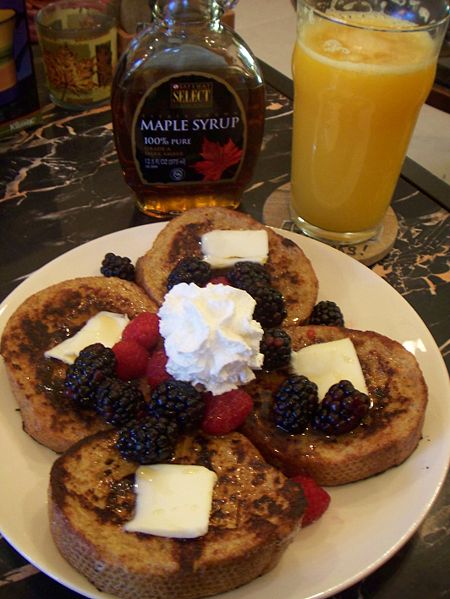
Myth: French toast was invented in France. 

French toast was not invented in France. In fact, French toast was around long before France even existed as a country. The exact origins of French toast are unknown, but it isn’t surprising that humans seem to have come up with the recipe quickly, given that French toast is traditionally made out of stale bread. Bread has been a staple food for most cultures since food first began being prepared and, up until very recently, the vast majority of humans would have never dreamed of wasting any food; thus, one has to find a way to make stale bread palatable. Soaking it in milk and egg and then cooking it, seems logical enough, making a good tasty meal while not wasting any bread.

The earliest reference to doing just this dates all the way back to 4th century Rome, in a cookbook attributed to Apicius, and it is thought to predate this work by a good margin. This style of “French” toast was called Pan Dulcis. The Romans would take the bread and soak it in a milk and egg mixture, and then cook it, typically frying it in oil or butter, pretty much just like it’s made today in many countries in the world.

This practice became common throughout Europe in the Middle Ages, including making it primarily out of stale bread. Indeed, the name for French toast in France itself is “pain perdu”, which literally means “lost bread” (it is also called this in Belgium, New Orleans, Acadiana, Newfoundland, and the Congo, among other places). It’s interesting to note, for the naysayers who like to cling to the belief that it came from France, that before the French called it pain perdu, they called it “pain a la Romaine” (Roman bread).

Another popular myth as to the origins of the name “French toast”, perpetuated in such publications asWhy Do Donuts Have Holes, is that French toast actually came from America, specifically, being created in 1724. The name “French” came from the chef who first made it, Joseph French. Supposedly, Mr. French was bad at grammar and when he named it, simply forgot the apostrophe, as in: Frenchs toast, instead of French’s toast. Alas, if only the Grammar Nazis of the day would have correct him.

This story, of course, is pure fiction as there are numerous references throughout history of what is now called, in North America, French toast. Indeed, there are numerous cookbooks from the middle ages throughout Europe that even give the classical recipes for French toast. Further, the name “French toast” pre-dates the 18th century, with the earliest references popping up in the mid-17th century, before the story of the grammatically inept Joesph French. Before that time, it was also known as German toast, Spanish toast, and a variety of other names, only some of which had anything to do with the name of a country.

North Americans call it French toast for very similar reasons as to why they call fried potato strips “French fries”. Simply that they were popularized in America by French immigrants. Note: for more on the fascinating history of the French Fry, check out Misconception Junction’s companion site Today I Found OutThe History of French Fries

source::::today i found out .com

natarajan

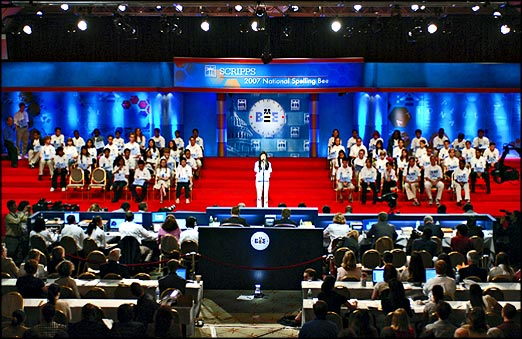
What the ” Bee” in “Spelling Bee” Means ….

Today I found out what the “bee” in “spelling bee” means.


While no one knows exactly where the word derives from, the “bee” in “spelling bee” simply means something to the effect of “gathering” or “get together”.  The earliest documented case of this word appearing with this meaning was in 1769, referring to a “spinning bee”, where people would gather to protest purchasing goods from Britain due to the high taxes on those items.

Other gatherings that were commonly labeled with “bee” were: apple bee, logging bee, quilting bee, barn bee, hanging bee, sewing bee, field bee, and corn husking bee, among others.  Basically, any sort of major competition or work gathering, with a specific task in mind tended to get the “bee” label added on the end.  With many of these bees being tedious work events, it was also customary to serve refreshments and provide entertainment at the end of the task.

The first documented case of a spelling bee called such was in 1825.  However, it is likely that there were spelling bees before this date.  This was simply the first time someone seems to have written down in print that has survived to today “spelling bee”.

There are a variety of theories as to where this word derives from.  It was long thought that it simply came from the similarity between insect bees working together towards a specific task and a gathering of people to accomplish some task.  However, this etymology has no specific documented evidence to support it; rather, simply stems from making a logical leap.

The popular theory among etymologists today is that it is more likely that the actual origin of “bee”, in the sense of “gathering”, derives from the Old English bēn (prayer / favor).  This, in turn, gave rise to the Middle English “bene”, which had more or less the same meaning as bēn except now adding “an extra service by a tenant to his lord”.  Finally, this resulted in “bean” meaning “help given by neighbors”.  The British dialectic version of this word is then “bee”. 

source:::: today i foundout .com 

natarajan

What is Greater Than God ? !!!…

The Riddle That 80% of Kindergartners Answered Correctly, but Only 17% of Stanford Seniors Got Right-Fiction!

e rumor…
A simple riddle with a simple answer that was allegedly reported on Paul Harvey…and that Kindergartners answered more correctly than university seniors.

The Truth
The riddle has been around for a long time, but there is no evidence that research was ever conducted on the comparative answers of Kindergartners and Stanford University seniors.
There is also no evidence that this was reported on Paul Harvey.

The riddle:
What is greater than God, More evil than the devil, The poor have it,
The rich don’t need it, And if you eat it, you’ll die?

The answer to the riddle is “nothing.”
Nothing is greater than God.
Nothing is more evil than the Devil.
The poor have nothing.
The rich need nothing.
And if you eat nothing, you’ll die.

A real example of the eRumor as it has appeared on the Internet:

Paul Harvey RIDDLE:

When asked this riddle, 80% of kindergarten kids got the answer,
compared to 17% of Stanford University seniors.
What is greater than God, More evil than the devil, The poor have it,
The rich need it, And if you eat it, you’ll die?


source ::::truth or fiction.com

natarajan

” Geek ” Named ” Word of 2013″ ….

The word geek, once used as a slurto describe a person with unfashionable interests or a social misfit, has now been declared the ‘word of the year’ by the Collins online dictionary.

The dictionary has also changed the definition of geek to “a person who is very knowledgeable and enthusiastic about a specific subject.”

Collins has already added ‘geekery’, ‘geek chic’ and ‘geekdom’ to the dictionary’s fold.

While ‘geek chic’ refers to a fashion style believed to be characteristic of geeks, ‘geekery’ means preoccupation with, or great knowledge about, a subject, according to the the dictionary.

“For those of us born into a pre-internet world ‘geek’ meant ‘a boring and unattractive social misfit – who tends to smell slightly gamey at close quarters,” the dictionary said on its website.

“But times change, even if we don’t change with them and what Collins first included as a secondary definition in 2003 – ‘A person who is preoccupied with or very knowledgeable about computing’ – has long since overtaken the original.

“Now the meaning has changed again and the new definition will read ‘a person who is knowledgeable and enthusiastic about a specific subject’,” Collins said on its website.

Last month, Oxford Dictionaries named selfie – “a photograph that one has taken of oneself, typically one taken with a smartphone or webcam and uploaded to a social media website” as the word of the year.

Geek has seen an interesting transformation in meaning over the last couple of decades.

According to Oxford Dictionaries, the word used to be a cruel and critical label attached to clever, but socially awkward, people – such as computer or science geeks.

However, in the 1990s, the computer industry helped many geeks to achieve great success, and the wider perception of geeks began to shift.
Source:  silicon india net

natarajan

Message For the Day…” Learn From Animals ,Birds &Insects ….”

Man can learn any number of good qualities from animals, birds, insects and worms. The animal, donkey is viewed with contempt. But the quality of patience to be found in a donkey is not found even in man. Whatever burdens may be heaped on its back, it bears them all with forbearance. Even when it is starved of food and water, it presents a calm face. Man has thus to learn the quality of forbearance from the donkey. The ant is one of the tiniest among insects. But the ant has a capacity for foresight; with foreknowledge of the rainy season ahead, it starts storing food from three months in advance. Then, there is the spider – Determination is one of its traits. How many times its web may be destroyed or broken, the spider will go on remaking it with relentless determination.


Sathya Sai Baba

Message For the Day…”Education Should also Purify Heart”…

True education means trying to manifest the inner divinity in man. How is this manifestation to be brought about? Students must receive education that illumines every aspect of life – the economic, the political, the moral, the spiritual and the physical, the mental and the social environment of man. It should not be confined to one specific sphere. Many students consider book knowledge as education. This gives them only superficial knowledge. They need practical knowledge which will enable them to lead righteous lives. Education should also result in the purification of the heart. Men and women must be taught to be sincere in thought, word and deed, as a mark of humanness. Students must also revere their parents at all times and promote the cause of social improvement. They must co-operate with all fellow-beings. These are the things all students should learn.

Sathya Sai Baba

In Homage to Uthradom Thirunal Marthanda Varma …


Uthradom Tirunal Marthanda Varma

Uthradom Tirunal Marthanda Varma

Kerala lost one of the last links with its royal past with the passing away of Uthradom Tirunal Marthanda Varma, head of the royal family of erstwhile Travancore, in the early hours of Monday.  16 Dec.2013.  . Mr. Varma, a witness to the transformation from imperial rule to a democratic polity, was a common presence in the social and cultural scene of the city.

He had stood guard over the age-old traditions, rites and rituals of Sree Padmanabhaswamy Temple ever since 1991, when he was anointed the trustee and “dasa” of the temple following the death of his elder brother and last sovereign of Travancore, Sree Chithira Tirunal Balarama Varma. Mr. Varma, born as the younger son of Maharani Sethuparvathi Bayi and Ravi Varma Koyi Thampuran on March 22, 1922, was educated in the Kowdiar Palace by a group of 14 tutors in various subjects. He later graduated from the then Travancore University with Economics, Politics and History as specialisations in 1943. He was the recipient of the Moncombu Aandi Iyer Gold Medal for the best student in Sanskrit.


source :::::Mahesh Krishnamurthy  in Sage of Kanchi Blog and Youtube and The Hindu

natarajan