World’s Eco-Friendliest Country, Bhutan, Celebrates Birth Of New Prince By Planting 108,000 trees…

How does Bhutan, the world’s most eco-friendly and carbon-negative country, celebrate the recent birth of its new prince? By planting trees of course. Lots and lots of trees.

108,000 saplings were planted in the tiny mountain Kingdom to commemorate the first Royal Child of His Majesty King Jigme Khesar Namgyel Wangchuck and Her Majesty Queen Jetsun Pema.

The Bhutanese constitution stipulates that at least 60 percent of land remains forested at all times, but this green-fingered celebration wasn’t just inspired by the country’s commitment to ecological preservation.

“In Buddhism, a tree is the provider and nourisher of all life forms,’ said Tenzin Lekphell, who coordinated the initiative. ‘It symbolizes longevity, health, beauty and even compassion.”

This isn’t the first time that Bhutan has made headlines for its epic tree-planting sessions. In 2015, the country set a Guinness World Record by planting almost 50,000 trees in just one hour. Which is proof, if ever you needed it, that while Bhutan might be small in size, it’s definitely big when it comes to awesomeness.

(h/t: treehugger)

bhutan-prince-plants-trees-jetsun-pema-10

bhutan-prince-plants-trees-jetsun-pema-6

bhutan-prince-plants-trees-jetsun-pema-7

bhutan-prince-plants-trees-jetsun-pema-1

bhutan-prince-plants-trees-jetsun-pema-11

bhutan-prince-plants-trees-jetsun-pema-9

bhutan-prince-plants-trees-jetsun-pema-8

Source…….www.boredpanda.com

Natarajan

An Oxford professor has won £500,000 for solving a 300-year-old mathematical mystery…!!!

Oxford University professor Sir Andrew Wiles has been awarded the prestigious Abel Prize for his “stunning proof” of Fermat’s Last Theorem.

Wiles life has been dedicated to the three-century-old theorem which has been his “passion from an early age” after he read “The Last Problem” by ET Bell.

His proof was first published in 1994 while working at Princeton University in New Jersey — he will collect the award 22 years later at a ceremony in Oslo in May.

The theorem, created in 1637 by French mathematician Pierre de Fermant, says that there are no solutions in integers — or whole numbers — to the equation  xn + yn = zn when n is greater than 2.


Wiles’ work isn’t merely a solution to the theory, his findings have shaped mathematics and the entire approach to the field, and were originally submitted as a 200-page file.

The Abel Prize is awarded by the Norwegian Academy of Sciences and Letters and is widely regarded as the most prestigious award in its field. As well as a trophy, winners of the award also take home six million Norwegian Krone (£500,000, $700,000).

When asked what it feels like to solve a puzzle that has mystified mathematicians for centuries, he said: “It’s thrilling. It’s the experience we live for, this insight, that suddenly you see everything clearly before you that’s been so obscure and so frustrating for so long.”

andrew wiles

The Norwegian academy lauded the professor’s groundbreaking work, saying: “Wiles’ proof was not only the high point of his career — and an epochal moment for mathematics — but also the culmination of a remarkable personal journey that began three decades earlier.”

This isn’t the first time Wiles has been recognised for his contributions to mathematics. He was knighted in 2000, and also won the US National Academy of Science’s Award in Mathematics, the Wolf Prize, and the Royal Medal of the Royal Society.

The Abel Prize was created in honour of Niels Henrik Abel, a Norwegian mathematician who died in 1829. It was created in 2001 and first awarded a year later. Previous winners include economist John F Nash Jr, who was the subject of the film “A Beautiful Mind,” and Sir Michael Atiyah for his work on the Atiyah-Singer theorem.

Source…… Charles Clark in http://www.businessinsider.com

Natarajan

Message for the Day…” To meditate on God, there is no fixed time , or place…”

There are no limitations of time or space for the establishment of oneself in the contemplation of the Omnipresent Lord. For this, there is nothing like a holy place or a special time. Wherever the mind revels in contemplation of the Divine that is the holy place! Whenever it does so, that is the auspicious moment! Then and there, one must meditate on the Lord. Hence scriptures reveal, ‘To meditate on God, there is no fixed time or place. When and where the mind so desires, then and there is the time and place!’ (Na kaala niyamo yathra, na deshasya sthalasya cha Yathrasya ramathe chittham, thathra dhyanena kevalam.) The world can achieve prosperity through disciplined souls whose hearts are pure and who represent the salt of the earth. To promote the welfare of the world, from this very minute, everyone should pray for the advent of such holy personages, and deserve the blessings of the great, and forget the sufferings of your daily living.

Sathya Sai Baba

Butcher’s Broom: Can Fruits Grow on Leaves…….?

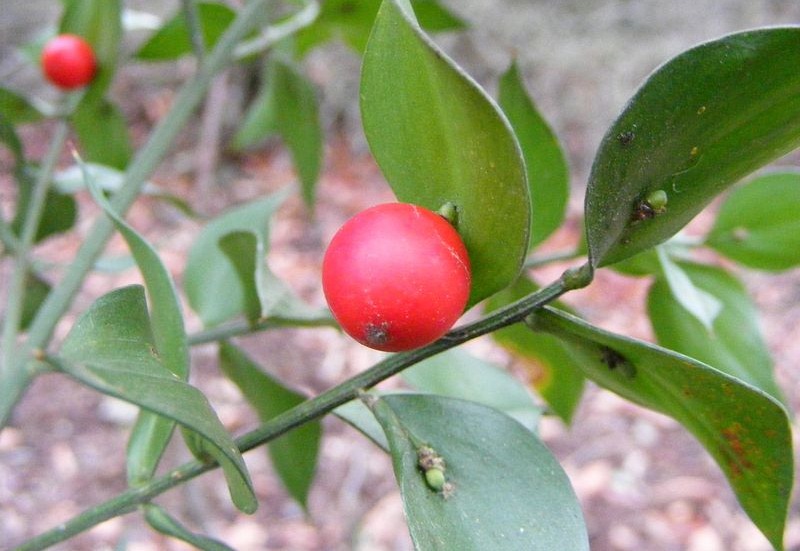
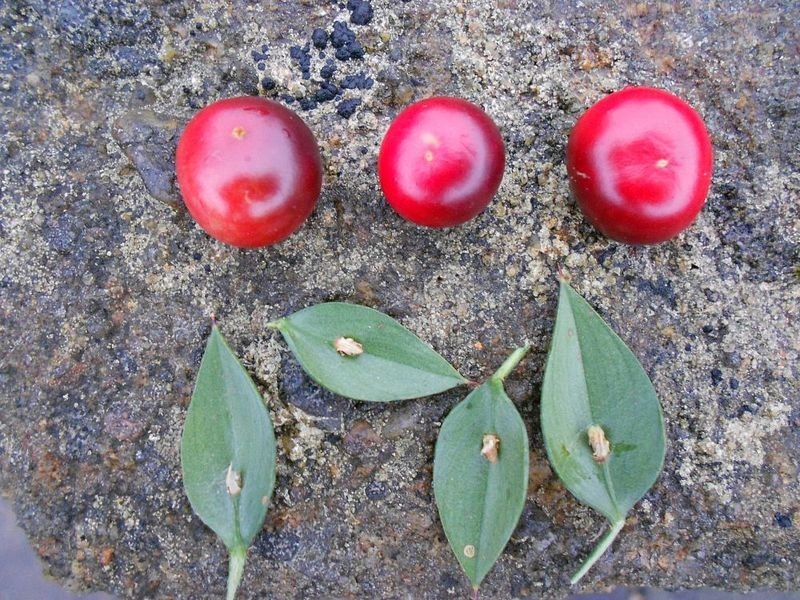
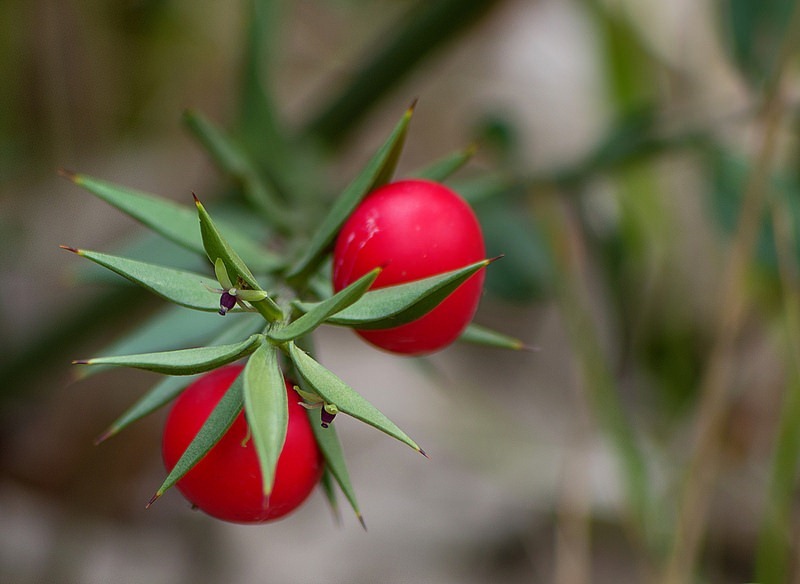
Butcher’s Broom, or Ruscus aculeatus, is a low-growing perennial shrub with tough, erect, stems and very rigid leaves that terminate in a sharp spine. From the center of the leaves grow small greenish-white flowers that blossom in early spring and develop into red berries in autumn. The tiny red berries are attached directly to the leaves by a short stem, making it a very strange looking plant.

The Butcher’s broom, however, is not breaking any rules of the plant kingdom, because what appears to be leaves are actually modified stems called cladodes, that have been flattened to not only look like leaves but serve their function as well.

ruscus-aculeatus-1

Photo credit: Gil Costa/Flickr


Butcher’s broom is widely distributed, from Iran to the Mediterranean and the southern United States. They have been used for more than 2,000 years as laxative and diuretic and to treat various ailments such as hemorrhoids, varicose veins, itching, and swelling. The young shoots of the plant are also eaten like those of asparagus. The stiff twigs were once bundled together and used by butchers to keep their cutting boards clean, from which came its common English name: butcher’s broom. It is also known by others names such as “Knee Holly”, because of its knee height, “Jew’s Myrtle”, for its use during the Feast of Tabernacles, “Sweet Broom” and “Pettigree”, although its meaning is not clear.

Extracts of butcher’s broom have been used throughout the ages, but the medicinal use of this plant did not become common until the last century. Investigation in the 1950s indicated that butcher’s broom could induce constriction of veins, because of which it is still widely used for treating certain circulatory diseases. It also contains an alkaloid which inhibits the passing of sodium ions across the cell membrane and thus is an effective anti-arrhythmic substance.

Butcher’s broom is also widely planted in gardens and its berries used as decorations.

ruscus-aculeatus-2

Photo credit: www.herbco.com

ruscus-aculeatus-3

Photo credit: stories.rbge.org.uk

ruscus-aculeatus-4

Photo credit: herbier.sesa-aude.fr

ruscus-aculeatus-6

Photo credit: Franz Xaver/Wikimedia

ruscus-aculeatus-7

Photo credit: Hans Hillewaert/Flickr

ruscus-aculeatus-8

Photo credit: Katya/Flickr

Sources: Drugs.com / Botanical.com / Plant World Seeds via mantisshrimp.wordpress.com

Source….www.amusingplanet.com

Natarajan

Soon, Eat Meat Without Killing Animals for It, Thanks to This Indian-American Scientist & His Team !!!

Memphis Meats Inc., a San Francisco-based company founded by three scientists, has developed a new technique to produce meat from stem cells of animals. Uma S Valeti, an Indian-American cardiologist, is the CEO and one of the co-founders of Memphis Meats.

By bringing meat production into the lab, this team can soon make it possible for people to eat meat without actually killing animals.

memphis1

Source: YouTube

According Uma Valeti, the meat is sustainable, healthier, safer, and cruelty free. It does not lead to any side effects like bacterial contamination or high saturated fat. Additionally, the technique produces 90 percent less greenhouse emissions and does not require antibiotics as used in traditional meat production.

For the production, the team identifies cells that are capable of renewing themselves, from a targeted animal. These cells are then provided with oxygen and nutrients like sugar, minerals, etc. while they develop inside bio-reactor tanks into skeletal muscle and can be harvested in nine to 21 days. The team is currently working on beef, chicken and pork cells, and have already conducted test runs on beef meat.

“Our goal is to be in restaurants in three years and retail in five years. In 2021, we want to be in retail or even earlier,” Uma Valeti told PTI.

The first manufacturing base will be set up in the US and he added that they are also exploring ideas about setting centres in India and China very soon.

Cardiologist Uma Valeti is an associate professor of medicine at the University of Minnesota and president of the Twin Cities American Heart Association. Other members of the team include Nicholas Genovese, a stem cell biologist, and Will Clem, a biomedical engineer who owns a chain of barbeque restaurants in Memphis, Tennessee.

Currently, even though the source cells can be collected without killing the animals, the process starts with the help of fetal bovine serum that is drawn from the blood of unborn calves. Memphis Meats is working on replacing the serum with a plant-based alternative very soon, to completely end the practice of extracting it from animals.

“Our concept is simple. Instead of farming animals to obtain their meat, why not farm the meat directly? To that end, we’re combining decades of experience in both the culinary and scientific fields to farm real meat cells—without the animals—in a process that is healthier, safer, and more sustainable than conventional animal agriculture,” says their website.

Source…Tanaya Singh in http://www.the betterindia.com

Natarajan


The Golden Temple’s Community Kitchen Goes Organic, Grows Its Own Vegetables without Pesticides…

Visitors of the Golden Temple in Amritsar are soon to be served healthy, freshly produced organic food at the community kitchen. The management committee has made a landmark decision to adopt organic farming to grow its own grains, fruits and vegetables, free of chemicals.

A new mission undertaken by The Shiromani Gurdwara Parbandhak Committee (SGPC), they also aim to inspire farmers to take up organic farming and cut down on the use of chemical products.

The SGPC now grows its own organic vegetables and fruits on 40 acres at Gurdwara Gurusar Satlani Sahib and Patiala.

Golden Temple, Amritsar

The Golden Temple, Amritsar. Source: Wikimedia Commons.

In the first phase of its experimental model, carrots, cabbages, spinach, and fenugreek or methi seeds from this farm have been successfully grown. About 10 quintals of organic produce are sent to the gurudwara every one or two days, according to SGPC officials.

The Punjab Agro Industries Corportation Limited (PAIC) was instrumental in helping the SGPC to test its soil and suggest options for organic farming. The experts at PAIC also advise them on how to replace pesticides and the use of organic fertilisers. They’ve suggested the use of neem patta, lassi and cow urine, among others.

The langar, or community kitchen, at the Golden Temple is the world’s largest free kitchen. It is popular for serving food to everyone irrespective of caste, religion or background. The gurudwara’s community kitchen, Guru Ramdas Langar Hall, receives nearly 100,000 people. It serves 200,000 roti made of 7000 kilograms of wheat flour, 1200 kilograms of rice, and 1300 kilograms of daal. The kitchen is manned by 450 dedicated people and many volunteers.

The SGPC is the apex organisation of Sikhs that manages all the gurudwaras in Punjab, Haryana and Himachal Pradesh. After its success at the Golden Temple, the move would be replicated to other gurudwaras in the country.

Source….Neeti Vijaykumar in http://www.the betterindia.com

Natarajan

How One Man Is Making Indian Museums Fun, Interactive and Inclusive…..!!!

The dismal and decrepit state of most Indian museums is no secret. But architect and designer Abhishek Ray and his team are trying to change the experience of museum visits by creating spaces with appropriate exhibition displays, good lighting and graphics, and interactive audio visual systems that keep visitors engaged.

Antiques trafficking, damage from seepage and other maintenance issues,  lack of qualified staff – Indian museums suffer from many woes. A 2011 UNESCO report on Indian museums was also scathing in pointing out a long list of deficiencies, among them poor lighting and maintenance, incorrect signage and lax security. In 2012, a parliamentary committee report said, “Our museums are in a bad shape. Only 10% of the acquisitions are put on display and those are not even rotated regularly. Museum stores and galleries are in poor condition.”

Meet the man who is trying to address at least some of these issues. Abhishek Ray, an architect and designer, wants to make Indian museums more fun, interactive and inclusive.

“I want to change the way museums are perceived today. Museums tell a story and it should be an interesting one,” he says.

Abhishek Ray

Abhishek Ray

Abhishek is the principal architect at Matrika Design Collaborative. Over the last decade, Abhishek and his team have been working on museum development projects from their inception to their execution.  With comprehensive services – ranging from historical and art research to creating spaces using appropriate exhibition displays, lighting and graphics accentuated with interactive audio visual systems to keep visitors engaged in learning about our cultural heritage of India – the team has been changing the experience of a museum visit.

The team closely works on each museum.

The team works on providing better lighting and displays

“We noticed that museums have not changed at all since decades in India. I have no living memory of visiting museums in my childhood and today we need to engage children with our museums and cultural spaces at a very early age. We work with the government and non governmental organisations to redesign existing cultural spaces and to develop new ones in order to conserve our heritage,” he says.

Matrika Design Collaborative is now developing one of the first dedicated textile museums that showcases the history and conservation of embroidery from the western region of Kutch, Gujarat at Bhuj.

The museum is a part of the Living and Learning Design Centre for local embroiderers and craftspeople, where visitors will gain extensive understanding of the rich heritage of embroidery from the communities themselves.

Innovation, says Abhishek, comes through engaging the community in the development of the museum or cultural space.

“If we intend to showcase their culture and traditions it is imperative for us to involve them at various stages of inception. A classic example is how the LLDC museum in Kutch has been developing around documenting the lives of embroiderers by recording their oral histories, their art and lifestyles,” he says.

They convert a museum from a boring place to an interactive place.

Abhishek and his team convert a museum from a static space to an interactive one.

They also recently commissioned a small exhibition for Godrej Industries, wherein they designed a humble exhibition focused on the pioneering work carried out by Shri Ardershir Godrej in developing India’s first safe, which, till today, is one of the mainstays of the products rolled out by the industrial giant. Coupled with a trivia based display on the events around the year 1914 (the year when the first safe was fabricated in India), they put together a host of rare documents that profiled the story of safe-making at Godrej.

Overall, by using presentations, online art guides, mobile apps, and making the places more comfortable for people with special needs, Abhishek and his team are making museums both physically and intellectually inclusive.

The USP lies in the design of the museum which is also a challenge.

Their USP lies in museum design

They are currently developing a unique outreach programme, a Museum on Wheels for the Chhatrapati Shivaji Maharaj Vastu Sangrahalaya, Mumbai (formerly Prince of Wales Museum), where the self contained museum bus would travel to urban, peri-urban and rural areas of Maharashtra to spread education by means of an interactive mobile museum.

The bus is fitted with exhibition cases, audio video hardware, etc. It will cater to municipal schools, adult education camps and artists’ conclaves in rural districts of India.

From improving the look of existing locations to coming up with new museums, the team has been preserving Indian heritage in amazing ways.

From improving existing museums to coming up with new ones, the team has been preserving Indian heritage in amazing ways.

The development of the Shastra Museum (Museum on Arms and Armory of the Sikhs) in Amritsar, alongside the Toshakhana (Royal Treasury), is a project that Abhishek and his team are proud of. It holds some of the most exquisite weapons used by the Sikh armies under the leadership of Maharaja Ranjit Singh.

The narrative here builds around the development of traditional weapons and their transition to mechanised weapons and modern artillery in the late 19th Century.

“We have designed unique solutions where children are given an understanding of the science behind weapons and fortification systems, categorically ruling out their association with violence and war,” says Abhishek.

Innovation has found a new meaning through inclusion of children and people with special needs at the New Shri Pratap Singh Musuem in Srinagar, Jammu and Kashmir.

The team has dedicated a complete gallery to children’s activities. The 100,000 square feet museum is also completely accessible to people with special needs.

Abhishek is now working on coming up with more such interesting exhibition and museum ideas.

Abhishek and his team are now working on more innovative ideas.

The challenge for the future, says Abhishek, lies in demystifying the realm of heritage and culture for people at large. Implementation of unique ideas and changing mindsets of people who sit at the helm of affairs is going to be a big challenge.

“We need to redefine the experience of the cultural space by reinventing the narrative and this can be achieved when policy makers, curators, archivists, designers, and users come together in a collaborative format to work out the best ways to tell the story of our culture and heritage through tangible and intangible ways,” he concludes. 

To know more about the team’s work check out their website – www.matrika.in

Source…..Shreya Pareek in http://www.the betterindia.com

Natarajan

Message for the Day….” Contemplate on Spiritual wisdom…”

Devote your time to the service of the world, with faith in the Lord, regardless of its fruits. Then you become blessed. Otherwise, though the body may be inactive, the mind will be very busy, committing acts on its own. People with such minds fall prey to karma in spite of their not doing anything! When a person has the mind fixed on contemplation of God and the pursuit of truth, though the body and senses do acts that are of service to the world, they won’t be affected by them; though they do actions (karma), they are still non-doers of action. This is the lesson from Bhagavad Gita. The heart of the person who doesn’t strive to cultivate the mind with holy thoughts is certain to be the paradise of evil and wickedness. Everyone who hopes to rise to greatness, seeks one-pointedness and aspires for salvation, must bear this in mind. Spiritual wisdom alone is the cause of liberation.

Sathya Sai Baba

Image of the Day… Total solar eclipse of March 9 2016 …

View larger. | March 9, 2016, total solar eclipse from Palu, Indonesia.  Photo by Justin Ng of Singapore.

View larger. | March 9, 2016, total solar eclipse from Palu, Indonesia. Photo by Justin Ng of Singapore, who wrote: “Sun’s corona extends millions of kilometers into space and it is visible to the unaided eye during a total solar eclipse. During totality, temperature at my location dropped by 10 to 15 degrees Celsius and I was able to see planet Venus and Mercury when the area became dark. I took 12 different exposures during totality to cover as much dynamic range as possible and stacked them in Photoshop to produce this image.”

Source…..www.earthsky.org

Natarajan

The Health Benefits of Olive Oil…….!!!

Olive oil is widely thought of as being good for our health. In fact, in terms of its health benefits, olive oil is unrivaled. New research continues to reveal more benefits almost every day. Nevertheless, we are only beginning to understand the countless ways olive oil can boost our health and quality of life. What is it that makes olive oil so beneficial to our health?

olive oil benefits

Nutrient composition of extra virgin olive oil

Olive oil contains modest amounts of Vitamins E and K, as well as a wealth of beneficial fatty acids. To start, let’s take a look at the nutritional facts of extra virgin olive oil:

100g of olive oil contains:

  • 13.8% saturated fat
  • 73% monounsaturated fat
  • 9.7% Omega 6
  • 0.76% Omega 3
  • 72% RDA Vitamin E
  • 75% RDA Vitamin K

*RDA: Recommended Daily Allowance

However, one of olive oil’s well-known benefits is its antioxidant content, which helps the body fight serious diseases. Olive oil’s main antioxidants protect the body from oxidation (more on this below) and against LDL (bad) cholesterol. With these facts in mind, let’s look at how olive oil can benefit the body:

10 Health Benefits of Olive Oil

1. It reduces the risk of Type 2 Diabetes

A low-fat diet is typically recommended to prevent diseases such as heart disease and diabetes. In fact, studies have shown that high fat diets may increase the risk of certain diseases, such as cancer and diabetes. With that being said, it’s worth pointing out that it’s the type of fat intake rather than the amount that affects health most severely. Consequently, it has been found that a diet rich in monounsaturated fats (such as those found in olive oil, nuts and seeds) actually offers protection from many chronic diseases. Furthermore, according to a study published in the scientific journal Diabetes Care, it was shown that a Mediterranean-style diet rich in olive oil reduced the risk of Type II diabetes by almost 50% when compared to a low-fat diet. Type II diabetes is the most common and preventable form of diabetes.

2. Olive oil may help prevent a stroke

According to a study from France, published in the online issue of Neurology, older individuals who consume olive oil daily may be able to protect themselves from stroke. The study gathered information from medical records of 7,625 individuals over the age of 65 from three cities in France – Bordeaux, Dijon and Montpellier – none of whom had a history of stroke. The individuals were then categorized into three groups, based on their olive oil consumption. After five years, 148 strokes were reported. The results showed that individuals who frequently consumed olive oil had a 41% lower risk of stroke, compared to those that did not consume olive oil at all.

3. It keeps the heart young and healthy

As we grow older, our heart goes through a normal aging process. Artery function tends to decline with age, leading to a number of health problems. In a recent study, Spanish researchers discovered that a diet rich in olive oil or other monounsaturated fats could improve arterial function in elderly individuals.

olive oil benefits

4. It helps fight osteoporosis

A disease predominantly characterized by a decrease in bone mass, osteoporosis causes the architecture of bone tissue to become fragile, increasing the possibility of fractures, making even the slightest of bumps or falls potentially fatal. However, olive oil supplementation was found to positively affect the thickness of bones. While olive oil is not the only solution, scientists have concluded that it is very promising for the development of future treatments of the disease.

5. Olive oil helps fight depression

While olive oil has been found to be beneficial for a number of physical ailments, what about emotional health benefits? Spanish researchers from the University of Navarra and Las Palmas de Gran Canaria, found that a diet rich in olive oil can protect from mental illness too. It was recently discovered that a higher intake of olive oil and polyunsaturated fats found in fatty fish and vegetable oils lowered the risk of depression. According to the findings, cardiovascular disease and depression share some common mechanisms related to diet.

6. Olive oil has been found to prevent skin cancer

A recent study found that olive oil may contribute to the prevention of malignant melanoma (the most dangerous type of skin cancer). Nevertheless, the use of sunscreen remains the best way to prevent sunburn, however, consuming olive oil and other Mediterranean food could help counter the oxidizing effect of the sun.

7. It can reduce the risk of Alzheimer’s disease

Numerous studies have been conducted on olive oil and how it may help reduce the risk of Alzheimer’s disease. One study published in the journal of Chemical Neuroscience showed that the oleocanthal (a type of natural phenolic compound found in extra-virgin olive oil) has the potential to reduce the risk of Alzheimer’s disease and the cognitive decline that comes with aging. Olive oil polyphenols are powerful antioxidants, which may help reverse oxidative damage that occurs due to the aging process.

olive oil benefits

8. It may potentially protect against breast cancer

A diet rich in fats is directly related to a higher risk of cancer. However, the types of fats consumed can actually play a protective role against the development of tumors. Virgin olive oil is rich in oleic acid – a mono-unsaturated fatty acid, containing several bioactive compounds such as antioxidants. Research shows that a moderate and regular intake of olive oil reduces the risk of certain types of cancer, including breast cancer.

9. Olive oil has been found to reduce oxidative stress

Studies suggest that olive oil can protect the liver from oxidative stress. To test this theory, scientists exposed rats to a moderately toxic herbicide known to deplete antioxidants and cause oxidative stress. The findings showed that rats fed a diet containing olive oil were partially protected from liver damage.

10. It contains anti-inflammatory substances

Chronic inflammation is believed to be one of the leading causes of many diseases, including heart disease, cancer, metabolic syndrome, diabetes, Alzheimer’s and arthritis. However, one of the benefits of olive oil lies in its ability to fight inflammation. The oil’s anti-inflammatory effects seem to be mediated by the antioxidants in olive oil. One such antioxidant is oleocanthal – which has been shown to work like ibuprofen, an anti-inflammatory drug. In fact, it has been found that 50ml of extra virgin olive oil has an effect similar to 10% of the adult ibuprofen dosage for pain relief.

Source……www.ba-bamail.com

Natarajan