Image of the Day… Heart Nebula For Valentine’s Day… !!!

Heart Nebula

It’s 7,500 light years away, in the Perseus Arm of our Milky Way galaxy, in the direction to the constellation Cassiopeia the Queen.

IC1805 aka the Heart Nebula via Justin Ng.  See it larger at his website.

Our friend Justin Ng sent in this photo of IC 1805 – otherwise known as the Heart Nebula – on this Valentine’s Day 2015. It’s an emission nebula with glowing gas and darker dust lanes, located some 7,500 light years away, in the Perseus Arm of our Milky Way galaxy, in the direction to the constellation Cassiopeia the Queen.

Thank you, Justin Ng!

To all who celebrate it, happy Valentine’s Day 2015!

SOURCE:::: http://www.earthskynews.org

Natarajan

Kashmir Willow Bat … An Important Player in Cricket World cup !!!

A look at Kashmiri willow bat factory, as sales boom during this World Cup season.

This Date …Feb 13…. .. BirthDay of Chuck Yeager… The 1st Pilot to Break the Sound Barrier…

February 13, 1923. Chuck Yeager, the first pilot to break the sound barrier, was born in Myra, West Virginia on this date in 1923.

Yaeger enlisted in the Army Air Corps in September 1941, at the age of 18. He fought in World War II before being assigned to fly high-performance aircraft at Edwards Air Force Base in 1947.

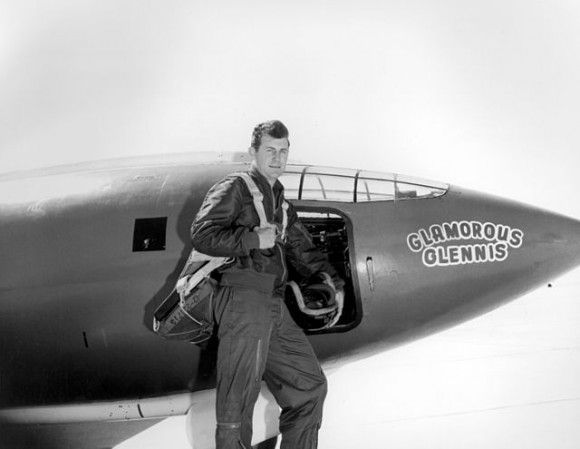
On October 14, 1947, Yeager piloted a plane called Glamorous Glennis to Mach 1.06, just over the speed of sound.

Dubbed the fastest man alive, he also won the prestigious Collier Trophy in aviation even as he continued setting speed records.

The plane in which he broke the sound barrier is on display at the Smithsonian National Air and Space Museum in Washington, D.C.

Yeager’s adventures were popularized in a 1980s satirical book and movie, both called The Right Stuff.

He currently lives California.

Yeager in front of the Bell X-1, which, as with all of the aircraft assigned to him, he named Glamorous Glennis after his wife.  Image via Wikimedia Commons.

Bottom line: On February 13, 1923, Chuck Yeager, the first pilot to break the sound barrier, was born in Myra, West Virginia.

SOURCE:::: http://www.esrthskynews.org

Natarajan

” Incredible….Watch Great Blue Heron Swallow a Huge Fish …” !!!

You may have seen a snake swallow a big animal, but have you ever seen a bird do it?

David Dickinson created this dramatic video photo essay of a great blue heron spearing and swallowing a huge carp in the floodplain of the Rio Grande in New Mexico’s Bosque del Apache National Wildlife Refuge on October 29, 2013.

He said the whole thing – from soup to nuts, if you will – took 11 minutes.

Bottom line: Video photo essay shows great blue heron spearing and swallowing a huge carp.

SOURCE:::: http://www.earthskynews.org  and You Tube

Natarajan


2000 Year Old Rice Terrace of Philippines…

Philippine Rice Terraces Why Reflection

Photo credit: Jon Rawlinson

For at least two millennia, the Ifugao people have sculpted the sides of mountains into useable farmland. Located in the heart of the Cordillera mountain range in the northern Philippines, these rice terraces rise like wide, monumental staircases. The United Nations Educational, Scientific and Cultural Organization (UNESCO) added these feats of ancient engineering to its list of World Heritage Sites in 1995. According to UNESCO, the Philippine rice terraces “create a landscape of great beauty that expresses the harmony between humankind and the environment.”

The terraces, however, also epitomize the story of how modern tensions are putting a strain on that “harmony” worldwide. Yes, natural disasters and the perennial typhoons that lash the Philippines threaten the preservation of the Cordillera rice terraces. But the biggest pressure they face is a shift in human society. As the UNESCO advisory body has written, “the terraced landscape is highly vulnerable because the social equilibrium that existed in the rice terraces for the past two millennia has become profoundly threatened by technological and evolutionary changes.”

Young Ifugao are migrating to the cities where they can find higher paying, less backbreaking work. At the same, the once remote region is becoming more interconnected through large investments in infrastructure. In the next two years, the Philippine government plans to spend around $25 million in road construction and improvement in the Cordillera region.

Philippine Rice Terraces Incline

Photo credit: Jon Rawlinson

One goal for the road project is to attract more tourists to the area and thereby bring more money to the regional economy. In 2013, according to Philippine government statistics, 1.1 million people visited the rice terraces. In the future, the government hopes to attract 10 million tourists annually. It is unclear whether this aspiration is misguided, since the arrival of foreign tourists can dramatically change the nature of a place. But Philippine officials are hoping tourism will also provide livelihoods to those Ifugao who otherwise might leave the boondocks for the cities.

Filipinos call the Cordillera rice terraces the Eighth Wonder of the World. UNESCO calls them “the priceless contribution of Philippine ancestors to humanity.” As shown in the expansive gallery below, this region of the Philippines has some of the most beautiful vistas on earth. This piece of humanity’s common heritage deserves to be preserved for generations to come.

Rice Terraces Mud Walls

Some of the terraces use mud walls, as pictured here; others use stone. (Photo credit: Flickr user Momo)
SOURCE:::: http://www.all that is interesting .com
Natarajan


This Date in Science….Feb 11 2010……When a Spacecraft Destroyed a Sundog…

February 11, 2010. On this date – the coolest space launch ever for us sky fans! I ran into this image and video yesterday via a post on Google+. I was interested when I saw a quote from the person who runs the world’s absolute best website for sky optics, Les Cowley of the website Atmospheric Optics. It turns out this story has been around a few years, but I liked it and thought you might, too. It began with the launch five years ago of NASA’s Solar Dynamics Observatory (SDO), one of several observatories that keep an eye on our sun. It seems that when SDO lifted off from Cape Canaveral on February 11, 2010, on its mission to observe the sun, it first destroyed a sundog in Earth’s atmosphere – in the process bringing to light the new form of ice halo – and teaching those who love and study sky optics new things about how shock waves interact with clouds.

The video above shows SDO’s 2010 launch via an Atlas V rocket. Watch it now, and turn up the volume to hear people cheer when the spacecraft’s passage through the atmosphere destroyed the sundog – which is a bright spot in the sky, formed by refraction of sunlight through plate-shaped ice crystals, which drift down from the sky like leaves fluttering from trees. If you have to, watch it twice to see the luminous column of white light that appears next to the Atlas V.

Les Cowley explained in this 2011 post at Science@NASA:

When the rocket penetrated the cirrus, shock waves rippled through the cloud and destroyed the alignment of the ice crystals. This extinguished the sundog.

The sundog’s destruction was understood. The events that followed were not. Cowley said:

A luminous column of white light appeared next to the Atlas V and followed the rocket up into the sky. We’d never seen anything like it.

Cowley and colleague Robert Greenler at first couldn’t explain this column of light. Then they realized that the plate-shaped ice crystals were organized by the shock wave from the Atlas V. Cowley explained:

The crystals are tilted between 8 and 12 degrees. Then they gyrate so that the main crystal axis describes a conical motion. Toy tops and gyroscopes do it. The earth does it once every 26000 years. The motion is ordered and precise.

Love it!

View larger. | Optics experts in the U.K. have discovered a new form of ice halo.  Image Credit: NASA/Goddard/Anne Koslosky View larger. | When the Solar Dynamic Observatory (bright streak in lower right quadrant of photo) lifted off from Cape Canaveral on February 11, 2010, its launch enabled optics experts to discover a new form of ice halo. Image via NASA/Goddard/Anne Koslosky

Bottom line: When NASA’s Solar Dynamics Observatory (SD0) lifted off from Cape Canaveral on February 11, 2010, on its mission to observe the sun, it first destroyed a sundog in Earth’s atmosphere – in the process bringing to light the new form of ice halo – and teaching those who love and study sky optics new things about how shock waves interact with clouds.

Via Science@NASA website

SOURCE:::: http://www.earthskynews.org

Natarajan

The Incredible Live Bridges of Meghalaya, India…!!!

Meghalaya, North India, where villagers have come up with a unique construction technique that harnesses nature in its purest form – they grow their own living bridges! Using the roots of the rubber fig tree, the natives have created an amazingly elaborate network living bridges, some of which, both researchers and natives believe, are over 500 years old! These extraordinary examples of living architecture are also lessons in patience, since they take about 15 years to grow, and are often continued by the sons and daughters of the original builders. With age, though, the living root bridges grow stronger and can often support the weight of 50 or more people at a time!

SOURCE:::: http://www.ba-bamail.com

Natarajan


Image of the Day….A Fantastic View From ISS.. ” !!!

European Space Agency astronaut Samantha Cristoforetti took this photograph from the International Space Station and posted it to social media on Jan. 30, 2015. Cristoforetti wrote, “A spectacular flyover of the Gulf of Aden and the Horn of Africa. #HelloEarth”

Image Credit: NASA/ESA/Samantha Cristoforetti 

SOURCE:::: www. nasa.gov.

Natarajan

Why We Do Not Feel the Earth Spin …?

Why can’t we feel Earth’s spin?

We can’t feel Earth’s rotation or spin because we’re all moving with it, at the same constant speed.

Earth spins on its axis once in every 24-hour day. At Earth’s equator, the speed of Earth’s spin is about 1,000 miles per hour (1,600 kph). The day-night has carried you around in a grand circle under the stars every day of your life, and yet you don’t feel Earth spinning. Why not? It’s because you and everything else – including Earth’s oceans and atmosphere – are spinning along with the Earth at the same constant speed.

Think about riding in a car or flying in a plane. As long as the ride is going smoothly, you can almost convince yourself you’re not moving. A jumbo jet flies at about 500 miles per hour (about 800 km per hour), or about half as fast as the Earth spins at its equator. But, while you’re riding on that jet, if you close your eyes, you don’t feel like you’re moving at all. And when the flight attendant comes by and pours coffee into your cup, the coffee doesn’t fly to the back of the plane. That’s because the coffee, the cup and you are all moving at the same rate as the plane.

Now think about what would happen if the car or plane wasn’t moving at a constant rate, but instead speeding up and slowing down. Then, when the flight attendant poured your coffee … look out!
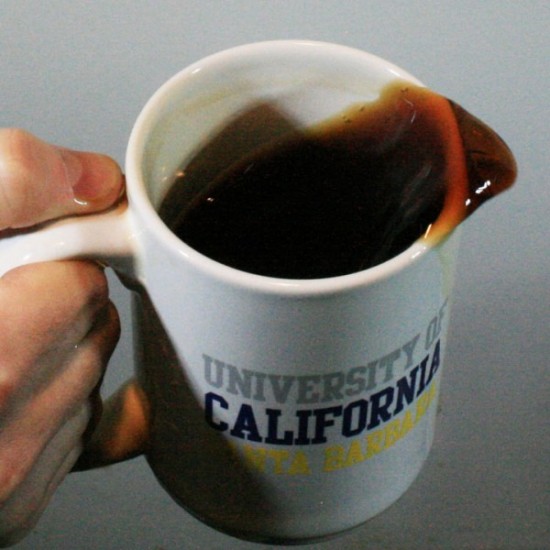
If you're drinking coffee in a steadily moving car or airplane, no problem.  But if the car or plane speeds up or slows down, your coffee sloshes and maybe spills.  Likewise, as long as Earth spins steadily, we can't feel it move.  Image by H.C. Mayer and R. Krechetnikov, via Science.

If you’re drinking coffee in a steadily moving car or airplane, no problem. But if the car or plane speeds up or slows down, your coffee sloshes and maybe spills. Likewise, as long as Earth spins steadily, we can’t feel it move. Image by H.C. Mayer and R. Krechetnikov, via Science.
Likewise, Earth is moving at a fixed rate, and we’re all moving along with it, and that’s why we don’t feel Earth’s spin. If Earth’s spin were suddenly to speed up or slow down, you would definitely feel it.

The constant spin of the Earth had our ancestors pretty confused about the true nature of the cosmos. They noticed that the stars, and the sun and the moon, all appeared to move above the Earth. Because they couldn’t feel Earth move, they logically interpreted this observation to mean that Earth was stationary and “the heavens” moved above us.

With the notable exception of the early Greek scientist Aristarchus, who first proposed a heliocentric (sun-centered) model of the universe hundreds of years B.C.E., the world’s great thinkers upheld the geocentric (Earth-centered) idea of the cosmos for many centuries.

It wasn’t until the 16th Century that the heliocentric model of Copernicus began to be discussed and understood. While not without errors, Copernicus’ model eventually convinced the world that Earth spun on its axis beneath the stars … and also moved in orbit around the sun.

Sky wheeling around Polaris, the North Star.

Sky wheeling around Polaris, the North Star.
A time exposure of the northern sky, revealing the apparent motion of all the stars around Polaris. In fact, this apparent motion is due to Earth’s spin. Image via Shutterstock
Bottom line: Why don’t we feel Earth rotating, or spinning, on its axis? It’s because Earth spins steadily – and moves at a constant rate in orbit around the sun – carrying you as a passenger right along with it.

SOURCE::::www.earthskynews.org

Natarajan
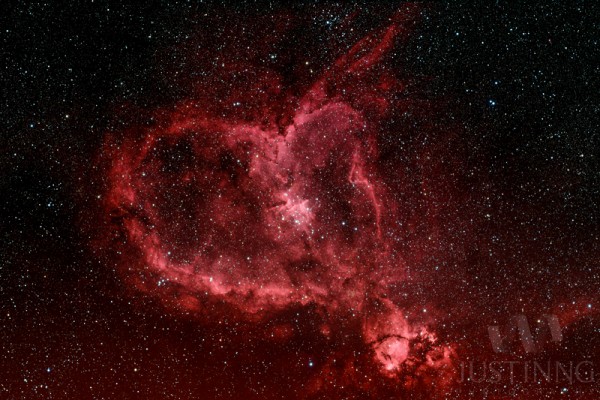
 

Image of the Day… Full Moon and Jupiter on 3 rd and 4th Feb 2015….

The moon and Jupiter on February 3 - over Atlantic Beach, Florida - posted to EarthSky Facebook by Eve Baker.

The moon and Jupiter on February 3 – over Atlantic Beach, Florida – posted to EarthSky Facebook by Eve Baker.

What a sight … the full moon coupled up with Jupiter on the night of February 3-4, 2015.

EarthSky Facebook friend Duke Marsh caught the February 3 moon and Jupiter from New Albany, Indiana.  Thanks, Duke.

EarthSky Facebook friend Duke Marsh caught the February 3 moon and Jupiter from New Albany, Indiana.

SOURCE:::: http://www.earthskynews.org

Natarajan