He could be working at a dhaba, but is now at IIT!…. Meet BrijeshKumar Saroj…

In a special series, Rediff.com looks at India through the lives of its people.

Today: Brijesh Kumar Saroj, the son of a poor weaver, who overcame every hardship to make it to IIT-Bombay. When he cleared the IIT entrance exam, villagers threw stones at his home because he is Dalit. This has only hardened his resolve to ‘make it in life.’

Brijesh Kumar Saroj with Aamir Khan

IMAGE: Impressed with Brijesh’s achievement, Aamir Khan met him after he arrived in Mumbai. The actor has asked him to get in touch if he needs help. Photograph: Kind courtesy, Brijesh Saroj


I heard about IIT (the Indian Institute of Technology) in Class 8. The boys in Class 10 would talk about IIT all the time.

So I asked a senior, ‘Bhaiyya, yeh IIT kis bala ka naam hai? (What is this thing called IIT?)’

He said after you finish IIT you can earn a salary of Rs 25 lakh per annum.

I thought kya baat hai! Pachhees lakh ka package! Phir to hum zaroor karenge. (Wow! A salary of Rs 25 lakh! I will definitely do it).

And here I am and believe me it’s like a Hollywood film.

There are projectors in the classrooms, everyone speaks in English, people look different, they are so open-minded … And you can take second, third helpings of food and even order for eggs in the canteen. The toilet even has a flush.

When I told my father I had got into IIT, he said, ‘Theek hai. Acchha hai (OK, Good).’ He was happy that I would be able to earn money soon.

Mummy is angutha chhap (illiterate). She said you must be doing something worthwhile if you are going so far away to study. I think she was happy just to watch my brother and me being interviewed on TV. (Brijesh’s brother Raju, 18, secured the 167th rank in the IIT entrance exam and is at IIT-Kharagpur.)

My parents may not understand the significance of getting into an IIT, but they have always been supportive. We are five brothers and one sister, all good students.

In Class 5, our teacher in the village school told my father, ‘Eat just one meal a day, wear one pair of clothes, but educate your children.’ That’s the funda my father held out to.

In my entire extended family, only we children are educated. All my cousins, elders in the family… everyone is illiterate.

Going to a Navodaya Vidyalaya was the turning point of my life. I too would have been a Chhotu, Motu, Pinku, working in a dhaba, but for Navodaya and my maths teacher Sunil Mishra.

I was in Class 5, late for class that day. Mishra Sir was solving a Simple Interest problem on the blackboard. The answer was wrong and I told him so. He said I should go to a better school, a Navodaya Vidyalaya, but warned me there was very little time to prepare for the entrance exam.

Most people in the village demotivated me. They would tell my father, ‘Why are you educating them? Kaam pe lagao (Make them work).’

Brijesh Kumar Saroj with his family

MAGE: Brijesh and his brother Raju (in a white shirt) with their family in Rehualalganj village in UP. Raju also cleared the IIT entrance exam and is in IIT-Kharagpur. Photograph: Kind courtesy, Brijesh Saroj.


My father works as a weaver in a Surat mill and earns between Rs 8,000 to Rs 10,000 a month which is not enough for us six children, my parents and my grandparents.

I took up a job in a garage in the village as a helper to a mechanic, ‘get the wrench, get the spanner. Yeh karo woh karo (Do this, do that).’ I learned nothing there, but earned Rs 3,000 in two months.

As Mishra Sir suggested, I filled out the Navodaya form and studied hard. I passed. I studied at the school from Class 6 to 10. It was a residential school and it was my foundation.

I got three meals a day. I learnt judo-karate and basketball and I’m a regional level player. I also ate paneer for the first time.

The Navodaya school had 40 students in a class, while the village school had 100 students in a class, different age groups all studying together. The teachers gave each student undivided attention.

People ask me what is the difference between life now and before IIT. Zameen aasman ka fark hai (the difference is as wide as heaven from earth). We had no electricity because we couldn’t afford it. We had no TV, no fan or running water, or a toilet or a gas cylinder.

In Class 10 during my final exams, the thatched roof of our house fell down. We had to spend a few days in the open. It was only because of the BPL card (Below Poverty Line ration card)]and the milk from our eight goats that we could survive.

When the media found our story, the life that we knew changed. As did the life of the village. Five hundred families in the village who had kachcha houses (made out of mud), got pucca ones (made of brick) with toilets, solar lights and hand pumps.

Tarred roads are being built, there are plans for a hospital and an ITI (Industrial Training Institute), as well as a coaching class for IIT entrance exams.

Yet, the villagers threw stones at our house when the results were announced because we are Dalits. They have threatened to throw acid on our family, they said we won’t allow your children to get jobs in this village. And it’s only because our father tried to push us towards the promise of a better life.

I get upset when people use the word ‘higher’ caste to describe these narrow-minded, uneducated, uncivilised people.

Whatever little I have achieved today is because of my opponents. What they said dil pe lagti thi aur jab dil pe lagti thi toh baat ban jati thi (It hurt me and it pushed me to realise my goals). They always told me you won’t be able to do it because you are Dalit.

If there is one thing I want ended in India, it is the caste system.

description here

IMAGE: The family home. Brijesh had no TV, fan, running water, toilet or a gas cylinder. When the thatched roof collapsed, the family lived in the open for 5 days. Photograph: Kind courtesy Brijesh Saroj.


There is nothing like this in IIT or Mumbai. Two weeks ago, I met Aamir Khan. He called me after a newspaper report about us and told me to meet him when I came to Mumbai. I did, for one-and-a-half hours! Just him and me.

You know, 3 Idiots is my favourite film. He told me I should get in touch with him if I ever needed any help.

Sometimes, when I walk around the IIT campus, I can’t believe I’m here. Socho Bombay aaaya aur woh bhi flight se aaya! (Imagine, I came to Mumbai, and that too I flew in!). It was sponsored, of course.

Nobody knew I hadn’t flown before; I just copied what everyone else did. If there is one thing I don’t lack, it is self confidence.

Arre, we don’t even speak Hindi in my village, we speak Awadhi. Everything is padhbya(padhna, studies), jabya (Jana, to go), khabya (khana, to eat). Here everything is in English. People think in English. I understand the language, but never spoke it. I thought I would be embarrassed, but I am not. It’s not my mother tongue, I’ll learn it. It’s just a matter of time.

But I have to get used to life in a city like Mumbai. In the beginning I was shocked to see so many people. In the village, when we went to graze our goats, there is just vast emptiness everywhere. Marathi is a problem.

Once I went and sat next to a woman in a bus because it was the only vacant seat. Another woman came and told me to get up. It was reserved for women apparently and I did read something that said striyam sathim or something (striyan saathi, For Ladies), but I couldn’t figure it out. But these incidents should happen. How will I learn otherwise?

Another thing about this city is that people hardly walk. In the village we used to hop and skip 5 km to watch Shaktiman (the superhero television series of the nineties), here people take a bus or auto for even 1 km.

And it is expensive, a plate of patties costs Rs 60 to Rs 70; do time ka khaana ho jata hai gaon mein (we can eat two meals for the same amount in the village).

But money is not such a problem now. We used to have two bank accounts — my brother’s had Rs 504 and my mother’s account had Rs 2,000. I don’t know about my father’s account since he lives in Surat.

After we got into IIT, the HRD ministry waived off our tuition fees, mess fees, hostel fees. We got funding of Rs 8 lakh (Rs 800,000) from private donors as well as the state government and politicians.

The government has also given us a plot of land. But that land is now under litigation since my neighbours claim it belongs to them. So we are using some of the funds to fight the case.

IMAGE: From the monetary help received, the brothers have set up a trust fund for deserving children in their village. Photograph: Kind courtesy, Brijesh Saroj.


We have received so much love from strangers; we want to return the favour. From the Rs 8 lakh we received, we set up a trust fund of Rs 2 lakh for 10 deserving children between 12 to 13 years from our village.

We will be funding their education and will shore up the money once we begin earning. The rest of the Rs 6 lakh will be spent on the education of my two brothers and sister.

Before I got into IIT, I used to tell people in my village to educate their children and they would brush me off saying, ‘Bade aayen tips dene (who are you to give advice?).’ I want to be able to achieve such a stature that when you help people they don’t question your motives.

I want to help my village, my family, especially my elder brother Rajesh. My brother always pulled me back into the straight and narrow when I strayed. I had started doing drugs in school and my brother found out and beat me up. Thank god for that. He is doing his MSc in Maths and he started giving tuitions to support the family.

After I finish my IIT, I want to do IAS so that I can be part of the system and change it. I idolise Swami Vivekananda and I have tried to follow what he said, ‘Arise and awake and stop not till the goal is reached.’

Brijesh Kumar Saroj

IMAGE: Brijesh at the IIT-Bombay campus. ‘Everyone speaks English,’ he says, ‘And you can take second, third helpings of food and even order for eggs. The toilet even has a flush’. Photograph: Reuben NV/Rediff.com


People warned me that I will be swept away by the glamour of Mumbai. But I have always been my own guardian. I went to the Navodaya school when I was just 10. If my friends here tell me to go out socialising with them, I will refuse. I don’t have the money, I can’t go out.

I have budgeted a personal expenditure of Rs 500 per month, otherwise I will be depleting the funds. Who doesn’t like going out? I will, when I can.

It was my birthday on August 10. I turned 19. Nobody wished me because nobody here knows it was my birthday. I called my parents and they blessed me. We have never ever celebrated birthdays because we never had the money. Actually I don’t even know what you are supposed to do…

Sometimes, it is a little lonely here. I find it difficult to connect with my batch mates because of the language barrier, so to keep my spirits up, I wrote these lines…

Jab tootne lage hausla
Toh itna yaad rakhna
Bina mehnat ke haasil
Takhto taj nahin hote
Dhoond lete hain andhere me bhi manzil ko
Jugno kabhi roshni ke mohtaj nahin hote

When you lose hope
Remember this thought O my friend
No scepter or crown ever came to one who did not work hard
There are some who find their destination even in darkness
Just like fireflies that are never scarce of light.

I know I will make it.

Brijesh Kumar Saroj, 19, is the son of a daily wage labourer from Rehualalganj village in Pratapgarh district, Uttar Pradesh. He scored the 410th rank and is now doing Engineering Physics at IIT-Bombay.

He spoke to Swarupa Dutt/Rediff.com after his classes at the IIT campus.

Source….www.rediff.com

Natarajan

Message for the Day…” Place all Your burden on God…You will then be Care-free and Grief-free…”

Sathya Sai Baba

You are not a despicable creature, born in slime or sin, to eke out a drab existence and be extinguished forever. You are immortal and eternal. So when the call comes, respond with your whole heart. The Principle of Divinity must be experienced, for it is beyond expressions and explanation. The richness, fullness and depth of that experience can never be communicated in words. You must feel that it is your highest destiny to attain that experience. You are a mixture of Deha and Deva – the mortal and the immortal. Liberation means stoppage of grief and acquisition of joy. All that you have to do is to place all your burdens on God. It makes you care-free and grief-free. Then you will take everything as a divine play of the Lord you love and live in bliss just as He is, when His plans are going through!

A Green Taxi of Kolkata…”Rooftop Garden on an Ambassador Car.”..!!!

Dhananjay Chakroborty, a taxi driver in Kolkata, has decided to use his green hands and transform his taxi into a miniature, mobile garden. A green crusader on the move.

Imagine our surprise when we came across Mr. Dhananjay Chakraborty, a taxi driver in Kolkata, who has created a rooftop garden on his cab and has a mini green cavern in the trunk of his car with potted plants. It was truly an amazing and awe-worthy sight. He calls it the ‘subuj rath’ or the green chariot.

11167977_1434920233476298_4783039778295666790_n

The car has metal containers on the rooftop whose bottom is laid with soil, white sand and stone chips and the original green grass grows up with the aid of those mechanizations. It weighs about 65 kgs and cost Mr. Chakraborty about Rs. 22000 to build. It continues to cost him with the increased fuel consumption because of the added weight. However, Mr. Chakraborty said he does not mind it.

The Kolkata cabbie is 40 years old and works from the taxi stand at Tollygunge Karunamoyee in Kolkata. In fact, he has planted flowers at the taxi stand too.

His Taxi, an Ambassador, apart from having a green grass-bed on the roof, has eight potted plants in the trunk and has a green interior completely to promote the message that trees and plants should be planted and taken care of.

10897050_1376593789308943_6898522744511849688_n

Mr. Chakraborty’s project came to fulfillment in parts. It began three years ago when he potted a money plant in a beautiful glass bottle that a passenger had left behind in the back seat. Mr. Chakraborty took care of it and nurtured it, while keeping it in the Taxi.

The bigger idea of a green garden taxi, came from one of his friends who found something similar on Internet and suggested the initiative to Chakraborty. He, being so much in love with nature and trees, decided to give it a try.

1510041_1433449920289996_7066905048024457448_n

Making of the green taxi. Mr. Chakrobarty, with help, adjusting the metal tray onto the roof. His inspiration also came from fellow passengers who appreciated the small money plant that he had begun with. –

11205091_1433449970289991_1012660167758205488_n

The painting of the metal tray on the Subza Rath. He has also been distributing leaflets with messages and sketches that he has made to passengers who are curious and delighted by his initiative. –

He has also been distributing leaflets with messages and sketches that he has made to passengers who are curious and delighted by his initiative. –

11229960_1433449953623326_4358720428597478899_n

However, Mr. Chakraborty does not own the Taxi that he has morphed into a mobile awareness masterpiece on environmental preservation and conservation. He had to sell his taxi, about eight years ago, when he required funds for his treatment post an accident.

But the owner, Mr. Amrish Singh, who owns some five more taxis, has stood up in full support of Chakraborty’s efforts. He says that Dhananjay is one of the safest drivers out there, and since this is for a good cause, he cannot do anything but extend his full support

10422290_1376612839307038_9126793043859879048_n

This is how the Taxi looked before it underwent the transformation to become a miniature mobile garden.

Although, it was not an easy ride, some fellow drivers ridiculed him. In fact, most people before looking at it in a deeper perspective thought he was crazy to even think of such a thing. But Mr. Chakraborty did not pay it any mind, and decided to go on with the project anyway.

Mr. Chakraborty gives an added message. According to him, planting trees is not enough; taking care of them and nurturing them is crucial. Because tree planting initiatives keep happening but most of the saplings just wither away due to lack of water. It is time people, all of us, begin doing our bit.

10885530_1376612842640371_103575272624805763_n

Apart from being an eye opener on environment, there are other benefits of the plants and the grass in the car. Mr. Chakraborty drives a Non- AC Taxi and because of the plants, his taxi remains much cooler than any other non-AC taxi. –

Also, we believe people would be fascinated with such an idea. We know we are. So, the next time you are in Kolkata, do not miss a ride in the green taxi, or as Mr. Chakraborty likes to call it, the ‘sabuj rath’. –

Source….Surabhi Katyal….www.the betterindia.com

Natarajan


How an Artist is Changing Bengaluru Streets, One Pothole at a Time….

How an Artist is Changing Bengaluru Streets, One Pothole at a Time

Baadal Nanjundaswamy’s art work is incredible and delivers results. Image Courtesy: Facebook/Baadal Nanjundaswamy

As Bengaluru preps for the upcoming civic body polls on Saturday, it will be interesting to see how the scary crocodiles and gigantic anacondas that have appeared on the city’s water-logged and pothole-ridden roads recently will affect voters.

The city has been struggling with polluted lakes, garbage crisis, bad roads and crippling traffic management for a while now. Fed up with the state of affairs, local artists took it upon themselves to make sure the problems spoke for themselves, using imagination and art as their tools.

The charge has been led by Baadal Nanjundaswamy who shook up social media and local authorities (into making amends) by creating a life-size crocodile and swamp as an installation to highlight a pothole that hadn’t been fixed for days.

The crocodile did the trick and the pothole was filled. Since then, Mr Nanjundaswamy has been changing the face of Bengaluru pot holes, one brush stroke after another.

From transforming broken dividers into sutli bombs in one place and wrapped gifts in another, to painting huge faces around uncovered man holes, his art work is incredible and delivers results.

Check out some of his work below:

A little Diwali gift – major social media explosion in 3-2-1:

Photo Credit: Facebook/Baadal Nanjundaswamy

Bengaluru’s Secret Santa leaving them colorfully wrapped gifts for Christmas:

Photo Credit: Facebook/Baadal Nanjundaswamy

How about this Valentine’s Day proposal to civic body Bruhat Bengaluru Mahanagara Palike (BBMP)?

Photo Credit: Facebook/Baadal Nanjundaswamy

Or these fearsome faces with gaping mouths?

Photo Credit: Facebook/Baadal Nanjundaswamy

They needed a zebra-crossing, so that’s what they got – a zebra crossing the road:

Photo Credit: Facebook/Baadal Nanjundaswamy

Would you like a game of Hopscotch on one of Bengaluru’s streets? It could be fun but also might be the only thing you do for a while:

Photo Credit: Facebook/Baadal Nanjundaswamy
source…..www.ndtv.com
natarajan

6 Weird Facts About Gravity…

Loren Shriver Credit..NASA

Gravity: You don’t know what you’ve got ’til it’s gone

Here on Earth, we take gravity so for granted that it took an apple falling from a tree to trigger Isaac Newton’s theory of gravitation. But gravity, which draws objects together in proportion to their mass, is about much more than fallen fruit. Read on for some of the strangest facts about this universal force.

girl doing headstand

It’s all in your head

Credit: © Paul Simcock | Dreamstime.com

Gravity may be pretty consistent on Earth, but our perception of it isn’t. According to research published in April 2011 in the journal PLoS ONE, people are better at judging how objects fall when they’re sitting upright versus lying on their sides.

The finding means that our perception of gravity may be less based on visual cues of gravity’s real direction and more rooted in the orientation of the body. The findings may lead to new strategies to help astronauts deal with microgravity in space.


Endeavour landing

Coming down to Earth is tough

Credit: NASA Kennedy Space Center

Speaking of astronauts, their experience has shown that a switch to weightlessness and back can be tough on the body. In the absence of gravity, muscles atrophy and bones likewise lose bone mass. According to NASA, astronauts can lose 1 percent of their bone mass per month in space.

When astronauts come back to Earth, their bodies and minds need time to recover. Blood pressure, which has equalized throughout the body in space, has to return to an Earthly pattern in which the heart must work hard to keep the brain nourished with blood. Occasionally, astronauts struggle with that adjustment. In 2006, astronaut Heidemarie Stefanyshyn-Piper collapsed at a welcome-home ceremony the day after returning from a Space Shuttle mission to the International Space Station.

The mental readjustment can be just as tricky. In 1973, Skylab 2 astronaut Jack Lousma told Time magazine that he’d accidentally smashed a bottle of aftershave in his first days back from a month-long sojourn in space. He’d let go of the bottle in mid-air, forgetting that it would crash to the ground rather than just float there.

null

For weight loss, try Pluto

Credit: nullPluto may no longer be a planet, but it’s still a good bet for lightening up. A 150-pound (68 kilogram) person would weigh no more than 10 pounds (4.5 kg) on the dwarf planet. The planet with the most crushing gravity, on the other hand, is Jupiter, where the same person would weigh more than 354 pounds (160.5 kg).

The planet humans are most likely to visit, Mars, would also leave explorers feeling light-footed. Mars’ gravitational pull is only 38 percent that of Earth’s, meaning a 150-pound person would feel like they weigh about 57 pounds (26 kg).


Hudson Bay, Canada

Gravity is lumpy

Credit: Jacques Descloitres, MODIS Land Rapid Response Team, NASA/GSFCEven on Earth, gravity isn’t entirely even. Because the globe isn’t a perfect sphere, its mass is distributed unevenly. And uneven mass means slightly uneven gravity.

One mysterious gravitational anomaly is in the Hudson Bay of Canada (shown above). This area has lower gravity than other regions, and a 2007 study finds that now-melted glaciers are to blame.

The ice that once cloaked the area during the last ice age has long since melted, but the Earth hasn’t entirely snapped back from the burden. Since gravity over an area is proportional to the mass atop that region, and the glacier’s imprint pushed aside some of the Earth’s mass, gravity is a bit less strong in the ice sheet’s imprint. The slight deformation of the crust explains 25 percent to 45 percent of the unusually low gravity; the rest may be explained by a downward drag caused the motion of magma in Earth’s mantle (the layer just beneath the crust), researchers reported in the journal Science.


Colorized scanning electron micrograph depicting Escherichia coli bacteria, which recent research shows can breed in gravity 400,000 times stronger than that of Earth. Most E. coli strains are harmless, but the one here is O157:H7, which can cause severe

Without gravity, some bugs get tougher

Credit: CDC/Janice Haney Carr

Bad news for space cadets: Some bacteria become nastier in space. A 2007 study published in the journal Proceedings of the National Academy of Sciences found that salmonella, the bacteria that commonlycauses food poisoning, becomes three times more virulent in microgravity. Something about the lack of gravity changed the activity of at least 167 salmonella genes and 73 of its proteins. Mice fed the gravity-free salmonella got sick faster after consuming less of the bacteria.

In other words, Michael Crichton’s “The Andromeda Strain” had it wrong: The danger of infection in space may not come from space bugs. It’s more likely our own bugs grown stronger would strike us.


Spinning black hole

Black holes at the center of galaxies

Credit: April Hobart, NASA, Chandra X-Ray ObservatoryNamed because nothing, not even light, can escape their gravitational clutches, black holes are some of the most destructive objects in the universe. At the center of our galaxy is a massive black hole with the mass of 3 million suns. Scarier thought? It might be “just resting,” according Kyoto University scientist Tatsuya Inui.

The black hole isn’t really a danger to us Earthlings — it’s both far away and it’s remarkably calm. But sometimes it does put on a show: Inui and colleagues reported in 2008 that the black hole sent out a flare of energy 300 years ago. Another study, released in 2007, found that several thousand years ago, a galactic hiccup sent a small amount of matter the size of Mercury falling into the black hole, leading to another outburst.

The black hole, named Sagittarius A*, is dim compared with other black holes.

“This faintness implies that stars and gas rarely get close enough to the black hole to be in any danger,” Frederick Baganoff, a researcher at the Massachusetts Institute of Technology who was involved with the 2007 study, told LiveScience’s sister site SPACE.com. “The huge appetite is there, but it’s not being satisfied.”

Source…www. livescience.com
Natarajan


Gifts Everybody Deserves to Receive…

Everybody loves receiving gifts – For their birthday, for Christmas or randomly. There’s nothing more thrilling, but deep down the real treasured gifts are intangible. These gifts are priceless and everybody deserves receiving them at some point in their lives.

gifts

gifts

gifts

gifts

gifts

gifts

gifts

gifts

Source…www.ba-bamail.com

Natarajan

Message for the Day…” Every Single Unselfish Act is a Righteous Act…”

Sathya Sai Baba

Sacrifice ignorance (ajnana) and ego (ahamkara) at the altar of wisdom (Jnana), and install righteousness(Dharma) therein” – this is the message of the scriptures. Every single unselfish act, which prepares the ground for the merging of the Soul with the Over-Soul, which broadens the vision towards the Divinity immanent everywhere, is a righteous act. Each such act is a tiny stream that swells the river of holiness rushing towards the sea of knowledge of Divinity. Your acts and activities are all rituals in the worship of the Paramatmathat pervades the Universe. Whatever is done in an attitude of dedication and surrender is a component of the Dharma, which leads to Realisation. The strategy of the ancient Bharathiya (Indian) way of life is directed towards the sanctification of every moment and every word, thought and deed as a step towards realising the Divine.

Health Benefits of Guava Fruit…

Guavas are found in the tropics, and invoke images of vacations, summer parties and island life, but this tasty fruit is more than a celebratory food. This fruit is bursting with healthy vitamins and minerals and can be used to treat many serious ailments. You can recognize guavas by their yellow, green or maroon skins and creamy white or pink pulp.

Weight loss and gain

Guava is a winning fruit for its many great benefits. If you’re trying to lose weight, guavas are not a fruit you need to give up. In fact, this snack-sized fruit can satisfy your appetite while adding few calories, low amounts of carbohydrates and no cholesterol to your diet. And, compared to other fruit, adds a low dose of sugar. Guavas also offer a great source of vitamins, proteins, roughage, fibers and minerals. For lean people trying to gain weight, this fruit is also beneficial as it promotes the healthy absorption of nutrients and its substantial nutrients regulate one’s metabolism.

Blood pressure and Diabetes

Guavas are hypoglycemic and rich in fiber, which helps reduce blood pressure. Dietary fibers maintain the blood’s fluidity and prevent it from thickening, which can worsen blood pressure. Foods lacking in fiber (for example refined flour) increase blood pressure because they convert to sugar more quickly. This can help fight or even prevent diabetes. The fiber regulates the sugar being absorbed by the body and the risk of both high spikes and drops in the body’s insulin and glucose levels is reduced.

Diarrhea, dysentery, and gastroenteritis

The abundant astringent (substances that contract body tissue) makeup of raw guava and guava leaves helps loosen the bowels and can reduce the symptoms of diarrhea and gastroenteritis. Being highly alkaline, the guavas act as a disinfectant, removing excess mucus from the intestines and inhibiting microbial growth. For these reasons, guavas can also be used to treat dysentery. The guavas’ plentiful supply of vitamin C, carotenoids and potassium can also boost your digestive system.

Thyroid health

A good substance for regulating the thyroid’s metabolism is copper, which guavas have plenty of. The thyroid glands regulate important hormones and organ system functions, which helps maintain a healthy balance in your body.

Healthy brains

Also present in guavas are high amounts of vitamins B3 and B6. These both have benefits for the health of your brain. B3, which is also called niacin, is known to help increase blood flow and stimulate cognitive function, while B6 helps preserve normal nerve function.

Scurvy

Guava is your best source for vitamin C. In fact it has four times the amount of Vitamin C found in oranges, which are regarded as the go-to food for this vitamin. The concentration of vitamin C can prevent scurvy, a disease caused by a deficiency of this vitamin.

Constipation

The seeds of guavas, either ingested whole or chewed, are excellent laxatives. In addition to the fruits’ substantial amount of dietary fiber, guavas are advantageous for treating constipation. These two sources cleanse your intestines and excretory system and help your body retain water, helping you achieve healthy bowel movements. Frequently snacking on guavas, then, can be beneficial for proper digestion.

Colds and coughs

Drinking the juice of guavas and fresh guava fruit helps in fighting colds and coughs. The astringent quality can lessen mucus, disinfect the respiratory tract, throat, and lungs and reduce microbial activity. The substantial amounts of iron and vitamin C in guavas also help treat viral infections. It’s advised to avoid eating overly ripe guavas when you have a cold or cough as they can actually aggravate them.

Eyesight

The considerable quantities of vitamin A in guavas are extremely beneficial for the health of your vision. This helps slow down macular degeneration, the growth of cataracts and even improve one’s eyesight degradation once it has begun.

Cancer prevention

Guava is also valuable in your diet as a preventative measure against cancerous growths and metastasis. The high levels of an antioxidant called lycopene has been shown to reduce the risk of prostate cancer and inhibit the growth of breast cancer cells. Guava leaf oil is another anti-proliferative extract from the guava plant that has proven effective in reducing cancer growth.

Skincare

Guavas are also fantastic at improving skin texture and keeping your skin looking fresh. Guavas are full of astringents, particularly in fresh fruit and the leaves of the plant. If you rinse your skin with a guava decoction, the fruit can tone and tighten areas of loose skin. Eating the fruit also provides a rich source of vitamins A, B, C, as well as potassium, which are excellent antioxidants and detoxifiers. They can keep your skin glowing, prevent premature aging and wrinkles, and can speed up the healing process of wounds.

Source….www.organicfacts.net and http://www.ba-bamail.com

Natarajan


Dashrath Manjhi Aka Mountain Man’s Story Is The Most Inspiring Thing You’ll Read Today…

Manjhi

Dashrath Manjhi, a poor landless labor moved a mountain in his lifetime, quiet literally! It took him 22 years but Manjhi shortened the travel between the Atri and Wazirganj of Gaya town from 55 km to 15 km. Not many are aware of this man’s greatness but thanks to Bollywood for converting his life story into a film. The film by Ketan Mehta is called Manjhi- The Mountain Man and is slated to release this Friday starring ace actors like Nawazuddin Siddiqui and Radhika Apte in lead roles. The story of a brave man who took the challenge of gifting accessibility to his remote village will inspire you beyond limit.

If you still haven’t heard of the man who fought with a mountain for more than two decades, his real story will move you!

1. Gehlour Ganj, Atri: A 300-foot tall mountain loomed between Atri block of Gaya, Bihar civilization in Wazirganj made commuting a difficult task for the locals

Dashrath Manjhi 1

2. Manjhi, a landless labourer worked in the fields on the other side of the mountain and lived with his wife, Falguni.

Manjhi 2

Manjhi belonged to a cast which was regarded the lowest of the low in a caste-ridden society. They were kept aloof from basic necessities like- water supply, electricity, a school and a medical centre.

3. Like everyday, Manjhi eagerly waited for his beloved wife Falguni who would bring lunch for him.  She did come to him that one eventful day, but her body had bruises and blood all over.

3

The treacherous trek up and around the mountain took hours. This led to frequent accidents and death of locals who lost their lives purely because reaching for medical facilities took hours. The nearest doctor was at Wazirganj, which was more than 70 kilometers over the mountain. Locals of the area cursed the inaccessibility but no one ever bothered to do anything about it. However, one man could wait no longer but that too alerted him after a tragedy. However, one day, Falguni tripped on loose rock, shattering her water pot. Not only she slid down several feet, she injured her leg. Manjhi could not save his wife and then he took a pledge.

4. “Jab Tak todenge nahi, tab tak chodenge nahi”- After losing his wife in 1959, Manjhi took up a challenge against the mountain and sold his goats to buy a hammer, chisel and crowbar.

Manjhi Story

“That mountain had shattered so many pots; claimed lives. I could not bear that it hurt my wife. If it took all my life now, I would carve us a road through the mountain.”- He said.

5. People called him a ‘lunatic’ but that did not deter him from his journey. After a struggle of 22 years (1960-1982), a tiny cleft across a rock wall opened up one day!

Mountain Man

He then went on to widen the cleft. Some several years later, he managed to carve out a passage 360 feet long and 30 feet wide.

Even though he lost his battle of life to cancer in 2007, thanks to Bollywood for converting his life into a film. Even when he was alive, people were totally awed by his will power and determination. Chief Minister Nitish Kumar agreed that once he had stood up and vacated his chair when Manjhi visited him in Janata Durbar in Patna.

Source…..Isha  Sharma… http://www.indiatimes.com

Natarajan

” These Chennai Scientists Are Trying To Solve An Impending Agricultural Crisis…”

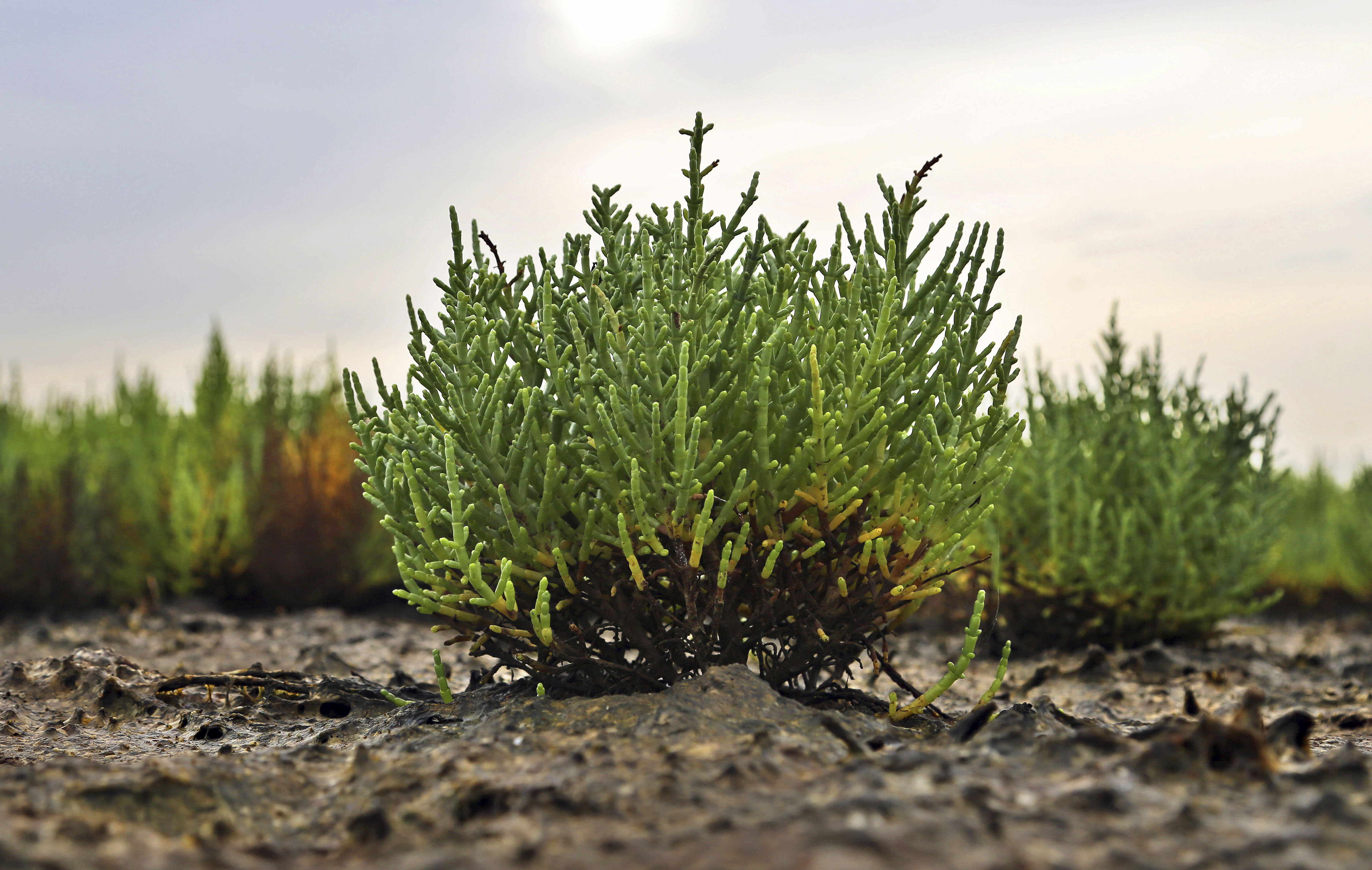
SALICORNIA BRACHIATA

VEDARANYAM, Tamil Nadu — On a sun-scorched wasteland near India’s southern tip, an unlikely garden filled with spiky shrubs and spindly greens is growing, seemingly against all odds.

The plants are living on saltwater, coping with drought and possibly offering viable farming alternatives for a future in which rising seas have inundated countless coastal farmlands.

Sea rise, one of the consequences of climate change, now threatens millions of poor subsistence farmers across Asia. As ocean water swamps low-lying plots, experts say many could be forced to flee inland.

“It’s hard to imagine how farmers will live,” said Tapas Paul, who as a World Bank official helped channel about $100,000 to help build the small garden a decade ago in a swampy, seaside town dominated by salt flats in southern Tamil Nadu state. “In the places subject to inundation and sea level rise, there are few options.”

A team of Indian scientists is searching for solutions to what they describe as a fast-approaching agricultural crisis. Their neatly plotted rows of naturally salt-tolerant plants, known as halophytes, could be a part of the answer. The scientists from the M.S. Swaminathan Research Foundation are also trying other approaches: tweaking genes and cross-breeding plants by conventional means to discover which might grow and even flourish.

“Sea level rise is inevitable, and we are not prepared,” said Swaminathan, who pioneered high-yield wheat and rice varieties for India in the 1960s. “The biggest problem in India is just the very large population. We can say people can relocate, but where could we even accommodate all those who need to move inland?”

Saltwater for a farmer long meant certain crop failure. Wartime foes sowed enemy fields with salt to ensure social collapse. Natural disasters such as the 2004 Asian tsunami left countless plots unproductive for years.

Asia’s coastal farmers, including millions impoverished in India, now face such problems. Climate change will bring stronger storms and warmer temperatures that expand ocean waters and melt ice caps and glaciers. As a result, seas are set to rise up to 1 meter (3.2 feet) in this century, according to the latest scientific forecasts.

Chellammal, a graceful, 65-year-old farming housewife in the Tamil Nadu village of Tetakudi, knows the nightmare of farming on salt-contaminated land too well.

“I struggled so long to get things to grow, but nothing worked,” said Chellammal, who goes by one name. “Every year just got worse until there was nothing left,” she said, crouched in a bright pink sari by her fields.

The land her family had saved for decades to buy went completely barren about five years ago, after a neighboring village took up shrimp farming when flooding from a nearby ocean canal salted their lands. The shrimp ponds were never lined properly, so their saltwater seeped into surrounding soils.

The farmland lost by Tetakudi’s 200 households now supports little more than a vast expanse of salt-tolerant shrubs called Suaeda maritime along with succulents called Salicornia brachiata, known to locals as “chicken feet.”

To the villagers, the bright green bushes are no better than weeds. Already, 12 families have boarded up their homes and left.

But scientists say suaeda is good for firewood. And salicornia species, which can tolerate nearly twice the salinity of seawater, have enormous potential as a biofuel crop, with seeds containing high concentrations of oil.

The problem, however, lies in realizing profits. For any crop to work on a large scale, inexpensive methods and machinery for harvesting will have to be developed. Then processing plants, production lines and markets would need to be built. As of now, none of that exists.

Chellammal is dubious, but interested.

“If we can make money from what we grow, we’ll try it. Why not?” she said. “Maybe all is not lost.”


salicornia brachiata

In this June 16, 2015 photo, a wild-growing Salicornia brachiata, a halophyte known to locals as ‘€chicken feet’, thrives on fields tainted by saltwater from a neighbouring shrimp farm near Velankanni, India.

The timing for an agricultural crisis due to sea rise couldn’t be worse. India’s poor farmers already struggle with frequent flooding, drought and soils degraded by agrochemical overuse. Those on the coast are also hit by storms, with at least 27 of the 35 deadliest cyclones in history barreling through the Bay of Bengal before slamming into either India or Bangladesh.

India’s freshwater sources are also in peril, with over-tapped groundwater reserves so low the country is expected to have only half the water it needs by 2030. Grain production, meanwhile, has stalled around 260 million tons in recent years, despite global pressure for India to boost yields, eliminate waste and eradicate widespread poverty and malnutrition.

To feed its growing 1.26 billion population, India must increase food production 45 percent by 2050, for which experts say it may need to cultivate more land. Instead, about 1.2 million hectares (3 million acres) of its coastal farmland has been degraded by salt, according to India’s Central Soil Salinity Research Institute.

Inland, India has lost another 5.5 million hectares of arable farmland, out of its nationwide total of 163 million hectares, though India’s soil salinity troubles are exacerbated by industrial salt flats, a growing number of shrimp farms and the depletion of groundwater reserves. The trend will only continue as seawater creeps onto low-lying lands along the 7,500-kilometer (4,700-mile) coast that outlines the country along the Bay of Bengal, Indian Ocean and Arabian Sea.

“Saltwater agriculture is considered a futuristic area. But it really shouldn’t be,” said marine biologist V. Selvam, the M.S. Swaminathan foundation’s mustachioed director of coastal research. “Very soon there won’t be enough land and water to meet our needs.”

And India is not alone. Countries including Egypt, Bangladesh and much of Southeast Asia also face heavy saltwater intrusion and loss of farmland. Already, 62 million hectares, or 20 percent, of the world’s total 300 million hectares of irrigated farmland has been salinized to some extent. Another 50 centimeters (1.6 feet) of sea rise, which is just half of what’s expected by 2100, would swamp up to 1.9 million more hectares, the Intergovernmental Panel on Climate Change has said.

That will undermine the world’s ability to find the additional 120 million hectares of farmland it needs for a staggering 70 percent increase in food production to feed the world by 2050, according to the U.N. Food and Agricultural Organization.

Experts say there will be little choice but to grow some non-food crops along the coasts.

The world’s irrigated acreage could be increased by about 50 percent by reusing saline water and salinized crop fields for halophytes, said University of Arizona environmental sciences professor Edward Glenn.

“As with aquaculture replacing wild fisheries, it is inevitable that halophytes will have their day,” he said.

Sesuvium portulacastrum. Paspalum vaginatum. Prosopis juliflora.

These are just a few of the 350 known species of salt-tolerant plants that are candidates to become crops for the future. Saltwater plants are unlikely to become staple foods, because while often high in nutrients they’re also very salty and so should be eaten in moderation.

Species such as Salicornia europaea, also known as glasswort or samphire, are already sold in European markets as a fancy salad addition or side dish. The bright purple-and-white blossoms of Limonium are a florist’s delight, while another species called Atriplex or saltbush is eaten by sheep.

Supporters note a host of potential uses to make harvests profitable, including firewood, decorative flowers, kitty litter, nutritional supplements, cooking oil and biofuel. Cattle fodder is another possibility, and Indian herders already graze their cattle on thorny shrubbery by the sea.

Despite the potential, saltwater agriculture is still seen as a fringe topic, even after decades of research by universities worldwide along with studies and pilot projects in countries including Mexico, Pakistan, Jordan and Eritrea. The aviation company Boeing is also researching biofuels from saltwater plants.

India’s scientists aren’t waiting for markets to develop. Nor are they relying on just the halophyte garden to offer up new options.

They’re scouring coasts for wild grain species that might naturally tolerate some salinity, and using arduous breeding methods to create new salt-tolerant strains.


The foundation has also developed genetically modified rice using genes from mangrove trees. It says the resulting plant can tolerate salt concentrations of 12-15 grams per liter. Seawater is typically two to three times saltier, but that’s still a major improvement from currently cultivated rice varieties, which can handle only up to 3 grams per liter.

Genetic modification is considered the most difficult approach, because salt tolerance is a trait that involves numerous genes. But the molecular biologist leading the development of GM halophytic rice believes it’s essential.

“Conventional breeding just takes too long, and this problem is urgent,” said Ajay Parida, the foundation’s executive director. His work stalled in 2007 under an effective moratorium on field testing GMOs, but the Indian government is considering shifting its GM testing policy and Parida now expects his trials to start soon.

“We could eventually be cultivating wastelands and places considered entirely unsuitable,” he said. “But it’s only after crisis hits that people realize the magnitude of the problem and start pushing for an answer.”

Source….  |  Katy Daigle….www.huffingtonpost.com

Natarajn