Source::::::::http://earthsky.org/
Natarajan
Bharatiya Culture is the very basis of human progress. It will uplift humanity by promoting brotherhood, upholding righteousness, and saturating every thought, word and act with reverence and humility. This culture will stand unshaken so long as the Ganga flows; no attempt to suppress or destroy it can succeed. The history and traditions of Bharat are as pure, holy, sanctifying, curative and precious as the Ganges. The origins of both are cool, comforting, and spotless snows! When young men and women are not trained to live a good and godly life, teaching them various skills and tricks, only makes them a danger to themselves and to others. The habit of prayer will inculcate courage and confidence; it will provide the student with a vast new source of energy. Every effort must be made to introduce the students to the sweet experiences of meditation and Yoga, or to the joy of inquiry into one’s own reality!
Source…..http://media.radiosai.org/
Natarajan
Charles ‘Biharilal’ Thomson, is an Australian who speaks fluent Hindi learnt on the streets, trains and buses of India’s hinterland.
Biharilal tells Rediff.com‘s Archana Masih how India has bewitched him.

Photograph: Kind courtesy Charles Thomson/Facebook
Biharilal Thomson is a white Australian who speaks Hindi better than many Indians.
The first time he saw a non-white person was as a 10 year old. His mother had invited an Indian yogi from Bihar into their home in Australia and asked her son to share his room with the sadhu for a few weeks.
“I had only seen white Australians till then, not even native Aboriginals — and here was an Indian in a langoti in my room!” he exclaims in good humour, sitting in a film producer’s home in suburban Mumbai, wearing a kurta-pajama and a yellow stole.
In the two hour conversation, he only speaks Hindi, a language he learnt in the streets, trains and buses of Bihar where he had arrived at age 13 in December 1974.
He loved his new home on the banks of the Ganga so much that he did not return to Australia for the next 11 years. Accounts of his experiences in India’s rural underbelly in the 1970s-1980s, include encounters with dacoits on horseback on at least two railway journeys.
“I saw real sadhus, I saw real dacoits — and I thought I had reached an amazing place,” says Biharilal with a grin. His life experiences, he says are so unbelievable that he sometimes thinks it is like a film.
It also reveals an India of another time — one that was simpler, wilder, unfamiliar and distant from what it is today.
“India was friendly with the Soviet Union, and I came across Indians who were desperate to emigrate to the USA, Canada or UK — not to the USSR.”
“The other thing that was common was cycles. Only the DM (district magistrate) and SP (superintendent of police) had cars — and in the trains people sometimes travelled with their own cooks!”
After going back to Australia in 1985, he returned to formally work in India in 2011.
India has seen a giant leap ahead since, and he has spent nearly 16 years here, but one question posed to him that hasn’t changed over the years is — “Why did you come to India?”
“This is what I am routinely asked, especially by the youth. They ask ‘Why have you come here when we want to settle abroad?’,” says Biharilal, who applied for Indian citizenship in 2014 and hopes to hold an Indian passport soon.
“The other thing I am amazed with is this craze for English. Even if I speak to those who know Hindi in Hindi, they reply in English!”
“Why?”
His fluency in Hindi has fetched him invites to Hindi events by the Indian high commission in Australia, to symposia at Savitribai Phule Pune university and Delhi’s Hansraj College. He has anchored a few film festivals and done some acting roles.
It has also brought him an FM radio show that he hopes to receive a confirmation for by April.
“In independent India it will be the first time that an angrez will do a radio show in Hindi,” he says enthusiastically.
Not wanting to be boxed into roles of the typical gora speaking tooti-phooti Hindi, he refers to the accomplished actor Tom Alter.
“He is an asli Hindustani, I’m nakli, but because earlier directors made him speak broken Hindi like an angrez, people thought he was English.”
“People didn’t know he was Indian, a Padma Shri, who spoke fluent Hindi and Urdu.”
Biharilal works at Josh Talks, a media company that invites guests to share inspirational stories. His focus is on all regional languages and tier-2 cities.
He has also done a few acting roles in Hindi and Marathi television serials, and recently appeared in an airline commercial for Scoot, a budget airline owned by Singapore Airlines.
There are quirky benefits to a white man speaking Hindi too — like the number of wedding invitations he receives. Many wedding organisers in the Delhi area send him invitations only to have a foreigner on display!
“I get so many invitations for chief guest. In the marriage season, I’ll be booked,” he laughs.
“People want a gora who speaks Hindi to show at their weddings.”
The move from Australia to India may have been a continental shift, but for Charles ‘Biharilal’ Thompson, it was like coming home.
It was a life introduced to him by his mother, a ballerina and an early convert to yoga, who came to learn at the Bihar School of Yoga in Munger in 1972.
“At that time only 1% of the world travelled by aeroplane,” says Biharilal, who is often recognised as ‘Biharilal Autowale Babu’ after a show on Zee TV where he covered the 2017 Delhi municipal election in a colourful autorickshaw.
He also covered the UP assembly election last year for WION, Zee’s English news channel.
“We used to fly to the Gold Coast to visit my grandparents every year. I made my father promise that he would send me to India instead, if I stood 1st or 2nd in school.”
He stood 2nd and travelled to Calcutta, he says, taking a train to Jamalpur and then a bus to Munger.
“I was shocked to see the poverty in Calcutta, but hearing ‘garam chai‘ by tea vendors in the train was like music,” he remembers.
Eight weeks later, his father returned to take him home.
“I told him I wanted to stay for one more year,” he says over a cup of tea.
“But I stayed for 11.”
blob:https://ishare.rediff.com/d8239350-f845-46f6-86e1-762bd67d53b5
He has now spent 16 years in India — first at the Bihar School of Yoga in Munger, then working in a financial tech start up Eko India, and currently in the entertainment industry.
At the famed yoga school in Munger, he says he learnt yoga and managed the library. He helped in the institute’s office work which would take him to Patna and Delhi.
It was on one these travels that he found himself in the middle of a dacoity.
He had bought a third class ticket and boarded a train from Jamalpur to Patna in Bihar. The TT saw his ticket and upgraded him to first class. Along the way, dacoits came riding alongside the train, detached the first class compartment and started looting passengers.
When they reached his coupe, he held out his hands, and said, “Ruko, ruko! (stop, stop!)”
The dacoits stopped.
“I was a young boy and did not know very good Hindi at that time, so I just managed to ask a dacoit if he had any videshifriend?”
The dacoit said ‘No’ and Biharilal told him that he would be his friend.
“He smiled and did not take anything from me.”
Caught in another dacoity on a railway platform — this time on a dark railway platform surrounded by crop fields — his saffron clothes came to his rescue.
“When they came to me, I just sprang up and started chanting Bum, Bum Bole-Bum, Bum Bole and they said, ‘Yeh toh Ganga jal wala aadmi hai‘ and let me go,” he chuckles.
India was very different then, he says. Yoga institutes were very austere and drew only the most committed.
He remembers the first function he organised which had a generator as backup for electricity failure. When the lights went off and the generator was switched on — the crowd left the sammelan and rushed to get a first glimpse of a generator at the back.
At fifty-seven, Biharilal has seen the arc of India’s history from Indira Gandhi’s Emergency to her assassination to the post liberalisation. He has travelled widely, even taken his mother to the Kumbh Mela.
In between, he returned to Australia and ran a Thai vegetarian restaurant but kept coming back to India.
“I started coming back in the late 80s, but visas were very difficult. Till the Modi Sarkar came, getting a visa to India was not easy. Sushma Swaraj is doing a good job,” he says.
In 2009, a startup started by Biharis, Eko India, offered him a job and he moved to India.
But it was a chance encounter with an Indian student at a Sydney swimming pool that opened the door to acting.
Shashank Ketkar, now a popular television actor, had got talking to him by the pool hearing his Hindi and came to eat at his Thai restaurant.
Few years later, Biharilal would visit him on the sets of his show whenever he was in Mumbai. His kurta-pajama style of dressing and fluency in Hindi caught the eyes of the director and led to small roles. He also got to play an angrez in a Marathi film Shashank Ketkar was acting in.
“I went to Kohlapur and shot a scene where I was seated on a horse in 40 degrees heat. I loved it. I thought I had become Shah Rukh Khan!”
He has also acted in a Hindi suspense thriller that will release this year.
Every day, he receives a large number of messages on Facebook and makes it a point to at least say ‘Ram, Ram’ or ‘Namaste’ to them.
“I feel the whole of Hindustan is made for me. Yeh kamal ka desh hai, yaha aapko sab kuch mil jayega (this is a great country, there is nothing you can’t find here),” he says, adjusting the famous Australian Akubra hat he is wearing and steps into the hot Mumbai sun.
Archana Masih / Rediff.com
Source…..www.rediff.com
Natarajan
The important qualification for seva (service) is a pure heart, uncontaminated by conceit, greed, envy, hatred or competition. Along with this, we need faith in God as the spring of vitality, virtue, and justice. Seva is the worship you offer to the God in the heart of everyone. Do not ask another which country or state you belong to, or which caste or creed you profess. See your favourite form of God in that ‘other person’; as a matter of fact, he or she is not ‘other’ at all – it is the Lord’s image, as much as you are. You are not helping ‘one individual’; you are adoring Me, in them. God is before you in that form; so, what room is there for the ego in you to raise its hood? Duty is God; Work is worship. Even the tiniest work is a flower placed at the Feet of God. Approach everyone you serve with a heart filled with the treasure of Love!
Source……http://media.radiosai.org
Natarajan
While in this transient world you have a sore need of someone of your kind to whom you can communicate your feelings, share your discoveries, depressions, moments of bliss and sorrow. Someone who can be by your side while trekking the hard road to truth and peace, encouraging and enthusing you towards the goal. Friends who can confer real counsel, comfort and consolation are precious gifts, rarely found today. Friendship must bind two hearts and affect both beneficially, whatever may happen to either – loss or gain, pain or pleasure. Each must correct the other, for each knows that they come from sympathy and love. Each must be vigilant that the other does not slide from the ideal, cultivate habits that are deleterious, or hide thoughts and plans that are evil. The honour of each is in the safekeeping of the other. Each trusts the other and places reliance on the other’s watchful love. Only those deserve the name ‘friends’, who help in uplifting life, cleansing ideals, elevating emotions and strengthening resolves.
Source::::: http://media.radiosai.org/
Natarajan
India’s exponential rise in both passenger and freight traffic means the country will need 1,750 new aircraft over the next 20 years, according to estimates from Airbus.
With air traffic growth driven by a fast expanding economy, rising wealth and urbanisation, and government-backed regional connectivity programmes, India will require 1,320 new single-aisle aircraft and 430 widebody aircraft over the next two decades.
That’s according to European aircraft manufacturer Airbus in its latest India Market Forecast. It said the total value of the aircraft would be $255bn.
The report predicted that by 2036, Indians will each make four times as many flights as today. As a result, traffic serving the Indian market is forecast to grow 8.1 percent per year over the next 20 years, almost twice as fast as the world average of 4.4 percent.
Domestic Indian traffic is expected to grow five-and-half times over by 2036, reaching the same level as US domestic traffic today.
According to figures from OAG Schedules, domestic air capacity in India rose from 74.2 million available seats in 2008 to 143.2 million in 2017. In the last calendar year alone, domestic capacity increased by 13.8 percent after adding more than 17 million available seats.
The domestic growth comes as India’s government pushes its regional connectivity scheme (RCS), also known as UDAN, which aims to make air travel affordable and widespread.
The programme seeks to develop new and enhance the existing regional airports, as well as connecting more than 100 underserved and unserved airports in smaller towns.
Source…..David Casey in https://www.routesonline.com
Natarajan

A young restaurant worker in Texas who spent the past year saving up for college is now one step closer to her dream – all thanks to a small act of kindness she performed. Evoni Williams, 18, went viral earlier this month for helping an elderly customer at the Waffle House Texas eat his food. A picture of Evoni, an employee of the Waffle House, cutting up food for a customer who was unable to do so himself, was clicked by another customer and shared on Facebook. The picture went viral with thousands of shares and even earned Evoni a scholarship to the Texas Southern University.
The incident took place on March 3 at La Marque in Texas, USA, when Adrian Charpentier came into the restaurant. He had recently undergone surgery, which made it difficult for him to cut his food, reports the Daily Mail. Evoni cut up his food for him, and her small act of kindness was captured on camera:
I don’t know her name but I heard this elderly man tell her his hands don’t work too good. He was also on oxygen and struggling to breathe.  😔 Without hesitation, she took his plate and began cutting up his ham. This may seem small but to him, I’m sure it was huge. I’m thankful to have seen this act of kindness and caring at the start of my day while everything in this world seems so negative. If we could all be like this waitress & take time to offer a helping hand….
 🤝 #wafflehouse#kindness #givingback #offerlove #bekind #goodnews
As the post gained attention, praise started pouring in for the teenager. “She’s an angel,” wrote one person. “That was very kind and sweet,” said another.
It eventually caught the eye of Texas Southern University, and they decided to present Evoni with a $16,000 scholarship. “Her act of kindness went viral on social media, and today Texas Southern University returned that act of kindness by surprising Evoni Williams with a scholarship,” they said.
Not only this, she was also honoured by the mayor of La Marque, Bobby Hocking.
It just came from the heart,” Evoni said to ABC 7 about her now-famous act.
Source….www.ndtv.com
Natarajan
When Adi Shankara was residing at Varanasi with his pupils, he came across a scholar, who was immersed in complicated rules of grammar. When asked why he had taken up this intensive study, he replied that it would easily fetch him a few pieces of silver. “If I am designed a pandit, I can go to the home of some big zamindars(landlords), and hope to receive alms and offerings from them for the upkeep of my large family,” he said. Shankara then advised him appropriately and charged him with self-confidence and courage. Returning to his hermitage, Shankara wrote a verse summarising the advice he gave the poor scholar thus: Bhaja Govindam, bhaja Govindam, bhaja Govindam, moodha mate. Samprapte sannihithe kale, nahi nahi rakshati dukrun karane (Praise God, Praise God, Praise God, you foolish mind! When death approaches, rules of grammar cannot save you). The study of these verses and the inspiration derived from them will promote discrimination and detachment, and thus, prepare the mind for the vision of the Supreme.
Source:::::: http://media.radiosai.org
Natarajan
Eight-year-old Kamali Moorthy, a child prodigy, is the only girl skateboarder and surfer in her hamlet in Tamil Nadu.
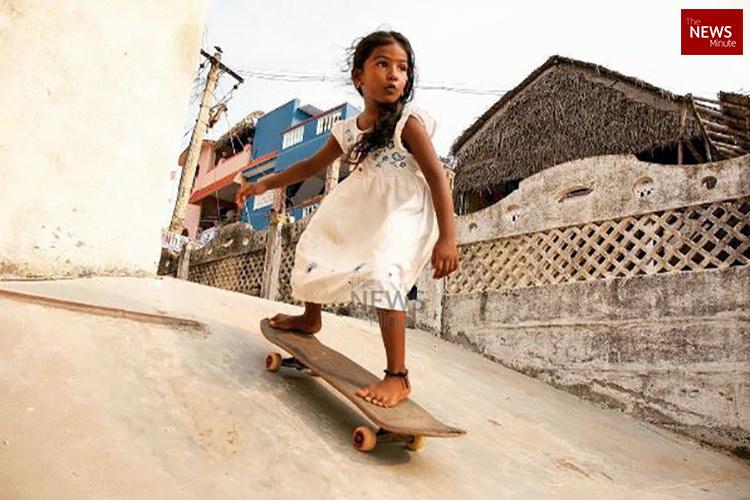
It was 3pm on a Friday. The air was hot and salty, and Fisherman Colony, a seaside village near Mahabalipuram in Tamil Nadu, was baking in the afternoon sun. Seemingly oblivious to the heat, a few children are skateboarding on a quirky new skating ramp set up in the street. Among them was an arresting sight – a small girl effortlessly navigating the concrete slopes of the ramp, setting herself apart from the rest.
With her short hair tied up and two front teeth still taking shape, 8-year-old Kamali Moorthy grins as she drops into the ramp from the granite coping and rolls down the slopes, as if she was born to do so. And this is indeed the common belief among many people, from tourists to the fisher folk, who adore Kamali, the only girl skateboarder and surfer in the hamlet.
“Was she born with a skateboard?” asks Steffano Beccari, an Italian sculptor as he watches Kamali on the ramp.
“Right? she makes it look so easy,” responds Aine Edwards, Kamali’s mentor and an Irish entrepreneur residing in Mahabalipuram.
For the skateboarding community in India, Kamali is a child prodigy. She is not a professional skateboarder yet, but she is already a part of the circuit and goes on tours with other skateboarders. How did this young girl from a fishing hamlet in coastal TN become the next big thing in Indian skateboarding?
Destined to meet
“Kamali was only 3 years old when she started skating on a slope built by Holystoked collective, which builds skating ramps free of cost across India,” Aine says, “Mahabs has always been a surfer’s town, and skateboarding is concrete surfing, so it goes hand-in-hand here.”
Velu, a well-known surfer and Kamali’s uncle’s friend taught her and her little brother, Harish, how to balance themselves on a skate board, she says. “He even gifted them two boards. Ever since those baby steps, Kamali has been on a roll, quite literally, teaching herself new tricks every day and skating to her heart’s content.”
However, it was when world-renowned skater Jamie Thomas visited Mahabs as part of a brand promotion event few years ago, that Kamali got her first big break.
“I was down the end of the street and one of my friends mentioned that there was a pro skate-boarder in town. Just then, Kamali came out in a white dress with a skate board in her hand and Jamie Thomas was by the beach. I went and asked him if I can introduce him to a little girl. The rest is history,” says Aine, adding that they were destined to meet.
For Aine, it was just surreal to watch Jamie and Kamali skateboard together.
“What was merely a chance encounter lasted 3 to 4 hours. Jamie changed all his plans and taught her new tricks,” Aine says, “And just like that, he took Kamali’s skills up by a few notches. It was magic.”
“I learned a lot of new tricks from Jamie which I have been practicing. He taught me to drop in from the big one (taller part of the ramp) and to skate through steeper slopes. Then he taught me this cool trick called rock to fakie which I’m not sure how to explain” Kamali chips in with excitement. A talkative child, who is not shy to speak up, Kamali has more than just the sporting talent, she has confidence.
Jamie even sent Kamali a skateboard, on which she has been practicing ever since. Every day, she takes her board and goes to the ramp opposite to her house to hone her skills. However, Kamali’s potential, Aine explains, is not limited to the ramps in her village.
“Last year, we took a bunch of kids, including Kamali, to Mangaluru where Holystoked set up a skate park. She skated non-stop. She dropped in from the top of the ramp which is twice as tall as the ramp she was used to back home. After she got back, she was dejected as she had to go back to the smaller ramp. It was like giving a kid a big candy and taking it back,” laughs Aine.
Skateboarder in the surfers’ family
Aine and Kamali were introduced to each other through a surfer friend who stayed in a homestay atop Kamali’s house. Kamali’s chirpy presence instantly drew everyone to her, and Aine too was charmed the moment they met.
“She was quite a character even then. A lot of fun to hang out with. We soon started going to the ocean to surf and she gradually picked up the art of riding the waves,” Aine recollects.
Unlike the other girls in the town, Kamali was born into a family of surfers and hence it came naturally to her, Aine explains.
“Surfing is in her blood. Kamali only started skating regularly during her school summer holidays, as there was no one to take her surfing. Now she can catch green waves and go sideways on her own, which is quite impressive,” says Aine.
“She has two skateboards and there’s a skating park conveniently located opposite to our house. She has been skateboarding almost every day since she was three. I sometimes think she uses her board more than her feet,” Kamali’s mother Suganthi says.
With the surf season beginning in March, Aine says that Kamali is excited to hit the waves again.
Skateboarding into the future
Living with her single mum, Suganthi, and grandparents, Kamali and her four-year-old brother Harish are the first-generation English medium school goers. So, they have to strike a balance between their formal education and sport. But with growing popularity, a lot of the residents around Mahabs want to send their kids to skate. And many of them even ask if Kamali can teach their children, explains Aine.
“The teachers in her school are very encouraging. Some of them wanted to get Kamali to teach skating to her classmates as part of the school’s extra-curricular activity,” says Aine.
“All said, this is still a conventional fishing village and the girls are brought up pretty traditionally. Many in this village don’t understand this culture of skating and surfing. For them it is something that has infiltrated from the West and they wonder what all the fuss is about?” says Aine.
Despite these challenges, Kamali, Harish and several other skater kids aim to shatter stereotypes and become mainstream skateboarders.
Aine and other surfing enthusiasts in Mahabs want to promote the sport in and around the village by setting up more and better ramps in the future. However, when asked about promoting skating through competitions, she remains sceptical, “She is too young to compete professionally. But besides this, skating much like surfing, is a soul sport. Although there are quite a few surfing contests, you do it not as a competition but for the love of the sport.”
Source ::::: Sreedevi Jayarajan in http://www.thenewsminute.com
natarajan
Long ago, there was a person who had three friends. Quite by accident, he was charged for some crime and a warrant was issued against him by the court. He approached one friend and asked him to bear witness to his innocence. He said, “I will not move out of this house; I can help you only from within this.” The second friend said, “I can come only upto the porch of the court. I will not enter the witness box.” The third friend said, “Come, I shall speak for you wherever you want me to.” The first friend is the ‘property and possessions’ which can bear witness only from within the house. The second is ‘the kinsmen and the members of the family’, who come as far as the cemetery but would not accompany the person to the seat of judgement. The third friend is the fair name earned by one’s virtues and service. These persist even after death and burial; they stand witness for ages, and announce the innocence and greatness of the individual. They decide the nature of the next birth too.
Source:::::: http://media.radiosai.org/
Natarajan

 Take off with Natarajan