A Moon is a Moon….

June full moon

Full moon was Tuesday, June 2 at 12:19 p.m. EDT (16:19 UTC). From across Earth, the full moon is shining now from around sunset to dawn.

Beautiful image from our friend Nikolaos Pantazis of the rising moon on June 2, behind Poseidon's Temple in Cape Sounion, Greece.

Beautiful image from our friend Nikolaos Pantazis of the rising moon on June 2, behind Poseidon’s Temple in Cape Sounion, Greece.

Full moon on June 2, 2015 at Hartman Rocks, Gunnison, Colorado, by Matt Burt.

Full moon on June 2, 2015 at Hartman Rocks, Gunnison, Colorado, by Matt Burt.

This wonderful shot from Chris Hartley in Queensland, Australia shows the constellation Scorpius - and the planet Saturn - inside a moon halo.  Thanks, Chris!

This wonderful shot posted to EarthSky Facebook by Chris Hartley in Queensland, Australia shows the constellation Scorpius – and the planet Saturn – inside a moon halo.

Full moon setting on June 3, 2015 from France by Patrick Astronomie.

Full moon setting on June 3, 2015 from France by Patrick Astronomie.

Full moon setting on the morning of June 3 from Paco Telescopios in Spain.

Full moon setting on the morning of June 3 from Paco Telescopios in Spain.

Full moon over Rillings Hills near Colorado Springs, Colorado by Forrest Boutin Photography.

Full moon over Rillings Hills near Colorado Springs, Colorado by Forrest Boutin Photography.

Full moon rising over Tucson, Arizona by Sean Parker Photography.

Full moon rising over Tucson, Arizona by Sean Parker Photography.

June 2, 2015 full moon behind the Tower of the Americas in San Antonio, Texas, from Chicky Leclair.

June 2, 2015 full moon behind the Tower of the Americas in San Antonio, Texas, from Chicky Leclair.


Not a full moon, but pretty close, from Odilon Simões Corrêa in Brazil.

Not a full moon, but pretty close, from EarthSky Facebook Odilon Simões Corrêa in Brazil.

Source….www.earthsky.org

Natarajan


Image of the Day…Bioluminescent Surf…!!!

Bioluminescent surf in Tasmania

The beaches around Tasmania, an island off Australia’s south coast, had a strong display of bioluminescence last month.

Photo by Paul Fleming (lovethywalrus on Instagram)

Check out this photo from Tasmania, an island state off Australia’s south coast, which had an awesome display of bioluminescence in May. Paul Fleming posted this photo on his Instagram pagein mid-May, 2015. He wrote:

Something a little different – ever been in water that sparkles and glows? For the past week, some beaches in southern Tasmania have been illuminating this awesome blue; thanks to noctiluca scintillans, a bioluminescent phytoplankton! Yep, the color and light is 100% natural. Pretty neat, eh! Commonly referred to as ‘sea sparkles’, it’s exactly as that name suggests: stir up the water, or watch the waves, and the water glistens, glows and absolutely sparkles!

By the way, bioluminescent life forms make their own light and carry it in their bodies. Fireflies are another, perhaps more commonly seen example.

In the oceans of our world, many creatures are bioluminescent. Just as fireflies use their lit-up abdomens to send mating signals and other forms of communication, so bioluminescent creatures of the deep use their internal ability to create light to warn or evade predators, lure or detect prey, and communicate between species members.

Noctiluca scintillans is amazing to see. This is a species of dinoflagellate, though, a kind of plankton linked to fish and marine invertebrate kills. A University of Tasmania website saidL

No toxic effects are known, but it is possible that the high ammonia content … irritates fish, which generally avoid the bloom areas. Noctiluca has been known to bloom extensively off the east and west coasts of India, where it has been implicated in the decline of fisheries.

Bottom line: The beaches around Tasmania, off Australia’s south coast, had a strong display of bioluminescence in May, 2015. Photo and a video by Paul Fleming,

Source….www.earthsky.org

Natarajan


Why Airplane Windows Have Tiny Holes….

My friends laugh at me when I ask for a window seat. You’re an airline pilot, they say. You have the window seat all the time.

True enough. But the cockpit, well, that’s work. As a passenger I’m actually free to enjoy the experience—to listen to music or a long-postponed podcast while gazing out at the world below, to remember that it’s still a wonder to look down, not up, at clouds. The window seat is like the best table in a café on a busy street, except that instead of people-watching, entire cities, oceans, and mountain ranges parade past.

airplane window

Still, every once in a while something interferes with that view. Maybe it’s the forehead smudges left by your seat’s previous occupant. Or the little hole that appears in the lower portion of a typical airliner window.

Hole in the window? The little one, near the bottom, that you perhaps only notice when a hollowed-out snowflake of frost forms near it. This tiny hole is called a breather hole or a bleed hole, and it serves an important safety function.

If you look closely at a typical passenger cabin window, you’ll see three panes, typically made of acrylic materials. The purpose of the innermost pane—sometimes called the scratch pane, but I like to call it the smudge pane—is merely to protect the next one.

The middle pane (with the breather hole in it) and the outer pane are more important. Generally speaking, as an aircraft climbs, the air pressure drops in both the cabin and the outside air—but it drops much more outside, as the aircraft’s pressurization system keeps the cabin pressure at a comfortable and safe level. This means that the pressure inside the aircraft during flight is typically much greater than the pressure outside.

The outer two cabin windows are designed to contain this difference in pressure between the cabin and the sky. Both the middle and the outer panes are strong enough to withstand the difference on their own, but under normal circumstances it’s the outer pane that bears this pressure—thanks to the breather hole.

airplane window

As Marlowe Moncur, director of technology 
for GKN Aerospace, a leading passenger cabin window manufacturer, put it to me via email: “[T]he purpose of the small bleed hole in the [middle] pane is to allow pressure to equilibrate between the passenger cabin and the air gap between the panes, so that the cabin pressure during flight is applied to only the outer pane.”

In the extraordinarily unlikely event that the outer pane fails, the middle pane takes over. And yes, in that case, there would be a small leak of air through the breather hole—but nothing the aircraft’s pressurization system couldn’t easily cope with.

Bret Jensen, an aerospace engineering guru at Boeing Commercial Airplanes, told me about a separate but related function of the hole: to release moisture from the air gap and stop (most) fog or frost from forming on the window. So when you’re looking out at the clouds and planetary wonders crossing below you, take a moment to give thanks for the breather hole.

There’s still the matter of that small but lovely pattern of frost that can form near the breather hole on a long flight. At cruising altitude the temperature of the outside air can be minus 70 degrees Fahrenheit. The frost, according to Moncur, “is caused by condensation of water when cabin air contacts the cold window surface.”

But what causes that telltale frost pattern? The physics behind it are an interesting question, he says. “The circular pattern must be a function of window surface temperature, humidity of the cabin air and flow rate through the bleed hole.”

Read the original article on Slate. Copyright 2015. Follow Slate on Twitter.

Read more: http://www.slate.com/blogs/the_eye/2015/05/29/what_s_that_thing_why_are_there_holes_in_airplane_windows.html#ixzz3bmg2xKTh


Brilliant Video shot From IAF Jaguar Plane…!!!


How difficult is it to film a running car sitting in another car? Pretty difficult. But this video mission has crossed all levels of precision and perfection by capturing the launch and the flight of India’s nuclear-capable sub sonic cruise missile called Nirbhay. The missile is being developed by India’s DRDO with features like wing development and a turbofan engine. It carries either conventional or a nuclear payload while flying to the target.

This video uploaded by Anantha Krishnan M. is from the last successful test and is shot from an IAF Jaguar plane. We salute the pilot and the camera person for a brilliant footage!

 Source…..www.storypick.com and http://www.youtube.com
Natarajan


Here is what a Pilot Thinks When the Aircraft loses all of its Engines in the Mid Air….

Last weekend, Singapore Airlines Flight 836 was traveling from Singapore to Shanghai when the twin-engine Airbus A330-343 lost power on both engines over the South China Sea.

Image result for airbus A330-343

Image of Airbus330-343


Fortunately, the pilots were able to restore power to the engines, and the flight was able to continue on to its destination.

No injuries have been reported.

Modern turbofan engines are very robust pieces of engineering and tend to be incredibly reliable.

That makes last weekend’s incident an exceedingly rare event.

In fact, experienced A330 pilot Karlene Petitt told Business Insider that in her years flying the popular jet, she has never encountered, in pilot parlance, a “dual flameout.”

So what is an airline pilot thinking when the engines on his or her plane inexplicably lose power?

“What would go through my mind is fly the plane and do everything I can to get the engines started,” Petitt said in an email. “That would be the only thing to think about.”

In the cockpit, pilots are equipped with reference guides which provides guidance and checklists for a wide variety of operational situations – including the loss of power on all engines.

At cruising altitudes – 39,000 ft. in the case of the Singapore jet – the air is very thin and there may not be enough oxygen to get the engines to relight.

However, according to Petitt, “Normally when you get down around 24,000 feet you should be able to get one started because of the denser air at that altitude.”

In the case of Singapore Flight 836, the airliner lost 13,000 feet of altitude before the pilots were able to get the engines going again.

According to Petitt, she would only think about looking for a landing location after realizing she wouldn’t be able to get the engines going.

Depending on how high and how far the airplane is from an airport, the pilot would then determine what would be the appropriate course of action

In past incidents, pilots have chosen a variety of strategies.

In 1983, Air Canada Flight 143 going from Montreal to Edmonton ran out of fuel midway through the flight after the ground crew miscalculated the amount needed for the trip. The pilots were able to glide the twin-engine Boeing 767-200 jet to safety at a retired Canadian military runway that had been turned into a race track.

In 2001, an Air Transat Airbus A330 traveling from Toronto to Lisbon developed a fuel leak while flying over the Atlantic Ocean. The widebody jet lost all power, but the pilots were able to glide to an airport in the Azores Islands.

Miracle on the Hudson
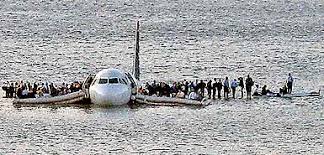
Most famously, US Airways flight 1549 lost both of its engines after colliding with a flock of geese while taking off from New York’s LaGuardia Airport. Due to the low altitude, the pilots didn’t have time to complete the engine restart procedure. Miraculously, Captain Sully Sullenberger was able to successfully guide the Airbus A320 down in the middle of the Hudson River.

In these instances, the pilots were able to safely land their planes with few injuries to the passengers and crew.

“Pilots never stop flying the plane,” Petitt reiterated. “No matter what, we will do what it takes.”

Source….BENJAMIN ZHANG in www.businessinsider.in

Natarajan

Image of the Day….FireFlies over Sky…!!!

Fireflies are back, upstate New York

Photo and report from an EarthSky friend who regularly watches for them.

View larger. | Fireflies in northern spring 2015 by Matt Pollock .

Here’s the first firefly photo we’ve seen so far this year. Matt Pollock in the town of Brunswick in upstate New York posted it at EarthSky Facebook this week (May 27, 2015). He wrote:

Each year as part of my planned outings I include the return of the fireflies. It seems they have come early this year and in great abundance. Last night it never dropped much below 70 degrees F and hot nights in deep grass is their favorite breeding time and place. Typically, the females climb up on the tips of the grass and signal to the males who search around in roving packs from above. I think I learned something interesting last night. When its windy, The males fly low when going upwind, then climb rapidly and let the wind cast them over the grass tops as they search for their mates. If they see one flashing, they drop like a meteor then hover (often in groups) and signal to the ladies below.

I set up my camera low to the ground, just above the grass tops and ran a time lapse. Each time the camera took a picture, the green LED would flash a few times indicating it was taking another photograph. At one point, I think a group saw this and decided to check it out. As I sat in the grass a few feet away, a cluster of them upwind from the setup suddenly rose and dive bombed the camera. Some of them actually came within inches of the lens.

I had the Fstop set for F/2.8 and focused at infinity at a focal length of 24mm with the hopes of catching the core of the Milky Way so the depth of field was fairly narrow and and field of view fairly wide. As can be seen they came in close enough to be pretty blurry and large considering that even something close to the lens is smaller than normal.

As is often the case, the cloud cover prevented any capture of galactic core, but for a brief interval you could see Sagittarius and the “Teapot” asterism which looked almost like lightning bolts coming out of its center. Next time I will pick the midpoint for focus but overall I am pleased with what I got. I thoroughly enjoyed being out there and watching the annual show and will be looking for more of them until the fields are cut and they move on again until next year.

By the way, fireflies have an organic compound in their abdomens called luciferin. As air rushes into the abdomen, a chemical reaction gives off the firefly’s familiar glow. Read more: Why do fireflies light up?

Bottom line: First firefly photo we’ve seen this year, from Matt Pollock in upstate New York.

Source….www.earthsky.org

Natarajan


image of the Day… Sunset Sequence in Mars…!!!

Sunset on Mars

NASA’s Curiosity Mars rover recorded this sequence of views of the sun setting at the close of the mission’s 956th Martian day, or sol (April 15, 2015), from the rover’s location in Gale Crater.

The four images shown in sequence here were taken over a span of 6 minutes, 51 seconds.

This was the first sunset observed in color by Curiosity.  The images come from the left-eye camera of the rover’s Mast Camera (Mastcam). The color has been calibrated and white-balanced to remove camera artifacts. Mastcam sees color very similarly to what human eyes see, although it is actually a little less sensitive to blue than people are.

Dust in the Martian atmosphere has fine particles that permit blue light to penetrate the atmosphere more efficiently than longer-wavelength colors.  That causes the blue colors in the mixed light coming from the sun to stay closer to sun’s part of the sky, compared to the wider scattering of yellow and red colors. The effect is most pronounced near sunset, when light from the sun passes through a longer path in the atmosphere than it does at mid-day.

Malin Space Science Systems, San Diego, built and operates the rover’s Mastcam. NASA’s Jet Propulsion Laboratory, a division of the California Institute of Technology, Pasadena, manages the Mars Science Laboratory Project for NASA’s Science Mission Directorate, Washington. JPL designed and built the project’s Curiosity rover.  For more information about Curiosity, visit http://www.nasa.gov/msl and http://mars.jpl.nasa.gov/msl.

Credit: NASA/JPL-Caltech/MSSS/Texas A&M Univ.

Source……www.nasa.gov

Image of the Day…Mammatus Clouds…!!!

Mammatus clouds over central Texas

Mammatus clouds don’t keep extending downward to form tornadoes, as some believe. But they do come before, during or after severe weather.

Captured on Memorial Day weekend 2015 Anne-Marie in Georgetown, Texas.  Visit her Facebook page:  Trees

In and around EarthSky’s hometown of Austin, Texas – and, in fact, up into Oklahoma and other parts of the central U.S. – there was some catastrophically bad weather over the Memorial Day weekend. Those who look skyward also noticed lots of mammatus clouds over a period of several days, like these clouds captured by Anne Marie in Georgetown, Texas. These ominous but beautiful clouds can appear around, before or after storms. Anne Marie appears to have caught them as the clouds were breaking up, just as the sun was going down. She wrote:

Mammatus clouds over Georgetown, Texas.

May 25, 2015.

These beautiful pearls formed at the end of a gritty day of weather across Central Texas.

Source…..www.earthsky.org

Natarajan


Image of the Day… Owls…!!!

Two owls

Looks like screech owls like to snuggle, too

Janet Furlong in Culpeper, Virginia captured this image of two screech owls on May 15, 2015.

A friend, Janet Furlong, posted this photo to EarthSky Facebook. Isn’t it sweet? When we passed the image along on Facebook last week, many noticed that the bark on tree in the lower right also looks like an owl. Seeing recognizable objects or patterns in otherwise random or unrelated objects or patterns is called pareidolia. Read about pareidolia, here.

Source….www.earthsky.org

Natarajan

Stunning Images of Planet Earth ….Captured From ISS…!!!

The Dutch physician and European Space Agency astronaut was selected to participate in International Space Station expeditions 30 and 31. Leaving the planet on December 21st 2011 and returning the following July, Andre Kuipers captured some absolutely incredible images of our planet.

Above Earth
400 kilometers above Earth
Astronauts
Australian Outback
The Australian Outback
Sunset From Space
A bizarre interaction between light and the sunset

Andre Kuipers Photo Of Canada
Canada
andre-kuipers-comet
A comet as seen from ISS
andre-kuipers-flattened-moonbeams
Flattened Moon beams
andre-kuipers-iss-moonlight
ISS at MOONLIGHT
andre-kuipers-sahara-atlantic
Sahara Desert and the Atlantic Ocean
andre-kuipers-moonrise
The Moonrise
andre-kuipers-observatorium
The ISS Observatories
Sahara Desert By Andre Kuipers
The Sahara Desert and Mauritania
andre-kuipers-somalian-desert
over the Somalian Desert
andre-kuipers-soyuz
The Soyuz – the apparatus Kuipers used to return to Earth

The Super Moon
The  Super  Moon
Natarajan