” Google’s Internet Balloons Have already Traveled 3 Million Kilometers…” !!!

Google‘s Internet balloons, part of an ambitious experiment called Project Loon to bring web connectivity to remote areas, have cumulatively traveled 3 million kilometers since 2013, the company said Thursday.

Since announcing the project last July, the search giant‘s experimental wing, Google X, has refined the manufacturing process so balloons last 10 times longer—so far, a record of 130 days—in the stratosphere compared with balloons from last year. Furthermore, with automated processes, Google can now launch up to 20 balloons a day. The company is also using computer trajectory simulations to maneuver balloons accurately to their targets.

Google’s made big progress on Project Loon, but it’s not the only company aiming to blanket the world with Internet access. Facebook is also building an army of drones, airplanes, and satellites to bring the web to remote areas lacking Internet infrastructure.

For now, though, take a moment and think about what it means to travel 3 million kilometers:

“That distance would take you around the earth 75 times, or get you to the moon and back nearly 4 times over,” according to Google.

[Screenshot: via Project Loon]

SOURCE::::www.fastcompany.com

Natarajan

This 110 Years old Light Bulb That’s is Never Been Turned Off …!!!

The 110 Year-Old Light Bulb That's Never Been Turned Off

The oldest lightbulb in continuous use was installed before the Wright Brothers took flight, is 110 years old, and is still as beautiful as the day she was born. In fact, it’s likely the oldest electrical device in continuous use period. Take a moment and consider just how much the world has changed around this one, singular device.

It was a hot summer evening in Livermore, California in 1901 and the band concert across the street was just about to conclude, but the fire captain had an announcement. The Fire Department Hose Cart House on L Street had just installed a new modern technological marvel, one of the first electric carbon lightbulbs in town and invited anyone curious to stop by and witness this new invention. This was the “Improved Incandescent Lamp” was the lightbulb of choice and it was an incredible design. In many cities the Fire Departments were motivating people to consider using this relatively new invention for safety. And of course this came by years of heartbreaking experience.

The 110 Year-Old Light Bulb That's Never Been Turned Off

A lost era when companies had so much pride about who they were, where they were and what they built.

Genius Inventor

This amazing light bulb was invented by Adolphe A. Chaillet and manufactured by the Shelby Electric Company. The beautiful handblown glass bulb with a uniquely shaped carbon filament beamed a consistent ~10 watts (perhaps more). This light bulb has been turned on ever since, over 40,150 days. The only rest she took was for about 7 days during a renovation and the random power outages over the decades. She always woke up.

You can check in on how she is doing, still proudly casting her light and reporting for duty for the last 110 years at this live webcam.

Bad For Business

Known as the Centennial Light, the Livermore Fire department is really quite proud of the bulb and the built to last American engineering and manufacturing that went into it. Sadly Adolphe’s superior lightbulb design and the Shelby Electric Company did not survive for a number of reasons.

The 110 Year-Old Light Bulb That's Never Been Turned Off

One of the many reasons tweets would not work in 1901.

Some suggest that it was a plan of planned obsolescence that was taking over the industry that finally drew the end of Adolphe’s design. Some may suggest that the Shelby technology did not survive because in some way it was inefficient or high wattage or bright light was not possible. This is not the case at all. When the Shelby bulb was installed in 1901 it was brighter than a standard Edison bulb. Shelby also had bulbs of up to 60 watts in 1901 with color tonality of light orange to almost bright white this was far better than any other product.

Shelby was sold in a roll-up of a vast majority of Lightbulb companies in the United States. The National Electric Lamp Association a division of the General Electric Company purchased the Shelby Electric Company and with-in a year stopped all production on Adolphe A. Chaillet amazing design.

The 110 Year-Old Light Bulb That's Never Been Turned Off

Still Here

The many advancements Adolphe made are lost to the sands of time. The exact processes may not have been saved, his knowledge is gone. Although there were three tantalizing patents issued in his life, they do not explain how he made his amazing carbon filament. What Adolphe really created was almost erased from popular history.

The 110 Year-Old Light Bulb That's Never Been Turned Off

Yet this 110 year old light bulb is proof of what one person can achieve. It’s very existence proudly states, I am still here. It is proof that there is far more to all technologies than we can ever imagine. It is proof that true history matters. If only to pay tribute to the genius that got us so very far.

This proud 110 year old girl elegantly reminds us of all of the past, present and future Adolphe A. Chaillet’s of the world.

My deepest wish is that this light never goes out and can be contemplated perhaps a thousand years from now. May she serve as a living reminder of how we can make even the most simple useful things heroically beautiful.

The 110 Year-Old Light Bulb That's Never Been Turned Off

The world may change and still she glows.

SOURCE:::: Brian Roemmele – Quora  IN  www.gizmodo.com

Natarajan


Awesome Zen Stories that Will Teach you Important Life Lessons….

Awesome Zen Stories That Will Teach You Important Life Lessons

Zen has a rich tradition of storytelling. Actually, just about the entire human race has a rich history of storytelling. Why do we like stories so much? Because we can identify with them. Stories, whether real or not, pull and tug at our emotions. We connect personally with stories.

Whereas someone can tell us that it’s important for us to appreciate and care for our parents, another person can tell us a story about the life of a daughter and her mother, and about how neither could ever see eye-to-eye all the way up until the day that the mother passed away.

Even if you aren’t a daughter, but a son, or if it was your father whom you had that type of relationship with, or even if you just feel like you don’t appreciate your mother or father (or both) enough, regardless, a story like that can touch you in a way that someone simply telling you, “hey, it’s important that you appreciate your parents”, could never do.

We need to experience something directly in order to really learn what it’s about. This is wisdom, as opposed to knowledge much like you’d acquire in a class at school, a parrot-like type of learning that serves as a nice basis for establishing the necessary foundation for certain larger tasks, but which can serve little real use elsewhere particularly in advancing your well-being.

I love Zen stories. Not just because I find them fun, because I do (most Zen stories require some level of meditative contemplation to figure out), I love them because their purpose is to teach a lesson. Also, Zen stories go beyond just Zen. They’re really just stories about life. So keep in mind I only say Zen stories because they originated from the Zen Buddhist tradition. They speak of truths which everyone can learn from though (as does all of Zen).

The lesson can be anything- any undeniable life truth which can be discovered through a life devoted to looking within yourself. This is the life of any Buddhist, many non-Buddhists, and should be the life of anyone who cares to find the path to true peace and happiness.

These stories only seek to point the way. Don’t take any of them for the truth without investigating them for yourself. The point isn’t to believe blindly, it’s to develop confidence in your life and in the way. By the way, I mean the way to live our best life and ultimately find peace within ourselves and with others. Here’s some of my favorite Zen stories:

6 Awesome Zen Stories That Will Teach You Important Life Lessons

1. Everything changes

“Suzuki Roshi, I’ve been listening to your lectures for years,” a student said during the question and answer time following a lecture, “but I just don’t understand. Could you just please put it in a nutshell? Can you reduce Buddhism to one phrase?”

Everyone laughed. Suzuki laughed.

“Everything changes,” he said. Then he asked for another question.

Explanation: One of the foremost teachings in Buddhism is that everything in life is impermanent. Suzuki Roshi (Shunryu Suzuki of Zen Mind, Beginner’s Mind) is referring to this impermanence by saying “everything changes”. This is a very deep teaching, but I’ll attempt to sum it up in a way that can be understood and immediately helpful in a few words.

Because it encompasses everything, you can contemplate for hours on end and not realize the full magnitude of the principle of impermanence. You are impermanent, your loved ones are impermanent, your home is impermanent, even our planet is impermanent.

Why is this important? Because it teaches us that grasping onto things is one of the major reasons as to why we suffer. We need to live being aware of the ever-changing nature of reality and appreciate the present moment. It’s not about letting go, it’s really about not grasping in the first place. If we can learn to live in this way, we can find peace in everyday life.

2. Empty your cup

Nan-in, a Japanese master during the Meiji era (1868-1912), received a university professor who came to inquire about Zen.

Nan-in served tea. He poured his visitor’s cup full, and then kept on pouring. The professor watched the overflow until he no longer could restrain himself. “It is overfull. No more will go in!”

“Like this cup,” Nan-in said, “you are full of your own opinions and speculations. How can I show you Zen unless you first empty your cup?”

Explanation: The story tells it how it is, so I’ll leave it at that.

3. Non-judgment 

Once upon the time there was an old farmer who had worked his crops for many years. One day his horse ran away. Upon hearing the news, his neighbors came to visit. “Such bad luck,” they said sympathetically.

“Maybe,” the farmer replied.

The next morning the horse returned, bringing with it three other wild horses. “How wonderful,” the neighbors exclaimed.

“Maybe,” replied the old man.

The following day, his son tried to ride one of the untamed horses, was thrown, and broke his leg. The neighbors again came to offer their sympathy on his misfortune.

“Maybe,” answered the farmer.

The day after, military officials came to the village to draft young men into the army. Seeing that the son’s leg was broken, they passed him by. The neighbors congratulated the farmer on how well things had turned out.

“Maybe,” said the farmer.

Explanation: The farmer is practicing non-judgment. He understands the true nature of life, that you can’t judge any event as an “end” in a way. Our life doesn’t play out like a work of fiction. There aren’t definite breaks that separate one moment versus another, and there isn’t a perfectly formulated end which everything builds to.

There’s always tomorrow. And whether the day was good or bad, there’s a million effects which can arise from one event. Good and bad are interconnected. They are, in fact, two sides of the same coin. If things seem perfect, they aren’t. If it seems like it’s Armageddon in your corner of the world, it’s not. Things can change in an instant, at all times. And they will at some point or another.

This doesn’t mean that we can’t be happy. On the contrary, it means that we need to realize this truth and live in a way that we’re constantly aware of it in order to find peace and happiness. Don’t let this change the way you live too much just yet though. For now just think on it, observe your life through the lens of this infinitely co-arising universe. This act in itself can bring you a great sense of peace.

4. Right and Wrong

When Bankei held his seclusion-weeks of meditation, pupils from many parts of Japan came to attend. During one of these gatherings a pupil was caught stealing. The matter was reported to Bankei with the request that the culprit be expelled. Bankei ignored the case.

Later the pupil was caught in a similar act, and again Bankei disregarded the matter. This angered the other pupils, who drew up a petition asking for the dismissal of the thief, stating that otherwise they would leave in a body.

When Bankei had read the petition he called everyone before him. “You are wise brothers,” he told them. “You know what is right and what is not right. You may go somewhere else to study if you wish, but this poor brother does not even know right from wrong. Who will teach him if I do not? I am going to keep him here even if all the rest of you leave.”

A torrent of tears cleansed the face of the brother who had stolen. All desire to steal had vanished.

Explanation: This story is pretty straightforward, but it certainly doesn’t make you think any less than the rest. How quickly would most people turn their back on someone who commits a crime like stealing, just as the pupils did. But look deeper and you might just see another human being. Someone that simply needs to be shown the path.

Don’t write people off so easily. Expressing compassion isn’t always easy, but we’re all together in this life, so we can’t just help those that keep good behavior. Those people who commit such crimes are often some of the people that need help with the most basic spiritual and human principles, such as right and wrong.

If you have a loved one who’s committed a crime before you’ll know exactly what I mean. You know they can be better and they shouldn’t be thrown out just because they did something wrong at some point. Sure, we need to keep order, so they should be disciplined for their behavior, but we also need to take time to teach them right and wrong. We should strive to lift them up just as we strive to lift ourselves and those we love up despite their own flaws.

5. Be the boss

A horse suddenly came galloping quickly down the road. It seemed as though the man had somewhere important to go.

Another man, who was standing alongside the road, shouted, “Where are you going?” and the man on the horse replied,

“I don’t know! Ask the horse!”

Explanation: This is a short but well-known Zen story with a powerful meaning behind it. The horse symbolizes our habit energy. The story explains the way we usually live, at the mercy of our old habit energies which have been established not by our intentional actions, but by our surroundings and mindless activity.

The horse is pulling us along, making us run here and there and hurry everywhere and we don’t even know why. If you stopped to ask yourself from time to time why exactly you’re running around so much, sometimes you might have an answer, but it’s never a very good one. You’re just used to it, it’s how we’re taught to live.

But as much as we run, it gets us nowhere. We need to learn how to take back the reigns and let the horse know who’s boss.

You’re the boss, you’ve always been the boss, so start acting like it.

6. Watch yourself

There was once a pair of acrobats. The teacher was a poor widower and the student was a young girl by the name of Meda. These acrobats performed each day on the streets in order to earn enough to eat.

Their act consisted of the teacher balancing a tall bamboo pole on his head while the little girl climbed slowly to the top. Once to the top, she remained there while the teacher walked along the ground.

Both performers had to maintain complete focus and balance in order to prevent any injury from occurring and to complete the performance. One day, the teacher said to the pupil:

‘Listen Meda, I will watch you and you watch me, so that we can help each other maintain concentration and balance and prevent an accident. Then we’ll surely earn enough to eat.’

But the little girl was wise, she answered, ‘Dear master, I think it would be better for each of us to watch ourself. To look after oneself means to look after both of us. That way I am sure we will avoid any accidents and earn enough to eat.’

Explanation: This one isn’t a specifically Zen story, but it’s said to have been told by the Buddha himself. This story is meant to illustrate that taking care of yourself is the most important thing you can do to take care of others.

By learning how to nourish your mind and body you’ll naturally begin to treat those around you with more compassion, love, and kindness and create a more positive impact on the world around you as a whole. There is no division, taking care of yourself (in a spiritual sense, not in a material “buy myself things” kind of sense) equals taking care of others.

Specifically, by taking care of yourself, the Buddha was referring to mindfulness. The Buddha also said that by taking care of others, by showing them compassion and loving-kindness, we take care of ourselves.

Message For the Day…” Spiritual Education is the Need of the Hour …”

Modern education is mere bookish knowledge, confined to what is contained in the texts. Today many are pursuing such secular education only (i.e., value neutral). Secular education alone is not enough. It must be supplemented with spiritual education. Spiritual education has its effect on one’s heart, and is called Educare. Educare means bringing out the latent Divinity, that is hidden in the heart of human beings and establishing it as an ideal to the whole world. Through Educare, you must develop the principle of love and students must follow the path of truth. True education is that which is suffused with truth and love. Secular education is for making a living, whereas spiritual education is for reaching the goal of life. It is the duty of students as well as educators to harmonize the secular education with spiritual education. This is the prime necessity today. 

Sathya Sai Baba

” Fax Machine was Invented in 1843 … ” !!!

Today, we mostly think of the fax machine as an outdated piece of technology. While there are still some uses for it in an office-setting, technological advances are sending the fax machines to the same pasture as pagers, land-line telephones, and disposable cameras. Even if this is the last we hear of the beeps and bops that echo as an incoming fax is transmitted, the fax machine had a very long life – an amazing 171 years to be exact. Yes, the fax machine was invented in 1843, before the Model-T was even a dream, before the telephone was invented, and even before the American Civil War broke out.

Alexander Bain, a Scotsman clockmaker living in London, was already a decently well-known inventor by the time he got to inventing the world’s first facsimile (meaning in Latin to “make alike”) – or fax – machine. In 1841, he had invented an electric clock by electrifying a pendulum (rather than using springs or weights), while submitting patents for several other useful inventions like improved control systems for railways, automated music machines, and devices to measure how fast a ship was going.

On May 27, 1843, he applied for a patent for a “chemical telegram” and “”improvements in producing and regulating electric currents and improvements in timepieces, and in electric printing, and signal telegraphs,” in which “a copy of any other surface composed of conducting and non-conducting materials can be taken by these means.”

His new invention used the newly popularized telegraph (the electrical telegraph, which was patented by Samuel Morse in 1837) as its base and then added electromagnetic pendulums (like his clock) that would scan the image and puncture a chemically treated paper with lines and tics, which would then be interpreted by a telegraph operator.

Bain’s initial version of the fax machine essentially was a written telegraph and this wasn’t lost upon Samuel Morse. Morse and Bain became embroiled in a patent dispute that eventually was ruled in Morse’s favor. Journalists of the time wondered out loud that since the dispute was taken up in US courts and Morse was American, that the ruling had a bias. In fact, one even went as far as to jokingly state that Bain should never bring his children to America because if he did, Morse would surely claim them as his own too.

Bain submitted another patent for the chemical telegram in 1846 with improvements to his invention that included sketching out and sending facsimile images. It used the same premise as before, but now the paper was treated with a mixture of ammonium nitrate and potassium ferrocyanide, so when electrified, the paper turned blue. (See: Why Blueprints are Blue.) Again, Morse blocked the patent. Within a few years, Bain would further improve his machine, resulting in a version capable of copying approximately 325 written words per minute, about 8 times what Morse’ telegraph system could do. However, by this time, other inventors were getting into the facsimile game with even better designs and Bain’s career was basically over. He would die in poverty in 1877.

This brings us to Frederick Bakewell who received a patent for his improved “image telegraph,” which essentially replaced the pendulums with synchronized rotating cylinders. He was able to send the first certified “telefax” with actual words and images. He demonstrated it at the Great Exhibition in London in 1851, but it wasn’t met with much enthusiasm due to the very long time it took to copy and transmit. Plus, as with Bain’s system, it suffered from synchronization problems.

Italian physicist Giovanni Caselli focused his work on making sure the cylinders stayed synchronized. He succeeded with his invention, the pantelegraph, which used a regulating clock signal to keep both ends in perfect synchronization. With Caselli’s device, first, a message or image would be written in non-conductive ink on a piece of tin. The thin tin sheet would then be scanned by an electrified transmitting stylus, attached to telegraph wires, going back and forth across the sheet. When the stylus encountered the non-conductive ink, rather than the tin, electrical conduction stopped. A very similar apparatus was placed on the receiving end, except this had chemically-treated paper and an electrified stylus (similar to what Bain had done), which would contact the paper where the conduction stopped on the sending side, creating an exact replica of the message. Thanks to his advancements in synchronization, Caselli had created the first reliable fax machine.

Caselli was so confident in it, he demonstrated it for the French Emperor Napoleon III in 1860. The Emperor was astounded with what he saw – the signature of well-known French composer Gioacchino Rossini transmitted over a 140 kilometer long telegraph line between Paris and Amiens. To ensure its viability, the Emperor asked for another test. So, Caselli sent a message between Paris and Marseille, which had 800 kilometers separating them. It worked. Napoleon III accepted the pantelegraph for use by law across France. A year later, Russian Tsar Nicholas I used the pantelegraph to send messages between his palaces in Moscow and Saint Petersburg. Unfortunately, the French-Prussian war of 1870 caused many telegraph poles to come down across both countries and forced the pantelegraph to cease operations. But the technology was here to stay.

Improvements continued on the image-creating telegraph with Bernhard Meyer using a drum to double the speed of the previous pantelegraph. In 1888, Ohio-born Elisha Gray received a patent for the telautograph, a unit that had horizontal and vertical bars that further quickened the pace. Foster Richie created the telewriter, which could be operated on the newly-built telephone lines that stretched across America, allowing for both speech and copies simultaneously.

The first wireless fax was sent, using radio-waves, in 1924. Richard Ranger worked for the Radio Corporation of America (RCA) when he sent an image of President Calvin Coolidge on November 29, 1924 across radio-waves. Also all the way back in 1924, the first color fax was sent by Herbert Ives of the American Telephone and Telegraph Company (AT&T).

Despite reliable fax machines (even wireless and color) being around for quite some time, it wouldn’t be until 1964 when fax machines were widely used commercially. Xerox, a Rochester, New York based company, developed the “Long Distance Xerography” which connected copiers in offices via telephone lines. It would take a few years, but Xerox fax machines soon were the mode de jour to send and receive documents. And the rest, as they say, is history.

SOURCE:::: http://www.todayifoundout.com

Natarajan

Message For the Day…” What is Liberation ?..Help Ever , Hurt Never … “

Do not find faults with others. If you point an accusing finger at someone, remember three fingers are pointing to you. Wear the ornament of Truth to adorn your neck (Sathyam Kantasya Bhushanam). Charity is the true ornament that make your hands beautiful and elegant (Hasthasya Bhushanam Dhanam). Thus you must sanctify each limb of your body by engaging in sacred activities. Your eyes should look at only sacred things. Do you know what an enormous power is latent in your eyes? There are crores of light rays in them. In olden days, people used to invoke the grace of Sun God to have a better vision. When you performSurya-namaskar (worship of Sun God) and invoke His grace, the light rays in your eyes will become more effulgent and inspire you. People aspire to attain liberation. What is liberation? Help ever, hurt never – that is true liberation. To get rid of attachment (moha) is true liberation (moksha).

Sathya Sai Baba

World”s Largest Swimming Pool…1KM Length Covering 20 Acres !!!

San Alfonso Del Mar Pool   The Worlds Largest Swimming Pool

San Alfonso del Mar Pool with its length of 1 km and a coverage of almost 20 acres is registered in the Guinness Book of Records as the world’s largest swimming pool. This amazing swimming pool seems to cover the same amount of water as 6000 regular swimming pools and visitors can enjoy in many different activities besides swimming, such as sailing, kayaking, scuba diving and paragliding.

This great man-made lagoon is part of the San Alfonso del Mar resort, located in the city Algarrobo, Chile. It was opened in 2006 and since then attracts an increasing number of tourists. This pool was made by collecting and filtering water from the ocean, while the sun warms it up to 9 degrees higher than the the ocean water. This technology was founded by Fernando Fischmann and the aim is to allow for ‘lagoons of unlimited size’ with crystal clear water and reduced costs to typical pools.

San Alfonso Del Mar Pool   The Worlds Largest Swimming Pool

Photo via: sanalfonso.cl

San Alfonso Del Mar Pool   The Worlds Largest Swimming Pool

Photo via: taringa.net

San Alfonso Del Mar Pool   The Worlds Largest Swimming Pool

San Alfonso Del Mar Pool   The Worlds Largest Swimming Pool

San Alfonso Del Mar Pool   The Worlds Largest Swimming Pool

San Alfonso Del Mar Pool   The Worlds Largest Swimming Pool

San Alfonso Del Mar Pool   The Worlds Largest Swimming Pool

San Alfonso Del Mar Pool   The Worlds Largest Swimming Pool

November 19… Birthday of Mrs. Indira Gandhi…Rare and Vintage Photos Collection…

Jawaharlal Nehru (1869 – 1964), President of the Indian Congress, with his daughter future Indian prime minister, Indira Nehru (Indira Priyardarshini Nehru, 1917 – 1984) in Bombay. (Photo by Keystone/Getty Images


Portrait of Indira Gandhi (1917 – 1984) who served as Prime Minister of India from 1966 to 1974 and 1980 until her assassination in 1984, New York, 1963. (Photo by Bachrach/Getty Images)

Queen Elizabeth II meets Indira Gandhi (1917 – 1984), the Prime Minister of India, at Hyderabad House in Delhi, India, 17th November 1983. (Photo by Tim Graham/Getty Images)


22nd March 1982: British prime minister Margaret Thatcher with the Indian prime minister, Indira Gandhi (1917 – 1984), outside number 10 Downing Street. (Photo by Gary Stone/Central Press/Getty Images)

23rd June 1938: Pandit Jawaharlal Nehru (1869 – 1964) in London for discussions. With him (right) is his daughter Indira (Indira Priyardarshini Nehru, later Gandhi, 1917 – 1984). (Photo by Keystone/Getty Images)

20th January 1966: Mrs Indira Gandhi (1917 – 1984) with Mr Kamaraj and Mr Nanda makes a gesture of peace after her election as leader of the Congress Party. (Photo by Keystone/Getty Images)

SOURCE::: https://in.news.yahoo.com/

Natarajan

” A Cycle Beats Ferrari…Reaches Over 330kmph !!!”

The cycle that you see in the video is definitely not an ordinary cycle, but a rocket-powered one. The cycle is fuelled by a mix of hydrogen peroxide and compressed air. On November 7, 2014, Francois Gissy reached the speed of 207mph on the cycle developed by his friend Arnold Neracher at a racing circuit in France. With the new record, Gissy broke his previous best of 177.13mph.

Makers of this rocket-powered cycle will now be working on a new bicycle to beat their own record in 2015.

Cycle Beats Ferrari; Reaches Over 330kmph


You must have seen so many drag races, where results turned out to be unexpected (a more powerful car losing to a lesser one), but none of those would have been half as exciting as this one. That is because of the fact that this race was not between two sportscars or supercars, but it was a cycle that took on a Ferrari.

Built by Arnold Neracher, the cycle shown above achieved a top-speed of mind-boggling 331Km/h in just 4.8 seconds! Yes you read it right, a cycle that goes faster than some of the most powerful cars out there in the market. The car it took on was a Ferrari F430 Scuderia, and within micro seconds, the cycle left the car way behind.

SOURCE:::: You Tube and auto.ndtv.com

Natarajan


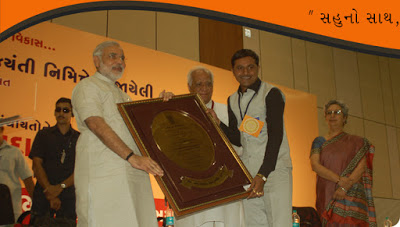
How One Man….Himanshu Patel…Transformed a Gujarat Village …!!!

Punsari village, barely 100 km from Ahmedabad, could be a textbook case of development. Closed-circuit cameras, water purifying plants, air-conditioned schools, Wi-Fi, biometric machines – the village has it all. And all of it was done in a matter of eight years, at a cost of a mere Rs. 16 crore.

The man behind the transformation is its young sarpanch – 31-year-old Himanshu Patel. A graduate from North Gujarat University, Mr Patel had won the panchayat polls in 2006, at the age of 23.

Back then, the village didn’t even have proper roads, power or water. The panchayat funds were in deficit. Mr Patel found though money come aplenty, it was the utilisation that’s at fault.

Over the next eight years, together with the district administration, he stitched up funds from under various heads – the District Planning Commission, Backward Regional Grant Fund, 12th Finance Commission, and those under Self Help Group Yojnas – and began the development of the village.

The results are obvious. Recently, a team from the Central ministries of rural and urban development had come to study the “Punsari model”.

But the young sarpanch is already onto his next projects – a unit producing electricity out of plastic waste and e-rickshaws for garbage collection. “The state government has already sanctioned Rs. 52 lakh,” he said.

Understanding the importance of education, Mr Patel has earmarked a chunk for the village school. From 300 students in 2006, the number has now doubled to over 600. The classrooms are not just air-conditioned but also have computers and projectors.

“We have managed to attract more children,” said teacher Narendra Jhala.  Vidya Patel, a student of Class 7, thinks learning is fun. “The audio visual presentations make it easier to remember our lessons,” she said.

Interestingly, Mr Patel has not asked for a penny from the MLA fund, and over the last eight years, the village has just got Rs. 1 lakh from the MP fund.

“We didn’t feel the need, since there is enough from various budgetary grants of the state and Centre. If you utilise it properly, you can work wonders,” said Mr Patel.

“The village has demonstrated how understanding various schemes available and leveraging them properly can bring about a qualitative change,” said Himmatnagar collector Banchha Nidhi Pani.

SOURCE::::www.ndtv.com and nidhi-bansal.blogspot.in

Natarajan