Earth
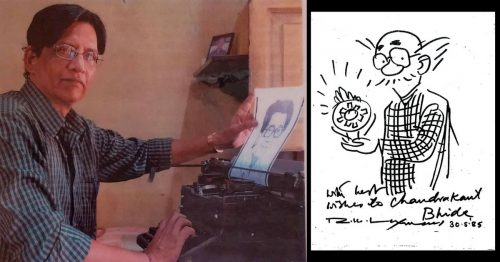
Chandrakant Bhide: Here is Why RK Laxman Was a Fan of this Diligent Typist…
A typist is required to be fast and accurate, and while he proved to be precisely that, Bhide was much more too. Throw in artistic to those set of skills, and you have Chandrakant Bhide.
“Sachin Tendulkar’s curls gave me the most trouble!”
Chandrakant Bhide is a typist by profession. In 1967 he joined the Union Bank of India and worked there for 3 decades.
A rather implausible scenario for Tendulkar’s curls to give him grief, right?
A typist is required to be fast and accurate, and Bhinde proved he was precisely that but more too.
Throw in artistic to those set of skills, and you have Chandrakant Bhide.

“Art helped me meet important people. How else does a modest typist like me get to meet and be appreciated by people like R. K. Laxman and Mario Miranda,” questions Mr Chandrakant Bhide?
Mr Bhide is anything but ‘just a typist’. His art is indicative of his sheer talent and why the likes of the above-mentioned greats were his fans.
Growing up, he always wanted to join an art school – specifically the Sir J.J. School of Art in Mumbai.
But financial constraints forced him to take a more secure job.
“One day I was asked to type out a list of phone numbers, instead of typing a regular list, I made one in the shape of a telephone instrument,” he remembers. That was the beginning of many more artistic endeavours to come.
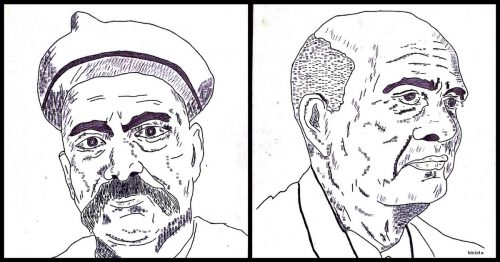
“I typed out Lord Ganesha using the ‘x’ key and it was published in the Maharashtra Times newspaper in 1975. I slowly started improvising and started using other keys like ‘_’, ‘=’, ‘@’, ‘-’, ‘,’ in my sketches,” recalls Bhide.
His father’s words inspired him to be better and do better. Each sketch takes him about 5-6 hours to complete.
“I hold the paper with my left hand and use the fingers on my right hand to type out the symbols. The different shades in a sketch are added by using a light or a hard touch on the keys. My hands start aching after 10-15 minutes, and so I need constant breaks,” he adds.
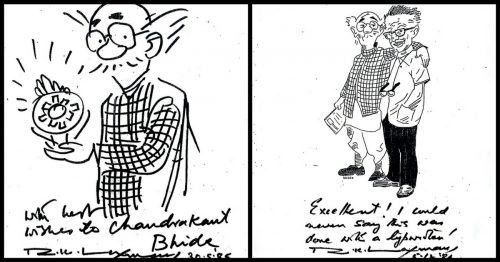
One day, Mr Bhide sketched RK Laxman’s, Common Man. It was a time when Xerox machines had just made their appearance. His friend helped him get copies and requested to keep the original.
“I wanted to show the sketch to R.K. Laxman sir. I went to his office without an appointment and showed it to the cartoonist. Laxman sir was so thrilled with it that he said the result could not have been better with a pen and brush. We spent 1.30 hours talking, and I even mentioned my lost dream of studying in Sir J.J. School of Art, and he said, you can be an artist anyway!” he recalls.
Bhide continued to keep in touch with the famed cartoonist and takes great pride in having several original ‘Common Man’ sketches.
Over the years, Mr Bhide has created almost 150 sketches including several of people he admires including Amitabh Bachchan, Dilip Kumar, Sunil Gavaskar, Dr Ambedkar, Lata Mangeshkar and more.
But it was Sachin Tendulkar’s curls that frustrated the master typer! “I finally used the ‘@’ symbol to get it right,” he recalls.
One of his fondest memories was meeting up with renowned cartoonist and illustrator Mario De Miranda via a common friend, the famous Behram Contractor also known as the Busy Bee. “I was nervous when I rang the bell to Mario’s home, but he soon put me to ease. Once he saw some of my sketches based on his famous characters (Ms Fonseca, Godbole and Boss), he autographed one of my sketches with the words – ‘I wish I could draw like you type.’ That was my biggest compliment,” says Mr Bhide.
Mario De Miranda encouraged and inaugurated Mr Bhide’s first exhibition. He went on to hold several more, including ones in festivals like IIT Mumbai’s Mood Indigo and IIT-Kanpur’s Antaragini.
Mr Chandrakant Bhide retired from the Union Bank of India in 1996. He approached the administration department with a request to buy his beloved companion, his typewriter but was denied it as it was against policy. But on the day of his farewell, the chairman of the Bank allowed him to buy it for just Rs. 1.
Today, the typewriter still holds a place of pride in his household. “It has been with me for fifty years now, I understand it, it understands me,” he chuckles.
Source….Uma Iyer in http://www.the betterindia.com
Natarajan
The Origin of 8 Famous Phrases…
We use phrases, expressions, and proverbs on a daily basis when conversing with each other. Whether you’re at home, hanging out with some friends, or at work, chances are that you’ve uttered one of the phrases below more than once in your life. But, do you ever stop to think about what these expressions really mean? Where they come from? The answer to this is probably no, so let’s take a look at 8 common phrases and learn where there came from.
1. It’s Raining Cats and Dogs
Houses used to have thatched roofs. These roofs had thick straw piled together to form a ceiling, but there was no wood underneath.
So how did this phrase come about? Well, according to a popular theory, on cold nights, animals such as cats, dogs, mice, and rats would climb onto these roofs in order to have a warm place to sleep. Unfortunately, when it started to rain, the thatched roofs got so slippery that cats and dogs would slip and fall off the roofs. Therefore, when it rained heavily, it would literally rain cats and dogs (and whatever other animals were on the roofs).
2. Mad as a Hatter
The average person will probably tell you that this famous expression comes from Alice in Wonderland, but they’d be sorely mistaken. The Mad Hatter character isn’t the reason you use this phrase when describing someone who has lost their mind.
The true origin goes back to the days when actual hatmakers used mercury to construct their hats. The mercury poisoned the hatmakers and affected their nervous systems. Mercury causes aggressive, heavy mood swings, and erratic behavior and, as a result, “mad hatter’s disease” became the nickname for mercury poisoning, and the expression has been popular ever since.
3. Cat Got Your Tongue?
This is often used when someone is silent or at a loss for words. Surprisingly though, it has nothing to do with cats. In the English navy, punishments were handed out in the form of a flogging, which was carried out with a whip known as a cat-o’-nine-tails.
This was a formidable weapon, and the pain from being flogged by it was so bad that it caused its victims to go mute. They would often be afraid to speak and would often remain mute for a long time after a flogging.
Drunken navy sailors would then walk around shouting, “Cat got your tongue?” as a way of taunting the victims. So, next time you’re rendered speechless because someone made a really good point, remember that it could be a lot worse.
4. Bring Home the Bacon
There are a number of theories as to where this phrase comes from, but the two most popular include pigs.
According to one theory, this phrase comes from winners at state fairs bringing home the greased pigs they caught in competitions. However, the more popular theory is that highly successful men back in the day would buy pork, cook some bacon, and then hang it on their walls when they had guests over. This showed everyone how successful the men were. Walking into a man’s house and seeing bacon hanging on the wall meant that he was to be respected. In this particular case, bringing home the bacon was the ultimate sign of power and class.
5. Eat Crow
Usually, we have to “eat crow” when we’ve been proven wrong after taking a strong stance on something.
The expression originates from where you’d expect. Crow meat tastes bad and is hard to swallow. The simple connection to this term can start and end here, but there’s an even more interesting origin story.
Back in 1812, an American accidentally went hunting across British enemy lines. The US soldier was caught shooting and killing a crow by a British soldier. As punishment, the British soldier, after praising the American for his accurate shooting, tricked him into giving up his gun.
Now armed, the Brit pointed the gun at the American and forced him to take a bite out of the crow. After the American complied, he was given back his gun. Angered, the American then turned the gun on the British soldier and forced him to eat the rest of the bird.
6. On Cloud Nine
It’s often thought that this is a reference to Heaven, but this is not true.
According to one known origin of this expression, one of the classifications of clouds, defined by the US Weather Bureau in the 1950s, is known as “Cloud Nine.” This is a type of fluffy, cumulonimbus type of cloud.
So, what makes this cloud so special? Well, this cloud is considered to be the most attractive in the cloud community, which is what gives the phrase it’s positive connotation.
7. Crocodile Tears
For those who may not know, this expression refers to someone who is faking crying or pretending to be upset. When they do this, they are said to be shedding crocodile tears.
Did this phrase come about because crocodiles never cry? Well, no, the origin is a lot more interesting than that. In an ancient anecdote, Photios claimed that crocodiles cry to strategically lure their prey closer to them. When the prey is close enough, the crocodiles drop the act and go in for the kill.
8. Don’t Throw the Baby Out with the Bathwater
This strange expression goes all the way back to the 1500s. Believe it or not, but people in the 16th century only bathed once a year, and to make matters worse, entire groups used to bathe in the same water.
The men would go first, then the women, and then the children and babies went last. The water was so dirty by the time the babies got in, that they often came out clouded. Sometimes, mothers had to make sure that the babies weren’t literally thrown out with the dirty bathwater.
The phrase, “don’t throw the baby out with the bathwater,” now means that you should make sure you don’t throw out anything valuable while getting rid of unnecessary things. Nothing is more valuable than a newborn baby, so the phrase still rings true even to this day.
Source: listverse
Natarajan
Images: depositphotos

The Buddhas of Bamiyan….
On the cliff face of a sandstone mountain, visible from the ancient Silk Road near the town of Bamiyan in Afghanistan, are two massive voids left by two monumental statues of Buddha that once stood there. In 2001, the nearly 1,500 year old statues were blown to bits by the Taliban in an act of violence that shook the entire world, and set a disturbing precedent which has been imitated in recent years by Islamic State fighters in the Middle East.
For a long time, Buddhism was an important religion in the Indian subcontinent and Central Asia, having been introduced during the early Kushan period, in the 1st century. Along the Silk Road, on which Bamiyan lies, are several Buddhist monasteries, chapels and sanctuaries constructed inside caves carved into the mountains. In several of the caves and niches, often linked by galleries, there are remains of wall paintings and seated Buddha figures.
The 175 feet high Buddha statue in Bamiyan, Afghanistan, destroyed in 2001. Photo credit: Afghanistan Embassy
The two most prominent figures were the giant Buddha statues destroyed in 2001. The larger of the two stood 175 feet tall, and was one of the largest standing Buddha carvings in the world. The second figure was also enormous and measured 120 feet in height. Both figures were carved into niches of the cliff side in high relief. The main bodies were hewn directly from the sandstone cliffs, but details were modeled in mud mixed with straw, coated with stucco. This coating had worn away a long time ago, but in the early days, it served to enhance the expressions of the faces, hands, and folds of the robes. Both statues were originally painted—the larger one in carmine red and the smaller one in multiple colors. The area near the heads of both Buddha figures and the area around the larger Buddha’s feet were carved in the round, allowing worshippers to walk around as a form of worship.
Much of what we know about the monumental Buddha sculptures comes from the travelogue of the Chinese monk Hsuan-Tsang, who traveled to Bamiyan in the 7th century. Hsuan-Tsang described Bamiyan as a flourishing Buddhist center “with more than ten monasteries and more than a thousand monks”. He also noted that both Buddha figures were decorated in “dazzling golden color and adorned with brilliant gems”. Historians believe that the monumental Buddha sculptures were carved into the cliffs between the 3rd to 6th centuries A.D. They were perhaps the most famous cultural landmarks of the region attracting numerous pilgrims from all around.
After the Islamic invasion in the 9th century, the presence of a large Buddhist cultural icon in Afghanistan greatly disturbed the Muslim rulers. The 17th century Mughal emperor, Aurangzeb, and the 18th century Persian king Nader Afshar, both tried to destroy the statues by using heavy artillery but failed to inflict any noticeable damage. It was the Afghan king Abdur Rahman Khan who eventually managed to destroyed its face.
In 2001, the leader of the Taliban movement ordered that all statues and non-Islamic shrines in the different areas of the Islamic Emirate must be destroyed. Accordingly, in March the same year, Taliban fighters laid explosives at the base and the shoulders of the two Buddhas and blew them to pieces.
Later in an interview, the Taliban supreme leader Mullah Omar defended his actions by saying:
I did not want to destroy the Bamiyan Buddha. In fact, some foreigners came to me and said they would like to conduct the repair work of the Bamiyan Buddha that had been slightly damaged due to rains. This shocked me. I thought, these callous people have no regard for thousands of living human beings – the Afghans who are dying of hunger, but they are so concerned about non-living objects like the Buddha. This was extremely deplorable. That is why I ordered its destruction. Had they come for humanitarian work, I would have never ordered the Buddha’s destruction.
The only silver lining in the cloud was, that after the destitution, several new caves and wall paintings were discovered, including fragments of a previously unknown 62-foot long reclining Buddha.
Sources: Wikipedia / Khan Academy
Source…. Kaushik in www. amusingplanet.com
Natarajan
Joe Reginella’s Memorials to Disasters That Never Happened…!!!
Most remember October 29th, 1929—also known as Black Tuesday—as the day when the New York stock market crashed. However, it was also the day when one of the most horrific tragedy involving human-animal conflict happened at the Brooklyn Bridge.
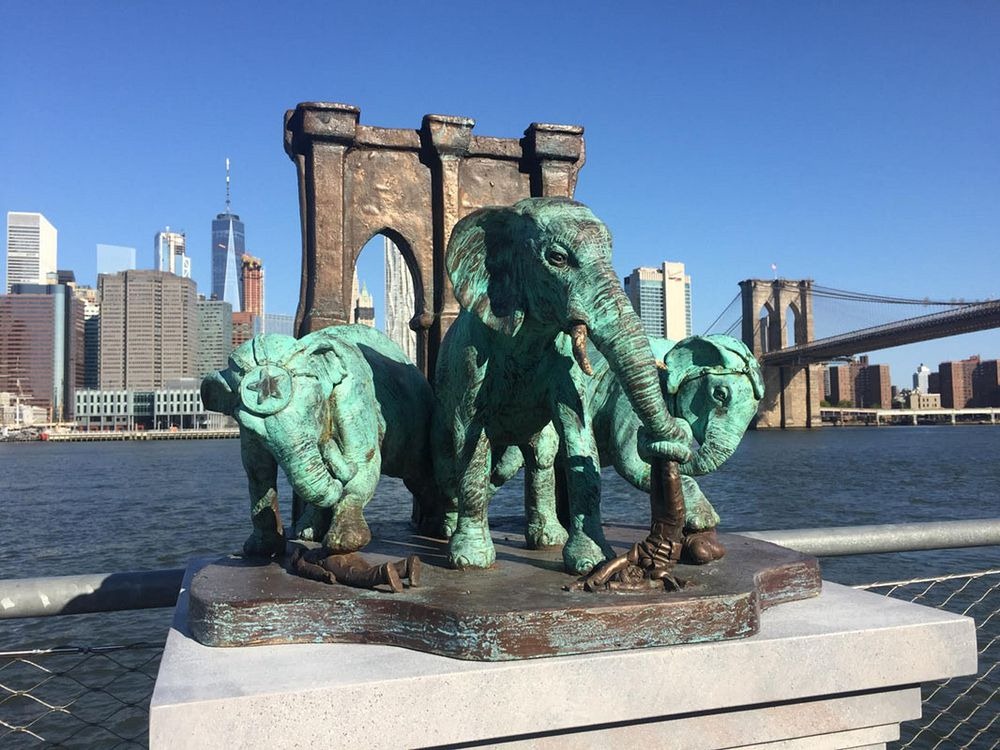
On that awful day a trio of three circus elephants, including the star attraction—a thirteen-foot-tall African elephant named Jumbo, was to cross the Brooklyn Bridge and into New York. The event was greatly publicized and crowds of people came from miles around to see Jumbo. While crossing the bridge, something caused the animals to panic and what was to be a slow and deliberate cross suddenly became a deadly stampede as the three elephants charged into the cheering crowd. Aside from scores of human casualty, two of the elephants died in the stampede, while Jumbo escaped to freedom through the Holland Tunnel and lived out his days at an elephant sanctuary.
The memorial to the 1929 Brooklyn Bridge Elephant Stampede. Photo credit: Joe Reginella
When a new bronze memorial to the tragedy was unveiled at the Brooklyn Bridge Park last month, it left visitors scratching their heads because no one ever remembered hearing or reading about the Brooklyn Bridge Elephant Stampede of 1929. That’s because the tragedy never happened. It’s a satirical piece of art by sculptor Joe Reginella.
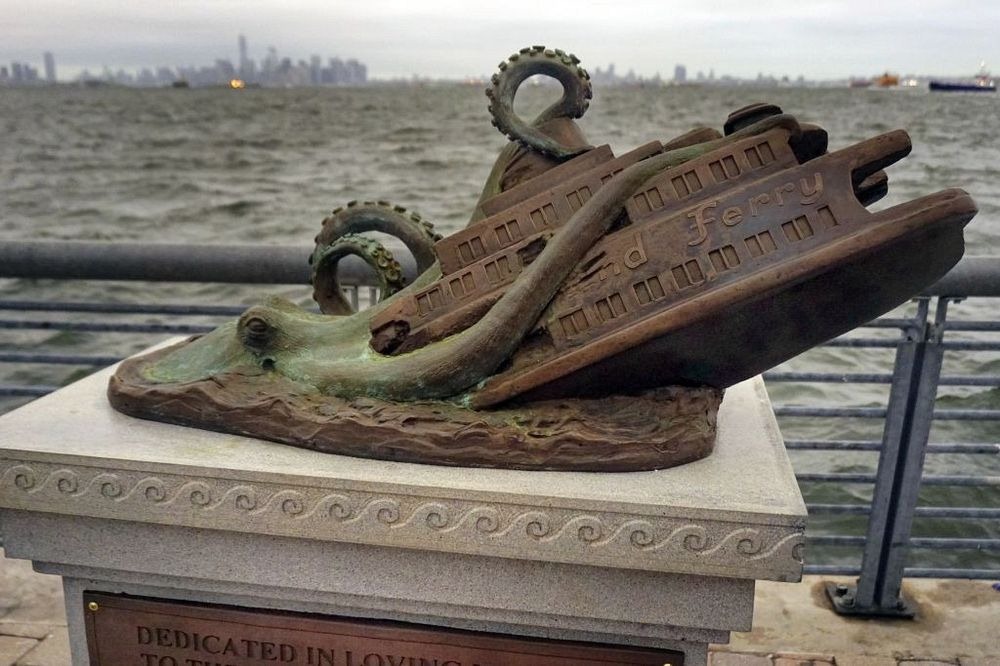
Last year, the prankster-artist erected another memorial to yet another fabricated tragedy—the so-called Staten Island Ferry Disaster—in Battery Park. The story goes, that on November 2nd, 1963, a Staten Island Ferry with over 400 people onboard was attacked by a giant octopus and was pulled beneath the water resulting in the death of all passengers. According to Reginella, the disaster went almost completely unnoticed by the public because it was overshadowed by another more “newsworthy” tragedy that occurred that day—the assassination of President John F. Kennedy.
As part of the hoax, Reginella created a fake documentary, fabricated newspaper articles and distributed flyers to puzzled tourists sending them to a nonexistent museum on Staten Island.
The memorial to the 1963 Staten Island Ferry Disaster. Photo credit: Ula Ilnytzky
The idea for the hoax came to him when Reginella was taking his 11-year-old nephew on the ferry between Manhattan and Staten Island. To satisfy the kid’s curious questions, such as if the waters were infested with shark, Reginella fabricated the story of a giant octopus attack.
“The story just rolled off the top of my head,” he told The Guardian, and it evolved to become “a multimedia art project and social experience – not maliciously – about how gullible people are”.
In the early few days after the memorial was unveiled, Reginella sat close by with a fishing pole pretending to fish so that he could eavesdrop on the conversations. Sometimes he overheard people wondering why nobody ever heard of it. Others simply stared out at the water and walked away.
While the Staten Island Ferry Disaster never happened, there is actually a bit of interesting history behind Reginella’s latest hoax—the Brooklyn Bridge Elephant Stampede. Elephants belonging to the Barnum and Bailey’s Circus did actually cross the Brooklyn Bridge in 1884, when the circus came to town. One of the elephants, a thirteen-foot and seven-ton African, was actually named Jumbo. He was accompanied by twenty other elephants, seven camels and ten dromedaries in what was known as Barnum’s legendary “elephant walk.”
Neither memorials are permanent, and are displayed only on specific days and times. Consult the memorials’ websites for timing before you decide to visit.
www.sioctopusdisaster.com
www.bbelephantstampede.com
Source….Kaushik in http://www.amusingplanet.com
Natarajan