What your Credit Score says about you….?

A commercial on TV shows a person waving his CIBIL Reports and the lenders flock to him to give him a loan; he is treated well, with a lot of respect and of course his loan is sanctioned. So what does the CIBIL Score actually say about a person’s financial profile that opens doors of banks for him; what all do those three digits tell?

Apart from lenders, employers when hiring people for higher management positions and looking for individuals to work in financial sectors can also ask for an applicant’s CIBIL score. This trend is still at a nascent stage in India. In USA, which is heavily credit driven, it is common for utility providers, insurers to ask for a credit report; even when looking for an apartment or a life partner the credit score comes into play! So have you ever wondered what does the CIBIL Score say about me?

Financial health

The most important fact revealed by the credit score is the financial health of an individual. Credit score is calculated based on a lot of information collected from various sources across a considerable time period. It’s not just recent behaviour or one off random action that is reflected in the credit behaviour.

A lot of variables and factors contribute to the final score; repayment behaviour for all types of credit dating back years, type of debt, credit utilisation, loan tenure etc are all considered when calculating the CIBIL score. Thus these three digits give a concise picture of your financial health and behaviour; any randomness is taken care of by the numerous variables and also the time period over which the data is spread.

In case one or two credit card payments are missed over a five year period then it can attributed to genuine reasons and they will not have an overall adverse impact on the credit score. However if credit card payments are missed every few months then they reflect on the poor financial health of the person. It is clear indicator that the person is in the risk of falling into a debt trap.

Risk profile

A low credit score means a high risk profile and a high CIBIL score means a low risk profile.

A financial institution when lending money does it with an understanding that it will get the money (principal and interest) back and ideally get it back on time. This they judge by looking at the CIBIL score which is an indicator of the risk profile of an applicant.

A high risk profile indicates that the chance of the customer defaulting or delaying payments is substantial; the lender may choose to reject such an application or charge a higher interest if sanctioning a loan.

Personality traits

Apart from the financial habits of a person the CIBIL score can also reveal a few traits about an individual’s personality. This is maybe one of the reason employers may want to have a look at it apart from the potential hazards (litigation, fraud) of hiring a person who is debt ridden or in poor financial health.

a. Planning and organisation

A CIBIL score indicates whether a person is organised and plans ahead or not. Financial health is a result of good financial planning and organisation too. Not planning your finances, taking a car loan without figuring out whether you can pay the EMIs or not; not being organised enough to check about a bank’s policies for sanctioning a loan and randomly applying to it are few actions that affect your CIBIL Score.

Careful planning ahead ensures that you are in a position to meet your financial obligations monthly and loan applications (which result in hard credit enquiries) are not rejected.

b. Discipline

Paying EMIs or credit card bills on time is the simplest thing to do in case you have planned your finances well. However not paying on time frequently is a sure indicator of lack of discipline; you are simply forgetful or not disciplined enough to follow the plan. Similarly swiping the credit card without bothering about the payment that needs to be made at the end of the month also reflects lack of restraint and discipline. All organisation and planning can go for a toss if one is not disciplined enough to follow it through.

c. Integrity

Defaulting on loans or credit card payments can also reflect lack of integrity in the person sometimes. It may be the case that the person does not simply intend to pay; s/he does not have the integrity to honor her/his commitment. There are enough cases of wilful defaults especially on credit card payments and personal loans simply because the bank has nothing the repossess.

The CIBIL score is an indicator of a person’s financial robustness, it is indicative of behavioural pattern to some extent and also tells about the risk potential the individual poses.

The author is a credit expert with 10 years of experience in personal finance and consumer banking industry and another 7 years in credit bureau sector. Rajiv was instrumental in setting up India’s first credit bureau, Credit Information Bureau (India) Limited (CIBIL). 

Source….Rajiv Raj….www.rediff.com

Natarajan


Message for the Day…” Faith in God Should never Waver…”

Sathya Sai Baba

You may have immense faith in God. But from time to time, the power of Maya may undermine this faith. So be vigilant. In Mahabharata even staunch devotees of Krishna like Dharmaraja and Arjuna displayed hesitancy in following the advice of Krishna and had to be reminded of their duty through Bhishma and Draupadi respectively. Faith in God should never waver. In no circumstance should anyone go against the injunctions of the Divine. Whatever worship one may offer, however intensely one may meditate, if one transgresses the commands of the Lord, these devotional practices become futile. The reason is that the Lord has no selfish objectives or goals. It is out of small-minded, narrow and selfish motives that people choose to act against the sacred and noble commandments of the Lord. Even small acts of transgression may in due course assume dangerous proportions.

Famous Concorde supersonic airliner could start flying again ….

How good would travelling to Europe in less than 14 hours be?

THE Concorde supersonic airliner looks like it will make a return to the skies thanks to some aviation enthusiasts with very deep pockets.

Club Concorde, a group of ex-pilots, airline executives, engineers and Concorde enthusiasts have unveiled their plan to have the legendary jet back in the air by 2019.

It has been nearly 12 years since Concorde took its last flight, with the final journey occurring on October 24th, 2003.

Although they need a little maintenance, these fully-functional planes are scattered across the globe in aviation museums and science centres.

The particular plane Club Concorde is after is located at Le Bourget airport in Paris, which they want to buy and restore for around $250 million.

Once the restorations are complete, Club Concorde wants to use the iconic plane at air shows, corporate events and for private charters. At this stage, there are no plans to resume commercial flights.

The pride of British aviation, the Concorde making its final landing in 2003.

The pride of British aviation, the Concorde making its final landing in 2003.Source:News Corp Australia

Flying at Supersonic speeds, a Concorde could fly between London and New York in a little less than three hours. In Comparison, a regular commercial flight can take around seven hours. However not many people got to experience this speed in its years in the sky. Due to limited seating capacity in the planes, ticket prices for regular economy seats were often around the same price as a first-class ticket in a standard airliner.

The Concorde’s 27 year life came to an end in 2003 following severe financial problems. A crash in 2000 which led to the death of all on-board passengers and crew, high maintenance costs and lack of customers after 9/11 was reported as the main reason for its downfall.

Despite the fact that we will most likely never see another commercial Concorde, companies such as Boeing and Lockheed Martin and even NASA are working on ways to have commercially available supersonic airliners in the air again by 2030.

Source….www.news.com.au

Natarajan

Clear Skies Over the United States… A View from International Space Station

Lights of the United States at night photographed from the International Space Station with HTV cargo vehicle in foreground

On Sept. 17, 2015, NASA astronaut Scott Kelly captured images and video from the International Space Station during an early morning flyover of the United States. Sharing with his social media followers, Kelly wrote, “Clear skies over much of the USA today. #GoodMorning from @Space_Station! #YearInSpace.”

Tuesday, Sept. 15 marked the midpoint of the one-year mission to the space station for Kelly and Russian cosmonaut Mikhail Kornienko. The average International Space Station expedition lasts four to six months. Research enabled by the one-year mission will help scientists better understand how the human body reacts and adapts to long-duration spaceflight. This knowledge is critical as NASA looks toward human missions deeper into the solar system, including to and from Mars, which could last 500 days or longer.

Image Credit: NASA

Source…www.nasa.gov

Natarajan

Meet the Only Indian Woman to Participate in ‘The Most Dangerous Race in the World…..

Who wants to ride through 17 cities, over 3000 kms, in 2 weeks over bumpy roads in a flimsy vehicle? Only crazy extreme-adventure-sport-loving foreigners, right? Wrong! There’s one daring 29-year-old from Mumbai who also decided to take on the challenge. Meet Rutavi Mehta, just back from her maiden auto rickshaw race, which she finished in only 12 days.

In April, 2015, about 250 people from over 50 countries came down to India to be part of a very unique adventure sport – an auto rickshaw run. The challenge was to drive an auto rickshaw for about 3,000 kms, from Jaisalmer in Rajasthan to Shillong in Meghalaya, covering the breadth of the country in just two weeks — that’s six states and 17 cities. This feat, considered one of the most dangerous adventure sports in the world, had to be accomplished without any backup teams of mechanics, no guidance in terms of directions or any other help, in barely roadworthy vehicles that are certainly not meant to be driven long distance.

Among these 250 people, there was just one Indian participant – Rutavi Mehta.

Rutavi and her team at the finish line

Rutavi and her team at the finish line

“I had known about this adventure sport since a long time,” says Rutavi, a travel consultant by profession. “It was in 2007, when a couple of rickshaws had come down to the hotel where I was working as a marketing head earlier…that’s when I came to know about the run.”

At that time though, she hadn’t even dreamt that she would herself participate in the run one day.

Rutavi is from the hospitality industry and has backpacked through Europe in the past. As a travel consultant today, she runs her own company called Photokatha – a place where various travelers from across the country share their travel experiences. She also runs various campaigns with tourism boards of different states as a consultant. Recently, she got a chance to design and head a Kerala Blog Express campaign where 27 international bloggers traveled in different parts of Kerala to experience the culture of the state.

The Rickshaw Run is organized by a UK-based group known as ‘The Adventurists.’ The first run took place in 2006, when the contestants covered the route from Kochi in Kerala to Darjeeling in West Bengal. Since then, the sport is organized with a different route in India every six months, and there has never been a single run in which all the participants have reached the finish line.

There is no prize for winning this difficult race, which is more about giving than getting. –

The participants

The only necessary requirement for competing is that every team (usually 3 people) should raise a minimum amount of £1000 (USD 1550) for organizations that are working towards the protection of the environment. The two organizations they donated to were Cool Earth and Planeterra. Cool Earth is an environmental charity group working for the protection of rainforests and the local communities living in those areas. Planeterra is also a non-profit organization that helps empower local people to develop their communities and conserve their environment.

Rutavi was very unsure about participating in the race at first.

“A couple of my friends from the travel blogger industry were coming to India and they wanted to be a part of the run. They had already registered for it, but I was not sure,” she remembers.

Being a woman and travelling pan-India was a scary thought to begin with. Moreover, she did not know how to drive a rickshaw. But the sense of adventure, the spirit of charity, and the motivation of friends added up and she got herself registered. “I went out, borrowed a rickshaw and learned how to ride it in a few days.”

Every team in the run has a maximum of three members. Rutavi participated with her friends Derek Freal and Ryan Brown who are travel bloggers from USA — they called themselves Teen Romanchaak Yaar (three adventurous friends). The teams are required to cover a distance of 300 km each day, with one person driving for 100 km at a stretch. –

rutavi3

“In a rickshaw, 300 km is like 600 km by car, since the maximum speed is only 55 km/hr, and you don’t have any cushions to support you during the bumpy ride,” says Rutavi.

The race is an expensive one, says Rutavi. The registration fee itself is £2500, a part of which goes directly for charity. In return for the registration amount, they only get the rickshaw. Her team decided to crowd fund this fee, and with the help of friends, family, some corporate organizations and the travelling network created by all three of them, they raised enough for registration as well as for the cause even before the race had started. As for their accommodation, they partnered with different organizations and individuals.

“Since we are travel bloggers, many companies supported us. Zostel (a chain of backpackers’ hostels) came on board as the hospitality partner. In most of the cities we stayed in Zostel and we partnered with similar organizations for our stay and food in other parts,” says Rutavi.

Mountainous terrain, broken roads, unknown paths, and rivers to cross – Rutavi saw it all during the journey.

rutavi2

“I met people from so many countries and got a chance to learn about their cultures. People from Norway, Canada, some countries that I had never even heard about – I learnt how they live, about their culture, food, music, and so much more. There was also a lot of creativity going on around us. Rickshaws were decorated in many unique and brilliant ways,” she says.

But there were some very difficult spots as well. The rickshaw run is considered to be one of the most dangerous adventurous sports by many.

Rickshaw Run – Old-school Adventure Across India

Watch this video clip ….

This is because the difficult roads have to be covered on a three wheeler seven horsepower rickshaw, without any support or knowledge about the way, without any back-up or a set route. Rutavi’s team survived two accidents also. One was in Allahabad and the other one in Guwahati, just 150 km before the final destination. But she did not give up and made it to the finish line in spite of some bad injuries.

The one thing that she realised with this journey is that no matter which part of India you are in, people are very helpful. She was amazed to see how the local people turned up to help every time they needed something. If the rickshaw broke down, mechanics would help them without taking any money in return, and people would also offer food at many places. All because they were happy to see a very simple vehicle being used for a charitable cause!

Rutavi says she has travelled to 1500 destinations around the world so far. This enthusiastic wayfarer has spent months exploring Lakshadweep all on her own. She also goes to Ladakh for two months every year where she teaches kids.

rutavi4

Rutavi says that besides getting the thrill of adventure from her rickshaw run, she had one more motive for doing it:

“To empower Indian women with a ‘women can do, and will do’ attitude. People keep saying India is not safe. The aim was to show that women can travel fearlessly in India. It all starts with the realization that they can overcome any fear,” she says.

“My attitude towards rickshaw rides has also changed. Whenever I travel by rickshaws now, I talk to the drivers and tell them about my experience. Many of them can’t believe that I rode a rickshaw for such a long time,” she concludes laughing.

You can contact Rutavi at rutavi@photokatha.in

Source…..Tanaya Singh ,…..www.the betterindia .com

Natarajan


Hats off to this Lady …A Mumbai Baker Made A 35 Kg Ganesha Idol From Pure Chocolate To Feed Underprivileged Kids….

Festivals indeed occupy an important place in our lives and they bring our family and friends together. But aren’t we supposed to spread happiness and share our joy with the world too?

This year, from Spiderman to Bahubali, we stumbled upon some of the most innovative designs of Ganesha idols.

But, this wonder woman, Rintu Kalyani Rathod, chose to celebrate Ganesh Chaturthi in a totally different way.

12039352_701034069997652_2507224158049280558_n

She has her own bakery, ‘Rini Bakes – Bake my Dreams’ in Mumbai. Apparently, this wonder woman made a 38 inches tall chocolate Ganesha with 35 kg of chocolate in 50 hours.

12042774_898470626873412_116968633211130024_n

After 5 days, she has planned to immerse Ganesha in milk, feed the chocolate Ganesha to hundreds of underprivileged kids and spread happiness in the lives of those kids.

This is what this amazing lady said on her Facebook post:

“It pains me tremendously to see the way our environment is exploited in the name of devotion. I just couldn’t bare the sight on the beach after the visarjan. Drunk people dancing on the streets on vulgar film songs blaring from loud speakers is not devotion.

I am a commercial designer turned designer baker. I decided to make my idol from chocolate last year. We immersed the idol in milk and distributed the chocolate milk among the underprivileged kids prasad. 1100 people took the prasad last year. It was a 28 kg, 32 inches tall idol. Real visarjan is done by bringing smiles on the faces of little kids not by polluting our waters.

This year my idol is 35 kg and 38 inches tall. It took me 50 hours to make it. Hope to distribute prasad to many more people this time, so bappa can stay in them forever. After all, bappa’s favourite place to reside is inside us, nowhere else.”


12004699_701011136666612_118751374215903213_n

Isn’t this the perfect way to celebrate Ganesh Chaturthi? After all, happiness doesn’t result from what we get, but from what we give.

If you really believe in God, then do your bit. Be a better person and celebrate the spirit of mankind.

News Source: Facebook andShuvro Ghoshal in  www.storypick.com

Natarajan

How smart can your bike be?…

The re-modelled Smarty Sports Bike of R. Muthu Kumar in Coimbatore Photo: S. Siva Saravanan

The re-modelled Smarty Sports Bike of R. Muthu Kumar in Coimbatore Photo: S. Siva Saravanan

THE HINDU -The remodelled Smarty Sports Bike of R. Muthu Kumar in Coimbatore Photo: S. Siva Saravanan

The bike parked at the campus is getting second, third and more looks. And, technocrat Muthu Kumar is happy. “My bikes are my soul,” he says. Following his passion, R. Muthu Kumar has restored and re-modified over 100 other bikes including bullets, scooter and Yamaha, and sports bikes. For him, it is not only about the good looks. It is about the complete experience. And about keeping the bike safe. “We spend so much to buy a bike. It is so easy to steal bikes! I use smart technology to ensure that stealing my bike is not going to be easy. Even a Harley Davidson doesn’t have enough security features,” he says. Muthu Kumar’s latest possession, which he calls a Smarty transfigured bike, comes loaded with security features. “I bought a Karizma ZMR sports bike and spent over a lakh to add features that ensure a safe riding experience. My ambition is to ensure that everyone enjoys their bike ride. You may ride a 100 CC bike, but with some technology added to it, you will feel you are riding a Harley Davidson,” he assures K. JESHI


Kick-start, the smart way

A Radio Frequency Identification Card (RFIC) Muthu Kumar shows the card on a screen attached to a keypad near the handle bar. And, the bike is ready to move. This card cannot be duplicated and has a lifeline of over 25 years. If one forgets the card, there is a password. If someone attempts to steal the bike, it locks up. And, with three unsuccessful attempts of feeding in a password, it stays locked for 15 minutes.

A reverse camera works as the rear mirror.

Accident identification system In case of an accident, it sends an alert to the 10 mobile numbers of family/friends stored in the software.

Blue tooth connectivity, and a speaker provides music There is a USB port to connect to the tab. The speaker welcomes the rider with recorded messages such as ‘Don’t use mobile phones while driving’, and ‘Do not drink and drive.’

Machine gun exhaust system This cools down the silencer, and maintains uniform temperature especially during long rides. This standardises mileage too.

The Smarty bike monitoring system runs a check on engine oil, electric circuit unit, headlight…before start up.

Smarty also has a rotating number plate. When idle, the number plate rotates and hides the number.

Gloves with a mind

The electrodes in the gloves sense the pulse of the rider. When the pulse is abnormal or low, a message on the screen asks the rider to stop the vehicle with a countdown time of 60 seconds.

Lights that speak

An Infra-Red sensor activates the ‘headlight projector lamp’ during dusk. When it faces a speeding vehicle in high beam, the light automatically switches to low beam. Lights should alert fellow riders, not disturb them.

The re-modelled Smarty Sports Bike of R. Muthu Kumar in Coimbatore Photo: S. Siva Saravanan

A laser beam from the tail end keeps the fellow riders away at a safe distance. A soft glow in blue and golden yellow on the body, a bright red light at the tail lights up the vehicle even when it is parked during the night time. The tail light comes with LED that is visible more than half-a-kilometre away. This helps reduce accidents during night time. A pair of avenger lights, ultra bright LED lights in the front, can light up area up to a kilometre and is of great help for rides inside a forest. It can alert you of any animal crossing and avoid road kills. In high altitudes it can also be used as fog light.

GPS on the move

There is GPS navigation with a sim card which acts as a transmitter and the mobile phone is the receiver. One can monitor movement of the bike, including the place where it is parked. When someone tries to move the bike the mobile can activate the horn on the bike from anywhere in the world (as it is connected via Wide Area Network).

Track the vehicle, the app way

The rider can activate’ stop the engine’ and bring the vehicle to a grinding halt in a matter of 20 seconds with the help of an app. “There’s a countdown time of 20 seconds to allow the rider to move the bike to a safe corner and avoid accidents. I can activate ‘continuous horn’ too. This can distract the thief and make him abandon the bike. A spy camera records his activities and it helps track the culprit.

To know more, call Muthu Kumar at 99439-37450 or email at muthu.minu@gmail.com

Source….K.Jeshi…www.thehindu.com

Natarajan

How a farm labourer became a CEO of a Company …. An Inspiring Story…

From earning Rs 5 a day as a farm labourer to starting an IT services company that is worth Rs 1.5 crore (Rs 15 million), Jyoti Reddy’s story of success is nothing short of an inspiring movie plot.

That night she decided to break the rules.

With a few friends, whom she referred as akka, she did not return to the orphanage till way past midnight.

It was Sivaratri, the great night of Shiva, when the planets are potently aligned to embrace his cosmic dance.

After visiting the Shiva temple in their village, they decided to do something really daring — go for a movie, a blockbuster love story.

She laughs, a deep throaty laugh, which betrays a teenager’s giggles at the memory of forbidden pleasure.

Anila Jyothi Reddy has travelled very far from that night and her obscure village in Warangal in Telangana.

Her memories though are as fresh as it were yesterday.

“When we returned late in the night, we got a good thrashing from the warden. But I was so enamoured by the movie that I did not much care for the repercussion. I thought I should also marry for love,” she tells me.

Jyoti Reddy

Not all dreams come true

But fate — the eternal party spoiler — intervened.

Jyothi was married off exactly a year later at the age of 16 to a man 10 years her senior.

Love did not figure in the arrangement that her parents made for her future.

All her hopes of a better life seemed to recede like the bullock cart in the rear view mirror of a speeding highway truck.

He was a farmer who had not even passed the intermediate.

She was thus doomed to a fate of a daily farm labourer slogging the whole day in the paddy field under the blazing hot Telangana sun.

For all her efforts, Jyothi earned a meagre Rs 5 a day. She did this for five years from 1985 to 1990.

“I became a mother at 17. I had to do all the household chores and then head straight to the fields.

“I would return home at dusk and get down to making dinner.

“We did not have any stove, so I had to cook on a wood fire chulha,” she tells me over the phone from Hyderabad, where she visits at this time of the year from her home in the US.

Today, Jyothi is the CEO of a $15 million IT company, Key Software Solutions, based in Phoenix, Arizona, US.

Her incredible story seems to be the stuff of fiction conjured up by a shrewd novelist inflicting numerous sufferings on his protagonist to eventually make her a winner.

Except here, Jyothi herself altered her destiny.

Unwilling to live a life that was preordained for her, she beat all odds to emerge a winner.

A forced orphan

Jyothi’s aspirations were slowly growing wings.

“I could not stand being poor. I was born poor and was wed into another poor family,” she says.

Those days her dream was to have four plastic boxes full of daal (lentils) and rice.

“I would dream of having more than enough food to feed my children. I did not want to give them the life I was leading.”

Having been married off at the age of 16, Jyothi became a mother at 17 with her first daughter, followed by another girl a year later.

“At 18, I was a mother to two girls. There was never enough money for either medicine or to buy them toys.”

When the time came to admit them in school, she opted for Telugu medium because the fees was Rs 25 a month, while for an English medium school it was Rs 50 per month.

I could educate both my girls at Rs 50 hence I chose to send them to a Telugu medium school.”

Jyothi is the second among her four siblings.

Because of abject poverty at home, her father admitted his two daughters into an orphanage saying that they were motherless.

“I lived in an orphanage for five years from class five to class 10. Life there was tougher. My sister could not manage and would cry the whole time. My father had to take her back home.”

But Jyothi stuck on.

Even though she missed her mother and needed her the most, she finally adjusted to remaining in the orphanage.

“I remember a wealthy man would visit the orphanage every year to distribute sweets and blankets.

“I was a very sickly child then, and I would imagine myself being rich one day and carry a suitcase with 10 new saris in it,” she laughs re-imagining her dreams those days, which she was afraid to share with her hostel mates lest they made fun of her.

Nobody’s children

Jyothi makes it a point to come to India every year on August 29.

It is her birthday and she celebrates it with children in different orphanages in Warangal.

She also sponsors a mentally challenged kids’ home where there are 220 children.

She says passionately, “Two percent of India’s population comprises orphans. They do not have any identification. They are uncared for and unwanted. The people who work in orphanages only work there for the money, and not to give care and love to the orphans.”

She has been pursuing the cause of orphan children for many years now and has met ministers in power to bring the plight of these children to their notice.

She is concerned that though the state government has released data for orphan boys till class 10 who are in child remand homes, there is no data for girl orphans.

Where are the girls? Why are they missing?” she asks and replies to her own question.

“Because they are trafficked; they are forced into prostitution. I visited one home in Hyderabad where six girls in their 10th class had given birth. In the same home, these mother orphans were living with their orphan children.”

Being in a position of power today, Jyothi is voicing her concerns at every forum and making sure that the plight of the orphans does not go unheard.

But there was a time when she had to be a mute spectator to the injustices meted out to her by her own husband and in-laws.

With many mouths to feed and little or no income, life was hard.

“My concern was my children. I had a lot of restrictions. I could not talk to any other men, could not go out besides going to work in the fields.”

But as they say where there’s a will, there’s a way.

Jyothi heard an opportunity knock on her door when she started teaching the other farm hands at a night school.

From a labourer, she became a government teacher.

“I would motivate them to learn the basics. That was my job. I soon got a promotion, and would visit every village in Warangal to train women and youth to learn to stitch clothes.”

She was now earning Rs 120 a month.

“It was as if I had got one lakh rupees. I could now spend on my children’s medicine. It was a lot of money for me.”

The American dream

She completed a vocational course from Ambedkar Open University and wanted to enroll for MA in English at Kakatiya University in Warangal.

“I had often dreamt of having a name plate outside my house with the words ‘Dr Anila Jyothi Reddy.'”

However, she could not pass her course and all her dreams of doing a PhD in English came to an end.

But a chance meeting with a cousin from the US fired her imagination and she knew it in her heart that if she had to escape this vortex of poverty she had to go to the US.

“This is too much, right? This is crazy,” she laughs again with joy in reply to my question on how she managed to go to the US.

Talking about her NRI cousin who inspired her, she says, “She had style. It was so different from my ‘teacher look’. I did not leave my hair loose, I did not wear goggles or drive a car. I asked her can I come to America.”

Her cousin told her, “An aggressive woman like you can easily manage in America.”

Jyothi did not waste any time and enrolled for computer software classes.

She would commute to Hyderabad daily because her husband did not like the idea of her living away from home.

She was determined to go to the US. But it was hard to convince her husband.

“I was really greedy to go to the US. That was the only way I thought I could give my children a good life.”

She took the help of relatives and friends to apply for a US visa.

“I make use of every resource and time that I can manage. I never wasted time even while teaching.

“I used to run a chit fund for the other teachers. My salary in 1994-95 was Rs 5,000, I used to earn Rs 25,000 from the chit fund — all this when I was only 23-24 years old.

“I tried to save as much as I could so that I could go to the US.”

Jyothi’s biggest desire was to drive a car, and she knew only if she went to the US, she could drive one.

“There were too many restrictions at home. But one good thing my husband has done is given me two children to fight my life,” she says with a chuckle.

“My girls are like me. They are hard workers and do not waste time.”

Her daughters are software engineers. They are both married now and live in the US.

From poverty to abundance

The American dream is not an easy one.

Though Jyothi fought her fate and reached the land of opportunities, it was a rough ride.

“There was no support for me there. I did not know English very well, and it was a struggle each day.”

She found a PG accommodation with a Gujarati family in New Jersey at $350 per month.

“I did not have a cell phone. I used to walk three miles daily to work.”

She worked as a sales girl, then as a room service person in a motel in South Carolina, as a baby sitter in Phoenix, Arizona, as a gas station attendant, and software recruiter in Virginia.

Finally, she started her own business.

“When I returned to my village after two years, I went to the village temple for Shiv puja and the priest told me, ‘You will not get a job in the US, but if you do business you will become a millionaire.’

She took the help of relatives and friends to apply for a US visa.

“I make use of every resource and time that I can manage. I never wasted time even while teaching.

“I used to run a chit fund for the other teachers. My salary in 1994-95 was Rs 5,000, I used to earn Rs 25,000 from the chit fund — all this when I was only 23-24 years old.

“I tried to save as much as I could so that I could go to the US.”

Jyothi’s biggest desire was to drive a car, and she knew only if she went to the US, she could drive one.

“There were too many restrictions at home. But one good thing my husband has done is given me two children to fight my life,” she says with a chuckle.

“My girls are like me. They are hard workers and do not waste time.”

Her daughters are software engineers. They are both married now and live in the US.

From poverty to abundance

The American dream is not an easy one.

Though Jyothi fought her fate and reached the land of opportunities, it was a rough ride.

“There was no support for me there. I did not know English very well, and it was a struggle each day.”

She found a PG accommodation with a Gujarati family in New Jersey at $350 per month.

“I did not have a cell phone. I used to walk three miles daily to work.”

She worked as a sales girl, then as a room service person in a motel in South Carolina, as a baby sitter in Phoenix, Arizona, as a gas station attendant, and software recruiter in Virginia.

Finally, she started her own business.

“When I returned to my village after two years, I went to the village temple for Shiv puja and the priest told me, ‘You will not get a job in the US, but if you do business you will become a millionaire.’

Jyoti Reddy with young kids

yothi recalls how she would walk bare feet even during the harsh summer months.

Curious, I ask her how many shoes she owns today?

“I now have 200 pairs. It takes me 10 to 15 minutes to find a matching pair with my clothes.”

And why shouldn’t she indulge.

The first time she bought herself anything was when she was working as a teacher.

“I had only two saris. I badly needed a third one. I bought a sari for myself for Rs 135 and believe it or not, I still have that sari.”

I had to ask her which is the most expensive sari in her wardrobe.

“I spent Rs 1 lakh, 60,000 on a blue and silver sari for my younger daughter’s wedding,” she tells me with a nervous laugh.

She owns six houses in the US and two in India. And yes, she finally made her dream of driving a car come true.

She drives a Mercedes-Benz, sports dark glasses and keeps her hair loose.

Drive to succeed

Such has been her journey that Kakatiya University’s second degree English lesson has a chapter on her.

“Believe me, once I had begged the same university to give me a job and they had refused. Today, a lot of village children read about me and want to know who this living person is.”

She has been speaking to me for more than an hour while she is on her way to a meeting in Hyderabad.

She is going to Delhi the next day to take her case about missing orphan girls to the ruling party.

Life for her is no longer looking into the rear view mirror and following rules made by other people. She is stepping up the accelerator at full speed ahead.

All photographs: Kind courtesy   jyothireddy.com

Source…Dipti Nair…www.rediff.com

Natarajan

Message for the Day…” HE is Omnipresent…You are an embodiment of Divinity…”

God is infinite. It is impossible to measure Him or compare Him with anything, for there is no ‘other’ to compare. He is omnipresent. The Vedas declare, “He is One alone without a second“ (Ekam eva Advitiyam). The Divine willed: “I am One; I shall become many”(Ekoham Bahusyaam). By His Will God manifested Himself in the many. All religions have accepted this truth. The Bible declares: “God created man in His own image.” Thus from the One, the manifold cosmos emerged. With the growth of knowledge, the animal nature in man has diminished and he has been able to develop and refine his culture. As the saying goes, Divine appears in human form (Daivam maanusha rupena). Hence do not consider yourself as a mere product of Nature, a creature of the senses and the physical elements. You are an embodiment of Divinity.

Sathya Sai Baba

” Fixing Taps to Save Water In India”…

Author and painter Aabid Surti may have won awards for his writing and art, but he has also made a mark in another field: water conservation. For the last seven years, the 77-year-old has spent his Sundays going to apartments in Mumbai, and volunteering to fix leaking taps.

The Alternative, a Bangalore-based website seeking to chronicle and support social development in India, is currently running a campaign on sustainable water conservation called Catch Every Drop (#catcheverydrop). At The Alternative, Kirti introduces us to Aabid Surti’s work:

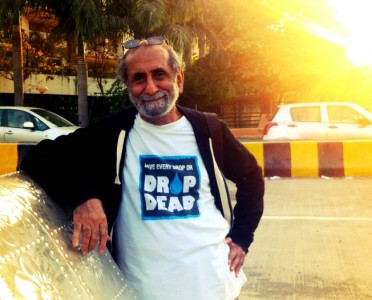
The 77-year-old celebrates Sunday like none else, picking a building in Mumbai’s far-flung suburb Mira Road and, with his plumber and a volunteer in tow, searching it for leaking taps to plug. Free of charge. His reward? “A lot of water saved. And sometimes, an offer for lunch,” he says simply. Surti’s non-governmental organisation, Drop Dead, has just one employee – him.

Aabid Surti, by Aalif Surti (CC BY-NC 3.0).

Aabid Surti, from Aalif Surti’s blog (CC BY-NC 3.0).

Aabid Surti’s son Aalif Surti (@SuperAalif) has told the story of how it all began:

“I read an interview of the former UN chief Boutros Boutros Ghali,” Aabid recalls, “who said that by 2025 more than 40 countries are expected to experience water crisis. I remembered my childhood in a ghetto fighting for each bucket of water. I knew that shortage of water is the end of civilized life.” Around the same time, in 2007, he was sitting in a friend’s house and noticed a leaky tap. It bothered him. When he pointed it out, his friend, like others, dismissed it casually: it was too expensive and inconvenient to call a plumber for such a minor job – even plumbers resisted coming to only replace old gaskets. A few days later, he came across a statistic in the newspaper: a tap that drips once every second wastes a thousand litres of water in a month. That triggered an idea. He would take a plumber from door to door and fix taps for free – one apartment complex every weekend.

Of course there was the issue of covering costs:

As a creative artist, he had earned more goodwill than money and the first challenge was funding. “But,” he says, “if you have a noble thought, nature takes care of it.” Within a few days, he got a message that he was unexpectedly being awarded Rs.1,00,000 ($2,000) by the Hindi Sahitya Sansthan for his contribution to Hindi literature [an award from the government of Uttar Pradesh]. And one Sunday morning in 2007, the International Year of Water, he set out with a plumber to fix the problem for his neighbors. He began by simply replacing old O-ring rubber gaskets with new ones, buying new fixtures from the wholesale market. He named his one-man NGO ‘Drop Dead’ and created a tagline: save every drop… or drop dead. Every Sunday, the Drop Dead team – which consisted of Aabid himself, Riyaaz the plumber and a female volunteer Tejal – picked the apartment blocks, got permission from the housing societies, and got to work. A day before, Tejal would hand out pamphlets explaining their mission and paste posters in elevators and apartment lobbies spreading awareness on the looming water crisis. And by Sunday afternoon, they would ensure the buildings were drip-dry. By the end of the first year, they had visited 1533 homes and fixed around 400 taps. Slowly, the news began to spread.

Not only does the project help save water, it empowers the community:

As Aabid rings another door-bell on yet another Sunday in Mira Road, seven years into his one-man mission, he says: “Anyone can launch a water conservation project in his or her area. That’s the beauty of this concept. It doesn’t require much funding or even an office. And most importantly, it puts the power back in our own hands.”

Now Aabid Surti would like similar initiatives to be started in others parts of India, so that as much water as possible is saved.