Image of the Day… Heart Nebula For Valentine’s Day… !!!

Heart Nebula

It’s 7,500 light years away, in the Perseus Arm of our Milky Way galaxy, in the direction to the constellation Cassiopeia the Queen.

IC1805 aka the Heart Nebula via Justin Ng.  See it larger at his website.

Our friend Justin Ng sent in this photo of IC 1805 – otherwise known as the Heart Nebula – on this Valentine’s Day 2015. It’s an emission nebula with glowing gas and darker dust lanes, located some 7,500 light years away, in the Perseus Arm of our Milky Way galaxy, in the direction to the constellation Cassiopeia the Queen.

Thank you, Justin Ng!

To all who celebrate it, happy Valentine’s Day 2015!

SOURCE:::: http://www.earthskynews.org

Natarajan

” Offer Archana To SriKrishna Reciting SriKrishna Ashthothram …”


Source: Moments of a lifetime
Dr.R.Balakrishnan Nair, Nephrologist, S.K.S. Hospitals, Salem

This person is a doctor practicing at Salem. He had his medical studies in England and in the thirst of having a religious and spiritual life, he returned to India. He is highly devoted to Sri Guruvayurappan. His bhakti has been further strengthened with his constant devotion to Sri Krishna Premi Swamiji. He has been doing Srimad Bhagavata Parayanam daily.

Early one morning, when the doctor was fast asleep, he had a dream in which Sri Mahaperiyaval appeared, and asked the doctor to offer ‘archana’ to Sri Krishna, reciting Sri Krishna Ashtothram. The doctor and his wife searched for the book. Unable to locate the book, in some days, they forgot the matter.

Again in the early hours, in his deep sleep, the doctor had a dream of Sri Mahaperiyaval, who reminded him about the Sri Krishna Ashtothram. The doctor replied that he could not find the book although he remembered to have bought it a few years ago. Sri Acharyal told the doctor that a book titled ‘Bruhatstotra Ratnakaram’ was on top of the refrigerator, in their house in Salem. The ‘Sri Krishna Ashtothram’ could be found in it.

Immediately cutting short their planned stay at Alleppy, they returned to Salem to find the “Sri Krishna Ashtothram” book exactly on top of the fridge in their house. From that day onwards, the doctor has been offering tulasi archana to Sri Guruvaayurappan, while reciting Sri Krishna Ashtothram. The first archana is being offered to Sri Mahaperiyaval.

SOURCE:::: http://www.periva.proboards.com

Natarajan

Read more: http://periva.proboards.com/thread/5822/divine-guidance#ixzz3RlnXmEBT

” Reason For Everything…So sit back and Relax…”

A Reason for Everything

Nobody’s day is perfect. Life is full of disappointments and pitfalls, but if you look deep enough, you’ll find that many of these little problems ultimately lead you on a better path. After all, there is a plan for everything, and we’re all part of it. So sit back, relax, and enjoy these peaceful  thoughts,

religion inspiring photos


religion inspiring photos


religion inspiring photos

religion inspiring photos

religion inspiring photos

religion inspiring photos

religion inspiring photos

Today is a gift of grace.
Share something precious with someone you like.
Take 60 seconds to be nice to someone.
Rejoice in the miracles of your life.
Identify one thing you’re happy about.
Be glad you have family & friends.
SOURCE::::www.ba-bamail.com
Natarajan


Message For the Day…” By Conscious Efforts Habits can be Changed and Character Refined …”

No person or wickedness in this planet is incorrigible. Wasn’t Angulimala, the robber, turned into a kindhearted person by Lord Buddha? Wasn’t thief Ratnakara transformed to Sage Valmiki? By conscious effort, habits can be changed and character refined. People always have within them, within their reach, the capacity to challenge their evil propensities and to change their evil habits. By selfless service, renunciation, devotion, prayer, and regulation of conduct, the old habits that bind people to earth can be discarded and new habits that take them along the divine path can be instilled into their lives. The purpose of all spiritual literature, poems, epics and books is to discuss the nature of mind, its ways and vagaries, and to inform about the process of reshaping it. Please realize that the mere reading of a book will not vouchsafe discrimination. That which is seen, heard, or read must be put into practice in actual life. 

Sathya Sai Baba

A Rewind…. When a 41 year old Former Captain came out of Retirement to Lead Australia against India

When the 41-year-old former captain came out of retirement to lead Australia against India…

India’s tour of Australia in 1977-78 was completely overshadowed by the arrival of Kerry Packer’s World Series Cricket (WSC), unleashed on the world six months earlier, which left the home side fielding a virtual third XI under Bob Simpson, a 40-something captain who had retired from the game a decade earlier. Despite that, the series proved exciting and Simpson’s comeback triumphant.

Bob Simpson drives on his way to 176 in Perth, in what was his fifth first-class match in a decade

Bob Simpson drives on his way to 176 in Perth, in what was his fifth first-class match in a decade © ESPNcricinfo Ltd 


In May 1977, news broke that media mogul Packer, frustrated by his inability to secure TV rights for cricket for his fledgling TV channel, had decided to organise games of his own. Capitalising on the low amounts cricketers were paid, particularly in Australia, he signed up more than 50 players for his enterprise.

With his “circus” – as the establishment and media dismissively labelled the venture – taking place in parallel to the Australian season, it meant that the national selectors sat down in October 1977 with almost two dozen of their more likely choices unavailable.

The Australian Cricket Board (ACB) did all it could to frustrate WSC, barring it from all major cricket grounds, and going to court to prevent it referring to games as Tests or from calling their side Australia.

Packer believed that given the national side was bereft of all the leading players – and most second-string ones as well – the public would turn their backs on the official Test series. The establishment feared the same.

A divided Australian team had lost the Ashes in England in the summer, and few seemed able to predict who they would pick to face the Indians, let alone who would lead them. Craig Serjeant, a 26 year-old batsman who had made his debut that summer, was one of the favourites, if only because he was one of the few established cricketers not to have signed for Packer. The other leading candidate was John Inverarity, a 33-year-old allrounder who had played the last of his six Tests five years earlier.

So the announcement that Simpson, a 41-year-old who had retired from the game in 1968, had been hauled out of retirement to lead the side was met with shock but almost no dissent. Indeed, journalists at the press conference at which the news was made public broke into spontaneous applause.

Among those close to the game there was a general belief Simpson was still good enough. “He has a wonderful batting technique,” Keith Miller said, “and is fitter at the moment than he has been for years.”

Simpson, who had been made the offer the previous month, had been a top player and had led Australia 28 times after taking over the captaincy from Richie Benaud in 1963. He averaged 48 with the bat in his 52 Tests and was a brilliant slip fielder and useful legspinner and had continued to play regularly after retiring and had scored a hundred for grade side Western Suburbs at the start of the season.

The ACB made clear it was not expecting miracles. Praising Simpson’s “experience and technical knowhow” it added: “Irrespective of the runs he may make Simpson will make a significant contribution to Australian cricket in the coming season.”

Simpson was an old-school leader and wasted no time in saying he felt that the Australians had become undisciplined. In England the side had come under fire for their slovenly appearance and attitude. “It starts in getting the players proud to represent their country,” he said. “I’ll be looking to restore some of the lost guidance.”

And whatever the board felt, he had no intention of not pulling his weight in the side. “I wouldn’t have made myself available if I didn’t think I would get runs. I have never surrendered my wicket easily. I have always considered it my obligation to my team, myself and spectators to get runs.

“Undoubtedly the success I have enjoyed in grade cricket in the past, and this year, made easier my decision to come back. If I had not been scoring runs, I would not have considered a return just as a figurehead.”

He admitted he had been approached “almost every year” to resume for his state in the decade since he retired, repeatedly declining as he felt New South Wales were good enough without him. But with Packer players missing from the Sheffield Shield, things had changed. “The special conditions this year have made it necessary for an experienced player to be at the helm.”

At the beginning of November, Simpson returned as captain of New South Wales, the side he led to their last Sheffield Shield title 12 years earlier. He had three matches before the first Test to find his feet.


In Perth, NSW lost to Western Australia by four wickets. Simpson made 14 and 5 and took three wickets. He then led his side to a nine-wicket win over South Australia, making 66 in his one outing. His final game was against the Indians, where he scored 58 and 94. He had proved he had not lost his ability with the bat, especially against spin.

India headed into the first Test with wins in all four of their matches against the states; on two previous tours of Australia they had never beaten a state side. But they were aware the opposition they had been facing were weak.

Australia’s squad contained six uncapped players. Simpson aside, they boasted 36 Test appearances between them, of which 22 belonged to Jeff Thomson – he had signed for Packer but subsequently changed his mind. Only Serjeant, named as vice-captain, Thomson and Kim Hughes survived from the XI that had played Australia’s previous Test at The Oval three months earlier.

In the fortnight before the opening Test, WSC had launched to poor attendances and a generally lukewarm response. The first Test between Simpson’s almost unknown Australia and India in Brisbane was nervously watched by both the ACB and WSC, as it directly clashed with Packer’s Supertest in Melbourne. The official Test was a cracker and attracted 32,000 to the Gabba; the Supertest drew a little over 13,000.

In Brisbane, Simpson was dismissed for 7 in the first innings, falling to the spin of Bishan Bedi. In his last Test before this one, in January 1968, he had been dismissed by Bedi, also for 7. Australia gained a slender 13-run lead on the first innings before Simpson made a vital 89 second time round. India, chasing an improbable 341 to win, fell 16 runs short.

The second Test, in Perth, was no less exciting. India took an eight-run first-innings lead – Simpson’s six-and-a-half hour 176 keeping them at bay almost alone – but lost by two wickets as Australia chased down 342 with 22 balls remaining. Again, crowds were larger than expected.

India kept the series alive with comprehensive wins in the third and fourth Tests, but Australia, anchored by Simpson’s 100 and 51, won the decider by 47 runs on the sixth day. Nevertheless, India made 445 in pursuit of 493, the highest losing total in the fourth innings of a Test; when they were 415 for 6, a remarkable win was still on the cards.

Simpson’s return had proved more successful than anyone had dared hope. Not only had he forged a winning side from a batch of youngsters, he had done so by leading from the front with 539 runs at 53.90. Financially, a thrilling Test series had won out over WSC’s garish, hyped Supertests.

But the tide was about to change. Shortly before the final Test, almost 25,000 watched a WSC limited-overs game under floodlights. Packer, with white balls, coloured clothing and a variety of gimmicks, had found what the public wanted. Cricket would never be the same again.

SOURCE:::: MARTIN WILLIAMSON  in http://www.espncricinfo.com

Natarajan

What Makes One Happy …

How to Live ….

Very nice article by Late  Khushwant Singh. Preserve this .

I’ve often thought about what it is that makes people happy—what one has to do in order to achieve happiness.


1- First and foremost is good health. If you do not enjoy good health, you can never be happy. Any ailment, however trivial, will deduct something from your happiness.

2- Second, a healthy bank balance. It need not run into crores, but it should be enough to provide for comforts, and there should be something to spare for recreation—eating out, going to the movies, travel and holidays in the hills or by the sea. Shortage of money can be demoralising. Living on credit or borrowing is demeaning and lowers one in one’s own eyes.

3- Third, your own home. Rented places can never give you the comfort or security of a home that is yours for keeps. If it has garden space, all the better. Plant your own trees and flowers, see them grow and blossom, and cultivate a sense of kinship with them.

4- Fourth, an understanding companion, be it your spouse or a friend. If you have too many misunderstandings, it robs you of your peace of mind. It is better to be divorced than to be quarrelling all the time.

5- Fifth, stop envying those who have done better than you in life—risen higher, made more money, or earned more fame. Envy can be corroding; avoid comparing yourself with others.

6- Sixth, do not allow people to descend on you for gossip. By the time you get rid of them, you will feel exhausted and poisoned by their gossip-mongering.

7- Seventh, cultivate a hobby or two that will fulfill you—gardening, reading, writing, painting, playing or listening to music. Going to clubs or parties to get free drinks, or to meet celebrities, is a criminal waste of time. It’s important to concentrate on something that keeps you occupied meaningfully.

8- Eighth, every morning and evening devote 15 minutes to introspection. In the mornings, 10 minutes should be spent in keeping the mind absolutely still, and five listing the things you have to do that day. In the evenings, five minutes should be set aside to keep the mind still and 10 to go over the tasks you had intended to do.

9- Ninth, don’t lose your temper. Try not to be short-tempered, or vengeful. Even when a friend has been rude, just move on.

10- Above all, when the time comes to go, one should go like a Person without any regret or grievance against anyone.

Really nice one…. 

SOURCE:::: input from a friend of mine

Natarajan

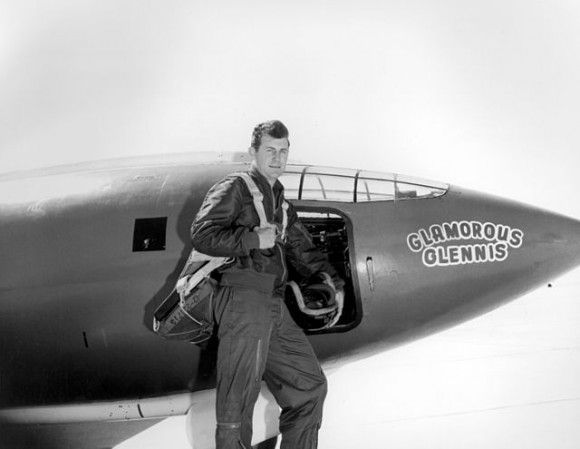
This Date …Feb 13…. .. BirthDay of Chuck Yeager… The 1st Pilot to Break the Sound Barrier…

February 13, 1923. Chuck Yeager, the first pilot to break the sound barrier, was born in Myra, West Virginia on this date in 1923.

Yaeger enlisted in the Army Air Corps in September 1941, at the age of 18. He fought in World War II before being assigned to fly high-performance aircraft at Edwards Air Force Base in 1947.

On October 14, 1947, Yeager piloted a plane called Glamorous Glennis to Mach 1.06, just over the speed of sound.

Dubbed the fastest man alive, he also won the prestigious Collier Trophy in aviation even as he continued setting speed records.

The plane in which he broke the sound barrier is on display at the Smithsonian National Air and Space Museum in Washington, D.C.

Yeager’s adventures were popularized in a 1980s satirical book and movie, both called The Right Stuff.

He currently lives California.

Yeager in front of the Bell X-1, which, as with all of the aircraft assigned to him, he named Glamorous Glennis after his wife.  Image via Wikimedia Commons.

Bottom line: On February 13, 1923, Chuck Yeager, the first pilot to break the sound barrier, was born in Myra, West Virginia.

SOURCE:::: http://www.esrthskynews.org

Natarajan

2000 Year Old Rice Terrace of Philippines…

Philippine Rice Terraces Why Reflection

Photo credit: Jon Rawlinson

For at least two millennia, the Ifugao people have sculpted the sides of mountains into useable farmland. Located in the heart of the Cordillera mountain range in the northern Philippines, these rice terraces rise like wide, monumental staircases. The United Nations Educational, Scientific and Cultural Organization (UNESCO) added these feats of ancient engineering to its list of World Heritage Sites in 1995. According to UNESCO, the Philippine rice terraces “create a landscape of great beauty that expresses the harmony between humankind and the environment.”

The terraces, however, also epitomize the story of how modern tensions are putting a strain on that “harmony” worldwide. Yes, natural disasters and the perennial typhoons that lash the Philippines threaten the preservation of the Cordillera rice terraces. But the biggest pressure they face is a shift in human society. As the UNESCO advisory body has written, “the terraced landscape is highly vulnerable because the social equilibrium that existed in the rice terraces for the past two millennia has become profoundly threatened by technological and evolutionary changes.”

Young Ifugao are migrating to the cities where they can find higher paying, less backbreaking work. At the same, the once remote region is becoming more interconnected through large investments in infrastructure. In the next two years, the Philippine government plans to spend around $25 million in road construction and improvement in the Cordillera region.

Philippine Rice Terraces Incline

Photo credit: Jon Rawlinson

One goal for the road project is to attract more tourists to the area and thereby bring more money to the regional economy. In 2013, according to Philippine government statistics, 1.1 million people visited the rice terraces. In the future, the government hopes to attract 10 million tourists annually. It is unclear whether this aspiration is misguided, since the arrival of foreign tourists can dramatically change the nature of a place. But Philippine officials are hoping tourism will also provide livelihoods to those Ifugao who otherwise might leave the boondocks for the cities.

Filipinos call the Cordillera rice terraces the Eighth Wonder of the World. UNESCO calls them “the priceless contribution of Philippine ancestors to humanity.” As shown in the expansive gallery below, this region of the Philippines has some of the most beautiful vistas on earth. This piece of humanity’s common heritage deserves to be preserved for generations to come.

Rice Terraces Mud Walls

Some of the terraces use mud walls, as pictured here; others use stone. (Photo credit: Flickr user Momo)
SOURCE:::: http://www.all that is interesting .com
Natarajan


Message For the Day…” Our Body is like a iron Safe to Protect Virtues like Knowledge and Bliss..”

To be able to experience the aspects of knowledge and bliss, we should protect our body, mind and life. Consider this example: We store valuable jewels and gems in our homes, in a relatively cheap iron safe to protect them. The steel almirah or an iron safe has no value compared to the jewels, but they are good enough to protect them. So too, our body is like the valueless iron safe. In this valueless, perishable body, God has kept for protection, very valuable things like knowledge and bliss. We all understand that valuable jewels cannot be protected by a valuable gold box, as the box itself can be stolen with the jewels in no time. Hence it is natural to protect valuable things in a valueless box which will not attract attention. Therefore, to reach the realm of knowledge, bliss and happiness it is necessary to look after the well-being of the outer casing namely, body, mind and life.

Sathya Sai Baba

Message For the Day…” Character is the Fragrance of the Flower of Life …”

Buddha, Jesus Christ, Shankaracharya, Vivekananda, and many great saints and devotees of the Lord are treasured in the memory of people even to this day. What quality made them memorable for all times to come? It is their character. The qualities that make up a flawless character are: love, patience, forbearance, steadfastness, and charity. These must be revered. Character is the fragrance of the flower of life; it gives value and worth to life. The hundred little deeds that we indulge in every day harden into habits; these habits shape the intelligence and mould our outlook and life. All that we weave in our imagination, seek in our ideals, and yearn in our aspirations leave an indelible imprint on the mind. Poets, painters, artists, and scientists may be great, each in their own field, but without character, they can have no standing in society.

Sathya Sai Baba