Message for the Day…”Worrying is fruitless..there is no occasion for despair…you must try prayer, service to others, and mutual love and respect…”

Sathya Sai Baba

When there is no possibility of achieving and acquiring devotion, charity, peace, and truth, the great and good people who desire to achieve them pray to the Lord within themselves. When the Lord’s will, the needs of spiritual seekers, and the teachings of great persons unite, the happiness of the world will be assured and undiminished. If all humanity prays at one time for unrest, injustice, disorder, and falsehood to be transformed into peace, truth, love, and mutual service, things will certainly become better. There is no other way out. Worrying is fruitless. This is no occasion for despair. It is against the essential nature of people to plead weakness and want of strength. Therefore giving up the search for other means, people must try prayer, service to others, and mutual love and respect. They should delay no longer; they will soon acquire contentment and joy.

The Feng Shui Skyscrapers of Hong Kong….!!!

In Hong Kong, a city with one of the most beautiful skyline, the plan and design of a building is determined as much as by architects and engineers as by feng shui masters. This ancient Chinese philosophy of positioning objects and buildings in harmony with nature to bring about good fortune, is deeply rooted in Hong Kong’s culture. Everything from the orientation of a building, the shape of the building, the position of the entrance and position of furniture within are believed to influence the prosperity of a business or the homeowner. Because of this belief, feng shui practitioners are consulted in almost every new home purchase and office floor plans, and even enormous architectural and engineering projects around this island nation are dictated to a large degree by feng shui. It’s not apparent but examples of feng shui practice are almost everywhere in Hong Kong.

hong-kong-dragon-holes-2

Why do these buildings have holes in the middle? Keep reading for the answer. Photo credit: shottapaul/Flickr

Feng shui was suppressed in mainland China during the Cultural Revolution in the 1960s but has made a dramatic revival in recent years, especially in the superstitious South. Even in modern Central, where feng shui is regarded as superstition, most developers still consult feng shui experts because they figure it’s better to be safe than sorry. Indeed, many corporations set aside a portion of their annual budget for feng shui consultation. Some of the suggestions that feng shui experts offer can be as simple as repositioning the desk of the CEO or placing coins under the carpet. Others can be as expensive as demolishing and reconstructing parts of the building.

When the famous HSBC headquarters with two bronze lions sitting in front were built in the mid-1980s, the escalators were reoriented from their original straight position to an angle with the entrance to prevent evil spirits from flowing straight off the Victoria Harbor and into the office.

feng-shui-hsbc-3

The HSBC building in Hong Kong. Photo credit: Ishak J/Flickr

The Bank of China Tower, on the other hand, neglected good feng shui practices and is now considered so unlucky that it sits empty most of the year. The tower with its many sharp edges is also said to be leaking its negative energy to its surrounding businesses. The owner of the Lippo Centre, which faces one of the building’s edges, went bankrupt and had to sell the building. Similarly, the Government House, which also faces one of the angles of the Bank of China Tower, had its share of troubles.

To prevent such misfortunes from befalling HSBC, the bank had two cannon-like structures installed at the top of their building. These cannons, which are pointed towards the Bank of China building, supposedly protects HSBC from the dreaded Bank of China Tower’s negative energy by deflecting the energy back to its source.

Hong Kong’s growth in recent years has been attributed to good feng shui. Its geographical location with the mountains behind and waters in front is said to be excellent in accordance to feng shui principles. Legend holds that these mountains are home to the dragons that are said to be the bearer of positive and powerful energy. This energy blows through Hong Kong as the dragons make their way from the mountains to the sea to drink and bathe.

This explains why many buildings along the waterline have gaping holes in the middle. These holes provide the dragons an unobstructed path to the water, so that the winds of positive energy continue to flow through the city.

hong-kong-dragon-holes-1

The “dragon hole” of The Repulse Bay building in Hong Kong. Photo credit: Paul Griffin/Flickr

hong-kong-dragon-holes-3

Photo credit: See-ming Lee/Flickr

hong-kong-dragon-holes-5

Photo credit: See-ming Lee/Flickr

Sources: NY Times / Discover Hong Kong / A Passport Affair / Wall Street Journal Blog

Source…….www.amusingplanet.com

Natarajan

This date in science: Yuri Gagarin’s birthday….9th March

He was a Russian Soviet pilot and the first human to travel to space, in 1961. Later, he became one of the world’s true heroes …


“Let’s go! (Poyekhali!)” Image via ESA.

March 9, 2016. Yuri Alekseyevitch Gagarin (1934 – 1968) would have been 82 today. He became the first human ever to travel into space on April 12, 1961, flying into orbit around Earth for 89.1 minutes in Russia’s Vostok 1 spacecraft. He circled the Earth once and flew as high as 200 miles (327 km). The entire mission, from launching to landing lasted 108 minutes.

Yuri was born on a small farm west of Moscow. His father was a bricklayer, a carpenter, and a farmer. His mother was a milkmaid. He was the third in a family of four children.

During the Second World War, the Gagarin family was broken apart as two of Yuri’s older sisters were taken into labor camps by the Nazis. The Gagarins were forced out of their house, and dug a hideout in the ground, where they stayed until the end of the war. After the war, the family moved to Gziatsk.

Gagarin was inspired to become a pilot while still a teenager. When a Russian Yak fighter plane was forced to land in a field near his home, the praise those pilots received left a mark on the young Gagarin. He wanted to be like them.

He studied to become a foundryman (a foundry is a factory that melts metals in special furnaces and pours the molten metal into molds for making products). He was singled out for his skillfulness to further his studies in the Saratov Technical School.

Vostok 1 via Wikimedia Commons.

Vostok 1 via Wikimedia Commons.

There, his dream to become a pilot took root, as during his 4th and last year at Saratov, he had the chance to join a local flying club. He learned to operate a plane, and flew by himself for the first time in 1955.

That same year, he also graduated from school, and was recruited by the Soviet Army.

At the advice of his flying mentor, he joined the Soviet Air Force, and went on studying at the Orenburg School of Aviation. There, he was taught to fly MIGs.

During his studies at Orenburg, he also met his future wife, Valentina Ivanova Goryacheva, who was a nursing student at the time.

In November, 1957, when Gagarin was 23, he graduated from Orenburg with honors and married Valentina. Later, the couple had two girls, Yelena, and Galina.

In 1959, after the Russians succeeded at photographing the far side of the moon for the first time with Luna 3, many – including Yuri – felt it was about time for the first man to be sent to space. He and a few other men were accepted for cosmonaut training in 1960 after a lot of selection.

The selected candidates underwent not only physical training, but also mental and psychological training.

Gagarin was known for his good humour, perseverance, and calm.

On April 12, 1961, the Russians amazed the world by launching Vostok 3KA-3 (Vostok 1) from the Baikonur Cosmodrome with Yuri Gagarin aboard. Vostok means East in Russian.

East for sunrise, and for the rise of the Space Age.

Hear a recording of Yuri Gagarin saying “poyekhali” (“let’s go”) before the launch.

Yuri  Gagarin in Warsaw in 1961.  Image via Wikimedia Commons.

Yuri Gagarin in Warsaw in 1961. Image via Wikimedia Commons.

Gagarin on a visit to Sweden, 1964.  Image via Wikimedia Commons.

Gagarin in Sweden in 1964. Image via Wikimedia Commons.

After coming back from space, Gagarin became an international celebrity. Khrushchev awarded him with the title of Hero of the Soviet Union.

His dream had come true.

Gagarin and his wife began touring the world, where Yuri was decorated for his legendary accomplishment. It’s rumored that Gagarin didn’t handle his fame very well, however.

In 1962, he was appointed as a deputy of the Soviet Union, and he was elected to the Central Committee of the Young Communist League. But Gagarin was not entirely happy. He felt he didn’t train to fly only once. He wanted to fly more, but – according to the stories about him – those around him tried to stop him for fear of losing the great Soviet hero.

In 1963, Gagarin later became deputy training director of the Cosmonaut Training Center outside Moscow. Later, the training center was named for him.

The following year he started extensive training to become a fighter pilot. He died on March 27, 1968, at the age of 34 due to the crash of a MiG – 15UTI that he and colleague Vladimir Seryogin were flying from the Chkalovski Air Base.

Their bodies were collected near the small town of Khirzach, and were cremated. Their ashes are a part of the Kremlin Building in the Red Square, in Moscow.

Yuri's plaque at the Kremlin in Moscow, via Wikimedia Commons.

Yuri’s plaque at the Kremlin in Moscow, via Wikimedia Commons.

Bottom line: Born on March 9, 1934, Yuri Alekseyevitch Gagarin (1934 – 1968) was the first human being ever to travel into space. His historic flight took place on on April 12, 1961, when he orbited Earth for 89.1 minutes in Russia’s Vostok 1 spacecraft.

Source……www.earthsky.org

Natarajan

” தமிழ் பழம் அருஞ்சொற்பொருள்/TAMIL FRUITS GLOSSARY….”


பழங்களின் பெயா்கள் / தமிழ் மற்றும் ஆங்கிலத்தில்:-

தமிழ் பழம் அருஞ்சொற்பொருள்/TAMIL FRUITS GLOSSARY

A – வரிசை
APPLE – அரத்திப்பழம், குமளிப்பழம்
APRICOT – சர்க்கரை பாதாமி
AVOCADO – வெண்ணைப் பழம்

B – வரிசை
BANANA – வாழைப்பழம்
BELL FRUIT – பஞ்சலிப்பழம்
BILBERRY – அவுரிநெல்லி
BLACK CURRANT – கருந்திராட்சை, கருங்கொடிமுந்திரி
BLACKBERRY – நாகப்பழம்
BLUEBERRY – அவுரிநெல்லி
BITTER WATERMELON – கெச்சி
BREADFRUIT – சீமைப்பலா, ஈரப்பலா

C – வரிசை
CANTALOUPE – மஞ்சள் முலாம்பழம்
CARAMBOLA – விளிம்பிப்பழம்
CASHEWFRUIT – முந்திரிப்பழம்
CHERRY – சேலா(ப்பழம்)
CHICKOO – சீமையிலுப்பை
CITRON – கடாரநாரத்தை
CITRUS AURANTIFOLIA – நாரத்தை
CITRUS AURANTIUM – கிச்சிலிப்பழம்
CITRUS MEDICA – கடரநாரத்தை
CITRUS RETICULATA – கமலாப்பழம்
CITRUS SINENSIS – சாத்துக்கொடி
CRANBERRY – குருதிநெல்லி
CUCUMUS TRIGONUS – கெச்சி
CUSTARD APPLE – சீத்தாப்பழம்

D – வரிசை
DEVIL FIG – பேயத்தி
DURIAN – முள்நாரிப்பழம்

E – வரிசை
EUGENIA RUBICUNDA – சிறுநாவல்

F – வரிசை

G – வரிசை
GOOSEBERRY – நெல்லிக்காய்
GRAPE – கொடிமுந்திரி, திராட்சைப்பழம்
GRAPEFRUIT – பம்பரமாசு
GUAVA – கொய்யாப்பழம்

H – வரிசை
HANEPOOT – அரபுக் கொடிமுந்திரி
HARFAROWRIE – அரைநெல்லி

I – வரிசை

J – வரிசை
JACKFRUIT – பலாப்பழம்
JAMBU FRUIT – நாவல்பழம்
JAMUN FRUIT – நாகப்பழம்

K – வரிசை
KIWI – பசலிப்பழம்

L – வரிசை
LYCHEE – விளச்சிப்பழம்

M – வரிசை
MANGO FRUIT – மாம்பழம்
MANGOSTEEN – கடார முருகல்
MELON – வெள்ளரிப்பழம்
MULBERRY – முசுக்கட்டைப்பழம்
MUSCAT GRAPE – அரபுக் கொடிமுந்திரி

N – வரிசை

O – வரிசை
ORANGE – தோடைப்பழம், நரந்தம்பழம்
ORANGE (SWEET) – சாத்துக்கொடி
ORANGE (LOOSE JACKET) – கமலாப்பழம்

P – வரிசை
PAIR – பேரிக்காய்
PAPAYA – பப்பாளி
PASSIONFRUIT – கொடித்தோடைப்பழம்
PEACH – குழிப்பேரி
PERSIMMON – சீமைப் பனிச்சை
PHYLLANTHUS DISTICHUS – அரைநெல்லி
PLUM – ஆல்பக்கோடா
POMELO – பம்பரமாசு
PRUNE – உலர்த்தியப் பழம்

Q – வரிசை
QUINCE – சீமைமாதுளை, சீமைமாதுளம்பழம்

R – வரிசை
RAISIN – உலர் கொடிமுந்திரி, உலர் திராட்சை
RASPBERRY – புற்றுப்பழம்
RED BANANA – செவ்வாழைப்பழம்
RED CURRANT – செந்திராட்சை, செங்கொடிமுந்திரி

S – வரிசை
SAPODILLA – சீமையிலுப்பை
STAR-FRUIT – விளிம்பிப்பழம்
STRAWBERRY – செம்புற்றுப்பழம்
SWEET SOP – சீத்தாப்பழம்

T – வரிசை
TAMARILLO – குறுந்தக்காளி
TANGERINE – தேனரந்தம்பழம்

U – வரிசை
UGLI FRUIT – முரட்டுத் தோடை

V – வரிசை

W – வரிசை
WATERMELON – குமட்டிப்பழம், தர்பூசணி
WOOD APPLE – விளாம்பழம்

 Source…..www.facebook.com/Tamil-Traditional-Foods… information credit…Harini Parthasarathy in facebook
Natarajan

Message for the Day……” You must remember that you are truly Divine…”

Embodiments of Love, consider for a moment, where from the rain comes. It comes from the clouds. Clouds come from water vapour, rising from the sea. Rain water becomes a channel on the earth, changes itself into a rivulet and merges into a big river, and finally reaches the sea as its destination. A pot made out of clay when broken, is cast on the ground, and in course of time, becomes clay again. Water from the sea joins the sea, clay from the earth, goes back to earth again, but why does a human being alone forget the source He came from? The only besetting evil in human being is the sense of ‘mine’ (Mamakara), the acquisitive and possessive feeling. This is the root-cause for all other evils. You must remember that you are truly divine. You inhale and exhale 21,600 times – it is a natural reminder of the message of ‘SO-HAM’ (I am God) which is the truth about your divine reality.

Sathya Sai Baba

Nine super-achieving women Bengaluru should be proud of …..

On the occasion of International Women’s Day, here is a list of 9 women achievers from Bengaluru who are recipients of the Namma Bengaluru Foundation Awards for the year 2015.

The Namma Bengaluru Foundation (NBF) is an independent organistation and inclusive social platform founded in 2009, which is committed to the betterment of the city through collective social engagement.


Twenty-year-old Aishwarya Hebbar has made over 21,000 kids happier through her project Let’s Write Together. She collects pens discarded by school and college students around the city, and restores them so that kids who can’t afford stationery can write. –

Ashwini Angadi manages a trust that runs the Belaku Academy, a school for the visually impaired, working with differently abled children with an aim of integrating them with the mainstream. She has been chosen as the UN Special Envoy to receive the Youth Courage Award for Education and the Queen of England’s Young Leader Award in 2015.  –

Suparna Ganguly ended the cruel practice of electrocution of stray dogs and co-founded Compassion Unlimited Plus Action – CUPA, an organization that took over the Koramangala dog-pound and over the years helped create a more humane world for strays. –

Gloria Benny put together a network of volunteers called Make a Difference (MAD) who would mentor children with skills and confidence and equip them for life after they left the shelter homes at the age of 18.  – 

Dr Rohini Katoch Sepat is the Director of the State Forensic Sciences Lab and has been instrumental in enabling the police force with technological advances such as the iBeat app and CCTV cameras on police vehicles to help the cops serve communities better.  –

Geetha Ramanujam set up Kathalaya, The House of Stories, with a vision of making positive social change in education through storytelling. The International Academy of Storytelling set up by Kathalaya has trained over 70,000 people to become storytellers and touched the lives of over 5 lakh children over the years.  –

Prarthana Kaul started Giftabled, an e-commerce venture that sells both gifts made by the disabled and merchandise for the disabled, thereby transforming many lives.  –

Ashwani is a news reporter with RajTV, who brought Mavallipura landfill garbage crisis into focus. As a result of her efforts, health camps were conducted and drinking water facilities were improved.  –

Lokayukta SP Sonia Narang’s strict action concerning extortion calls allegedly made to Government employees for bribes in return for immunity in corruption cases resulted in the filing of 5 FIRs and 11 arrests.  –

Source…..www.thenewsminute.com

Natarajan

Message for the Day…”No one should become desperate and give up Prayers…”

Sathya Sai Baba

Truly, the prayers of the great act as an invitation even for the advent of the Lord. In the external world, when the subjects need any convenience or help, they approach the rulers and inform them of their request. So also, in the internal state, when there is no possibility of achieving and acquiring devotion, charity, peace, and truth, the great and good people who desire to achieve them pray to the Lord within themselves. Then, listening to their prayers, He Himself comes into the world and showers His grace on them. Ramayana and Bhagavata reveal that Lord Rama and Krishna incarnated as an answer to the prayers of the sages. Thus prayers should be offered again and again for the realisation of the task. No one should become desperate and give up prayers if they don’t result immediately in the advent of the Lord.

The Mysterious Caves of Mustang, Nepal……

The Kingdom of Mustang, bordering the Tibetan plateau, is one of the most remote and isolated region of Nepalese Himalaya. Once an independent Buddhist kingdom, Mustang was annexed by Nepal at the end of the 18th century, but retained its status as a separate principality until the 1950’s when the area was more closely consolidated into Nepal. Because of its sensitive border location, Mustang was off-limits to foreigners until 1992. The relative isolation of the region from the outside world has helped Mustang preserve its ancient culture which is more closely tied to Tibet than to Nepal.

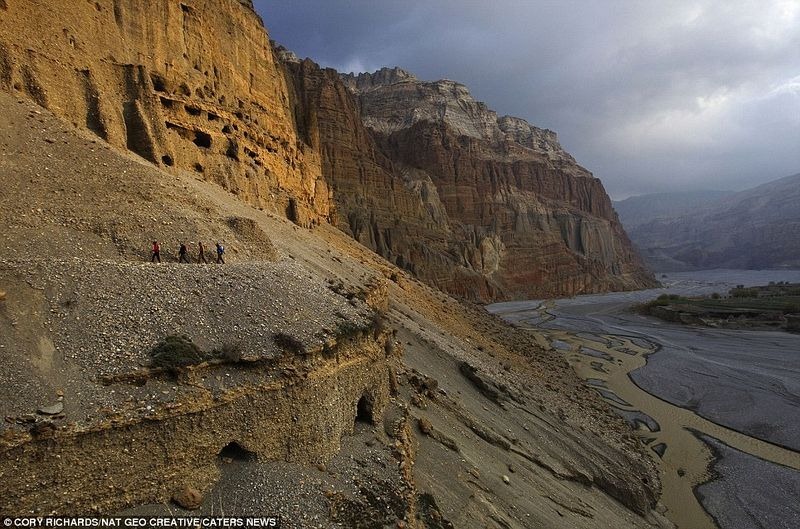
The landscape is also unlike anything that is to be found anywhere else in Nepal —deep gorges carved by the Kali Gandaki River, and strangely sculptured rock formations. The cliffs’ face are pitted with an estimated 10,000 ancient cave dwellings, some of which are perched more than 150 feet above the valley floor. No one knows who dug them, or how people even scaled the near vertical rock face to access them. Some of the caves appear almost impossible to reach even to experienced climbers.
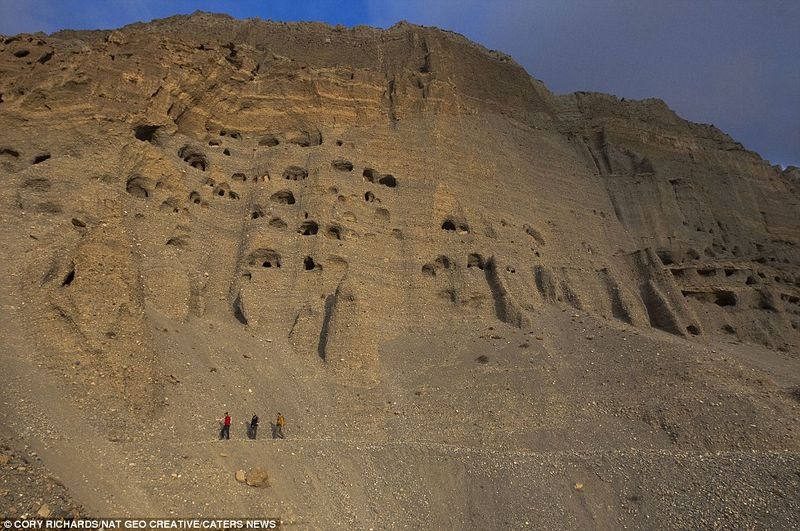
mustang-caves-4

Photo credit: National Geographic

Most of the caves are now empty, but others show signs of domestic habitation —hearths, grain-storage bins, and sleeping spaces. Some caves were apparently used as burial chambers. The several dozen bodies that were found in these caves were all more than 2,000 years old. They lay on wooden beds and decorated with copper jewelry and glass beads.

In other caves, skeletons dating from the 3rd to the 8th centuries, before Buddhism came to Mustang, had cut marks on the bones that may have been inflicted during the practice of sky burial, where the body’s flesh is sliced into small pieces and left to be eaten by vultures. Sky burial is still practiced in many remote regions in the Himalaya.

Archeologists believe that the caves in Mustang were used in three general periods. They were first used some 3,000 years ago as burial chambers. Then around 1,000 years ago, they became primarily living quarters, perhaps to escape battles and intruders into the valley. Finally, by the 1400s, most people had moved into traditional villages and the caves became places of meditation. Some of these caves were turned into monasteries such as the Luri Gompa, the Chungsi Cave monastery and the Nyiphuk Cave Monastery, all of which were built around and inside the caves.

Luri Gompa is one of the most famous in Mustang. The monastery is set on a ledge, at least a hundred meter high from the ground, in one of the many natural pillar like sandstone structures. A winding footpath climbs all the way from the bottom of the valley to a single entrance door that leads into two interconnecting chambers. The outer chamber contains a shrine, while the inner chamber —the main treasure of Luri Gompa— is beautifully decorated with a series of paintings depicting Indian Mahasiddhas — saints who were said to have achieved siddhi, or extraordinary powers by meditation. No documentation pertaining to this mysterious gompa or monastery has been found, but the wall paintings appear to be have been made in the 14th century or even earlier.

mustang-caves-1

Photo credit: National Geographic

mustang-caves-3

Photo credit: National Geographic

mustang-caves-5

Photo credit: National Geographic

mustang-caves-6

mustang-caves-7

Photo credit: nepaladvisor.com

mustang-caves-8

Photo credit: David Rengel/Washington Post
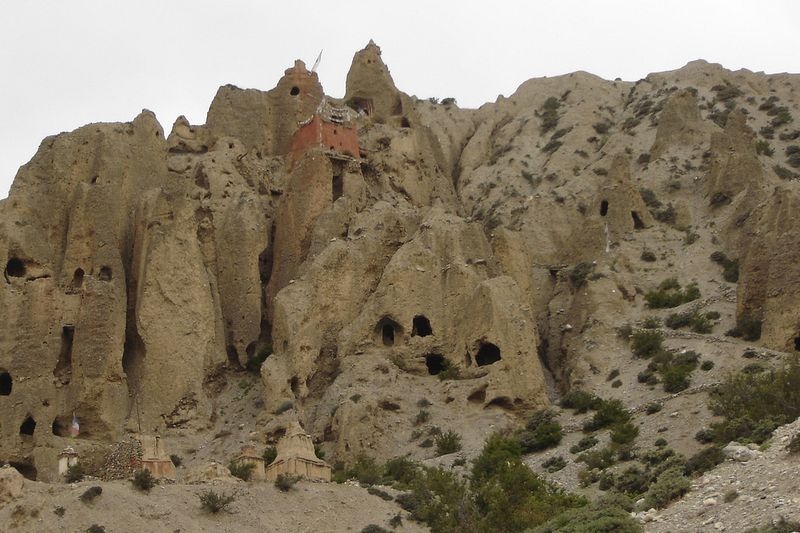
luri-gompa-2

Luri Gompa. Photo credit: Bob Witlox/Flickr

luri-gompa-3

luri-gompa-4

Frescos in the ceilings of Luri Gompa. Photo credit: library.brown.edu

Sources: Nat Geo / library.brown.edu / www.oneworldtrekking.com

Source……..www.amusingplanet.com

Natarajan

இந்த வாரக் கவிதை ….” துணையாய் தொடரும் நிழல்கள் “!!!

துணையாய் தொடரும் நிழல்கள் ….
………………………..
பிறந்த மண்ணை முத்தமிடும் குழந்தை தன்  அன்னையின் நிழலில்
மழலை அது நடை பயிலும்   தந்தையின் நிழலில் !
ஒரு நல்ல ஆசானின் நிழலில் கல்வி ….தக்க பருவத்தில்
இல்லறம் செழிக்க நல்லற நிழலாய் தொடரும்  ஒரு வாழ்க்கை துணை !
துணையாய் தொடரும் நிழல்கள்  இப்படி எத்தனை எத்தனை… ஒருவர்
வாழ்வில் !
காலம் மாறும் …காட்சியும் மாறும் !  தொடரும் நிழல் துணையும்
உருமாறும் !…
காலத்தின் கோலத்தில் மாற்றம் பல நிகழ்ந்தாலும் தொடர்ந்து
உறு துணையாகும் ஒரே ஒரு நிழல்…  நம் வாழ்வில் !
காட்சியும்  சாட்சியும் தேவை இல்லை இந்த நிழலுக்கு !
அதுதான் நம் மனசாட்சி !  வாழ்க்கையின்  நல்லாட்சிக்கு
என்றும் துணையாக தொடரும்  அதன் அரசாட்சி !
Natarajan

Message for the Day…” Get rid of Desire and Hatred and experience the Divinity inherent within …”

Who is Lord Shiva, and where is He to be found? Many answers are given, including Kailash as His place of residence. The true answer is, ‘Isavasyam Idam Sarvam’ (All this is pervaded by Isa). He is omnipresent. There is no place, object or being where God is not present. Correct your outlook and recognise this unity in the apparent diversity around you. When God is omnipresent, what need is there to go in search of Him? The search is meaningless. If one gets rid of attachment and hatred, one will experience the Divinity inherent within. This is the sadhana (spiritual exercise) one has to do today – to get rid of desire and hatred which conceal the God within. Many people ask: “Swami! Show us the way.” All you have to do is to go back to the source from which you came. Where is the need for seeking the way? The Bhagavatha has declared that it is the natural destiny of every living being to go back to where each one came from.

Sathya Sai Baba